Bottom line: when on-device beats cloud for compressed LLMs
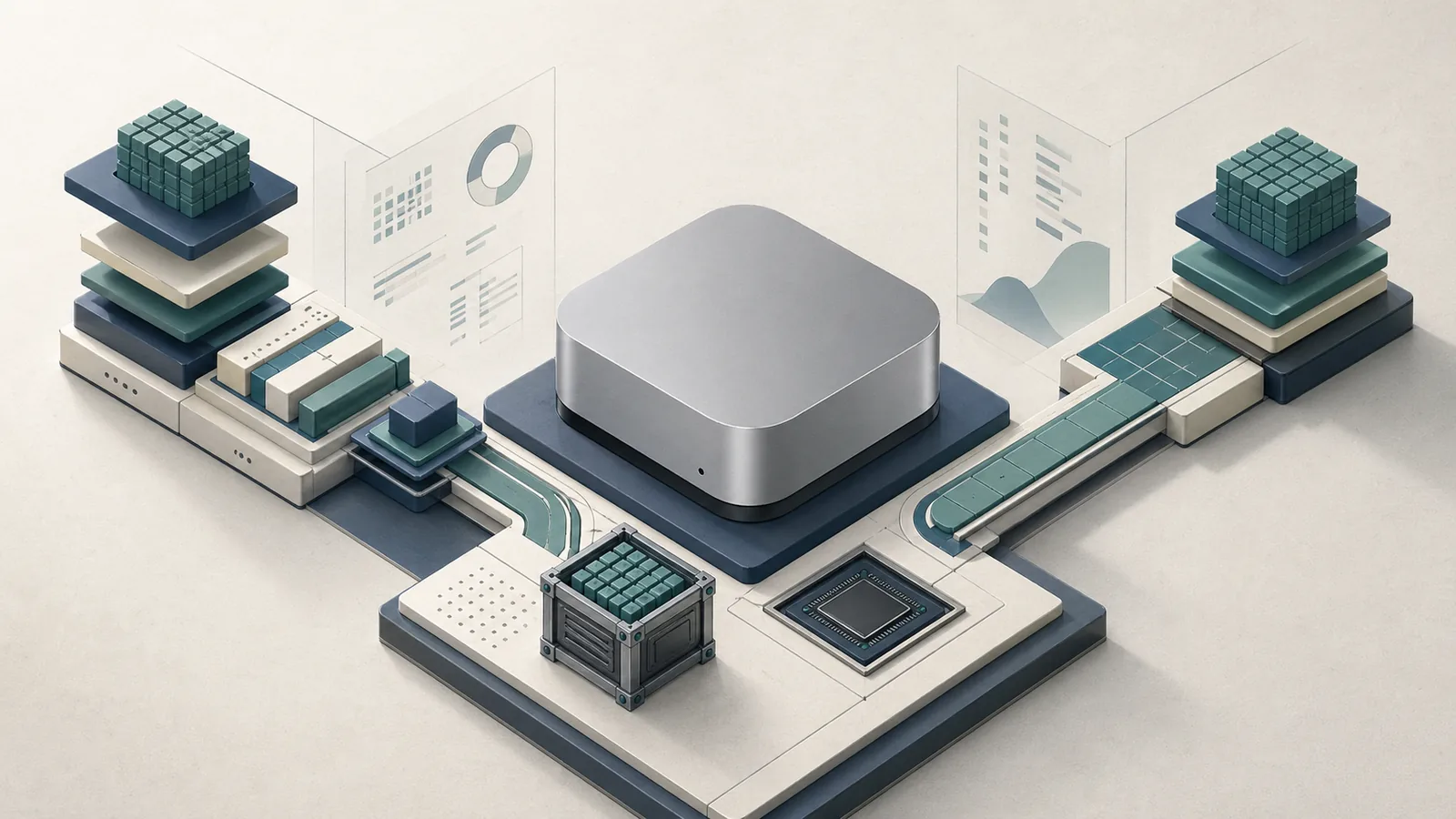
Bottom Line: Ship on-device when your workload is dominated by short-context, repetitive, or privacy-sensitive requests that a quantized 1B–7B model can handle acceptably — and when enough of your traffic stays local that you avoid paying OpenAI API pricing per token at scale. At GPT-4o mini's published rate of $0.15 per 1M input tokens and $0.60 per 1M output tokens, even modest consumer query volumes accumulate real spend. The break-even condition is not a fixed number; it depends on device cost, router quality, and how well the local model covers your actual traffic. Hybrid systems only make financial sense when the local model handles a majority of requests and the router's maintenance and fallback costs do not erase the savings. On-device wins cleanly when offline reliability and data minimization are product requirements, not just preferences. As Apple states explicitly: "We protect our users' privacy with powerful on-device processing and groundbreaking infrastructure like Private Cloud Compute."
The cloud still wins on long-context reasoning, tool-heavy agent flows, and tasks where answer quality degradation is commercially unacceptable. Both deployments are viable in 2026; the question is which one fits your traffic shape, privacy constraints, and per-token economics.
What actually drives the decision: latency, privacy, and unit economics
Four variables dominate the on-device versus cloud inference decision: latency to first token, marginal token cost, privacy exposure, and the engineering burden of keeping a deployment running. Generic checklists treat these as equally weighted; they are not. For consumer apps, latency and marginal cost usually dominate at scale, while privacy and offline reliability become hard constraints that override the other factors in regulated or data-sensitive contexts.
The table below maps each variable to its on-device and cloud profile so you can identify your own dominant constraint quickly.
| Variable | On-Device | Cloud |
|---|---|---|
| Latency to first token | Under 20 ms/token for short context (local) | 200–500 ms network round-trip before first token |
| Marginal cost per token | Near zero after device capex | Metered: e.g., $0.15/1M input, $0.60/1M output (GPT-4o mini) |
| Privacy / data residency | Data never leaves device | Data transits to provider infrastructure |
| Offline reliability | Works without connectivity | Fails without connectivity |
| Operational complexity | Model packaging, device coverage, update cadence | API key, rate limits, provider SLA dependence |
Apple's developer documentation describes on-device experiences as able to be "smart, private, and work without internet connectivity" — three properties that cloud deployments cannot simultaneously guarantee.
Cloud inference introduces ongoing cloud inference cost that scales linearly with usage. On-device inference shifts much of the cost to device capability and product engineering — a different cash-flow profile that front-loads investment and reduces marginal spend. Neither profile dominates unconditionally; the right choice emerges from your specific request distribution and quality tolerance.
Why cloud round-trips change the user experience
Cloud round-trip latency is not just a performance footnote — it structurally changes the interaction model. According to Tian Pan's hybrid cloud-edge engineering analysis, cloud round-trips add 200–500 ms before the first token arrives, while short-context local inference can generate individual tokens in under 20 ms.
Pro Tip: For short-output requests — autocomplete, classification labels, single-sentence replies — the entire on-device response may complete before a cloud-first deployment delivers its first token. The 200–500 ms pre-first-token penalty is not amortized across a long output; it is paid in full on every request. For keyboard-level responsiveness or real-time assistant UX, local token generation under 20 ms/token is not an optimization — it is a product requirement.
The implication for product decisions: if perceived responsiveness is a differentiator, cloud inference cost includes not just token spend but the latency tax on every user interaction.
Why privacy and data residency often favor local execution
Local execution eliminates the most common privacy attack surface: data in transit to and processed by a third-party provider. Apple's privacy documentation states directly: "On-device processing allows Apple Intelligence to be aware of your data without collecting your data."
Watch Out: Regulated inputs — personal health records, payment data, legal communications, enterprise IP under data-residency obligations — can make cloud routing a product blocker regardless of model quality. If a single query type in your traffic contains regulated content and your router cannot reliably exclude it from cloud fallback, the entire deployment may be non-compliant. Privacy is not a preference to trade off against quality; for these workloads, on-device LLM execution is the only compliant path.
Data residency requirements vary by jurisdiction and product category. The engineering question is not just "does the model work locally?" but "can we guarantee that sensitive data never reaches a cloud endpoint, even under fallback conditions?"
Where compressed local models are actually good enough
Compressed models in the 1.5B–7B parameter range — including Llama 3.2, Qwen 2.5, Phi-3.5/4-mini, and Gemma 2/3 — are the practical population of on-device LLM candidates for consumer hardware in 2026. Whether any of them are "good enough" depends entirely on the task class, not the parameter count alone.
| Task Class | Context Length | Quality Tolerance | On-Device Fit |
|---|---|---|---|
| Autocomplete / next-word suggestion | Short (< 512 tokens) | High tolerance for minor errors | Strong fit |
| Text summarization (short docs) | Medium (512–2K tokens) | Moderate tolerance | Conditional fit |
| Classification / intent detection | Short | Low tolerance acceptable | Strong fit |
| Long-document Q&A / RAG | Long (> 4K tokens) | Low tolerance | Poor fit |
| Multi-tool agent orchestration | Variable, often long | Very low tolerance | Poor fit |
| Code generation (complete functions) | Medium–long | Low tolerance | Marginal to poor fit |
The constraint is not just parameter count. A quantized 7B model must still fit the device's memory bandwidth envelope and deliver acceptable latency under realistic context lengths for its target UX. A model that passes accuracy benchmarks at batch size 1 on a benchmark set may still produce unacceptable latency on a mid-tier mobile device under production load patterns.
Short-form user requests and repetitive workflows
Short-context, repetitive, and latency-sensitive requests are the strongest on-device candidates because they satisfy all three local-inference conditions simultaneously: the model's quality shortfall is least visible, the latency advantage over cloud is largest, and the per-token API spend avoided is highest per unit of user value.
Pro Tip: At GPT-4o mini's pricing of $0.15 per 1M input tokens and $0.60 per 1M output tokens, an app generating 100M short assistant completions per month can accumulate meaningful OpenAI API pricing charges — before accounting for higher-tier models used for harder fallback queries. Local execution of that repetitive traffic costs nothing at the margin once the model is deployed. The economics are most favorable precisely where the quality bar is lowest: the traffic you most want to keep local is also the traffic your local model handles most reliably.
When compressed models fail and the cloud still wins
Compressed local models fail predictably on tasks that require broad factual recall across long contexts, reliable multi-step tool use, or outputs where quality degradation has direct commercial consequences.
Watch Out: Long-context reasoning (documents over 4K tokens), multi-tool agent flows that require sequential API calls with state tracking, and quality-sensitive outputs like legal drafts, diagnostic support text, or customer-facing product copy are high-risk for compressed on-device models. The failure mode is not a hard error; it is a plausible-sounding wrong answer. When wrong answers have real costs — support escalations, user churn, compliance violations — cloud inference cost is a cost of quality insurance, not just a fee for compute. OpenAI's API pricing at the GPT-4o mini tier is structured to make the cloud option affordable for exactly these fallback scenarios.
The hybrid routing model that makes the business case work
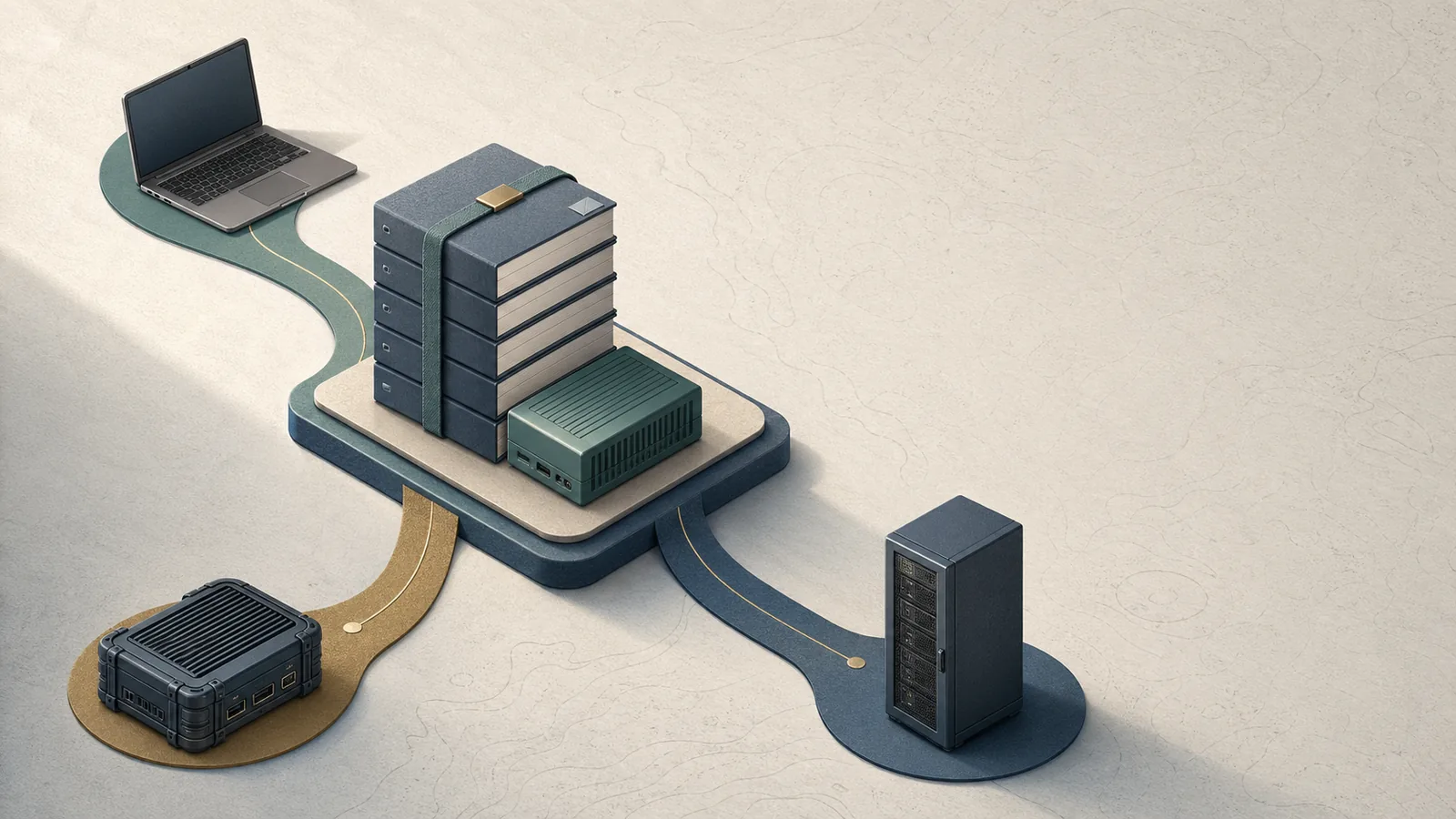
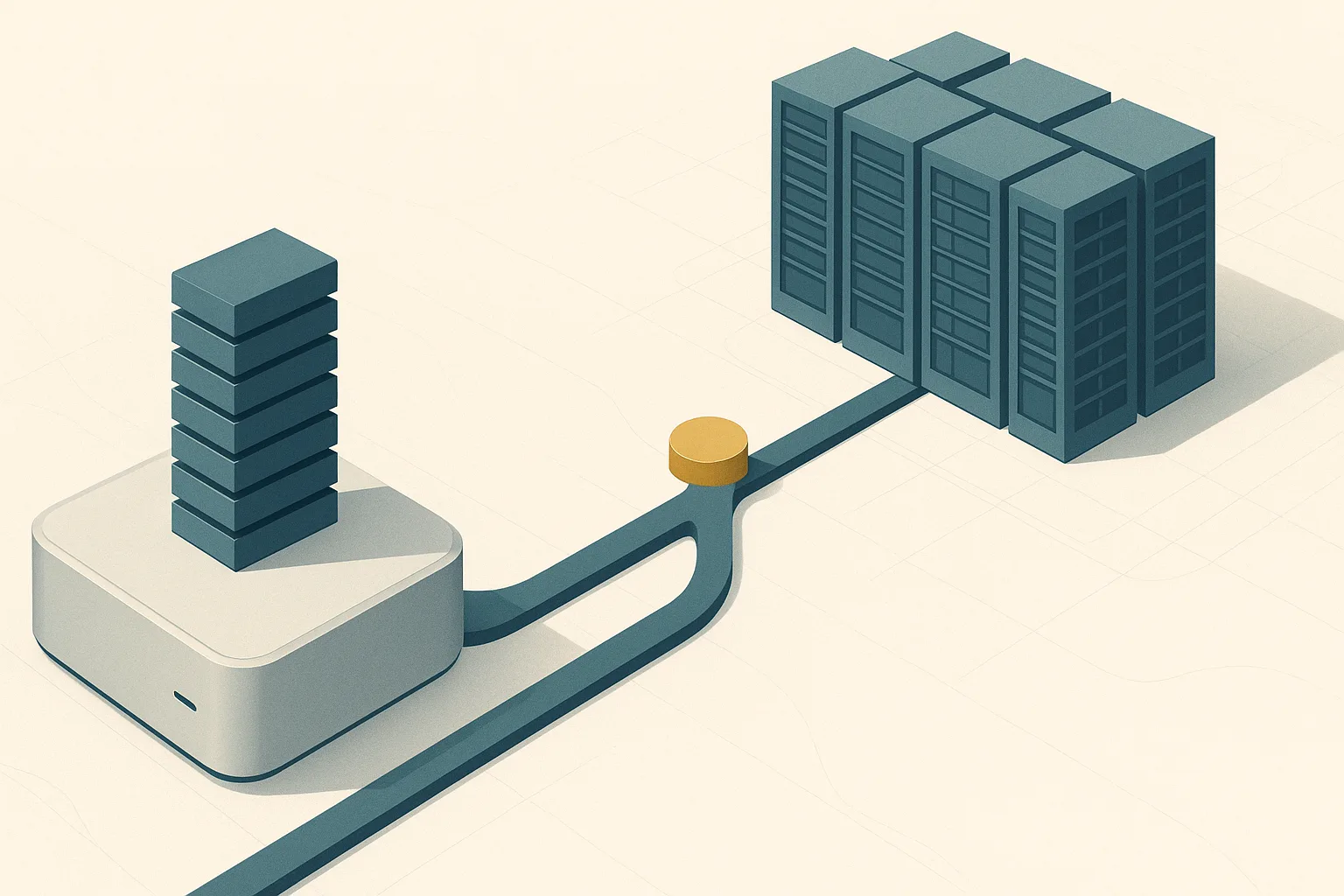
The hybrid edge-cloud model is not a compromise — it is a deliberate architecture that makes on-device economics viable at scale. Tian Pan's engineering analysis describes hybrid routing as a per-query decision rather than a deployment-time commitment.
The business case works when: (1) a router correctly classifies query difficulty before inference, (2) the majority of traffic is routed locally, and (3) only genuinely hard queries incur cloud inference cost. When those three conditions hold, the hybrid model captures on-device latency and cost savings on most traffic while preserving cloud quality on the minority that requires it.
| Request Type | Routing Decision | Rationale |
|---|---|---|
| Short autocomplete / fill-in | On-device | Low context, latency-critical, high repetition |
| Personal/sensitive data queries | On-device (mandatory) | Privacy/data-residency constraint |
| Medium-context Q&A, moderate quality bar | On-device with cloud fallback | Local first; cloud if confidence threshold not met |
| Long-context reasoning, > 4K tokens | Cloud | Exceeds local model's reliable range |
| Multi-tool agent with external APIs | Cloud | Orchestration complexity beyond local model fit |
| High-stakes quality-sensitive output | Cloud | Quality insurance exceeds token cost |
Per-query routing instead of all-or-nothing deployment
Routing evaluated per query — not per deployment — is the architectural insight that separates the hybrid model from a simple primary/backup arrangement. Each request is assessed at dispatch time against a set of signals: prompt length, detected input sensitivity, task type classification, and optionally a lightweight confidence estimate from the local model itself.
| Router Design Element | Options | Tradeoff |
|---|---|---|
| Classification signal | Prompt length, topic, detected PII | Cheap but coarse vs. accurate but latency-adding |
| Confidence threshold | Fixed percentile, adaptive per task class | Stability vs. responsiveness to traffic shift |
| Fallback policy | Hard (local fail → cloud) vs. soft (retry on quality score) | Latency cost vs. quality assurance |
| Telemetry | Per-query outcome logging | Required for drift detection; adds operational surface |
A production router requires confidence thresholds calibrated to your actual traffic, not a toy benchmark set. Routing policies drift as user behavior, prompt patterns, and model behavior change after deployment — which means the router is a live system requiring its own observability stack.
How much traffic must stay local for the savings to stick
The break-even point for hybrid deployment is a function of four inputs: per-token cloud inference cost, device amortized capex per query, router engineering overhead, and local hit rate. No single industry threshold applies universally.
| Scenario / Tier | Local Hit Rate | Cloud Spend Baseline | Latency Savings | Device Capex Trade-off | Platform Overhead |
|---|---|---|---|---|---|
| High-volume repetitive app | 80% local | $300/month at $0.60 per 1M output tokens, illustrative | Material reduction in first-token wait for short requests | Higher device capability requirement is offset by repetition | Router build and ongoing ops are non-trivial |
| Medium-volume mixed app | 60% local | $60/month at $0.60 per 1M output tokens, illustrative | Noticeable for local-first traffic, smaller on fallback queries | Moderate device support burden | Router build and ongoing ops may not justify the savings |
| Low-volume sensitive app | 90% local (privacy-driven) | $6/month at $0.60 per 1M output tokens, illustrative | Latency benefit is secondary to data-residency compliance | Device trade-off is justified by no-egress constraints | Platform overhead is outweighed by privacy value |
| High-volume quality-sensitive app | 30% local (hard queries dominate) | $120/month at $0.60 per 1M output tokens, illustrative | Limited because most requests still fall back | Device capex savings do not offset quality risk | Savings are likely erased by router and model-maintenance overhead |
The third scenario illustrates an important point: when privacy is the primary driver, the financial ROI calculus is secondary. Local inference's value is the absence of data egress, not just the absence of API spend.
The fourth scenario is the failure mode. When the local hit rate is too low because the traffic mix is dominated by hard queries, the hybrid system pays full platform overhead without sufficient API spend reduction. At GPT-4o mini pricing, the absolute dollar savings on a small or hard-query-dominated volume may not cover the engineering cost of maintaining a router.
The hidden cost: maintaining a hybrid router in production
A hybrid router is a production system with its own failure modes. It requires telemetry to detect when local model quality degrades silently, policy management to update routing rules as models are swapped, and regression testing whenever either the local or cloud model changes. Apple's own infrastructure for hybrid execution — which includes Private Cloud Compute for privacy-preserving cloud fallback — reflects the nontrivial platform investment required to make this architecture reliable at consumer scale.
Production Note: Observability is non-negotiable for a hybrid router. Without per-query outcome logging, quality regressions from the local model appear as vague user satisfaction drops rather than attributable failures. Policy drift — where routing rules become miscalibrated to actual traffic after weeks of model or prompt evolution — is the most common production failure mode and the hardest to detect without deliberate instrumentation. The practical recommendation is to budget ongoing engineering time for router validation, not just initial build cost, because the router is a load-bearing component of the inference architecture.
A practical decision framework for product and platform teams
The on-device versus cloud decision is not a once-and-done architecture call. It is a per-product, per-workload evaluation across four axes: marginal cost, privacy constraint, latency requirement, and support burden. The right answer is different across products with different traffic shapes, even if both use compressed LLMs.
| Axis | On-Device Wins When | Cloud Wins When | Hybrid Wins When |
|---|---|---|---|
| Marginal cost | High query volume, repetitive patterns | Low volume, high quality bar justifies token spend | Mixed volume; local handles majority |
| Privacy / data residency | Regulated data, no-egress requirement | Non-sensitive data, provider DPA acceptable | Most traffic non-sensitive; exceptions routed locally |
| Latency | Sub-100 ms required, short context | Latency tolerance > 500 ms, long output acceptable | Latency-critical short queries local; slower complex queries to cloud |
| Support burden | Stable model, controlled update cadence | Rapid model iteration, no device deployment | Willing to maintain router + two model stacks |
Apple's developer platform and OpenAI's API pricing structure represent the two poles of this decision operationally: Apple optimizes for privacy and local execution; OpenAI's per-token metering optimizes for quality and zero device overhead.
Choose on-device when offline, privacy, or marginal cost dominate
Bottom Line: Ship on-device first when three signals are present together: the product must function without a network connection, user data cannot leave the device boundary (regulatory or product requirement), and query patterns are repetitive enough that marginal API spend would accumulate meaningfully at your scale. Apple's framing — "On-device processing allows Apple Intelligence to be aware of your data without collecting your data" — captures the privacy case precisely. On-device is not a cost-cutting shortcut; it is the only architecture that satisfies offline and privacy requirements simultaneously.
Choose cloud when quality, scale, or rapid iteration dominate
Bottom Line: Route to cloud-first when large-context work, multi-tool agent orchestration, or quality-sensitive outputs are the product's core value proposition. OpenAI's API pricing makes it straightforward to start without device deployment overhead and iterate rapidly on model capability. At the GPT-4o mini pricing benchmark, cloud is the simplest place to begin when you want to validate traffic patterns before committing to local packaging, signing, and fleet update work. The cloud also wins when the engineering cost of packaging, signing, and updating a local model across a heterogeneous device fleet exceeds the API spend it would save.
Choose hybrid when your traffic shape is mixed
Most consumer applications with heterogeneous user behavior and mixed request complexity fall into the hybrid category by default. The decision is whether to build for it deliberately or accept the cost inefficiency of pure cloud.
| Condition | Routing | Reason |
|---|---|---|
| Short, repetitive, privacy-neutral | On-device | Maximum local throughput; zero token cost |
| Short, privacy-sensitive | On-device (enforced) | Data residency constraint overrides quality |
| Medium complexity, confidence met | On-device | Local quality sufficient; avoid API spend |
| Medium complexity, confidence not met | Cloud fallback | Quality threshold not cleared locally |
| Long context or tool use | Cloud (direct) | Beyond reliable local model range |
Hybrid routing at Apple and Google scale demonstrates that per-query routing is operationally viable, as described in Tian Pan's engineering analysis — but both companies operate at device and infrastructure scale that absorbs router maintenance cost efficiently. For smaller teams, the threshold question is whether the projected cloud inference cost savings over 12 months justify the router build and ongoing operations investment. If local hit rate cannot realistically exceed 60% given your traffic mix, the pure-cloud option is likely lower total cost of ownership.
FAQ on shipping compressed LLMs across device and cloud
Is on-device AI better than cloud AI?
Neither dominates. On-device wins on latency, privacy, and marginal cost for repetitive short-context traffic. Cloud wins on quality, context length, and iteration speed. The correct framing is fit to workload, not absolute superiority.
How much does cloud LLM inference cost?
At the affordable end, GPT-4o mini runs $0.15/1M input tokens and $0.60/1M output tokens. Higher-capability models cost significantly more per token. Check OpenAI's live pricing page for current rates; pricing changes regularly.
What are the privacy benefits of on-device AI?
User data never transits to a provider's infrastructure. This is the only architecture that satisfies strict data-residency requirements and supports air-gapped or regulated environments.
Can a hybrid edge-cloud model reduce inference costs?
Yes — if and only if the local hit rate is high enough to offset the platform engineering overhead of maintaining a router, two model stacks, and telemetry. When most requests stay local, the hybrid model can reduce spend while preserving cloud quality for hard cases. Below that point, pure cloud is usually cheaper in total cost.
Which compressed models are realistic for consumer hardware?
The 1.5B–7B range — including Llama 3.2, Qwen 2.5, Phi-3.5/4-mini, and Gemma 2/3 — represents the practical on-device LLM population for current consumer hardware, per 2026 edge inference benchmarking. Fit depends on device memory bandwidth and target latency, not just parameter count.
Does model packaging change the trade-offs?
Packaging affects deployment friction, update cadence, and device compatibility, but it does not change the core trade-off: cloud optimizes for rapid iteration and lower deployment burden, while on-device optimizes for privacy, offline reliability, and lower marginal cost.
Sources and references
- Tian Pan — Hybrid Cloud-Edge LLM Inference: When to Run On-Device (April 2026) — Primary engineering source for latency figures (200–500 ms cloud round-trip; under-20 ms local token generation) and per-query routing framework
- OpenAI — GPT-4o mini: Advancing Cost-Efficient Intelligence — Source for $0.15/1M input and $0.60/1M output token pricing benchmark
- OpenAI API Pricing (live) — Canonical live reference for current cloud inference token costs across all models
- Apple Developer — Apple Intelligence — Canonical source for on-device foundation model capabilities and offline/privacy product commitments
- Apple — Introducing Apple's On-Device and Server Foundation Models — Source for Private Cloud Compute architecture and privacy policy quotes
- Apple Privacy — Source for on-device data minimization statement
- arXiv 2604.24785 — Cloud to Edge: Benchmarking LLM Inference On… — Source for 1.5B–7B distilled model landscape (Llama 3.2, Qwen 2.5, Phi-3.5/4-mini, Gemma 2/3) as edge inference candidates
Keywords: on-device LLM, cloud inference cost, OpenAI API pricing, Llama 3.1, GPT-4o-mini, Ollama, vLLM, Apple on-device models, Google hybrid cloud-edge routing, quantized LLMs, consumer hardware, token-level routing, latency to first token, data residency, edge-cloud inference, per-token API spend