What Ring Attention solves for long-context Transformers
Standard Transformer attention materializes an (N \times N) attention matrix, where $N$ is sequence length. At 1M tokens, that matrix alone consumes on the order of terabytes of memory — before activations, weights, or optimizer state. Even memory-efficient single-device methods like FlashAttention avoid writing the full matrix to HBM, but they cannot escape the fundamental constraint: the entire key-value cache for a sequence must fit on one device's memory.
Ring Attention with Blockwise Transformers reframes the problem. Rather than fitting a long sequence on a single device, it distributes the sequence across a ring of devices, rotating key-value blocks peer-to-peer while each device computes attention over its local query block against each incoming KV block. As the paper's abstract states: "We present a distinct approach, Ring Attention, which leverages blockwise computation of self-attention and feedforward to distribute long sequences across multiple devices while fully overlapping the communication of key-value blocks with the computation of blockwise attention." The architectural consequence is that maximum trainable sequence length scales with device count, not individual device memory.
The mechanism is not approximation — it is exact distributed attention. The cost is mandatory multi-device execution and distributed communication latency; this is not a single-GPU memory fix.
At a Glance: Problem: attention memory scales quadratically with sequence length, capping single-device context at ~128K–256K tokens on current hardware. Multi-device prerequisite: Ring Attention requires a collective-capable device ring (NVLink or InfiniBand). Trade-off: context capacity scales with device count, but communication bandwidth and topology become first-class constraints. The paper reports millions-of-tokens context sizes on language modeling and reinforcement learning tasks.
How the ring topology maps sequence blocks across devices
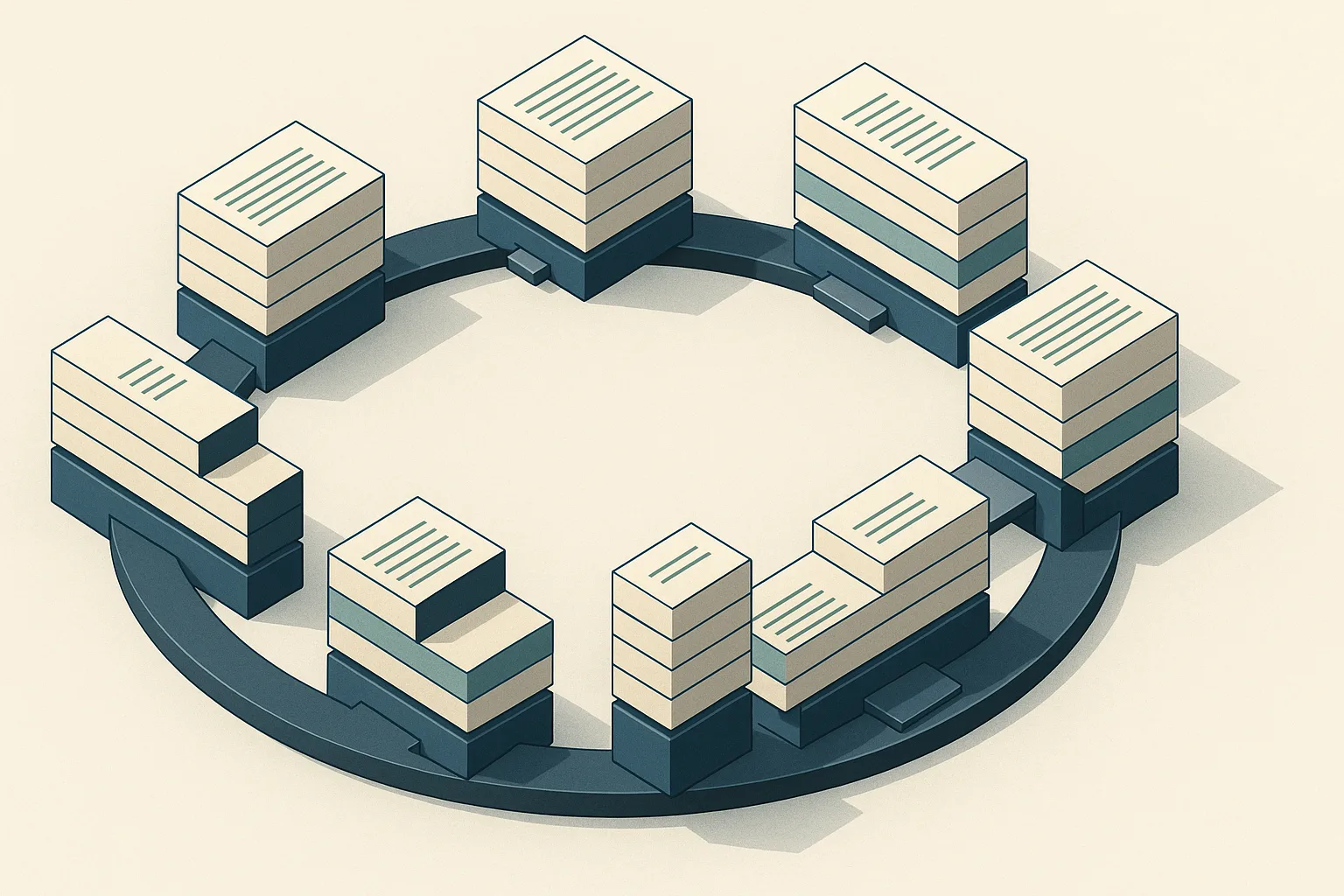
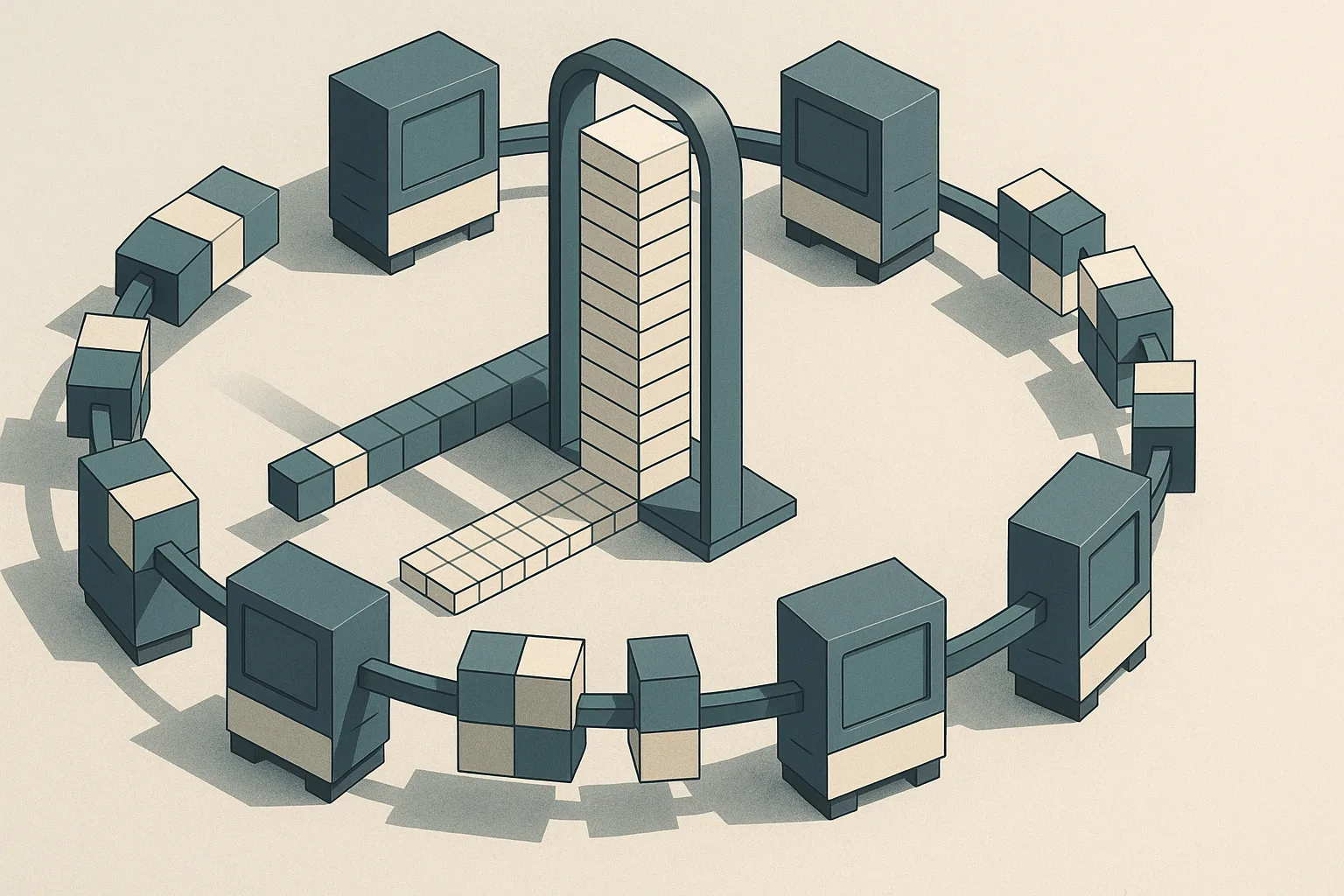
Ring Attention partitions the full input sequence $S$ into $D$ contiguous blocks — one block per device in a ring of $D$ H100 or equivalent GPUs. Each device $d$ owns query block (Q_d), key block (K_d), and value block (V_d) permanently. Over $D$ steps, every device receives and processes every remote KV block, accumulating partial attention output. The ring communication schedule is point-to-point: at each step, device $d$ sends its current KV block to device ((d+1) \bmod D) and simultaneously receives the KV block from device ((d-1) \bmod D), while computing blockwise attention against the KV block it currently holds.
The diagram below illustrates the rotation pattern across $D$ devices:
sequenceDiagram
    participant D0
    participant D1
    participant D2
    participant D3

    Note over D0,D3: Step 0 — each device computes attn(Q_d, K_d, V_d)
    D0->>D1: send KV_0
    D1->>D2: send KV_1
    D2->>D3: send KV_2
    D3->>D0: send KV_3

    Note over D0,D3: Step 1 — compute attn(Q_d, K_{d-1}, V_{d-1}), accumulate
    D0->>D1: send KV_3
    D1->>D2: send KV_0
    D2->>D3: send KV_1
    D3->>D0: send KV_2

    Note over D0,D3: Step 2 — compute attn(Q_d, K_{d-2}, V_{d-2}), accumulate
    D0->>D1: send KV_2
    D1->>D2: send KV_3
    D2->>D3: send KV_0
    D3->>D0: send KV_1

    Note over D0,D3: Step 3 — final block, full attention output assembled on each device
The critical design property is overlap: the send/receive of the next KV block executes concurrently with the blockwise attention compute on the current KV block. NCCL's collective communication layer, which exposes the send/receive and collective primitives over NVLink, NVSwitch, and InfiniBand Verbs, underpins this staging. As NVIDIA's NCCL documentation states: "NCCL provides fast collectives over multiple GPUs both within and across nodes."
H100's ~3 TB/s on-device memory bandwidth and high-bandwidth NVLink interconnect, documented on the H100 product page, make the hardware a strong fit for this schedule; the ring topology works best when the fabric can sustain transfers fast enough to keep pace with blockwise compute.
Why the sequence is split into blocks instead of tokens
Blockwise decomposition is the mechanism that makes distributed exact attention tractable. Processing the sequence token-by-token across a ring would generate one communication event per token — catastrophic overhead. Grouping tokens into blocks amortizes the per-transfer cost: each ring step moves one KV block (thousands of tokens) rather than individual vectors, and each device runs a fused attention kernel over that block before the next transfer begins.
The decomposition preserves exactness because self-attention is mathematically separable across key-value chunks. A device computing attention for query block (Q_d) against key-value block ((K_j, V_j)) produces a partial output (O_{d,j}) and associated log-sum-exp statistics. These partials are numerically combined with those from all other KV blocks using the same online softmax accumulation that FlashAttention uses for tiling within a single device. The mathematical result is identical to computing full attention over the concatenated sequence — no approximation is introduced.
FlashAttention's contribution is precisely this insight: "We propose FlashAttention, a new attention algorithm that computes exact attention with far fewer memory accesses." as stated in the FlashAttention paper. Ring Attention extends this from a single-device tiling strategy to a cross-device ring protocol.
Block size is an explicit tuning parameter with real consequences:
Pro Tip: Block size controls the granularity of both communication and kernel compute. Too small — sub-512 token blocks on H100 — and NCCL transfer overhead dominates, the kernel never reaches peak FLOP utilization, and the ring stalls waiting for next-block data. Too large — blocks approaching the device's usable HBM limit — and KV buffer pressure increases, reducing headroom for activations and leaving less opportunity to hide transfer latency behind compute. Tune block size empirically per model width and cluster fabric; a 2K–8K token block is a reasonable starting range for H100-class hardware.
What each device holds before, during, and after a ring step
Before a ring step begins, device $d$ holds: its permanent query block (Q_d), its permanent local KV block ((K_d, V_d)) in HBM, a receive buffer sized for one KV block, and the running accumulator state — partial output (O_d), running maximum (m_d), and running sum of exponentials (\ell_d) — initialized from the previous step.
During the step, two operations proceed in parallel. The compute stream executes blockwise attention over the current KV block in the receive buffer, updating ((O_d, m_d, \ell_d)) via the online softmax update. The communication stream, coordinated by NCCL, executes a send of the current KV block to device ((d+1) \bmod D) and a receive of the next KV block from device ((d-1) \bmod D) into a double-buffered staging area.
After the step, the newly received KV block is promoted to the active buffer, the staging area is ready for the next transfer, and the accumulators carry updated state. At the final step, (O_d) is normalized by (\ell_d) to produce the exact attention output for (Q_d).
This state layout means each device's peak KV memory footprint at any moment is two blocks — one active, one in the receive buffer — rather than the full sequence's KV cache. That is the source of the per-device memory efficiency.
NCCL implements exactly the primitives needed here: "NCCL (pronounced 'Nickel') is a stand-alone library of standard communication routines for GPUs, implementing all-reduce, all-gather, reduce, broadcast, reduce-scatter, as well as any send/receive based communication pattern."
Watch Out: KV buffer memory is bounded at two blocks per device only when double-buffering is cleanly implemented. If the ring pipeline stalls — because compute finishes before the next KV block arrives, forcing the device to wait — synchronization pressure appears as idle GPU cycles. On cross-node InfiniBand topologies, transfer times are higher and more variable than intra-node NVLink paths, increasing the probability of stall events. Monitor pipeline bubble rate; it is the earliest signal that fabric bandwidth is becoming the bottleneck rather than compute.
Why blockwise attention remains exact instead of approximate
Ring Attention produces the same attention output as standard full-sequence attention because the blockwise accumulation is algebraically equivalent to the monolithic computation. The correctness proof rests on the numerically stable online softmax algorithm.
For a single query $q$ attending over the full key set ({k_1, \ldots, k_N}), standard softmax attention computes:
$(\text{Attention}(q, K, V) = \frac{\sum_{j=1}^{N} \exp(q k_j^\top / \sqrt{d}) v_j}{\sum_{j=1}^{N} \exp(q k_j^\top / \sqrt{d})})$
Processing keys in chunks requires stable partial accumulation. For chunks indexed by $c$, the online softmax update maintains running state ((m, \ell, O)) — the current maximum log-score, the sum of shifted exponentials, and the partial output — and merges each new chunk:
$(m_{\text{new}} = \max(m, m_c))$
$(\ell_{\text{new}} = e^{m - m_{\text{new}}} \cdot \ell + e^{m_c - m_{\text{new}}} \cdot \ell_c)$
$(O_{\text{new}} = \frac{e^{m - m_{\text{new}}} \cdot \ell \cdot O + e^{m_c - m_{\text{new}}} \cdot \ell_c \cdot O_c}{\ell_{\text{new}}})$
At the final chunk, (O_{\text{new}}) equals the exact full-sequence softmax output up to floating-point rounding — the same rounding present in any attention implementation. No token interaction is dropped, truncated, or approximated.
This is the identical mechanism FlashAttention uses to avoid materializing the (N \times N) attention matrix in HBM. Ring Attention applies it across device boundaries rather than across SRAM tiles. Both are exact; neither introduces the sparse masking or low-rank approximations that characterize methods like Longformer, BigBird, or Performer.
The mathematical equivalence holds across all $D$ ring steps: the query block (Q_d) on device $d$ accumulates partial outputs from all $D$ KV blocks, combining them through the above update at each ring step. The final normalization by the accumulated (\ell) produces the complete attention output for that query block.
How the partial scores are accumulated across remote KV blocks
The communication schedule that competitors typically omit is what makes the overlap tractable rather than theoretical. At each of the $D$ ring steps, device $d$ performs a point-to-point send to device ((d+1) \bmod D) and a point-to-point receive from device ((d-1) \bmod D). This is not an all-gather followed by local attention — that pattern would require all devices to simultaneously hold the full global KV cache, eliminating the memory benefit.
Instead, Ring Attention stages the KV data one block at a time: as the paper's OpenReview manuscript states, "As we compute attention, each host sends key-value blocks to the next host while receives key-value blocks from the preceding host. The communication is overlapped with the computation of blockwise attention and feedforward."
NCCL's send/receive primitives, combined with all-gather and reduce-scatter operations for output aggregation phases, orchestrate this staged movement. The critical point is that reduce-scatter and all-gather are used not for moving KV data — that happens peer-to-peer — but for combining outputs during the overall distributed schedule.
Production Note: Full overlap is achievable only when the time to transfer one KV block across the fabric is less than or equal to the time to compute blockwise attention over that block. On H100 intra-node NVLink rings, this condition often holds because compute per block is substantial and NVLink bandwidth is high. On cross-node InfiniBand-only rings, transfer time can exceed compute time — especially for smaller models or smaller block sizes — leaving devices idle and converting the theoretical communication-compute overlap into partial or zero overlap. Profile this ratio explicitly before committing to a ring configuration; the latency hiding degrades continuously as the fabric-to-compute ratio deteriorates.
Why feedforward blocks are scheduled alongside attention blocks
Ring Attention distributes feedforward computation — not just self-attention — across the ring. This is not incidental; it is a deliberate choice to increase compute density per ring step.
The feedforward sublayer following attention in a Transformer block is compute-intensive relative to its memory footprint: each token independently passes through two linear projections and a nonlinearity. In a blockwise execution model, the feedforward computation over the current query block can be interleaved with the ring communication that fetches the next KV block. The paper explicitly states it uses "blockwise computation of self-attention and feedforward to distribute long sequences across multiple devices." in the Ring Attention paper.
The mechanism is: after computing partial attention output (O_d^{(c)}) for KV chunk $c$, the device immediately applies the feedforward transformation to the tokens of (Q_d) for which attention is complete. PyTorch Distributed's process group infrastructure schedules the overlapping NCCL sends behind the feedforward kernel launches, keeping the compute stream saturated.
Pro Tip: Models with higher feedforward-to-attention compute ratios — large FFN expansion factors or gated MLP variants — benefit more from this schedule. The feedforward pass provides more cycles to hide the ring communication. Narrow FFN models or purely attention-heavy architectures leave less compute to absorb the transfer time, reducing effective overlap efficiency. When selecting block size and ring size, account for the model's total compute per block, not just the attention FLOPs.
What communication-computation overlap buys you in practice
The direct benefit of full overlap is wall-clock time reduction relative to a naive distribute-then-gather approach. Without overlap, each ring step would follow a strict sequence: compute attention, then transfer KV, then compute next attention. With full overlap, transfer and compute run concurrently, and the ring step wall-clock time approaches (\max(T_{\text{compute}}, T_{\text{transfer}})) rather than (T_{\text{compute}} + T_{\text{transfer}}).
On NVIDIA H100 systems with NVLink/NVSwitch, which deliver approximately 3 TB/s of on-device memory bandwidth per GPU and high-bandwidth GPU-to-GPU interconnect, as documented on the H100 product page, this overlap condition is achievable for realistic block sizes and model widths. NCCL is designed for exactly this type of multi-GPU environment: fast collectives within and across nodes, with the transport layer selected automatically based on topology.
The following table provides a conceptual comparison of memory scaling, communication regime, and overlap quality across ring configurations, based on the architectural properties described in the Ring Attention paper:
| Configuration | Sequence capacity (vs. single device) | KV memory per device | Communication regime | Overlap quality |
|---|---|---|---|---|
| 1 device (baseline) | 1× | Full sequence | None | N/A |
| 8× H100 NVLink ring | ~8× | ~2 blocks | Intra-node NVLink | High — transfer < compute |
| 64× H100 NVSwitch ring | ~64× | ~2 blocks | Intra-node switch fabric | High — NVSwitch bisection BW |
| 64× H100 cross-node IB | ~64× | ~2 blocks | Inter-node InfiniBand | Moderate — IB latency visible |
| 512× cross-node IB | ~512× | ~2 blocks | Multi-hop IB fabric | Low-moderate — jitter accumulates |
The per-device KV memory stays at approximately two blocks regardless of ring size — that is the memory efficiency argument. But the wall-clock benefit weakens as the ring grows across slower fabrics.
Where overlap hides latency and where it cannot
Overlap fully hides communication latency only when (T_{\text{transfer}} \leq T_{\text{compute}}). Two failure modes break this condition in practice.
Bandwidth saturation. Once the interconnect fills, no amount of algorithmic overlap can recover wall-clock time. On a 64-device InfiniBand ring, the aggregate ring traffic scales with ring diameter and block size; if the fabric is already near capacity from other jobs or tenant traffic, individual ring steps stall waiting for bandwidth. NVLink's point-to-point bandwidth between H100s within a node is substantially higher and more deterministic than cross-node InfiniBand paths, making intra-node rings materially more predictable.
Topology mismatch. Rings that cross multiple InfiniBand switches introduce variable latency from routing arbitration and congestion. A single slow hop in the ring dictates the throughput of the entire ring, because each device must receive its KV block before computing the next step. NCCL supports InfiniBand Verbs, PCIe, and NVLink transports, but the effective latency characteristics of these transports diverge by an order of magnitude in adverse conditions.
Watch Out: Cross-node rings on InfiniBand expose jitter that intra-node NVLink rings do not. A single congested IB link can stall all ring steps that pass through it. Before scaling to large cross-node rings, verify that your fabric's per-port bandwidth and latency are consistent under the expected collective load — use
perftestand NCCL's built-in environment variableNCCL_DEBUG=INFOto surface topology negotiation and transport selection before training begins.
Why topology matters as much as algorithm design
The Ring Attention algorithm is topology-agnostic in its mathematical formulation. The implementation is not. NVIDIA's H100 product page states directly: "Accelerated servers with H100 deliver the compute power — along with 3 terabytes per second (TB/s) of memory bandwidth per GPU and scalability with NVLink and NVSwitch™ — to tackle data analytics with high performance and scale to support massive datasets."
A ring built entirely within an 8-GPU H100 SXM5 node uses NVLink 4.0's full point-to-point bandwidth with deterministic latency. A ring that crosses nodes relies on InfiniBand HDR or NDR, which offers significantly lower per-GPU bandwidth and introduces network-layer variability. The algorithm's overlap guarantee — that communication is hidden behind compute — degrades gracefully from intra-node NVLink rings to cross-node IB rings, but it does not vanish: even partial overlap reduces wall-clock time relative to no overlap.
Production Note: When deploying Ring Attention on multi-node H100 clusters, minimize the number of inter-node ring edges. A ring that stays within an 8-GPU node for as many steps as possible, and only crosses nodes at the ring boundary, experiences NVLink bandwidth for the majority of steps. If the ring must span many nodes, prioritize non-blocking fat-tree InfiniBand topologies with sufficient rail bandwidth to support the collective schedule without contention. Check that NCCL's topology detection (
NCCL_TOPO_DUMP_FILE) correctly identifies NVLink paths; misconfigured topology files cause NCCL to fall back to slower PCIe transfers even when NVLink is physically present.
Where Ring Attention compares with prior memory-efficient Transformers
Ring Attention's specific distinction from prior memory-efficient Transformers is the combination of exact attention and multi-device sequence distribution. The paper states: "By processing longer input sequences while maintaining memory efficiency, Ring Attention enables training and inference of sequences that are device count times longer than those of prior memory-efficient Transformers."
The comparison field includes three distinct approaches:
| Method | Exactness | Context scaling | Communication pattern | Single-device required |
|---|---|---|---|---|
| Standard attention | Exact | 1× (memory-bound) | None | Yes |
| FlashAttention | Exact | 1× (memory-efficient, not longer) | None | Yes |
| Sparse/approx attention (Longformer, BigBird) | Approximate | Limited by sparsity pattern | None | Yes |
| Ring Attention | Exact | Device-count × | Staged P2P ring | No (multi-device) |
FlashAttention is exact and memory-efficient, but it does not distribute the sequence across devices — its memory savings come from tiling within a single device's SRAM, not from partitioning across a cluster. A 128K-token sequence that barely fits on a single H100 with FlashAttention still requires that full KV cache to reside on one device; Ring Attention's distributed scheme places only one block's worth of KV on each device.
Approximate long-context methods reduce compute and memory by attending to a sparse or low-rank subset of tokens. They can achieve long context on a single device, but they sacrifice exact attention and introduce task-dependent accuracy degradation. Ring Attention pays in distributed infrastructure cost rather than in attention quality.
Why device-count-longer contexts are the real architectural claim
The "device-count times longer" claim is precise but conditional. If a single H100 can train a model with 128K context under FlashAttention, a ring of 8 H100s can in principle train the same model at 8 × 128K = ~1M tokens under Ring Attention, using the same per-device memory budget. The paper reports experiments reaching millions of tokens of context on language modeling and reinforcement learning tasks.
In practice, the effective ceiling sits below the headline. Batch size must often shrink as context grows to keep total activation memory manageable. Optimizer states (particularly Adam's momentum and variance buffers) add per-parameter overhead that does not scale with sequence distribution. Network contention on large clusters can absorb the transfer budget that was supposed to be hidden behind compute.
Models in the Llama family illustrate the gap between nominal context support and operational deployment limits. Serving at 128K is already operationally demanding; extending to 1M+ tokens with Ring Attention requires not just the ring protocol but careful KV-movement planning, sharding co-design across tensor-parallel and sequence-parallel dimensions, and explicit management of attention sink behavior at extreme lengths.
Pro Tip: "Device-count times longer" is an upper bound on sequence capacity, not a statement about throughput or cost. Doubling the ring size to double context length also doubles inter-device communication volume. When evaluating Ring Attention for a specific model and task, measure tokens-per-second at target context length on your actual cluster rather than projecting from single-device FlashAttention benchmarks — the ratio is rarely 1:1 once fabric overhead is included.
Where RAG still makes more sense than ultra-long context
Ultra-long exact attention and retrieval-augmented generation (RAG) solve overlapping but distinct problems. Ring Attention enables a model to attend over every token in a million-token sequence, capturing global dependencies that retrieval cannot recover. RAG avoids that cost by fetching a small, high-relevance evidence set and presenting only that to a shorter-context model.
Choose Ring Attention when: - The task requires reasoning over dense token-level dependencies distributed across the full input (e.g., code analysis over a large repository, multi-document synthesis where cross-document references are non-local) - Retrieval granularity is too coarse — key information is diffuse and cannot be isolated into retrievable chunks - Training data naturally contains very long sequences and the model needs to generalize at those lengths
Choose RAG when: - The task requires locating a small number of relevant facts from a large corpus — retrieval precision is high - Latency and per-request compute cost are primary constraints - The corpus changes frequently, making full-context re-encoding expensive - The serving infrastructure does not support multi-GPU sequence parallelism
Choose neither (use a smaller context window) when: - The task's relevant context fits comfortably within 32K–128K tokens, which standard FlashAttention-based serving handles on a single H100 without ring overhead
Practical limits that show up before the paper headline does
Before reaching the million-token regime the paper headline describes, three categories of real-cluster failure mode appear in approximately this order of encounter.
Bandwidth ceilings. The ring's throughput ceiling is set by the slowest link any block must traverse. On a multi-node cluster, this is cross-node InfiniBand bandwidth per GPU, which is substantially lower than NVLink bandwidth per GPU. NCCL's collective scheduling attempts to maximize utilization, but it cannot exceed physical link capacity. Once KV block transfers saturate the available inter-node bandwidth, overlap breaks and ring steps serialize.
Synchronization jitter. Point-to-point ring steps are synchronous barriers in practice: device $d$ cannot proceed to step $c+1$ until it has received the KV block from device $(d-1)$. Any jitter on a single link propagates to all downstream devices in the ring. On large clusters, background traffic from co-located jobs, operating system interrupts, and RDMA retransmissions all contribute jitter. NCCL's transport layer over InfiniBand Verbs is sensitive to this; intra-node NVLink paths are more deterministic.
Memory fragmentation. Extended training runs with variable-length sequences in the same ring configuration cause HBM fragmentation. PyTorch's caching allocator may fail to find contiguous blocks for large KV buffers even when total free memory appears sufficient, causing out-of-memory errors at sequence lengths that should theoretically fit.
Watch Out: In real clusters, the first failure mode is rarely algorithmic incorrectness in the ring schedule — it is the inability to keep the ring saturated without bubbles. A cluster that achieves 95% overlap efficiency at 8 devices may achieve only 60% at 64 devices when cross-node IB fabric becomes the bottleneck. Measure overlap efficiency directly (idle device cycles per ring step) before concluding that the performance is algorithm-limited rather than infrastructure-limited. NCCL bandwidth ceilings, synchronization jitter across InfiniBand links, and HBM fragmentation under long-sequence workloads on H100 clusters are the three failure modes most commonly encountered before reaching the paper's theoretical sequence capacity.
How recall and wall-clock cost degrade as context grows
The Ring Attention paper reports that its approach "demonstrate[s] the effectiveness of our approach in allowing millions of tokens context size and improving performance" on language modeling and reinforcement learning tasks, but it does not provide a universal recall curve across context lengths. Performance at extreme context lengths depends on the model's training distribution, attention sink behavior, and the density of relevant tokens in the sequence.
Empirically, models trained on short sequences tend to exhibit recall degradation when evaluated at context lengths far beyond their training distribution — a property that Ring Attention alone cannot fix. The architecture enables the context; it does not guarantee the model has learned to use it. Training specifically on long sequences is a separate requirement.
Wall-clock cost per token grows with context even under perfect overlap, because the number of ring steps equals the number of KV blocks (device count), and each step consumes a fixed amount of time. Total training FLOP scales as (O(N^2 / D)) per device (quadratic attention distributed across $D$ devices), so per-device compute scales linearly with $N/D$. Communication volume per device scales with the KV block size times the number of steps, which is linear in $N/D$. The net effect is that doubling context length approximately doubles both per-device compute and communication volume, holding device count constant.
| Context length | Relative per-device FLOPs | Relative KV comm. volume | Practical wall-clock concern |
|---|---|---|---|
| 128K (FlashAttention baseline) | 1× | N/A (single device) | None — fits one H100 |
| 1M (8-device ring) | ~8× | 7 ring steps | Fabric bandwidth critical |
| 1M (64-device ring) | ~1× | 63 ring steps | Jitter and synchronization |
| 10M (64-device ring) | ~10× | 63 ring steps | Memory fragmentation + comm. |
What to instrument before trying this in production
Before scaling context length on a Ring Attention deployment, establish baselines on three signal categories.
Collective latency per ring step. Use PyTorch Distributed's profiler hooks or NCCL's debug output (NCCL_DEBUG=INFO, NCCL_DEBUG_SUBSYS=ALL) to measure actual transfer time per KV block across the ring. Compare this against blockwise attention compute time to estimate overlap efficiency. If transfer time exceeds compute time, the overlap is not hiding the communication cost.
Kernel occupancy. NVIDIA Nsight Systems traces reveal whether attention and feedforward kernels achieve target GPU utilization or stall on memory transfers. Low kernel occupancy during nominally "compute" steps indicates that the KV block is arriving late — compute started but stalled waiting for data.
Interconnect utilization. Monitor NVLink and InfiniBand utilization during ring steps using DCGM or NVIDIA System Management Interface. Sustained utilization above 80% of peak bandwidth on any link signals that bandwidth is the active bottleneck, not compute.
Production Note: Load imbalance across ring participants is a subtle failure mode. If one device consistently lags — due to thermal throttling, a slower NVLink port, or a co-located workload — every ring step inherits that device's latency. PyTorch Distributed's rank-level timing (accessible via
torch.distributed.barrier()timing around ring steps) surfaces per-rank latency distributions. NCCL's collective operations will not proceed until all ranks are ready; even one slow rank serializes the entire ring. Identify and eliminate load imbalance before interpreting collective latency measurements as architecture-limited rather than hardware-limited.
FAQ: ring topology, exactness, and hardware requirements
How does Ring Attention work?
Each device holds a permanent shard of the query sequence and a rotating KV block. Over $D$ ring steps, KV blocks travel peer-to-peer around the ring, and each device accumulates partial attention output using online softmax. After $D$ steps, every device holds the exact attention output for its query shard against the full global sequence.
What is blockwise attention?
Blockwise attention processes the attention computation over chunks (blocks) of keys and values rather than the full sequence at once, accumulating partial results using running max and sum statistics. It is the same mechanism FlashAttention uses for memory-efficient single-device tiling. Ring Attention applies it across device boundaries.
Is Ring Attention exact or approximate?
Exact. The online softmax accumulation across blocks produces results identical to standard full-sequence softmax attention up to floating-point rounding. No token interactions are dropped, masked, or approximated. This distinguishes Ring Attention from sparse or low-rank methods like Longformer or Performer.
How does Ring Attention compare to standard Transformer attention?
Standard attention materializes the full attention matrix on one device; memory scales as (O(N^2)). Ring Attention keeps only two KV blocks per device at any moment; memory scales as $O(N/D)$ per device. The computational complexity remains (O(N^2)) in aggregate — distributed across $D$ devices — but per-device compute scales as (O(N^2/D)).
What are the limitations of Ring Attention?
Multi-device execution is mandatory — this is not a single-GPU optimization. Communication overlap efficiency degrades on weak or congested interconnects. Bandwidth saturation on cross-node InfiniBand fabrics can eliminate the overlap benefit entirely. Memory fragmentation and synchronization jitter appear before the theoretical sequence ceiling is reached. Longer context does not automatically improve recall unless the model was trained at those lengths.
Pro Tip: Ring Attention's central architectural contribution is not a new attention formula — it is the insight that blockwise decomposition makes attention communication-parallelizable, and that scheduling KV transfers to overlap with blockwise compute converts distributed communication overhead from a serialization penalty into a hidden cost. Every other property — exact attention, device-count scaling, and long-context capacity — follows from this single architectural choice.
Sources and references
- Ring Attention with Blockwise Transformers for Near-Infinite Context (arXiv:2310.01889) — Primary source for Ring Attention algorithm, communication schedule, overlap mechanism, and scaling experiments
- Ring Attention OpenReview manuscript — Source for the direct quote on per-step KV send/receive communication schedule
- FlashAttention: Fast and Memory-Efficient Exact Attention with IO-Awareness (arXiv:2205.14135) — Foundation for blockwise online softmax and exact tiled attention mechanics
- NVIDIA NCCL Documentation — Collective primitive specifications, transport layer support (NVLink, InfiniBand, PCIe), and multi-GPU scheduling
- NVIDIA NCCL GitHub Repository — Source for NCCL collective API definitions
- NVIDIA H100 Tensor Core GPU Product Page — H100 memory bandwidth specification (~3 TB/s), NVLink/NVSwitch scaling characteristics
- PyTorch Distributed Documentation — Framework layer for NCCL-backed multi-GPU training and profiling hooks
Keywords: Ring Attention, blockwise attention, NCCL, PyTorch Distributed, FlashAttention, online softmax, all-reduce, all-gather, reduce-scatter, NVIDIA H100, InfiniBand, NVLink, Llama 3.1, million-token context