AI & ML
GGUF with llama.cpp is the lowest-friction path to portable local inference across CPU, Apple Silicon, and heterogeneous devices — but the trade-off is that you accept manual conversion and tuning in exchange for avoiding GPU cloud costs and vendor lock-in.
18 min read
AI & ML
By transitioning from capital-heavy on-premise clusters to GPU-as-a-Service (GPUaaS) models, enterprises can reduce infrastructure TCO by 30-40%, provided they implement liquid cooling and high-density rack power management to maintain uptime for sustained, high-intensity inference workloads.
16 min read
AI & ML
By implementing AWQ (Activation-Aware Weight Quantization) alongside speculative decoding, engineering teams can achieve a 3-4x throughput improvement while keeping accuracy degradation under 1%, though this necessitates careful management of the KV-cache memory overhead during parallel request batching.
15 min read
AI & ML
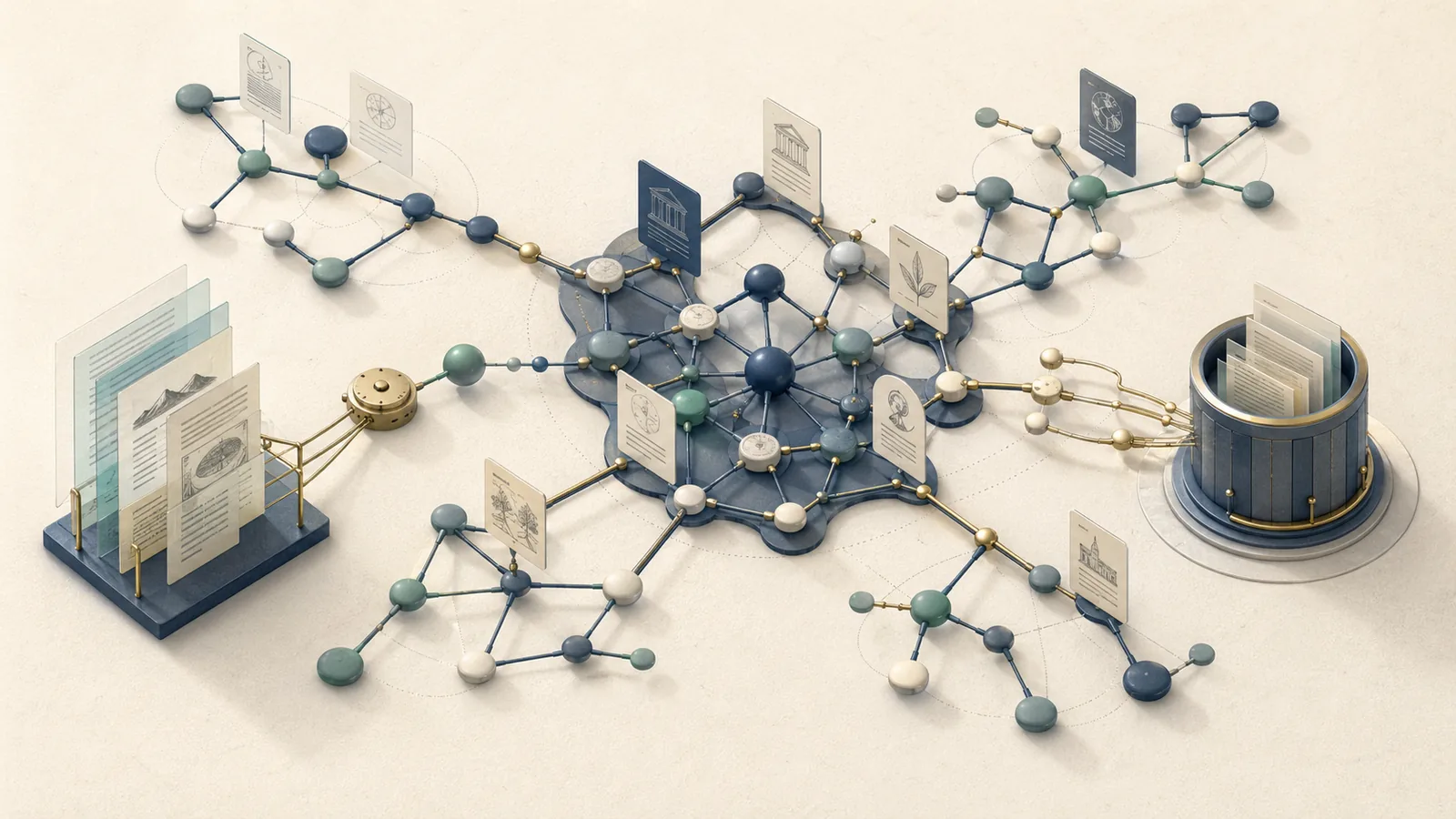
Knowledge-graph agentic RAG works by using entity links and graph traversal to expand the evidence frontier beyond nearest-neighbor chunk retrieval — this improves multi-hop recall when relationships matter — but it depends on strong entity resolution and graph quality, so noisy extraction can amplify wrong paths rather than fix them.
26 min read
AI & ML
Jointly applying Knowledge Distillation during Quantization-Aware Training (QAT) reduces the 'accuracy floor' typical of ultra-low bit-width models by transferring the inductive biases of the teacher model directly into the quantized weight space of the student, mitigating the signal loss inherent in post-training quantization.
14 min read
AI & ML
By implementing a three-layer RAG measurement framework—measuring retrieval precision@k, generation faithfulness, and business resolution rates—enterprises can detect silent system degradation before it impacts user experience, typically surfacing issues 20% earlier than anecdotal monitoring.
16 min read
AI & ML
Optimizing pass@N performance is no longer a matter of scaling sample counts; by implementing dynamic early-exit policies and gradient-based token refinement, production teams can minimize tail latency spikes without sacrificing logical consistency in complex reasoning tasks.
15 min read
AI & ML
By configuring HNSW parameters with m=16 and ef_construction=200 within pgvector, engineers can achieve up to 5,250x faster query performance compared to sequential scans, albeit at the cost of higher memory overhead and longer initial index build times.
14 min read
AI & ML
By transitioning from standard DPO to Primal-Dual alignment frameworks, engineers can enforce hard safety constraints on model output distributions that standard preference optimization fails to guarantee, effectively reducing safety-violation drift by up to 15% in high-stakes B2B contexts.
14 min read
AI & ML
By leveraging the State Space Duality (SSD) framework, developers can achieve 2-8x throughput gains over vanilla Mamba via tensor-core-friendly parallel projections, provided they optimize for the specific grouped-value attention head structures.
14 min read
AI & ML
UniComp finds a consistent 'knowledge bias' across compression — factual recall is relatively preserved while reasoning, multilingual, and instruction-following degrade — but task-specific calibration can recover up to 50% of pruned-model reasoning performance, with quantization offering the best overall performance-efficiency trade-off.
19 min read
AI & ML
A robust multi-agent control plane splits planning, policy, communication, memory, observability, evaluation, and governance into separate building blocks — which Microsoft’s reference architecture and A2A both position as the scalable way to coordinate specialized agents — but the model deliberately stays framework-agnostic and caps connected-agent depth to avoid uncontrolled agent trees.
28 min read