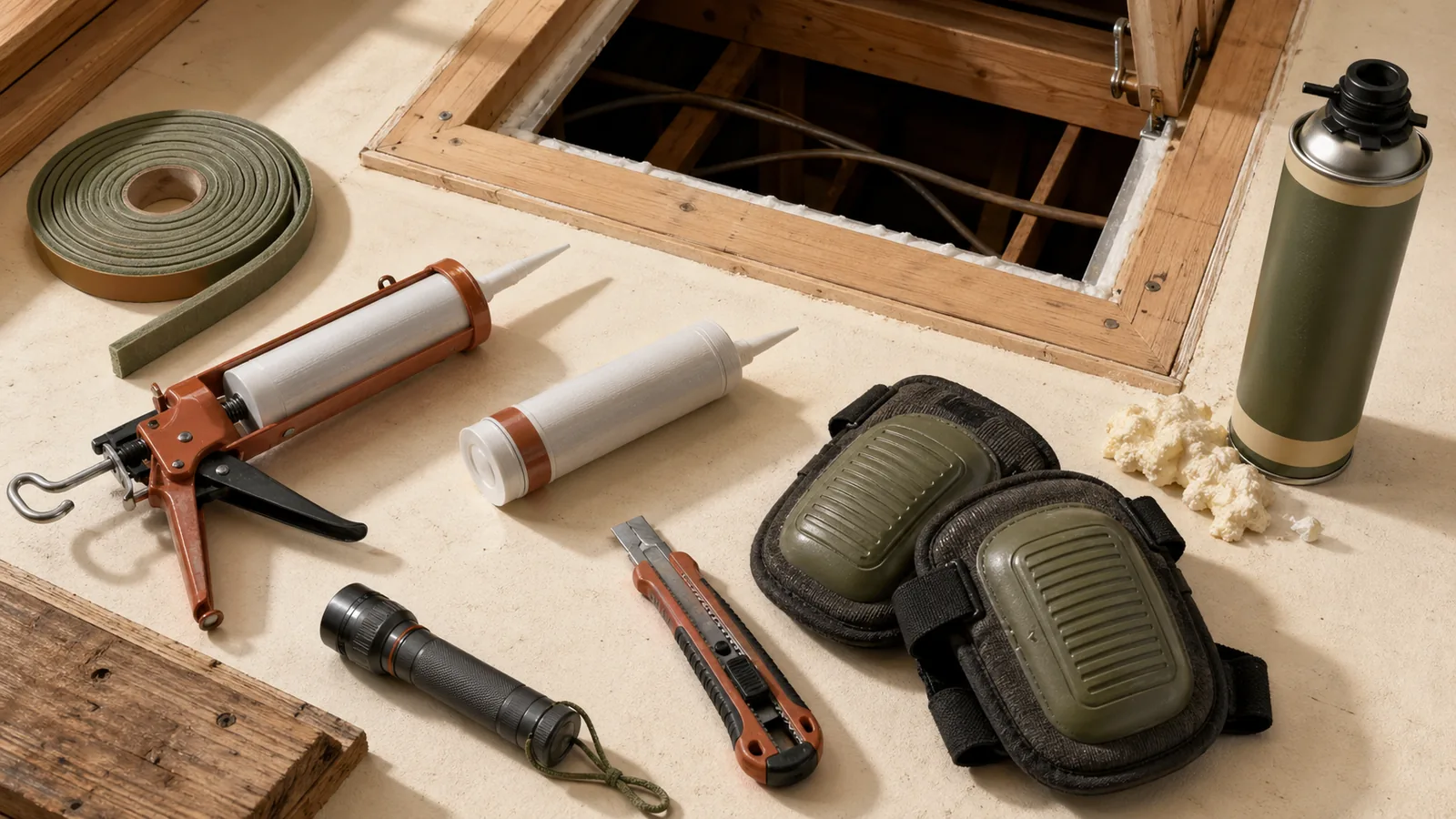
At a Glance: - Time: One weekend for DIY attic and basement sealing; 1–3 days for a whole-house pro job - Cost: $50–$300 in materials for DIY; $1,500–$4,000+ for a blower-door-guided contractor project - Skill level: Beginner to intermediate (attic penetrations) / Pro required (combustion-safety situations) - Tools: Caulk gun, canned spray foam, weatherstripping, utility knife, flashlight, knee pads
Seal first, insulate second — that sequence is the single most important thing to take away from this article. Insulation slows heat transfer through materials; it cannot stop air moving through gaps. If your attic has open wiring holes, a poorly fitted pull-down stair, or an unsealed chimney chase, adding a foot of blown cellulose over those gaps is like laying a down comforter on a screen door. You'll feel warmer for about 20 minutes.
ENERGY STAR recommends air sealing the attic before adding attic insulation, and its home-sealing guidance is explicit: plug the big holes first, usually in the attic and basement, then add insulation.
The one non-negotiable before you start: if your home has an older gas furnace, boiler, or water heater that pulls combustion air from the room (called "atmospheric venting"), stop and read the combustion-safety sections below before sealing anything. Tightening a house with the wrong equipment can pull carbon monoxide into your living space. A professional energy audit is the first step to assessing how much energy your home consumes and to deciding what measures you can take to make your home energy efficient and comfortable.
Why air sealing matters more than adding insulation alone
Adding insulation without first sealing air leaks is one of the most common and expensive sequencing mistakes in home energy upgrades. ENERGY STAR reports that sealing air leaks and adding insulation together can deliver up to 10% savings on annual energy bills — but that number depends on doing both, in the right order.
Here's the practical distinction: R-value measures how well a material resists conducted heat loss through solid material. Air leakage bypasses R-value entirely. A 1-square-inch hole in your attic floor can allow more heat to escape than a square foot of under-insulated drywall. No amount of fiberglass batts fixes a gap you never closed.
Pro Tip: Run your hand along the top of interior walls on a cold, windy day. If you feel a cold draft coming from the electrical outlets or ceiling light trim, that's stack effect pulling outdoor air straight through your wall cavities into your living space.
A professional energy audit is the most reliable way to quantify both leakage and insulation deficiencies before you spend money on materials.
What stack effect does in a two-story or single-story house
Stack effect is the engine behind most drafts, and understanding it changes where you focus your sealing work.
Warm air is less dense than cold air, so it rises. In winter, the heated air inside your home floats upward toward the attic and exits through every gap it can find — open wiring holes, recessed light fixtures, pull-down stair gaps, plumbing penetrations. As that warm air escapes at the top of the house, it creates a low-pressure zone at the bottom that pulls cold outside air in through rim joists, electrical outlets, sill plates, and basement penetrations.
Picture it as a chimney effect running floor-to-ceiling through your entire house:
[Image: Stack effect diagram — cold air infiltration at basement and sill plate level, warm air exfiltration at attic floor and top-plate penetrations]
- Basement/crawlspace level: Cold air enters through rim joists, sill plates, and pipe chases
- Main floor: Air moves through wall cavities, outlet boxes, and recessed lights in upper-floor ceilings
- Attic floor: Warm air exits through every unsealed penetration — the bigger the hole, the more it acts like an open window
In a two-story home, the pressure difference between basement and attic can be significant enough that sealing only the attic floor makes the entire house feel noticeably tighter. That's why the attic is always the first stop.
Why old windows are often only part of the problem
Windows get blamed for drafty houses because you can feel cold air near them in winter. But that sensation often comes from radiant cold off the glass surface, not air leakage. A single-pane window does have poor thermal performance (roughly R-1), but a well-installed double-pane window loses almost no air — the frame is continuous and the weatherstripping is intact.
Compare that to a typical attic floor:
| Leak source | Relative air leakage impact |
|---|---|
| Unsealed top plates (linear run) | High — runs the perimeter of every room |
| Pull-down attic stairs | High — often a 10+ sq. ft. uninsulated gap |
| Recessed lights (old, non-IC-rated) | High — each fixture is an open hole to attic |
| Windows (all, combined) | Medium — but often blamed first |
| Electrical outlets on exterior walls | Low-medium — adds up across a house |
Replacing windows runs $400–$1,000+ per unit installed and typically has a long payback period. Sealing the attic hatch with weatherstripping and a foam-board cover costs under $30 and takes an afternoon. Start at the top, work your way down, and revisit windows only after the bigger leaks are handled.
Before you start: energy audit, blower-door test, and safety checks
You can start sealing based on a visual inspection — and for many homes, that's enough to make a real dent. But if your energy bills are high, your house has unusual cold spots, or you're planning to apply for utility rebates, a professional energy audit is worth scheduling first.
As the U.S. Department of Energy states, "A home energy audit is the first step to assessing how much energy your home consumes and to deciding what measures you can take to make your home energy efficient and comfortable."
An audit tells you where you're losing energy, ranked by impact, before you spend a dollar on materials. Many utilities offer subsidized audits — sometimes free — as a precursor to rebate programs.
When to Call a Pro: Stop DIY sealing immediately and call an air sealing contractor if any of these apply: - You suspect backdrafting — you smell exhaust or see soot staining around your furnace, water heater flue, or fireplace - Your home has an older atmospheric-combustion furnace, boiler, or water heater (any unit with a metal draft hood or a flue pipe that vents by natural draft) - You see mold, condensation on interior surfaces, or water staining in the attic - Your attic is inaccessible, has no floor boards, or is less than 18 inches of clearance - A blower-door test shows large whole-house air leakage and you want to qualify for utility rebates or a blower-door-verified contractor incentive
How utility energy audits find the biggest leaks
A professional energy auditor's most important tool is a blower door — a calibrated fan mounted in an exterior door frame that depressurizes the house to a standard pressure difference. As the DOE explains, "Professional energy auditors use blower door tests to help determine a home's airtightness." The fan reading, expressed in cubic feet per minute (CFM), tells the auditor exactly how leaky your house is relative to its size.
During the blower-door test, the auditor may use an infrared camera to scan walls, ceilings, and floors. As the DOE notes, "While the blower test is being conducted, the analyst may use an infrared camera to look at the walls, ceilings, and floors, to find specific locations where insulation is missing and air is leaking." Those cold blue spots on an IR image are your sealing priorities, ranked by size.
Ask your auditor whether they will provide a DOE Home Energy Score report — it gives you a 1–10 rating that's useful for comparing rebate eligibility and resale documentation.
On tax credits: The cost of a home energy audit may have separate credit treatment. Under Form 5695 rules, home energy audits can qualify for a credit of up to $150 under a separate line item from the insulation/air-sealing credit — check the current IRS instructions for the year you're filing, because annual limits and eligible expenses can shift.
Red flags that mean you should call an air sealing contractor
The DOE is direct on this: "Backdrafting is when the various combustion appliances and exhaust fans in the home compete for fresh air." When you tighten a house, you reduce the amount of air available for combustion appliances that need room air to operate. If you seal a house that has an older atmospheric-vented furnace without professional guidance, you can create conditions that pull combustion gases — including carbon monoxide — back into the living space.
Per DOE guidance, a certified energy contractor should conduct combustion safety testing as part of any air-sealing work in homes with combustion appliances, because sealing can increase the risk of backdrafting atmospheric-vented equipment.
DIY vs Pro: Most penetration sealing — wiring holes, recessed lights, rim joists, weatherstripping — is safe DIY work. Anything near a flue, a gas appliance draft hood, or a fireplace chase requires either pro assessment first or combustion-safety testing after. Large whole-house jobs targeting utility rebates almost always require a blower-door-verified contractor to document the leakage reduction.
Tools and materials for sealing air leaks
Stock these before you start. Running to the hardware store mid-project when you're covered in attic dust and holding a flashlight is avoidable.
Core materials: - Acrylic latex caulk (paintable, for gaps under ¼ inch at room temperature — around window and door trim, baseboards, electrical boxes) - Canned spray foam designed to air seal (Great Stuff Gaps & Cracks or equivalent — for gaps ¼ inch to 3 inches around pipes, wiring, and framing) - Closed-cell spray foam (larger attic bypasses, rim joists where you want higher R-value and a tighter air seal) - Two-component polyurethane foam (larger attic bypasses, rim joists where you want closed-cell performance) - Weatherstripping — adhesive-backed foam tape (V-strip or door compression) for attic hatch perimeters, door frames - Door sweeps — aluminum with a rubber or brush seal for the gap under exterior doors - Foam gaskets — pre-cut outlet and switch-plate gaskets (Frost King or equivalent, under $5 per pack) - High-temperature sealant — specifically rated for use near flues and fireplace surrounds (Rutland or equivalent, rated 500°F+) - Rigid foam board — 2-inch polyisocyanurate for insulating the back of attic hatches and pull-down stair covers - Rafter vents / baffles — cardboard or foam channels to keep soffit vent pathways open when adding attic insulation
Use it where it belongs:
| Material | Best use | Avoid using it for |
|---|---|---|
| Acrylic latex caulk | Hairline gaps at trim, baseboards, outlet-plate edges | Wide openings or moving joints |
| Canned spray foam | Pipe and wire penetrations, small attic bypasses | Hot surfaces, flues, or tight-moving parts |
| Weatherstripping | Doors, windows, attic hatches, pull-down stairs | Static cracks that should be caulked instead |
| Door sweeps | Exterior doors and basement bulkhead doors | Window frames or electrical penetrations |
| Foam gaskets | Outlet and switch plates on exterior walls | Filling the electrical box itself |
| High-temperature sealant | Chimney surrounds and flue-adjacent framing | Ordinary gaps elsewhere |
ENERGY STAR confirms that weatherstripping, canned spray foam designed to air seal, and caulk designed to air seal can all qualify for the insulation tax credit when the product comes with a Manufacturer's Certification Statement — so save your receipts and product packaging.
Caulk, spray foam, and high-temperature sealant: where each one belongs
Choosing the wrong product for a location is the most common DIY mistake. Here's the breakdown:
| Gap size / location | Right product | Wrong product |
|---|---|---|
| Under ¼ inch — trim, baseboards, window frames | Acrylic latex caulk | Spray foam (expands too much, lifts trim) |
| ¼ inch to 3 inches — pipe and wire penetrations | Canned spray foam (gaps & cracks formula) | Caulk (can't bridge the gap) |
| Large framing gaps, rim joists | Two-component spray foam or cut-and-cobble rigid foam | Canned foam alone (shrinks, gaps remain) |
| Near flue pipes, chimney surrounds | High-temperature sealant (500°F+ rated) | Standard caulk or spray foam (fire hazard) |
| Moving parts — door/window frames | Weatherstripping | Caulk or foam (breaks with movement) |
Watch Out: Never use standard spray foam or caulk within 2 inches of a flue pipe, metal chimney liner, or any surface that gets hot during appliance operation. Use only high-temperature-rated sealant in those locations, and maintain required clearances per local code.
ENERGY STAR's guidance on attic sealing emphasizes closing gaps where walls meet the attic floor and around dropped soffits — those are exactly the locations where spray foam excels. The key is not to block designed ventilation openings in the process.
Weatherstripping, door sweeps, and foam gaskets for doors and outlets
Weatherstripping is the right tool anywhere a moving part must seal against a frame: doors, operable windows, and attic hatches.
Weatherstripping mini-checklist: - Exterior door frames: V-strip (tension seal) on the hinge and latch sides; compression bulb on the top - Door bottom: aluminum door sweep with rubber seal, or an automatic door bottom if you want zero-maintenance - Attic pull-down stair frame: adhesive foam tape around the full perimeter; replace if the old tape is compressed flat - Operable windows: V-strip on the sliding or pivoting surfaces; check that sash locks draw the sash firmly against the seal
Foam gaskets for electrical penetrations: Electrical outlets and switches on exterior walls — and any boxes on an interior wall shared with the attic — are direct air pathways through the insulation cavity. Install pre-cut foam gaskets (Frost King EO18H or equivalent) under every outlet and switch plate on exterior walls. Costs roughly $0.50 per outlet and takes 30 seconds per plate. Do not use foam inside the electrical box itself.
Pro Tip: After weatherstripping exterior doors, close the door on a dollar bill. If you can pull the bill out with no resistance, the seal isn't tight enough. Adjust the strike plate or add a thicker weatherstrip profile.
Room-by-room air sealing workflow for the draftiest parts of the house
This sequence is what competitor articles skip: a ranked, homeowner-ready order that prioritizes the highest-impact leaks first. Work top-down — attic floor first, then main floor penetrations, then basement — because fixing the top stops the stack effect engine.
- Seal the attic hatch and pull-down stairs first.
- Close recessed lights, wiring holes, and plumbing penetrations.
- Seal top plates, bath fan ducts, and chimney or fireplace chases.
- Air seal rim joists, basement penetrations, windows, and doors.
- Preserve attic ventilation and then add insulation once the air boundary is complete.
Seal the attic hatch and pull-down stairs first
The attic hatch or pull-down stair is often the single biggest unsealed opening in a house. A standard pull-down stair covers roughly 8–10 square feet of uninsulated, unsealed opening directly above your conditioned space.
ENERGY STAR's attic-hatch guidance is specific: cut a piece of rigid foam board insulation the same size as the attic hatch and attach it to the back of the hatch; for pull-down stairs or an attic door, weatherstrip the edges and attach rigid foam board insulation to the back of the door.
Materials callout: weatherstripping, 2-inch polyiso or an insulated stair cover box, and latch or hinge adjustments if the hatch won't close tightly after the added thickness.
Step-by-step for a pull-down attic stair:
- Buy a pre-made insulated stair cover (brands: Battic Door, Energy Guardian) or build your own from 2-inch polyiso foam board — either approach works
- Scrape or peel any old, compressed weatherstripping from the stair frame perimeter
- Apply new adhesive-backed foam tape (¾-inch wide, ½-inch thick) around the full perimeter of the stair opening frame in the ceiling
- Cut two-component rigid foam or polyiso to fit the back of the hatch door panel; attach with construction adhesive
- If using a pre-made cover box, set it over the opening in the attic floor; add weatherstripping where the box meets the drywall
- Check that the latch or spring arms pull the door firmly against the new weatherstrip — adjust tension if needed
Total material cost: $25–$80 DIY; $150–$300 installed.
Close recessed lights, wiring holes, and plumbing penetrations
Recessed can lights — especially older non-IC (non-insulation contact) rated fixtures — are one of the biggest air-leakage paths in a typical home. Each fixture is essentially a hole punched through your attic floor with warm, conditioned air flowing out around the trim ring and through the can housing.
For recessed lights in the ceiling below your attic:
- In the attic, locate each recessed fixture — they look like silver or white metal cans poking up through the insulation
- For non-IC-rated cans, build an airtight cover from rigid foam board — five pieces cut and taped together with foil tape, sealed to the attic floor with caulk or foam around the perimeter. Leave at least 3 inches of clearance between the cover and the fixture for heat dissipation
- For IC-rated fixtures, apply a bead of caulk or foam directly around the perimeter of the can where it meets the drywall ceiling below
- Upgrade path: replace old non-IC cans with new LED IC-rated and airtight (ICAT) fixtures — these are sealed at the factory and eliminate the problem entirely
For wiring and plumbing penetrations:
[Image: Labeled diagram of attic floor penetrations — wiring holes through top plate, plumbing stack, bath fan duct, and recessed light can]
- Look for every hole where a wire or pipe passes through the top plate (the framing at the edge of the attic floor where walls meet the ceiling)
- Small wiring holes (under ½ inch): fill with acrylic latex caulk
- Larger pipe and wire chases (½ inch to 3 inches): fill with canned spray foam — Great Stuff Gaps & Cracks or equivalent
- Large pipe chases (over 3 inches wide, common at plumbing stacks): cut rigid foam to fit, glue in place, and seal the perimeter with foam
Per ENERGY STAR's attic-sealing guidance, the attic floor penetrations — where walls meet the attic floor — are consistently among the highest-leakage areas in most homes. Address every penetration you can reach before laying insulation on top, because once it's covered, you won't find them again.
Seal top plates, bath fan ducts, and chimney or fireplace chases
Top plates are the double layer of framing lumber running along the top of every interior and exterior wall. In most homes built before the mid-2000s, these are not sealed where they meet the attic floor — meaning every interior wall cavity is open to the attic like a highway on-ramp for warm air.
Top plates: - Run a bead of canned spray foam along both edges of every top plate visible from the attic — front edge and back edge where the plate meets the drywall - On long runs, foam the seam continuously; don't spot-fill every foot - Pay extra attention to the top plates around dropped soffits (the framed soffit boxes above kitchen cabinets or bathroom ceilings) — these are often wide-open boxes into the attic
Bath fan ducts: - Confirm the bath fan duct is connected, intact, and vents to the exterior — not just dumping into the attic space (a common installation error that causes moisture and mold) - Seal around the duct where it penetrates the attic floor with foam or caulk - If the bath fan duct is disconnected or terminating in the attic, reconnect or replace it before adding insulation
Chimney and fireplace chases:
Watch Out: Chimney chases require high-temperature sealant, not standard foam or caulk. Framing around a chimney must maintain required clearances (typically 2 inches from the flue liner for wood-framing per local building code). Use only products rated for the temperature and proximity. If you're unsure, this is a job for a certified contractor.
Per DOE guidance, chimney and fireplace chase work intersects with combustion-safety concerns. The chase around a masonry or metal chimney is typically a large, open air shaft running from the basement to above the roofline. Seal the gap between the framing and the chimney masonry using a metal flashing collar and high-temperature sealant — Rutland 500 or equivalent. Never seal designed combustion air openings on the fireplace itself.
ENERGY STAR confirms that attic ventilation channels must remain open throughout all this work — the sealing goal is the air boundary at the attic floor, not the ventilated space above it.
Air seal rim joists, basement penetrations, windows, and doors
After the attic is sealed, move to the basement or crawlspace. ENERGY STAR's home-sealing guidance ranks the basement second: plug the big holes first, usually in the attic and basement, then add insulation.
Rim joist checklist: The rim joists are the perimeter framing boards that sit on top of your foundation wall. In most older homes, this area is uninsulated and leaky.
- Inspect the entire perimeter of the basement ceiling where framing meets the foundation — look for gaps, missing sill sealer, and open cavities
- Cut 2-inch rigid foam (polyiso or XPS) to fit each joist bay between the floor joists; push it firmly against the rim joist
- Seal all four edges of each foam piece with canned spray foam — the foam forms the air seal; the rigid board provides the R-value
- Seal around any pipes, wires, or dryer ducts penetrating the rim joist with foam before inserting the foam batt
Basement and crawlspace pipe chases: - Seal around all utility penetrations (gas lines, water lines, drain pipes, electrical conduit) where they pass through the foundation wall or floor framing - Use canned foam for gaps; hydraulic cement for active water penetrations
Windows and doors (lower priority, but don't ignore them): - Check weatherstripping on all exterior doors — replace if compressed, torn, or missing - Apply V-strip weatherstripping to double-hung window sashes where the sash meets the frame - Caulk the exterior perimeter of window and door frames where the frame meets the siding or brick — this stops bulk water as well as air - Install foam gaskets under outlet and switch covers on exterior walls at this level
Weatherstripping for exterior doors and windows qualifies for the federal tax credit when backed by a Manufacturer's Certification Statement — keep the packaging.
How to preserve attic ventilation while air sealing
Air sealing the attic floor is not the same as sealing the attic itself. This is the most misunderstood concept in DIY attic work, and getting it wrong causes moisture damage, rot, and mold.
Air sealing is about the attic floor air boundary, not blocking the required airflow through the attic space above it.
The goal is a tight air boundary at the attic floor — the ceiling plane of your living space — while leaving the attic space above it freely ventilated to the outside. Your roof assembly needs to breathe. Moisture from the house that migrates into the attic must be able to exit, and in summer, heat buildup must have somewhere to go.
ENERGY STAR states clearly that complete coverage of the attic floor along with sealing air leaks helps insulation performance, but attic ventilation must remain open so outside air moves into the attic at the soffits and out through the gable or ridge vent.
Watch Out: Never spray foam, caulk, or fill designed attic vents. The soffit vents, ridge vent, and any gable vents in your attic are there by design. Blocking them traps moisture, accelerates sheathing rot, and can void your roofing warranty.
Which attic vents must stay open
Leave these completely unobstructed:
- Soffit vents — the perforated vents or strips along the underside of your roof overhangs; these bring outside air into the attic at the low point
- Ridge vent — the continuous or segmented vent running along the roof peak; warm, moist air exits here
- Gable vents — triangular or rectangular vents in the end walls of the attic; these provide cross-ventilation in lieu of or in addition to ridge ventilation
- Rafter baffles / vent chutes — the cardboard or foam channels stapled between rafters at the eaves; these keep insulation from blocking the soffit vent opening. Install them before adding blown insulation
Do not block soffit, ridge, or gable vents: soffits bring air in, ridge vents let it out, and gable vents provide cross-flow where they are part of the roof design. Per ENERGY STAR's attic ventilation guidance, rafter vents ensure soffit vents are clear and create a channel for outside air to move into the attic at the soffits and out through the gable or ridge vent. If you're adding blown insulation and can't see the soffit vents from inside the attic, install rafter baffles first.
Combustion appliances and backdrafting risks
This section is not optional reading if you have a gas or oil furnace, boiler, or water heater.
As the DOE explains, "Backdrafting is when the various combustion appliances and exhaust fans in the home compete for fresh air." Older atmospheric-combustion appliances — those with a metal draft hood or a double-wall metal flue pipe venting by natural draft — rely on the pressure difference between indoor and outdoor air to draw combustion gases up and out of the flue. When you tighten a house significantly, you reduce the available makeup air for that process.
The result can be backdrafting: the furnace or water heater pulls combustion gases — including carbon monoxide — back into the house instead of venting them outside. Per DOE guidance, air sealing can increase the risk of backdrafting any atmospheric-vented combustion appliance or fireplace, and certified energy contractors should conduct combustion safety testing before or as part of this work.
When to Call a Pro: Call an air sealing contractor or HVAC technician before sealing if: - Your furnace, boiler, or water heater has a metal draft hood (looks like an inverted funnel where the flue connects) - You smell exhaust gas indoors when the furnace runs - You see soot or brown staining around the flue draft hood - Your home has a fireplace you use regularly - You don't know whether your appliances are atmospheric-vented or power-vented
Modern sealed-combustion or direct-vent appliances (those with PVC flue pipes rather than metal) pull combustion air from outside and are not affected by house tightening in the same way. If your equipment has already been upgraded, note it in your audit paperwork.
When to stop DIY and hire an air sealing contractor
Most penetration sealing — wiring holes, rim joists, attic hatches, weatherstripping, outlet gaskets — is safe, affordable DIY work that any careful homeowner can do on a weekend. The question of when to hire an air sealing contractor comes down to complexity, safety, and incentive eligibility.
ENERGY STAR acknowledges that attic air sealing is a challenging DIY project and that many qualified contractors can help get the work done. "Challenging" here means limited access, unknown penetration locations, and the difficulty of applying foam with good coverage in a hot, cramped space while wearing a respirator.
DIY vs Pro: DIY wins on weatherstripping, outlet gaskets, rim joist foam-and-board, and caulking around window trim. Pro wins on large whole-house leakage reduction, combustion-safety testing, blower-door-verified rebate projects, and any home with atmospheric-combustion equipment.
Utility rebate programs often require a before-and-after blower-door test to document the air leakage reduction — which means you need a contractor with the equipment. If your utility offers a rebate of $500–$2,000 for verified whole-house air sealing (check DSIRE for your state), the math usually favors hiring a pro who can qualify you for the incentive.
What a pro whole-house air sealing job includes
A qualified air sealing contractor brings tools and capabilities that fundamentally change what's possible:
- Initial blower-door test to measure baseline air leakage in CFM at standard pressure
- Thermal imaging during the blower-door test to locate specific leak sites in walls, ceilings, and floors — finding gaps you'd never locate visually
- Targeted attic sealing with two-component spray foam, covering top plates, dropped soffits, and all major penetrations systematically
- Rim joist sealing with closed-cell two-component foam (better air and vapor performance than DIY cut-and-cobble in many climates)
- Post-sealing blower-door test to confirm the reduction and document results for rebate claims
- Combustion safety testing — a standard part of any professional weatherization job — to verify appliances are venting correctly after the house is tightened
Per DOE guidance, a professional home energy assessment is the best way to determine where a home is losing energy and what measures to take. The assessment and the sealing work done together are more efficient than either alone.
What qualifies for ENERGY STAR insulation tax credits and Form 5695
The Energy Efficient Home Improvement Credit — claimed on Form 5695 Part II — covers more than insulation. The IRS states that a 30% credit, up to a maximum of $1,200, may be allowed for insulation material or air sealing material or systems. That $1,200 cap applies to all envelope improvements combined in a single tax year (insulation, windows, doors, and air sealing together), so plan your phasing if you're doing multiple projects.
To qualify, the material or system must be specifically and primarily designed to reduce heat loss or gain and meet criteria established by the IECC (International Energy Conservation Code). The practical test: if the product is labeled as an air-sealing material, comes with a Manufacturer's Certification Statement, and you bought it for your principal residence, it very likely qualifies.
ENERGY STAR's tax credit guidance confirms that air-sealing materials or systems qualify when they come with a Manufacturer's Certification Statement.
Which air sealing materials can qualify for the credit
Per ENERGY STAR, these products are explicitly listed as qualifying air-sealing materials when backed by a Manufacturer's Certification Statement:
- Weatherstripping — foam tape, V-strip, compression seals, and similar products designed to air seal around doors and windows
- Spray foam in a can designed to air seal — products like Great Stuff Gaps & Cracks that are specifically labeled as air-sealing products (not all expanding foam qualifies — check the label)
- Caulk designed to air seal — products specifically marketed and labeled for air sealing, not just general construction adhesive
- House wrap — when installed as an air barrier on the building envelope
Save all product receipts and keep the packaging or manufacturer's certification. The IRS may request documentation, and the certification statement is the key qualifying document — not just the product category.
Who can claim the credit and who cannot
The eligibility rules are clear from ENERGY STAR: for air sealing, insulation, windows, doors, and skylights, the home must be located in the United States and must be owned and used by the taxpayer as a principal residence. The credit is not available for:
- Renters — you must own the home
- Second homes or vacation properties — the envelope-improvement credits require principal residence status
- New construction — the Energy Efficient Home Improvement Credit applies to existing homes being improved, not newly built homes
To claim the credit, file Form 5695 with your federal tax return for the year the materials were purchased and installed. Keep receipts, the Manufacturer's Certification Statement, and (for contractor work) the contractor's itemized invoice showing what was installed.
Pro Tip: The $1,200 annual cap on envelope improvements resets each tax year. If your total project costs exceed that cap, spreading work across two tax years — sealing in year one, insulating in year two — can maximize total credits.
Common mistakes that make air sealing fail
- Blocking attic ventilation while sealing the attic floor. Sealing is for the ceiling plane, not the roof cavity. ENERGY STAR is explicit: soffit, ridge, and gable vent paths must stay open. Foam expanding into a soffit channel or covering a rafter baffle destroys airflow and invites moisture damage.
- Skipping the attic and starting with windows. Window replacements feel productive. They're also expensive and often low-impact. ENERGY STAR consistently ranks attic and basement leaks above windows in air-sealing priority.
- Using standard foam near flues or hot surfaces. Standard polyurethane foam ignites. Use only high-temperature-rated sealant within manufacturer-specified clearances of flue pipes and chimney masonry.
- Ignoring combustion safety. The DOE warns that backdrafting can increase indoor carbon monoxide levels. Sealing a house with an atmospheric-combustion furnace without pro guidance is a safety risk, not just an efficiency question.
- Over-foaming and splitting trim. Expanding spray foam exerts significant pressure as it cures. Never fill a closed cavity (like a window frame cavity) completely — it will bow and crack the surrounding framing or trim.
- Sealing without cleaning first. Foam and caulk don't adhere to dusty, greasy, or wet surfaces. Wipe down penetration areas before applying sealant.
- Adding insulation before sealing. Insulation installed over unsealed penetrations locks those leaks in place permanently. ENERGY STAR's sequence is clear: air seal the attic before adding attic insulation.
FAQ about air sealing a drafty house before insulation
Should you air seal before insulating?
Yes — always seal before you insulate, especially in the attic. Insulation slows conductive heat loss but cannot stop air movement through gaps. Sealing first ensures that every R-value you add actually performs as rated. ENERGY STAR recommends air sealing the attic before adding attic insulation.
Where are the biggest air leaks in a house?
In most homes, the largest leaks are at the attic floor: pull-down stair openings, recessed light fixtures, top plates along wall perimeters, and dropped-soffit framing. The basement rim joists are the second-biggest source. Windows and doors, while noticeable, are typically lower-impact than these structural bypasses.
Do I need an energy audit before air sealing?
Not necessarily, but an energy audit is the smartest first step if your bills are high, you want rebate documentation, or you have any combustion appliances. As the DOE states, "A home energy audit is the first step to assessing how much energy your home consumes and to deciding what measures you can take to make your home energy efficient and comfortable." Many utilities offer subsidized or free audits — check your utility's website first.
Can air sealing cause mold or ventilation problems?
It can, if done wrong. Blocking designed attic ventilation — soffit, ridge, or gable vents — traps moisture and causes condensation and rot. Air sealing the attic floor while leaving the attic space ventilated is the correct approach. In very tight homes, controlled mechanical ventilation (an ERV or HRV) may be appropriate — ask your auditor. ENERGY STAR's attic ventilation guidance specifically warns not to block designed airflow paths.
How do I know if I need an air sealing contractor versus DIY?
Do it yourself if your projects are limited to attic penetrations, rim joists, weatherstripping, and outlet gaskets — and you don't have atmospheric-combustion appliances. Call an air sealing contractor if you have an older gas furnace or water heater with natural-draft venting, if you smell exhaust indoors, if your attic is inaccessible, or if you want to qualify for utility rebates that require blower-door verification.
The best sequence for sealing first and insulating second
Follow this sequence and you'll address the right leaks in the right order — without creating new problems.
- Schedule an energy audit (or at minimum, do a DIY walkthrough with a flashlight on a cold, windy day) to identify your biggest leak locations
- Check for combustion-safety red flags — draft-hood furnaces or water heaters, soot staining, exhaust odors. If any apply, call a pro before sealing anything
- Seal the attic hatch or pull-down stairs — weatherstrip the perimeter, add rigid foam insulation to the back of the door
- Seal all attic-floor penetrations — recessed lights (box them or upgrade to ICAT), wiring holes through top plates, plumbing stack penetrations, bath fan duct surrounds
- Seal top plates and dropped soffits — continuous foam bead along every accessible wall top plate perimeter
- Address the chimney chase — high-temperature sealant and metal flashing only; maintain required clearances
- Verify all designed attic vents are unobstructed — soffit vents clear, rafter baffles in place at eaves, ridge or gable vent path open
- Move to the basement — cut-and-cobble rigid foam in rim joist bays, sealed with spray foam on all four edges
- Seal basement pipe and wire penetrations — foam around all utility entries through the foundation
- Address doors and windows — weatherstripping on exterior door frames, door sweeps on door bottoms, foam gaskets behind outlet and switch plates, caulk around window trim
- Add insulation — now that air leaks are sealed, insulation R-value will perform as rated. Install rafter baffles first if blowing attic insulation
- Document everything for Form 5695 — save receipts, Manufacturer's Certification Statements, and contractor invoices for the tax year in which work is completed
That's the complete workflow from a drafty house to an efficient one. Sealing before insulating is not just good practice — it's the sequence ENERGY STAR and the DOE both endorse, and it's the only way to ensure the money you spend on insulation actually shows up on your energy bill.
Sources & References
- ENERGY STAR — Federal Tax Credits: Insulation — ENERGY STAR guidance on qualifying air-sealing materials, Manufacturer's Certification Statement requirements, and principal-residence eligibility rules
- ENERGY STAR — Seal and Insulate with ENERGY STAR — Overview of energy savings from combined air sealing and insulation (up to 10% on annual energy bills)
- ENERGY STAR — Attic Air Sealing Project — ENERGY STAR recommendation to air seal before adding attic insulation
- ENERGY STAR — About Attic Ventilation — Guidance on keeping soffit, ridge, and gable vent paths open during sealing work
- ENERGY STAR — Sealing Air Leaks: Attic Hatch or Door — Specific instructions for weatherstripping and insulating attic hatches and pull-down stairs
- IRS Form 5695 Instructions — 30% credit up to $1,200 for insulation material or air sealing material or systems under Part II
- IRS Form 5695 (PDF) — IECC-criteria requirement for qualifying materials
- IRS — Energy Efficient Home Improvement Credit — Filing requirements and credit overview
- DOE — Home Energy Assessments — DOE definition of a home energy audit as the first step to efficiency improvements
- DOE — Professional Home Energy Assessments — Guidance on blower-door tests, thermographic inspection, and DOE Home Energy Score
- DOE — Blower Door Tests — Explanation of blower-door testing and infrared camera use during audits
- DOE — DIY Home Energy Assessments — Backdrafting definition and combustion-safety warnings
- DOE — Building America Best Practices: HVAC Guide — DOE combustion-safety testing requirements and backdrafting risk from air sealing
Keywords: ENERGY STAR, Form 5695, blower-door test, infrared camera, attic hatch, top plates, rim joists, recessed can lights, bath fan duct, weatherstripping, closed-cell spray foam, acrylic latex caulk, door sweep