How much does babyproofing a house cost in 2026?
At a Glance: DIY starter setup: $25–$100 | DIY whole-home: $150–$400 | Pro-installed whole-home: $181–$614 | Homes with stairs add about $100 | Homes with pools add $1,500–$20,000
Babyproofing a typical US home runs between $181 and $614 for professional installation, with an average around $387, according to HomeAdvisor's childproofing cost guide. But that range tells only part of the story. A focused DIY run through an apartment can come in under $75. A full single-family home with stairs, multiple kids' rooms, and a backyard pool can push well past $20,000 once you factor in pool fencing. Knowing which category your home falls into — and which specific items drive the cost — is the difference between an informed budget and a panicked credit card charge at midnight.
Cost Snapshot: DIY starter setup: $25–$100 | DIY whole-home: $150–$400 | Pro-installed whole-home: $181–$614 | Homes with stairs add $100 | Homes with pools add $1,500–$20,000
Quick budget by home type (2026 US estimates):
- Apartment or condo: $40–$150 DIY; $181–$350 pro-installed
- Single-family home (no stairs, no pool): $150–$300 DIY; $300–$614 pro-installed
- Townhome or split-level with stairs: Add about $100 or more for stair gates
- Home with pool: Add $1,500–$20,000 for pool barriers — a completely separate project category
How much does babyproofing a house cost in 2026?
DIY babyproofing cost vs pro-installed babyproofing cost
Materials alone cost far less than paying someone to install them, but labor is often worth it once your install list gets long. Here's how the numbers compare across common scenarios.
| Scenario | DIY Materials Only | Pro-Installed (Labor + Materials) |
|---|---|---|
| Starter kit (outlet covers, latches, corner guards) | $25–$75 | $100–$200 |
| Single room (kitchen or nursery) | $50–$150 | $150–$300 |
| Whole home, no stairs | $150–$350 | $300–$614 |
| Whole home with stair gates | $200–$450 | $400–$700+ |
HomeAdvisor's national data puts the pro-installed average at $387, with a normal spread of $181 to $614. Local labor markets move that number significantly: handyman listings in Bethesda, MD show childproofing installs quoted from $0 to $400, while Naperville, IL listings run $0 to $900 for the same scope of work. If you compare those quotes with Angi baby proofing service cost estimates, the service-call math is usually similar: once you add a stair gate and several cabinet systems, the labor starts to outweigh the materials.
DIY vs Pro: Install outlet covers, cabinet latches, and corner guards yourself — they're peel-and-press or push-in. Hire a handyman for hardware-mounted stair gates, furniture wall anchoring, and any custom barrier that requires drilling into drywall or masonry.
Decision rule: If your total material list runs past 15–20 items, involves stair gates, or includes furniture anchoring across multiple rooms, the national average of $387 for a home safety installation service often comes out cheaper per hour than your own weekend time — and you get cleaner, more secure hardware placement.
What a basic babyproofing kit costs in 2026
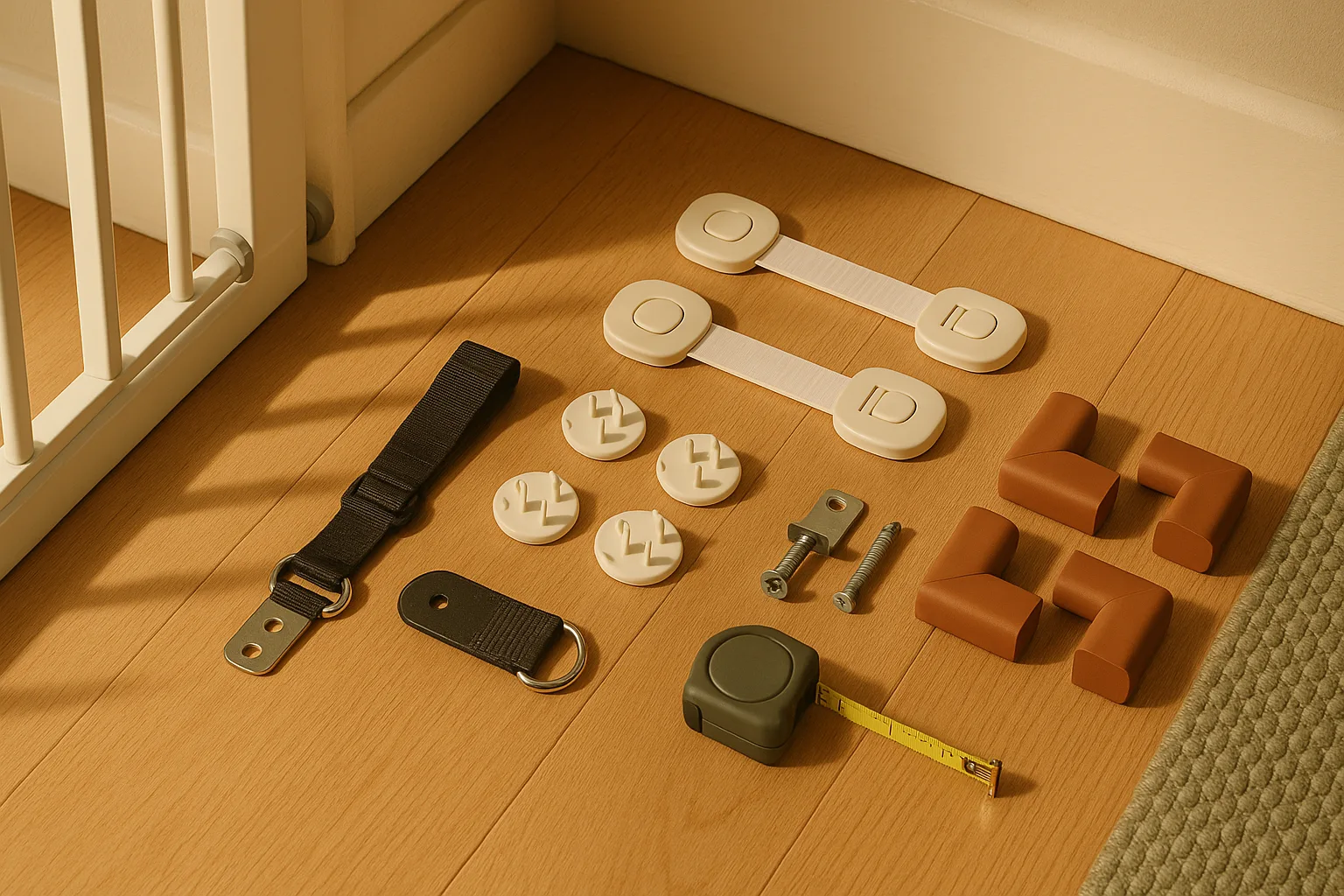
A starter kit covering the three biggest quick-wins — outlet protection, cabinet latches, and corner cushioning — runs about $25 to $60 in materials. Here's a realistic line-up for what that $25–$60 buys, using HomeAdvisor's childproofing cost guide as the pricing baseline:
- Safety locks and latches: $3–$25 per pack
- Outlet plug covers: $5–$15 per pack
- Door pinch guards: $3–$20 per pack
- Anti-tip furniture anchors: $10–$20 per kit
What's typically bundled: Many big-box baby safety kits (sold by brands like Safety 1st and Summer Infant) combine outlet plugs, cabinet latches, and corner guards in a single box for $20–$45. These bundles are a solid starting point but usually lack magnetic cabinet locks, furniture anchors, or stair gates — you'll buy those separately regardless.
Babyproofing cost breakdown by item
The five categories below drive the bulk of your babyproofing spend. Prices are 2026 US retail estimates based on HomeAdvisor's device price ranges.
Line-item budget:
- Safety gates: $30–$150 per gate (materials); add $50–$100 labor per gate if pro-installed
- Magnetic cabinet locks: $20–$50 per pack of 8–12 (higher-end than basic latches); basic adhesive latches $3–$25 per pack
- Outlet plug covers: $5–$15 per pack
- Anti-tip furniture anchors: $10–$20 per kit (covers 1–2 pieces of furniture)
- Corner and edge guards: $8–$20 per pack
- Door pinch guards: $3–$20 per pack
- Toilet locks: about $15 each
- Door knob covers / door locks: $10–$32 each
The two categories that move the budget most are gates and magnetic cabinet locks. A single hardware-mounted gate for a stair landing can cost $80–$150 in materials, and a kitchen with 10–15 cabinets needs two or three packs of magnetic locks to cover everything. If you hire a handyman for babyproofing products installation, gates and magnetic lock systems are where the labor time concentrates.
Baby gate prices and installation costs
Safety gates run $30 to $150 depending on type, width, and mounting method. The single most important distinction isn't brand — it's whether the gate is pressure-mounted or hardware-mounted.
| Gate Type | Price Range | Best For | Top-of-Stairs Safe? |
|---|---|---|---|
| Pressure-mounted | $30–$80 | Doorways, bottom of stairs | No |
| Hardware-mounted | $60–$150 | Top of stairs, deck openings | Yes |
| Extra-wide (30–48 in.) | $80–$150 | Open floor plans, wide openings | Depends on mount type |
Pressure-mounted gates use tension against door frames or walls — no drilling required, which makes them great for apartments. CPSC's business guidance on gates and enclosures references pressure-mounted hardware specifically, and it's a popular renter solution for doorways and the bottom of a stair run.
Watch Out: Never use a pressure-mounted gate at the top of stairs. A baby leaning against it can pop it free and fall. CPSC has issued recalls on top-of-stair gates with fall hazards — the issue is almost always inadequate mounting. A hardware-mounted gate bolted into wall studs or a stair banister is the only safe call at a stair top.
Hardware-mounted gates require drilling 2–4 holes and anchoring mounting brackets into studs or a solid newel post. This is a 30–45 minute job for a confident DIYer with a stud finder and drill. If you're not sure your fasteners are hitting solid wood, hire a handyman — a gate at the top of a staircase is not the place to hope the drywall anchors hold. Pro installation for a single stair gate typically adds $50–$100 to the materials cost.
Cabinet lock and drawer latch costs
Basic adhesive cabinet latches from brands like Safety 1st or Jool Baby cost $3–$25 per pack and are the fastest DIY install in the category — most use foam adhesive tape and require no tools. The limitation is real: adhesive latches can fail on heavily used cabinets or oily kitchen surfaces if you skip proper surface prep with rubbing alcohol first.
Magnetic cabinet locks are the premium tier. A kit of 8–12 locks typically runs $20–$50 retail (brands like Jool Baby, Vmaisi, and Rev-A-Lock are common at major retailers). You get one magnetic key that unlocks any cabinet in the system — convenient for adults, completely opaque to toddlers. The trade-off: magnetic systems require drilling small holes inside cabinet doors and frames, so they're not ideal if you're renting without permission to drill.
If a handyman installs a full kitchen's worth of magnetic locks (10–15 cabinets), expect to pay $50–$100 in additional labor on top of materials. That labor is usually worth it — alignment matters, and a slightly off magnet catch defeats the whole system.
The CPSC advises that "taking simple precautions like storing medications and cleaners in locked cabinets or high shelves can make a big difference in keeping children safe." That guidance applies to both kitchen cleaning supplies and bathroom medicine cabinets — prioritize those specific cabinets even if you skip others.
Outlet covers, door pinch guards, and corner guards
These three categories are the lowest-cost layer in any babyproofing products setup and the clearest DIY territory.
Quick-scan checklist with per-pack prices:
- Outlet plug covers (plug-in style): $5–$15 per pack of 10–36; push into any standard NEMA 5-15 outlet
- Sliding outlet plate covers: $2–$5 per plate; replaces the existing cover, self-closes when unplugged — better than removable plugs a toddler can pull out
- Tamper-resistant receptacles (TRRs): $3–$8 per outlet (requires replacing the outlet itself — a job for an electrician or confident DIYer comfortable working in an electrical panel). Note: homes built or renovated after 2008 in the US are required by the National Electrical Code to have TRRs in new construction, so check yours before buying plug covers.
- Door pinch guards (foam sleeve style): $3–$20 per pack; slip over the door edge or hinge side to prevent finger-trap injuries
- Corner and edge guards: $8–$20 per pack; foam or rubber; most effective on coffee tables, hearths, and raised tile edges
One honest limitation: outlet plug covers don't address the hazard of an unsecured cord that a toddler can pull, or a loose outlet that arcs. They cover the receptacle hole, nothing else. Likewise, door pinch guards reduce crush injuries but don't keep a toddler from entering a room — door handle locks ($10–$32 each) do that job.
Furniture anchors and TV tip-over prevention
Furniture anchoring is the single highest-priority safety item in this entire guide — not because it's the most expensive, but because the consequences of skipping it are severe and the fix costs under $20 per piece of furniture.
The CPSC's Anchor It! campaign states plainly: "The best way to protect your children from falling furniture is to secure your furniture to the wall with anti-tipover devices like furniture and/or TV anchors." A January 2026 CPSC news release reinforced the message: "Anchoring TVs and furniture is a quick, effective step that can prevent serious injuries and save lives."
Anti-tip furniture anchor kits run $10–$20 each and typically include L-bracket straps, screws, and wall anchors for one to two pieces of furniture. That's roughly $30–$80 to anchor a full nursery's worth of furniture — dresser, bookcase, and changing table.
When to Call a Pro: Hire a handyman for furniture anchoring if: (1) your walls are plaster-over-brick or concrete rather than standard drywall, (2) you can't locate wall studs confidently with a stud finder, or (3) you have more than 6–8 pieces to anchor and want them done right in a single visit. A two-hour handyman job at $75–$100/hour covers most homes thoroughly.
Wall-anchor checklist for every mobile-toddler home:
- [ ] Dresser (especially tall 5- or 6-drawer units)
- [ ] Bookcase (any freestanding shelf taller than 30 inches)
- [ ] Wardrobe or armoire
- [ ] TV on a stand (CPSC notes that even TVs not wall-mounted should be anchored)
- [ ] Filing cabinet
- [ ] Nightstand in toddler's room
Room-by-room babyproofing budget for 2026
HomeAdvisor's room estimates give a practical framework for how costs distribute across a typical home. These are pro-installed ranges; DIY materials-only costs run roughly 40–60% lower.
| Room | Pro-Installed Range | Key Items Driving Cost |
|---|---|---|
| Nursery / bedroom | $150–$250 | Furniture anchors, outlet covers, cord management |
| Kitchen | $200–$300 | Cabinet locks, appliance latches, drawer locks |
| Bathroom | about $150 | Cabinet locks, toilet lock, door lock |
| Stairs | about $100 | Hardware-mounted gate (materials often $60–$150 additional) |
| Pool area | $1,500–$20,000 | Full fencing, gate hardware, alarms |
Priority sequence if you're doing it in phases: stairs and furniture first, then kitchen, bathroom, nursery, living areas. The highest-injury hazards — falls from stairs, tip-overs, chemical poisoning — cluster in the first three categories.
Nursery and bedroom babyproofing costs
Budget $150–$250 for a pro-installed nursery; DIY materials land closer to $60–$130. The cost concentrates in three areas: outlet protection, furniture anchoring, and cord management.
Prioritized install order for a sleep space:
- Anchor the dresser and any tall furniture to the wall — do this before the baby is mobile, ideally before they're born
- Cover all outlets — plug-in covers are fine for a newborn's room; upgrade to sliding plate covers once the baby can pull things out (usually 9–12 months)
- Manage blind and curtain cords — cord wind-ups or cordless window treatments prevent strangulation; this is a zero-cost fix if you tie cords up, or a moderate cost if you replace window treatments
- Install a door knob cover ($10–$32) if the nursery opens to a stair landing or hazardous area
A home safety installation visit that covers just the nursery typically runs $150–$250 including labor and materials, which is reasonable if you combine it with at least one other room to get more value per service call.
Kitchen and bathroom babyproofing costs
The kitchen is the highest-cost standard room at $200–$300 pro-installed, because it has more hardware to secure than anywhere else in the house. The bathroom comes in around $150 and is faster to complete but punches above its weight on hazard severity.
Kitchen hazard priorities: - Cabinet and drawer locks for cleaning supplies, knives, and breakables: $3–$50 in materials depending on latch type - Stove knob covers: $10–$20 per set - Appliance latches (dishwasher, refrigerator): $5–$20 each - Oven door lock: $15–$25
Bathroom hazard priorities: - Cabinet locks for medications and cleaning products — CPSC guidance is specific: "Taking simple precautions like storing medications and cleaners in locked cabinets or high shelves can make a big difference in keeping children safe" - Toilet lock: about $15 (drowning risk for toddlers under 2 is real even in shallow water) - Non-slip bath mat and faucet cover: $10–$30 combined - Door lock or handle cover to restrict access entirely: $10–$32
If you can only afford one room for magnetic cabinet locks, make it the cabinet under the bathroom sink where cleaning products live, or the kitchen cabinet with the drain cleaner and dish pods.
Stair safety costs for townhomes and split-level homes
Stair childproofing runs about $100 for a basic pro-installed single gate — but that estimate works best for a simple doorway-width opening at the bottom of a straight run. Townhomes and split-levels with multiple stair runs, wide landings, or angled openings can need two or three gates and custom-fit hardware, pushing the stair budget to $200–$400.
Decision rule — pressure-mounted vs hardware-mounted:
- Bottom of stairs, doorways, room transitions: Pressure-mounted is acceptable and renter-friendly. Materials: $30–$80.
- Top of stairs, deck openings, any location where a fall is possible if the gate shifts: Hardware-mounted only. Materials: $60–$150. Installation into wall studs or a solid banister post is non-negotiable.
For a standard top-of-stair hardware-mounted gate, a handyman takes 30–60 minutes including locating studs, drilling, and confirming the gate swings and latches securely. At typical handyman rates, that's $50–$100 in labor — budget $150–$250 total for materials plus installation at a stair top. Hiring for this specific job is worth the money because misaligned mounting brackets create a false sense of security that's more dangerous than no gate at all.
When to DIY babyproofing and when to hire a handyman
Most babyproofing is genuinely DIY-accessible. But a handful of tasks are worth paying a handyman service to handle correctly, and the logic is straightforward: the cost of getting those specific jobs wrong is measured in emergency room visits.
DIY vs. Hire decision matrix:
| Task | DIY? | Hire? | Why |
|---|---|---|---|
| Outlet plug covers | ✅ | — | Push-in, no tools |
| Adhesive cabinet latches | ✅ | — | Tape-and-press install |
| Corner guards | ✅ | — | Peel-and-stick |
| Door pinch guards | ✅ | — | Slip-on or adhesive |
| Bottom-of-stair pressure gate | ✅ | Optional | Easy if opening is standard width |
| Magnetic cabinet lock system | ✅ Confident DIYer | ✅ Handyman | Requires drilling, alignment matters |
| Top-of-stair hardware gate | Experienced DIYer only | ✅ Recommended | Stud-finding and secure mounting critical |
| Furniture wall anchoring (multiple pieces) | ✅ Confident DIYer | ✅ If plaster/masonry walls | High-stakes, wall condition matters |
| Pool barrier fencing | — | ✅ Licensed contractor | Permit-required in most jurisdictions |
DIY jobs most parents can handle
Outlet covers, adhesive cabinet latches, corner guards, door pinch guards, and toilet locks are all confident-DIYer territory. You need no special tools beyond a measuring tape and rubbing alcohol for surface prep.
Tools and supplies checklist: - Rubbing alcohol wipes (surface prep for any adhesive product) - Screwdriver (Phillips and flathead) - Stud finder (for any wall-anchor work) - Drill with 3/16-inch bit (for magnetic cabinet locks) - Measuring tape - Pencil
Watch Out: Adhesive cabinet latches fail most often because the surface wasn't cleaned before application. Wipe the inside cabinet face and door with rubbing alcohol, let it dry completely, then press the adhesive and wait 24 hours before testing. Skipping this step is why half the latches you see in real homes are dangling off the cabinet by one corner.
Professional install jobs worth paying for
Three categories clearly justify hiring a pro: hardware-mounted stair gates, multi-piece furniture anchoring, and anything involving custom barriers or non-standard openings.
Pro-Only Jobs: - Top-of-stair gate — must be anchored into studs or a solid newel post; a misaligned install creates a fall hazard - Furniture anchoring in plaster, tile, or masonry walls — standard toggle bolts aren't sufficient; a handyman or contractor knows the right fastener for the wall type - Wide or angled stair openings — may require a custom-width gate or a custom wood barrier; measuring and fitting correctly takes experience - Pool fence and gate hardware — requires permits and inspection in most US jurisdictions; hire a licensed fence contractor
The price logic: a home safety installation visit in the $181–$614 national range typically covers 2–4 hours of skilled labor. If you'd spend your own weekend afternoon second-guessing stud placement and re-drilling a gate bracket three times, the handyman is cheaper — and the gate will be right the first time.
Does pool fencing change the babyproofing budget?
If your home has a pool, pool safety is a completely separate budget line from cabinet locks, outlet covers, and stair gates — and it can dwarf every other babyproofing expense in the house combined.
Cost Snapshot: Pool childproofing: $1,500–$20,000. Standard whole-home childproofing (without pool): $181–$614 pro-installed. The pool barrier alone can cost 5 to 50 times more than everything else.
The $1,500–$20,000 range from HomeAdvisor covers the wide spread between a basic pool alarm system (low end) and a full perimeter fence with self-closing, self-latching gate hardware and an in-ground pool safety net (high end). Most families end up somewhere in the $3,000–$8,000 range for a compliant 4-sided isolation fence around an average residential pool.
Why pool barriers can cost thousands
Pool fencing costs scale with perimeter footage, fence material, and local permit requirements. A standard 4-foot-high aluminum mesh safety fence runs roughly $15–$25 per linear foot installed. A 12-by-24-foot pool has roughly 72 feet of perimeter — that's $1,080–$1,800 in fencing alone, before gate hardware, permits, or a safety net.
Premium pool enclosures, retractable safety nets, and above-ground pool ladder barriers add cost quickly. And in most US jurisdictions, a pool fence requires a permit and a final inspection — so this is not a DIY-and-hope situation. Hire a licensed fence contractor, budget separately from your interior childproofing spend, and check your municipality's specific barrier height and gate latch requirements before purchasing any materials.
How to budget babyproofing for an apartment or a full house
Your home type is the single biggest lever on total babyproofing spend. Here's a practical budget planning matrix for 2026.
| Home Type | Minimum Budget | Mid-Range Budget | Premium Budget |
|---|---|---|---|
| Apartment / condo (1–2 BR) | $40–$75 DIY | $100–$200 DIY | $181–$350 pro-installed |
| Single-family home, no stairs | $100–$200 DIY | $250–$400 DIY | $400–$614 pro-installed |
| Townhome / split-level w/ stairs | $150–$300 DIY | $350–$500 DIY | $500–$800 pro-installed |
| Home with pool (pool fence separate) | Add $1,500+ | Add $3,000–$8,000 | Add up to $20,000 |
Minimum babyproofing plan for renters and apartments
The renter's constraint is simple: you can't drill without permission, and you'll want your security deposit back. Fortunately, most high-frequency babyproofing items don't require drilling.
Renter-safe product list: - Outlet plug covers ($5–$15/pack) — push-in, no tools, fully removable - Adhesive cabinet latches ($3–$25/pack) — remove with dental floss and adhesive remover, usually leave no mark - Pressure-mounted baby gate ($30–$80) — no wall holes; suitable for doorways and bottom of any stair run - Corner and edge foam guards ($8–$20/pack) — peel-and-stick, removable - Door pinch guards ($3–$20/pack) — slip-on foam sleeve, zero installation - Toilet lock (~$15) — clip-on, no drilling
What renters need to plan around: if the apartment has an interior stair (common in duplex apartments and some newer builds), a hardware-mounted gate at the stair top requires permission from the landlord. Ask first — most landlords agree when it's framed as a safety improvement. If they say no, a furniture-mounted gate system (anchored to a freestanding bookcase secured to a baseboard) is an imperfect but functional alternative.
Premium whole-home babyproofing plan for larger homes
A full-coverage whole-home setup for a 3–4 bedroom single-family home with stairs prioritizes every room and uses professional installation for the high-stakes items.
Premium bundle summary: - Nursery/bedrooms (2–3 rooms): Furniture anchors for all tall pieces, outlet covers throughout, cord management, door knob covers — budget $150–$250 per room - Kitchen: Full magnetic cabinet lock system (10–15 cabinets), appliance latches, stove knob covers — budget $200–$300 - Bathrooms (1–2): Cabinet locks, toilet locks, non-slip mats, faucet covers — budget $150 per bathroom - Stairs: Hardware-mounted gate at stair top, pressure-mounted at bottom — budget $100–$250 - Living areas: Coffee table corner guards, TV anchor, additional furniture anchors — budget $50–$100 - Handyman service for gate installation, magnetic lock systems, and furniture anchoring — budget $200–$400 in labor
Total premium estimate (no pool): $900–$1,600 materials and labor for a 3-bedroom home. Add the pool barrier line separately if applicable.
Room-by-room priority sequence for a phased rollout: 1. Stairs (hardware gate at top) — do before baby is mobile 2. Furniture anchoring across all rooms — do before baby is mobile 3. Kitchen cabinet locks and appliance latches — by 6 months 4. Bathrooms — by 6 months 5. Nursery outlet covers and cord management — from day one 6. Living area corner guards and door pinch guards — by 8 months
What babyproofing to do first for a newly mobile baby
Once a baby starts crawling (typically 6–10 months), the priority list changes fast. You have a narrow window between "not moving" and "scaling the furniture." Here's what to tackle in order of actual injury risk:
Priority-ranking checklist:
- Anchor tall furniture and the TV — tip-over injuries are a leading cause of pediatric emergency room visits; this costs $10–$20 per piece of furniture and is the highest-return safety action you can take
- Block stair access — hardware-mounted gate at the top of any stair run
- Cover outlets — fast and cheap; do all rooms, not just the nursery
- Lock cabinets with cleaning products and medications — kitchen and bathroom cabinets first
- Toilet lock — for any home with a toddler under 3
- Corner guards on low tables and hearths — after the above are done
High-priority hazards to fix before low-risk extras
The CPSC is direct about furniture tip-overs and the CPSC's guidance on locked storage for toxic products makes the must-do list clear. Do these before spending time or money on anything decorative.
Must-do safety fixes first: - Furniture wall anchors on every piece taller than 30 inches - Locked storage for medications, cleaning products, dishwasher pods, laundry pods - Hardware-mounted stair gate at stair tops - Outlet protection throughout the home
Nice-to-have accessories (do after the above): - Door pinch guards (convenient, not urgent unless a toddler has already had a finger caught) - Decorative corner bumpers (matching furniture finish) - Smart video monitoring and sensor-based door alerts - Lever door handle covers - Oven door locks (useful, but a supervised kitchen and stove knob covers cover the higher-risk hazard first)
Babyproofing FAQ
How much does it cost to babyproof a house?
A realistic whole-home babyproofing budget for a typical US single-family home in 2026 runs $150–$400 for DIY materials or $181–$614 for professional installation, based on HomeAdvisor's national cost data. The national average for pro-installed childproofing is $387. Apartments and condos come in lower — often $40–$200 depending on how many rooms you're addressing. Homes with pools require a separate pool barrier budget of $1,500–$20,000 that should be planned completely independently from interior childproofing.
How much does professional babyproofing cost?
Professional babyproofing (typically done by a handyman service) runs $181–$614 nationally, with an average of $387. Local markets vary: some handyman services in high-cost metros quote up to $900 for a full-home installation scope. A single-room install (kitchen or nursery) usually runs $150–$300 including labor and materials. The best use of a pro visit is bundling multiple high-stakes installs — stair gates, furniture anchoring, and magnetic cabinet locks — into a single service call so you pay one trip charge and get everything done correctly.
Do you need a hardware-mounted gate at the top of stairs?
Yes. A pressure-mounted gate at the top of stairs is a fall hazard. Pressure-mounted gates resist force from one direction, but a baby pressing forward on the gate at the top of a stair run can push it free of the wall and fall. CPSC's recall history on top-of-stair gates is almost entirely about inadequate mounting. Use a hardware-mounted gate bolted into studs or a solid newel post at every stair top — no exceptions.
Is furniture anchoring really necessary for babyproofing?
Yes, and CPSC has been consistent about this for years. The agency's 2026 public safety messaging states: "Anchoring TVs and furniture is a quick, effective step that can prevent serious injuries and save lives." Anti-tip furniture anchor kits cost $10–$20 each and take about 15 minutes per piece to install. That's among the highest safety-return-on-investment of any item in this guide. Any dresser, bookcase, or wardrobe taller than 30 inches in a room a toddler can access should be anchored — full stop. Look for products bearing the JPMA Certified Seal, which "represents the highest standards in consumer safety testing for juvenile products," when selecting juvenile furniture with built-in anchor hardware.
Does every home need the same babyproofing devices?
No. The right setup depends on your home's specific hazards. A ground-floor apartment without stairs needs no stair gate. A home without a pool skips the $1,500–$20,000 pool barrier budget entirely. Homes built after 2008 already have tamper-resistant receptacles built into the outlets under the National Electrical Code, so basic plug covers may be redundant in newer construction. The priority is matching the protection to the actual hazard — walk each room at crawl level to find what a baby at floor height can reach, pull, or climb.
Sources & References
- HomeAdvisor: Cost to Install Childproofing Devices — Primary source for all 2026 US cost ranges, room-by-room estimates, and device price data
- CPSC: Gates and Enclosures Business Guidance — Regulatory guidance on gate types including pressure-mounted hardware
- CPSC: Evenflo Recalls Top-of-Stair Gates Due to Fall Hazard (2010) — Recall documentation supporting hardware-mounted stair gate requirement
- CPSC: IKEA Pressure-Mounted Safety Gate Recall (2015) — Additional gate recall documentation
- CPSC: AnchorIt.gov Safety Education Center — Furniture and TV tip-over prevention guidance
- CPSC: Anchor It! Video — How to Protect Children from Furniture Tip-Overs — Source for CPSC quote on anti-tip devices
- CPSC: 2026 News Release — Anchor TVs and Furniture Before Super Bowl LX — 2026 CPSC public safety statement on furniture anchoring
- CPSC: Multimedia Safety Guidance — Source for locked cabinet guidance on medications and cleaners
- JPMA: Certification Program 40th Anniversary — Source for JPMA Certified Seal quote
- Angi: Baby Proofing Cost — Tier 2 supporting source for service-cost comparison
Keywords: HomeAdvisor babyproofing cost guide, Angi baby proofing service cost, CPSC, JPMA, pressure-mounted baby gate, hardware-mounted baby gate, magnetic cabinet locks, tamper-resistant receptacles, anti-tip furniture anchors, outlet plug covers, door pinch guards, toilet locks, pool fencing, handyman service