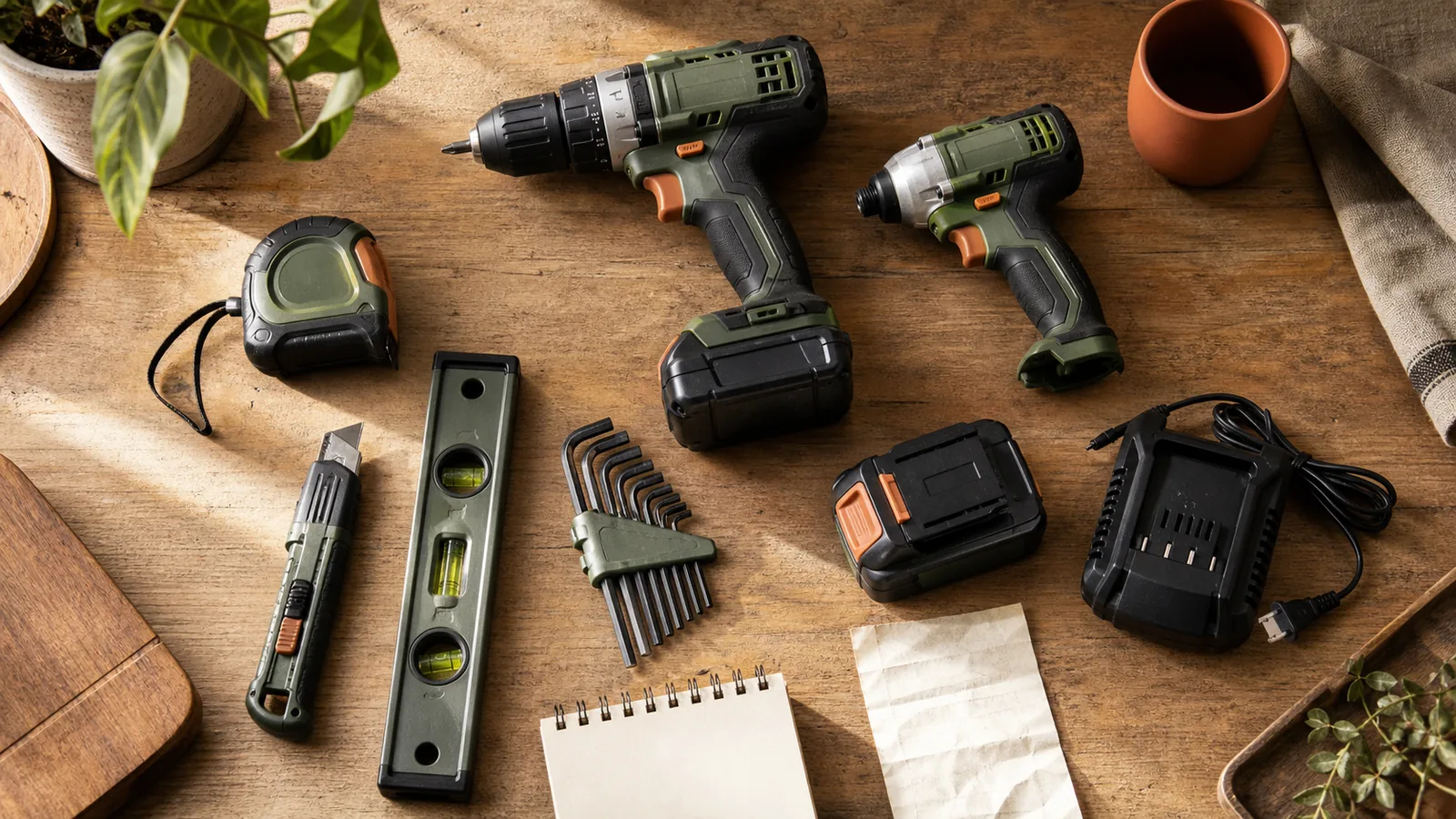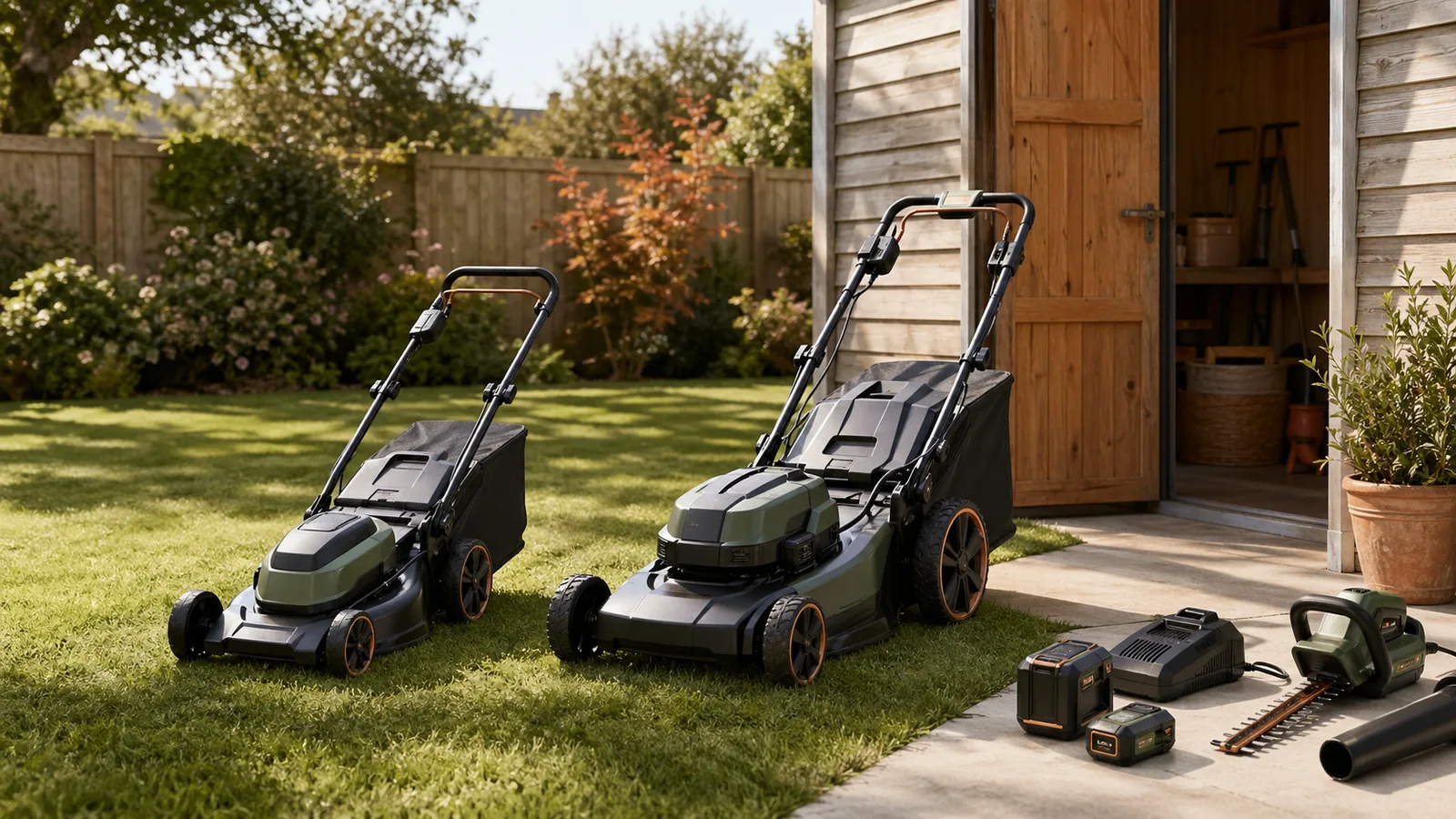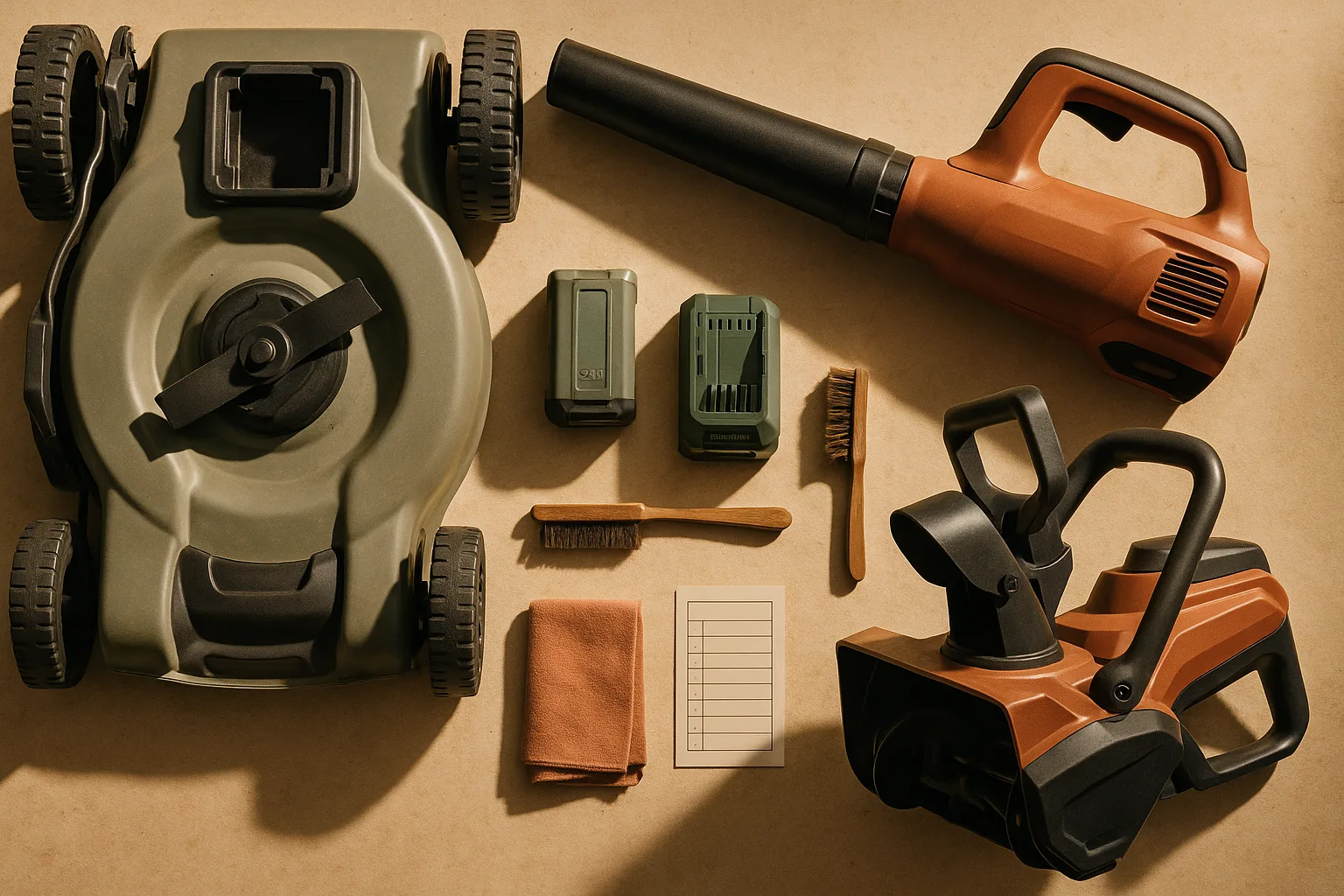
Battery-powered yard tools need a fundamentally different winter routine than gas machines. There's no fuel to stabilize, no carburetor to drain, and no oil to change — but the lithium-ion batteries powering your mower, blower, and snow blower are sensitive to cold, moisture, and neglect in ways that can quietly shorten their lifespan or leave you with a dead pack come spring. Get this right before the first hard freeze and your tools will start reliably in March. Get it wrong and you may be filing a warranty claim before you cut a single blade of grass.
Winter storage checklist for battery lawn mowers, blowers, and snow blowers
Before the temperature drops below freezing, run through these five steps for every battery-powered tool in your garage:
- Clean off all debris — grass clippings, leaves, wet mud, packed snow
- Dry the tool thoroughly — wipe down housing, vents, and any crevices where moisture collects
- Remove the battery from the tool — do not leave packs installed in equipment that sits unattended for months
- Store batteries indoors in a dry, cool location away from freezing temps and humidity
- Bring chargers inside — do not leave charging hardware in an unheated garage or shed
These steps apply whether you own a Greenworks 24V cordless mower, a 60V snow blower, or a 40V backpack blower. Greenworks structures its entire batteries and chargers ecosystem across five voltage families — 24V, 40V, 48V, 60V, and 80V — which means your battery charger accessories are platform-specific, not interchangeable across voltages. Storing and maintaining them correctly matters both for tool performance and for staying within warranty coverage.
Pro Tip: Pull up the Greenworks Customer Support Hub and download the PDF owner's manual for each product you own before winter hits. Greenworks says the hub helps you find manuals, warranty information, product FAQs, how-to, and compatible accessories and parts. Manufacturer temperature and storage guidance varies by platform and model — your manual is the authoritative source.
What to do before the first freeze
Do this the weekend before your area's first expected hard frost — not after. Waiting until after a freeze means batteries may have already experienced a cold-damage cycle.
Step 1: Remove and inspect every battery pack. Pop each pack out of the tool, check the terminals for corrosion or debris, and look for any cracks in the casing. A 40V 5.0Ah Greenworks pack carries no memory loss and virtually no self-discharge in normal conditions, per Greenworks product documentation — but that performance assumes proper storage. Greenworks' 24V 4.0Ah USB battery starter kit identifies the pack as lithium-ion and lists 96Wh Max capacity, a useful reference point for how much energy even a compact mower battery can hold.
Step 2: Check the charge level. Refer to your owner's manual for any platform-specific guidance on winter storage charge. As a general best practice widely used in lithium-ion battery care, storing at a partial charge — rather than fully depleted or fully topped off — reduces stress on the cells during long idle periods. Your manual will tell you whether your specific Greenworks pack has a recommended storage state-of-charge.
Step 3: Clean the tool before it sits. Grass clippings hold moisture. Dried mud cracks housing seals. Leaf debris clogs intake vents. Spend 10 minutes now so you don't spend an hour troubleshooting in April.
Step 4: Dry everything before bringing it indoors. A damp battery in a dry closet will create its own moisture problem. Wipe down all surfaces, leave vents facing down for a few minutes to drain, and let the tool air out in a dry space before final storage.
Where each item should be stored indoors
The right storage location depends on what you're storing.
| Item | Best Location | Acceptable | Avoid |
|---|---|---|---|
| Lithium-ion battery packs | Climate-controlled basement or utility closet | Conditioned interior garage | Unheated garage, shed, or outdoor storage |
| Battery charger accessories | Same indoor space as batteries | Near an interior outlet for spring readiness | Unheated or damp space |
| Mower, blower, snow blower body | Dry garage or shed | Enclosed porch | Exposed to weather, moisture, or flooding risk |
Greenworks states directly on its 60V 4.0Ah battery product page: "To avoid battery temperature issues, batteries should be stored indoors in a dry and cool location." That 60V pack lists 216Wh max power and an on-board LED indicator — a reminder that even a relatively compact pack stores enough energy to deserve indoor care, not a winter of exposure in a cold garage.
The tool bodies themselves — mower deck, blower housing, snow blower frame — can generally stay in a dry garage or shed. They're built for weather exposure. The battery packs and their chargers are not.
How to store a battery lawn mower for winter
Remove the battery, clean the deck, and find covered indoor floor space for the mower body. That's the short version. Here's what each of those steps actually involves.
The lawn mower has more surface area for trapped debris than almost any other yard tool you own. The underside of the deck, the bagger attachment, and the discharge chute all collect compacted clippings that hold moisture against metal surfaces all winter. Battery mowers don't need oil changes or fuel treatment, but the deck maintenance is the same as any mower. Greenworks' 24V 4.0Ah USB battery starter kit is a useful battery example here too: the pack is lithium-ion and rated at 96Wh Max, which is enough capacity to power a compact mower without changing the fact that the battery still needs dry, indoor winter storage.
Good lawn mower storage products — including wall-mount brackets and compact folding storage — can save floor space if your garage is tight. A folded mower with a mounted bracket takes less room than a shovel lying on the ground.
At a Glance: - Time: 30–45 minutes - Cost: $0–$40 (cleaning brush, storage hook or bracket) - Skill: Beginner - Tools: Garden hose or pressure washer, stiff brush, dry rags, scraper
Clean the deck, bagger, and underside before storage
Flip the mower on its side (or use a mower lift if you have one) and scrape the underside of the deck before doing anything else. Dried clippings pack into a thick mat around the blade and discharge area — a stiff brush and a plastic scraper handle this in a few minutes. Do not use a pressure washer directly on the motor housing or battery port; keep water away from electrical components.
Mower cleaning checklist:
- Scrape and brush the underside of the deck, focusing on clippings packed around the blade
- Remove the bagger and shake out all clippings; let it dry completely before storing it
- Clear the discharge chute — a stick or gloved hand works; clippings left in the chute attract pests
- Wipe down the handlebar grips, controls, and battery slot with a dry cloth
- Inspect the blade for nicks or damage — if it needs sharpening or replacement, do it now so the mower is ready in spring
For lawn mower storage products, a simple wall hook rated for your mower's weight (most battery push mowers run 40–70 lbs) keeps the deck off the ground and reduces moisture wicking from concrete floors.
Store lithium-ion mower batteries at a partial charge if the manual allows it
The key word here is "if the manual allows it." Greenworks indicates on its product pages that battery storage temperature guidance is manual-specific, so the instruction for your 40V 4.0Ah pack may differ from the guidance for a 60V pack. Do not assume a single percentage applies across all Greenworks platforms.
What's consistent across lithium-ion battery chemistry generally: storing a fully depleted cell for months causes permanent capacity loss. Lithium-ion cells need a minimum voltage to protect the electrochemical structure inside. A pack that reads zero charge in October and sits until April may never fully recover.
On the other end, storing a fully topped-off battery at elevated temperatures also degrades cells over time. The sweet spot — check your manual for the confirmed target — is somewhere in the middle range of the battery's capacity.
Watch Out: Do not leave a battery on the charger all winter in an attempt to "maintain" it. A standard charger will complete its cycle and stop, but sitting in a warm spot at 100% charge for months is harder on lithium-ion cells than a clean mid-range storage charge. Check whether your Greenworks charger has a maintenance/storage mode before doing this.
Greenworks' battery charger accessories for the 40V platform charge a 2.0Ah pack in 60 minutes and a 4.0Ah pack in 120 minutes, per the 40V charger product page. The page also includes the verified compatibility line, "Universal Compatibility – Works with all Greenworks 40V lithium-ion batteries." That's useful context for spring reactivation planning, but it also means charging to a specific partial level before winter storage only takes an hour or two of supervised time.
Never leave the charger in an unheated garage all winter
Battery charger accessories contain electronics that perform best within a reasonable temperature range. A charger left in an unheated garage or damp shed can pick up condensation when temperatures swing, and that moisture can corrode internal components or circuit boards over time.
The practical rule: wherever you store your battery packs, store the matching charger in the same location. You'll also want the charger accessible when spring comes so you can do a slow warm-up charge before the first mow. A battery charger accessory stored indoors with the packs is immediately ready to use in March; one buried on a frozen garage shelf is not.
How to store a cordless leaf blower for winter
A battery blower is the easiest of the three tools to winterize because it has the fewest parts exposed to debris and moisture. The main risks are packed debris in the intake vents, a damp housing that corrodes terminals, and a battery left installed in freezing conditions.
Most battery blower storage routines take under 15 minutes. The bigger risk is skipping the process entirely — blowers tend to be "set on a shelf and forgotten" tools because they're light and easy to grab.
Blower winterization checklist:
- Remove the battery before doing any cleaning
- Blow out or brush loose debris from the intake vents and around the motor housing
- Wipe down the exterior with a dry cloth
- Inspect the battery port and terminals for debris or corrosion
- Store battery and charger indoors (see storage location table above)
- Hang or shelf the blower body in a dry covered space
Greenworks' support hub lists compatible accessories and parts for its blower lineup — if you've cracked a tube or worn out a nozzle over the season, the Customer Support Hub is the place to order replacements before winter so you're not scrambling in spring.
Remove dust, leaves, and damp debris from intake vents
The intake vents on a battery blower are where debris does the most damage during storage. A clogged vent that traps moisture against internal components over a five-month winter can corrode terminals and interfere with motor function by spring.
Vent-cleaning step sequence:
- Hold the blower over a trash can or outside and tap the housing gently to dislodge loose debris
- Use a dry, soft-bristle brush (an old toothbrush works well) to clear the vent grilles
- Do not spray water into the vents — use compressed air if available, or the brush alone
- After cleaning, set the blower with vents facing slightly down for a few minutes to let any residual moisture exit
- Wipe down the nozzle and tube interior with a dry cloth before storing
If leaves got pulled into the intake and you can feel resistance when you manually spin the fan (with the battery removed and the tool off), clear the obstruction before storage. Running a blower with a partially blocked impeller next spring risks overheating on the first use.
Keep blower batteries away from freezing temperatures
This applies to every battery-powered tool in the lineup, but it's worth repeating specifically for blowers because blower batteries are frequently left installed in the tool, which then gets stacked on an unheated garage shelf and forgotten.
As Greenworks states on its 60V battery product page: "To avoid battery temperature issues, batteries should be stored indoors in a dry and cool location." The guidance does not specify a numeric cutoff temperature — your owner's manual for the specific pack is the right reference for that. What's clear is that the packs belong indoors, not in a cold or damp storage area.
Lithium-ion batteries that experience repeated freeze-thaw cycles lose capacity more quickly than packs stored at consistent indoor temperatures. Even if the battery appears functional in spring, cumulative cold exposure reduces the total number of charge cycles the pack delivers over its lifetime — which is the same as saying it becomes a $100–$200 replacement item sooner than it should.
How to winterize a battery snow blower
A battery snow blower gets a different end-of-season checklist than a mower or blower because it handles wet, heavy, freezing material by design — and that same material will cause corrosion, ice bonding, and motor strain if it's left inside the machine after the last plow.
The Greenworks Pro 60V brushless snow blower, for example, clears a 20-inch path, handles snowfalls up to 10 inches deep, and delivers up to 30 minutes of runtime per charge. After a hard winter season, the auger housing, the discharge chute, and the impeller area all accumulate compacted ice, salt residue, and wet debris that must be cleared before the machine goes into storage.
Snow blower storage checklist:
- Clear all snow and ice from the auger, impeller housing, and chute — do not store with ice packed in the machine
- Dry the auger housing and chute surfaces with dry rags; let the machine sit in a dry space for several hours to fully dry before final storage
- Remove the battery and store it indoors per battery guidelines
- Inspect the auger paddles or blades for wear or damage; order replacement parts now if needed for next season
- Wipe down controls and any metal surfaces exposed to salt or road spray
- Store the snow blower body in a dry, covered location — a garage or shed is fine; the battery and charger come inside
Snow blower maintenance at end-of-season for a battery machine is dramatically simpler than for a gas unit — no oil drain, no fuel system to address, no spark plug to pull. The time savings are real, but they don't eliminate the mechanical checklist for the physical machine.
Dry the auger housing, chute, and controls after every use
Ice bonding in the chute is the most common snow blower storage problem. Water from wet snow refreezes inside the discharge chute or auger housing between uses, and over time that ice expands and stresses plastic components or jams the auger.
Moisture-removal checklist for snow blowers:
- After each use (not just end of season): run the blower for 30 seconds on bare pavement or in a dry space to clear snow from the chute and impeller
- After the last use of the season: use a dry rag or shop towel to wipe the interior of the chute, the outer surface of the auger housing, and any metal or plastic where ice has collected
- Check control cables and triggers for ice or debris — wipe these dry and make sure they move freely before storage
- If the machine was used in roads treated with salt or sand, wipe all exposed surfaces with a slightly damp cloth (followed by a dry cloth) to reduce corrosion from salt residue
Storing a snow blower with wet ice inside the chute and then leaving it in an unheated garage for seven months is the fastest way to crack the chute housing or seize the impeller before next season.
Watch Out: Do not use lubricant sprays on auger surfaces before storage unless your owner's manual specifically recommends it. Some spray lubricants attract dust and debris, which can cause problems next season.
Match the battery and charger to the correct Greenworks platform
Battery ecosystem compatibility is where a lot of homeowners make expensive mistakes — especially when a family has multiple Greenworks tools across different acquisition years and voltage tiers.
Greenworks' batteries and chargers collection spans five distinct platforms: 24V, 40V, 48V, 60V, and 80V. These are not interchangeable. The Greenworks 40V charger, for example, carries explicit "Universal Compatibility — Works with all Greenworks 40V lithium-ion batteries" language on the product page. That compatibility claim applies within the 40V family — not across the full product lineup. A 60V pack from your snow blower does not go on a 40V charger.
Why does this matter at winter storage time? Because this is often when people consolidate tools, hand off equipment to a family member, or pull out an older charger from a shelf and assume it will work. Using a mismatched charger risks improper charging cycles, potential cell damage, and void warranty coverage.
Before you put anything away for winter:
- Label each battery with a piece of tape noting its voltage (24V, 40V, 60V, etc.)
- Store each battery with its correct-platform charger, or in a clearly labeled bin
- If you're unsure about compatibility, check the product page for your specific charger — the Greenworks batteries and chargers collection lists each charger's compatible voltage family
The 60V 4.0Ah Greenworks battery carries 216Wh of energy capacity, per the product page. That's a meaningful amount of stored energy — worth protecting with the correct battery charger accessories and the right storage habits.
How to winterize gas equipment you still own
If you're running a mixed fleet — maybe a battery push mower but a gas-powered zero-turn, or a battery blower alongside a gas snow blower — the gas equipment needs its own separate checklist. The battery tools and gas tools have almost nothing in common when it comes to winter prep.
Watch Out: Always follow the engine or equipment manufacturer's specific winterization instructions for your gas machine. The guidance below is presented only as manual-dependent examples for non-verified gas equipment, and your engine maker's manual supersedes general advice.
Add fuel stabilizer and run the engine if the manual recommends it
Gasoline left in a carburetor for months degrades, forms varnish deposits, and is the single most common cause of no-start conditions in spring. The two common manual-dependent approaches are:
Option A — Fuel stabilization: 1. Add a fuel stabilizer (brands like STA-BIL are widely available at hardware stores and home centers) to a full tank of fresh gasoline, following the product's mixing ratio 2. Run the engine for several minutes so the stabilized fuel works through the carburetor and fuel lines 3. Store the machine with this treated fuel in the tank
Option B — Run the carburetor dry: 1. Turn off the fuel valve (if your machine has one) or run the engine until it stops from fuel starvation 2. This empties the carburetor bowl so no fuel can degrade and gum up the jets over winter
Check your owner's manual to confirm which approach your specific engine requires — some manufacturers explicitly recommend one method over the other, and some prohibit running the carburetor dry because it can damage certain fuel system components. Do not guess.
Check oil, spark plug, and air filter before spring use
Gas equipment spring-startup checklist:
- Oil: Check the dipstick before the first start. If you didn't change the oil at end of season, do it now before running the engine. Old oil contaminated with combustion byproducts from the last season breaks down faster under load.
- Spark plug: Pull the plug, inspect for fouling or electrode wear, and replace if it looks worn. A new plug is a few dollars and eliminates a common hard-start cause.
- Air filter: A clogged air filter causes rich running, hard starting, and power loss. Remove, inspect, and clean or replace per the manufacturer's recommendation.
- Fuel: If you stored with untreated fuel and it's been more than 30 days, drain and replace with fresh gas before starting.
- Blade or auger inspection: Check for damage before the first use of the season — never start a mower or snow blower with a bent or cracked blade and assume it will be fine.
What not to do when storing yard tools for winter
A few bad habits shorten battery life, cause spring-start failures, and void warranty coverage. These come up every year.
Do not store wet equipment or batteries in damp areas
An unheated garage in a humid climate is not a safe battery storage location. Neither is a garden shed with a leaking roof, a basement corner that floods, or a storage unit with condensation problems.
| Location | Batteries | Chargers | Tool Bodies |
|---|---|---|---|
| Climate-controlled basement | ✅ Safe | ✅ Safe | ✅ Safe |
| Dry conditioned garage | ✅ Safe | ✅ Safe | ✅ Safe |
| Unheated garage (dry) | ❌ Risk | ❌ Risk | ✅ Acceptable |
| Shed (dry, no leaks) | ❌ Risk | ❌ Risk | ✅ Acceptable |
| Damp basement or shed | ❌ Unsafe | ❌ Unsafe | ❌ Unsafe |
Greenworks confirms the indoor dry-storage standard on its 60V battery page: "To avoid battery temperature issues, batteries should be stored indoors in a dry and cool location." The tool bodies are designed to tolerate a dry unheated space; the battery packs are not.
Do not rely on a dead battery to survive the off-season
A weak or depleted lithium-ion battery that sits for several months may be harder to recover in spring, and a pack that starts the off-season already struggling is a poor candidate for long storage. Treat that as general battery-care advice, not a guarantee that every weak pack is beyond rescue.
If your battery was showing signs of weakness at the end of the season — reduced runtime, slow startup, the battery indicator dropping faster than usual — do not assume winter storage will fix or preserve it. Check your specific Greenworks manual for storage charge guidance, charge the pack appropriately before putting it away, and check it again midwinter if possible.
If a battery fails to recover in spring, Greenworks provides a Battery Warranty Claim Form for eligible packs. Greenworks also maintains an Authorized Service Center network for hands-on troubleshooting — and if you bring the tool in, bring the battery and charger with you. Greenworks specifically instructs customers: "Please bring the battery(ies) and charger(s) used with your Greenworks product…" when visiting an authorized service center. One important caveat: transportation costs to and from an authorized service location are the customer's responsibility and are not covered under warranty.
Spring reactivation checklist for battery and gas yard tools
The first week of March (or whenever your last frost date passes) is the right time to bring equipment back online — not the morning of your first mow when you have 45 minutes and a foot of dead grass to cut. Greenworks' Customer Support Hub is the place to pull manuals, warranty information, product FAQs, how-to, and compatible accessories and parts before you start troubleshooting after storage.
Battery tools — spring reactivation sequence:
- Retrieve batteries and chargers from indoor storage
- Inspect each battery casing for cracks, swelling, or corrosion at the terminals
- Place the battery on its platform-matched charger and charge fully
- Once charged, check the battery indicator — all indicator lights should illuminate and hold
- Re-install the battery in the tool and do a brief test run before committing to a full session
- Inspect blades, cutting lines, auger paddles, and nozzle attachments for wear or damage
- Check any adjustable settings (cutting height, chute direction, speed) that may have shifted during storage
Gas tools — spring reactivation sequence:
- Check oil level and condition; change if needed
- Inspect and replace the spark plug if needed
- Check or replace the air filter
- Confirm fuel system status (fresh treated fuel or fresh gas, depending on how you stored)
- Start the engine and let it warm up before full load use
Charge and test batteries before the first mow or plow
Do not skip the test-run step. A battery that stored correctly and shows a full charge indicator is probably fine — but a brief 2–3 minute run in a low-demand mode confirms the pack is delivering power normally before you're mid-yard with a dead mower.
For Greenworks 40V users, the 40V standard charger will bring a 2.0Ah pack to full charge in 60 minutes and a 4.0Ah pack in 120 minutes. Build that charging window into your first-use morning so you're not waiting with a half-charged pack. The charger's "Universal Compatibility – Works with all Greenworks 40V lithium-ion batteries" applies within the 40V family — confirm you're using the correct-platform battery charger accessories for each pack.
If a battery charges and tests fine but delivers noticeably reduced runtime compared to last season, that's a sign of cell degradation — not necessarily a failure that prevents use, but a signal to start budgeting for a replacement pack.
Use service centers and warranty claims if a pack fails
If a battery won't accept a charge, won't hold a charge, or shows physical damage after winter storage, don't force it. Take it to a Greenworks Authorized Service Center for evaluation. Per Greenworks' support guidance, bring the battery and charger together — the service center needs both to properly diagnose whether the fault is in the pack or the charging hardware.
For warranty-eligible failures, Greenworks offers a Battery Warranty Claim Form through its support hub. Check your battery's warranty status before assuming a dead pack is just an out-of-pocket replacement. Transportation to and from the service center is not covered under the Greenworks warranty, so factor that into your decision — for a failed 24V pack worth $40–$60, a nearby authorized service center makes more sense than shipping costs that approach the battery's value.
If you're outside warranty coverage and facing a battery replacement, this is also a good moment to evaluate whether upgrading to a higher-capacity pack within the same voltage platform makes sense for your usage pattern.
Sources & References
- Greenworks Tools — Official Site — Manufacturer home page for battery outdoor power equipment, ecosystem overview
- Greenworks Batteries & Chargers Collection — Full lineup across 24V, 40V, 48V, 60V, and 80V platforms
- Greenworks 40V Battery Charger Product Page — Charge times, compatibility specs, and 40V platform notes
- Greenworks 60V 4.0Ah Battery Product Page — Battery specs (216Wh), storage guidance, temperature notes
- Greenworks 24V 4.0Ah USB Battery Starter Kit — 24V platform battery specs and lithium-ion performance notes
- Greenworks G-Max 40V 5.0Ah Battery — 40V high-capacity pack, no memory loss confirmation
- Greenworks Customer Support Hub — Manuals, FAQs, parts finder, and warranty resources
- Greenworks Authorized Service Center Locator — Service center finder, customer responsibility notes on transportation costs
- Greenworks Battery Warranty Claim Form — Battery warranty replacement process
- Greenworks Pro 60V Snow Blower Product Page — Runtime, clearing width, and snowfall depth specs
- Greenworks Snow Blowers Collection — Full battery-powered snow equipment lineup
Keywords: lithium-ion battery, state of charge, Greenworks 24V battery, Greenworks 40V charger, authorized service center, battery warranty replacement form, fuel stabilizer, carburetor, spark plug, oil change, battery-powered lawn mower, cordless leaf blower, battery snow blower, unheated garage