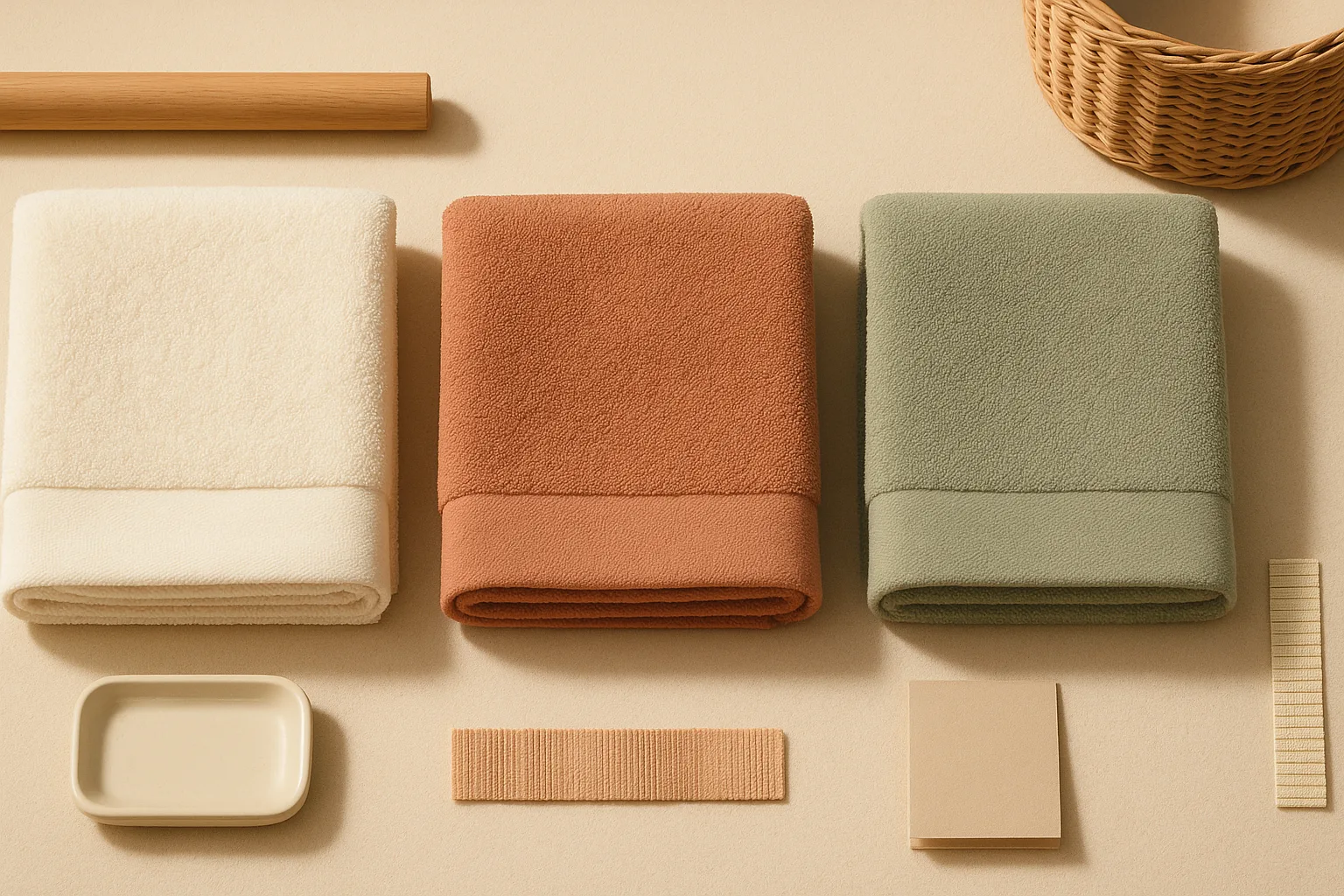
The label on a towel — "Turkish cotton," "Egyptian cotton," "quick-dry" — tells you almost nothing useful on its own. What actually determines whether a towel feels good, dries fast, and holds up after a hundred washes is the construction behind the name: GSM (grams per square meter), loop density, pile height, and fiber quality. Here's how to cut through the marketing and buy a bath towel that works for your real bathroom, your real laundry routine, and your real budget.
How we chose the best everyday bath towels
Choosing between fabric types without a testing framework leads to expensive mistakes. Our comparison is anchored to the same performance dimensions that Consumer Reports uses in its bath towel testing program and that the Good Housekeeping Institute Textiles Lab evaluates in its towel testing, including absorbency, drying speed, softness, durability, and maintenance. Consumer Reports' 2025 bath towel roundup tested popular brands like Brooklinen, Quince, and Target's Casaluna line to identify the softest, most comfortable, and quickest-drying options on the US market — a useful baseline because it prioritizes actual performance over label claims.
Our selection rubric weights the following criteria in order:
- Absorbency and drying speed — how well the towel picks up moisture and how quickly it dries between uses
- Softness out of the package and after repeated washing — because a towel that starts plush but turns scratchy within a few months is a bad value
- Durability and shrinkage — especially relevant for family bathrooms and frequent laundering
- Construction quality — GSM, loop type, and fiber length, which predict long-term performance better than a country name
- Value — performance relative to what you pay, across budget and mid-range bath linens
We also checked the FTC's Textile Fiber Rule, which sets the legal floor for what manufacturers must disclose on labels sold through US retailers including Target, Walmart, Costco, Amazon, and specialty bedding stores. That context matters because it helps you verify which label claims are legally required versus purely promotional.
Turkish cotton vs Egyptian cotton vs quick-dry towels: quick comparison table
Turkish cotton is not inherently better than Egyptian cotton, and neither is automatically better than a well-made quick-dry towel. The right answer depends on how you weigh four factors: how the towel feels against skin, how well it absorbs water in one pass, how quickly it dries hanging in your bathroom, and how much maintenance it needs. If you shop through a bath linens affiliate or a bath towels affiliate, use that same checklist instead of letting the label do the work for you.
Consumer Reports' tested towel set includes both Turkish-cotton and quick-dry style products — specific examples that appear in its coverage include the Brooklinen Super Plush Turkish Cotton Bath Towels and the Tens Towels Soft Bath Towels — which means the comparisons below are grounded in test-backed behavior, not just category generalizations.
| Feature | Turkish Cotton | Egyptian Cotton | Quick-Dry |
|---|---|---|---|
| Typical feel | Lightweight, smooth, gets softer with washing | Thick, plush, hotel-style softness | Waffle or flat-weave; lighter, less fluffy |
| Absorbency | Good; wicks moisture efficiently | High; dense loops hold more water | Moderate; fast-wicking but lower total capacity |
| Drying speed | Faster than Egyptian; dries same-day in most bathrooms | Slowest of the three; dense pile retains moisture | Fastest; designed to dry quickly in ventilated spaces |
| Maintenance | Easy; machine-wash, minimal fuss | Needs more airflow; prone to musty smell if bunched | Easy; low-weight and air-dry friendly |
| Best use case | Everyday family bathroom, gym, humid climates | Guest baths, gifts, spa-feel at home | Gym bag, travel, humid climates, small bathrooms |
The core trade-off is consistent across all bath linens: softness and absorbency correlate with weight and density, and weight and density slow drying. You cannot maximize all three.
Which towel type dries fastest in a real bathroom
Quick-dry towels dry fastest — by design. Their construction uses either a waffle weave, a flatweave, or a low-pile terry that exposes more surface area to air. That structure means less fiber holding trapped moisture between uses. In the Consumer Reports drying-performance framework, that is exactly the kind of construction that tends to score well for faster dry-down in real-world use.
Lightweight Turkish-style towels come in second. Traditional Turkish towels (often called peshtemals) are flat-woven and thin, but most retail "Turkish cotton" bath towels sold in the US are a thicker terry construction — they dry noticeably faster than Egyptian cotton but slower than a dedicated quick-dry weave.
Egyptian cotton towels are the slowest to dry, full stop. Their hallmark — those dense, long-fiber loops packed tightly together — is exactly what makes them feel so plush but also what traps humidity. In a bathroom without good airflow, an Egyptian cotton towel left in a heap can start to smell musty within 24 hours.
Watch Out: Towels that take longer than 24 hours to air-dry between uses will eventually develop a mildew smell that washing does not always fully fix. If your bathroom is small or poorly ventilated, that is a construction problem, not a detergent problem. Consumer Reports' drying performance metric confirms that weight and construction — not just fiber origin — drive how fast a towel actually dries.
If you have a small bathroom, live in a humid climate, or share towels on a tight rotation, prioritize drying speed over plushness. You can always layer on warmth with a robe. You cannot un-mildew a towel that never fully dries.
Which towel type feels the most plush and absorbent
Egyptian cotton towels win on plushness, and it is not a close contest when the construction is right. The combination of long-staple fibers (which are stronger and smoother than short-staple cotton) woven into dense, tall loops creates that thick, hotel-spa feel that many shoppers specifically want when they are buying bath linens as a treat or a gift.
Turkish cotton bath towels — particularly the heavier terry-woven versions — are genuinely soft, and they get softer over repeated washes as the fibers loosen. They absorb well and feel smooth rather than fluffy. Think of the difference between a plush robe and a lightweight one: both keep you warm and dry, but they feel different against skin.
Quick-dry towels feel noticeably different from both. Waffle-weave versions have a pleasant, textured feel but do not drape or wrap like a traditional terry bath towel. They work well and many people come to prefer them, but if you are expecting a traditional plush towel feel, a quick-dry option will be an adjustment.
Consumer Reports' softness and change-in-softness metrics are the most reliable way to compare specific towels within a category — because within "Egyptian cotton" or "Turkish cotton," construction quality varies enough that a cheap version of either can feel worse than a well-made version of the other.
Pro Tip: The softness vs. speed trade-off is real, but it is not a cliff — it is a spectrum. A mid-weight Turkish cotton towel can deliver solid absorbency without feeling sluggish between washes, which is why it often works so well in the middle ground between a spa towel and a true quick-dry design.
Why GSM, loop density, and pile height matter more than country name
Country-of-origin labels — "Egyptian cotton," "Turkish cotton" — are marketing shorthand, not performance specifications. They tell you where the cotton was grown (or where it is claimed to have been grown), but nothing about how it was processed, how tightly the loops were woven, or how heavy the finished towel is per square meter. The FTC's Textile Fiber Rule requires that textiles sold in the US carry labels disclosing generic fiber names, percentages by weight, manufacturer or marketer identity, and country of origin — but that rule does not establish that any origin name alone determines quality.
This is the gap that sends shoppers home with disappointing towels: they buy the one with the most prestigious-sounding label and discover it pills after three washes, turns stiff after six, or feels thinner than a paper towel after a year.
Consumer Reports confirms that it measures towel weight and dimensional properties — width, height, and length — alongside performance scores for drying, softness, and shrinkage. That construction-and-performance combination is what matters. A towel's origin label is, at best, a starting point; the specs behind it are what determine the actual experience.
Here is what to look at instead:
GSM (grams per square meter) is the single most useful number on a towel's product page. It tells you how densely packed the fibers are per unit of area. Higher GSM usually means a heavier, denser, typically more absorbent towel, while lower GSM usually means a lighter, thinner, typically faster-drying towel.
Loop density describes how tightly the terry loops are packed. More loops per inch means more surface area for water absorption — but also more fiber to dry out afterward. A high-loop-density towel feels dense and plush; a lower-density towel feels lighter and breathes faster.
Pile height is the length of those individual loops above the base weave. Taller pile traps more air and moisture, contributing to that cloud-like feel in premium Egyptian cotton towels. Shorter or cut pile (called velour on some towels) dries faster and has a flatter, smoother texture.
Watch Out: "Egyptian cotton" and "Turkish cotton" are marketing descriptors that require a second look. The FTC's textile labeling rules require accurate fiber-content and origin disclosure — but they do not prevent a manufacturer from sourcing inferior cotton grown in Egypt or Turkey and labeling it accordingly. Always check GSM, fiber content percentage, and construction type before you buy.
What GSM is best for everyday bath towels
GSM is useful, but it is not a magic quality score. In real bathrooms, the best number depends on the weave, the loop height, your ventilation, and how often the towel gets washed. A heavier towel feels plusher and usually absorbs more, while a lighter towel tends to dry faster and feel easier to manage day to day.
Pro Tip: If you want a practical everyday towel, start with a mid-weight terry towel that feels balanced in hand rather than chasing the heaviest option on the shelf. For guest baths, choose something that feels substantial; for a tight laundry routine, choose something that gives moisture back to the air quickly.
For a family bathroom where towels are used daily and laundered several times a week, the most practical choice is usually a towel that balances absorbency with dry time so it does not stay damp on the bar.
Humid climates and small bathrooms with limited airflow shift the math toward lighter constructions, where faster drying is more valuable than maximum plushness.
How loop density and pile height affect absorbency and dry time
The way a towel absorbs water — and how quickly it gives that water back to the air — comes down to how its terry loops are constructed, not the geographic origin of the cotton fiber in those loops.
A towel with dense, tall loops has more total fiber surface area in contact with your skin in a single pass. That is why a thick Egyptian-cotton-style bath towel can feel like it absorbs every drop in one motion. But those same dense loops retain moisture because they are tightly packed: air cannot circulate through them efficiently, which slows evaporation after you hang the towel up.
A towel with shorter or less densely packed loops — or a flat/waffle weave with no loop structure at all — absorbs less in a single pass but dries dramatically faster because the structure is more open to airflow. Quick-dry towels are engineered around this principle.
Terry weave is the classic structure for most bath towels: uncut loops on one or both sides of a woven base. Cut-loop terry (velour) gives a softer initial feel and a flatter surface, but the cut fibers can break down faster over many washes. Uncut loop terry is generally more durable for everyday use and holds up better to repeated laundering.
Pro Tip: When comparing two towels at the same GSM, weave and loop structure matter as much as weight. A waffle-weave quick-dry option often dries faster than a terry-loop option because the structure is more open to airflow. GSM tells you weight; construction tells you drying behavior. You need both numbers together.
Best towels for family bathrooms, guest baths, humid climates, and gym use
No single towel type is best for every situation. Consumer Reports' 2025 testing categorizes towels by their strongest dimension — softest, most comfortable, quickest-drying — rather than declaring one type universally superior. That performance-first approach is the right lens for use-case matching. It also pairs well with recommendations from a home goods affiliate or a bath towels affiliate, because the right towel for a family bathroom is not the same as the right towel for a travel kit.
| Use Case | Best Towel Type | Priority Specs |
|---|---|---|
| Family bathroom (daily use) | Mid-weight Turkish cotton or mid-GSM terry | balanced feel, shrink-resistant, softness-stable |
| Guest bath | Egyptian cotton-style or heavier Turkish terry | presentable look, plush pile, easy care |
| Humid climates / small bathrooms | Quick-dry or lightweight Turkish | low weight, open weave, fast air-dry |
| Gym bag / travel | Quick-dry microfiber or flat-weave Turkish peshtemal | lightweight, compact, fast-drying |
| Holiday gift | Egyptian cotton or premium Turkish terry | attractive presentation, softness, easy care |
Best everyday towel for family bathrooms
For a family bathroom that sees multiple users and multiple laundry cycles a week, durability and consistent softness after washing matter more than peak plushness off the shelf. A towel that starts luxurious but turns scratchy after 20 washes is a bad deal at any price.
Consumer Reports explicitly tests shrinkage and change in softness — the two metrics most relevant to long-term feel in a high-use household. When shopping bath towels for a family bathroom, look for towels that perform well on both dimensions, not just initial softness.
Mid-weight Turkish cotton bath towels in a ring-spun construction tend to hold their texture well through repeated laundering because the long, tightly twisted fibers resist pilling and breakdown. Egyptian cotton bath towels can also last well when the construction quality is high, but their dense loops are more vulnerable to matting under heavy, frequent use if not cared for correctly (tumble dry on low, avoid fabric softener, which coats fibers and reduces absorbency over time).
Pro Tip: Avoid fabric softener on any bath towel. It feels like an improvement short-term but coats the cotton fibers with a waxy residue that progressively reduces absorbency. Use white vinegar in the rinse cycle occasionally if your towels feel stiff or start repelling water.
Best towel for guest baths and holiday gifting
For guest baths, the visual and tactile first impression matters as much as drying performance — because guest bath towels might go weeks between uses. A heavier, plush bath towel creates that hotel-quality impression that makes guests notice the care you put into your home.
A practical example is the Brooklinen Super-Plush Bath Towel, which is positioned as a thick, soft option with a clean look that suits a guest bath and comes in coordinated sets for easier gifting. Another straightforward option is the Casaluna Premium Bath Towel, which gives you a simple presentation, soft hand feel, and easy replacement if you want matching towels across a bathroom.
When buying towels as a gift, prioritize two things beyond feel: OEKO-TEX Standard 100 certification and a clean, gift-ready presentation — either a bundled set or a coordinating color range. Sets of two bath towels plus two hand towels make a practical gift that reads as thoughtful rather than utilitarian.
Pro Tip: For holiday gifting, sets with matching hand towels and washcloths from the same line are more practical and feel more complete than mismatched towel bundles. Check that all pieces in the set share the same GSM and weave so they age evenly together.
Best towel for humid climates and small bathrooms
If your bathroom lacks a window, runs a humidity level that fogs the mirror for 30 minutes after a shower, or simply doesn't have enough towel bar space to spread a bath towel flat, slow-drying towels are a recurring problem. A towel that stays damp becomes a towel that smells.
The fix is construction, not brand: choose a quick-dry waffle-weave towel or a lightweight flat-weave Turkish peshtemal. Both have open structures that allow air to circulate through the weave and pull moisture out quickly once hung flat. Consumer Reports' drying performance tests confirm that construction and weight determine drying behavior — a lighter, more open weave dries faster regardless of what country the cotton came from.
When to Choose Quick-Dry: If your towel smells musty by day two, you need a faster-drying construction — not a different detergent. Switch to a waffle-weave or flat-weave option, hang it fully extended on a bar (not a hook), and wash it every two to three uses.
Maintenance tips for humid spaces:
- Hang towels fully open on a bar, not folded on a hook
- Run the exhaust fan for at least 15 minutes after every shower
- Wash towels every 2–3 uses rather than waiting for a weekly laundry day
- Avoid overloading the dryer — towels need airflow to dry evenly
Best towel for gym bags and travel
Quick-dry towels earn their place in a gym bag or carry-on. A full-size Egyptian cotton bath towel packed into a gym bag would weigh it down, take a full day to dry in a locker room, and take up half the bag's volume. A microfiber quick-dry towel or a flat-weave Turkish peshtemal solves all three problems: they pack small, dry fast, and weigh next to nothing.
Microfiber quick-dry towels are the lightest option and often come in compact roll or fold configurations designed for travel. They absorb well relative to their weight and dry within 30–60 minutes if hung in a ventilated space. The texture is not for everyone — it feels more synthetic than cotton — but the performance for on-the-go use is hard to match.
A flat-weave Turkish peshtemal is the cotton alternative: it folds flat, dries quickly because it has no thick pile to trap moisture, and can double as a beach blanket or poolside wrap. If you want the feel of real cotton in a travel towel, a peshtemal is a practical choice.
Neither option replaces a plush bath towel at home — but outside the home bathroom, function beats feel every time.
How to shop for a towel that stays plush after repeated washes
A towel that loses its softness, matts down, pills, or turns scratchy after a few months is a common complaint — and it is almost always a construction and care issue, not bad luck.
Consumer Reports' bath towel tests explicitly measure change in softness alongside shrinkage, because these two dimensions capture long-term livability better than a single out-of-box feel assessment. A towel's change-in-softness score tells you how well it holds its texture after laundering — which is what you are actually buying when you spend more on a towel.
When evaluating a towel for durability, here is what to check:
- Softness change after washing: This is the most useful long-term durability signal, because a towel that feels good only once is not a good value.
- Shrinkage: A towel that shrinks aggressively can become awkwardly small, harder to wrap with, and more likely to wear unevenly.
- Lint shedding: Heavy lint shedding in the first few washes is normal for new terry towels, but excessive shedding after several washes can signal weak yarn construction that will continue to degrade.
- Loop type: Uncut terry loops hold up better over time than cut-loop (velour) finishes, which are softer initially but more vulnerable to fiber breakdown with heavy use.
Labels and certifications to trust on US retail shelves
US retailers — Target, Walmart, Costco, Amazon, and specialty bedding and home goods stores — are required under the FTC's Textile Fiber Rule to disclose on product labels or product pages: the generic fiber names and their percentages by weight, the manufacturer or marketer identity, and the country of origin. That information is the legally required baseline — check it before you buy.
Beyond those required disclosures, the most useful third-party certification to look for on bath towels sold in the US is OEKO-TEX Standard 100. As OEKO-TEX describes it, "every item bearing the STANDARD 100 label is certified as having passed safety tests for the presence of harmful substances." That means the towel has been independently tested for safety against a defined list of restricted substances.
OEKO-TEX certification is a safety signal, not a quality or plushness guarantee. A certified towel could still have mediocre GSM or weak construction. But it does tell you that what touches your skin every day after a shower has been independently verified to meet a meaningful chemical safety standard — which is more than a marketing label can claim.
Watch Out: "Egyptian cotton" and "Turkish cotton" appear on towels at every price point from discount grocery stores to luxury linen boutiques. The FTC's labeling rules require accurate fiber-content disclosure, but they do not prevent a manufacturer from using low-grade cotton grown in Egypt or Turkey and marketing it under those names. Never let the country name replace your evaluation of GSM, construction, and — ideally — performance test results.
When a low-price towel is still a smart buy
Not every situation calls for a premium towel. A low-price towel makes practical sense when:
- You need a large quantity fast — outfitting a vacation rental, a new apartment, or a gym locker room
- The towels will take heavy abuse and be replaced regularly
- You are buying for children who go through towels at a rate that makes premium pricing feel wasteful
- You want a quick-dry gym towel that lives in a bag and gets washed after every use
The value question is not "is this cheap towel as good as the expensive one?" — it usually isn't. The question is whether the performance gap justifies the price difference for your specific use case. A mid-range towel at a fair price per unit, with solid construction and a good shrinkage score from Consumer Reports testing, will outperform an expensive towel with weak construction every single time.
Best bath towel shopping checklist before you buy
Before you click buy or grab a towel off a store shelf, run through these checks. They take two minutes and will save you from buyer's remorse.
- Fiber content and percentage: Check the FTC-required label. "100% cotton" is clear. "Cotton-rich" means less than 100% — verify the percentage. Blends with polyester dry faster but feel different from pure cotton.
- Country of origin: Required on the label. Cross-check it against the brand's sourcing claims if origin matters to you.
- GSM: Look for it in the product description online or on the hangtag. If it is not listed, that is a yellow flag — quality manufacturers typically publish this spec.
- Weave type: Terry, waffle, flatweave, or velour. Terry is the standard; waffle and flatweave dry faster; velour feels initially soft but may wear faster.
- Towel size: Standard US bath towel runs approximately 27 × 52 inches. A bath sheet — the larger format — runs approximately 35 × 60 inches or larger. Check the exact dimensions; sizes vary significantly by brand.
- Certifications: Look for OEKO-TEX Standard 100 if chemical safety matters to you. Verify against OEKO-TEX's certification database, not just marketing copy.
- Care instructions: Machine-washable is the baseline. Tumble dry low is safest for preserving loop structure. Note whether the manufacturer says to avoid fabric softener (most good cotton towels perform better without it).
- Return policy: For online purchases especially, confirm the return window before you buy a set. Towels are difficult to evaluate from a photo.
Size, weight, and care instructions that matter most
Consumer Reports evaluates each towel's weight, width, height, and length as part of its test protocol — because those physical dimensions affect both usability and how the towel performs in the dryer. A towel that is nominally "standard size" can vary meaningfully in actual dimensions between brands.
When comparing towels side by side on a product page, pull these three columns:
- Actual dimensions (inches): Confirm the towel will wrap around you comfortably and hang on your towel bar without dragging the floor
- Weight (ounces or grams): A heavier towel takes longer to dry and costs more to launder energy-wise; this matters over thousands of wash cycles
- Care: Tumble-dry-low instructions protect loop structure; high heat breaks down fibers faster
For machine-wash care specifically: most quality cotton towels are fine in warm water with a standard detergent. Avoid chlorine bleach on colored towels. Skip fabric softener. Shake the towels out before folding to re-fluff the loops before they set.
What to ignore: country-name marketing without construction details
The FTC states directly: "The Textile Fiber Rule requires that certain textiles sold in the United States carry labels disclosing the generic names and percentages by weight of the constituent fibers in the product, the manufacturer or marketer name, and the country where the product was processed or manufactured." That is what is legally required. Everything else on the packaging — "luxury Egyptian cotton," "premium Turkish spa quality," "cloud-soft," "hotel collection" — is marketing copy with no regulatory standard behind it.
A towel labeled "Egyptian cotton" must come from cotton that was processed in Egypt. It does not have to be long-staple. It does not have to hit a minimum GSM. It does not have to perform at any particular level of softness or durability. The same is true for "Turkish cotton." The origin name is a necessary but wholly insufficient reason to buy.
When you see those labels, treat them as a starting point and then look past them to the construction specs: GSM, weave type, fiber length claims (long-staple vs. standard), and available performance data. A mid-range towel from a brand with published performance results and third-party certification will serve you better than an expensive towel selling you a geography lesson.
Frequently asked questions about bath towels
Are Turkish cotton towels better than Egyptian cotton towels?
Neither is categorically better — they perform differently. Turkish cotton (particularly in lighter terry or flat-weave constructions) dries faster and gets softer with washing, making it a practical everyday choice. Egyptian cotton, when well-made, delivers thicker, plush absorbency and a heavier feel that many people prefer for a spa-like experience. The deciding factor is what you need most: faster drying or maximum plushness. Check GSM and weave type on any specific towel rather than relying on the country name to predict performance.
What GSM is best for bath towels?
For most everyday US bathrooms, a mid-weight towel that balances absorbency, feel, and practical drying time on a towel bar is usually the best bet. If you want the fastest-drying option, go lighter. If you want maximum plushness and your bathroom has good airflow, choose a heavier towel. Avoid towels that do not list GSM at all — reputable manufacturers publish this number.
Why do my bath towels take so long to dry?
Usually it is a combination of dense construction, poor airflow in the bathroom, and being hung folded or on a hook instead of spread on a bar. Fabric softener buildup also reduces absorbency over time and can cause towels to hold moisture rather than release it. If your towels consistently smell musty before the next use, switch to a lighter or more open-weave construction, hang them fully extended, and run your exhaust fan longer after showers.
Are quick-dry towels good for everyday use?
Yes, but with a caveat on feel. Quick-dry towels — waffle-weave or flat-weave constructions — work well for everyday use, particularly in humid climates, small bathrooms, or for people who prefer a lighter, less bulky towel. They do not feel like a classic plush terry bath towel, so if that is your preference, a lightweight Turkish cotton terry is a better everyday compromise: faster-drying than Egyptian cotton but still recognizably a traditional bath towel.
Sources & References
- Consumer Reports – Bath Towels Overview — Testing methodology covering drying performance, dryer energy use, softness, change in softness, shrinkage, and dimensional measurements
- Consumer Reports – Best Bath Towels 2025 — Roundup testing Brooklinen, Quince, Casaluna, and other US-available brands
- Consumer Reports – Brooklinen Super Plush Turkish Cotton Bath Towels Review — Individual product performance data
- Consumer Reports – Tens Towels Soft Bath Towels Review — Individual product performance data
- FTC Textile Fiber Rule — Federal labeling requirements for fiber content, origin, and manufacturer disclosure
- FTC – Calling It Cotton: Labeling and Advertising Cotton Products — Guidance on accurate fiber labeling claims
- FTC – Threading Your Way Through Labeling Requirements Under the Textile and Wool Acts — Comprehensive labeling guidance
- OEKO-TEX STANDARD 100 Overview — Certification standard for harmful substance testing in textiles
Keywords: GSM (grams per square meter), loop density, pile height, ring-spun cotton, long-staple cotton, turkish cotton, egyptian cotton, quick-dry towel, terry weave, bath sheet, bath towel, microfiber, OEKO-TEX Standard 100, Good Housekeeping Institute Textiles Lab, Consumer Reports