A flooded basement is not a humidity problem — it's a water damage event, and the dehumidifier is only one tool in a larger drying system. Grab the right equipment in the right order, and you can salvage flooring, framing, and finishes. Skip steps or undersize the equipment, and you'll still be dealing with mold three weeks from now. Here's exactly what to do and what to buy.
What to do first after a flooded basement before buying a dehumidifier
Before any dehumidifier gets turned on, your first moves in the hour after a basement flood determine whether you're doing cleanup or full-scale water damage restoration. Those are not the same project, and confusing them is the single biggest mistake homeowners make.
Immediate safety checklist:
- Cut the electricity to the basement at the breaker panel before stepping in. Standing water and live circuits are a lethal combination.
- Identify the water source and stop it — shut off the main if a pipe burst, or wait for the municipality if it's a storm event.
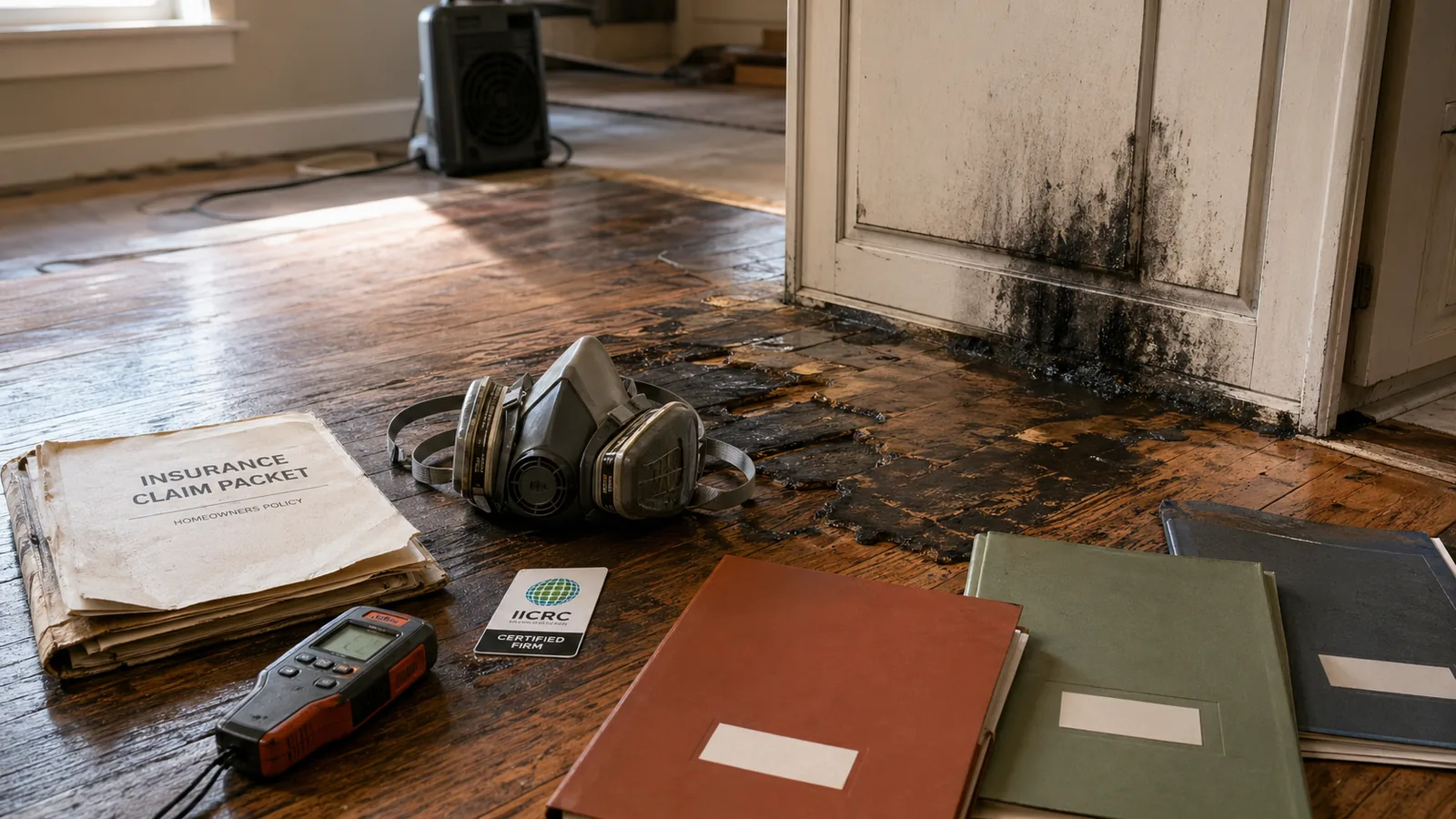
- Photograph everything for your HO-3 homeowners insurance claim before moving or removing anything. Document water lines on walls, wet materials, and damaged contents.
- Call your insurer to open a claim. Standard HO-3 policies typically cover sudden water damage from burst pipes but often exclude gradual seepage and surface flooding (a critical distinction your adjuster will raise on day one).
- Remove standing water first using a wet/dry shop vac or a submersible pump — a dehumidifier cannot pull water off the floor; it only removes moisture from the air.
- Open windows and doors if outdoor humidity is below indoor humidity; close them if it's humid outside.
Watch Out: If your drywall or fiberglass batt insulation is wet, a dehumidifier alone is not enough. Wet drywall absorbs and holds water inside its paper facing and gypsum core; wet insulation traps moisture behind wall cavities where no consumer unit can reach. The IICRC S500 — the ANSI-accredited standard for water damage restoration — explicitly includes "inspections, preliminary determinations, and pre-restoration evaluations" and "structural restoration" in its scope precisely because drying a structure after flooding is a multi-step technical process, not just running a box fan and a dehumidifier.
The line between DIY cleanup and professional water damage restoration runs through the walls. If water wicked up more than a few inches into drywall or soaked insulation, you're on the restoration side of that line.
What size dehumidifier do you need for a wet basement
The right dehumidifier size for a flooded basement depends on three variables: square footage, how saturated the space is, and what your actual goal is. "Prevention" and "post-flood structural drying" require completely different equipment, and most consumer buying guides don't separate them.
Use this sizing matrix before you click "add to cart":
| Basement Size | Saturation Level | Goal | Minimum Capacity |
|---|---|---|---|
| Up to 500 sq ft | Damp smell, no standing water | Prevention / humidity control | 30–50 pint/day |
| 500–1,000 sq ft | Visibly wet floor, dried within 24 hrs | Light cleanup | 50 pint/day |
| 1,000–1,500 sq ft | Wet floor + wet lower walls | Post-flood cleanup | 70 pint/day + air mover |
| Any size | Standing water, soaked drywall, soaked insulation | Structural drying | Pro LGR equipment + multiple air movers |
ENERGY STAR's certified dehumidifier database lists consumer units by removal capacity in pints per day, measured as an Integrated Energy Factor (L/kWh) for efficiency comparison. Those ratings are measured under standard lab conditions — not in a soaking-wet basement at peak saturation. Real-world output in a flooded space, especially in the first 24–48 hours when humidity is near 100%, will be lower than the rated capacity. Size up, not down, when you're recovering from a flood.
Pro Tip: Consumer dehumidifiers are rated for efficiency at 80°F and 60% relative humidity. A soaked basement running at 90%+ relative humidity and cooler temperatures will push even a 70-pint unit close to its limits. When in doubt, rent a second unit for the first week.
50-pint vs 70-pint dehumidifier for basement cleanup
For moderately wet basements — say, a water heater that leaked overnight and you caught it by morning — a 50-pint unit is often workable. For anything involving standing water, a storm event, or a basement larger than 800 square feet with wet surfaces on multiple walls, step up to a 70-pint unit without debate.
| Feature | 50-Pint Class | 70-Pint Class |
|---|---|---|
| Rated removal | 50 pints/day | 70 pints/day |
| Typical coverage | Up to ~1,000 sq ft (damp) | Up to ~1,500 sq ft (damp) |
| Best use case | Prevention, light cleanup | Moderate flooding, ongoing basement humidity |
| Built-in pump | Available on some models | Available on most current models |
| Tank size (typical) | 13–14 pints | 14–15 pints |
| Post-flood flood use | Marginal — often undersized | Minimum starting point |
Consumer Reports' reviewed dehumidifiers in both the 50-pint and 70-pint classes show built-in pump configurations and tank sizes in the 13–15 pint range. That tank capacity matters: a 70-pint unit filling a 14-pint bucket means you're emptying it five times a day in a wet basement if you're not running a continuous drain line. That detail alone should drive your purchase decision.
For prevention — controlling a chronically damp basement that never floods but always smells musty — a quality 50-pint ENERGY STAR-certified unit with a continuous drain connection is entirely appropriate. For active post-flood cleanup, treat 70 pints/day as the floor, not the ceiling.
When you need multiple dehumidifiers or pro-grade drying equipment
One consumer dehumidifier rarely dries a flooded basement by itself, and if the flooding was significant, it may not be enough equipment at all. Here's the honest answer:
A single 70-pint unit covers roughly one large room under ideal conditions. A typical finished basement of 1,200–1,500 square feet, still damp after a multi-inch flooding event, is not ideal conditions. The IICRC's Air Mover and Gallons Calculation Worksheet — the framework that certified restoration technicians use to plan drying — is built around deploying multiple airmovers across the affected area, not a single device in the corner. In small rooms or areas under approximately 25 square feet, one airmover may be adequate, and the worksheet directs technicians to round up fractions so coverage is never short.
Multi-unit rule of thumb for DIY flood cleanup: Run one 70-pint dehumidifier per 500–600 square feet of wet floor area. In a 1,200-square-foot flooded basement, that's two units minimum, plus air movers.
For heavy saturation — any event where water stood for more than a few hours, soaked into framing lumber, or wicked up walls — the appropriate basement drying equipment is an LGR (Low Grain Refrigerant) dehumidifier. LGR units are the workhorses of professional water damage restoration. They're engineered to pull moisture efficiently at lower temperatures and higher saturation levels than consumer refrigerant-cycle units. Restoration companies deploy these by the pallet; you can also rent them from equipment rental companies (United Rentals, Sunbelt, and regional restoration suppliers typically stock them).
The IICRC S500 standard explicitly frames large-scale flood drying as work for "specialized experts" handling "large or catastrophic restoration projects" — not a single household appliance running over a weekend. If your flooding falls in that category, read the pro-vs-DIY section below before buying anything.
How long it takes to dry out a flooded basement
Drying time after a basement flood depends on four factors working together: flood severity, air movement, dehumidification capacity, and whether wall cavities are wet.
| Flood Scenario | Equipment Used | Estimated Drying Time |
|---|---|---|
| Minor seepage, surface moisture only | 1x 70-pint dehumidifier + fans | Varies by conditions; monitor with a moisture meter |
| Moderate flood, wet concrete floor, no wall damage | 1–2x 70-pint dehumidifiers + air movers | Varies by conditions; monitor with a moisture meter |
| Significant flood, wet lower walls (drywall intact) | Multiple dehumidifiers + multiple air movers | Varies by conditions; monitor with a moisture meter |
| Soaked drywall, wet insulation, or wet framing | Pro LGR equipment + wall cavity drying | Varies by conditions; wall removal may be required |
These ranges reflect the complexity restoration professionals work with; your actual timeline will vary based on your basement's construction, ventilation, and the outdoor climate during drying. Cooler, low-humidity outdoor conditions in spring or fall can help accelerate drying if you can bring in fresh air. Hot, humid summer conditions work against you.
Watch Out: The number one reason DIY basement drying fails is stopping too early. A floor that looks dry to the eye and feels dry underfoot can still hold enough moisture in the concrete slab, subfloor, or wall framing to feed mold within days. Rent or buy a pin-type moisture meter and don't declare victory until readings on wood framing are below 16% moisture content and concrete readings are consistently at ambient levels.
The critical variable the drying-time table above can't fully capture is wall cavities. When water wicks up into the bottom of drywall, the paper facing and gypsum hold moisture that airflow at the surface can barely reach. Restoring those areas often requires cutting out the wet drywall from the bottom up — typically the first 2 feet — to expose the wet framing and insulation behind it. Per the IICRC's airmover worksheet, lower-wall drying up to approximately 24 inches is factored into the affected floor area for equipment calculations, and technicians round up fractions so the total coverage does not come up short, which is why restoration crews often cut that line and direct airmovers along the base of the wall.
How air movers speed structural drying
A dehumidifier removes moisture from the air; an air mover makes wet surfaces release moisture into the air. You need both working together, or the dehumidifier is simply not getting enough material to work with.
Here's the mechanism: wet concrete, wood, or drywall releases moisture through evaporation at the surface. Still air at a wet surface quickly reaches local saturation, which slows evaporation to nearly zero. An air mover — a low-profile, high-CFM (cubic feet per minute) fan designed to push air along surfaces rather than across a room — constantly sweeps away that saturated boundary layer and replaces it with drier air, which lets the surface keep evaporating. The dehumidifier then pulls that now-moisture-loaded room air through its coils and deposits the extracted water into the drain.
The IICRC's airmover calculation worksheet is built entirely on this principle: restoration technicians calculate how many airmovers are needed based on the square footage of wet surfaces, rounding up any fraction to ensure full coverage. In small areas under roughly 25 square feet, one airmover may cover the space; larger basements require several, positioned in a daisy-chain or serpentine pattern around the perimeter. The same worksheet also factors in lower-wall drying up to approximately 24 inches, which is why crews often treat the bottom two feet of affected drywall as part of the drying plan rather than ignoring it.
Consumer box fans and tower fans are not the same as restoration-grade air movers. Rental air movers from restoration equipment suppliers (brands like Dri-Eaz and Legend are common in rental fleets) move significantly more air at floor level than a household fan. If you're doing serious post-flood drying, rent at least two to three air movers alongside your dehumidifier.
Pro Tip: Position air movers to blow along the surface of wet walls and floors at a low angle, not straight up into the room. Maximize the contact area between moving air and the wet surface, and let the dehumidifier handle extracting what gets evaporated.
Best dehumidifier features for a flooded basement
Brand and price matter less than getting the right feature set for a flood-cleanup scenario. A $200 unit with the wrong drainage setup will make your cleanup twice as hard.
Feature checklist for flood cleanup:
- Continuous drain or built-in condensate pump (non-negotiable — see below)
- 70-pint or higher capacity for any active flooding situation
- Auto-restart after power outage — basements lose power; you need the unit to resume automatically
- Washable air filter — running a dehumidifier in a wet, debris-filled basement will clog a cheap filter fast
- Top carry handles and caster wheels for moving down basement stairs and repositioning
- Digital humidity readout so you can monitor progress toward stabilization
- Auto-shutoff with full-tank alert as a fallback if the drain line fails
| Verified feature | Why it matters | Example evidence |
|---|---|---|
| Built-in pump | Moves water when gravity drainage is not possible | Consumer Reports lists pump-equipped units such as the GE APEW50LZ and Honeywell DH70PW |
| Drain hose / continuous drain | Supports unattended operation | Lowe's describes continuous drain as letting condensate flow into a low-level drain for worry-free operation |
| Auto-restart | Keeps drying going after outage | Common on reviewed basement units in Consumer Reports |
| Tank size around 13–15 pints | Reduces emptying frequency on bucket-only use | Consumer Reports notes tank sizes in the 13–15 pint range for reviewed 50-pint and 70-pint models |
Water bucket vs continuous drain hose
During active flood cleanup, the bucket is nearly useless as a primary drainage method. A 70-pint dehumidifier with a 14-pint tank fills its bucket roughly five times per day at full extraction — that's an emptying run every 4–5 hours, including overnight. Miss one, and the unit shuts off on full-tank alert and stops drying while you sleep.
Continuous drain via gravity hose: Most dehumidifiers include a standard garden-hose-thread drain port. Run a hose to a floor drain, laundry tub, or sump pit. As Lowe's describes it, a continuous drain connection lets condensate flow into a low-level drain for worry-free operation — the unit never fills a tank and never auto-shuts off for that reason. Some listings also note a front-access collection bucket for manual emptying when a drain hose is not in use.
Built-in condensate pump: If your basement doesn't have a floor drain at a lower elevation than the dehumidifier's drain port, gravity won't move the water. A built-in pump pushes condensate upward and across the room — typically 15–20 vertical feet — to a utility sink, washing machine drain, or even out a basement window. Units like the GE APEW50LZ (50-pint, with built-in pump) and the Honeywell DH70PW (70-pint, with built-in pump) include this feature.
| Drainage Method | Pros | Cons | Best For |
|---|---|---|---|
| Bucket only | No setup | Requires constant emptying; shuts off when full | Spot/occasional use, small spaces |
| Gravity drain hose | Simple, reliable, no pump failure | Needs floor drain lower than unit | Basements with floor drains |
| Built-in pump | Works without a low drain point | Adds mechanical complexity; pump can fail | Basements without accessible floor drains |
Pro Tip: Even if you have a floor drain, run a test pour down the drain before connecting your dehumidifier. A clogged floor drain will back water up onto your already-wet floor.
Noise, portability, and pump features that matter in real homes
A dehumidifier running in a flooded basement is going to run continuously for days or weeks. Noise and mobility matter more than they do for a unit sitting quietly in a finished space.
Portability checklist for basement use:
- Dual top handles: Essential for carrying the unit down basement stairs without dropping it. Look for integrated molded handles, not aftermarket straps. The Honeywell 70-pint units at Lowe's specifically note convenient top handles alongside smooth-gliding caster wheels.
- Caster wheels: Non-negotiable for repositioning around wet debris. Locking casters are a bonus.
- Hose routing: Check where the drain port exits the unit — rear-exit ports are easiest to route cleanly; side exits can create awkward kinks.
- Weight: Most 70-pint units run 30–45 lbs. That's manageable for stair carrying with the bucket emptied, but heavier units become a two-person job.
On noise: consumer basement dehumidifiers run at refrigerator-level noise or slightly above. No manufacturer decibel spec was verified in this review's research, so treat any exact dB claim you see in other articles with skepticism unless it links to the manufacturer's spec sheet. In practice, if you're sleeping directly above the basement, you'll likely hear it — less so if there's a finished floor between you and it.
Consumer dehumidifiers vs LGR mitigation equipment for flood cleanup
This is the gap that most consumer roundups don't address honestly: a home-center dehumidifier and a restoration-grade LGR unit are fundamentally different tools designed for different conditions.
Consumer refrigerant-cycle dehumidifiers (the 50-pint and 70-pint units at Home Depot, Lowe's, and Walmart) are designed for ongoing humidity control in moderately damp spaces. They perform well at typical basement humidity levels of 60–80% relative humidity and at temperatures above 60°F. As basement air approaches 90–100% relative humidity — which is where a flooded basement starts — consumer units become progressively less efficient, and some enter defrost mode, which suspends drying entirely.
LGR (Low Grain Refrigerant) dehumidifiers are engineered specifically to perform at high humidity and lower temperatures. The "low grain" designation refers to the unit's ability to reduce air to a very low grain-per-pound moisture content — meaning they keep pulling moisture efficiently even when the air is nearly saturated. Restoration companies use LGR units because they extract more water per kilowatt-hour under flood conditions than a standard refrigerant-cycle consumer unit can.
The performance gap matters most in the first 72 hours after a flood, when humidity is highest and the structural drying window is most critical. Running underpowered consumer equipment during that window means slower drying, which means a higher mold risk.
| Factor | Consumer Dehumidifier | LGR Restoration Unit |
|---|---|---|
| Typical capacity | 50–70 pints/day (rated) | 100–200+ pints/day (field conditions) |
| Performance at 90%+ RH | Reduced; may enter defrost | Optimized for high-saturation |
| Cost to buy | $200–$400 | $1,200–$2,500+ |
| Cost to rent | N/A (not typically rented) | $80–$150/day from restoration suppliers |
| Best use | Prevention, light cleanup | Post-flood structural drying |
Watch Out: Wet drywall and fiberglass batt insulation are not dehumidifier problems — they're structural restoration problems. Fiberglass insulation holds water for weeks and will not dry in place; it typically needs to be removed and replaced. Wet drywall, especially the bottom courses along a flooded wall, generally needs to be cut out. The IICRC S500 standard treats these as structural restoration tasks requiring "specialized experts" — and for good reason. Leaving wet insulation behind a rebuilt wall is one of the most common sources of recurring mold in post-flood homes.
The IICRC S500 also distinguishes "large or catastrophic restoration projects" from routine cleanup and places them in the realm of "specialized experts", which is why a consumer dehumidifier is not the right answer for every basement flood.
Which basement dehumidifiers are best for prevention, light cleanup, and post-flood drying
Rather than ranking units head-to-head by brand, the most useful frame here is matching the right equipment class to the right situation. What you need for a chronically damp basement is genuinely different from what you need after three inches of standing water.
Best dehumidifiers for prevention in damp basements
A strong prevention pick when the basement is damp but not flooded, because the larger capacity means shorter cycles and less wear on the compressor. The listing highlights top handles, caster wheels, and continuous drain support, which makes unattended use practical.
What to look for: - ENERGY STAR certification (confirms the unit meets efficiency standards for its rated capacity) - Continuous drain port or built-in pump (you want this running unattended) - Digital humidistat with programmable target — set it to a reasonable stabilization setpoint and let it cycle on its own - Auto-restart after power outage
Recommended class: 50-pint with continuous drain. The Honeywell 70-pint TP70WK (available at Lowe's, approximately $260–$280) is a solid choice even for prevention use because the additional capacity means the unit runs shorter cycles to hit your humidity target — which extends compressor life. It includes top handles, caster wheels, and a continuous drain option.
Best dehumidifiers for light cleanup after a small leak
Honeywell DH70PW and Emerson Quiet Kool EAD70EP1
These are the kind of 70-pint consumer units that make sense after a leak that was caught quickly. The Consumer Reports reviews point to built-in pump configurations, and the tank sizes on reviewed units sit in the 13–15 pint range, which is exactly why continuous drainage matters so much.
What to look for: - 70-pint capacity minimum - Built-in pump or continuous drain (mandatory — you'll be running this for 5–10 days straight) - Auto-restart - Washable filter
Recommended class: 70-pint with built-in pump. The Honeywell DH70PW and the Emerson Quiet Kool EAD70EP1 are both reviewed by Consumer Reports in this class with built-in pump configurations. Pair it with two box fans or a rental air mover for the first week, and monitor with a moisture meter until concrete readings plateau. Budget 5–10 days of continuous operation.
Cost Snapshot: 70-pint dehumidifiers with built-in pumps typically run $250–$350 at Lowe's, Home Depot, and online retailers. Add $60–$100/day for air mover rental if you go that route.
Best equipment for major flood recovery and structural drying
After a significant flood — storm water intrusion, a burst main, a backed-up sewer line, or any event that left water standing for more than a few hours — consumer dehumidifiers are a starting point at best and a false sense of progress at worst.
For major flood recovery, the right approach is:
- Rent LGR dehumidifiers from a restoration equipment rental supplier (United Rentals and regional restoration supply companies stock them). Expect to run two or more units for a 1,000+ square foot basement.
- Rent air movers alongside them — typically one airmover per 50–100 square feet of wet floor.
- Cut and remove wet drywall from the bottom 2 feet of affected walls before deploying equipment — you cannot dry what you cannot reach with airflow.
- Remove all wet insulation — it does not dry in place.
Per the IICRC S500, "large or catastrophic restoration projects" fall within the scope of "specialized experts" and "structural restoration" workflows — and that framing exists because the drying science, equipment calculations, and material decisions in a major flood are beyond what a consumer unit and a weekend can solve.
DIY vs Pro: If you're running LGR rentals, air movers, and managing your own moisture readings, you're essentially doing what a restoration crew does — but without their liability insurance, their moisture mapping experience, or their documentation for your insurance adjuster. If your loss is large enough to involve a claim, having an IICRC-aware restoration company do the work creates a documented drying log that supports your claim and your home's resale history.
What a flooded basement drying setup should include besides a dehumidifier
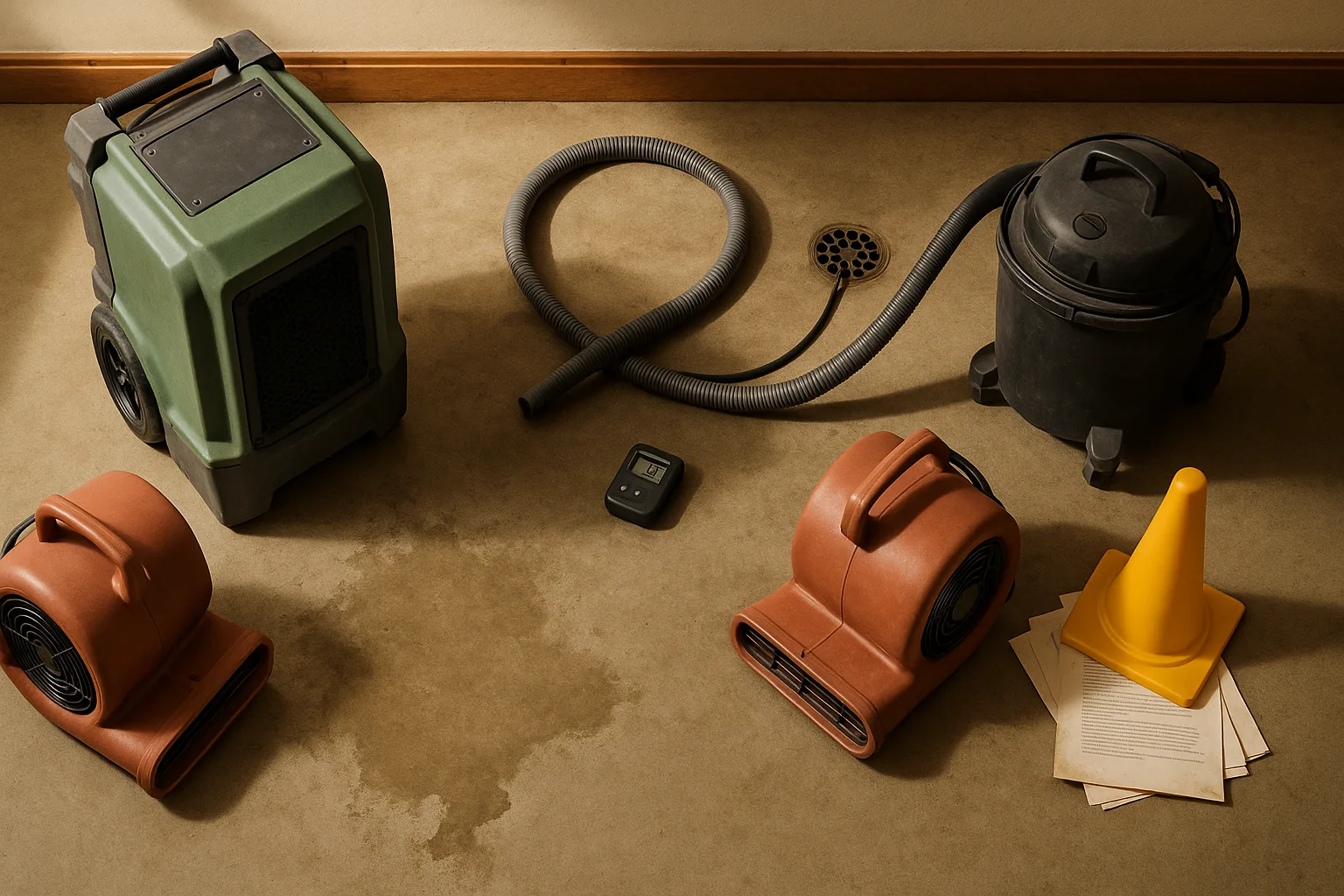
A complete drying setup for a flooded basement requires more than plugging in one machine.
Minimum drying kit:
- Wet/dry shop vac or submersible pump — remove standing water first, before anything else runs
- Air movers — at least two for a typical basement; positioned to blow along floor and wall surfaces at low angles. Per the IICRC's airmover worksheet, lower-wall drying up to approximately 24 inches factors into the total surface area calculation for equipment placement
- Dehumidifier(s) — 70-pint minimum for any active cleanup; multiple units or LGR rental for significant flooding
- Pin-type moisture meter — essential for tracking actual drying progress in wood framing and drywall. Without one, you're guessing
- Personal protective equipment — at minimum, rubber boots, waterproof gloves, and an N95 respirator if there's any possibility of sewage contamination or visible mold
- Heavy-duty contractor bags — for bagging wet insulation, flooring, and unsalvageable materials before removal
- Extension cords rated for the load — use 12-gauge cords for runs over 25 feet and never daisy-chain extension cords
Watch Out: Don't run dehumidifiers and air movers on the same circuit if you're also running a shop vac or sump pump. Tripping a breaker during active drying means equipment sits idle — sometimes for hours — without you knowing. Spread equipment across multiple circuits.
Should you call a water damage restoration company instead of buying a dehumidifier
Call a pro if any of the following is true:
When to Call a Pro: - Water stood for more than 24 hours - Sewage or gray water was involved (health hazard — requires specialized protocols) - Drywall is wet above the baseboard line - You can see or smell mold - The basement is larger than 1,000 sq ft and significantly wet - Your insurance claim is open — a documented restoration log protects your claim - Structural components (floor joists, sill plates, support beams) were submerged
An IICRC-certified restoration contractor brings equipment, training, and documentation that a consumer dehumidifier purchase cannot replicate. The IICRC S500 standard — which covers "inspections, preliminary determinations, pre-restoration evaluations, and structural restoration" — is the technical framework certified restoration pros follow. When interviewing companies, ask whether the crew has current IICRC awareness and a clear moisture mapping process.
Storm events generate a wave of non-certified "storm chasers" offering fast, cheap drying. These operations sometimes use inadequate equipment, skip moisture mapping, and leave homes with hidden wet framing that produces mold months later. Ask for proof of local licensing before signing anything.
Restoration work for a significant basement flood typically runs $3,000–$15,000 or more depending on scope, square footage, and material replacement. If you carry an HO-3 homeowners policy and the flooding stems from a covered peril (like a burst pipe), your insurer's preferred vendor list is a reasonable starting point — though you generally have the right to choose your own contractor.
FAQ about dehumidifiers for flooded basements
What size dehumidifier do I need for a flooded basement?
Start with a 70-pint unit as the absolute minimum for any active post-flood situation. For basements over 1,000 square feet or with wet walls, plan on two 70-pint units working simultaneously, or rent LGR-grade restoration equipment. Consumer 50-pint models are appropriate for prevention and very minor seepage cleanup, but they're typically undersized for anything involving standing water or wet drywall.
How long does it take to dry out a flooded basement with a dehumidifier?
Drying time varies widely with materials, saturation, ventilation, and ambient conditions. Minor seepage with no wall damage may dry in a couple of days under favorable conditions, while more saturated areas can take longer and may require wall material removal. Track actual progress with a moisture meter — visual inspection alone is unreliable.
Can one dehumidifier dry a flooded basement?
For very small spaces (under 500 square feet) with light moisture and no wall damage, one quality 70-pint unit may be sufficient. For anything larger or more saturated, one consumer unit is rarely enough. The IICRC S500 framework for structural drying is built around deploying multiple airmovers and appropriate dehumidification capacity matched to the total affected surface area — not a single household appliance. Plan on multiple units or pro equipment for a meaningful flood event.
Is a dehumidifier enough after basement flooding?
Usually not on its own. A dehumidifier removes moisture from the air, but it needs air movers to push that moisture off wet surfaces. And if drywall, fiberglass insulation, or structural framing is wet, no dehumidifier can reach those materials without physical access — meaning those components typically need to be opened up, removed, or dried with directed airflow before any dehumidifier can do its job. For floods involving standing water or wet walls, a dehumidifier is one part of the drying system, not the whole solution.
Sources & References
- BobVila.com — Best Dehumidifiers for Basements
- IICRC S500 Water Damage Restoration Standard
- IICRC Air Mover and Gallons Calculation Worksheet
- ENERGY STAR Certified Dehumidifiers
- Consumer Reports — GE APEW50LZ Dehumidifier
- Consumer Reports — Honeywell DH70PW Dehumidifier
- Consumer Reports — Emerson Quiet Kool EAD70EP1
- Lowe's — Honeywell 70-Pint 2-Speed Dehumidifier (ENERGY STAR)
Keywords: LGR dehumidifier, air mover, IICRC S500, water damage restoration, ENERGY STAR, continuous drain hose, built-in condensate pump, 50-pint dehumidifier, 70-pint dehumidifier, coverage area (sq ft), relative humidity, structural drying, saturation level, drywall and fiberglass insulation, HO-3 homeowners insurance