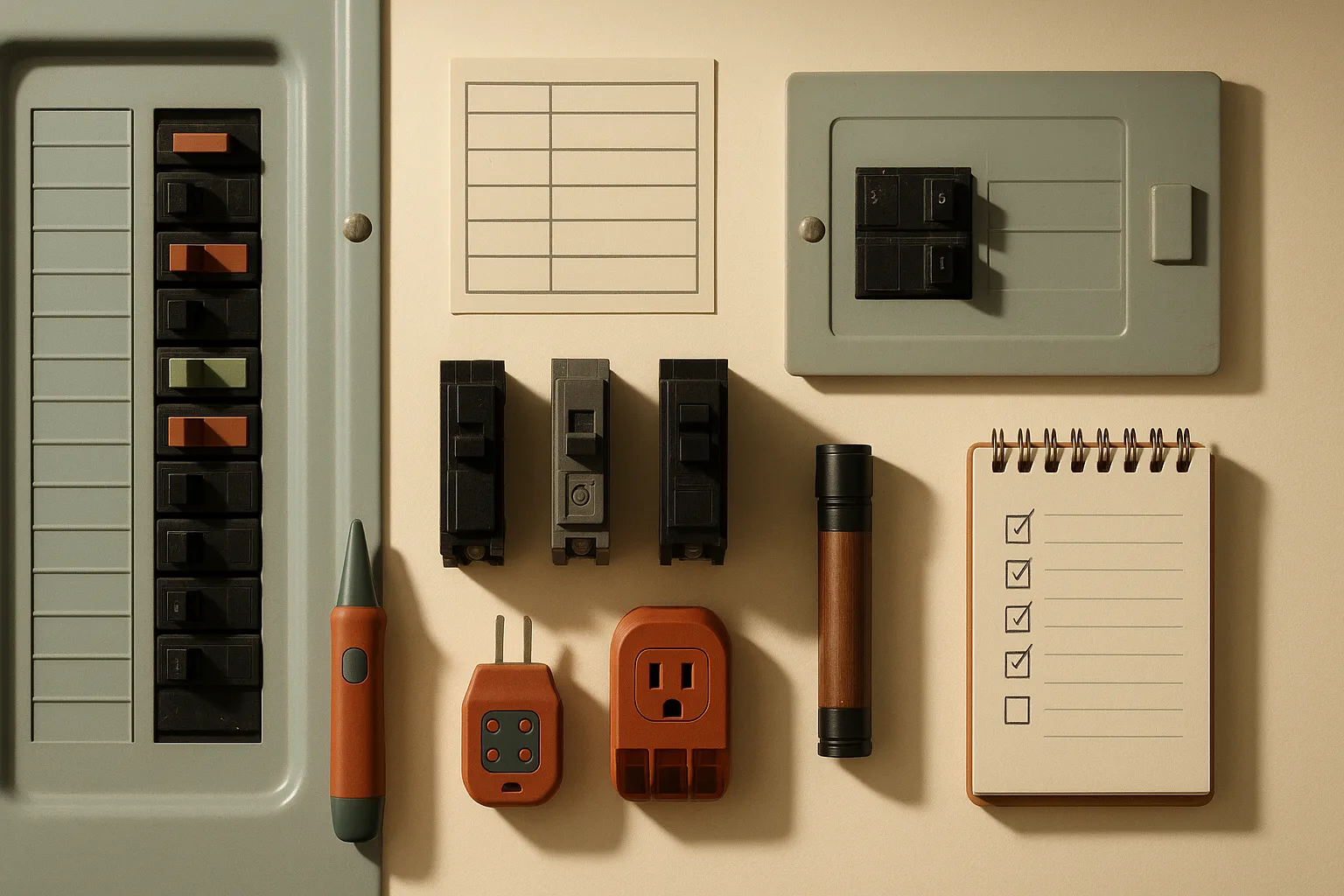
Breaker keeps tripping: quick safety check before you reset it
Before you touch that breaker, spend 60 seconds doing a safety scan. Most tripping breakers are straightforward overloads — too many appliances on one circuit — and you can diagnose the problem in under 20 minutes without any special skills. But some trips are warning signals for something that can start a fire, and the difference matters right now.
First, do this quick scan at the panel:
- Does the breaker feel hot when you touch it? Stop.
- Do you smell burning plastic or a sharp electrical odor near the panel? Stop.
- Are there scorch marks or discoloration around the breaker or panel? Stop.
- Do you hear buzzing, crackling, or popping from the panel or any outlet? Stop.
- Does the breaker trip instantly the moment you reset it, even with nothing plugged in anywhere on that circuit? Stop.
As HomeMD.ai's circuit breaker guide puts it: "Breaker tripping is a safety event, not a nuisance to silence." Any one of those five conditions above points to a short circuit, ground fault, or failing equipment — not an overload. Call a licensed electrician service immediately and do not attempt further resets.
If none of those conditions are present, flip the breaker fully to the OFF position now. Do not reset it yet. That single step — turning it off before you trace the circuit — is what separates safe troubleshooting from accidental shock. The rest of this guide walks you through the next steps.
[Image: Panel safety scan checklist — annotated breaker panel with callouts for hot breakers, scorch marks, and the off position]
Why breakers trip: overload, short circuit, or ground fault
A breaker trips when current through the circuit exceeds its rated capacity. Understanding which of the three causes is behind your trip tells you whether this is a ten-minute fix or a job for a licensed electrical repair service. As EC&M explains citing NEC Article 100: "Overcurrent exists when current exceeds the rating of equipment or the ampacity of a conductor. This can be due to an overload, short circuit, or ground fault."
Here's the plain-English breakdown:
| Cause | What's happening | Typical behavior | DIY or Pro? |
|---|---|---|---|
| Overload | Too many amps drawn from one circuit | Trips during heavy use; resets and holds if loads are removed | Usually DIY-safe to diagnose |
| Short circuit | Hot wire contacts a neutral or another hot | Trips instantly; may cause a pop or spark | Pro only |
| Ground fault | Hot wire contacts a ground or grounded surface | Trips instantly or via GFCI; sometimes a damaged cord or wet outlet | Pro only in most cases |
The breaker exists to interrupt the circuit before wires overheat. It is a protective device that did exactly its job — which is why repeatedly resetting without diagnosing the cause is the wrong move.
Overloaded circuit symptoms homeowners can usually fix
An overloaded circuit behaves predictably: the breaker holds fine when you turn on the lights, but trips 10–20 minutes after you run a space heater and a hair dryer at the same time in the same area of the house. That delay matters — the heat inside the breaker builds up slowly under an overload, and thermal-magnetic breakers need time to respond proportionally to the current excess.
High-draw appliances that commonly push a circuit over the limit include:
- Space heaters (typically 1,500 watts on a 15-amp circuit draws 12.5 amps — already 83% of circuit capacity alone)
- Portable AC units (typically 900–1,500 watts)
- Microwaves (typically 1,000–1,500 watts)
- Hair dryers (typically 1,200–1,875 watts)
- Coffee makers (typically 900–1,200 watts)
Run two of those on the same branch circuit and you're past a 15-amp or even a 20-amp limit almost instantly. If your tripping pattern matches "circuit holds fine, then trips when I use the [appliance] in the bedroom / kitchen / bathroom," you're almost certainly looking at an overload, not a wiring fault.
Short circuit and ground fault red flags that are not DIY
HomeMD.ai's guide is direct: "instant trips on reset, a hot breaker, burning smell, scorch marks, or a breaker that trips with nothing plugged in indicate short circuits, ground faults, or failing equipment that require an electrician immediately."
Stop work and call a licensed electrician service if you observe:
- The breaker trips the instant you flip it back to ON
- The breaker trips with every outlet on the circuit unplugged and every light fixture switched off
- You can smell burnt plastic, rubber, or a sharp electrical smell near any outlet, fixture, or the panel itself
- Any outlet cover, switch plate, or the panel itself shows scorch marks, darkening, or melted plastic
- You hear a buzzing, crackling, or sizzling sound from inside the wall, at an outlet, or at the panel
These are not overload conditions. A short circuit means two conductors that shouldn't touch are touching, dumping current that far exceeds the breaker rating. A ground fault is similar but involves an unintended path to ground. Neither resolves by removing loads — the fault is in the wiring, a device, or the panel itself.
When to Call a Pro: Hot breaker, burning smell, scorch marks, buzzing or crackling from the wall or panel, instant trip on reset, or a trip with nothing on the circuit. These are not DIY conditions. Stop, leave the breaker off, and contact a licensed electrician.
How to find the overloaded circuit in your house
The practical overload test has three moves: identify what went dead, unplug the heaviest loads one at a time, then reset once. This process takes most homeowners 15–20 minutes and tells you whether removing loads solves the problem — or whether something more serious is going on. If you need an electrical repair service after running these steps, you'll also have useful information to share with the electrician.
Turn the breaker off and map every dead outlet and light
With the breaker in the OFF position, walk the affected area and identify every outlet and light that's now dead. Don't guess — confirm with tools.
Step-by-step circuit mapping:
- Grab a plug-in outlet tester (a three-prong device with indicator lights, around $10–$15 at any hardware store). Plug it into every outlet in the room, then in adjacent rooms. Any outlet that shows no response is on your tripped circuit.
- Use a non-contact voltage tester (a pen-style tool, around $15–$25 from Klein Tools or Fluke) to check fixtures and switches without touching conductors. With the breaker off, it should read no voltage at every outlet on that circuit.
- Write down every dead outlet and light fixture on a notepad. This is your circuit map — you'll need it to know what to unplug before the next step.
- Check your panel's circuit directory (the label inside the panel door). A well-labeled panel will tell you which rooms or devices are on each breaker. If yours is blank or wrong, your map from steps 1–3 is your actual reference.
Pro Tip: A Klein Tools NCVT-1 non-contact voltage tester (around $20) or a simple 3-light outlet tester like the Sperry Instruments STK001 (around $12) handles everything you need here. You don't need a multimeter for this job.
Do not touch any wire, terminal, screw, or the breaker lug inside the panel. Your job is outlet-level — plug tester in, read the lights, move on.
Unplug high-draw appliances one at a time and reset once
With your circuit map in hand, unplug devices from every dead outlet in a specific order — highest wattage first.
Unplug in this order:
- Space heaters (priority #1 — highest load, most common culprit)
- Portable AC units
- Hair dryers
- Microwaves (if on the same circuit — less common in newer homes, which typically give kitchens dedicated circuits)
- Coffee makers
- Any other appliances drawing 900 watts or more
Once you've unplugged every high-draw device on that circuit, go back to the panel. Flip the breaker from OFF to the full ON position in one firm motion. (Some breakers require you to push past a middle "tripped" position to OFF first, then back to ON — if it doesn't reset, check that you moved it fully to OFF before trying ON again.)
Now watch it for 60 seconds. If it holds, you've confirmed an overload. Plug devices back in one at a time, waiting a minute between each. The device that causes the trip when added back is your overload culprit.
If the breaker trips again immediately — with everything unplugged and confirmed dead — stop. This is no longer an overload test. Put the breaker back to OFF and call an electrician.
Watch Out: Only reset the breaker once during this test. Repeated resets under a fault condition can overheat the wiring and damage the breaker itself. One reset, observe, then stop if it trips again.
How to tell whether the circuit is overloaded or the breaker is failing
The behavioral split is clear: a circuit that trips under load (appliances running) and holds when loads are removed is an overload. A circuit that trips with nothing plugged in, or trips instantly every time you reset regardless of load, has a different problem — either a wiring fault somewhere in the circuit or a breaker that has degraded and can no longer hold its rated current.
Breakers do fail over time. Most residential breakers are rated for a specific number of trips, and decades of service plus age can cause a breaker to nuisance-trip at well below its rated amperage. A failing breaker is still a pro job — and here's where brand matching becomes critical.
Square D, Eaton, Siemens, and GE breakers are not interchangeable across panels without verification. Each manufacturer makes breakers for specific loadcenter families, and mismatching a breaker to a panel is a code violation and a safety hazard.
Eaton does publish UL-classified replacement options — their Classified Breakers are "rigorously tested and listed by UL. Compatible with loadcenters produced by General Electric, Siemens, Murray, Square D and other manufacturers." Siemens similarly publishes their Type QD breaker as "UL Classified for use in place of Square D Type QO circuit breakers in Square D load centers." But "UL Classified for a specific use" means the electrician must verify that exact compatibility — it is not a blanket green light for any substitution.
The bottom line: if the breaker needs replacement, hand that job to a licensed electrician who will pull the panel label, match the breaker family, and confirm the wire size is appropriate for the new breaker's rating.
What is safe to test yourself versus what is never DIY in the panel
This is the section competing guides skip over. The line between safe homeowner diagnosis and dangerous panel work is not fuzzy — it's a physical boundary: the outside of the panel versus the inside.
A non-contact voltage tester and a plug-in outlet tester are the two tools that keep you on the safe side of that line.
DIY vs Pro: Everything safe for a homeowner happens at the outlet, fixture, or appliance level — outside the panel. Everything inside the panel (replacing breakers, handling wires, touching lugs) is pro-only, requires a permit in most jurisdictions, and can be fatal if done wrong. The two homeowner tools to keep in reach are a non-contact voltage tester and a plug-in outlet tester.
Safe homeowner checks outside the panel
What you can do safely:
- Plug a three-light outlet tester into every outlet on the tripped circuit to identify what's dead and to check for wiring faults at receptacles (reversed polarity, open ground, open neutral — all of which the tester will flag)
- Use a non-contact voltage tester at outlets and fixture bases to confirm dead circuits before working near them
- Unplug appliances and extension cords throughout the affected circuit
- Reset the breaker once after removing loads and observe the result
- Check GFCI outlets (the ones with TEST and RESET buttons, common in bathrooms, kitchens, garages, and outdoor locations) — a tripped GFCI can cut power to multiple downstream outlets and looks identical to a breaker trip from the user's perspective. Press the RESET button on the GFCI receptacle first before assuming the panel breaker is the problem
- Note your panel's circuit directory and photograph it for reference
What you must never do outside the panel:
- Don't pull outlet covers off while the circuit is energized
- Don't touch the wires, screws, or terminals behind an outlet or switch until you've confirmed with a non-contact voltage tester that the circuit is dead
- Don't touch any AFCI (arc fault) or GFCI breakers and treat them as regular breakers without understanding that testing them involves momentary energization
Pro-only work inside the breaker panel
The interior of a breaker panel is always partially energized — even with every individual breaker switched off, the two large service lugs connecting to the utility feed remain live. There is no safe way for an untrained homeowner to de-energize those.
Pro-only panel work includes:
- Replacing a circuit breaker
- Handling, rerouting, or splicing any wire inside the panel
- Installing a new circuit (adding a dedicated circuit for a high-draw appliance)
- Testing or replacing AFCI or GFCI breakers
- Any work that requires touching the bus bars, lugs, or service wires
As Lowe's states clearly: "Replacing an electrical circuit breaker may require a permit, and strict electrical codes must be followed to ensure safe installation."
That permit requirement exists for good reason — unpermitted breaker work can affect your homeowner's insurance coverage and create liability if a fire occurs. A licensed electrician handles the permit, inspection, and installation in one visit. The breaker replacement cost is real, but it's far less than the alternative.
Breaker brands, wire size, and panel label matching matter
Not every breaker fits every panel, and installing the wrong one is both a code violation and a fire risk. Before any replacement, an electrician reads the panel label — the manufacturer's identification plate inside the door that specifies which breaker families are approved for that loadcenter.
The four brands you'll most commonly find in US homes:
- Square D — common series include QO (plug-in, 3/4" wide) and Homeline; not interchangeable between series
- Eaton — common series include BR and CH; Eaton also makes UL-classified replacements for other brands' panels
- Siemens — common series include QP and QD (the QD is specifically UL-classified for Square D QO panels)
- GE — common in older homes; newer GE panels may use ABB/Eaton replacements depending on the series
Wire size must also match breaker size — this isn't optional. Under EC&M's summary of NEC 240.4 and 240.6, conductors must be protected against overcurrent at their rated ampacity, and standard overcurrent devices come in listed sizes rather than custom values. The standard residential pairings:
- 14-gauge wire → 15-amp breaker (NEC 240.4 limits 14 AWG to 15 amps)
- 12-gauge wire → 20-amp breaker (12 AWG supports a 20-amp circuit)
- 10-gauge wire → 30-amp breaker (common for dryers, water heaters)
Replacing a 15-amp breaker with a 20-amp one on a circuit wired with 14-gauge wire does not add capacity — it removes the protection the wire needs and is a code violation. EC&M's NEC 240.6 reference covers the standard OCPD sizes that govern this matching, and the breaker must match the wire, not the appliance you wish the circuit could power.
If your panel or wiring doesn't support the load you need, the answer is a new dedicated circuit — not an upsized breaker.
When to call an electrician for repeated breaker trips
If you've run the overload test sequence above — removed all loads, reset once, and confirmed the breaker holds with nothing on the circuit — you've ruled out a simple overload. Here's when the call to an electrician service stops being optional.
When to Call a Pro: - Breaker trips instantly on reset, even with nothing plugged in - Breaker trips with every outlet on the circuit unplugged and confirmed empty - You notice a hot breaker, burning smell, scorch marks, buzzing, or crackling at any point - The breaker trips again after you've successfully removed the overload and thought it was fixed - The breaker is more than 20–25 years old and starts tripping under loads it previously handled fine - Multiple circuits are tripping at once - You see any visible damage — melted insulation, blackened wire ends, charred outlet boxes
A qualified electrical repair service will use a clamp meter to measure actual load on the circuit, inspect wire terminations inside the panel, test breaker performance, and identify faults in wall wiring — none of which are safe or practical for a homeowner to replicate.
Cost ranges for breaker replacement, dedicated circuits, and panel upgrades
When professional work is needed, here's what to budget. These ranges reflect 2025–2026 US national averages and will vary by region, accessibility, and local permit fees.
Cost Breakdown: - Breaker replacement (single breaker, installed): $150–$300. Standard residential breakers themselves usually cost $5–$50 depending on whether they're standard, AFCI, or GFCI type. - Adding a dedicated circuit (new run from panel to outlet): $300–$800. The price rises if the run requires fishing wire through finished walls, long distances, or attic/crawlspace access. - Panel upgrade or replacement: $800–$4,000 on average for an upgrade, with panel replacement often running $530–$2,100 depending on location, hardware, and required materials. - Total: labor, permit fees, material choice, and service accessibility determine the final bill.
A dedicated circuit is often the right long-term fix if a particular high-draw appliance (space heater, EV charger, window AC, chest freezer) keeps overloading a shared branch circuit. It's a permanent solution rather than a workaround, and many appliance manufacturers actually require a dedicated circuit in their installation instructions.
A full panel upgrade becomes necessary when the system itself is undersized — common in homes built before the 1990s with 100-amp or smaller service — or when the panel brand has known safety issues that make insuring the home difficult.
Tools and parts checklist for a safe breaker trip diagnosis
Gather these before you start. This is the pre-troubleshooting checklist: collect the tools first, then begin at the outlet level. Do not open the panel or touch conductors before you have these items in hand.
- Non-contact voltage tester — Klein Tools NCVT-1 or Fluke 1AC II, around $15–$25. Confirms dead circuits without touching wires.
- Plug-in outlet tester — Sperry Instruments STK001 or similar, around $10–$15. Plugs into any standard outlet and reads wiring status via three lights.
- Flashlight or headlamp — your panel may be in a dim utility room or garage; a headlamp keeps your hands free.
- Notepad and pen — write down every dead outlet and fixture. You will not remember which outlets were on the tripped circuit once power is restored.
- Panel circuit directory — if yours is blank, use this diagnosis as an opportunity to label it properly after the issue is resolved.
What you don't need for this job: a multimeter, wire strippers, a screwdriver (for the panel), or any replacement parts. If the diagnosis leads to a hardware fix, that's the electrician's materials list, not yours.
Breaker keeps tripping FAQs
Why does my breaker keep tripping with nothing plugged in?
A breaker that trips with nothing plugged in — every outlet on that circuit empty, every light switch off — is not an overload. The circuit is being overloaded by something in the wiring itself: a short circuit (two conductors contacting each other somewhere inside the wall), a ground fault (a hot conductor touching a grounded surface or the ground wire), or a failing breaker that can no longer hold its rated amperage. If the breaker trips the moment you push it to ON, leave it OFF and call a licensed electrician.
Can a breaker that keeps tripping be dangerous?
Yes. The tripping is protective; the danger is repeatedly resetting a breaker that is responding to a short circuit or ground fault. That can keep heat in the wiring and damage the breaker. Manage overloads by reducing load, but do not keep resetting a faulted circuit.
What happens if you keep resetting a tripping breaker?
Each reset under an active fault lets the fault current flow again and can heat wire insulation, terminations, and the breaker mechanism itself. One reset after unloading the circuit is reasonable; repeated resets are not troubleshooting and can damage the protection system.
Related reading on electrical safety and home circuit repairs
If this diagnosis led you to a suspected GFCI problem, check your bathroom, kitchen, garage, and exterior outlets for GFCI receptacles with tripped TEST/RESET buttons — a single tripped GFCI can kill power to multiple outlets downstream and is often misidentified as a panel problem.
If your home has AFCI breakers (required by the NEC in living areas, bedrooms, and most habitable rooms in newer construction), those breakers have a TEST button and trip for arc faults as well as overloads — a flickering light or loose outlet connection can trigger them. AFCI trips follow the same triage as standard breakers, but their sensitive arc-detection circuitry means nuisance trips from loose connections are more common.
If your panel is more than 25–30 years old, the outcome of any professional visit for a breaker trip is sometimes a recommendation for full panel evaluation. Understanding what a panel upgrade involves — permits, utility coordination, service size, and main disconnect requirements — helps you have an informed conversation with your electrician rather than making decisions under pressure.
Sources & References
- HomeMD.ai — Circuit Breaker Keeps Tripping Guide — primary diagnostic framework; safety triage, red flags, and overload test sequence
- EC&M — NEC Rules on Overcurrent Protection for Equipment and Conductors — NEC Article 100 definition of overcurrent (overload, short circuit, ground fault)
- EC&M — Article 240: Overcurrent Protection — NEC 240.4 conductor protection and 240.6 standard OCPD sizes
- Eaton — Classified Circuit Breakers — UL-classified cross-compatibility with Square D, Siemens, GE, Murray panels
- Siemens — Type QD Breaker Specification Sheet — UL Classified for use in Square D QO load centers
- Lowe's — Circuit Breakers — permit requirements for breaker replacement
- Angi — Electrical Panel Upgrade Costs — panel upgrade cost range $800–$4,000
- Angi — Circuit Breaker Types and Replacement Costs — panel replacement cost range $530–$2,100
- Angi — How to Install an Electric Car Outlet — dedicated circuit installation reference
Keywords: non-contact voltage tester, plug-in outlet tester, Square D, Eaton, Siemens, GE breaker, NEC 210.19, NEC 240.4, GFCI, AFCI, 12-gauge wire, 15-amp circuit, 20-amp circuit, dedicated circuit, UL Listed