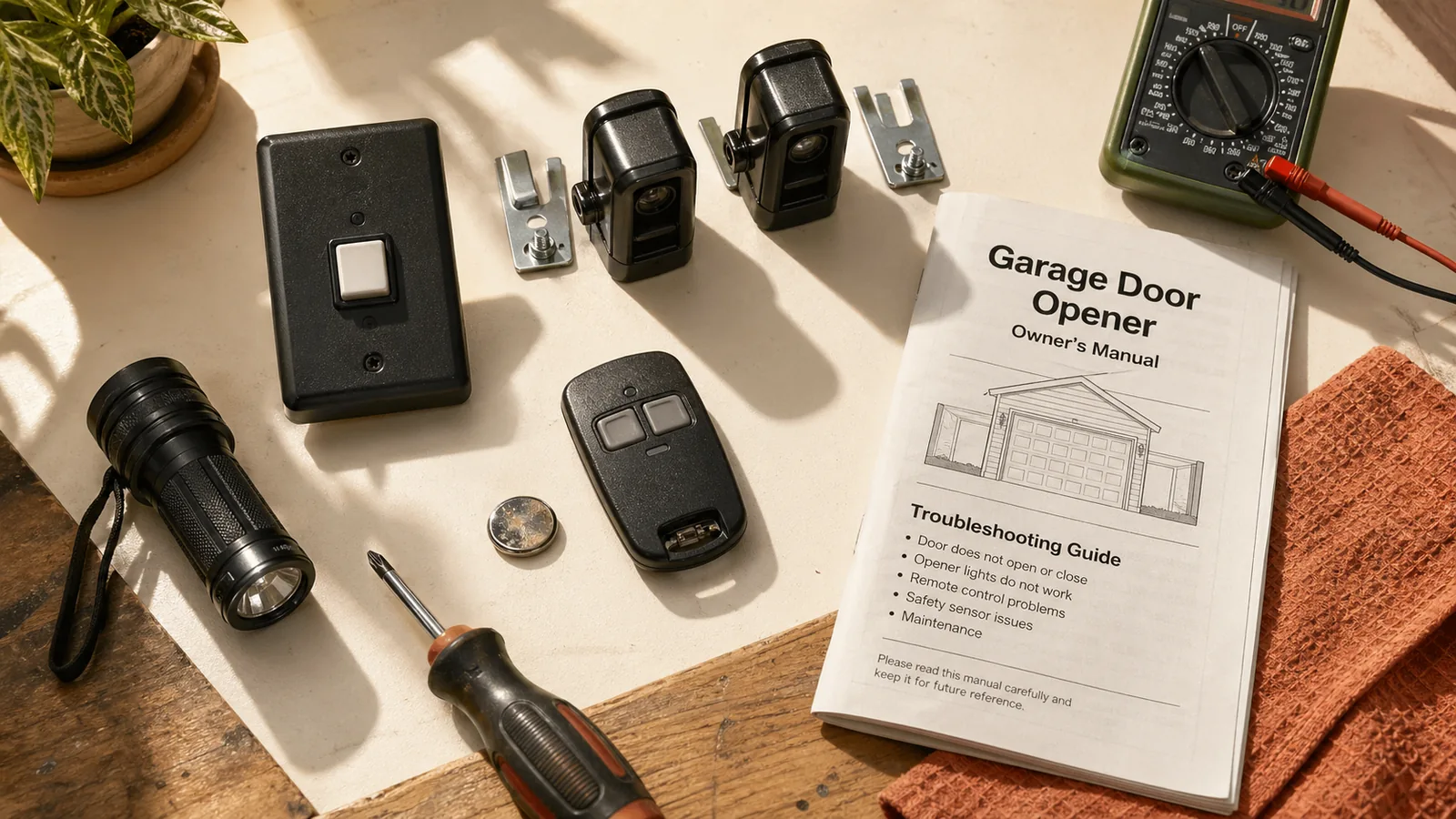
Most garage door opener failures are not a dead motor. A worn-out $3 battery, a dirty sensor lens, a loose wire at the wall button, or a blown circuit board (around $80 to replace) account for the overwhelming majority of service calls — and several of those fixes take under 15 minutes with tools you already own. But before you touch a single part on the opener itself, one test tells you everything.
Garage door opener not working? Start with the manual door test
QuickAnswerBox: Work with the garage door in the down position, unplug the opener, and do not pull the emergency release cord on a raised door if spring failure is suspected.
Pull the red emergency release cord — but only when the door is fully closed and you have confirmed there is no visible cable slack or broken spring hardware. That cord disengages the trolley carriage from the drive rail and lets you operate the door by hand, which is the single most important diagnostic step you can take.
Watch Out: Work with the garage door in the down position before you unplug the opener or pull the emergency release cord. If you suspect a broken spring — door is lopsided, cable is slack, or you heard a loud bang — do not pull the release cord while the door is raised. A door held up only by a damaged spring system can fall suddenly and cause serious injury.
Once the opener is disengaged and unplugged, try lifting the door manually from the bottom. A properly balanced door should glide up smoothly with light hand pressure — roughly 10 pounds of lift or less — and stay in place when you let it go halfway. Per the Family Handyman 2025 troubleshooting guide, if it does not open and close smoothly, the problem is in the door hardware, not the opener.
If the door passes this test and moves easily, you have confirmed the opener is the culprit. Read through the seven ranked checks below. If the door fails, stop reading this article and skip ahead to the red flags section — you need a garage door repair service, not an opener fix.
What the hand test tells you about springs, tracks, and rollers
The manual lift test separates two entirely different repair categories. When the opener is disengaged, the motor, board, sensors, and remote are all removed from the equation. What you feel at that moment is purely the mechanical state of the door: the torsion or extension springs, the rollers riding in the tracks, and the cables connecting the spring system to the bottom corners of the door.
Door Hardware vs. Opener — Decision Callout: - Problem is the opener if: door lifts smoothly by hand, stays balanced at mid-point, and moves without binding or grinding - Problem is door hardware if: door feels heavy or jerky, grinds in the tracks, tilts to one side, falls quickly when released, or won't stay up at all
Specific hardware failure signs to look for before touching the opener: - Torsion spring (horizontal spring above the door) has a visible gap or break in the coil - Extension springs (side springs running along the horizontal track) are stretched, hanging loose, or broken - Tracks are bent, pulled away from the wall, or visibly out of plumb - Cables at the bottom corners are frayed, unwound, or slack on one side - Rollers are cracked, flat, or jumping out of the track
[Image: Side-by-side comparison — healthy torsion spring vs. broken torsion spring with visible gap in coil]
Red flags that mean you should stop DIY immediately
A door that doesn't lift smoothly points to a problem the opener cannot and should not be asked to compensate for. Cranking up the force settings to muscle a stiff door through damaged hardware puts strain on the opener mechanism, risks a door drop, and does not fix anything.
When to Call a Pro: Schedule same-day garage door repair service if any of these are true: - The door feels extremely heavy during the manual lift test (broken torsion or extension spring) - The door falls fast instead of staying up when you release it - You heard a loud bang from the garage, especially overnight (classic sign of a torsion spring snapping) - One side of the door is higher than the other (cable off drum or broken spring on one side) - Track is visibly bent or pulled away from the wall framing - Cables at the bottom brackets are frayed, kinked, or unwound
Torsion spring replacement in particular involves cables under high tension and is not a safe DIY repair for most homeowners. The cost of a professional spring replacement is far lower than the cost of a door-drop injury.
Garage door opener problems ranked by likelihood and risk
If your door passed the hand test, here is the triage sequence that professional technicians — and the Chamberlain support documentation — use to work through opener failures from most to least common. This order also moves from cheapest to most expensive fix, so you're not buying an $80 circuit board when a $3 battery was the answer.
TroubleshootingPriorityList — Ranked by Likelihood:
- Wall switch / wiring — if remote works but button doesn't, or neither works
- Remote battery or programming — if wall button works but remote doesn't
- Safety sensor alignment or obstruction — if door won't close or opener flashes
- Power outlet or breaker — if the unit is completely dead
- Travel / force settings — if door reverses early or won't complete its travel
- Circuit board (logic board) — if dead after a storm or power surge
Trolley carriage or main drive gear — if motor runs but door doesn't move
Main drive gear replacement — if the motor is humming but the door never moves and the opener head is making a slipping sound
Work through this list in order. Most residential garage door opener repair situations resolve at step 1, 2, or 3 — the combined cost of those fixes is under $15.
Bad wall switch or wiring when the remote works but the button does not
When the remote triggers the opener fine but pressing the wall button does nothing, the wall switch circuit is the suspect — not the opener motor or board.
StepCard 1:
- Unplug the opener at the ceiling outlet before touching any wiring.
- Locate the two low-voltage wires connecting the wall button to the opener's terminal strip (usually labeled "push button" or "wall control").
- Remove the wall button cover and check for a loose, corroded, or disconnected wire at the terminal screws. Tighten or reseat any loose connections.
- Plug the opener back in and test the wall button.
- If still dead, temporarily connect the two wires directly together at the opener's terminal strip using a short jumper wire. If the door operates, the wall button itself is faulty and needs replacement.
StepCard 2: On older-style openers with a simple push-button wall control, replace the button with a compatible $10–$15 unit. On Security+ 2.0 systems, source the matched wall panel from the opener brand’s parts list or owner's manual.
Watch Out — LiftMaster and Chamberlain Security+ 2.0 systems: If your opener uses Chamberlain's or LiftMaster's Security+ 2.0 encrypted technology (look for the yellow "learn" button on the back panel, combined with a multifunction wall panel), the wall control communicates via encrypted serial signal — not a simple two-wire circuit. Shorting the wires together will not work for diagnostics on these systems, and replacement requires a model-specific wall control panel. Check your owner's manual or the Chamberlain support portal for the compatible replacement part number. A generic button will not work.
The fix on older-style openers with a simple push-button wall control is usually a $10–15 replacement button. On Security+ 2.0 systems, the matched wall panel runs higher, but it's still a straightforward swap for garage door opener repair that doesn't require a service call.
Dead remote battery, stuck button, or remote programming issue
A remote that stops working while the wall button still functions is almost always a battery. Try this before anything else: most standard garage door remotes use a 3V CR2032 coin battery or a pair of AA/AAA cells, depending on the brand. Pop the cover off, swap in a fresh battery, and test within 5 feet of the opener.
StepCard 1: Replace the battery with the correct 3V CR2032 coin cell or AA/AAA cells, then test the remote within 5 feet of the opener. StepCard 2: If new batteries don't restore operation, press each button and feel for one that doesn't spring back cleanly. StepCard 3: If the battery and buttons check out, clear and relearn the remote using your brand’s programming sequence.
If both batteries and buttons check out, the remote may have lost its programming. Per Family Handyman, remote and receiver issues are among the most common causes of a suddenly unresponsive opener when the wall button still works.
Quick reprogram check for common US brands: - LiftMaster / Chamberlain (Security+ 2.0): Press and hold the "Learn" button on the opener until the LED goes out (~6 seconds) to clear all remotes. Then hold the Learn button briefly (1–2 seconds) until the LED lights, press the remote button once, and wait for the opener light to blink confirming programming. - Genie (Intellicode): Press and hold the remote's program button for about 3 seconds, then press the "Learn Code" button on the opener unit.
Cost Snapshot: Replacement 3V CR2032 batteries run under $5 for a two-pack at any hardware store or pharmacy. A full replacement remote for LiftMaster, Chamberlain, or Genie typically costs $25–$40 — still far less than a service call.
Swapping remote batteries usually costs under $15 total, even if you buy a spare set for the glove box. That makes it the cheapest possible garage door opener repair to try first.
Misaligned safety sensors, dirty lenses, and direct sunlight interference
Safety sensors — sometimes called photo-eyes — are the two small units mounted near the floor on each side of the door, typically around 4–6 inches off the ground. They send an invisible infrared beam across the door opening. If that beam is broken or blocked, the opener won't close the door.
At a Glance: - Solid LEDs: the beam is aligned and clear - Blinking or absent LED: sensor fault, obstruction, or misalignment - Door closes only while holding button: likely photo-eye problem or sunlight interference - Best first fix: clean lenses, remove obstructions, and realign brackets
According to Chamberlain's safety sensor documentation, if the door won't close and the opener lights are flashing (on most LiftMaster, Chamberlain, and Genie units, 10 flashes indicates a sensor problem), start by checking the sensors before anything else.
Sensor alignment mini-workflow:
- Look at both sensors. One should show a solid green or amber LED; the other shows a solid LED only when aligned. A blinking or absent LED means the beam is broken.
- Check for a physical obstruction — a broom handle, a bag, a child's toy in the door path.
- Wipe both sensor lenses with a soft cloth. Dust, cobwebs, and dried dirt are frequent culprits, especially after a winter.
- Loosen the wing nut or bracket screw on the blinking sensor and gently shift it until both LEDs are solid, then retighten.
- Test the close operation.
[Image: Photo-eye sensor at floor level — left sensor showing solid green LED (sending), right sensor showing solid amber LED (receiving and aligned) at the proper 4–6 inch mounting height. Caption: Properly mounted sensors at 4–6 inches off the floor should show solid LEDs on both units when the beam is clear; a blinking LED on either unit is your fault signal.]
Pro Tip: Wipe both sensor lenses with a soft cloth before you reach for the bracket screws.
Pro Tip — Direct sunlight interference: If your sensors work fine in the morning but the door won't close around noon or late afternoon, direct sunlight hitting the receiving sensor is likely the cause. LiftMaster and Chamberlain both document this edge case as a known issue. The fix is usually a small sun shield — a few inches of cardboard or a purpose-made sensor shield taped over the receiving eye to block the sun angle. Alternatively, repositioning the sensor bracket slightly downward can take it out of the direct beam path.
Sensor alignment and cleaning is the most common garage door sensor repair you'll ever need, it costs nothing, and it takes about five minutes.
No power, no lights, and no sound: outlet, breaker, or logic board problem
A completely silent opener — no lights, no hum, no clicking relay — narrows the problem to either the power supply or the circuit board itself.
Start with the power source. Plug a lamp or phone charger into the ceiling outlet the opener uses. If it doesn't work, you have a tripped breaker or a tripped GFCI outlet. Reset the breaker or find the GFCI outlet controlling that circuit and press the reset button. Note: under NEC 210.8, garage outlets in homes built or renovated since the late 1970s are required to be GFCI-protected, and a tripped GFCI is a surprisingly common "opener is dead" culprit that costs nothing to fix.
If the outlet has power and the opener is still silent, the logic board — also called the circuit board — is the likely failure.
BoardFailureCallout: A failed logic board is especially common after a lightning strike or power surge hits the home. The board controls every function: motor activation, light switching, remote receiver, and sensor processing. When it fails, the unit goes completely dark.
Per the Family Handyman 2025 troubleshooting guide, a replacement circuit board costs about $80. The swap typically requires only a 1/4-in. nut driver to remove the back panel screws. After replacing the board, add a surge protector — available for under $10 at any home center — to protect your investment.
DIY vs Pro: Swapping a logic board is a reasonable DIY repair for garage door opener repair if you can identify the correct board part number for your unit (printed on the old board or in the owner's manual), are comfortable working at ceiling height on a stepladder, and can follow a model-specific wiring diagram. If your opener is more than 15 years old, factor in whether the cost of the board approaches the cost of a new opener unit.
How lightning, surges, and failed light sockets can mimic a dead opener
Before ordering an $80 circuit board, rule out one more low-cost culprit: the light socket. A shorted or failed light socket inside the opener housing can, in some units, cause the board's fuse to blow or prevent normal operation, making the entire unit appear dead.
Pull the light bulb out and inspect the socket contacts for corrosion or scorch marks. A replacement light socket for most LiftMaster, Chamberlain, and Genie units costs under $15 per Family Handyman. It's worth the five-minute check before committing to a board replacement.
Pro Tip: Add a surge protector after any electrical repair. Under $10 at a home center, it is the cheapest protection for the replacement board, socket, or outlet circuit.
And after any electrical repair — board, socket, or outlet — add a surge protector at the outlet. These cost under $10 and are the cheapest insurance you can buy for an opener that costs hundreds to replace.
Trolley carriage and drive gear failures: the last DIY checks before replacement
The trolley carriage is the metal carriage that rides along the drive rail and physically pushes and pulls the door bracket. The main drive gear is the plastic or nylon gear inside the opener head that meshes with the motor's worm gear to drive the chain, belt, or screw. Both are wear items — especially on openers that have been running daily for 10 or more years.
Check these only after you've confirmed the opener has power, the wall button and remote work, the sensors are aligned, and the board is functional. Per the Family Handyman guide, trolley and gear checks come last in the diagnostic sequence.
Cost Snapshot: Replacement trolley carriage: $25–$40 depending on brand and drive type (chain, belt, or screw). Main drive gear kits for most LiftMaster and Chamberlain units run similar prices at hardware stores or direct from the manufacturer.
[Image: Close-up visual — trolley carriage on the drive rail beside a stripped main drive gear with missing teeth inside the opener head. Caption: The trolley carriage and stripped main drive gear are the last DIY checks; if the gear teeth are missing or the carriage is cracked, the motor can run but the door will not move.]
Signs the trolley has broken or slipped off the rail
A broken or disengaged trolley produces a specific symptom: the motor runs, you hear the chain or belt moving, but the door doesn't travel at all or barely starts before stopping.
StepCard 1:
- With the door down and the opener powered, activate the opener and watch the drive rail from the side. The trolley should move smoothly back and forth along the rail.
- If the motor runs and the chain or belt moves but the door stays put, look at the trolley for a broken attachment point, a cracked carriage body, or the trolley disengaged from the rail slot.
- If the trolley has popped off the rail, do not force it back by hand while the opener is powered. Unplug the opener first, reseat the trolley on the rail, and test.
- If the carriage is cracked or the attachment point is broken, replacement is required. Order the part specific to your opener's rail type.
Watch Out: Don't attempt forceful disassembly of the trolley while it's under tension or while the opener is plugged in. Visual inspection is the goal at this stage.
Signs of a stripped main drive gear
A stripped drive gear sounds like a humming or running motor with nothing happening at the door — similar to a trolley failure but usually accompanied by a grinding or slipping sound from inside the opener head unit itself.
Repair vs. Replace Callout: For openers under 10 years old, a drive gear kit (typically $15–$30) is a cost-effective fix and a reasonable weekend DIY project. For openers older than 12–15 years, consider that the motor bearings, circuit board, and other components are also aging. At that point, a new opener — LiftMaster, Chamberlain, or Genie all make solid units in the $200–$350 installed range — may be the smarter investment for garage door opener repair rather than chasing individual component failures.
Garage door opener repair scam red flags homeowners should know
The most common overcharge in the garage door repair service industry is a technician who diagnoses "the motor is fried" without first doing the hand test. A competent tech does that test immediately because it determines whether the real problem is the opener or the door itself — and motors fail far less often than springs, sensors, and wall switches.
ScamRedFlagChecklist: - Quotes motor replacement before checking sensor alignment, batteries, or wall wiring - Claims the opener needs full replacement when the unit is less than 10 years old, without showing you the failed component - Quotes spring replacement for both springs when only one is broken (some services push dual replacement even when not needed — the counterargument that "the other will fail soon" is sometimes valid on very old springs, but ask for the age and condition of both) - Arrives without a written estimate and quotes verbally on the spot - Refuses to show you the failed part before charging for replacement - Cannot name the brand and part number of the replacement component
A legitimate tech will show you exactly what failed. On a $200–$500 repair, you're entitled to see the broken part.
When a repair quote is probably really a spring or track problem
If a technician quotes you for garage door repair service that involves the opener electronics, but the door fails the manual hand test — it's heavy, binds, or won't stay up — the real problem is almost certainly the spring system or track, not the opener itself. The opener quote is either an honest misdiagnosis or a way to pad the bill.
Go back to the hand test result: if the door didn't move smoothly by hand, spring or track repair is the legitimate fix, and that's the estimate you should be getting. Spring replacement by a qualified technician is a legitimate, necessary, and reasonably priced service — it just should not be bundled with unnecessary opener repairs. Family Handyman ties that failed hand test directly to spring or track repair rather than opener replacement.
Tools, parts, and costs for a fast garage door opener fix
Gather everything before you climb the ladder. A mid-repair hardware store run costs you more time than the repair itself.
ToolsAndPartsChecklist: - Stepladder (rated for ceiling-height work in your garage) - 1/4-in. nut driver - Phillips head screwdriver - Flathead screwdriver - Replacement batteries for remote (check type: CR2032, AA, or AAA) - Soft cloth for sensor cleaning - Surge protector for outlet (do not skip this after any electrical repair)
CostBreakdown:
Part Typical Cost Notes Remote batteries Under $5 CR2032 or AA — check your remote Outlet surge protector Under $10 Add after any board or electrical work Light socket Under $15 Model-specific for LiftMaster/Chamberlain Trolley carriage $25–$40 Match to your rail and drive type Circuit board (logic board) ~$80 Match exact model number from board label
All costs per Family Handyman's 2025 troubleshooting guide. Parts for garage door opener repair and garage door sensor repair are available at Home Depot, Lowe's, and directly from Chamberlain's parts site.
Garage door opener not working FAQs
Why won't my garage door close unless I hold the button?
Holding the wall button while the door closes is the built-in workaround your opener uses when it detects a safety sensor fault. Per Chamberlain's safety sensor documentation, when the sensors are misaligned, obstructed, or the beam is broken, the system allows closing only with continuous button pressure as a temporary override — not a permanent solution.
Check both sensors for physical obstructions first. Then clean the lenses with a soft cloth and verify both LEDs are solid. If the problem only occurs at certain times of day, direct sunlight hitting the receiving sensor is the likely cause — a common issue documented by both LiftMaster and Chamberlain. Shade the receiving sensor or adjust its bracket angle slightly downward to eliminate the direct sun angle.
For ongoing garage door sensor repair, also check that the sensor mounting brackets haven't been bumped by a vehicle or shifted over time.
How do I tell if my garage door spring is broken?
The most obvious sign is a loud bang from the garage — torsion springs store enormous energy and release it explosively when they snap. After the bang, the door often won't open at all, or opens a few inches with the opener straining.
Visually, look above the door at the horizontal shaft running across the top of the opening. A broken torsion spring has a clear gap in the coil — you'll see a separation where the spring is split into two pieces. For extension springs (the stretchy springs running along the horizontal tracks on each side), a broken spring will be visibly separated or hanging loose.
The hand test confirms it: a door with a broken spring feels almost impossibly heavy — you may not be able to lift it at all, or it may fall quickly when you try.
When to Call a Pro: Do not attempt to operate a door with a suspected broken spring. Call a garage door repair service immediately. Torsion spring replacement involves cables under extreme tension and specialized tools — this is not a standard DIY repair.
How do I reset a garage door opener that stopped working?
Follow this sequence to reset safely without masking a bigger problem:
- Confirm the door is down before doing anything.
- Check the outlet — plug a lamp into the same ceiling outlet to verify power. If no power, find and reset the tripped breaker or GFCI outlet.
- Unplug the opener for 30 seconds, then plug it back in. This power cycle clears minor software faults on most LiftMaster, Chamberlain, and Genie units.
- Do the manual hand test — disengage the trolley and confirm the door moves smoothly.
- Test the wall button first before reprogramming remotes. If the wall button works, the board and motor are fine.
- Reprogram remotes using the "Learn" button sequence for your brand (see the remote section above).
- Check sensor LEDs — both should be solid, not blinking.
Per Family Handyman and Chamberlain's support documentation, if the opener remains completely silent after confirmed outlet power, logic board failure becomes the most likely explanation — especially if a surge or storm preceded the failure.
Sources & References
- Family Handyman — Garage Door Opener Not Working (2025) — Primary troubleshooting guide; source for all part cost ranges and diagnostic sequence
- Chamberlain — How to Troubleshoot a Door Control Panel — Official documentation for wall control diagnosis, travel/force settings, and Security+ 2.0 system notes
- Chamberlain — How to Align Safety Reversing Sensors — Official sensor alignment and diagnostic code documentation
- LiftMaster / Chamberlain — Sunlight Interference with Safety Sensors — Official documentation for sun interference as a sensor failure cause
Keywords: LiftMaster, Chamberlain, Genie, Family Handyman 2025 troubleshooting guide, garage door safety sensors, photo-eyes, logic board, trolley carriage, main drive gear, emergency release cord, torsion spring, extension spring, 1/4-in. nut driver, surge protector, NEC 210.8