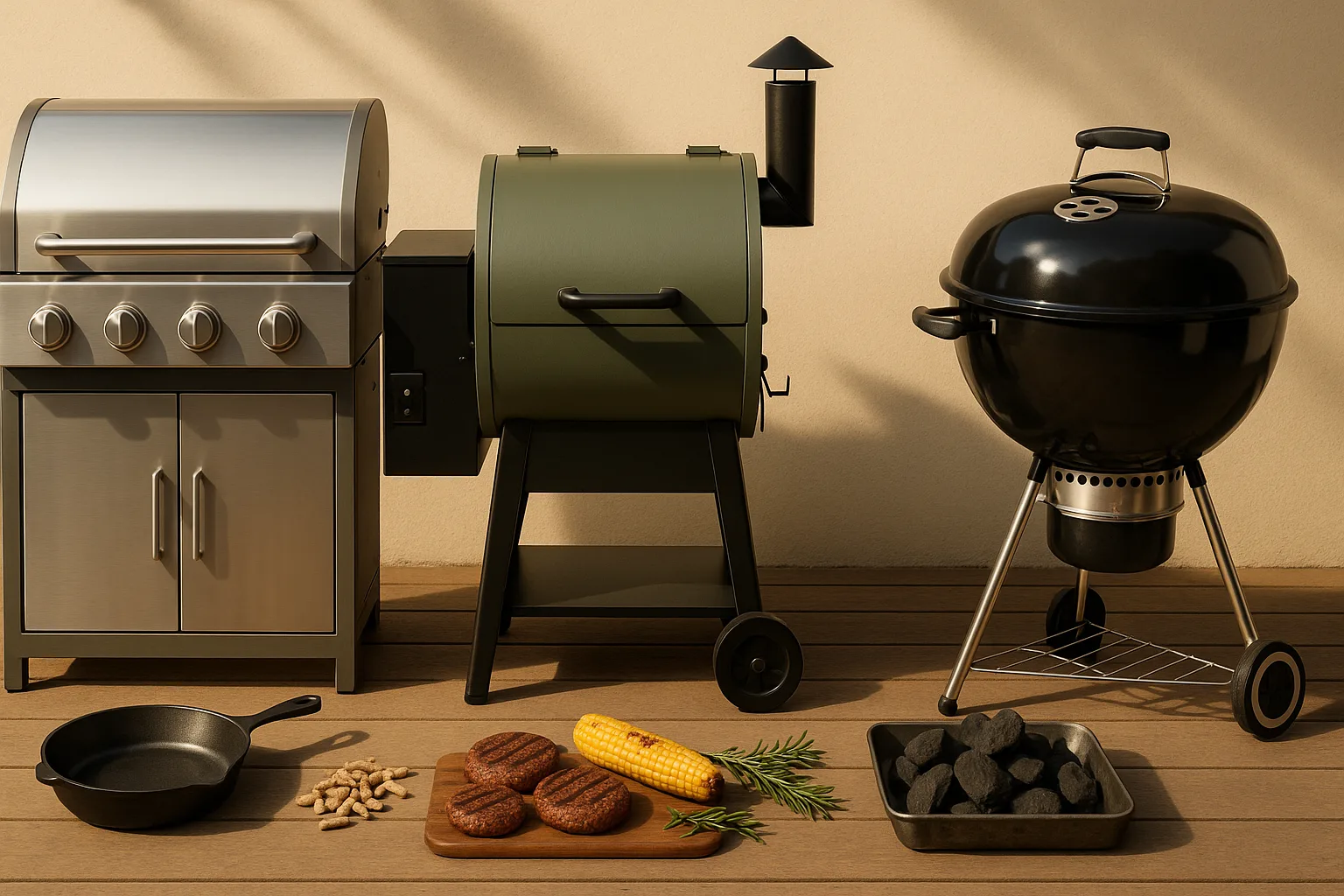
Gas grill vs pellet grill vs charcoal grill: quick answer for backyard cooks
If your cooking style is weeknight burgers, fast searing, and a low cleanup burden, choose gas; if you want low-and-slow smoking with set-and-forget temperature control and you have outdoor power, choose pellet; if you want the deepest smoke flavor and the highest heat intensity and you do not mind extra cleanup or more fire management, choose charcoal.
At a Glance: - Gas grill — fastest heat-up, highest sear temps, easiest weeknight use, less smoke flavor - Pellet grill — best set-and-forget smoking, consistent temperature, tops out around 500°F, needs outdoor power - Charcoal grill — richest smoke flavor, intense heat, more cleanup, more attention required
The one-sentence matrix: choose a Weber gas grill if your cooking style is fast weeknight meals and your heat need is high direct heat with the lowest cleanup burden, choose a Traeger pellet grill if your cooking style is long smokes and your heat need is moderate with low cleanup tolerance and a mid-to-higher budget, and choose charcoal if your cooking style is flavor-first grilling and your heat need is very high with a higher cleanup tolerance and a budget-first or value-first setup.
Per Traeger's official grill comparison, pellet grills are "powered by 100% natural hardwood pellets" and use fans to circulate heat and smoke throughout the cooking chamber — but they require an electrical supply with GFCI protection and have a maximum temperature of about 500°F. Those two facts alone eliminate pellet grills for some buyers and make them perfect for others. The rest of this article gives you the specifics to make that call for your yard.
How we compare gas, pellet, and charcoal grills for U.S. homeowners
Most comparison articles lean on flavor clichés — "charcoal tastes better," "gas is more convenient" — and stop there. That's not useful when you're standing in front of a $600–$1,500 purchase decision. This article compares all three grill types across criteria that actually affect your Saturday afternoon and your Tuesday night dinner.
The CPSC explicitly warns that "gas or charcoal grills can present a risk of fire and/or carbon monoxide poisoning that could result in injury or death," so safety requirements are baked into every section below, not buried in an afterthought.
Before browsing grill options on retailer sites or a trusted grill affiliate shopping page, run through these six comparison criteria for your specific situation:
- Fuel source — propane tank, natural gas line, wood pellets, or charcoal?
- Heat-up speed — do you need dinner in 20 minutes or do you have all afternoon?
- Max temperature — do you want a hard sear on a ribeye, or mostly low-and-slow cooks?
- Smoke flavor — is genuine wood smoke flavor a priority, or is it a nice-to-have?
- Ease of cleaning — how much post-cook cleanup will you actually do consistently?
- Electricity needs — does your outdoor space have a GFCI-protected outlet within reach?
The spec points that actually matter: fuel, heat-up speed, max temperature, cleanup, and power
Ads lead with design and color. The specs that determine whether you'll actually enjoy your grill two years from now are more practical.
- BTU rating — relevant primarily for gas grills; higher BTU means more total heat output, but BTU numbers vary by model and burner configuration. Check the manufacturer's spec sheet for the specific grill you're considering — a grill with a high BTU rating on a small cooking surface is different from the same BTU spread across a larger grate.
- Propane vs. natural gas — not all gas grills come ready for both. Weber, for example, sells its Genesis and Spirit lines in both liquid propane and natural gas configurations, but you must choose the right version at purchase. A natural gas hookup eliminates the need to swap propane tanks, but it means the grill stays in one spot.
- Pellet hopper size — determines how long a pellet grill runs unattended. Check the specific model's hopper capacity on the manufacturer's product page before buying; a larger hopper means fewer refills during a long brisket cook.
- GFCI outdoor power — Traeger's comparison page confirms that pellet grills require an electrical supply with GFCI protection. If your patio or deck doesn't have a weather-rated GFCI outlet within cord reach, that's an electrician visit before your first cook.
Pro Tip: Before buying a pellet grill, walk outside and count your GFCI outlets. If you don't have one close to your planned grill spot, budget an additional $150–$300 to have an electrician add one — or reconsider placement.
Gas grill pros and cons for weeknight burgers and high-heat searing
Gas grills are the right tool for speed, reliability, and daily use. Turn the knob, push the igniter, and you're at cooking temperature in 10–15 minutes. There's no charcoal to light, no hopper to fill, and no outlet required. For families who grill three to four times a week, that frictionless start matters.
Weber's Genesis line and Spirit line are the two most recognizable gas grill families in the U.S. mainstream market. Weber makes both available in liquid propane and natural gas configurations — as their site states, "Find the Genesis grill for you available in liquid propane or natural gas." The Spirit II line comes backed by a 10-year warranty on all parts, excluding normal wear and tear, and Weber says, "Get high-tech grilling with Weber's Spirit series Wi-Fi gas grills in propane & natural gas." That combination of configuration flexibility, modern controls, and warranty coverage is a meaningful long-term ownership benefit.
Gas grills deliver consistent, even temperatures that are easy to dial in for direct grilling. Two-zone cooking — one side on high heat, one side on low or off — is simple to set up on any multi-burner gas grill and gives you the flexibility to sear and then finish cooking over indirect heat.
Per Traeger's category comparison, gas grills are burner-fed, propane-common units that deliver consistent temperatures — but with less natural smoke flavor than pellet or charcoal. That's the honest trade-off.
When a gas grill is the right choice
Gas is the strongest fit when you value convenience over smoke flavor, cook frequently, and want reliable results without extra setup.
Choose a gas grill if your cooking looks like this:
- Weeknight dinners where dinner needs to be on the table in 45 minutes or less
- Regular family grilling — burgers, chicken thighs, vegetables, hot dogs — where speed and ease outrank smoke intensity
- Casual backyard entertaining where you want to be present with guests rather than managing a fire
- Mixed cooks where you grill different proteins at different temperatures on the same evening
- Households where the grill is used four or more times per week
A Weber Spirit or Genesis model is a practical starting point for most U.S. households in this category. Weber's Spirit series also includes Wi-Fi-enabled gas grills in both propane and natural gas variants for those who want app-based temperature monitoring.
Gas grill trade-offs: less smoke flavor and flare-up risk
Gas grills produce little to no wood smoke flavor on their own. The food tastes grilled, not smoked. You can add a smoker box with wood chips to introduce some smoke, but it won't match what a pellet or charcoal fire delivers. If you've been chasing the flavor of competition barbecue or backyard brisket, a gas grill will leave you underwhelmed.
Flare-ups are a real safety consideration. Fat and juices dripping onto hot burners can ignite quickly. Per CPSC guidance, "if a flare-up occurs, adjust the controls on the gas grill or spread out the coals on a charcoal grill to lower the temperature." Keep a spray bottle nearby and have a plan — move food to a cooler zone and reduce burner output rather than reaching over the flames.
Watch Out: Never leave a gas grill running unattended. Grease fires can escalate fast. If you walk away, turn the burners to low or off.
Pellet grill pros and cons for set-and-forget smoking
Pellet grills are designed to remove the difficulty of smoking. You set a temperature — say, 225°F for a pork shoulder — fill the hopper with hardwood pellets, and the grill's auger feeds pellets into the fire pot automatically. Built-in fans circulate heat and smoke throughout the cooking chamber, maintaining consistent temperature without you adjusting vents or adding fuel. That is not hyperbole; it's how the technology works, and it's why pellet grills have become the first choice for home cooks who want serious smoked barbecue without a steep learning curve.
As Traeger states directly, pellet grills are "powered by 100% natural hardwood pellets" and use "fans" to circulate heat and smoke throughout the chamber. Temperatures are adjustable by the controller, and the grill does not require constant monitoring.
For long cooks — brisket at 12+ hours, pork ribs at 5–6 hours, whole chicken — a Traeger pellet grill gives you a fundamentally different experience than charcoal. You can go inside, check on the temperature from an app, and come back hours later to a properly smoked piece of meat. That convenience is the core value proposition, and it's real.
The honest downside: pellet grills require an outdoor power source and cannot reach the high temperatures of a gas or charcoal fire. Both of those constraints matter depending on your yard setup and your cooking priorities.
Do pellet grills need electricity and a GFCI outlet?
Yes — this is one of the most commonly omitted facts in grill comparison articles, and it disqualifies pellet grills for some buyers before they even consider price or flavor.
Per Traeger's comparison page, pellet grills "require an electrical supply with GFCI protection." The electronics that control the auger, the fan, and the temperature probe all need power. No outlet, no operation.
A GFCI outlet (Ground Fault Circuit Interrupter) is the standard requirement for outdoor electrical installations in the U.S. It's the outlet type with the TEST and RESET buttons you see near sinks and on exterior walls. If your deck or patio already has one within cord reach of your planned grill placement, you're set. If not, you'll need a licensed electrician to add one — plan for that cost before the grill arrives.
Watch Out: Don't run a standard extension cord from an indoor outlet to power a pellet grill through a window or door. Use only outdoor-rated, GFCI-protected power. Weather exposure to an unprotected cord is a fire and shock hazard.
Why pellet grills can miss on high-heat searing
Pellet grills top out at about 500°F, according to Traeger's own comparison documentation. A hard sear on a steak — the kind that produces a deep, caramelized crust — typically benefits from surface temperatures well above that. A charcoal chimney or gas grill on high can reach 600°F–700°F at the grate. That gap is noticeable on thick steaks and lamb chops.
The workaround most pellet grill owners use is the reverse sear: smoke the steak at 225°F until it's a few degrees below your target internal temperature, then move it to a very hot cast iron skillet or a separate gas burner for a quick two-minute sear. It works well, but it requires a second heat source. If you want to do everything on one grill, pellet grills are not the strongest tool for hard searing.
Pro Tip: If you're committed to a pellet grill but don't want to give up a good sear, a cast iron grill grate placed directly over the fire pot can increase surface contact temps on the grill itself — check whether your specific Traeger model supports this configuration.
Charcoal grill pros and cons for flavor and heat intensity
Charcoal delivers a smoke and heat experience that gas and pellets genuinely can't replicate. The combination of direct radiant heat, convection, and real combustion byproducts — including the dripping fat igniting on hot coals — creates flavor complexity that has kept charcoal relevant for decades despite every technological advancement in the category.
The Big Green Egg is the best-known kamado-style charcoal grill in the U.S. A kamado grill is a ceramic, egg-shaped cooker that uses lump charcoal and airflow control (through adjustable vents) to manage temperature across an enormous range — from low-and-slow smoking to screaming-hot pizza and searing cooks. The Big Green Egg positions itself as "The ultimate Kamado Grill for outdoor cooking. Grill, smoke, bake, and roast with unmatched flavor and temperature control" and backs ceramic parts with a limited lifetime warranty.
A 2-zone fire — where you pile coals on one side and leave the other side empty — is a practical charcoal cooking technique that gives you a hot direct zone and a cooler indirect zone on the same grill. Used this way, it supports both fast searing and gentler finishing on the same cook.
When charcoal is best for backyard cooks
Charcoal is the right call when you're willing to accept more effort and cleanup in exchange for the best flavor and the most intense direct heat.
Reach for charcoal when:
- You're cooking steaks, lamb chops, or thick burgers where a deep char is the entire point
- Weekend cookouts where you have time to light the coals and tend the fire
- You want to experiment with smoking on a kamado like the Big Green Egg without buying a dedicated smoker
- You genuinely enjoy the ritual of fire management — building the fire, adjusting vents, reading the grill
- You're a flavor-first cook who ranks taste above convenience every time
Cleanup, ash removal, and fire management trade-offs
Charcoal requires attention during the cook and cleanup after. Ash builds up in the bottom of the grill and must be removed regularly — especially after multiple uses — to maintain proper airflow and prevent moisture retention. A charcoal ash tool and a metal ash bucket make this faster, but it's still a step that gas and pellet grills skip entirely.
Fire management on charcoal means watching your temperature throughout the cook. Vent adjustments — opening the bottom vent for more oxygen and heat, closing it to bring temps down — take practice. You can run hot and flat suddenly if the wind picks up or you add too much coal.
Flare-ups are more frequent on charcoal than gas because there's no burner control to dial back instantly. Per CPSC guidance, spread the coals to reduce the contact point when a flare-up occurs.
Watch Out: Never add lighter fluid to already-lit charcoal. Use a chimney starter with newspaper or paraffin cubes to light charcoal without accelerants — it's safer and produces cleaner flavor.
Best grill type by cooking style: decision table for real backyard use cases
This is the section most comparison articles skip. Below is a direct map from cooking style to the right grill type, with the honest constraints included.
| Cooking Style | Best Grill Type | Why | Key Constraint |
|---|---|---|---|
| Weeknight burgers & fast searing | Gas | Fast heat-up, high direct temps, no setup | Less smoke flavor |
| Low-and-slow smoking | Pellet | Set-and-forget temp control, real wood smoke | Needs GFCI outlet; max ~500°F |
| Flavor-first steaks & cookouts | Charcoal/Kamado | Highest heat intensity, richest smoke flavor | More cleanup, more attention |
| Occasional entertaining | Gas or Pellet | Consistent results, less management | Gas for speed; pellet for smoke |
| Budget-first buyers | Charcoal | Lowest entry price | More effort per cook |
Traeger and Weber represent the U.S. mainstream in their respective categories. Use the table above to determine which category fits your actual cooking before going to a product page.
Weeknight burgers and fast searing
Gas is the clear winner for weeknight cooking. You can go from cold grill to searing temperature in about 10–15 minutes, cook burgers and chicken in another 10–15 minutes, and have dinner on the table fast. There's no ash to dispose of, no hopper to fill, and no outlet to locate.
Compared to charcoal and pellet for this use case: charcoal takes 20–30 minutes just to get the coals ready, and a pellet grill's 500°F ceiling means it technically can sear but not with the same intensity a gas grill at full burner achieves. For fast weeknight cooking, a Weber gas grill in the Spirit or Genesis line handles the job without complications.
Low-and-slow smoking and all-day barbecue
Pellet grills own this category. Per Traeger's comparison documentation, pellet grills provide consistent, easily adjustable temperatures and do not need constant monitoring — which is exactly what a 12-hour brisket cook requires. You set the temperature, confirm the hopper has enough pellets for the duration, and walk away. The controller maintains temperature automatically.
A Traeger Pro or Ironwood series grill (check current models at traeger.com) gives you app connectivity so you can monitor the cook from inside the house. That's a fundamentally different experience from managing a charcoal fire through an all-day smoke, and for most homeowners who want to host rather than tend, it's the right call. Just confirm you have a GFCI outlet in the right spot before the grill arrives.
Occasional entertaining and mixed-use patios
For homeowners who grill a few times a month — not every night — the decision comes down to cleanup burden, smoke flavor priority, and how long guests are willing to wait while the grill preheats.
A gas grill is the most forgiving choice here. It fires up quickly when guests arrive, cleanup is minimal, and it handles everything from appetizers to main courses without drama. If you entertain and also occasionally want smoked food, consider pairing a gas grill with a standalone pellet smoker or a charcoal kettle used specifically for smoking sessions.
If your patio has a GFCI outlet and you entertain with a lot of smoked meats — pulled pork, ribs, whole brisket — a pellet grill can actually be the better entertainer's grill, because you're not stuck tending it while guests are present.
Budget-first buyers and value shoppers
Charcoal has the lowest entry price of the three categories. A quality kettle-style charcoal grill from a name brand can be purchased for well under $200, and a basic charcoal grill costs even less. For someone who grills occasionally and is not ready to commit to a gas or pellet setup, charcoal is the right starting point.
The ownership cost picture changes over time. Charcoal fuel is inexpensive per use but adds up over a full season. Propane for a gas grill averages a predictable per-tank cost. Pellet grills carry a higher upfront price — most quality Traeger models start well above $500 — plus ongoing pellet cost and the potential electrician fee for a GFCI outlet.
Cost Snapshot: Entry charcoal grill: under $200. Mid-range gas grill (Weber Spirit range): typically $400–$700. Entry pellet grill (Traeger): typically $500–$900+. Add $150–$300 if you need a new GFCI outdoor outlet installed. Prices vary by retailer and season — verify current pricing at weber.com, traeger.com, or major retailers before purchasing.
Watch Out: The cheapest grill in any category tends to have the thinnest steel, the least precise temperature control, and the shortest useful life. Buying slightly up within a category almost always pays off over three to five seasons.
Safety and placement notes for propane, electricity, and flare-ups
The CPSC states directly that "gas or charcoal grills can present a risk of fire and/or carbon monoxide poisoning that could result in injury or death." That's not scare language — it's a real baseline for how you set up and use any backyard grill.
Safety checklist before your first cook of the season:
- Confirm the grill is positioned at least 10 feet from the house, siding, deck railings, and any overhanging structure
- Check propane connections for leaks with soapy water before the first use each season
- Inspect gas burner tubes for spider webs or debris blockages (a common problem after winter storage)
- Confirm the GFCI outlet powering any pellet grill is rated for outdoor/weather-exposed use
- Keep a fire extinguisher rated for grease fires (Class K or Class B:C) accessible near the cooking area
- Never grill in a covered porch, garage, or enclosed space — carbon monoxide accumulation is the hazard
- Keep children and pets at a safe distance from any lit grill — establish a no-zone around the unit
Flare-up awareness applies to gas and charcoal both. Have a plan before every cook, not after a grease fire starts.
Where to place a pellet grill near outdoor outlets
Pellet grills need a GFCI-protected outdoor outlet within safe cord reach. The outlet must be rated for outdoor/weather-exposed use — standard indoor outlets are not appropriate, even with a weatherproof cover box.
Placement considerations:
- Keep the grill away from direct overhead rain exposure when possible; a patio cover or grill canopy helps protect both the grill and the power cord connection
- Use only the manufacturer-supplied power cord and length; do not daisy-chain extension cords to reach a distant outlet
- Make sure the GFCI outlet is easily accessible so you can reset it if it trips during a cook
- Allow adequate clearance behind and to the sides of the grill per the manufacturer's installation manual for airflow and heat dissipation
Propane handling and natural gas hookup basics
As Weber confirms, "Find the Genesis grill for you available in liquid propane or natural gas." The Genesis line is available in both liquid propane and natural gas — and the same is true for the Spirit series. Choose the correct configuration at purchase. Converting between fuel types typically requires a conversion kit and should only be done using manufacturer-specified parts; improper conversion is a safety risk and may void the warranty.
For propane:
- Have your tank inspected annually for rust, dents, or valve damage before connecting
- Never overfill a propane tank — the CPSC has specifically flagged overfilling as a safety hazard
- Store propane tanks outdoors in an upright position, away from heat sources and direct sunlight
- When transporting tanks in a vehicle, keep windows open and make the trip directly to your destination
For natural gas:
- Natural gas hookups require a licensed plumber or gas fitter in most U.S. jurisdictions
- Confirm your local gas line pressure is compatible with the grill's natural gas regulator before installation
- A natural gas grill cannot use a propane tank as a backup — it is permanently plumbed to the gas line
Best grill brands to consider: Weber for gas and Traeger for pellet
Two brands dominate the U.S. mainstream conversation: Weber for gas grills and Traeger for pellet grills. Both have wide parts availability, established customer service infrastructure, and genuine product depth at different price points. Traeger says, "Shop wood pellet grills and WiFi smokers." That brand language matches the category's core promise: simple smoking with connected controls.
For charcoal and kamado cooking, the Big Green Egg is the most recognized premium name in the U.S. market, with ceramic components covered by a limited lifetime warranty. Standard kettle charcoal grills are widely available from multiple brands at accessible price points.
Weber gas grill examples for speed and searing
Weber's two main residential gas grill families are Genesis and Spirit. The Spirit line sits at a lower price point and is a strong starting choice for households new to gas grilling or with smaller patio space. The Genesis line steps up in cooking area, burner count, and build quality.
Both Genesis and Spirit are available in liquid propane and natural gas versions — confirm which fuel type you need before ordering. Weber says, "Find the Genesis grill for you available in liquid propane or natural gas." The Spirit II line carries a 10-year warranty on all parts (excluding normal wear and tear per Weber's warranty terms), which is a meaningful durability signal in a category where lower-cost competitors offer far shorter coverage.
Neither line should be purchased without checking Weber's current model lineup — the product family is updated regularly, and current models may differ from what appeared in older reviews.
Traeger pellet grill examples for easy smoking
Traeger is the brand that popularized wood pellet grills in the U.S. and their lineup spans from entry-level to competition-class models. They make both hardwood pellets and the grills themselves, which matters for pellet compatibility and flavor consistency.
Two caveats to repeat before any Traeger purchase: per Traeger's own documentation, pellet grills are powered by 100% natural hardwood pellets and require an electrical supply with GFCI protection, and they top out at about 500°F. If your patio lacks a GFCI outlet, or if high-heat searing is your primary goal, confirm your situation before committing. For everything else — smoking, roasting, baking on the grill, low-and-slow BBQ — Traeger's lineup is a practical, well-supported choice backed by a large U.S. community and parts network.
Common mistakes buyers make when choosing a backyard grill
Most grill regret comes from one of four predictable mistakes. Knowing them costs nothing; making them costs a full season of frustration.
1. Buying for flavor alone, ignoring how you actually cook Everyone wants smoky brisket. But if you grill on Tuesday nights and have 40 minutes, a charcoal grill or a pellet grill that takes 30 minutes to preheat doesn't fit your life. Be honest about your real cooking habits, not your aspirational ones.
2. Ignoring outdoor power access before buying a pellet grill The number of pellet grills sitting unused because the buyer didn't realize they needed a GFCI outlet is not small. Check your outdoor power situation before you buy, not after the grill is on the patio.
3. Underestimating cleanup commitment Charcoal ash, pellet hopper cleaning, and gas grill grease trap maintenance all require consistent attention. If you have ever let a grill go all winter without a cover or a cleaning, be honest about which grill type matches your actual maintenance habits, not your intentions.
4. Mismatching grill type to cooking style Buying a pellet grill when you need weeknight burgers, or a gas grill when you want to compete in a backyard BBQ competition — these mismatches are common and expensive. The decision table above is the antidote: use it to match your dominant use case to the right tool.
Watch Out: The CPSC warns that fire and carbon monoxide risks apply to both gas and charcoal grills. Skipping setup safety basics — like checking for gas leaks or confirming outdoor-only use — is the fifth mistake, and it's the one with the worst consequences.
Which grill should you buy if you want the easiest all-around fit?
For most U.S. households, a gas grill is the easiest all-around fit. It covers 80% of backyard cooking scenarios — burgers, chicken, fish, vegetables, casual entertaining — with the least friction, the fastest startup, and the most predictable results. A mid-range Weber gas grill in the Spirit or Genesis family is a practical, well-warranted starting point.
If you smoke meat regularly — even just three or four times a season — or you want wood-fired flavor without mastering fire management, add a Traeger pellet grill as a complement or primary grill. Confirm you have outdoor GFCI power first, and accept that high-heat searing will require either a separate searing method or cooking on the pellet grill's upper temperature ceiling.
If flavor is your north star and you're willing to invest time in the cook, a charcoal setup — whether a classic kettle or a kamado like the Big Green Egg — delivers an experience that gas and pellet cannot match on raw flavor and heat intensity.
Use the decision table in the section above to revisit your primary use case, then go directly to weber.com, traeger.com, or biggreenegg.com to compare current models and pricing. Prices shift seasonally, and spring through early summer is when most retailers run the most competitive promotions.
Gas grill vs pellet grill vs charcoal grill FAQs
Which is better, a pellet grill or a gas grill?
Neither is objectively better — they're optimized for different cooks. Gas grills heat faster, reach higher temperatures, and require no electricity, making them the stronger choice for weeknight grilling and direct searing. Pellet grills maintain consistent low temperatures automatically and deliver real wood smoke flavor, making them the stronger choice for smoking and long slow cooks. If you do most of your cooking on weeknights with occasional weekend BBQ, gas fits most people better. If you prioritize smoking and smoked flavor above all else, pellet wins.
Can a pellet grill sear like a gas grill?
Not quite. Per Traeger's own documentation, pellet grills have a "maximum temperature of about 500 degrees Fahrenheit." A gas grill on high or a fully loaded charcoal chimney can exceed that significantly at the grate surface. Pellet grills can technically sear, but the intensity of the crust you get from higher direct heat is different. The reverse-sear method — smoke on the pellet grill, then finish in a screaming-hot cast iron skillet — bridges the gap, but it requires a second heat source.
Are charcoal grills better for flavor than gas grills?
Yes, in the way most people mean "flavor." Charcoal combustion produces a more complex combination of smoke, char, and dripping-fat ignition that creates flavor compounds gas burners simply don't generate. Per Traeger's category comparison, gas grills deliver consistent temperatures but with less natural smoke flavor than charcoal or pellet options. Whether that flavor difference is worth the extra effort and cleanup is a personal call, but on the straight flavor question, charcoal and wood-fire options have the edge.
Do pellet grills need electricity?
Yes. This is one of the most important practical facts about pellet grills, and many comparison articles skip it. Per Traeger's official comparison page, pellet grills "require an electrical supply with GFCI protection." The fan, auger motor, and temperature controller all run on electricity. If your planned grill location doesn't have a weather-rated GFCI outlet nearby, either choose a different grill type or have an electrician add one before the grill arrives.
Sources & References
- Traeger: Pellet Grills vs Gas vs Charcoal Grills — Primary manufacturer comparison source for pellet, gas, and charcoal category differences; source of the 500°F max temp and GFCI requirement facts
- Traeger: Shop Pellet Grills — Traeger's pellet grill product lineup
- Weber: Genesis Gas Grills — Weber's Genesis line, available in LP and natural gas
- Weber: Spirit Gas Grills — Weber's Spirit line, available in propane and natural gas with Wi-Fi options
- Weber: Warranty Information — Source for Spirit II 10-year all-parts warranty terms
- Big Green Egg — Kamado grill positioning and product overview
- Big Green Egg: Warranty Terms — Ceramic parts limited lifetime warranty details
- CPSC: Summer Grill Safety — Federal safety guidance on fire and carbon monoxide risks
- CPSC: Fire It Up Safely (2011) — CPSC flare-up handling guidance
- CPSC: Propane Tank Safety (2001) — CPSC guidance on propane tank overfilling hazards
Keywords: Traeger pellet grill, Weber gas grill, Weber Genesis, Weber Spirit, Big Green Egg, Kamado grill, propane tank, natural gas hookup, GFCI outlet, 500°F max temperature, 2-zone fire, flare-ups, wood pellet hopper, BTU rating