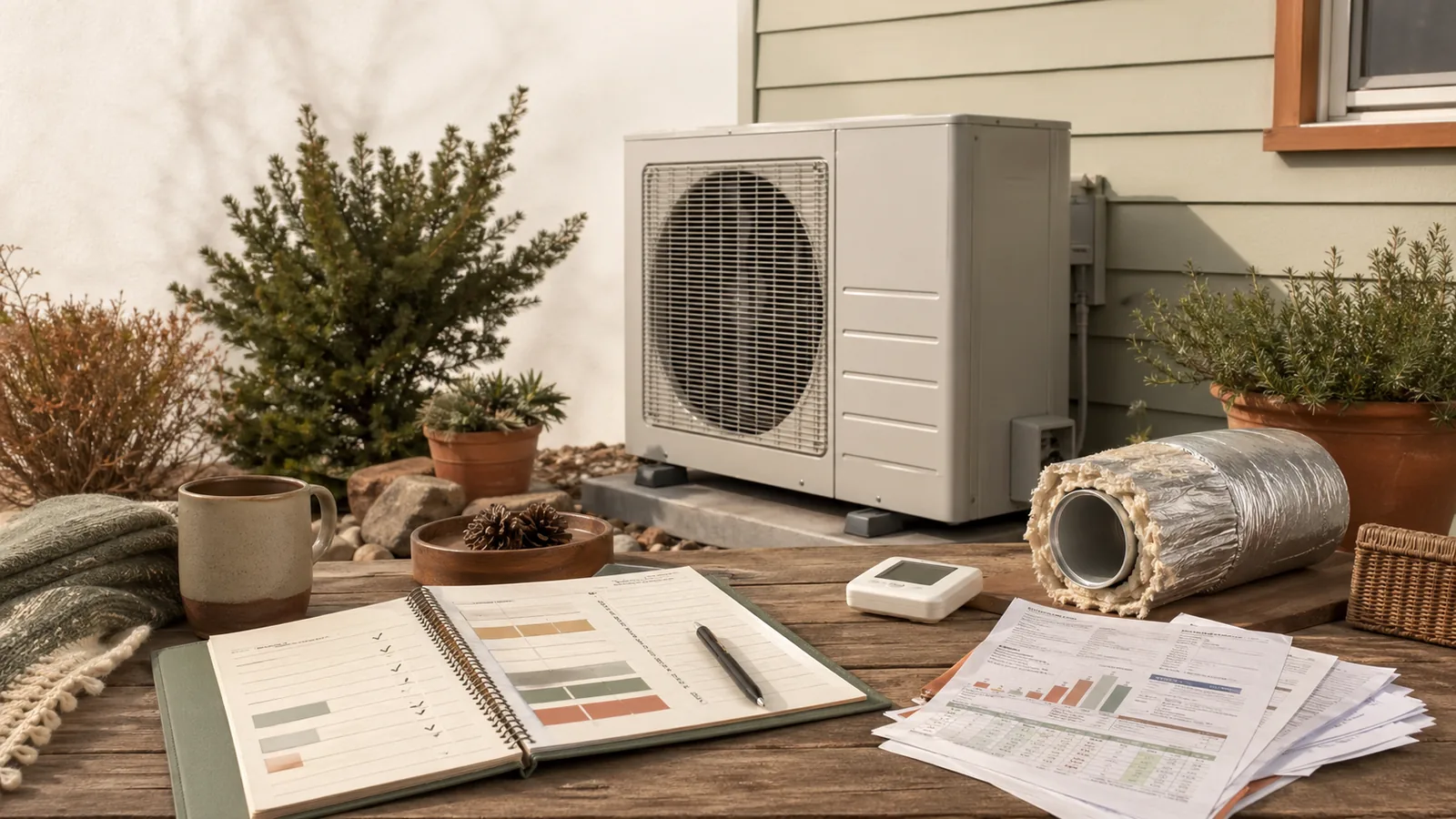
For most homes currently heating with propane, oil, or electric resistance, a cold-climate heat pump will cut annual energy costs — but by how much depends on your fuel price, climate zone, and how well your home holds heat. The federal tax credit of up to $2,000 (30% of project cost) is real and accessible to cold-climate homeowners right now, but only if you buy a model on the ENERGY STAR Most Efficient list and complete the install before the program deadline. This guide gives you the exact numbers, the current eligibility rules, and a clear framework to decide whether the math works for your house.
Quick answer: are heat pumps worth it in cold climates?
For most homeowners replacing propane, oil, or electric baseboard heat, yes — a modern cold-climate heat pump will lower operating costs and qualify for meaningful federal tax relief. For homeowners on inexpensive natural gas in a mild-winter climate, the payback math is tighter and sometimes doesn't pencil out at current equipment prices.
At a Glance: - Best case for a heat pump: You heat with propane, oil, or electric resistance; your utility electricity rate is moderate; your home is reasonably insulated. - Weakest case: You have cheap natural gas service, leaky ductwork, an undersized electrical panel, and winters that routinely hit -20°F without supplemental heat budgeted in. - Federal credit available now: 30% of installed cost, up to $2,000 per year, for ENERGY STAR Most Efficient models under IRS Section 25C. - Key variables: current fuel type and local rate, climate zone, home envelope condition, duct system status, and whether electrical service needs an upgrade.
The four factors that most change the answer are your existing fuel type, your local electricity rate, your home's insulation level, and the condition of your duct system. None of those are one-size-fits-all, which is why this article walks through each one rather than giving you a single payback number that won't apply to your situation.
What a cold-climate heat pump does differently from a standard heat pump
Standard air-source heat pumps — the kind sold widely before cold-climate models became common — lose capacity as outdoor temperatures fall and often need backup heat to carry part of the load in colder weather. ENERGY STAR Cold Climate–designated models are engineered to retain meaningful heating performance well below freezing, down to roughly -15°F in many residential applications, according to DOE and ENERGY STAR cold-climate program materials.
The difference shows up on your utility bill. A standard heat pump leaning on backup resistance heat in very cold weather is effectively behaving like an electric furnace at that point. A cold-climate unit at the same temperature is still moving heat rather than generating it, with a COP meaningfully above 1.0. Per DOE's air-source heat pump guidance, a properly installed air-source heat pump can deliver two to four times more heat energy than the electrical energy it consumes — and even at the lower end of that range in cold weather, you're doing better than a resistance heater.
Why cold-climate models keep heating when outdoor temperatures drop
Cold-climate heat pumps use variable-speed (inverter-driven) compressors rather than single-stage or two-stage units. A conventional compressor is either on or off; an inverter compressor modulates to match the load and keep extracting heat from cold outdoor air instead of handing the job off too quickly to backup strips.
SEER2 (Seasonal Energy Efficiency Ratio 2) measures cooling efficiency; HSPF2 (Heating Seasonal Performance Factor 2) measures heating efficiency over an entire season. Cold-climate models earn the ENERGY STAR Cold Climate designation partly by demonstrating a minimum COP of 1.75 at 5°F — a threshold verified in ENERGY STAR's cold-climate heat pump controls verification procedure. That standard is about the equipment's ability to keep heating efficiently as temperatures fall, not about a single brand family or one specific product line.
When supplemental heat may still turn on during extreme cold
Even the best cold-climate units have a balance point — the outdoor temperature below which the heat pump alone can't fully meet your home's heat load. For a tightly insulated home, that point may be much lower than it is for an older, leakier house. Below your specific balance point, a backup heat source makes up the difference.
Watch Out: If your contractor proposes sizing a heat pump to eliminate backup heat entirely in a northern climate without first running a Manual J load calculation, be skeptical. Supplemental heat sizing should be based on a load calculation and local design temperatures, not guesswork.
Your backup heat options are: - Electric resistance strips built into the air handler — the most common setup, included with most ducted heat pump packages. Simple, but expensive to run at full load. - Dual-fuel setup — the heat pump handles mild and moderate cold; a gas or propane furnace takes over at a set switchover temperature depending on fuel prices. This is worth considering if you already have a working furnace and natural gas or propane service. - No dedicated backup — viable only in very well-insulated homes in moderate cold climates with an accurately sized heat pump.
How much a heat pump costs installed in ducted, ductless, and cold-climate setups
Installed prices for heat pumps vary more than almost any other home system because four cost drivers — equipment tier, duct condition, electrical panel capacity, and backup heat strategy — can each add or subtract thousands of dollars. ENERGY STAR and DOE publish equipment eligibility rules rather than price benchmarks, so the most reliable way to compare bids is to focus on scope, model number, and what is included in the quote.
Cost Snapshot: Installed heat pump costs vary widely by home, region, and scope. ENERGY STAR and DOE do not publish standardized installed-price ranges, so homeowners should compare detailed bids rather than rely on generic national averages.
Installed cost ranges for ducted systems
A ducted central heat pump HVAC replacement — swapping out an existing forced-air furnace and central air conditioner for a heat pump with an air handler — depends heavily on the condition of the existing ductwork and whether the indoor unit, controls, and refrigerant lines can be reused or need to be replaced. Cold-climate–rated ducted systems usually involve more equipment complexity and commissioning than simpler replacements, which is why the final quote can move a lot from house to house.
What's included in a complete ducted HVAC replacement: outdoor unit, indoor air handler, refrigerant line set, thermostat (usually a communicating smart thermostat for inverter systems), electrical disconnect and connections, and startup commissioning. What's not automatically included: duct repairs, panel upgrades, new return-air openings, or backup heat additions.
Pro Tip: If a quote comes in well below other bids for a whole-home ducted cold-climate system, verify whether it includes the air handler, line set, and commissioning — or whether it's equipment-only pricing.
Installed cost ranges for ductless mini-splits
A ductless mini-split heat pump — one outdoor unit connected to one or more wall-mounted indoor heads — typically scales in cost by zones, line-set length, and the number of indoor heads. Multi-zone systems cost more than single-zone systems because each added head increases labor, line-set work, and controls complexity.
Cold-climate–rated mini-splits — Mitsubishi's Hyper Heat line, Fujitsu's XLTH series, and Daikin's cold-climate lineup — are designed for colder-weather operation, but the real-world price difference is driven less by the brand name than by the number of zones, the routing path, and the amount of finish work needed in the rooms being served.
Line-set length matters: runs over 50 feet add refrigerant charge, more labor, and sometimes insulated conduit. Wall penetration locations also affect labor time, especially in homes with thick exterior walls or finished basements.
Why old ducts, panel work, and backup heat strategy change the price
This is where competitor pricing estimates fall apart. Three variables can each change the scope of a quoted project:
Duct condition. DOE guidance on heat pump maintenance explicitly identifies duct leakage as a key performance factor. Leaky or undersized ducts don't just waste energy — they can cause the system to short-cycle and fail to meet load. Duct sealing, duct repairs, and partial duct replacement all depend on access, attic or crawlspace conditions, and how much of the distribution system has to be reworked. ENERGY STAR's product finders distinguish ducted central systems from ductless mini-splits precisely because a home's existing duct infrastructure determines which system type is even viable.
Electrical panel and service. Most modern heat pumps require a dedicated circuit and the right available capacity in the main electrical panel. If your panel is already full, or if the service equipment has limited room for new loads, a sub-panel or panel upgrade can become part of the job. If your home is also adding an EV charger or induction range, a full service upgrade may need to be considered at the same time.
Backup heat strategy. Adding an electric air handler with resistance strips is typically included in most heat pump packages. Adding a dual-fuel setup is a bigger decision because it changes the equipment mix, controls, and service plan, especially if the furnace already exists and is still usable.
Watch Out: Always get a line-item quote that separates equipment cost, labor, duct work, electrical work, and permit fees. A single lump-sum number makes it impossible to comparison-shop.
How much you can save versus propane, oil, natural gas, and resistance heat
DOE reports that a properly installed air-source heat pump can reduce electricity use for heating by up to 75% compared to electric resistance heating. Separately, DOE notes that heat pumps can deliver two to four times more heat energy than the electrical energy they consume. Both of those numbers reflect the core physics of moving heat versus generating it — and they're why the savings math depends so heavily on what you're replacing.
No universal payback timeline exists. A DOE Building America field-performance study explicitly notes that COP switchover points — the moment a heat pump's operating cost beats a competing fuel — vary based on utility costs and climate. The comparisons below reflect the current direction of the math, not a guaranteed number.
Why heat pumps usually beat resistance heat on operating cost
Electric resistance heat (baseboard heaters, wall units, and the strips in an old electric furnace) has a COP of exactly 1.0: one unit of electricity in, one unit of heat out. A cold-climate heat pump in moderate winter conditions operates at a COP above 1.0, which means it delivers more heat per unit of electricity consumed than resistance heat does.
Here's what that means concretely: the same heat load that is expensive to serve with resistance heat will usually cost less to serve with a cold-climate heat pump, especially when the outdoor temperature is still well above the equipment's balance point. That gap is where the annual savings come from for electric-only homes in colder regions.
How savings change when your current heat is propane, oil, or natural gas
Propane and heating oil: These are the strongest cases for switching to a heat pump. Propane and heating oil prices are both volatile and high on a per-BTU basis compared to electricity in most US markets. Homes heating with propane or oil often see the clearest operating-cost improvement because the equipment is moving the heat instead of making it directly. In cold-climate states like Maine, Vermont, and Minnesota, where propane reliance is high and state rebate programs often stack with the federal credit, the financial case is strong.
Natural gas: This is the most nuanced case. In US markets with inexpensive natural gas — parts of the South, Midwest, and Mountain West — the per-BTU cost of gas can still undercut electricity even accounting for the heat pump's efficiency multiplier. DOE's field research found that heat pumps monitored in one cold-climate study would cost more to operate than natural gas systems in some utility-rate scenarios. If you're on cheap gas, run your own numbers using your actual gas and electricity rates before assuming a heat pump saves money on operating cost alone — the tax credit and avoided equipment replacement cost may still tip the decision.
Electric resistance: As described above, this is the clearest financial win. If your home currently heats with electric baseboard or an electric furnace, a heat pump upgrade almost always pays back the incremental cost within a reasonable timeframe.
2025 federal tax credit rules for ENERGY STAR heat pumps
The Inflation Reduction Act's residential clean energy provisions updated the Section 25C tax credit significantly. Starting January 1, 2025, ENERGY STAR states directly: "Starting January 1, 2025, air source heat pumps that are recognized as ENERGY STAR Most Efficient are eligible for this credit."
The credit is 30% of your project cost, up to $2,000 for heat pumps. ENERGY STAR further clarifies: "Any combination of heat pumps, heat pump water heaters and biomass stoves/boilers are subject to an annual total limit of $2,000." This means if you install a heat pump and a heat pump water heater in the same tax year, the combined 25C credit for that bucket is still capped at $2,000 — not $2,000 per item. You claim it on IRS Form 5695 when filing your taxes for the year the installation was completed.
The $2,000 heat pump credit is separate from other 25C credits (insulation, windows, doors, and electrical panel upgrades have their own buckets and annual caps), so a whole-home efficiency upgrade project can access more than $2,000 total across all categories in a single year.
Why the ENERGY STAR Most Efficient listing matters now
Not all heat pumps qualify — and this is the detail most competitor articles skip. The model must appear on the ENERGY STAR Most Efficient certified central heat pumps list or the Most Efficient mini-split heat pumps list. Standard ENERGY STAR certification alone is no longer sufficient for the credit.
The Most Efficient designation requires meeting the Consortium for Energy Efficiency (CEE) highest efficiency tier in effect at the beginning of the calendar year — a threshold that incorporates SEER2, HSPF2, and other performance specs. CEE tiers are reviewed annually, so the efficiency bar can move. The safest approach: search the ENERGY STAR Most Efficient product finder by brand name and model number before signing any contract, not after.
Cold Climate and dual-fuel pathways no longer depend on your region
This is the 2025 rule change that most homeowners — and frankly, many contractors — don't know about yet. Previously, the Cold Climate pathway for tax credit eligibility had geographic restrictions. Starting January 1, 2025, those regional limits are gone.
ENERGY STAR now explains that there are two qualifying pathways, and consumers or contractors can choose either one regardless of where the home is located:
| Pathway | Regional Requirement? |
|---|---|
| ENERGY STAR Cold Climate | None — any location qualifies |
| ENERGY STAR Most Efficient | None — any location qualifies |
A homeowner in Georgia can now qualify under the Cold Climate pathway if they choose a Cold Climate–designated model. A homeowner in Minnesota can qualify under the standard Most Efficient pathway if their chosen model meets that list's specs. The flexibility is real — what matters is the model appearing on the correct eligible listing, not your zip code.
How to check eligibility before you sign a contract
Before you authorize any heat pump installation, run through this checklist with your contractor:
- Get the exact model number for the proposed outdoor unit and air handler/indoor head.
- Search the ENERGY STAR Most Efficient product finder at ENERGY STAR's eligible heat pump listings using that model number. Confirm it appears under the Most Efficient listing — not just the standard ENERGY STAR listing.
- Confirm which pathway applies — Cold Climate or standard Most Efficient — and verify that your chosen model appears on that pathway's list.
- Complete the install in the tax year you plan to claim the credit. Keep the timing aligned with the current eligibility rules.
- Save all documentation: the manufacturer's certification statement (most brands publish this on their website), your purchase receipt, and the installer's invoice showing the model number.
Pro Tip: If your contractor can't immediately confirm whether the proposed model appears on the ENERGY STAR Most Efficient list, look it up yourself at energystar.gov before signing. Swapping a model after installation to chase the credit is logistically painful and sometimes impossible.
When a cold-climate heat pump makes sense for your house
A cold-climate heat pump makes the strongest financial and practical sense when: your current heating fuel is propane, oil, or electric resistance; your home's insulation is reasonably good (not necessarily perfect — just not a sieve); your existing ductwork is in decent shape or you're willing to go ductless; and your electrical service can support the new load without a major upgrade. The federal credit shaves up to $2,000 off the net cost, which meaningfully improves the payback calculation compared to just two or three years ago.
The case weakens when you're on cheap natural gas, your home has serious envelope issues (high heat load that a heat pump alone can't meet economically), and you're looking at major duct repairs or electrical upgrades on top of equipment costs.
Homes with undersized ducts or a missing Manual J need a pro first
A Manual J load calculation is the engineering analysis that determines how much heating and cooling capacity your home actually needs, room by room. It accounts for square footage, ceiling height, insulation levels, window area, infiltration rate, and local design temperatures. Without it, a contractor is guessing at system size — and both oversized and undersized systems cost you money.
DOE recommends working with a trusted professional who specializes in heat pump installation to determine what's right for your home and budget. Before getting quotes, flag these red-light situations that require professional assessment first:
- No existing Manual J on file (most homes don't have one unless they've had a recent HVAC replacement done properly)
- Ducts installed before 1990, visibly damaged, or located in unconditioned attic or crawlspace
- Rooms that are chronically over- or under-heated with the current system
- Home additions that extended square footage without expanding ductwork
When to Call a Pro: Get a Manual J before collecting bids if your home has any duct concerns, if it's been significantly renovated or added onto, or if you have any rooms with extreme temperature variation. An HVAC contractor who proposes a system size without running (or reviewing) a load calculation is skipping the most important step.
Signs your electrical panel or service may need upgrades
Most modern heat pumps — both ducted and ductless — need a dedicated circuit and the right available capacity in the main electrical panel. If your panel is already full, or if the service equipment has limited room for new loads, a sub-panel or panel upgrade may become part of the job. If your home is also adding an EV charger or induction range, a full service upgrade may need to be considered at the same time.
Ask your contractor or a licensed electrician to assess your panel before finalizing the heat pump quote. Signs that electrical work may be required:
- The main panel has little or no room for another dedicated circuit
- Existing service equipment is crowded or outdated
- Aluminum wiring throughout (requires specific connection hardware)
- No existing dedicated circuit near the planned outdoor unit location
Electrical upgrades can also be part of a broader efficiency project, so it is worth checking the current IRS guidance before assuming every panel-related expense is handled the same way.
Cold-climate performance caveats to ask about before buying
Defrost cycles. During cold, humid weather, frost accumulates on the outdoor coil. The unit periodically reverses refrigerant flow to melt that frost — this is a defrost cycle. ENERGY STAR's test procedure for cold-climate heat pumps explicitly includes defrost cycle performance as part of testing. During a defrost cycle, the unit temporarily stops delivering heat to your home and may blow cooler air through vents. It's normal, but it surprises homeowners who don't expect it.
Outdoor unit clearance. Cold-climate units need adequate clearance for airflow and for snow and ice management. Installing a unit in a location where snow drifts can block it creates defrost and airflow problems. Ask your heat pump installer about mounting height and placement during the site visit — elevated mounting brackets are inexpensive insurance.
Sound levels. Modern inverter-driven heat pumps are significantly quieter than older units, but the unit can still be heard during high-output operation in cold weather. Placement near bedroom windows or neighbor property lines is worth discussing with your contractor before finalizing the location.
Performance at extreme lows. Cold-climate models can operate down to approximately -15°F in many residential applications, but capacity at that temperature is significantly lower than at milder outdoor temperatures. Make sure your contractor accounts for your local 99% design temperature (the coldest temperature exceeded only 1% of winter hours) when sizing supplemental heat — not just average January temperatures.
How to choose a contractor for a heat pump replacement
The quality of your heat pump installation matters as much as the equipment itself. An undersized system, a poorly routed line set, or improperly charged refrigerant will cost you in comfort and efficiency for years. When shopping for a heat pump installer for an HVAC replacement, your goal is to find someone who treats sizing and commissioning as seriously as equipment selection.
Look for contractors who: - Hold current EPA 608 refrigerant certification (legally required for anyone handling refrigerants) - Are licensed HVAC contractors in your state (licensing requirements vary — check your state's contractor licensing board) - Have documented experience with the specific cold-climate brand they're proposing (Mitsubishi, Daikin, Bosch, LG, and Fujitsu all have training programs) - Will provide a written load calculation (Manual J) with your quote
Questions to ask before getting a quote
Use these questions to create an apples-to-apples comparison when collecting multiple HVAC replacement bids:
- What is the exact make and model of the outdoor unit and air handler/indoor head you're proposing? The model number is the fastest way to verify eligible listings on the ENERGY STAR Most Efficient product finder or the Most Efficient mini-split heat pumps list.
- Is that model on the ENERGY STAR Most Efficient list? You should verify this yourself too, using the same ENERGY STAR heat pump eligibility page.
- What is the system's HSPF2 and SEER2 rating?
- How did you size the system? Did you run a Manual J, and will you provide it in writing?
- What is included in the quoted price? Ask for separate line items: equipment, labor, refrigerant, line set, electrical connections, duct repairs (if any), thermostat, permit, and commissioning.
- What is the line-set length and routing path?
- What backup heat is included, and what is its capacity?
- What are the manufacturer warranty terms, and what does your labor warranty cover?
Pro Tip: Get at least three quotes. If one comes in 40% below the others, dig into what's excluded rather than assuming you found a deal.
Red flags that mean the bid is too vague
A bid that can't answer the questions above is a bid you can't evaluate. Specific red flags:
- No model number listed — you can't verify ENERGY STAR eligibility, warranty terms, or efficiency ratings without it
- "Heat pump system" with a single lump-sum price — no breakdown of equipment vs. labor vs. ancillary work
- No mention of Manual J or load calculation — the contractor is sizing by rule of thumb
- No line-set length or routing plan — relevant to both cost and performance
- No commissioning step listed — proper startup and refrigerant charge verification is a best practice for performance
- Verbal-only warranty promises — get labor warranty terms in writing on the contract
Watch Out: Some contractors push specific brands heavily because of dealer incentives rather than because the model is the best fit for your home. The brand matters less than correct sizing, cold-climate designation, and ENERGY STAR Most Efficient status for your specific situation.
Cold-climate heat pump FAQs
Do heat pumps work in cold climates?
Yes — modern cold-climate heat pumps are designed and tested to operate in temperatures far below freezing. The key difference from older standard heat pumps is the variable-speed (inverter) compressor, which maintains meaningful heating capacity in subfreezing temperatures instead of handing off to backup resistance strips. ENERGY STAR Cold Climate–designated models must demonstrate a minimum COP of 1.75 at 5°F. In practice, properly sized models from recognized manufacturers can perform well in northern US winters when the home load and supplemental heat strategy are matched to the equipment.
Do all heat pumps qualify for the federal tax credit?
No. Starting January 1, 2025, only air-source heat pumps recognized as ENERGY STAR Most Efficient are eligible for the 25C credit. Standard ENERGY STAR certification alone does not qualify. The model must also meet the CEE highest efficiency tier in effect at the beginning of the calendar year. Always search the ENERGY STAR Most Efficient product finder by exact model number before purchase — not after.
What temperature is too cold for a heat pump?
For a standard (non–cold climate) heat pump, heating capacity drops as temperatures fall and the backup heat carries an increasing share of the load. For ENERGY STAR Cold Climate–designated models, meaningful heating capacity continues in very cold weather, though total output is lower at extreme temperatures than at milder ones. Below your home's specific balance point — which depends on insulation, home size, and the heat pump's rated capacity — supplemental heat is needed regardless of the equipment type. There is no single universal cutoff temperature.
When is a dual-fuel heat pump system a smarter choice?
A dual-fuel setup — heat pump for moderate weather, gas or propane furnace for deep cold — makes the most sense when: you already have a working furnace that's mid-life, your local gas or propane rate is low enough to make full electrification less economical, or your home's heat load is high enough that an all-electric system would need very large backup strips. Dual-fuel systems also qualify for the federal tax credit if the heat pump component is on the ENERGY STAR Most Efficient list. The trade-off is continued fossil fuel use and furnace maintenance costs, but for some homes the operating cost math favors the hybrid approach over full electrification at current utility rates.
Sources & References
- ENERGY STAR Air Source Heat Pumps Tax Credit — Official ENERGY STAR page confirming 2025 eligibility rules, Most Efficient requirement, $2,000 cap, and dual-pathway structure
- ENERGY STAR Most Efficient Central Heat Pumps Product Finder — Searchable list of qualifying ducted heat pump models
- ENERGY STAR Most Efficient Mini-Split Heat Pumps Product Finder — Searchable list of qualifying ductless models
- DOE Energy Saver: Air-Source Heat Pumps — DOE overview including efficiency ranges and performance context
- DOE Energy Saver: Operating and Maintaining Your Heat Pump — DOE guidance on duct inspection, maintenance, and installation quality
- DOE Heat Pumps Overview — DOE residential heat pump program page
- DOE Building America: Inverter-Driven Heat Pumps in Cold Climates — Field performance study noting utility-rate and climate dependence of COP comparisons
- ENERGY STAR Cold Climate Heat Pump Controls Verification Procedure — Technical test procedure including defrost cycle requirements
Keywords: ENERGY STAR Most Efficient, ENERGY STAR Cold Climate, CEE tiers, SEER2, HSPF2, COP, manual J load calculation, ducted heat pump, ductless mini-split, dual-fuel heat pump, Form 5695, IRS Section 25C, 30% tax credit, $2,000 cap, defrost cycle