A knife that drags through a tomato or crushes an onion instead of slicing it isn't just annoying — it's slower, less safe, and harder on the food. The fix is usually simple, but only if you diagnose the problem correctly first. Honing and sharpening are different tools for different problems, and using the wrong one wastes time or shortens your blade's life.
How to tell if a kitchen knife needs honing or sharpening
Run through this quick checklist before you reach for any tool. The edge condition tells you exactly what you need.
Signs your knife needs honing (realignment, not metal removal): - The blade slides sideways slightly when you start a cut - It feels inconsistently sharp — catches sometimes, slips others - The knife worked fine recently but performance dropped after a few cooking sessions - Under a light, you can see tiny glinting spots along the edge where the steel has bent slightly
Signs your knife needs sharpening (new edge required): - Honing no longer brings the performance back, even briefly - The edge looks or feels blunt rather than rolled — no glint, just flat - You notice a visible chip or nick along the cutting edge - The blade feels wavy or uneven when drawn slowly across your thumbnail - You haven't sharpened in a long time and honing sessions are getting closer and closer together
As WÜSTHOF's official knife care guidance explains, a knife that needs a reset shows an edge that is no longer aligned, while sharpening is the step that removes a small amount of steel to create a new edge. WÜSTHOF also says, "The best way to avoid a dull blade is to maintain your blade's edge by regularly honing your knife." Shun's care page draws the same line: "Honing helps maintain your knife's edge by realigning it when it begins to roll, while sharpening restores true sharpness by removing a small amount of metal."
The tomato, paper, and onion tests that reveal edge condition
You don't need a loupe or a special gauge to read your edge. Three kitchen-counter tests tell you almost everything.
The tomato test: Hold the tomato still and draw the knife across the skin using almost no downward pressure. A sharp edge catches and breaks the skin immediately. A knife that needs honing skates or requires you to press down. A knife that needs sharpening slips entirely or tears rather than slices.
The paper test: Hold a sheet of standard printer paper by one edge. Draw the knife downward through it using only the blade's weight. A sharp, well-aligned edge cuts cleanly and leaves a straight cut. A rolled edge catches and tears. A dull edge crumples the paper rather than cutting it.
The onion test: A sharp knife parts onion layers cleanly and the cells compress without squishing. If your knife is crushing instead of cutting, the edge is gone. This is the test that matters most for everyday cooking.
Pro Tip: Consumer Reports notes that a dull knife is more dangerous than a sharp one: "A dull knife is more dangerous than a sharp one." A blade that requires extra force to cut is more likely to slip. Running these three tests takes 30 seconds and tells you exactly where you stand before you pick up a steel or a stone.
When a knife feels dull but still has an intact edge
If the tomato test shows sliding rather than gripping, and the paper test tears rather than tears cleanly but isn't completely hopeless, your edge is probably rolled — bent microscopically to one side from repeated use against a cutting board. That's a honing job, not a sharpening job.
As WÜSTHOF describes it: "Honing realigns the ultra-tiny 'teeth' on the edge of your knife so your blade stays as fine as possible between each sharpening session." Nothing is being ground away. You're straightening bent metal back into alignment.
Shun's FAQ says its honing steel includes a built-in guide set to the correct 16° angle, and Shun advises light strokes on each side when honing. That keeps the edge aligned without overworking it.
Watch Out: A honing steel can realign a rolled edge, but it cannot replace metal that sharpening would remove. If the edge is actually blunt — not rolled — honing gives you nothing. You'll feel like you're doing maintenance but the knife won't improve. Diagnose first.
This distinction matters for your wallet, too. Every sharpening session removes steel. If you hone correctly and often, you delay the need to sharpen. Less sharpening means more blade life. Premium chef's knives like the WÜSTHOF Classic 8-inch Chef's Knife or a Shun Premier are investments worth protecting — and honing is the low-cost insurance policy.
Honing vs sharpening: what each method actually does to the edge
Here's the side-by-side view that most competing guides skip over or blur together:
| Honing | Sharpening | |
|---|---|---|
| What it does | Realigns the bent edge back to center | Removes steel to create a brand-new edge |
| Metal removed | None (or negligible) | A small amount — every session shortens the blade slightly |
| Best for | Rolled or misaligned edges from normal use | Blunt, chipped, or persistently dull edges |
| Frequency | After every use, or every few uses | Only when honing stops working |
| Main tools | Honing steel, ceramic rod | Whetstone, electric sharpener, manual pull-through sharpener |
| Skill required | Low-moderate (angle matters) | Moderate-high for whetstones; low for pull-through tools |
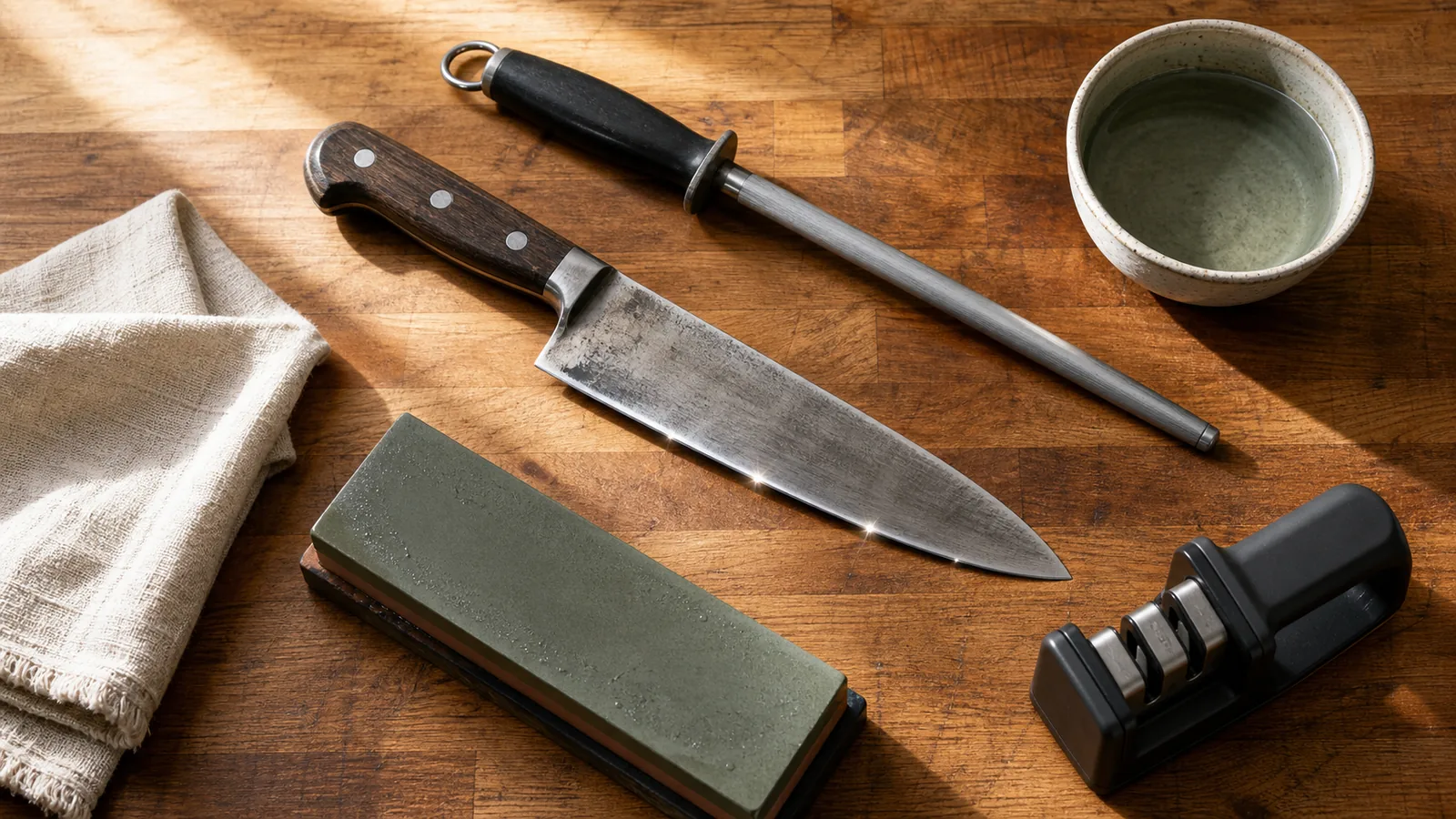
WÜSTHOF confirms that knives can be maintained with a hand-held sharpener, an electric knife sharpener, a honing steel, a sharpening steel, or a whetstone. WÜSTHOF also notes: "Sharpening takes a small amount of steel off the blade, creating a new edge." And Shun states plainly: "Sharpening and honing are not the same."
WÜSTHOF notes that its knives can be maintained with a hand-held sharpener, an electric knife sharpener, a honing steel, sharpening steel, or a whetstone — but the method you choose should match your knife's steel and the current edge condition. Shun advises a more conservative approach: hone regularly, and sharpen only when honing no longer brings the edge back.
What a honing steel does to microscopic edge roll
Under magnification, a knife edge looks like a series of tiny teeth. Every time you use the knife, those teeth bend slightly — toward one side or the other, depending on how you cut and what surface you cut on. The edge "rolls." The knife still has metal there; it's just pointing in the wrong direction.
A honing steel — typically a smooth or lightly ridged rod of harder steel or ceramic — presses those teeth back into alignment as you draw the blade across it at the correct angle. No metal leaves the knife. The edge you had is restored, not replaced.
Angle control is critical here. WÜSTHOF specifies 14 degrees for its standard knives and 10 degrees for Asian-styled knives. The technique: rest the tip of the honing steel on a nonslip surface pointing downward, place the heel of the knife at the top of the steel at the correct angle, and draw the knife down and across with light, even pressure. Shun's honing steel solves the angle problem differently — it includes a built-in angle guide set to 16°, which Shun says "ensures you're honing to the correct angle" without having to estimate.
Pro Tip: Light pressure is the rule for honing. Pressing hard doesn't improve the result and risks bending the edge further. Three to five strokes per side is enough for routine maintenance.
What sharpening removes from a dull blade
When honing stops working — when the performance drop is back within one or two cutting sessions after honing, or when the edge is visibly blunt — you're past realignment. The metal at the edge is either too far gone or missing. Sharpening is the only fix.
WÜSTHOF's explanation is the clearest version: "Sharpening takes a small amount of steel off the blade, creating a new edge." That removal is what makes sharpening more consequential than honing. Every sharpening session slightly shortens the blade's total lifespan. A knife sharpened too aggressively or too often will wear down faster than one that is honed consistently and sharpened only when necessary.
This is why waiting too long to sharpen actually backfires in a different way. A severely blunt edge requires more metal removal to restore — more passes, deeper abrasion, more total steel lost — than an edge caught early when it first stopped responding to honing. The sweet spot is sharpening at the first sign that honing is no longer sufficient, not waiting until the knife is completely useless.
WÜSTHOF's 9-inch Diamond Knife Sharpener is designed for dull or moderately sharp knives. The manufacturer recommends pairing it with a honing steel for daily or weekly maintenance precisely because the sharpener removes metal every time you use it.
How often to hone kitchen knives based on use
WÜSTHOF states directly: "Regularly honing your knife after use is the best way to prevent a dull blade." That's the principle. Translating it into a practical schedule depends on how often you cook, what you're cutting, and what surface you're cutting on.
Honing frequency should follow cooking frequency, not a calendar. A knife that sits untouched for two weeks doesn't need honing. A knife used six nights a week to break down vegetables and proteins does.
Daily cooks, weekly cooks, and occasional cooks
| Cook Type | Profile | Honing Frequency |
|---|---|---|
| Daily cook | Cooks dinner most nights, meal preps on weekends | Hone before or after each session — 4–7x per week |
| Regular home cook | Cooks 3–4 nights per week | Hone every 2–3 uses |
| Weekly meal prepper | One big cook session per week | Hone at the start of each prep session |
| Occasional cook | Cooks 2–4 times per month | Hone before each use; test with the paper test first |
A daily cook who hones consistently will typically need to sharpen far less often than someone who skips honing and only sharpens when the knife stops working entirely. The math is straightforward: regular small corrections prevent large-scale edge failure.
WÜSTHOF's guidance frames honing as a between-session maintenance habit rather than a one-time fix. Shun agrees — their care pages emphasize regular honing as the foundation of edge longevity.
Signs you are honing too late or too often
Honing too late — red flags: - The knife improves after honing but dulls again within one cooking session - You need more than six or seven strokes per side to feel any improvement - The blade skips or catches inconsistently along its length even after honing - You find yourself pressing harder than usual just to complete a cut
Any of these signals means honing is no longer sufficient. Shun says it plainly: "Sharpen only when honing no longer brings the edge back." If you're past that threshold, reach for a sharpener, not the steel.
Honing too often — a smaller problem, but worth noting: There's no real mechanical harm in honing more than needed, since honing removes negligible metal. The risk is confusing honing sessions with actual maintenance. If you hone before every use but never sharpen, and the knife continues to feel dull, you may be masking a sharpening problem with a honing habit. If honing isn't making a noticeable difference, stop honing and sharpen.
How often to sharpen kitchen knives and what changes the schedule
WÜSTHOF recommends: "We recommend using a honing steel for regular maintenance and a sharpening steel when your knife needs an edge reset." That is the practical rule. Sharpening frequency belongs to a condition-based schedule, not a calendar one.
For most home cooks who hone consistently, sharpening a primary chef's knife might happen two to four times per year. For someone who skips honing entirely, that number can jump to monthly. The variable isn't time — it's cumulative edge wear, which depends on use intensity, cutting surface, and blade steel.
Home-cook sharpening frequency by blade type and use
Different blade steels hold and lose edges differently. The same maintenance schedule does not apply across knife types.
| Blade Type | Steel Hardness | Honing Angle | Sharpening Notes |
|---|---|---|---|
| German stainless (WÜSTHOF, Henckels) | Softer, ~58 HRC | 14° per side | Tolerates regular honing well; less prone to chipping; sharpen 2–4x/year with consistent honing |
| Japanese-style (Shun, Global) | Harder, ~60–67 HRC | 10–16° per side | Holds edge longer but chips more easily; use a finer grit; follow manufacturer angle exactly |
| Carbon steel | Varies; often similar to Japanese-style | Match to manufacturer specs | Sharpens easily; may need more frequent honing due to reactivity; follow brand guidance |
WÜSTHOF specifies 14° for standard knives and 10° for Asian-styled knives. Shun's standard edge is 16° per side, with heavier-duty knives sharpened to 22°. These aren't interchangeable — using the wrong angle degrades a precision edge faster than normal use would.
Watch Out: Do not apply a one-size-fits-all sharpening angle across different knife brands. Using a 20° generic sharpener on a Shun knife designed for 16° will change the blade geometry permanently over time. Always check the manufacturer's specified angle for your knife line.
Why premium knives need angle control and slower sharpening methods
A $40 knife and a $200 knife both need sharpening eventually, but the stakes are different. Premium Japanese blades use harder steel ground to precise, narrow angles. That combination delivers an exceptionally sharp, long-lasting edge — but it's also more fragile than a softer German-style blade and more sensitive to angle errors during sharpening.
Shun is explicit about this: "If you choose an electric sharpener other than Shun, please make sure it will sharpen your knives to the correct 16° angle." An electric sharpener with fixed slots set at 20° will blunt a Shun's geometry in a few sessions without you realizing it — you'll just notice the knife never feels quite right.
Watch Out: For high-end blades from Shun, WÜSTHOF, Miyabi, or similar makers, use only sharpening tools specifically designed for your knife's angle. WÜSTHOF also recommends using same-brand sharpeners where possible, so the abrasive material hardness is matched to the blade steel. A whetstone gives you full angle control if you practice — but if you can't maintain a consistent bevel, a professional service is safer than a poorly angled electric sharpener.
Best sharpeners for beginners: whetstone, manual pull-through, or electric
The right sharpener for a beginner is the one that matches the knife's required angle while minimizing the risk of removing too much steel or grinding the wrong bevel. Here's the honest breakdown:
| Tool | Skill Required | Edge Quality | Metal Removed | Best For |
|---|---|---|---|---|
| WÜSTHOF whetstone | Moderate-high | Highest potential | Controlled by user | Enthusiasts, premium knives, long-term use |
| WÜSTHOF manual pull-through sharpener | Low | Moderate | Often more than needed | Beginners with standard home knives |
| WÜSTHOF electric knife sharpener | Low | Consistent but fixed | Can be aggressive | Busy home cooks who want speed |
WÜSTHOF confirms all three are compatible with its knives, and notes its own 9-inch Diamond Knife Sharpener is designed for dull or moderately sharp blades. Shun is more cautious: electric sharpeners must match the blade's correct angle, or you're better off using a honing steel with its built-in guide or sending the knife to a qualified service.
When a whetstone is the best long-term choice
A WÜSTHOF whetstone (also called a sharpening stone) gives you full control over angle, pressure, and how much metal you remove. That control is the reason experienced cooks prefer it — and the reason beginners sometimes avoid it.
The learning curve is real. Maintaining a consistent 14° or 16° angle across the entire length of a blade for multiple strokes takes practice. But once you have it, a whetstone outperforms any fixed-slot sharpener in edge quality and longevity. You're creating the exact edge geometry the knife was designed for, not approximating it through a preset slot.
For premium knives — WÜSTHOF Ikon, Shun Classic, Miyabi Birchwood — a whetstone is the best DIY choice if you're willing to practice. Start with a dual-grit stone (something like 1000/6000 grit) and use a permanent marker on the bevel to check whether you're hitting the right angle: the marker wears off where the stone makes contact. WÜSTHOF lists whetstones among its accepted sharpening methods, and the edge quality they produce justifies the time investment.
Pro Tip: Soak a water-based whetstone for five to ten minutes before use. Draw the blade across the coarser grit first (toward you or away — consistency matters more than direction), then refine on the finer grit. Finish with a few light strokes on a honing steel to realign the edge.
When to choose a manual or electric sharpener
For a beginner with a standard home knife collection — WÜSTHOF Gourmet, a Victorinox Fibrox, or similar workhorse German stainless — a manual pull-through sharpener is the safest starting point. The preset angle does the geometry work for you, the risk of removing excessive metal is lower than with a coarse electric sharpener, and the learning curve is minimal.
Pro Tip: If you go manual pull-through, use it with light pressure and fewer passes than you think you need. Two to three pulls is often enough for a moderately dull knife. Over-pulling removes more metal than necessary.
Electric sharpeners are faster and work well for cooks who want a quick reset without technique practice. The trade-off is that most electric sharpeners use fixed-angle slots, and those angles may not match every knife in your collection. An electric sharpener set at 20° is fine for a German stainless knife designed at that angle. Put a Shun Classic through it and you've permanently altered the blade geometry.
WÜSTHOF's diamond sharpener is designed for dull or moderately sharp knives and is intended as a periodic reset tool, not a replacement for daily honing. The manufacturer's recommendation is to use it alongside a honing steel — sharpen when needed, hone between sessions.
When to stop DIY and send a knife to a professional
Some blade problems are past what a home setup can fix safely or well. If any of these are true, stop and consider a professional sharpening service.
When to Call a Pro: - A visible chip or nick in the blade that is deeper than a surface scratch - A wavy or warped edge that doesn't run straight when viewed from above - Severe, uniform bluntness that doesn't respond after three or four proper sharpening sessions - A high-end knife (Shun, Miyabi, WÜSTHOF Ikon, MAC) where angle precision matters and you aren't confident maintaining it - Any serrated knife — standard home sharpeners can't handle the individual serrations correctly - A knife that has been sharpened at the wrong angle repeatedly and needs the geometry rebuilt from scratch
Professional services use equipment that matches the original edge geometry. Shun operates its own sharpening service and uses the same type of sharpening wheel that put the original edge on the knife. Their wet sharpening process protects blades from the heat buildup that can damage the steel's temper — something dry electric sharpeners don't always manage.
Blade chips, warped edges, and severe dulling
A chip in the edge is a different problem from a dull edge, and it needs to be treated differently.
Red-flag checklist — damage beyond home honing: - Chip or nick: A section of edge is missing, not rolled. Honing cannot fix this; sharpening removes enough metal to get below the chip, which requires significant work and precision - Wavy or uneven edge: The blade doesn't run in a straight line when you look down the spine. This is usually a geometry problem, not just a sharpness problem - Severe uniform dulling: The blade has lost its bevel structure entirely, often from extended neglect or improper sharpening at the wrong angle - Tip damage: A broken or badly bent tip requires professional reprofiling
Repairable at home vs. send it out:
| Damage Type | Home Fix? | Notes |
|---|---|---|
| Rolled edge (normal use) | Yes — hone | Standard maintenance |
| Moderate dulling | Yes — sharpen | Stone or appropriate sharpener |
| Small chip (< 1mm) | Possible — coarse stone | Requires removing metal below the chip; time-consuming |
| Large chip or multiple chips | Professional recommended | Too much metal removal for most home setups |
| Wavy or warped edge | Professional required | Geometry rebuild, not a sharpness issue |
| Severely neglected edge | Professional recommended | May require reprofiling |
Shun's sharpening service re-sharpens knives "on the same type of sharpening wheel used to put the original edge on the knife," using a wet method that protects the blade from overheating. That level of precision matters for high-end blades — overheating during dry sharpening can damage the steel's temper and permanently affect edge retention.
Manufacturer guidance for WÜSTHOF, Shun, and other premium brands
The single most important rule for premium knives: follow the manufacturer's instructions, not generic knife-care advice. Different blade steels and grind styles require different angles and different tools, and generic advice often gets this wrong.
- WÜSTHOF: 14° per side for standard knives; 10° per side for Asian-styled knives. "If sharpening an Asian styled knife, tilt the knife to a 10-degree angle." Use same-brand sharpening tools where possible to ensure hardness compatibility.
- Shun: 16° per side for most knives; 22° for heavier-duty blades. Built-in angle guide on the Shun Honing Steel. Electric sharpeners must be verified to sharpen at the correct angle before use.
- Other Japanese-style knives (Miyabi, MAC, Global): Follow each brand's published angle specifications. Do not assume what works for one Japanese-style knife works for all of them.
Manufacturer instructions override generic advice without exception. A $15 sharpener that works fine on a Victorinox Fibrox may damage a Shun Classic.
Simple kitchen knife maintenance schedule for home cooks
This schedule works for most home cooks with German stainless or Japanese-style knives. Adjust the sharpening frequency based on your blade type and how quickly honing stops working.
Weekly care (every 2–4 uses): 1. Before or after each session, take three to five light strokes per side on a honing steel at the correct angle for your knife brand 2. Run the tomato test if the knife has been sitting unused for more than a week 3. Hand wash and dry immediately — never the dishwasher
Monthly check: 1. Run the paper test 2. If the knife passes cleanly, continue honing only 3. If the paper tears or the knife skips on the tomato, sharpen
Sharpen when: - Honing no longer restores performance between sessions - The paper test fails consistently - The blade shows visible dullness or minor chips - You notice yourself pressing harder than you used to
Annually: - Inspect blade geometry — look for waviness along the edge - Consider professional sharpening if the knife has heavy use or is a premium blade
After-each-use care that protects the edge
The fastest way to dull a knife is to put it in the dishwasher or let it air-dry wet. Neither is a sharpness problem at first — but both accelerate edge wear and blade corrosion over time.
- Wash by hand with warm water and a small amount of dish soap. Don't soak.
- Dry immediately with a dish towel. Water sitting on high-carbon or carbon steel blades causes rust; even stainless steel can develop water spots or pitting over time.
- Don't stack in a drawer without protection — blade-on-blade contact chips edges.
- Store in a knife block, on a magnetic strip, or in blade guards to keep edges from contacting hard surfaces.
Storage, cutting boards, and habits that slow dulling
Where and how you store a knife matters almost as much as how you sharpen it. And the cutting surface you use affects how fast the edge rolls.
Best storage options: - A knife block keeps blades separated and protected; horizontal or slotted versions that insert with the edge up prevent the edge from dragging on wood as you insert and remove - A magnetic wall strip is excellent for access and edge protection — just make sure the magnet is strong enough to hold the knife securely without the blade sliding - Blade guards or sheaths work for drawer storage when a block isn't practical
Cutting board choices: - End-grain wood boards are the best choice for edge longevity — the blade slips between the wood fibers rather than dragging across them - Plastic boards are serviceable and easy to sanitize; they're harder on edges than end-grain wood but better than many alternatives - Glass, ceramic, stone, and marble will destroy an edge in one session. Never cut on these surfaces
Habits that cost you edge life: - Scraping food off the board with the blade's edge instead of the spine - Cutting on dinner plates or countertops - Leaving knives in a pile in a drawer - Dishwashing (heat, detergent, and rattling all degrade the edge and handle)
WÜSTHOF's guidance consistently frames honing after use as the most important single habit — not storage, not cutting board choice, not anything else. Get that right and everything else is optimization.
FAQ about honing, sharpening, and knife edge care
Can you sharpen a knife too much?
Yes, and it's a real concern. Every sharpening session removes a small amount of steel from the blade. That's not a problem when sharpening is necessary — a new edge is worth the metal cost. But sharpening unnecessarily, or at the wrong angle, removes steel that didn't need to go. Over years of aggressive or too-frequent sharpening, a blade narrows and shortens noticeably.
The fix is straightforward: hone often, and sharpen only when honing stops working. A home cook who hones consistently may sharpen a primary knife just two or three times per year. That's the correct rhythm — not because of a calendar rule, but because the knife simply doesn't need more than that.
What knives should not be honed on a steel?
Serrated knives should not be honed on a standard smooth or ridged steel. The serrations require a tapered ceramic rod or a specialized serrated sharpener to work each individual tooth. Standard honing steels flatten the serrations rather than maintaining them. Shun's sharpening service can hone serrated knives but specifically notes it cannot sharpen them — the geometry requires professional equipment.
Single-bevel knives (common in traditional Japanese knife making) should not be honed on a standard steel — they require a specialized technique that maintains only one side of the bevel.
When in doubt, check the manufacturer's care instructions. For WÜSTHOF, honing on a honing steel is recommended for maintenance. For Shun, use the brand's own honing steel with the built-in angle guide. Manufacturer exceptions override general advice.
Is sharpening with a whetstone better than an electric sharpener?
It depends on the knife and your skill level, and neither answer is universal.
A whetstone gives you complete control over angle and pressure, which means a skilled user can produce an edge that outperforms what most fixed-slot electric sharpeners deliver. For premium Japanese-style knives with precise angle requirements, a whetstone is often the better choice — or professional service, if you can't maintain the angle consistently.
An electric sharpener is faster, requires less skill, and works well for standard home knives where angle precision is less critical. The trade-off: if the sharpener's fixed angle doesn't match your knife's designed bevel, you're slowly changing the geometry every time you sharpen.
For most beginners with a standard home collection of German stainless knives, a quality manual pull-through or electric sharpener from the same brand as the knife is the safe starting point. For anyone with a Shun, Miyabi, or high-end WÜSTHOF line, a whetstone with practice — or a professional service — will protect the blade better than a generic electric slot sharpener. The question to ask before buying any sharpener: does it sharpen at the angle my knife was designed for?
Sources & References
- WÜSTHOF — How to Sharpen Your WÜSTHOF Knives — Primary manufacturer guidance on honing vs sharpening, sharpening methods, and edge maintenance
- WÜSTHOF — Edge Care Collection — Honing frequency and maintenance philosophy
- WÜSTHOF — 9-inch Diamond Knife Sharpener — Tool specifications and use guidance
- WÜSTHOF — 9-inch Fine Diamond Knife Sharpener — Metal removal details and maintenance pairing recommendations
- Shun — Sharpening vs Honing — Manufacturer explanation of the distinction and when each applies
- Shun — FAQ — Angle specifications, honing steel guidance, and electric sharpener compatibility
- Shun — Sharpening Service — Professional service details, serrated knife policy
- Shun — Sharpening Q&A — Wet sharpening process, overheating risk, and original edge restoration
- Shun — Use and Care — Edge angle specifications by knife line
- Consumer Reports — Sharpening a Knife — Safety note on dull knife risk
Keywords: WÜSTHOF knife care, honing steel, sharpening stone, whetstone, manual pull-through sharpener, electric knife sharpener, rolled edge, chipped blade, blade bevel angle, German stainless steel, Japanese-style knife, carbon steel, stainless steel, professional sharpening service, knife block