How much does interior painting cost for a room refresh?
A single-room interior paint job in the US typically runs between $350 and $850 for a standard-sized room when you hire a professional — but that range can stretch well above (1,000 once you add ceiling work, trim, wall repairs, or texture. The honest starting point is the Homewyse's January 2026 interior painting calculator, which lists a baseline of )4.79 to $9.04 per square foot for interior painting. That figure is a benchmark for readily serviceable conditions; local labor, room condition, and scope still move the total a long way.
Cost Snapshot: Homewyse January 2026 interior painting baseline: $4.79–$9.04/sq ft. A typical 12x12 room: $350–$850 for walls only. Full room with ceiling and trim: $525–$1,125+, depending on local labor, room condition, and scope.
Homewyse is direct about the limits of its tool: it says "actual costs vary significantly with the job size, conditions, local labor rates, schedule difficulty, high-demand professional service providers, premium materials, and project supervision." Translation — a calculator gives you a benchmark, not a budget. Your actual cost depends on where you live, what your walls look like, and how complicated the job is. An interior painting service in Austin, TX will cost materially less than the same scope of work in San Francisco or New York. Always get written quotes — no calculator replaces that step.
What does it cost to paint a 12x12 room?
A 12x12 room is the closest thing to a "standard" bedroom in American homes, and it's the most common benchmark painters and homeowners use when talking about per-room costs. According to Fixr, professional room painting ranges from $300 to $1,750 depending on size, dimensions, and scope — and a 12x12 room typically lands in the lower-to-middle portion of that range for walls-only work. For a quick answer: expect about $350–$700 for walls only and about $525–$1,125 for walls plus ceiling and trim on a standard 12x12 room.
Connecting the per-square-foot baseline to a real number requires a little arithmetic that most calculator pages skip. Here's how to do it yourself, and what the two most common scopes actually cost.
Pro Tip: When requesting quotes, always specify whether you want walls only, or walls plus ceiling and trim. These are treated as separate scopes by most painters, and combining them on a single estimate will get you a meaningfully different price than asking for each piece separately.
12x12 room estimate for walls only
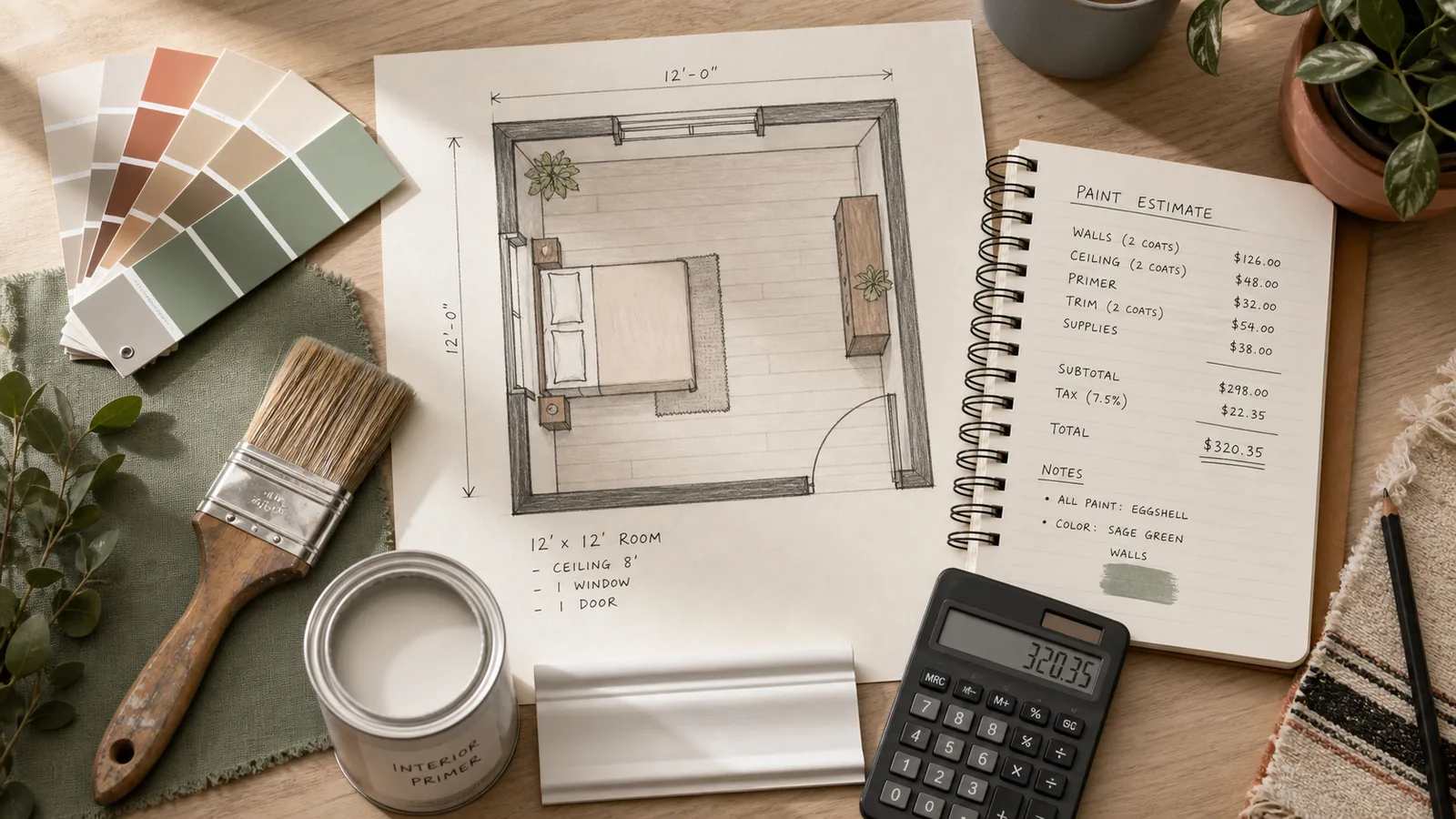
A 12x12 room with 8-foot ceilings has roughly 384 square feet of wall area before deductions (four walls × 12 feet each × 8 feet high = 384 sq ft; after subtracting a standard door and one window, a usable painting area often lands near 320–350 sq ft). Applied to the Homewyse baseline of $4.79–$9.04 per square foot, that calculation would overstate a single-room refresh because the tool is built for broader project pricing. A more realistic walls-only estimate for a standard 12x12 room is $350–$700, which fits the lower end of Fixr's room-painting range.
Simple calculation pattern:
- Wall area: 384 sq ft gross
- Usable wall area after door/window deductions: about 320–350 sq ft
- Practical walls-only refresh: $350–$700 for two coats in average condition
For a single-room refresh on walls only, most professional painters work from a flat-room rate rather than a strict per-square-foot calculation. That's why real-world single-room quotes for a standard 12x12 more often land in the $350–$700 range for two coats of latex paint in average condition — closer to the lower end of Fixr's $300–$1,750 room-cost range.
One variable that can change the coat count: a significant color change, such as going from deep red to pale gray, often requires a coat of primer plus two finish coats instead of the standard two-coat application. That adds material cost and time, which painters pass on. If your room needs a dramatic color shift, budget toward the higher end of that range.
12x12 room estimate with ceiling and trim
Adding ceiling and trim painting to a 12x12 room typically pushes the total cost $150–$400 higher than walls alone, depending on ceiling finish complexity and the linear footage of baseboard and trim.
For a standard flat ceiling in a 12x12 room (144 sq ft), expect to pay roughly $75–$175 for ceiling paint and labor at normal ceiling heights. Fixr notes that vaulted ceilings run $2–$4 per sq ft for paint work, reflecting the added difficulty of ladders, extension poles, and slower application. A standard 8-foot flat ceiling costs less — it's the vaulted or coffered versions that drive cost up sharply.
Trim and baseboards are priced separately by most painters. Homewyse maintains a dedicated trim molding calculator, which reflects the fact that trim work carries its own labor overhead: masking, cutting in at edges, and typically a semi-gloss or gloss finish that requires more care than flat wall paint.
Combined estimate — 12x12 room, walls + ceiling + trim:
| Scope | Estimated Cost Range |
|---|---|
| Walls only (2 coats) | $350–$700 |
| Add ceiling (flat, 8 ft) | $75–$175 |
| Add trim and baseboards | $100–$250 |
| Full room total | $525–$1,125 |
If your paint contractor leads are quoting outside that range, ask them to itemize — the line items tell you where the money is going.
Interior painting cost breakdown by line item
Most competitor cost pages give you one number and call it a day. That's not useful when you're planning a budget, because a professional interior painting service involves multiple distinct cost buckets, and knowing which bucket is driving the price tells you where you have negotiating room — and where you don't.
Below is a realistic line-item breakdown for a professional house painting service on a standard 12x12 room. These are practical ranges drawn from contractor data and industry sources.
CostBreakdown — professional paint job, 12x12 room:
| Line Item | Estimated Cost Range | Notes |
|---|---|---|
| Labor | $200–$500 | Dominant cost; Fixr reports painter labor at $25–$100/hr per painter |
| Primer | $20–$45 | One gallon covers roughly 350 sq ft; required for new drywall, stain-blocking, or dramatic color changes |
| Paint (finish coat) | $35–$80 per gallon | Two coats typically require 1.5–2 gallons for a 12x12 room |
| Supplies (brushes, rollers, tray, caulk) | $25–$60 | Consumables for setup and application |
| Painter's tape and drop cloths | $15–$30 | Masking and floor protection |
| Furniture moving | $0–$75 | Some painters include it; many don't — clarify upfront |
| Wall repair (minor) | $50–$150 | Nail holes, small dents, hairline cracks — see wall repair section below |
| Trim and baseboards | $100–$250 | Separate scope |
| Ceiling | $75–$175 | Standard 8-ft flat ceiling |
| Cleanup and disposal | Often bundled | Confirm in writing |
| Estimated total | $525–$1,125 | Walls, ceiling, trim, and typical prep in average condition |
One important number from Homewyse: if a general contractor supervises the project rather than the painting crew working directly with you, expect general contractor overhead and markup of 13% to 22% added to the job total. On a $700 project, that's an additional $91–$154.
Prep work and furniture moving
Prep is where professional painting jobs earn their keep — and where DIY painters most often underestimate what they've signed up for.
A proper prep sequence for a room refresh includes:
- Clearing and moving furniture (or pushing it to the center and covering it)
- Masking trim, outlets, and switch plates with painter's tape
- Laying drop cloths over floors and furniture
- Cleaning walls to remove grease, dust, and grime (critical in kitchens and near doors)
- Filling nail holes and small dents with spackle and sanding smooth
- Recaulking around window frames, door casings, and where wall meets baseboard
- Cleanup and tape removal after the paint dries
Watch Out: Homewyse's baseline calculator assumes "readily serviceable conditions" — meaning clean, smooth walls with no significant repairs needed. If your room has moderate or heavy prep requirements, a calculator output will underestimate your actual cost. Always describe your wall condition in detail when requesting quotes.
Many professional painters include basic tape, drop cloths, and cleanup in their labor rate. Furniture moving is less consistent — some painters charge a flat fee of $50–$75 to move and replace heavy pieces; others require the room to be cleared before they arrive. Confirm this in writing before the job starts.
Primer, paint, and supplies
Materials typically account for 20–35% of a professional painting estimate for a single room; the majority of the cost is labor. For a DIY project, that ratio flips — your cash outlay is almost entirely materials, and your "labor" is your own weekend hours.
Materials breakdown — 12x12 room:
- Interior latex paint: quality products from Sherwin-Williams, Benjamin Moore, or Behr are common choices for a room refresh, and the finish you pick matters as much as the brand. Cheaper paints often require more coats, which erases the savings.
- Interior primer: $20–$40/gallon for a standard water-based option; skip primer only if the walls are already the same color in decent condition.
- Roller covers (3/8" nap for smooth walls, 1/2" for light texture): $5–$12 each
- Angled sash brush (2.5" for cutting in): $8–$18
- Roller frame and tray: $10–$20
- Painter's tape (3M ScotchBlue 1" and 2"): $7–$12 per roll
- Caulk (latex paintable): $4–$8 per tube
- Spackle and putty knife: $8–$15
Total materials for a basic DIY room refresh: $100–$200, depending on paint quality and whether you already own supplies.
Wall repair, trim, ceiling, and texture adders
These are the line items most likely to surprise you — because they're rarely included in a baseline calculator estimate.
Drywall repair: Minor nail holes and small dents ($50–$150 added to a pro job) are manageable repairs any painter can handle. But cracks longer than a few inches, water-stained drywall, or soft/bubbling sections are signs of something larger. A drywall patch for a 4x4-inch section typically adds $100–$200 to the job; larger repairs can cost $300 or more and may require a separate drywall contractor.
Trim and baseboard painting: Priced separately, as noted above. Detailed Victorian or craftsman trim with multiple profiles takes longer to mask and cut in than simple flat baseboards, so labor goes up with complexity. Budget $100–$250 for a 12x12 room with standard trim.
Ceiling painting: Standard flat 8-foot ceiling adds $75–$175. Vaulted ceilings add $2–$4 per sq ft to the ceiling-specific cost — a 12x12 vaulted ceiling could run $175–$350 on its own because of the ladder work involved.
Texture upgrades: Knockdown, orange peel, or skip-trowel texture applied before painting is a separate trade task. Expect to add $1–$2.50 per sq ft for texture application, which means a 12x12 room's walls could add $300–$800 before paint even touches them. Homewyse explicitly excludes code-compliance repairs and hazardous-material remediation — so if your texture contains asbestos (common in homes built before 1980), testing and abatement costs are entirely separate and can be substantial.
What Homewyse's baseline interior painting estimate excludes
The Homewyse calculator is useful for getting your bearings, but treating it as a quote is a budgeting mistake. Homewyse's room-painting calculator explicitly lists what its estimate does not include, and the exclusions matter.
Watch Out: Homewyse's room-painting calculator says its estimate does not include "general contractor overhead and markup," "sales tax on materials and supplies," or "permit or inspection fees." The calculator also excludes hazardous-material testing and remediation, code-compliance repairs, schedule difficulty, premium materials, and project supervision.
- General contractor overhead and markup (13%–22% of project cost if a GC supervises)
- Sales tax on materials and supplies
- Permit or inspection fees (rare for interior painting, but applicable in some jurisdictions for rental properties or commercial spaces)
- Hazardous-material testing and remediation (lead paint, asbestos in texture coatings)
- Code-compliance repairs (failing drywall, water-damaged substrates)
- Work outside the stated scope (anything not explicitly in the calculator's assumptions)
- Schedule difficulty (last-minute bookings, premium-demand contractors, tight access)
- Premium materials (high-end paint brands, specialty finishes)
- Project supervision (GC coordination time)
The overhead and markup line is worth pausing on. If you hire a painting subcontractor through a general contractor — say, as part of a larger renovation — that 13%–22% markup is real money. On a $1,000 painting job, you're looking at $130–$220 in added cost just for the GC's involvement. Hiring a painting crew directly, without a GC layer, eliminates that markup.
Homewyse recommends getting written quotes from trade professionals, and that's the right call. A calculator tells you what the job might cost in an average market under average conditions. A quote tells you what your job will cost given your specific room, your walls, and your local labor market.
Which factors push interior painting cost up or down?
The single-room price range is wide — $300 to over $1,500 — because room conditions, scope, and location vary enormously. Fixr notes that interior painting costs vary based on square footage, paint type, wall condition, and ceiling height. Here's how each factor plays out in practice.
Room condition and wall prep level
Wall condition is the factor most likely to turn a $500 job into a $900 job. Most contractors mentally sort rooms into three prep tiers:
Basic prep — Walls are clean, smooth, and recently painted. Minor touch-up caulking, a few small nail holes, and standard masking. Minimal added cost; this is what the Homewyse baseline assumes.
Moderate prep — Multiple nail holes, minor scuffs, some hairline cracks at corners, outdated color requiring a primer coat. Adds $75–$200 to the job total, depending on how much spackle and sanding time is involved.
Heavy prep — Smoke or water staining, peeling paint, multiple layers of old paint, significant cracking, or badly patched repairs. Adds $200–$500 or more, and may require a dedicated prep visit separate from the painting day. Some heavy-prep rooms cross into repair territory (see the "When should a room refresh become a repair project?" section below).
Smoke stains and grease require a stain-blocking primer (like Zinsser BIN shellac-based or Kilz Premium) before any finish coat will stick. Skipping that step means the stain bleeds through within weeks. Good painters won't skip it — but make sure the bid explicitly includes it.
Ceiling height, trim complexity, and number of coats
A standard 8-foot ceiling is a painter's baseline. Everything above 8 feet adds time, because it requires taller ladders, extension poles, slower movement, and more fatigue. A 10-foot ceiling might add 15–20% to labor cost; a vaulted ceiling — especially one with angles or dormers — can add 30–50% or more. Fixr's ceiling painting data puts vaulted ceiling work at $2–$4 per sq ft, and painter labor runs $25–$100 per hour per painter, so a vaulted ceiling that takes two extra hours adds real dollars fast.
Trim complexity works the same way. Flat modern baseboards take 20–30 minutes to mask and cut in for a standard room. Craftsman or Victorian profiles with multiple edges and coves take significantly longer — and if you want the trim in a different sheen from the walls (common — flat or eggshell for walls, semi-gloss for trim), the painter has to let edges dry before moving on, which adds to the job timeline.
Number of coats is driven by paint quality and color change magnitude. A like-for-like refresh in the same color or a lighter shade often works in two coats. Going from dark to light, or using a low-coverage budget paint, can require three coats — adding one gallon of paint and 30–60 minutes of labor per room.
DIY vs professional interior painting cost
DIY is cheaper on paper — but the honest comparison includes time, learning curve, quality risk, and what happens if the prep isn't done right.
| Factor | DIY | Professional |
|---|---|---|
| Total cost (12x12 room) | $100–$200 | $350–$1,125 |
| Time required | 6–14 hours (spread over 2 days) | 4–8 hours (one crew visit) |
| Skill level | Beginner-friendly with patience | Experienced, warranted work |
| What's included | Materials only; your labor is free | Labor, setup, protection, application, cleanup |
| Quality risk | Lap marks, holidays, uneven edges | Minimal if contractor is vetted |
| Best for | Budget-constrained, patient DIYers | High-visibility rooms, complex prep |
DIY vs Pro: DIY makes sense for a low-stakes bedroom refresh with smooth walls, a simple color change, and no furniture you can't move yourself. Hire a pro for living rooms, primary bedrooms, any room with water damage history, or anywhere you want a clean finish you'll be happy with for five-plus years.
What DIY painting usually costs
Your cash outlay for a DIY 12x12 room refresh is mainly paint and supplies. Budget roughly:
- Paint (1.5–2 gallons, mid-range brand): $55–$120
- Primer (if needed): $20–$40
- Roller, brushes, tray, drop cloth: $30–$50 (or $0 if you own them)
- Painter's tape: $10–$20
- Spackle, caulk, sandpaper: $15–$25
DIY total: $130–$255 for a standard room with no wall repair needs. If you need a gallon of stain-blocking primer or more spackle, add $30–$60.
The hidden cost of DIY is time and quality. A first-time DIY paint job often takes two full days: one for prep and primer, one for finish coats. Professional crews move faster because they work together, they've mastered efficient masking, and they know when a surface is ready for the next coat without guessing.
What professional painting usually includes
A reputable professional painter's estimate should include:
- Surface prep (masking, taping, drop cloths, minor filling)
- Primer coat (when needed — confirm if it's included or priced as an add-on)
- Two coats of finish paint on all agreed surfaces
- Cut-in work at ceiling lines, corners, and trim edges
- Roller application on wall fields
- Touch-ups before they leave
- Cleanup and tape removal
- Disposal of paint and materials
What's often not included unless you ask: furniture moving, ceiling painting, trim painting, wall repair beyond minor holes, and premium paint (many painters have a standard allowance and upcharge for premium brands). Get every inclusion in writing.
When should a room refresh become a repair project?
A refresh assumes the walls are fundamentally sound — just tired, dated, or the wrong color. When the walls themselves are failing, painting over the problem doesn't fix it; it hides it briefly and then looks worse than before.
When to Call a Pro: Stop treating it as a refresh and get a repair-first estimate if you see any of these in the room you're planning to paint:
- Peeling or bubbling paint — almost always a moisture problem underneath; painting over it will peel again within weeks
- Soft, crumbling, or swollen drywall — indicates water damage; the damaged section needs to be cut out and replaced before priming
- Brown or yellow water stains — the leak must be fixed and the area must dry completely (often 48–72 hours minimum) before a stain-blocking primer and repaint
- Mold or dark spotting behind or through paint — requires remediation before any cosmetic work; painting over mold is a health hazard and a code violation in many jurisdictions
- Cracks wider than 1/8 inch or cracks that keep reopening — may indicate structural movement; get a contractor's assessment before spending money on paint
- Texture that crumbles when touched in older homes — may contain asbestos; do not sand or scrape; get it tested before disturbing it
Finding paint contractor leads who specialize in both painting and minor drywall repair saves a phone call — most painting contractors handle small-to-moderate repairs. For water damage, structural cracks, or mold, you need a dedicated remediation or drywall contractor before the painter steps in.
How to get 3 to 4 painting quotes and compare them
Getting a single quote and accepting it is how homeowners overpay for mediocre work. Getting three to four quotes gives you a realistic price range for your specific project and surfaces the contractors who are cutting corners in their bid to win the job.
When requesting quotes, give every painter the same information: room dimensions, ceiling height, number of walls, scope (walls only vs. walls plus ceiling and trim), a description of wall condition, and whether furniture will be cleared or needs to be moved. Inconsistent information produces incomparable bids.
Pro Tip: Request your quotes within the same two-week window. Labor markets and material costs shift — a quote from January compared to one from March may not reflect the same market conditions.
Questions to ask in a painting estimate
Before you sign anything, ask each painter these questions directly:
- What specific surfaces are included in this price? (Walls, ceiling, trim — be precise)
- Does this include primer, or is that an add-on?
- What paint brand and product are you using, and can I see the spec sheet?
- How many coats are in the bid?
- What prep work does the bid include? (Spackle, caulk, sanding, furniture moving)
- How do you handle discoveries — like finding water damage or failing drywall once the job starts? (What's the change-order process?)
- What is your payment schedule? (A contractor demanding 100% upfront is a red flag; 30–50% deposit, balance on completion is standard)
- Do you carry liability insurance and workers' compensation? (Ask for proof — you're liable for injuries on your property if they don't)
- What's your warranty or callback policy if something looks wrong after the job?
How to compare apples-to-apples bids
The lowest bid is often the cheapest for a reason. Before you assume the lowest number is the best deal, check each bid for these common omissions:
- No mention of primer — leaving it out saves time and materials, but means the paint may not adhere properly on bare drywall or stained walls
- "Labor only" or "customer supplies paint" — shifts material quality risk to you; some painters prefer this to protect their margin
- Vague language like "prep as needed" — this is a blank check for skipping prep; require a specific list
- No mention of how many coats — two coats should be the baseline; one coat is rarely sufficient
- No cleanup or disposal language — you'd be surprised how often painters leave tape, plastic, and paint cans behind
- No paint brand specified — "quality paint" is meaningless; get the brand and product name
If two bids are within 10% of each other and both include the same scope, materials, and prep, the lower one is probably fine. If one bid is 40% lower than the others, it's almost certainly missing something — ask what.
FAQ about interior painting costs
How much does it cost to paint a room in the US?
Fixr reports that professional room painting in the US ranges from $300 to $1,750, with a standard bedroom on the lower end and larger or more complex rooms toward the top. For a 12x12 room under average conditions with two coats of latex paint on walls only, most homeowners pay $350–$700. Room condition is the biggest variable — a room that needs heavy prep or repairs can push past $1,000 before the finish coat goes on.
Does trim and ceiling painting cost extra?
Yes — almost always. Most professional painters treat walls, ceiling, and trim as separate scopes, and a standard quote will specify which surfaces are included. Ceiling painting on a standard flat 8-foot ceiling typically adds $75–$175; trim and baseboards add $100–$250 for a 12x12 room. Vaulted ceilings run $2–$4 per sq ft for paint work alone. If your quote doesn't explicitly list ceiling and trim, assume they're not included.
How much of the price is labor versus materials?
In a professional estimate, labor typically makes up 65–80% of the total cost. Painter labor runs $25–$100 per hour per painter, and most single-room jobs take one to two painters four to six hours including setup and cleanup. Materials — primer, paint, tape, drop cloths, caulk — account for the remaining 20–35%. In a DIY project, that ratio reverses: your cash outlay is almost entirely materials ($100–$200), and labor is your own time.
What room conditions make interior painting more expensive?
The four biggest cost multipliers in order of impact:
- Heavy wall prep — smoke staining, peeling, multiple old layers, or significant cracking adds $200–$500+ before the paint brush comes out
- Tall or vaulted ceilings — anything above 8 feet increases access time and slows labor, raising cost 15–50% depending on height
- Dramatic color change — going from a dark to a light color (or vice versa) requires primer plus extra coats, adding one gallon of material and 30–60 minutes per room
- High local labor market — painter rates in major metros like New York, San Francisco, or Boston run toward $75–$100/hour; smaller markets may see $25–$45/hour for comparable work
Sources & References
- Homewyse Interior Painting Calculator (January 2026) — Baseline $4.79–$9.04/sq ft estimate with explicit exclusions and scope notes
- Homewyse Cost to Paint Rooms Calculator — Exclusion list including GC overhead (13–22%), sales tax, permits, and hazardous-material costs
- Homewyse Cost to Paint Trim Molding — Separate trim scope pricing framework
- Fixr: Cost to Paint a Room — National range $300–$1,750 by room size and dimensions
- Fixr: Cost to Paint a House — Whole-home interior painting cost factors including square footage, paint type, wall condition, and ceiling height
- Fixr: Cost to Paint a Ceiling — Vaulted ceiling range $2–$4/sq ft
- Fixr: Painter Cost — Painter labor rate $25–$100/hour per painter
Keywords: Homewyse January 2026 calculator, $4.79 to $9.04 per square foot, 12x12 room, 8-foot ceiling, interior primer, latex paint, trim and baseboards, ceiling paint, wall patching, textured walls, drywall repair, furniture moving, painter's tape, professional labor, DIY materials