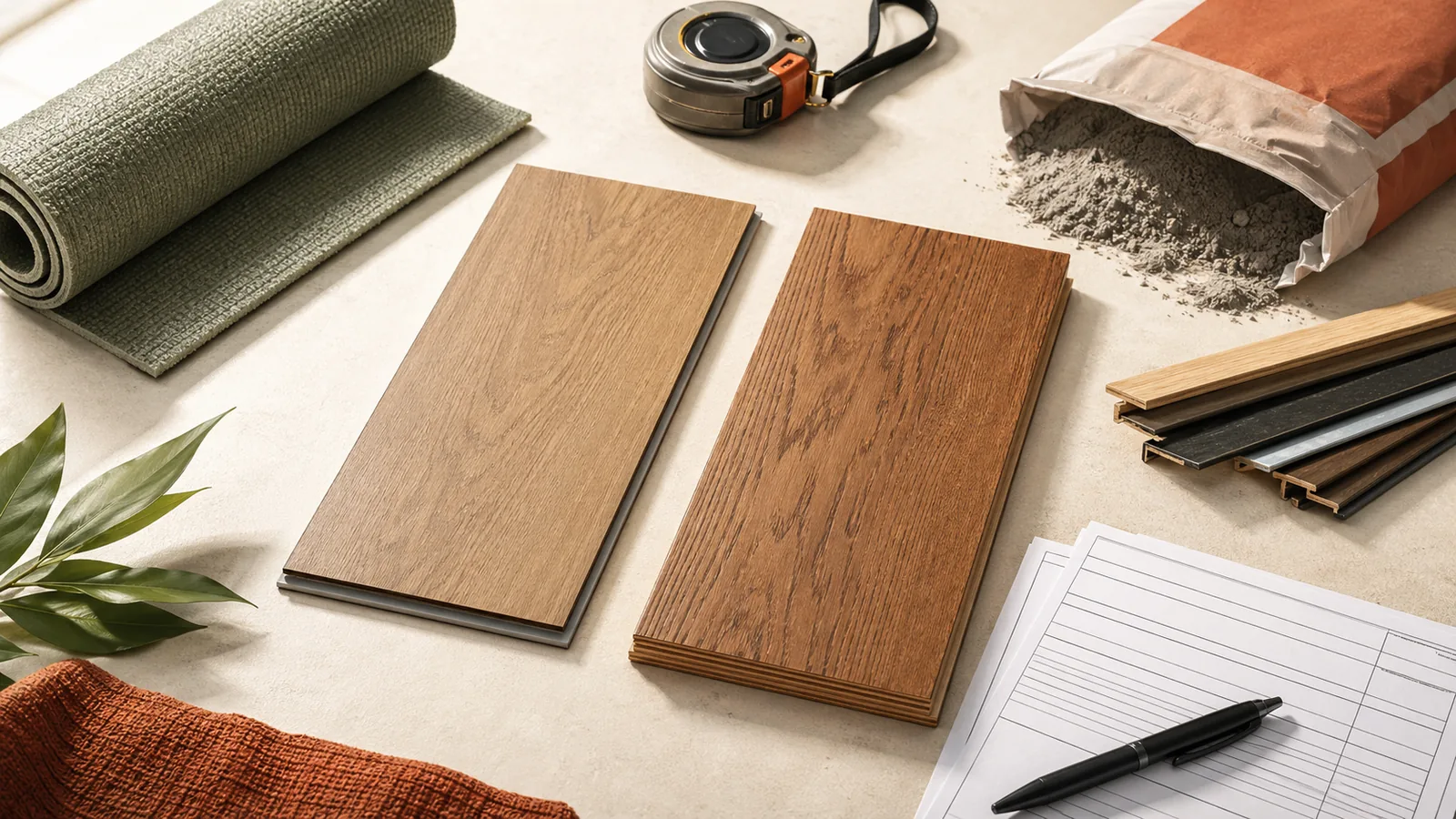
Luxury vinyl plank runs $6–$12 per square foot installed. Engineered hardwood runs $10–$22 per square foot installed. On a 1,500 sq ft whole-house project, that gap can mean $6,000–$15,000 more for wood — before you factor in the subfloor prep, old floor removal, transition kits, and disposal fees that routinely push both projects 15–25% over the initial quote. This article breaks down every line item so you can build a realistic budget, compare contractor bids on equal footing, and decide which floor actually makes financial sense for your home.
LVP vs. engineered hardwood installation cost in 2026
Cost Snapshot: LVP installed: $6–$12/sq ft | Engineered hardwood installed: $10–$22/sq ft | Labor: 40–50% of total project cost
Per ConstructionCalcHub flooring cost data, the fully installed cost for LVP averages $6–$12 per square foot in 2026, while engineered hardwood averages $10–$22 per square foot. On a standard 1,500 sq ft home, that translates to a total project cost of roughly $9,000–$18,000 for LVP and $15,000–$33,000 for engineered hardwood.
Quick comparison snapshot:
| LVP | Engineered Hardwood | |
|---|---|---|
| Installed cost (per sq ft) | $6–$12 | $10–$22 |
| 1,500 sq ft project total | $9,000–$18,000 | $15,000–$33,000 |
| Labor share of total | 40–50% | 40–50% |
| DIY-friendly? | Yes, for most installs | Rarely recommended |
| Refinishable? | No | Yes (1–3 times) |
The ranges are wide because material grade, subfloor condition, regional labor rates, and project complexity all move the number. The single most important takeaway: labor accounts for 40–50% of your total project cost, which means the flooring you see on the showroom floor at Floor & Decor is only half the story. A professional flooring installation service bid that itemizes labor separately is the only way to compare quotes accurately.
Installed cost breakdown by line item
Most flooring quotes homeowners receive online or over the phone are materials-only estimates — sometimes called "supply and install" quotes that bundle labor but exclude subfloor prep, disposal, and trim. The result is a number that looks manageable until the installer shows up and discovers your subfloor needs leveling. Subfloor preparation is the single most common variable that pushes projects over the initial bid by 15–25%, and it is rarely included in a first quote.
Here is the cost hierarchy to expect on a real bid: Materials and labor make up the base project, then subfloor prep and disposal push the total upward, and trim or transition work finishes the job. On a 1,500 sq ft project, that hidden 25% overage usually lands in the $2,250–$6,000 range, depending on the floor condition and how many doorways and edges are involved.
The "Hidden 25%" breaks down across five categories that should appear as separate line items on every legitimate bid:
Full line-item cost breakdown (1,500 sq ft project, national averages):
| Line Item | LVP | Engineered Hardwood | Notes |
|---|---|---|---|
| Materials (flooring) | $2–$7/sq ft | $5–$14/sq ft | Grade-dependent |
| Labor (installation) | $2–$4/sq ft | $3–$8/sq ft | 40–50% of total |
| Subfloor prep/leveling | $1–$3/sq ft | $1–$3/sq ft | Most common overrun trigger |
| Moisture-barrier underlayment | $0.25–$0.75/sq ft | $0.50–$1.00/sq ft | Must be itemized in writing |
| Old floor removal/disposal | $1–$2/sq ft | $1–$2/sq ft | Non-negotiable if floor exists |
| Trim, baseboard, transition kits | $200–$600 flat | $300–$800 flat | Scales with doorways and stairs |
Watch Out: A quote that shows only a single "supply and install" number with no line items is a red flag. You have no way to know whether subfloor prep, underlayment, or disposal are included — and those omissions are exactly where change orders are born.
Materials cost: LVP planks, engineered boards, and underlayment
LVP materials range from $2–$7 per square foot, with budget-tier options from LifeProof flooring at Home Depot and Smartcore at Lowe's sitting at the lower end, mid-range products from Shaw Floorte vinyl flooring and COREtec luxury vinyl running $3–$5 per square foot, and premium wide-plank options from Mohawk flooring reaching $6–$7 per square foot. If you want a quick shopping shortcut, the LifeProof rigid core collection is a practical value pick for bedrooms and hallways, while COREtec Plus gives you a thicker premium build for busy main rooms.
Engineered hardwood materials run $5–$14 per square foot for the boards alone. Entry-level options from Shaw and Mohawk start around $5–$6; mid-grade products with 3mm+ wear layers and wider boards run $7–$10; premium options in species like white oak or hickory with hand-scraped or wire-brushed finishes push $11–$14 per square foot. For a higher-end shopping comparison, Shaw engineered hardwood collections and Mohawk engineered wood flooring are common starting points for homeowners who want a wider plank and a more convincing wood look.
Underlayment is not optional — and it is not always included. Both floor types require an underlayment layer, but the specs differ:
- LVP: Many products from COREtec and LifeProof come with underlayment pre-attached. If yours does not, a basic foam underlayment runs $0.25–$0.40 per square foot. If your install is over concrete (basement, slab), you need a moisture-barrier underlayment — a 6-mil poly vapor barrier or a combination foam/moisture-barrier product at $0.50–$0.75 per square foot. Confirm the exact moisture-barrier product, brand, and cost on the contractor quote in writing before you sign, because a contractor who says "standard underlayment included" is not the same as one who specifies a vapor barrier.
- Engineered hardwood: Requires a felt or foam underlayment at $0.50–$1.00 per square foot. Over concrete, a moisture-barrier underlayment is non-negotiable — moisture vapor transmission can void your hardwood warranty. Ask the contractor to specify the brand and spec (e.g., Roberts 70-193 or similar) in the quote, and make sure the underlayment line is itemized rather than assumed.
Pro Tip: When shopping at Home Depot or Floor & Decor, ask the sales associate whether the specific LVP you're considering has attached underlayment. If it does, you can subtract that line from your contractor bid — it's one of the few places where a product upgrade actually simplifies the install.
Labor cost: why installation can be 40% to 50% of the total
At a Glance: Labor typically makes up 40–50% of the finished project, and engineered hardwood usually lands closer to the top of that range because the install is slower and more technical.
Labor consistently eats 40–50% of the total project cost, which surprises most homeowners who focus on per-square-foot material pricing. On a $15,000 engineered hardwood project, $6,000–$7,500 is labor. Here's why:
Why labor costs what it does:
- Engineered hardwood installation is slower than LVP. Nail-down and glue-down methods require specialized tools (flooring nailers, tapping blocks, pull bars) and technique. An experienced installer can lay 300–400 sq ft of click-lock LVP per day; the same installer may only complete 200–300 sq ft of nail-down engineered hardwood.
- Acclimation time — engineered hardwood must sit in the room for 48–72 hours before installation — is unpaid staging time the installer must schedule around.
- Engineered hardwood requires precise moisture testing of both the subfloor and the boards before installation begins.
Labor vs. material split (1,500 sq ft example):
| LVP | Engineered Hardwood | |
|---|---|---|
| Materials cost | $4,500–$10,500 | $9,000–$21,000 |
| Labor cost | $3,000–$6,000 | $4,500–$12,000 |
| Labor as % of total | ~40–45% | ~40–50% |
LVP's click-lock floating installation is faster and requires less specialized skill, which explains why labor runs slightly lower as a percentage for LVP. Engineered hardwood nailed over a wood subfloor — the traditional method — demands an experienced installer and more time, pushing labor toward the top of the range.
Subfloor prep, leveling, and moisture remediation
Subfloor condition is the variable that makes or breaks a flooring budget. It is the most common reason projects exceed their initial bid by 15–25% — yet it is the item most frequently absent from a first-round quote.
Scope-verification callout: Ask the contractor to write down the subfloor flatness measurement, the moisture test method, the remediation trigger, and the leveling-compound price per square foot before you sign. If those fields are not on the quote, you do not have a real budget.
Both LVP and engineered hardwood require a flat subfloor: no more than 3/16-inch variation over a 10-foot span for most engineered hardwood, and no more than 3/16-inch over 10 feet for click-lock LVP (some manufacturers specify 1/8-inch over 6 feet — check your product's installation guide). Any deviation outside spec requires leveling compound, grinding, or plank replacement before the new floor goes down.
Subfloor risk checklist — confirm each item before signing a contract:
- [ ] Subfloor flatness: measured and documented by the installer
- [ ] Subfloor type: plywood vs. OSB vs. concrete (affects adhesive and fastening method)
- [ ] Moisture test results: both subfloor and (for engineered hardwood) the boards themselves
- [ ] Existing damage: soft spots, squeaks, popped nails — must be repaired before install
- [ ] Leveling compound: quantity estimated and priced separately, not buried in a contingency
Watch Out: If a quote says "subfloor prep included as needed" without a separate dollar amount, you have no ceiling on that cost. Push for a flat subfloor inspection charge ($75–$150 in most markets) and a leveling-compound cost estimate based on the actual measurement. Concrete subfloors almost always need leveling work — budget $1–$3 per square foot for this line item.
Moisture remediation is a separate concern. On a concrete slab or over a crawl space, elevated moisture vapor can delaminate engineered hardwood and cause LVP adhesive failures. A contractor should take readings with a moisture meter (calcium chloride test or RH probe for concrete) and note the results in the contract. If remediation is needed — epoxy moisture barrier, additional vapor barrier — expect to add $0.50–$2.00 per square foot.
Disposal, demo, trim, and transition threshold kits
These four line items collectively form the "Hidden 25%" that makes a materials-only estimate useless as a budget tool. Each is non-negotiable when it applies to your project.
Hidden add-on checklist:
- Old floor removal (demo): $1–$2 per sq ft. Removing existing hardwood takes longer than removing carpet — expect the higher end. Some contractors will waive the fee for jobs over 1,000 sq ft; get this in writing.
- Disposal fees: $0.25–$0.75 per sq ft, or a flat $150–$400 haul-away charge. Confirm whether the contractor handles disposal or leaves the debris for you.
- Baseboard and quarter-round: $1.50–$4 per linear foot for removal and reinstall. New quarter-round runs $0.75–$2 per linear foot in materials. On a 1,500 sq ft room layout, you may have 200+ linear feet of baseboard.
- Transition threshold kits: $15–$65 per threshold. A standard 3-bedroom home has 8–15 doorway transitions. For engineered hardwood to LVP, tile, or carpet, each threshold is a separate line item. Stair nosing pieces for engineered hardwood run $40–$90 each, and stair nosing for LVP runs $25–$55.
Pro Tip: Count your doorways before you get a quote. Multiply by $35 (midpoint for threshold kits) and add that to your mental budget. A 10-doorway home adds $350 in threshold hardware alone — a number that won't appear on a materials quote but will appear on the final invoice.
What pushes flooring quotes up or down
Five variables move the needle more than any material upgrade:
RegionalCostNote: Major metros can run 20–35% above baseline because labor, parking, permitting, and trade availability all push contractor pricing upward. That matters because a quote that looks competitive in one city can be inflated or unusually low in another.
| Cost Driver | Impact on Budget | Notes |
|---|---|---|
| Room shape (irregular, angles) | +10–20% labor | Straight rectangles are fastest |
| Stairs | +$35–$90 per stair | Engineered hardwood higher end |
| Subfloor flatness | +15–25% overall | Most common overrun cause |
| Tear-out / demo | +$1–$2/sq ft | Add only if floor exists |
| Product grade upgrade | +$2–$8/sq ft materials | Grade jump is most visible ROI |
Square footage, room layout, and waste factor
Always buy 10% more flooring than your measured square footage for rectangular rooms; bump that to 15% for rooms with angles, diagonal layouts, or L-shapes. Here's why: every cut piece generates waste, and if you run short mid-job, a dye lot mismatch on a return trip to Home Depot can mean visible color variation across your floor.
On a 250 sq ft bedroom (a common single-room project), a 10% waste factor means buying for 275 sq ft. At $5 per square foot for mid-grade LVP materials, that's an extra $125 — a small number that still surprises homeowners who bought exactly to measurement. For engineered hardwood at $9 per square foot, the same waste buffer costs $225.
Pro Tip: Keep leftover flooring after the install. Store planks in a climate-controlled space. If a plank gets damaged two years from now, you'll want a matching replacement — and your specific dye lot may be discontinued.
Product grade, wear layer, and board thickness
For LVP, the wear layer thickness is the primary quality differentiator — and the spec that determines how the floor holds up under foot traffic, pets, and furniture drag.
LVP wear layer comparison:
| Wear Layer | Thickness | Best For | Approx. Material Cost |
|---|---|---|---|
| Entry-grade | 6 mil | Low-traffic bedrooms | $2–$3/sq ft |
| Standard residential | 12 mil | Living rooms, kitchens | $3–$5/sq ft |
| Heavy residential | 20 mil | Families, pets | $4–$7/sq ft |
| Commercial/contractor grade | 28–40 mil | Rental properties, high traffic | $6–$9/sq ft |
COREtec Plus Enhanced and Shaw Floorte Pro Series both offer 20-mil wear layers in the $4–$6 range — the sweet spot for most households. LifeProof from Home Depot offers 12-mil options starting around $3, which works fine for bedrooms but shows scratching faster in heavy-traffic areas.
For engineered hardwood, the veneer thickness (the actual hardwood layer on top) determines how many times the floor can be refinished. A 2mm veneer can typically be sanded and refinished once; a 4mm veneer supports 2–3 refinishing cycles. Most mid-grade engineered hardwood products from Shaw and Mohawk use a 3mm veneer; premium products use 4–6mm.
Stairs, hallways, and complex transitions
Stairs are the most expensive per-linear-foot flooring surface in any home. Each stair tread requires a precisely cut piece of flooring plus a stair nosing — the bullnose-edge piece that covers the front of the tread. Labor for a single stair runs $25–$50 for LVP and $45–$90 for engineered hardwood. A 14-stair straight run can add $700–$1,260 in labor alone before materials.
Hallways cost more per square foot than open rooms because the ratio of cuts to installed area is higher. A 3-foot-wide hallway requires two full-length cuts for every run — you're essentially throwing away the cut-off on every row. Budget 15–20% extra material for hallways.
Complex transitions — where your new floor meets an existing tile floor at a different height, or where you're connecting two flooring types at a doorway — each require a custom reducer or T-molding. Get a count of every transition point before signing a contract.
Regional flooring price adjustments in major US metros
The same flooring project costs 20–35% more in major metros than the national average. This is not a rounding error — it is the difference between a $12,000 project in Memphis and a $15,600 project in Boston for identical materials and scope.
High-cost metro pricing vs. national averages
Metro pricing note: Use the national average as the baseline, then apply the 20–35% major-metro premium to cities with higher labor, parking, and permitting costs.
Regional cost adjustment example (1,500 sq ft LVP install, mid-grade):
| Market | Adjustment Factor | Estimated Total |
|---|---|---|
| National average | Baseline | $12,000–$15,000 |
| Southeast (Atlanta, Charlotte) | +5–10% | $12,600–$16,500 |
| Midwest (Chicago, Minneapolis) | +10–20% | $13,200–$18,000 |
| Northeast (Boston, NYC) | +25–35% | $15,000–$20,250 |
| West Coast (LA, Seattle, SF) | +25–35% | $15,000–$20,250 |
The metro premium comes primarily from labor rates, not materials — you can buy the same Shaw Floorte plank at Floor & Decor in any market. What you can't escape is the local installer's hourly rate, which reflects the local cost of living and trades union norms.
Pro Tip: In high-cost metros, getting three bids is more important than in any other market — the spread between the lowest and highest legitimate installer quote can be 30–40%. That gap pays for itself many times over.
How to compare bids in your local market
A flooring bid is only comparable to another bid if the scope is identical. Contractors routinely omit different line items, which makes a $9,500 bid and an $11,200 bid impossible to compare at face value.
Bid-comparison checklist — confirm each item is included in writing:
- [ ] Same flooring product (brand, SKU, color name, wear layer spec)
- [ ] Same square footage (measured the same way)
- [ ] Subfloor inspection included, with leveling priced separately as an estimate
- [ ] Moisture testing specified (meter type, acceptable threshold)
- [ ] Underlayment type and spec named (not "standard underlayment")
- [ ] Moisture-barrier underlayment confirmed if installing over concrete
- [ ] Old floor removal included or explicitly excluded
- [ ] Disposal included or explicitly excluded, with method specified
- [ ] All transition thresholds and stair nosing counted and priced
- [ ] Baseboard removal and reinstall (or quarter-round) included or excluded
If one bid excludes subfloor prep and another includes it, subtract the prep estimate from the second bid before comparing totals. A lower headline number with exclusions is almost never the better deal.
Twenty-year ownership cost: maintenance, refinishing, and resale
The installed cost difference between LVP and engineered hardwood is real, but it is not the whole financial picture. Over 20 years, the total cost of ownership — including maintenance, refinishing, and the floor's impact on resale price — changes the calculation significantly.
Engineered hardwood typically adds 2–3% to total home value at resale.
Per contractor cost research, engineered hardwood typically adds 2–3% to total home value at resale, while LVP does not carry the same buyer appeal. On a $400,000 home, a 2–3% lift equals $8,000–$12,000 — enough to recover a meaningful portion of the higher upfront cost, but only in the right market.
The technical hook here is worth sitting with: LVP's 20-year total cost of ownership favors it by roughly $5,000–$10,000 on a 1,500 sq ft home when you factor in hardwood's refinishing and maintenance requirements. Engineered hardwood can recover that gap — and then some — at resale in a move-up market. The math depends on your home's price point, your neighborhood's buyer expectations, and how long you plan to stay.
Pro Tip: If you're staging for sale within 3 years, engineered hardwood in main living areas may genuinely pay back its premium. If you're planning a 10+ year stay in a starter home, LVP's lower maintenance costs and comparable aesthetics often make more financial sense. Pair your flooring decision with your home's long-term role — not just today's look. If you're budgeting for a larger whole-house project, explore home improvement financing options to spread the cost without draining savings. Pairing new floors with other appliance upgrades — kitchen or laundry — is a common strategy for maximizing contractor scheduling and resale impact simultaneously.
Maintenance costs for LVP vs. engineered hardwood
Annual maintenance comparison:
| Task | LVP | Engineered Hardwood |
|---|---|---|
| Daily cleaning | Damp mop, any pH-neutral cleaner | Dry mop or vacuum only; damp mop sparingly |
| Approved cleaners | Bona Hard-Surface, Swiffer WetJet | Bona Hardwood, Bona Cleaner for Hardwood |
| Annual deep clean | $0 (DIY) | $0–$50 (specialized cleaner) |
| Scratch repair | Wax pen ($8–$15); plank replacement for severe damage | Touch-up kit ($15–$30); pro refinish for widespread damage |
| Moisture sensitivity | High tolerance; most rated for wet areas | Sensitive; no wet mopping, no steam |
| Annual maintenance cost estimate | $10–$30 | $40–$100 |
LVP wins on maintenance simplicity. It tolerates spills, pets, and damp mopping that would swell or stain an engineered hardwood floor. Households with dogs, young children, or high kitchen humidity are better served by LVP from a maintenance standpoint.
Refinishing, repairs, and replacement cycles
Engineered hardwood can be sanded and refinished — but only if the veneer is thick enough. A 2mm veneer supports roughly one light sanding; a 4mm veneer supports two to three refinishing cycles. Budget $3–$5 per square foot for a professional sand-and-refinish job, or $4,500–$7,500 for a 1,500 sq ft home. Most engineered hardwood floors need their first refinish at 8–12 years of normal use, with a second cycle possible at 15–20 years on thicker veneer products.
LVP cannot be refinished. Once the wear layer is scratched through — which on a 20-mil residential product typically happens after 15–25 years of normal use — the entire floor needs replacement. Individual plank replacement is possible (one of LVP's underrated advantages) as long as you have matching stock. Full replacement for LVP runs $6–$12 per square foot installed, same as a new install.
Lifecycle cost comparison (1,500 sq ft):
| Cost Event | LVP | Engineered Hardwood |
|---|---|---|
| Year 0: Install | $9,000–$18,000 | $15,000–$33,000 |
| Year 8–12: Refinish | N/A | $4,500–$7,500 |
| Year 15–20: Refinish #2 | N/A | $4,500–$7,500 |
| Year 20: Replacement | $9,000–$18,000 | $0–$5,000 (partial or none) |
| 20-year total (midpoint) | ~$22,500 | ~$33,000 |
The LVP 20-year cost advantage of roughly $5,000–$10,000 holds — but it assumes a full replacement at year 20, which may not be necessary if the floor is well-maintained. Engineered hardwood, by contrast, may still be viable at 20 years with a second refinish.
Resale impact and when hardwood pays back
Engineered hardwood typically adds 2–3% to total home value at resale, according to contractor cost research. On a $500,000 home, that's $10,000–$15,000 in additional perceived value. On a $250,000 starter home, it's $5,000–$7,500 — which may not fully recover the higher installation cost.
The resale benefit is strongest in move-up homes priced $400,000+ where buyers expect hardwood or hardwood-look floors in the main living areas. It is also strongest in competitive neighborhoods where two similar listings differ only in floor type. In starter-home price tiers or markets where high-end LVP is the neighborhood norm, the premium narrows considerably. LVP, particularly high-end products like COREtec Plus XL or Shaw Floorte Pro, photographs extremely well and satisfies most buyers — the premium may not exist if your comparable sales all feature LVP.
Contractor vetting for LVP and hardwood quotes
Getting a flooring quote is easy. Getting a complete, accurate quote from a qualified installer is harder. These three areas — certification, moisture verification, and bid scope — are where homeowners consistently lose money. Use a professional flooring installation service that can provide itemized, written quotes and verifiable credentials.
If your project budget exceeds $10,000 or you're financing the work, it's worth taking extra time here. A home improvement loan can spread the cost of a larger flooring project over time, but it amplifies the cost of change orders — so a clean, complete scope document protects you more when you're borrowing.
ContractorVetting checklist:
- [ ] Confirm installer experience with your chosen product type and installation method
- [ ] Ask for itemized labor, materials, prep, disposal, trim, and transition costs
- [ ] Verify moisture testing and subfloor flatness inspection are included
- [ ] Confirm whether underlayment and moisture barrier are part of the quoted price
- [ ] Request written warranty compliance for the exact product and method
- [ ] Get a start date, duration, and change-order policy in writing
What NWFA certification means for hardwood installers
Not every installer who offers to put down engineered hardwood is qualified to do it correctly. For wood flooring specifically, the National Wood Flooring Association (NWFA) runs a Certified Professional (CP) program that is the industry benchmark.
As the NWFA states: "The NWFA's Certified Professional program was developed to recognize and promote the competence of wood flooring professionals throughout the industry." Certification requires both online coursework and hands-on testing — it is not a membership badge or a self-reported credential.
To qualify for NWFA CP certification, an installer must meet at least one of these experience paths per NWFA's eligibility requirements: - 3 years of on-the-job installation experience, or - 1 year of on-the-job experience plus qualifying classes, or - Completion of a Wood Floor Specialist apprenticeship
This matters for your project in two ways. First, improper acclimation, moisture testing, or fastening of engineered hardwood can void your manufacturer warranty — and most manufacturers specify professional installation. Second, the NWFA's directory only lists certified professionals — so searching there gives you a pre-screened list.
For LVP, NWFA certification is not required (LVP is not a wood product), but asking about training and experience with your specific product type (floating vs. glue-down) is still appropriate. General handyman labor is acceptable for basic click-lock LVP installs; for glue-down LVP, ask specifically about adhesive experience.
How to verify moisture barrier, underlayment, and prep scope
Both moisture-barrier underlayment and subfloor prep need to be itemized in the contractor quote before you sign.
Quote-scope verification checklist:
- [ ] Moisture-barrier underlayment: What is the exact product name, brand, and thickness? Is it included in the price, or is it an add-on? What square-foot price is being used over concrete or slab?
- [ ] Subfloor moisture test: Will you perform a moisture test before installation? What instrument will you use, what reading will you record, and what reading triggers remediation?
- [ ] Subfloor flatness assessment: What is the measured flatness result over 10 feet or 6 feet, depending on the product spec? Is that measurement within the manufacturer requirement?
- [ ] Leveling-compound pricing: If leveling is needed, what is the price per square foot or bag, and is labor separate from materials?
- [ ] Acclimation period (hardwood only): How long will the boards acclimate before installation? In what room conditions?
- [ ] Fastening method (hardwood only): Will this be nail-down, glue-down, or floating? Does the subfloor type support that method?
- [ ] Warranty compliance: Does your installation method comply with the manufacturer's installation warranty requirements?
If a contractor cannot answer these questions or says "we'll handle that on the day," move to the next bid.
Red flags in flooring bids that create change orders
These phrases in a flooring contract are financial risk signals:
- "Subfloor prep as needed" without a separate dollar estimate — no ceiling, no accountability
- "Standard underlayment included" without specifying moisture-barrier vs. foam — only one of these protects against slab moisture
- "Allowance for materials" without a named product, SKU, or spec — contractor can substitute a cheaper product and pocket the difference
- "Demo excluded" with no mention of who handles removal or disposal — you may return home to find old flooring stacked in your driveway
- "Installation per manufacturer spec" without confirmation the installer has reviewed the specific product's spec sheet
- "Price subject to subfloor conditions" without a discovery process and written cap — this phrase can double a quote
Every one of these phrases represents a cost the contractor has not yet absorbed into the bid. Push for specifics before signing. A legitimate installer will not object to writing out what is and is not included — it protects them too.
DIY LVP vs. pro-installed engineered hardwood
LVP is one of the most DIY-accessible flooring options on the market. Engineered hardwood is not. The difference comes down to installation method, subfloor requirements, and manufacturer warranty conditions.
DIY vs Pro: LVP floating click-lock: strong DIY candidate for flat subfloors in good condition. Engineered hardwood nail-down or glue-down: hire a pro with verifiable hardwood experience unless you have done it before. The margin for error on wood is narrow, and mistakes are expensive to fix.
If you're considering financing to bridge a budget gap, a home improvement loan can cover a full professional install for less than the cost of fixing a DIY hardwood mistake — worth factoring into your decision if you're on the fence.
Choose DIY LVP if the room is flat, rectangular, and free of moisture issues; choose pro-installed engineered hardwood if the project involves wood fastening, concrete, stairs, or a warranty-sensitive product.
When LVP is a realistic DIY project
Click-lock floating LVP is genuinely achievable for a first-time installer, provided the subfloor is in good condition. If you need to level the subfloor or remediate moisture, those steps should be handled professionally first.
DIY suitability checklist:
- [ ] Subfloor is flat (within 3/16 inch over 10 feet)
- [ ] Subfloor is dry (moisture reading within product spec)
- [ ] No existing floor to remove, or existing floor has been removed
- [ ] Room is mostly rectangular with limited cuts needed
- [ ] No stairs in scope
Basic tool list for DIY LVP install:
- Tape measure and chalk line
- Pull bar and tapping block (often sold as a kit, $15–$25 at Lowe's)
- Flush-cut handsaw or oscillating tool (for door casings)
- Miter saw or circular saw with fine-tooth blade
- Rubber mallet
- Spacers (1/4-inch) for expansion gap
- Utility knife
- Knee pads
A DIY LVP install saves roughly $2–$4 per square foot in labor — $3,000–$6,000 on a 1,500 sq ft home. That is a real number, and it's why so many homeowners choose LVP for whole-house projects.
When engineered hardwood should stay with a pro
When to Call a Pro: Hire a certified professional for engineered hardwood if any of these apply: (1) your subfloor is concrete; (2) your subfloor is OSB under 3/4 inch thick; (3) the product requires nail-down or glue-down installation rather than floating; (4) the room is below grade (basement); (5) you have not installed wood flooring before. Manufacturer warranties typically specify professional installation for nail-down and glue-down products — a DIY install may void coverage.
Engineered hardwood's failure modes — gapping, cupping, squeaking, delamination — are largely caused by improper subfloor prep, skipped acclimation, or incorrect fastening. A nail-down installation over a plywood subfloor requires a flooring nailer (rental: $40–$60/day) and the experience to maintain consistent nail angle and spacing. A glue-down install over concrete requires the right adhesive for the product and a moisture-mitigation plan. Neither is a good first-time project.
If you confirm in writing that the product, subfloor, and fastening method all meet manufacturer spec — and you have prior experience with wood flooring — a floating engineered hardwood install is more forgiving than nail-down. But absent those conditions, the pro labor cost is insurance against a $15,000+ mistake.
FAQ about LVP vs. engineered hardwood installation cost
FAQ Accordion: Five quick answers below, each covering a common budgeting question about installed cost, hidden fees, resale, and financing.
Which is cheaper to install, LVP or engineered hardwood?
LVP is consistently cheaper. Per 2026 contractor cost data, LVP installs for $6–$12 per square foot fully installed, compared to $10–$22 per square foot for engineered hardwood. On a 1,500 sq ft home, LVP saves $6,000–$15,000 in upfront installed cost, with the gap widening as you move toward premium engineered hardwood grades.
How much do hidden flooring costs add to the total?
Hidden costs typically add 15–25% to the initial quote, with subfloor preparation being the single largest driver. The most common add-ons are: old floor removal ($1–$2/sq ft), disposal fees ($150–$400 flat), moisture-barrier underlayment ($0.50–$0.75/sq ft), baseboard and quarter-round ($1.50–$4/linear ft), and transition threshold kits ($15–$65 each). A homeowner who receives a $10,000 quote without these items can realistically end up at $12,000–$13,000 when all line items are accounted for.
Does engineered hardwood increase home value more than LVP?
Yes, in most markets. Engineered hardwood typically adds 2–3% to total home value at resale. On a $450,000 home, that's $9,000–$13,500 in additional buyer-perceived value. The premium is strongest in move-up markets ($400,000+) and in neighborhoods where hardwood is an expected feature. In starter-home price tiers or markets where high-end LVP is standard, the gap shrinks considerably — LVP from brands like COREtec or Shaw Floorte Pro satisfies most buyers and photographs nearly identically to wood.
Can I finance a flooring project?
Yes, and for projects over $8,000–$10,000 it's worth exploring. Financing can be useful for a larger flooring project when you want to preserve cash for other home priorities, but the important part is to use it only after you have a complete, itemized quote. One caution: financing increases the real cost of change orders, so a complete scope document is even more important when borrowing to pay for a project. Do not enter a financing agreement based on an incomplete quote.
Sources & References
- ConstructionCalcHub flooring cost data — Primary contractor cost data for installed cost ranges, labor share, subfloor overrun statistics, regional pricing adjustments, hidden add-ons, and ownership-cost comparisons
- NWFA Certified Professional (CP) Program — About — Description of the NWFA CP certification program and the industry role of certified wood flooring professionals
- NWFA — Become a Certified Professional — Eligibility paths and experience requirements for NWFA CP certification
- NWFA — Certifications Landing Page — Directory of certified professionals and verification resource for wood flooring installers
Keywords: luxury vinyl plank (LVP), engineered hardwood, moisture-barrier underlayment, subfloor leveling, transition strips, stair nosing, old floor removal, NWFA-certified installer, CoreTec, LifeProof, Shaw Floorte, Mohawk, Home Depot, Lowe's, Floor & Decor