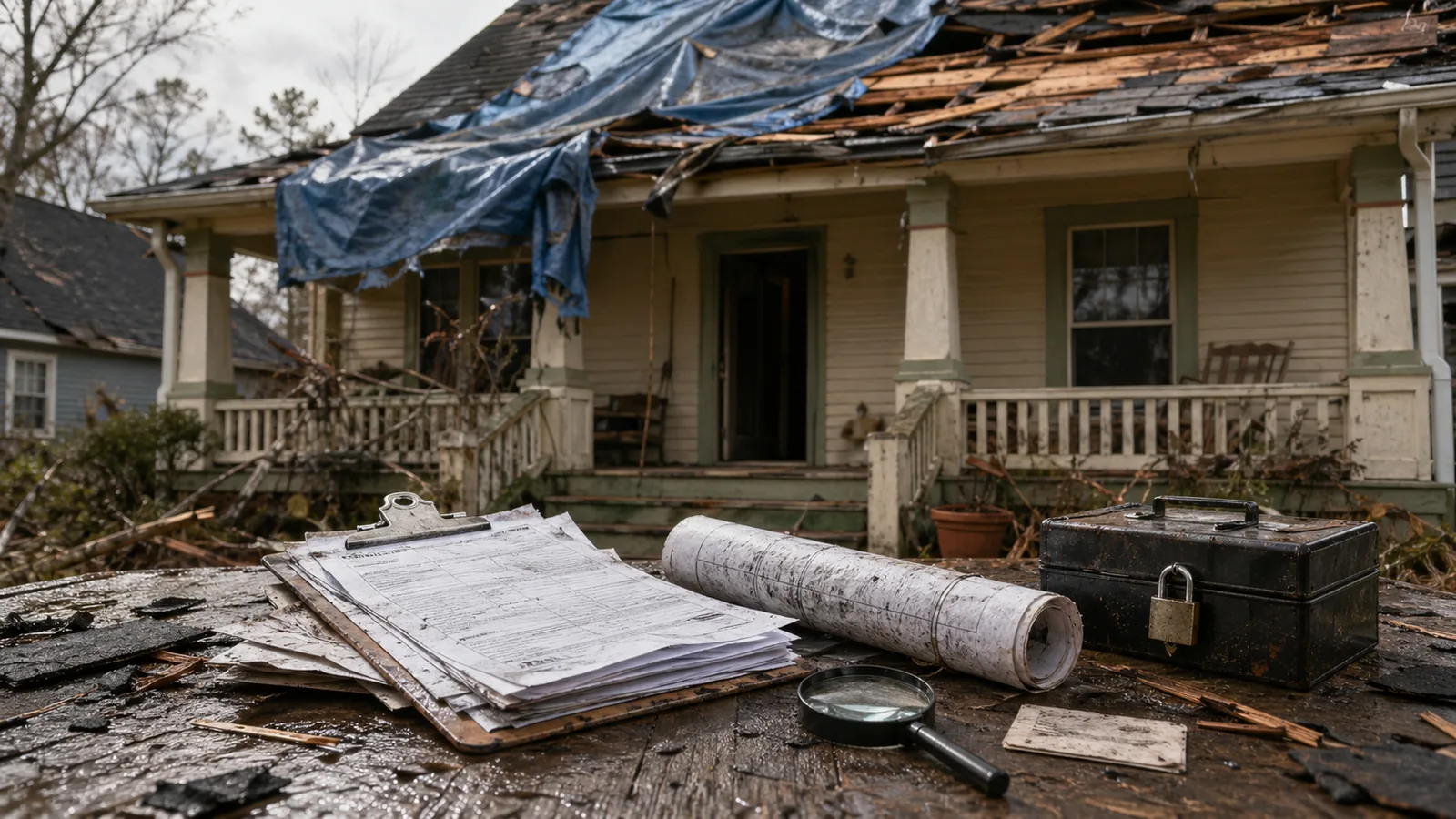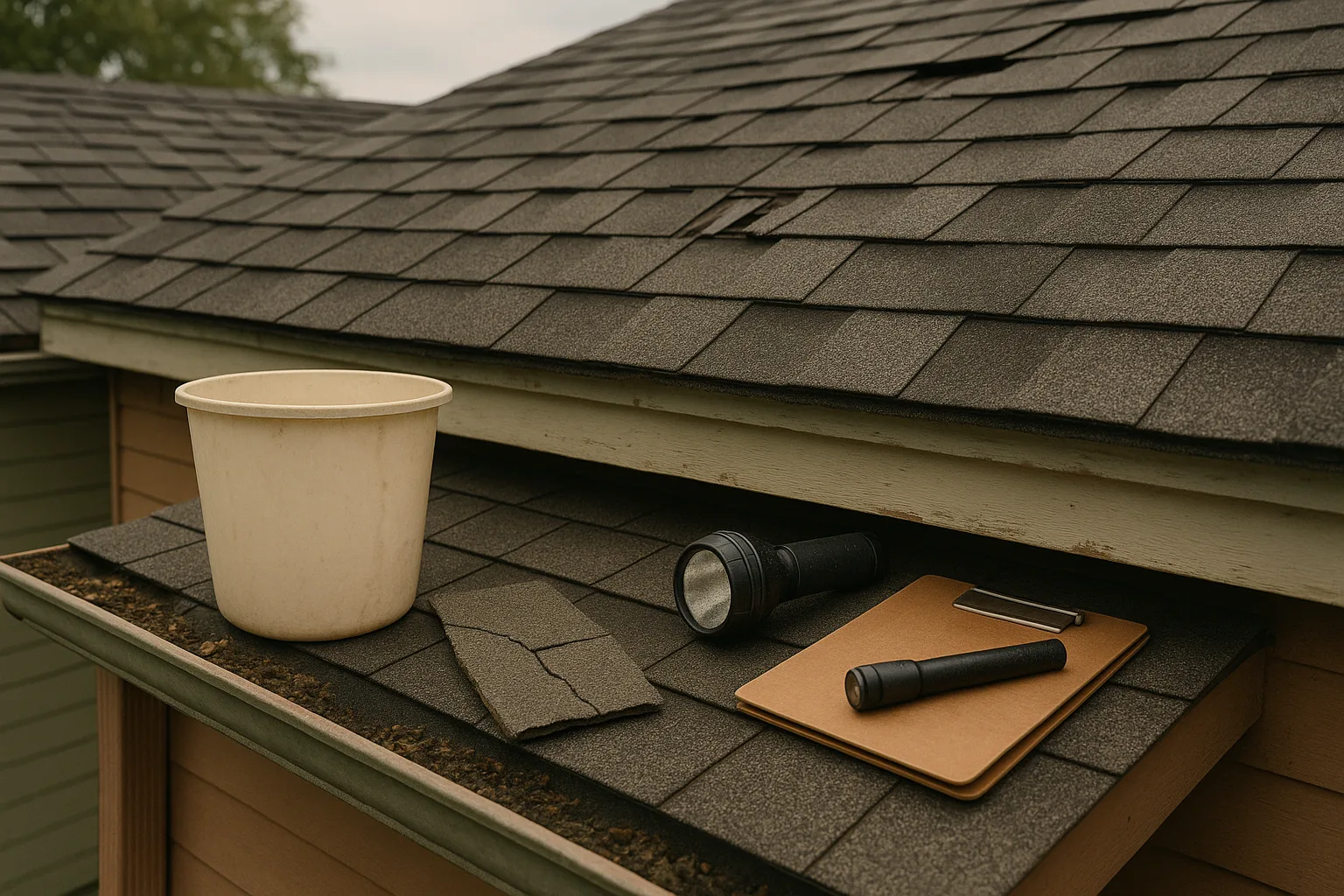
The difference between a $400 repair and a $15,000 replacement often comes down to reading the right combination of warning signs — not just counting how many shingles blew off. A single missing shingle on an otherwise healthy 8-year-old roof is a straightforward patch job. That same missing shingle on a 19-year-old Gulf Coast roof with granule loss in the gutters and a water stain on the bedroom ceiling is a replacement conversation.
This article ranks damage signs by severity, explains which combinations push from repair to replacement, and separates what you need to do right after a storm from what a long-term aging pattern looks like. It also covers how to document damage before you call your insurer — and what a thorough professional inspection should actually include.
Quick signs you need roof repair or roof replacement
QuickAnswerBox: - Repair: 1–2 isolated missing shingles, minor flashing damage, or a single small leak on a roof under 15 years old with no other warning signs - Replace: Sagging roofline, daylight visible in attic, active interior water staining, granule loss across multiple slopes, curling shingles, repeated missing shingles — especially on any roof 15+ years old - Urgent: Sagging, daylight through roof boards, and active interior staining are structural red flags, not maintenance items - Rule: Storm triage is handled separately from age-related replacement, because post-storm damage needs immediate documentation and inspection while aging deterioration builds a case over months or years
As Patriot Roofing's homeowner guide puts it: "Common replacement signals include age, curling or missing shingles, granules in gutters, water leaks or stains, sagging rooflines, daylight through roof boards, moss/mold/algae growth, and storm damage." The key word there is signals — plural. One sign in isolation is usually a repair trigger. Two or three together, especially on an older roof, is a replacement trigger.
This article handles storm triage and long-term aging separately because they require different decision-making timelines — storm damage needs immediate documentation and inspection, while aging deterioration builds a case over months or years.
One climate note before diving in: if you're in the Gulf Coast region — Alabama, Mississippi, Louisiana, Florida Panhandle — the national shingle lifespan numbers you see in product literature are a useful baseline, but local conditions often shorten the real-world service window. Architectural shingles rated for 25–30 years nationally typically age out in 15–22 years in South Alabama and Gulf Coast conditions. Adjust every threshold in this article accordingly.
When a roof problem becomes an urgent replacement issue
Three symptoms demand an immediate professional inspection, not a watch-and-wait approach: a sagging roofline, daylight visible through the attic roof boards, and active interior water staining. These are not maintenance issues. They indicate either structural failure of the roof deck, complete loss of weather protection, or active water intrusion — any of which can escalate rapidly.
Severity-ranked red flags — inspect from highest urgency downward:
- Sagging roofline or visible roof deck deflection — potential structural failure; requires same-day professional assessment
- Daylight visible through attic roof boards — no membrane or deck integrity; weather intrusion is already happening
- Active water staining on interior ceilings or walls — leak is active; electrical hazard possible if staining appears near fixtures
- Water stains near overhead lighting or electrical panels — FEMA guidance classifies this as a condition requiring urgent repair because of the electrical hazard, not just cosmetic concern
- Multiple warning signs together on a roof 15+ years old — even without structural symptoms, this combination supports replacement
When to Call a Pro: Call a licensed roofing contractor same-day if you see any sagging in the roofline, can see light in the attic during daylight hours, or have active ceiling staining near electrical fixtures. These are not situations to monitor over a rainy weekend — water moves fast through damaged assemblies, and what looks like a stain today can become a mold colony or a failed ceiling in weeks. FEMA's disaster recovery guidance notes that roof leaks threatening electrical components are treated as urgent damage conditions — not the same category as old stains.
The distinction matters for your insurance claim too. FEMA's FAQ notes that disaster assistance may help repair leaks "that damage ceilings and threaten electrical components, like overhead lights, but not stains from roof leaks" — meaning how you document the damage affects what qualifies for assistance.
Sagging roofline and soft spots in the roof deck
A sagging roofline means the structural layer beneath your shingles — the roof decking, typically oriented strand board (OSB) or plywood — has been compromised. This happens when moisture penetrates the surface layer and saturates the deck over time, or when structural damage from a severe storm overloads the rafters or trusses below.
How to check without climbing the roof:
- Stand at the end of your driveway or across the street and look at each slope. A healthy roofline runs in a straight plane. Any visible curve, dip, or wave in the profile is a red flag.
- From inside the attic (using a flashlight, on a dry day), press gently on the underside of the roof deck near any areas that look discolored or wet. Soft or spongy spots indicate decayed OSB or plywood.
- Look for daylight coming through between decking boards or around rafters.
- Check for rafters or trusses that appear bowed, cracked, or separated from the ridge beam.
Watch Out: Do not climb onto a roof that shows any signs of sagging or soft spots. A compromised deck can fail under your weight without warning. Assessment from ground level and from inside the attic gives you everything a professional needs to confirm the problem. A licensed roofer will use their own safety protocols when conducting the on-roof portion of the inspection.
Soft spots paired with a sagging roofline almost always indicate a roof replacement — not a repair. Replacing individual sections of rotted decking without addressing the moisture source, and without replacing the shingles and underlayment above, is a short-term fix that typically fails within a few seasons.
Daylight in the attic and water stains on ceilings
Yes — daylight visible in the attic is a sign you need a new roof, or at minimum a significant repair. It means there are gaps in your roof deck where weather can enter directly. The homeowner guide from Southern Roofing Systems lists daylight through roof boards as an explicit replacement signal, not a patch candidate.
Attic inspection checklist — do this on a sunny day with the attic access lights off:
- Turn off your flashlight and let your eyes adjust. Any pinpoints or streaks of light indicate gaps.
- Note the location of any light sources relative to the ridge, valleys, and penetrations (vents, chimney, skylights).
- Look for water staining or discoloration on the underside of the decking — dark streaks often trace the leak path.
- Check insulation for compression, wet clumping, or discoloration. Wet fiberglass insulation loses most of its R-value and can become a mold substrate.
- Look for rust stains on any metal fasteners or joist hangers — a sign of prolonged moisture exposure.
Water stains on your bedroom or living room ceiling are another matter entirely. The stain you see may be several feet — or an entire room — away from where water actually entered the roof assembly. Roof leaks travel. Water can enter at a valley or around a chimney flashing, run along a rafter for 10 feet, then drip down through the insulation and appear as a stain on a ceiling directly below a section of roof that looks perfectly intact from the outside.
This is why a roof repair or replacement estimate that's based only on what the contractor can see from the attic hatch — without tracing the leak path — may miss the actual entry point entirely.
Mold, moisture, and insulation damage in the attic
Attic mold is almost never an attic problem. It's a roof or ventilation problem that the attic makes visible. When shingle or flashing failures allow moisture to enter slowly — too slowly to show as an active drip — the moisture accumulates in the attic, saturates insulation, and creates the warm, humid conditions mold needs.
Attic warning-sign checklist:
- Black, green, or white fuzzy growth on the underside of roof sheathing or on rafters
- A musty smell when you open the attic hatch, even in dry weather
- Insulation that looks matted, compressed, or discolored (especially near the eaves)
- Frost or ice on interior roof surfaces in winter (indicates warm, moist air escaping upward)
- Rust on any metal components — joist hangers, truss plates, ridge vent hardware
Watch Out: Moss, mold, and algae growth are listed among common roof replacement signals not because the organisms themselves destroy your roof instantly, but because their presence confirms that moisture is getting in and staying in. Treating the mold without fixing the roof entry point is a temporary measure — the mold returns. And if the moisture has been present long enough to grow a visible colony, the insulation and potentially the decking beneath it have already taken damage that needs professional evaluation.
Interior symptoms can lag the actual roof entry point by months or even years. A slow leak around a ridge vent or improperly sealed skylight flashing may saturate insulation gradually before any stain appears below. This hidden-leak path is exactly why a thorough inspection includes the attic, not just the shingle surface.
Age-based roof replacement signs on Gulf Coast and other US climates
The national standard claim — that architectural shingles last 25–30 years — reflects testing done under average US climate conditions. If you live on or near the Gulf Coast, local heat, humidity, salt air, rainfall, and wind can shorten that service window. Southern Roofing Systems' regional guidance states directly: "Gulf Coast Climate Accelerates Every Roof Aging Factor." Their practical lifespan for architectural shingles in South Alabama and similar Gulf Coast markets is 15–22 years, not 25–30.
That gap has real consequences for the repair-vs-replace decision. A 17-year-old roof in Minnesota with two missing shingles and minor granule loss might be legitimately worth repairing. The same 17-year-old roof in Mobile, Alabama, is already operating beyond or near the end of its climate-adjusted lifespan. Adding another repair layer to a roof that's already exhausted is spending money to delay an inevitable replacement by one storm.
ClimateAdjustedThreshold: If your Gulf Coast roof is 15 years or older and showing 2–3 warning signs — any combination of granule loss, curling shingles, repeated missing shingles, attic moisture, interior staining, or moss growth — the data supports a replacement conversation, not another patch. Get a professional inspection and ask the contractor to assess remaining service life explicitly, not just the damage in front of them.
For homeowners in other high-stress climates, the same logic applies at different thresholds: - Midwest hail corridors (Kansas, Nebraska, Oklahoma): Hail impact fractures shingle mats beneath the surface; visible bruising plus age over 15 years is a replacement signal - Desert Southwest (Arizona, Nevada): Intense UV and thermal cycling degrade asphalt binders faster; 20-year-old roofs often show significant surface cracking even without storm events - Northern snowbelt: Ice dam cycles stress shingle edges and flashing; roofs over 20 years in heavy-snowfall areas warrant close inspection for underlayment failure
Curling, cracked, or missing shingles across multiple slopes
Curling comes in two forms, and both matter. Cupping is when the edges of a shingle turn upward — a sign of moisture imbalance in the shingle mat, often tied to inadequate attic ventilation. Clawing is when the middle of a shingle rises while the edges stay flat — typically indicating that the shingle has dried out and lost flexibility, a sign of age and UV degradation.
Repair vs. replace decision rule for missing and curling shingles:
| Situation | Verdict |
|---|---|
| 1–2 shingles missing, roof under 15 years old, no other signs | Repair — patch is appropriate |
| 1–2 shingles missing, roof 15+ years, coastal climate | Inspect — assess full roof condition before patching |
| Missing shingles on multiple slopes | Replacement signal — systemic issue, not isolated event |
| Curling on one slope only, ventilation issue suspected | Repair + ventilation fix may extend life |
| Curling across multiple slopes | Replacement signal — shingles at end of service life |
| Any missing shingles + granule loss + attic moisture | Replacement — multiple signs together confirm aging |
One or two isolated missing shingles can absolutely be repaired — if the rest of the roof is structurally sound and within its climate-adjusted service life. A licensed roofer can match your existing shingle profile reasonably well if the product line is still available; GAF Timberline HDZ, one of the most widely installed architectural shingles in the US, has been in continuous production long enough that color matches on roofs under 10 years old are often feasible. Older roofs may show weathering differences between new patches and existing shingles.
Repeated missing shingles — losing shingles after every significant wind event, or replacing the same area more than once in three years — is not a bad-luck pattern. It's a failure signal. Either the shingles have lost their adhesive strip integrity, the deck below has softened and won't hold fasteners properly, or the shingles are simply past their rated service life. Replacement is the appropriate response.
Granules in gutters and bald shingle surfaces
Asphalt shingles use a surface layer of mineral granules — typically crushed basalt or slate — to protect the asphalt binder from UV degradation and add fire resistance. When those granules wash into your gutters in significant quantities, the underlying asphalt is exposed and begins deteriorating faster.
Gutter inspection cue list:
- After rain, look at your downspout discharge. Granules washing out look like coarse, dark sand.
- Clean your gutters and look for granule accumulation in the valleys of the gutter trough — not just after a storm, but consistently.
- Inspect the shingle surface from the ground using binoculars. Bald patches or color-lightened areas on the shingle surface indicate where granule coverage has worn away.
- Check the area directly below downspout outlets — granule deposits here are a clear sign of ongoing loss.
Some granule shedding in the first year or two after installation is normal — manufacturers embed extra granules to account for initial weathering loss. Significant granule loss on a roof that's 10 or more years old is a different situation: it's a sign the shingles are approaching end of life and the protective surface is failing, not shedding normally.
Widespread granule loss across multiple sections of the roof is a replacement signal. At that point, the shingles are not protecting the deck; they're just a thin layer of degraded asphalt waiting for the next heavy rain or wind event to expose the underlayment.
How Gulf Coast heat, humidity, salt air, and UV shorten shingle life
Five specific environmental stressors accelerate roof aging in coastal Southeast climates, according to Southern Roofing Systems' regional guide: UV radiation, humidity, salt air, heavy rainfall, and high winds. None of them is unusual in isolation. On the Gulf Coast, all five operate simultaneously, year-round.
Climate-lifespan comparison:
| Climate | Architectural Shingle Expected Life | Key Stress Factor |
|---|---|---|
| National average | 25–30 years | Mixed conditions |
| Gulf Coast (AL, MS, LA, FL Panhandle) | 15–22 years | UV + humidity + salt + wind |
| Desert Southwest | 20–25 years | UV + thermal cycling |
| Northern snowbelt | 20–25 years | Freeze-thaw + ice dams |
| Midwest hail corridor | 15–25 years (hail-dependent) | Hail impact damage |
Salt air is the factor most homeowners underestimate. The coastal mix of salt, heat, and humidity can speed shingle surface wear and granule loss, especially when paired with direct sun and frequent wind-driven rain. Combine that with Gulf Coast UV intensity (which degrades the asphalt binder itself) and summer humidity that holds moisture in the shingle mat, and you get a roof that can reach the end of its practical life sooner than the calendar suggests.
The practical implication: if your roofer quotes you a 30-year architectural shingle and says it'll last 30 years, ask specifically about the climate-adjusted lifespan for your ZIP code and wind-speed zone. The shingle warranty and the real-world service life in coastal Alabama are not the same number.
Storm damage signs that need an immediate roof inspection
Call a licensed roofer for a professional inspection after any of the following storm events — even if you don't see active leaks inside:
- Wind events above 50 mph (tropical storm force or higher)
- Hail of any size if you're in an older roof's final third of its service life; hail ¾ inch or larger on any roof
- A tree limb or debris impact anywhere on the roof surface
- Any named tropical storm or hurricane that passed within 50 miles of your property
StormInspectionCallout: Do not wait for an interior leak to confirm storm damage. Hail impact, lifted shingles, and bruised shingles often don't show as interior leaks immediately — they create vulnerabilities that fail weeks or months later when the next rain hits. FEMA's severe-weather documentation guidance is explicit: start documenting damage and "consult your insurance adjuster or insurance company before you sign any cleaning, remediation, or maintenance agreement." That means get an inspection and document it before you authorize any repair work. And do not climb the roof yourself — a storm-damaged roof can have compromised areas that aren't visible from above and can fail under foot traffic.
The inspection itself costs nothing from most reputable roofing contractors in storm-prone markets. What you get is a written inspection report and, if damage is present, a scope of work that becomes part of your insurance claim documentation.
Missing shingles, lifted shingles, and bruised shingles after wind or hail
Storm damage shows up in three distinct patterns, and they don't all lead to the same outcome.
Storm-damage comparison:
| Damage Type | What It Looks Like | Repair or Replace? |
|---|---|---|
| 1–3 missing shingles, scattered, young roof | Bare deck visible in small areas | Usually repairable |
| Multiple missing shingles across slopes | Widespread bare sections | Replacement signal, especially 15+ years |
| Lifted shingles (tabs raised, seal broken) | Shingles raised at edges but still attached | Repair if isolated; replace if widespread or older roof |
| Bruised shingles from hail | Dark circular impact marks, granule displacement | Inspect for mat fractures; widespread bruising = replacement |
| Creased or folded shingles | Shingles bent or kinked by debris or wind | Replace affected sections; check deck below for damage |
The critical distinction for hail is surface bruising versus mat fracture. A hail hit that leaves a granule depression but leaves the asphalt mat intact is less urgent than a hit that fractures the mat beneath the surface — and mat fractures aren't always visible without pressing on the shingle. This is exactly why a professional inspector matters after hail events; they know how to identify sub-surface damage that looks minor from a distance.
Scattered damage on one slope of a newer roof may be repairable. Damage spread across multiple slopes, or damage on a roof already showing aging signs, pushes toward full replacement — and is more likely to support a successful insurance claim as a total loss rather than a partial repair.
Flashing damage around chimneys, vents, skylights, and valleys
The majority of storm-related leaks don't enter through the middle of a shingle field. They enter at transitions — the points where the roof surface meets a vertical element (chimney, dormer, skylight) or where two slopes intersect (a valley). These are the areas where flashing (thin metal strips, typically galvanized steel or aluminum) creates the weather seal, and they're the areas most vulnerable to storm damage.
Per IRC Chapter 9 roof assembly requirements, penetrations and transition areas are code-specified inspection priorities because they represent the highest-risk points in any roof assembly.
High-risk penetration inspection checklist — check each of these after any significant storm:
- Chimney flashing: Step flashing along the sides and counter-flashing at the top. Look for lifted edges, gaps, or rust.
- Pipe boots and vent collars: Rubber boots around plumbing vents crack and split with age; storm stress accelerates failure.
- Skylight frames and curb flashing: Check for lifted or buckled metal at all four corners.
- Valley metal or valley shingles: Open valleys (exposed metal) and closed valleys (woven or cut shingles) both need inspection after high wind.
- Ridge cap shingles: These take direct wind exposure and often lift or lose tabs before field shingles do.
- Soffit and fascia: Look for lifted or cracked fascia boards, which can allow wind-driven rain to enter the eave assembly.
Flashing repair — re-seating lifted step flashing, replacing a cracked pipe boot, resealing a skylight frame — is often a legitimate repair option even on older roofs, provided the shingle field itself is intact. But if flashing repair is needed repeatedly in the same location, it usually means the underlying waterproofing assembly has failed and the surface patch is buying time, not solving the problem.
How to decide between roof repair and roof replacement
The repair-vs-replace decision isn't a single symptom question — it's a combination of age, severity, and pattern. Here's how to work through it:
RepairVsReplaceChecklist:
- Isolated damage only: One small area, one slope, one recent event, roof still within climate-adjusted service life — lean toward repair.
- Repeated failure in the same area: The same section has leaked or lost shingles more than once, or has needed patching several times — lean toward replacement because the underlying assembly is no longer stable.
- Multiple warning signs together: Age plus granule loss, curling, attic moisture, interior staining, or storm damage across more than one slope — schedule a replacement estimate and treat repair as a short-term option only.
- Structural or near-structural symptoms: Sagging roofline, daylight through the deck, soft spots, or active interior water near electrical fixtures — replacement is the correct response.
Repair vs. replace decision rule for missing and curling shingles:
| Situation | Verdict |
|---|---|
| 1–2 shingles missing, roof under 15 years old, no other signs | Repair — patch is appropriate |
| 1–2 shingles missing, roof 15+ years, coastal climate | Inspect — assess full roof condition before patching |
| Missing shingles on multiple slopes | Replacement signal — systemic issue, not isolated event |
| Curling on one slope only, ventilation issue suspected | Repair + ventilation fix may extend life |
| Curling across multiple slopes | Replacement signal — shingles at end of service life |
| Any missing shingles + granule loss + attic moisture | Replacement — multiple signs together confirm aging |
One or two isolated missing shingles can absolutely be repaired — if the rest of the roof is structurally sound and within its climate-adjusted service life. A licensed roofer can match your existing shingle profile reasonably well if the product line is still available; GAF Timberline HDZ, one of the most widely installed architectural shingles in the US, has been in continuous production long enough that color matches on roofs under 10 years old are often feasible. Older roofs may show weathering differences between new patches and existing shingles.
Repeated missing shingles — losing shingles after every significant wind event, or replacing the same area more than once in three years — is not a bad-luck pattern. It's a failure signal. Either the shingles have lost their adhesive strip integrity, the deck below has softened and won't hold fasteners properly, or the shingles are simply past their rated service life. Replacement is the appropriate response.
Granules in gutters and bald shingle surfaces
Asphalt shingles use a surface layer of mineral granules — typically crushed basalt or slate — to protect the asphalt binder from UV degradation and add fire resistance. When those granules wash into your gutters in significant quantities, the underlying asphalt is exposed and begins deteriorating faster.
Gutter inspection cue list:
- After rain, look at your downspout discharge. Granules washing out look like coarse, dark sand.
- Clean your gutters and look for granule accumulation in the valleys of the gutter trough — not just after a storm, but consistently.
- Inspect the shingle surface from the ground using binoculars. Bald patches or color-lightened areas on the shingle surface indicate where granule coverage has worn away.
- Check the area directly below downspout outlets — granule deposits here are a clear sign of ongoing loss.
Some granule shedding in the first year or two after installation is normal — manufacturers embed extra granules to account for initial weathering loss. Significant granule loss on a roof that's 10 or more years old is a different situation: it's a sign the shingles are approaching end of life and the protective surface is failing, not shedding normally.
Widespread granule loss across multiple sections of the roof is a replacement signal. At that point, the shingles are not protecting the deck; they're just a thin layer of degraded asphalt waiting for the next heavy rain or wind event to expose the underlayment.
How Gulf Coast heat, humidity, salt air, and UV shorten shingle life
Five specific environmental stressors accelerate roof aging in coastal Southeast climates, according to Southern Roofing Systems' regional guide: UV radiation, humidity, salt air, heavy rainfall, and high winds. None of them is unusual in isolation. On the Gulf Coast, all five operate simultaneously, year-round.
Climate-lifespan comparison:
| Climate | Architectural Shingle Expected Life | Key Stress Factor |
|---|---|---|
| National average | 25–30 years | Mixed conditions |
| Gulf Coast (AL, MS, LA, FL Panhandle) | 15–22 years | UV + humidity + salt + wind |
| Desert Southwest | 20–25 years | UV + thermal cycling |
| Northern snowbelt | 20–25 years | Freeze-thaw + ice dams |
| Midwest hail corridor | 15–25 years (hail-dependent) | Hail impact damage |
Salt air is the factor most homeowners underestimate. The coastal mix of salt, heat, and humidity can speed shingle surface wear and granule loss, especially when paired with direct sun and frequent wind-driven rain. Combine that with Gulf Coast UV intensity (which degrades the asphalt binder itself) and summer humidity that holds moisture in the shingle mat, and you get a roof that can reach the end of its practical life sooner than the calendar suggests.
The practical implication: if your roofer quotes you a 30-year architectural shingle and says it'll last 30 years, ask specifically about the climate-adjusted lifespan for your ZIP code and wind-speed zone. The shingle warranty and the real-world service life in coastal Alabama are not the same number.
Storm damage signs that need an immediate roof inspection
Call a licensed roofer for a professional inspection after any of the following storm events — even if you don't see active leaks inside:
- Wind events above 50 mph (tropical storm force or higher)
- Hail of any size if you're in an older roof's final third of its service life; hail ¾ inch or larger on any roof
- A tree limb or debris impact anywhere on the roof surface
- Any named tropical storm or hurricane that passed within 50 miles of your property
StormInspectionCallout: Do not wait for an interior leak to confirm storm damage. Hail impact, lifted shingles, and bruised shingles often don't show as interior leaks immediately — they create vulnerabilities that fail weeks or months later when the next rain hits. FEMA's severe-weather documentation guidance is explicit: start documenting damage and "consult your insurance adjuster or insurance company before you sign any cleaning, remediation, or maintenance agreement." That means get an inspection and document it before you authorize any repair work. And do not climb the roof yourself — a storm-damaged roof can have compromised areas that aren't visible from above and can fail under foot traffic.
The inspection itself costs nothing from most reputable roofing contractors in storm-prone markets. What you get is a written inspection report and, if damage is present, a scope of work that becomes part of your insurance claim documentation.
Missing shingles, lifted shingles, and bruised shingles after wind or hail
Storm damage shows up in three distinct patterns, and they don't all lead to the same outcome.
Storm-damage comparison:
| Damage Type | What It Looks Like | Repair or Replace? |
|---|---|---|
| 1–3 missing shingles, scattered, young roof | Bare deck visible in small areas | Usually repairable |
| Multiple missing shingles across slopes | Widespread bare sections | Replacement signal, especially 15+ years |
| Lifted shingles (tabs raised, seal broken) | Shingles raised at edges but still attached | Repair if isolated; replace if widespread or older roof |
| Bruised shingles from hail | Dark circular impact marks, granule displacement | Inspect for mat fractures; widespread bruising = replacement |
| Creased or folded shingles | Shingles bent or kinked by debris or wind | Replace affected sections; check deck below for damage |
The critical distinction for hail is surface bruising versus mat fracture. A hail hit that leaves a granule depression but leaves the asphalt mat intact is less urgent than a hit that fractures the mat beneath the surface — and mat fractures aren't always visible without pressing on the shingle. This is exactly why a professional inspector matters after hail events; they know how to identify sub-surface damage that looks minor from a distance.
Scattered damage on one slope of a newer roof may be repairable. Damage spread across multiple slopes, or damage on a roof already showing aging signs, pushes toward full replacement — and is more likely to support a successful insurance claim as a total loss rather than a partial repair.
Flashing damage around chimneys, vents, skylights, and valleys
The majority of storm-related leaks don't enter through the middle of a shingle field. They enter at transitions — the points where the roof surface meets a vertical element (chimney, dormer, skylight) or where two slopes intersect (a valley). These are the areas where flashing (thin metal strips, typically galvanized steel or aluminum) creates the weather seal, and they're the areas most vulnerable to storm damage.
Per IRC Chapter 9 roof assembly requirements, penetrations and transition areas are code-specified inspection priorities because they represent the highest-risk points in any roof assembly.
High-risk penetration inspection checklist — check each of these after any significant storm:
- Chimney flashing: Step flashing along the sides and counter-flashing at the top. Look for lifted edges, gaps, or rust.
- Pipe boots and vent collars: Rubber boots around plumbing vents crack and split with age; storm stress accelerates failure.
- Skylight frames and curb flashing: Check for lifted or buckled metal at all four corners.
- Valley metal or valley shingles: Open valleys (exposed metal) and closed valleys (woven or cut shingles) both need inspection after high wind.
- Ridge cap shingles: These take direct wind exposure and often lift or lose tabs before field shingles do.
- Soffit and fascia: Look for lifted or cracked fascia boards, which can allow wind-driven rain to enter the eave assembly.
Flashing repair — re-seating lifted step flashing, replacing a cracked pipe boot, resealing a skylight frame — is often a legitimate repair option even on older roofs, provided the shingle field itself is intact. But if flashing repair is needed repeatedly in the same location, it usually means the underlying waterproofing assembly has failed and the surface patch is buying time, not solving the problem.
How to decide between roof repair and roof replacement
The repair-vs-replace decision isn't a single symptom question — it's a combination of age, severity, and pattern. Here's how to work through it:
RepairVsReplaceChecklist:
- Isolated damage only: One small area, one slope, one recent event, roof still within climate-adjusted service life — lean toward repair.
- Repeated failure in the same area: The same section has leaked or lost shingles more than once, or has needed patching several times — lean toward replacement because the underlying assembly is no longer stable.
- Multiple warning signs together: Age plus granule loss, curling, attic moisture, interior staining, or storm damage across more than one slope — schedule a replacement estimate and treat repair as a short-term option only.
- Structural or near-structural symptoms: Sagging roofline, daylight through the deck, soft spots, or active interior water near electrical fixtures — replacement is the correct response.
Repair vs. replace decision rule for missing and curling shingles:
| Situation | Verdict |
|---|---|
| 1–2 shingles missing, roof under 15 years old, no other signs | Repair — patch is appropriate |
| 1–2 shingles missing, roof 15+ years, coastal climate | Inspect — assess full roof condition before patching |
| Missing shingles on multiple slopes | Replacement signal — systemic issue, not isolated event |
| Curling on one slope only, ventilation issue suspected | Repair + ventilation fix may extend life |
| Curling across multiple slopes | Replacement signal — shingles at end of service life |
| Any missing shingles + granule loss + attic moisture | Replacement — multiple signs together confirm aging |
One or two isolated missing shingles can absolutely be repaired — if the rest of the roof is structurally sound and within its climate-adjusted service life. A licensed roofer can match your existing shingle profile reasonably well if the product line is still available; GAF Timberline HDZ, one of the most widely installed architectural shingles in the US, has been in continuous production long enough that color matches on roofs under 10 years old are often feasible. Older roofs may show weathering differences between new patches and existing shingles.
Repeated missing shingles — losing shingles after every significant wind event, or replacing the same area more than once in three years — is not a bad-luck pattern. It's a failure signal. Either the shingles have lost their adhesive strip integrity, the deck below has softened and won't hold fasteners properly, or the shingles are simply past their rated service life. Replacement is the appropriate response.
Granules in gutters and bald shingle surfaces
Asphalt shingles use a surface layer of mineral granules — typically crushed basalt or slate — to protect the asphalt binder from UV degradation and add fire resistance. When those granules wash into your gutters in significant quantities, the underlying asphalt is exposed and begins deteriorating faster.
Gutter inspection cue list:
- After rain, look at your downspout discharge. Granules washing out look like coarse, dark sand.
- Clean your gutters and look for granule accumulation in the valleys of the gutter trough — not just after a storm, but consistently.
- Inspect the shingle surface from the ground using binoculars. Bald patches or color-lightened areas on the shingle surface indicate where granule coverage has worn away.
- Check the area directly below downspout outlets — granule deposits here are a clear sign of ongoing loss.
Some granule shedding in the first year or two after installation is normal — manufacturers embed extra granules to account for initial weathering loss. Significant granule loss on a roof that's 10 or more years old is a different situation: it's a sign the shingles are approaching end of life and the protective surface is failing, not shedding normally.
Widespread granule loss across multiple sections of the roof is a replacement signal. At that point, the shingles are not protecting the deck; they're just a thin layer of degraded asphalt waiting for the next heavy rain or wind event to expose the underlayment.
How Gulf Coast heat, humidity, salt air, and UV shorten shingle life
Five specific environmental stressors accelerate roof aging in coastal Southeast climates, according to Southern Roofing Systems' regional guide: UV radiation, humidity, salt air, heavy rainfall, and high winds. None of them is unusual in isolation. On the Gulf Coast, all five operate simultaneously, year-round.
Climate-lifespan comparison:
| Climate | Architectural Shingle Expected Life | Key Stress Factor |
|---|---|---|
| National average | 25–30 years | Mixed conditions |
| Gulf Coast (AL, MS, LA, FL Panhandle) | 15–22 years | UV + humidity + salt + wind |
| Desert Southwest | 20–25 years | UV + thermal cycling |
| Northern snowbelt | 20–25 years | Freeze-thaw + ice dams |
| Midwest hail corridor | 15–25 years (hail-dependent) | Hail impact damage |
Salt air is the factor most homeowners underestimate. The coastal mix of salt, heat, and humidity can speed shingle surface wear and granule loss, especially when paired with direct sun and frequent wind-driven rain. Combine that with Gulf Coast UV intensity (which degrades the asphalt binder itself) and summer humidity that holds moisture in the shingle mat, and you get a roof that can reach the end of its practical life sooner than the calendar suggests.
The practical implication: if your roofer quotes you a 30-year architectural shingle and says it'll last 30 years, ask specifically about the climate-adjusted lifespan for your ZIP code and wind-speed zone. The shingle warranty and the real-world service life in coastal Alabama are not the same number.
Storm damage signs that need an immediate roof inspection
Call a licensed roofer for a professional inspection after any of the following storm events — even if you don't see active leaks inside:
- Wind events above 50 mph (tropical storm force or higher)
- Hail of any size if you're in an older roof's final third of its service life; hail ¾ inch or larger on any roof
- A tree limb or debris impact anywhere on the roof surface
- Any named tropical storm or hurricane that passed within 50 miles of your property
StormInspectionCallout: Do not wait for an interior leak to confirm storm damage. Hail impact, lifted shingles, and bruised shingles often don't show as interior leaks immediately — they create vulnerabilities that fail weeks or months later when the next rain hits. FEMA's severe-weather documentation guidance is explicit: start documenting damage and "consult your insurance adjuster or insurance company before you sign any cleaning, remediation, or maintenance agreement." That means get an inspection and document it before you authorize any repair work. And do not climb the roof yourself — a storm-damaged roof can have compromised areas that aren't visible from above and can fail under foot traffic.
The inspection itself costs nothing from most reputable roofing contractors in storm-prone markets. What you get is a written inspection report and, if damage is present, a scope of work that becomes part of your insurance claim documentation.
Missing shingles, lifted shingles, and bruised shingles after wind or hail
Storm damage shows up in three distinct patterns, and they don't all lead to the same outcome.
Storm-damage comparison:
| Damage Type | What It Looks Like | Repair or Replace? |
|---|---|---|
| 1–3 missing shingles, scattered, young roof | Bare deck visible in small areas | Usually repairable |
| Multiple missing shingles across slopes | Widespread bare sections | Replacement signal, especially 15+ years |
| Lifted shingles (tabs raised, seal broken) | Shingles raised at edges but still attached | Repair if isolated; replace if widespread or older roof |
| Bruised shingles from hail | Dark circular impact marks, granule displacement | Inspect for mat fractures; widespread bruising = replacement |
| Creased or folded shingles | Shingles bent or kinked by debris or wind | Replace affected sections; check deck below for damage |
The critical distinction for hail is surface bruising versus mat fracture. A hail hit that leaves a granule depression but leaves the asphalt mat intact is less urgent than a hit that fractures the mat beneath the surface — and mat fractures aren't always visible without pressing on the shingle. This is exactly why a professional inspector matters after hail events; they know how to identify sub-surface damage that looks minor from a distance.
Scattered damage on one slope of a newer roof may be repairable. Damage spread across multiple slopes, or damage on a roof already showing aging signs, pushes toward full replacement — and is more likely to support a successful insurance claim as a total loss rather than a partial repair.
Flashing damage around chimneys, vents, skylights, and valleys
The majority of storm-related leaks don't enter through the middle of a shingle field. They enter at transitions — the points where the roof surface meets a vertical element (chimney, dormer, skylight) or where two slopes intersect (a valley). These are the areas where flashing (thin metal strips, typically galvanized steel or aluminum) creates the weather seal, and they're the areas most vulnerable to storm damage.
Per IRC Chapter 9 roof assembly requirements, penetrations and transition areas are code-specified inspection priorities because they represent the highest-risk points in any roof assembly.
High-risk penetration inspection checklist — check each of these after any significant storm:
- Chimney flashing: Step flashing along the sides and counter-flashing at the top. Look for lifted edges, gaps, or rust.
- Pipe boots and vent collars: Rubber boots around plumbing vents crack and split with age; storm stress accelerates failure.
- Skylight frames and curb flashing: Check for lifted or buckled metal at all four corners.
- Valley metal or valley shingles: Open valleys (exposed metal) and closed valleys (woven or cut shingles) both need inspection after high wind.
- Ridge cap shingles: These take direct wind exposure and often lift or lose tabs before field shingles do.
- Soffit and fascia: Look for lifted or cracked fascia boards, which can allow wind-driven rain to enter the eave assembly.
Flashing repair — re-seating lifted step flashing, replacing a cracked pipe boot, resealing a skylight frame — is often a legitimate repair option even on older roofs, provided the shingle field itself is intact. But if flashing repair is needed repeatedly in the same location, it usually means the underlying waterproofing assembly has failed and the surface patch is buying time, not solving the problem.
How to decide between roof repair and roof replacement
The repair-vs-replace decision isn't a single symptom question — it's a combination of age, severity, and pattern. Here's how to work through it:
RepairVsReplaceChecklist:
- Isolated damage only: One small area, one slope, one recent event, roof still within climate-adjusted service life — lean toward repair.
- Repeated failure in the same area: The same section has leaked or lost shingles more than once, or has needed patching several times — lean toward replacement because the underlying assembly is no longer stable.
- Multiple warning signs together: Age plus granule loss, curling, attic moisture, interior staining, or storm damage across more than one slope — schedule a replacement estimate and treat repair as a short-term option only.
- Structural or near-structural symptoms: Sagging roofline, daylight through the deck, soft spots, or active interior water near electrical fixtures — replacement is the correct response.
Repair vs. replace decision rule for missing and curling shingles:
| Situation | Verdict |
|---|---|
| 1–2 shingles missing, roof under 15 years old, no other signs | Repair — patch is appropriate |
| 1–2 shingles missing, roof 15+ years, coastal climate | Inspect — assess full roof condition before patching |
| Missing shingles on multiple slopes | Replacement signal — systemic issue, not isolated event |
| Curling on one slope only, ventilation issue suspected | Repair + ventilation fix may extend life |
| Curling across multiple slopes | Replacement signal — shingles at end of service life |
| Any missing shingles + granule loss + attic moisture | Replacement — multiple signs together confirm aging |
One or two isolated missing shingles can absolutely be repaired — if the rest of the roof is structurally sound and within its climate-adjusted service life. A licensed roofer can match your existing shingle profile reasonably well if the product line is still available; GAF Timberline HDZ, one of the most widely installed architectural shingles in the US, has been in continuous production long enough that color matches on roofs under 10 years old are often feasible. Older roofs may show weathering differences between new patches and existing shingles.
Repeated missing shingles — losing shingles after every significant wind event, or replacing the same area more than once in three years — is not a bad-luck pattern. It's a failure signal. Either the shingles have lost their adhesive strip integrity, the deck below has softened and won't hold fasteners properly, or the shingles are simply past their rated service life. Replacement is the appropriate response.
Granules in gutters and bald shingle surfaces
Asphalt shingles use a surface layer of mineral granules — typically crushed basalt or slate — to protect the asphalt binder from UV degradation and add fire resistance. When those granules wash into your gutters in significant quantities, the underlying asphalt is exposed and begins deteriorating faster.
Gutter inspection cue list:
- After rain, look at your downspout discharge. Granules washing out look like coarse, dark sand.
- Clean your gutters and look for granule accumulation in the valleys of the gutter trough — not just after a storm, but consistently.
- Inspect the shingle surface from the ground using binoculars. Bald patches or color-lightened areas on the shingle surface indicate where granule coverage has worn away.
- Check the area directly below downspout outlets — granule deposits here are a clear sign of ongoing loss.
Some granule shedding in the first year or two after installation is normal — manufacturers embed extra granules to account for initial weathering loss. Significant granule loss on a roof that's 10 or more years old is a different situation: it's a sign the shingles are approaching end of life and the protective surface is failing, not shedding normally.
Widespread granule loss across multiple sections of the roof is a replacement signal. At that point, the shingles are not protecting the deck; they're just a thin layer of degraded asphalt waiting for the next heavy rain or wind event to expose the underlayment.
How Gulf Coast heat, humidity, salt air, and UV shorten shingle life
Five specific environmental stressors accelerate roof aging in coastal Southeast climates, according to Southern Roofing Systems' regional guide: UV radiation, humidity, salt air, heavy rainfall, and high winds. None of them is unusual in isolation. On the Gulf Coast, all five operate simultaneously, year-round.
Climate-lifespan comparison:
| Climate | Architectural Shingle Expected Life | Key Stress Factor |
|---|---|---|
| National average | 25–30 years | Mixed conditions |
| Gulf Coast (AL, MS, LA, FL Panhandle) | 15–22 years | UV + humidity + salt + wind |
| Desert Southwest | 20–25 years | UV + thermal cycling |
| Northern snowbelt | 20–25 years | Freeze-thaw + ice dams |
| Midwest hail corridor | 15–25 years (hail-dependent) | Hail impact damage |
Salt air is the factor most homeowners underestimate. The coastal mix of salt, heat, and humidity can speed shingle surface wear and granule loss, especially when paired with direct sun and frequent wind-driven rain. Combine that with Gulf Coast UV intensity (which degrades the asphalt binder itself) and summer humidity that holds moisture in the shingle mat, and you get a roof that can reach the end of its practical life sooner than the calendar suggests.
The practical implication: if your roofer quotes you a 30-year architectural shingle and says it'll last 30 years, ask specifically about the climate-adjusted lifespan for your ZIP code and wind-speed zone. The shingle warranty and the real-world service life in coastal Alabama are not the same number.
How to document roof damage for an insurance claim
Start your documentation before you call your insurer — and before you authorize any contractor to begin work. FEMA's severe-weather guidance is clear: "Consult your insurance adjuster or insurance company before you sign any cleaning, remediation, or maintenance agreement." That sequencing matters for your claim.
InsuranceClaimDocumentation: Documenting storm damage thoroughly before any work begins gives your insurer and adjuster the clearest possible picture of pre-repair conditions. Missing this step — or authorizing emergency repairs before getting the damage on record — can complicate or limit your claim, depending on your policy language. Whether damage is covered, and to what extent, depends entirely on your carrier, your specific policy terms, and the adjuster's findings. Nothing in this article constitutes a coverage guarantee or prediction.
Photos, dates, weather reports, and contractor inspection notes
Document-now checklist — collect all of this before calling your insurer:
- Timestamped photos from ground level: All four sides of the house, gutter lines, visible shingle areas, any debris or impact marks visible from the ground
- Timestamped attic photos: Water staining on decking, wet insulation, any visible daylight, mold or discoloration
- Interior ceiling photos: All water stains, including room location and proximity to light fixtures or electrical components
- Storm date and time: Pull the exact date and time of the storm event from a local National Weather Service record or weather app — the storm date anchors the damage to a covered event
- Local weather report or NWS alert: A printed or saved screenshot of the storm report for your county, including wind speeds or hail reports, is supporting evidence
- Contractor inspection report: Get a written inspection report from a licensed roofer that includes the scope and location of damage, estimated cause, and the contractor's recommendation (repair or replacement). This is your technical documentation.
- Emergency protection receipts: If you installed a tarp or took any emergency action to prevent further damage, save those receipts — they're typically reimbursable and relevant to the claim.
Do not clean up or discard damaged materials (shingles, gutters, fascia sections) before your adjuster visit. Physical evidence supports the claim.
What to avoid saying before a carrier review
Watch Out: Don't tell a contractor "my insurance will cover this" before you've spoken with your carrier. Don't tell your insurer "my contractor says it's a total loss" before the adjuster inspects. Both statements can create friction in the claims process — one may encourage overbidding, the other may prejudge a coverage decision before the carrier has its required information. Describe what you observed and when. Let the adjuster and contractor make their independent assessments. Coverage decisions depend on your carrier's terms, your policy deductible and coverage type (ACV vs. RCV), the adjuster's findings, and applicable state regulations. No roofer, inspector, or article can guarantee what your policy will pay.
If your claim is denied and you believe the denial is incorrect, most states allow you to request a re-inspection or hire a public adjuster to represent your interests. That's a legitimate process — but it starts with good documentation from day one.
What a roofer should check during a professional inspection
A thorough post-storm or post-leak inspection goes well beyond walking the shingle surface. If a roofer shows up, walks the roof for 10 minutes, and hands you a quote without going into the attic or checking the flashing up close, that's not a complete inspection.
ProInspectionChecklist — minimum scope of a quality inspection:
- Shingle surface: Condition, granule coverage, adhesive strip integrity, curling, cracking, bruising
- Flashing at all penetrations: Chimney, vents, skylights, valleys — checked for lift, gaps, rust, and sealant failure
- Ridge cap condition: Exposed to maximum wind; should be checked for loose or missing caps
- Gutter and soffit attachment: Gutters pulling away from fascia indicate water damage to the fascia board below
- Attic moisture and mold: Visual inspection of decking underside, insulation, and rafters for moisture, staining, or biological growth
- Roof decking integrity: Soft spots, delamination, rot — assessed from inside the attic where possible
- Underlayment condition: May be partially visible at eaves or around penetrations; tears or water saturation are failure indicators
- Ventilation system: Ridge vent, soffit vents, and any powered ventilators — blocked or damaged ventilation accelerates moisture buildup
- Fascia and soffit panels: Warping, rot, or separation indicates water has reached the eave assembly
Roof decking, underlayment, and ventilation checks
The components beneath your shingles are what actually determine whether a surface repair will hold. A shingle is a weather deflector; the roof underlayment (typically a synthetic or felt membrane installed directly on the decking) is the secondary water barrier. The roof decking — OSB or plywood — is the structural substrate everything else attaches to.
Hidden-damage checklist:
- Decking (OSB/plywood): Soft spots, delamination at edges, or visible rot indicate moisture intrusion that has gone past the surface layer — this turns a shingle replacement into a full tear-off with deck replacement
- Underlayment: Tears, wrinkles, or saturated sections visible at eave edges or around penetrations indicate the secondary barrier has failed
- Ridge vent: Blockage or storm damage to ridge vents traps heat and moisture in the attic, accelerating deck deterioration from below
- Soffit vents: Blocked soffit vents break the intake-to-exhaust ventilation cycle; check that they're clear of insulation and debris
- Fascia boards: Rotted or saturated fascia means water is running behind the gutter and into the eave — a path that can reach the decking
A contractor who identifies damaged decking during a replacement job should document it with photos and get your approval before replacing it, since decking replacement adds material and labor cost beyond the shingle quote. Reputable contractors show you the damage; they don't assume you've approved the extra scope.
Why water stains can show up far from the leak source
A ceiling stain in the hallway does not necessarily mean your hallway roof is leaking. Water entering through a ridge vent gap, a lifted shingle near the peak, or a failed valley flashing can travel horizontally along a rafter or roof deck for several feet before finding a low point to drip through. The drip point — and the resulting stain — may be a full room away from the entry point.
Attic leak-trace checklist:
- Start at the ceiling stain and locate the corresponding position on the underside of the roof deck in the attic above it
- Look uphill (toward the peak) from that point — leak paths almost always originate higher than where they manifest
- Follow any water staining or discoloration on the decking or rafters back toward its source
- Check penetrations and transitions within a 10-foot radius of the visible stain — chimney, vent pipe, valley — before assuming the shingles directly above the stain are the problem
- Look for wet or compressed insulation as a trail marker — water saturates insulation before it finds the ceiling drywall
This is why the roof repair or replacement diagnosis has to include the attic. Replacing shingles directly over a ceiling stain, without tracing the leak path, is a common way to spend money on the wrong part of the roof.
Roof replacement warning signs FAQ
How do I know if my roof needs replacing or just repairing?
Count the warning signs and check the age. One isolated problem — a few missing shingles, a small flashing gap — on a roof within its service life is usually a repair. Two or three signs together (granule loss plus curling plus attic moisture, for example), especially on a roof 15 or more years old in a high-stress climate, is a replacement signal. If the same area has been repaired more than once, or if you have interior staining plus exterior damage, get a replacement quote alongside the repair quote and compare them directly.
Can one or two missing shingles be repaired?
Yes, in most cases. One or two isolated missing shingles on a roof that's otherwise in good condition — no attic moisture, no granule loss across the field, no interior staining — can be patched by a licensed roofer. The patch holds if the surrounding shingles have intact adhesive strips and the deck below is solid. Where repair stops making sense is when the same shingles are replaced repeatedly, when shingles are missing from multiple slopes, or when missing shingles coincide with other aging signs.
What are the signs of storm damage on a roof?
Look for missing shingles, lifted shingle tabs (edges raised), bruised or dented shingle surfaces from hail (circular dark marks with granule displacement), damaged or lifted ridge cap shingles, bent or separated flashing at chimneys and vents, and granules accumulating in gutters after the storm. Inside, check the attic for new water staining or wet insulation. Not all storm damage produces an immediate interior leak — get a professional inspection after any wind event above 50 mph, any hail, or any direct debris impact.
Is daylight in the attic a sign I need a new roof?
Yes. Daylight visible through attic roof boards means there are gaps in the deck — no shingle, no underlayment, no membrane is covering those points. Weather is entering or can enter immediately. This is an explicit replacement signal, not a maintenance item. Turn the attic lights off on a sunny day and let your eyes adjust. Pinpoints of light indicate nail holes or small gaps; streaks or patches of light indicate missing deck sections or significant gaps around penetrations. Call a roofer same-day.
Should I call a roofer after a storm even if I don't see leaks?
Yes. Storm damage — particularly hail bruising and lifted shingles — often doesn't produce an interior leak immediately. The damage creates a vulnerability that fails on the next rain event, which may be weeks away. Beyond the physical damage concern, you need a contractor's written inspection report to support an insurance claim. Without that documentation done before any repair work, your claim may be harder to substantiate. Call a licensed roofer within a few days of any significant storm and get the inspection in writing before authorizing any work.
Sources & References
- Southern Roofing Systems — Signs You Need a New Roof — Primary source for Gulf Coast climate-adjusted lifespan data, severity-ranked warning signs, and repair-vs-replace thresholds
- FEMA Disaster Recovery FAQ — Federal guidance on what qualifies as urgent roof damage vs. cosmetic staining for disaster assistance purposes
- FEMA: How to Document Damages After Severe Weather Events — Official documentation guidance for storm damage claims; source for insurance adjuster consultation sequencing
- IRC Chapter 9 — Roof Assemblies (ICC Safe) — Code reference for roof assembly inspection priorities including flashing, penetrations, underlayment, and ventilation requirements
- GAF Timberline HDZ Shingles — Referenced as a widely available architectural shingle product for context on patch color-matching
Keywords: architectural shingles, granule loss, roof decking, roof underlayment, attic inspection, sagging roofline, daylight through roof boards, water stains on ceiling, asphalt shingles, flashing, ridge vent, soffit, fascia, homeowners insurance claim, GAF Timberline HDZ