The fastest shade fix for a small patio is a freestanding patio umbrella — you can have it up in an afternoon with zero tools and move it whenever you want. A shade sail spans a bigger footprint and looks cleaner, but it needs structurally sound anchor points and proper tensioning hardware. A pergola is a real outdoor room — more cost, more commitment, and more payoff if you use that space every season. Which one is right for your yard depends on how much space you need to cover, how exposed your yard is to wind, and whether you want something you can take down in November or something that stays up year-round.
Patio umbrella vs shade sail vs pergola: the fastest way to choose
Pick a patio umbrella if you need shade over a single dining table or lounge cluster, want to be able to move the shade on a whim, and do not want to involve a drill, a post, or a permit. Pick a shade sail if your seating area is too wide for one umbrella and you have at least two or three solid anchor points — a fence post, a wall, or a structural column — spaced to create tension across the canopy. Pick a pergola if you are building a defined outdoor room, plan to hang string lights or a ceiling fan, and are ready to invest in something that permanently changes the look of your backyard.
At a Glance: - Patio umbrella — portable, setup under an hour, lowest cost, movable - Shade sail — spans 10–20+ ft, fixed installation, mid-range cost, semi-permanent - Pergola — structural outdoor room, requires planning, highest cost, permanent
Here is the quick decision matrix before you read further:
| Criteria | Patio Umbrella | Shade Sail | Pergola |
|---|---|---|---|
| Portability | High — move it any time | None — fixed anchors | None — permanent |
| Coverage shape | Round or square, 7–13 ft | Triangle, square, or rectangle | Rectangular footprint |
| Wind tolerance | Low–moderate (needs heavy base) | Moderate (needs sound anchors) | High (structural posts) |
| Budget tier | $ (under $300 most setups) | $$ ($150–$500 installed avg) | $$$ ($700–$5,750+) |
| Installation effort | 30–60 minutes, no tools | Half-day, hardware required | Half-day to full weekend DIY, or hire a contractor |
CostBreakdown
- Patio umbrella: $80–$300 for the umbrella, plus $40–$120 for a weighted base, for a typical total of $120–$420.
- Shade sail: $60–$180 for fabric on a small to medium sail, plus $60–$150 for stainless hardware, plus roughly $150–$500 installed on average depending on site conditions.
- Pergola: $700–$4,000 for a DIY kit, or $1,450–$5,750 installed for a prefabricated unit, with custom builds running $30–$65 per square foot installed.
- Total cost range: about $120–$420 for a basic umbrella setup, $150–$500+ for a shade sail project, and $700–$5,750+ for a pergola.
Quick comparison table for backyard shade systems
The best shade for a patio is the one that matches the size of your seating area, holds up in your local wind conditions, and does not overcommit you financially to a space you are still figuring out. That answer is different for a 6-foot bistro setup than for a 20-foot open-concept outdoor kitchen.
| Patio Umbrella | Shade Sail | Pergola | |
|---|---|---|---|
| Best use case | 1 table, 4–6 chairs, small footprint | Spanning 2+ zones or irregular space | Defined outdoor room, long-term use |
| Typical cost | $80–$300+ for umbrella + base | $150–$500 installed average | $700–$4,000 DIY kit; $1,450–$5,750 installed |
| Installation effort | Minimal — fill base, insert pole | Moderate — requires anchors and tensioning hardware | Moderate to high — footing prep, assembly |
| Maintenance burden | Close during wind, store off-season | Inspect hardware seasonally, re-tension as needed | Minimal for aluminum; seal or stain wood annually |
| Off-season storage | Yes — pull the canopy, deflate or store base | Leave up or loosen tension in harsh winters | Aluminum stays up; wood may need covering |
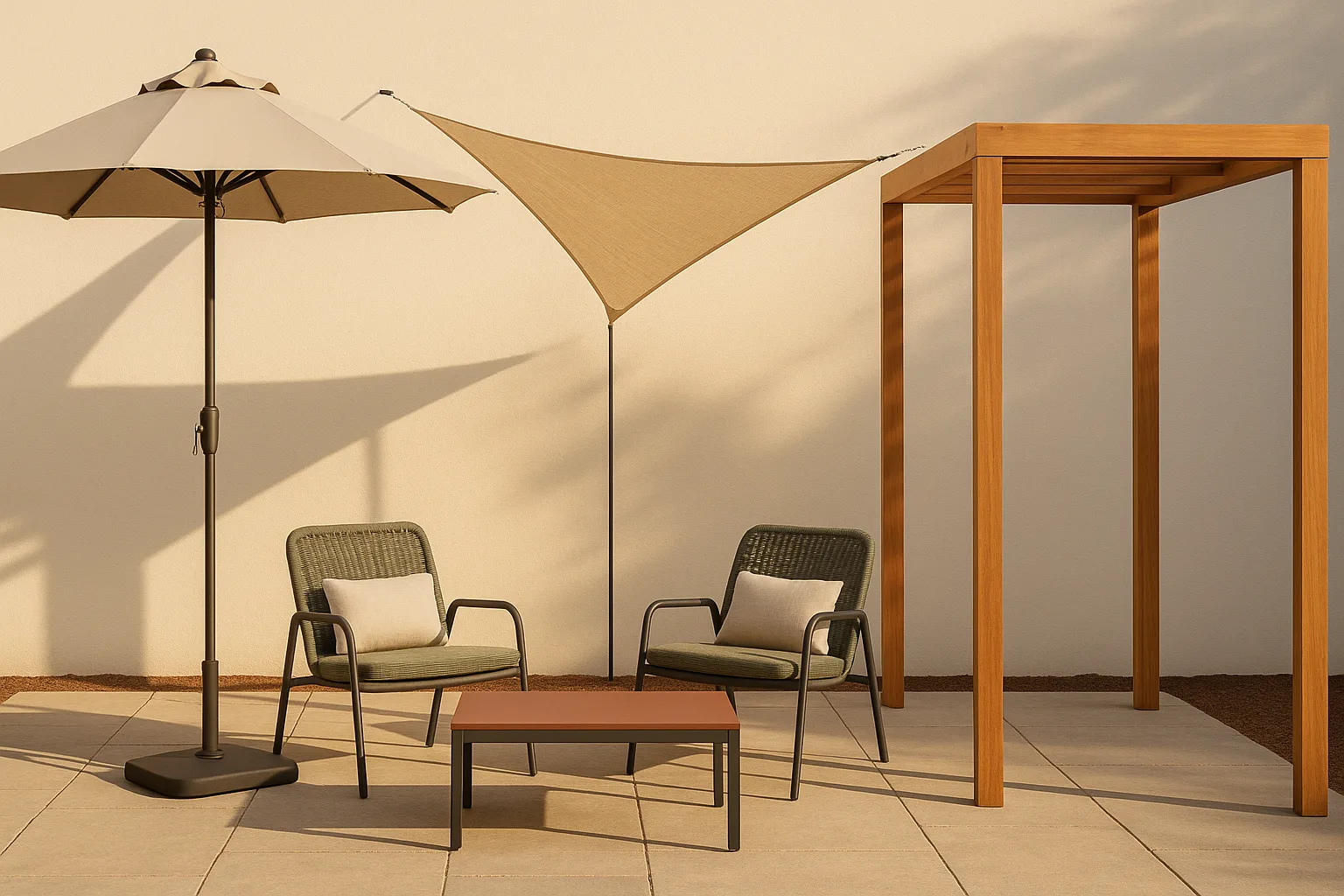
[Image: Side-by-side comparison visual — patio umbrella over bistro table, shade sail spanning a lounge area, pergola framing an outdoor dining room]
Freestanding patio umbrella: easiest and most movable option
A freestanding patio umbrella is the right call for a single table and a few chairs. The setup is what you expect: a canopy on a pole, a weighted base, and nothing else. You fill the base with sand or water, drop the pole in, and you are done. The range of base weights you will see commercially runs from 40 lb to 55 lb for standard freestanding setups — Wayfair's umbrella base category shows both classes, with adjustable pole fits from 1.37 inches to 1.9 inches in diameter, so base and umbrella compatibility is worth checking before you buy.
For the canopy itself, look for two specific mechanical features: a crank lift (a side handle that raises and lowers the canopy without wrestling with the pole) and a tilt mechanism (which lets you angle the canopy to follow the sun rather than just having it straight up). Costway's 10-feet patio outdoor sunshade hanging umbrella explicitly lists a crank-and-tilt design, and the same listing notes the 21 lb umbrella weight specification, which is useful as a reminder that the canopy itself is not the ballast.
The honest trade-off: a freestanding patio umbrella is only as stable as its base. In gusty conditions, 40 or 55 pounds is not an enormous amount of ballast when a large canopy acts like a sail. Close the umbrella when wind picks up, and bring the canopy in for storage before the first hard freeze. Sunbrella-fabric canopies hold color significantly longer than cheaper polyester alternatives and are worth the premium if the umbrella will see daily summer use.
Pro Tip: Fill a sand-and-water hybrid base with play sand first, then add water. The combination packs tighter and gives you close to the maximum ballast weight the base is rated for.
[AffiliateProductCard placeholder — Category: Freestanding patio umbrellas with crank and tilt, 9 ft–13 ft canopy diameter, Sunbrella fabric option, 50 lb+ base included or sold separately]
Cantilever umbrella: best for keeping the center pole out of the way
A cantilever umbrella (also called an offset umbrella) puts the support arm to the side instead of through the center of the table. That single change matters more than it sounds: with no center pole to work around, you can pull chairs freely in any direction, and you can position the canopy over a lounge setup, a daybed, or an irregular seating cluster where a center pole would land in the worst possible spot.
The catch is weight. Because the arm extends out horizontally, the base has to counterbalance significant leverage — Homary's 10-foot cantilever umbrella uses a 100 kg (about 220 lb) granite base to stabilize the offset design. That is not a base you are casually relocating. Plan where you want a cantilever umbrella before you set it up, because moving it becomes a two-person job.
If your patio is close to a grill zone, note Weber's safety guidance: keep any grill at least 2 feet away from combustible materials, including wood decks and patios. A cantilever canopy that hovers over or near a grill is a placement problem — position the arm so the canopy shades the dining side, not the cooking side, and preserve clear airflow over the grill.
Shade sail: best for spanning larger seating areas
A shade sail is worth it if your seating footprint is too large for a single umbrella and you have anchor points that can handle tension loads. Done right — with proper hardware and structurally sound fixing points — a shade sail looks clean, provides consistent shade across a wide area, and earns its keep on a busy patio.
HDPE mesh versus coated fabric is the first material decision. HDPE (high-density polyethylene) mesh fabric is the industry standard for exterior shade sails: it is breathable, sheds water rather than collecting it (important for drainage and mold prevention), and handles UV exposure well. Coolaroo's commercial-grade shade sails, one of the most established names in this category, build their commercial-grade sails from HDPE fabric and rate them for up to 95% UV block with resistance to fading, mold, and mildew. For the specific warranty and UV-block benchmark, Coolaroo's commercial-grade rectangle shade sail states the 95% UV block and 15-year warranty on the product page, which is the clearest source to check before buying. Their commercial-grade line carries a 15-year warranty — but that warranty applies to the commercial-grade products specifically, so verify the warranty tier before assuming it covers an everyday-grade sail.
Coated fabric sails (solid weave with a waterproof coating) shed rain more effectively but trap heat underneath and do not breathe. For a covered porch, a coated sail may work fine. For an open seating area, HDPE mesh is almost always the better call.
Anchoring is where shade sails fail or succeed. Coolaroo's installation guide is direct: all fixing points must be structurally sound and fixings tightly secured. A fence board is not a structurally sound anchor point. A post set in concrete, a structural column, or a solid masonry wall is. The hardware connecting the sail's corner rings to your anchors should be marine grade 316 stainless steel — it resists salt, moisture, and rust far better than basic galvanized hardware. Coolaroo's own turnbuckle accessory is 8 mm marine grade 316 stainless steel, and the brand is clear on one point: “There should always be two tensioning devices per shade sail.” Skipping the second turnbuckle means you cannot balance tension across the sail evenly, which leads to sagging and anchor stress.
Watch Out: Do not anchor a shade sail to a wood fence panel, a lightweight post not set in concrete, or a deck railing that is not engineered for lateral load. A 12-foot sail in a 20 mph gust generates enough force to pull a poorly anchored fixing point right out of the ground.
Pergola: most structural and most permanent shade choice
A pergola makes sense when you have committed to an outdoor living space — not just a patio you occasionally sit on, but a destination you are going to use for meals, gatherings, and weekend mornings. It defines the zone, frames a view, and gives you a structure to hang things from: lights, a ceiling fan, a retractable canopy, shade cloth, or climbing plants.
Aluminum versus wood is the first decision. Powder-coated aluminum pergola kits — like the M-D Building Products Classic Pergola at Home Depot, made from aircraft-grade extruded aluminum and powder-coated to AAMA 2604 standard and available in 8×12, 10×14, and 12×12 — are low maintenance, rust-resistant, and available as DIY kits that a motivated homeowner can assemble over a weekend. Cedar or pressure-treated wood pergolas cost less up front in kit form and look more traditional, but they require annual sealing or staining to prevent rot and weathering. In humid climates — the Southeast, the Pacific Northwest — that maintenance cycle matters.
Wall-mounted pergolas save on footprint and cost because they share one side of the structure with your house, reducing the number of posts you need to set. Home Depot's wall-mounted aluminum pergola category includes options with aluminum alloy frames and adjustable louvered steel roofs — a practical choice if you want light control without adding a separate shade sail or canopy. The trade-off: wall-mounted pergolas are load-bearing attachments to your home's structure, so a structural assessment (and likely a permit) is the right move before installation.
Pro Tip: Louvered roof pergolas — with adjustable slats that open and close — give you shade-on-demand without a separate canopy or curtain system. They cost more than a standard open-beam pergola but eliminate the need to maintain a fabric canopy, which matters in regions with heavy pollen or frequent rain.
[AffiliateProductCard placeholder — Category: Aluminum pergola kits in 10×12 to 12×16 footprints, powder-coated finish, louvered or open-beam options, freestanding or wall-mounted]
How much patio shade costs by option
Budget ranges for all three shade solutions vary by size, material, and how much site preparation your yard requires. Regional labor rates, material availability, and installation conditions can move quotes meaningfully up or down, so a coastal metro with higher contractor demand will usually price differently from a suburban market with easy access and level ground.
Cost Snapshot: - Patio umbrella (umbrella + base): $80–$300 for a quality freestanding setup; cantilever umbrellas with large bases typically run $250–$600+ - Shade sail (material + hardware + installation): $150–$500 installed on average, or roughly $1–$2 per square foot total for basic installations - Pergola: $700–$4,000 for a DIY kit; $1,450–$5,750 installed for a prefabricated unit; $30–$65 per square foot installed for a custom build
Those pergola numbers from HomeGuide's 2026 pricing guide deserve unpacking. At the low end — say a $700 DIY aluminum kit on an existing level concrete patio — you are buying an assembly project with no labor cost beyond your own weekend. At $1,450 to $5,750 for professional installation of a prefabricated unit, you are adding contractor labor and site coordination. A custom pergola at $30–$65 per square foot means a 12×16 footprint runs roughly $5,760 to $12,480 installed — that is the range when you are spec'ing materials, sizing, and finish to a specific design rather than buying a kit off the shelf.
Shade sails look cheap until you factor in hardware. Stainless turnbuckles, eye bolts, snap hooks, and carabiners for a three-point sail can add $60–$150 in hardware alone before the sail fabric itself.
What pushes shade costs up or down
For shade sails: Size is the primary cost driver. A larger sail needs more fabric, more hardware, and more labor to tension correctly. Anchoring into masonry (concrete block, brick) rather than into wood framing or an existing post adds both hardware and labor. Irregular anchor-point geometry — when your three or four fix points are not evenly spaced — creates uneven tension problems that can require additional hardware or a custom-cut sail.
For pergolas: The factors that push a basic kit assembly into a mid-range build include:
- Size: A 10×12 footprint versus a 16×20 changes kit cost significantly
- Material: Aluminum kits cost more up front but eliminate wood maintenance; cedar kits cost less initially but require ongoing treatment
- Roof type: Open-beam (cheapest), shade cloth or polycarbonate panels (mid-range), louvered aluminum (premium)
- Foundation condition: HomeGuide notes that a strong, level patio is necessary for the base of a pergola kit. If your slab is cracked, uneven, or non-existent, you are adding concrete work before the pergola goes up
- Wall-mounted vs freestanding: Wall-mounting cuts post count but may require structural consultation and a permit
HomeGuide's assembly baseline for a basic kit on an existing foundation is roughly $10 to $40 per square foot for contractor assembly, and that number is what many homeowners underestimate. It covers the labor to assemble and set the structure when the slab or patio is already ready, but it does not include major prep, electrical work, or custom carpentry.
Watch Out: Custom pergolas at $30–$65 per square foot are quoted installed, meaning contractor labor, materials, and finishing. A contractor who quotes you "per square foot installed" and then adds a long materials list separately is working outside that standard framing. Get an itemized quote.
Wind, UV exposure, and weather resistance: what U.S. homeowners should check
UV exposure is the hidden cost of backyard shade: the wrong fabric degrades fast in direct sun and ends up replaced in two to three seasons. Coolaroo's commercial-grade shade sails block up to 95% of UV rays and are UV stabilized with resistance to fading, mold, and mildew — specs that reflect what you want from any outdoor shade fabric, regardless of brand. Their commercial-grade product carries a 15-year warranty, which is a useful benchmark when evaluating other brands' claims. Weber says, “Grilling is a year-round event.” That matters because if you plan to use the grill through colder months, your shade setup needs to work in shoulder-season wind and not just in summer calm.
Weather resistance checklist before you buy:
- Does the canopy fabric specify a UV block rating? Look for 90%+ block on any shade product marketed for sun protection
- Is the fabric solution-dyed acrylic (like Sunbrella) or a cheaper polyester print? Solution-dyed acrylic holds color longer because the pigment runs through the entire fiber, not just the surface
- For shade sails: is the fabric HDPE mesh with tested UV stabilization, or a coated fabric that may crack and degrade faster?
- For pergolas: does the structure have a powder-coated or otherwise sealed finish? An uncoated aluminum or raw steel frame will pit and rust in coastal and humid climates
- Does the product include an off-season storage recommendation? Most umbrella manufacturers recommend storing the canopy (and ideally the base) when not in use to extend lifespan and prevent winter damage
Watch Out: Bring in patio umbrella canopies — and where possible their bases — before a hard freeze or a storm with sustained winds above 25 mph. A closed umbrella in a light-weight base can still topple in strong gusts and damage furniture, windows, or a fence.
How wind changes the right shade choice
In a yard with regular strong gusts — open lots, elevated properties, coastal areas, the southern Great Plains — portable shade is sometimes safer than fixed shade, because you can take it down. A freestanding patio umbrella in a 55 lb base is stable in a light breeze, but in a genuine gust it becomes a projectile if you forget to close it. Cantilever umbrellas are more exposed to wind leverage because of the offset arm, which is why Homary's offset design uses a 220 lb granite base — the mass is doing real work.
Pro Tip: If you regularly see afternoon wind gusts of 15–20 mph, budget for a base in the 55 lb class minimum for a standard 9–11 ft umbrella. Size up the base, not just the umbrella.
Shade sails handle moderate wind reasonably well when properly tensioned and anchored — the mesh fabric breathes rather than creating a full sail effect. But the anchor points bear the load, and Coolaroo's installation requirements are clear that structurally sound fixing points are non-negotiable. A shade sail on marginal anchors in a windy yard will eventually pull something loose.
Pergolas, once properly installed, handle wind best of the three — structural posts set in footings or bolted to a concrete slab are not going anywhere. The vulnerability with pergolas is any attached fabric canopy or shade cloth, which should be retracted or removed when severe weather is forecast. The structural frame itself is generally the most wind-tolerant option.
UV protection and fabric durability
Look for these specific fabric attributes when shopping any of the three shade categories:
- UV block rating: A number expressed as a percentage (95% UV block) or as a UPF (Ultraviolet Protection Factor) rating. UPF 50+ blocks 98% of UV radiation; 95% UV block is comparable. Either is a meaningful spec. A product that mentions "UV-resistant" without a number is vaguer — ask for the spec or check the manufacturer's product sheet
- Solution-dyed acrylic: Sunbrella is the most recognized brand in this category. The dye runs through the fiber rather than being applied to the surface, which is why the color stays more consistent through years of outdoor exposure. Budget for solution-dyed fabric if the umbrella will be your primary daily-use shade
- HDPE mesh: The standard for shade sails. Coolaroo's HDPE shade sail fabric is designed for harsh climate conditions — Australian sun intensity is a meaningful real-world durability benchmark. HDPE mesh also allows airflow, which meaningfully reduces the heat-trap effect under a sail
- Coated fabric: Waterproof but does not breathe. Better suited for covered porch applications or climates with heavy rain where keeping dry is the priority over temperature
Pro Tip: On umbrellas, check whether the canopy fabric is removable and machine-washable. Pollen, bird debris, and mildew accumulate on outdoor fabrics. A canopy you can pull off the frame and wash extends its usable life by years.
Where to place backyard shade without creating problems
Placement determines whether your shade system actually works in daily use. Three zones deserve specific attention before you commit: the grill zone, the furniture circulation zone, and the structural support zone underneath your anchor or post locations.
Placement checklist before installation:
- [ ] Mark where the sun hits hardest between 11 a.m. and 3 p.m. — that is the area your shade needs to cover
- [ ] Confirm grill clearance of at least 2 feet from any combustible surface — shade structures overhead or adjacent count
- [ ] Identify all potential anchor or post locations and verify the mounting surface can accept the load (see section below)
- [ ] Walk the perimeter of your planned shade footprint and check for pole, post, or line interference with chair pull-out and walkway paths
- [ ] Check whether the shade will create a smoke or heat trap if positioned near a grill or fire pit
Keep shade out of grill smoke paths
Weber's guidance applies directly here: a grill should be at least 2 feet from combustible materials, including wood or treated wood decks, patios, and porches. Shade structures are typically not the combustible material itself (unless you have a wood pergola beam directly overhead), but they can trap smoke, concentrate heat, and create an uncomfortable cooking environment if positioned incorrectly.
The practical rule: keep your grill zone at the downwind edge of your patio, outside the footprint of your shade structure. If your outdoor kitchen or grill cart is positioned along a wall or in a corner, a cantilever umbrella extended away from the cooking zone works better than a center-pole umbrella that has to be threaded through the work area. A pergola over an outdoor kitchen is a legitimate design choice — open-beam pergolas allow smoke to exit naturally — but a solid canopy or shade sail directly above a grill traps heat and smoke in a way that makes grilling unpleasant.
Leave enough open space so smoke can drift away and the fabric stays clear of flare-ups.
Preserve circulation around dining furniture
Outdoor dining clearance follows the same logic as indoor dining: you need enough room behind each chair for a seated person to push back, stand up, and walk away without banging into a post, stepping over a base, or catching a sail line.
A practical minimum is 36 inches of clear passage behind any chair. A 48-inch clearance is more comfortable if you have multiple chairs against a wall or fence side. Here is how each shade option affects that clearance:
- Center-pole patio umbrella: The pole sits in the center of the table (or through a table with a hole), and the weighted base sits at ground level around the pole. A 55 lb base typically has an 18–24 inch footprint, which means chairs on the pole side have to work around it. If your table does not have a center pole hole, the umbrella base itself becomes an obstacle at foot level
- Cantilever umbrella: No center pole at the table — the support arm comes in from one side, typically from a corner of the patio. This is the cleanest option for dining circulation, but position the base so it does not block the main walkway into the seating area
- Shade sail: Anchor points at the corners of the sail are fixed to posts, walls, or fencing. The lines running from corners down to fixing points at lower angles can cross at head height or knee height — map those lines before you finalize anchor positions, and make sure no line runs directly through a chair path or entry walkway
- Pergola: Posts define the perimeter of the outdoor room and typically clear the dining area entirely. The bigger circulation concern with a pergola is post placement relative to the furniture layout — position posts so they land at the corners of your dining zone, not in the middle of a walkway
Verify the mounting surface before you buy
This step happens before purchase, not after. Returning a 200 lb pergola kit or realizing your fence posts cannot support a shade sail tension load is an expensive and frustrating lesson.
Concrete patio or slab: - Best base for a freestanding pergola kit — HomeGuide confirms a strong, level patio is the assumed baseline for kit installation - Check for cracks, significant heaving, or unlevel areas before committing to a kit; a cracked slab may require repair before post anchors will sit properly - Shade sail anchor bolts set into concrete are secure when properly installed with appropriate anchor hardware rated for lateral loads
Wood deck framing: - Pergola posts on a wood deck require attachment to the structural framing below the deck boards — not just the decking surface. Consult the deck's original plans or a contractor before drilling post locations - Shade sail anchors on a wood deck should bolt through the structural rim joist or a dedicated blocking section, not into a railing post or surface-mounted cleat - Weber's combustible materials guidance applies here: wood decks are combustible, so keep grill clearance rules in mind when siting any shade anchor near a grill zone
Freestanding in the yard (on grass or gravel): - Freestanding patio umbrellas just need a level surface and a heavy enough base — 40 to 55 lb covers most conditions with a 9–11 ft umbrella - Freestanding pergola kits require setting posts in concrete footings; the depth and diameter depend on the kit manufacturer's specifications and local frost-line depth - Shade sails anchored to freestanding posts require those posts to be set in concrete at adequate depth — a post that is only surface-spiked will pull out under sail tension
Watch Out: Wall-mounted pergolas attach directly to your home's structure. Home Depot's wall-mounted pergola category includes models that require attachment to a wall — which means lag bolts into structural framing, not just siding or stucco. If you are not sure your wall can handle the load, a structural consultation before installation is worth the cost.
When a patio umbrella is enough versus when to upgrade
A patio umbrella is enough when: your seating area is one table and four to six chairs, you are not ready to commit to a specific backyard layout, you rent or plan to move, your budget is under $300, or you need the flexibility to move the shade depending on the time of day.
Upgrade to a shade sail when: your seating zone is wider than one umbrella can cover, you want a cleaner visual line than a pole-and-base setup, you have solid anchor points available (or are willing to set posts), and your budget runs $150–$500.
Upgrade to a pergola when: you have committed to the space, plan to furnish it like an outdoor room, want to add lighting or a fan, and are ready to invest $700–$5,750 depending on size and whether you DIY or hire out.
Pro Tip — Decision tree: - "I just need shade over one table" → Freestanding patio umbrella with crank and tilt, 9–11 ft canopy, 50+ lb base - "I have multiple seating zones or a long rectangular layout" → Shade sail, HDPE mesh, stainless hardware, properly anchored - "I want an outdoor room I use every weekend" → Pergola kit (aluminum for low maintenance, cedar for traditional look), freestanding or wall-mounted based on your layout - "I'm in a windy yard and want something I can take down" → Patio umbrella, close it every time wind picks up; shade sail is a secondary option only if your anchor points are solid - "I want permanent shade and I grill under it" → Pergola with open-beam roof, grill positioned outside the footprint, clear airflow around the grill and any overhead structure
The cost gap between a $200 umbrella setup and a $1,500 pergola kit is real, but so is the permanence gap. A patio umbrella you can upgrade from later — it stores in a garage — whereas a pergola becomes part of your property. Neither is a wrong answer; they are just different commitments.
FAQ about patio umbrellas, shade sails, and pergolas
FAQAccordion
Q: What is the best shade for a patio? A: The best shade for a patio is the option that fits your space, anchors correctly in your yard, and matches how permanently you have committed to the layout. A freestanding patio umbrella is the best shade for a small dining setup where portability matters. A shade sail is the best choice for a larger open seating area with solid anchor points available. A pergola is the best shade for an outdoor room you are furnishing and using seasonally or year-round. There is no single answer that works for every backyard.
Q: Are shade sails worth it? A: Yes, when properly installed. Coolaroo's commercial-grade HDPE shade sails block up to 95% of UV rays and, in the commercial-grade line, carry a 15-year warranty — that kind of performance lifespan makes them worth the installation effort for a space you plan to use consistently. The caveat is the anchoring requirement: all fixing points must be structurally sound, hardware must be marine grade 316 stainless steel, and there should be two tensioning devices per sail. Installed on weak or improvised anchors, a shade sail is not worth it — it will sag, move, and eventually pull the anchor out.
Q: Can a patio umbrella withstand wind? A: A patio umbrella can handle light breezes when it is properly ballasted — a 55 lb base class is a reasonable minimum for a 9–11 ft canopy. It is not designed to hold up in sustained winds or gusts. Close the umbrella whenever you are not actively using it, close it immediately when wind picks up, and never leave it open overnight. Cantilever (offset) umbrellas require heavier bases because of the leverage their arm creates — a 220 lb granite base is used on some commercial cantilever models for exactly this reason. No freestanding patio umbrella should be trusted to stay put in a storm.
Q: Do pergolas provide full shade? A: Open-beam pergolas provide partial, dappled shade — the rafters block some direct sun but not all of it, especially at low sun angles. The shade coverage improves during peak midday sun when the angle is more directly overhead. For full shade from a pergola, you need a shade cloth, a fabric canopy, polycarbonate panels, or a louvered roof stretched or attached across the beams. Powder-coated aluminum pergolas with adjustable louvered roofs give you the most control: open the louvers for airflow and partial sun, close them for full shade or rain protection.
Sources & References
- Wayfair — Patio Umbrella Stands & Bases — Commercial umbrella base weight classes and pole diameter compatibility
- Coolaroo — Shade Sails Overview — UV block rating and product overview
- Coolaroo — Commercial Grade Rectangle Shade Sail — 95% UV block, 15-year warranty specs
- Coolaroo — Turnbuckle Accessory — Marine grade 316 stainless steel hardware, two tensioning devices per sail requirement
- Coolaroo — Shade Sail Installation Guide (PDF) — Structural anchor requirements
- Coolaroo — Commercial Grade Shade Sail Instructions (PDF) — HDPE fabric specification and climate durability
- HomeGuide — Pergola Cost Guide 2026 — DIY kit, prefabricated, and custom pergola price ranges; labor rates
- HomeGuide — Covered Deck Cost Guide — Shade sail installation cost estimates
- Weber — Grill Safety: Distance from Combustible Materials — 2-foot clearance requirement from combustible surfaces
- Weber — Winter Grilling Tips — Grilling safety and ventilation guidance
- Home Depot — M-D Building Products 8×12 Aluminum Classic Pergola — Aircraft-grade aluminum, AAMA 2604 powder coat, available sizes
- Home Depot — 20 ft × 12 ft Aluminum Pergola with Retractable Canopy — Aluminum frame, galvanized steel louvered roof
- Home Depot — 10 ft × 13 ft Wall-Mounted Aluminum Pergola — Wall-mounted aluminum alloy, powder-coated louvered roof
- Homary — 10-ft Cantilever Patio Umbrella — 100 kg granite base, waterproof UV-resistant canopy
- Costway — 10-ft Patio Outdoor Sunshade Umbrella — Crank and tilt function, 21 lb umbrella weight specification
- Wayfair — Arlmont & Co. Thatch Umbrella with Solar Lights — Commercial relevance reference for umbrella-style shade products
Keywords: cantilever umbrella, freestanding patio umbrella, crank lift, tilt mechanism, HDPE shade sail, UV block rating, stainless steel hardware, turnbuckle, anchor point, pergola kit, powder-coated aluminum, Sunbrella fabric, outdoor dining clearance, wind load, off-season storage