Pet-safe houseplants for cats and dogs: the fast answer before you buy
The fastest way to verify whether a houseplant is safe for your cat or dog is to look up its exact botanical name in the ASPCA Toxic and Non-Toxic Plants database. If the species appears on the non-toxic list, it's a safer option for a pet-friendly home. If it appears on the toxic list — or you can't find it at all — don't bring it home until you've confirmed the identity with a vet or ASPCA Poison Control at (888) 426-4435.
The critical thing to understand upfront: the ASPCA database is a species-level resource, not a category resource. The same common name — "lily," "ivy," "dracaena" — can refer to multiple plants with completely different safety profiles. As ASPCA states directly on the database page, "Please be sure to check the name of the plant to determine its toxicity." That means every plant you're considering for your pet-safe home decor needs a Latin-name check, not just a vibe check.
Watch Out: The ASPCA plant list is not all-inclusive — it covers the most frequently encountered plants, not every species. When in doubt, treat an unlisted plant as suspect and consult your vet before purchase.
How to verify a houseplant in the ASPCA toxic and non-toxic plants database
Skipping this step is exactly how a well-intentioned plant purchase turns into a vet visit. The ASPCA's searchable plant database is organized by both scientific name and common name, but the safety entries are indexed at the species level. Here's the workflow that actually protects your pets. ASPCA puts the rule in plain language: "Please be sure to check the name of the plant to determine its toxicity."
Check the exact botanical name on the nursery tag or product page
Before anything else, find the two-part Latin name (genus + species) on the nursery stake, the grower's pot label, or the product page description. This is non-negotiable. ASPCA says it directly: "Please be sure to check the name of the plant to determine its toxicity."
Here's why common names fail you: "Peace lily" sounds harmless, but Spathiphyllum spp. is listed as toxic to cats and dogs by ASPCA due to calcium oxalate crystals — those are microscopic needle-like compounds that cause oral pain, drooling, and swelling on contact. Meanwhile, a plant sold as "Chinese evergreen" could be Aglaonema (toxic to cats and dogs) or could be mislabeled entirely. Common names tell you almost nothing about safety.
The ASPCA database entries pair common names with their scientific equivalents — for example, an entry might list "Boston Fern" alongside Nephrolepis exaltata bostoniensis. Your job is to find that scientific name on the product tag before you check out, not after the plant is already on your windowsill and your cat has already chewed a frond. That is why ASPCA repeats, "Please be sure to check the name of the plant to determine its toxicity."
Pro Tip: Many online plant retailers — The Sill, Bloomscape, and Rooted — include the botanical name in their product listings. If a retailer's listing only shows a common name, search the ASPCA database for that common name first, confirm the scientific name the database associates with it, then verify that the Latin name on the actual plant's grower tag matches before finalizing your order.
Cross-check the species in ASPCA before adding it to cart
Once you have the exact botanical name, go to aspca.org/pet-care/animal-poison-control/toxic-and-non-toxic-plants/search and search it. ASPCA's reminder still applies: "Please be sure to check the name of the plant to determine its toxicity." The decision rule is straightforward:
- Listed as non-toxic to cats and dogs: Proceed to placement planning (more on that below).
- Listed as toxic: Do not buy it for a home with cats or dogs, regardless of how attractive the plant is.
- Not found in the database: Treat it as unverified. Contact your vet or ASPCA Poison Control before purchase.
One more constraint worth knowing: ASPCA notes that individual plants may look different from the photos on their listings, so photo-matching a plant to the database is not a reliable verification method. The Latin name is the only safe filter.
Why pet-safe does not mean pet-proof in a home with cats and dogs
"Non-toxic" and "pet-proof" are two different things, and conflating them is one of the most common mistakes pet owners make when styling a plant-friendly home. A non-toxic plant won't send your dog to the emergency vet — but it can still cause real problems if your pets eat it, dig in the soil, or knock it off a shelf. ASPCA cautions that "Also, be advised that the consumption of any plant material may cause vomiting and gastrointestinal upset for dogs and cats."
ASPCA puts it plainly on the database page: "Also, be advised that the consumption of any plant material may cause vomiting and gastrointestinal upset for dogs and cats." That applies to non-toxic species too. So even after you've done your ASPCA check, you still need a placement strategy that accounts for your specific pet's behavior.
What chewing, vomiting, and soil digging can still do to a non-toxic plant
Even a fully ASPCA-cleared plant can cause a rough afternoon for your pet — and for your plant. A cat that chews Calathea orbifolia leaves may vomit simply because plant fiber irritates a cat's digestive system, not because the plant is poisonous. ASPCA warns that "Also, be advised that the consumption of any plant material may cause vomiting and gastrointestinal upset for dogs and cats." A dog that digs in a pot of rich, peaty soil may ingest fertilizer, fungus gnats, or amendments that have nothing to do with the plant itself but can still cause GI upset.
The takeaway is not to skip ASPCA checks — it's to not stop there. Supervision and physical deterrence still matter for non-toxic plants. If you have a cat who chews everything or a dog who treats every pot as a water dish and snack bar, place plants where they genuinely cannot reach them, even if the species is cleared.
How pet traffic, reach, and jump height change placement decisions
Different pets require different placement strategies, and the right hardware matters as much as the right plant. Use this matrix as a starting point:
| Pet Type | Highest Risk Placement | Safer Placement Options |
|---|---|---|
| Cat (climber) | Windowsill, bookshelf, floor pot | Ceiling-hung macramé planter, wall-mounted bracket out of leap range |
| Cat (floor dweller) | Floor pots, low coffee tables | Tabletops above 36 inches, tall plant stands |
| Small dog (under 25 lbs) | Floor pots, low plant stands | Countertop planters, wall shelves, hanging planters |
| Large dog (over 50 lbs) | Floor pots, low shelves, countertops | High wall shelves, ceiling planters, rooms dogs don't access |
For hanging planters, look for ceiling hooks rated for at least twice your planter's filled weight — a 10-inch pot with soil and a mature plant can weigh 8–12 lbs. Brands like Mkono and Umbra make ceiling and wall-mounted plant hangers that work with standard drywall anchors. On the plant-stand side, a tall, narrow stand (think 40–60 inches) puts a floor plant well above a medium dog's snout and above most cats' casual reach — though no stand defeats a determined climbing cat, which is why toxicity status still matters.
Best pet-safe houseplant style categories to shop in US stores
The ASPCA database is your safety filter first. Style and light come second. With that workflow in place, here are the pet-safe plant categories that map cleanly to common US home styles and room conditions — with specific ASPCA-verified species named so you know exactly what to search for at retailers like The Sill, Bloomscape, Rooted, IKEA, Home Depot, and Trader Joe's.
Low-light pet-safe houseplants for apartments and rentals
Low-light spaces — north-facing windows, interior rooms, apartments with light filtered through neighboring buildings — narrow your options, but several ASPCA-verified non-toxic species thrive there.
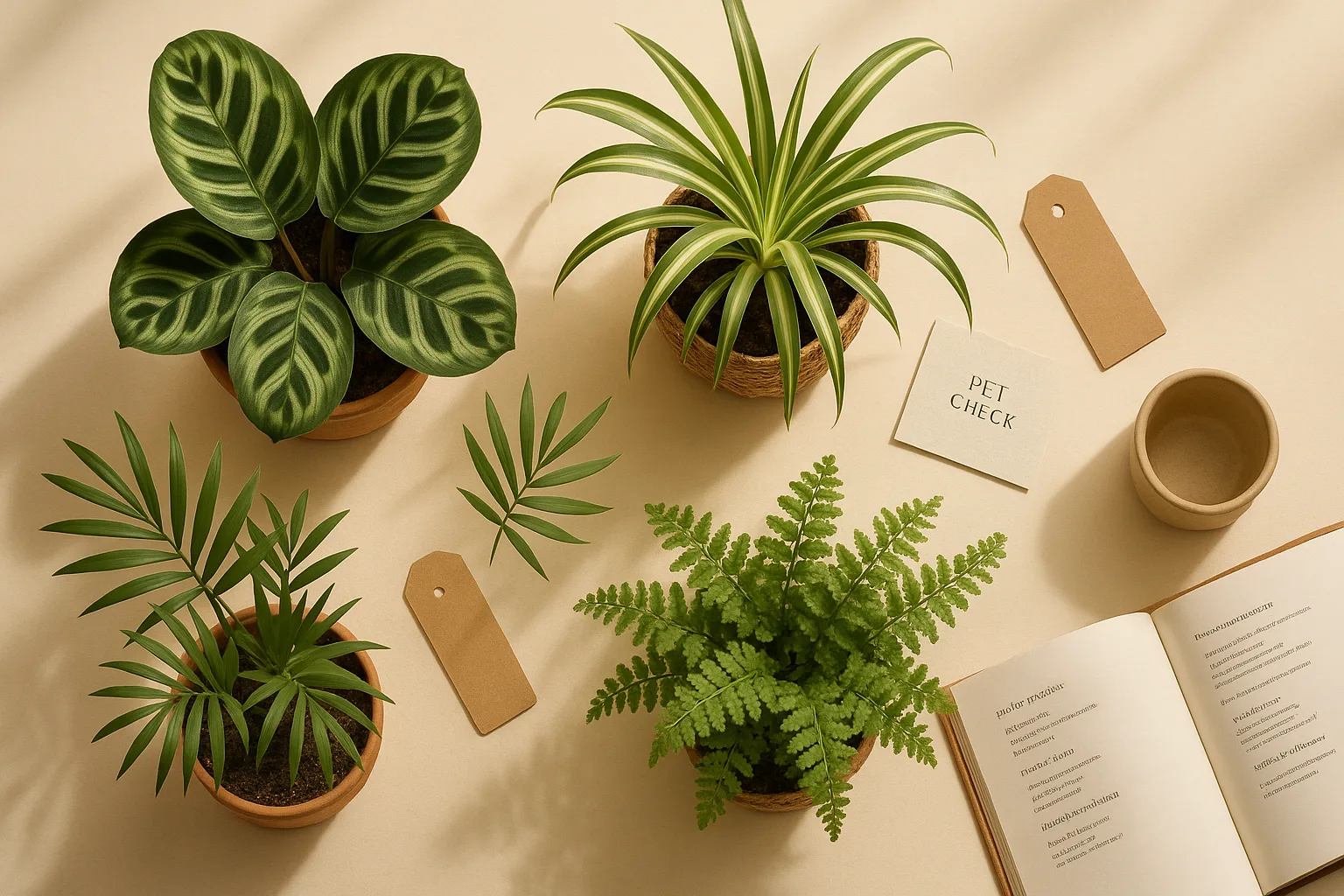
Parlor Palm (Chamaedorea elegans) — Listed as non-toxic to cats and dogs by ASPCA. Tolerates low to medium indirect light, grows slowly to 4–6 feet, and looks architectural in a tall ceramic pot. Available at Home Depot, The Sill, and Bloomscape, typically ranging from $15 for a 4-inch starter to $60+ for a 10-inch specimen.
Boston Fern (Nephrolepis exaltata bostoniensis) — ASPCA-listed as non-toxic to both cats and dogs. Prefers humidity and indirect light; a hanging planter in a bathroom with a frosted window is ideal. Widely available at Home Depot and Lowe's for $10–$25.
Spider Plant (Chlorophytum comosum) — Non-toxic per ASPCA, one of the easiest houseplants available, and extremely forgiving of low light and irregular watering. Available everywhere from IKEA ($5–$10) to Trader Joe's seasonal plant sections.
Watch Out: Do not substitute Dracaena species thinking they are similar to spider plants — multiple Dracaena species are toxic to cats and dogs. Always confirm the Latin name matches your ASPCA lookup.
Bright indirect-light pet-safe houseplants for sunny rooms
South- and east-facing windows that receive several hours of bright but filtered light open up a larger range of pet-safe choices.
Calathea / Goeppertia spp. — Several species in this group, including Calathea orbifolia, Calathea roseopicta, and Calathea makoyana, are listed as non-toxic to cats and dogs by ASPCA. Before you buy, confirm the exact species on the tag, since the genus has been reclassified and products may be labeled inconsistently at retail. Calatheas prefer bright indirect light and high humidity; they're a strong fit for east-facing rooms.
Areca Palm (Dypsis lutescens) — ASPCA-listed as non-toxic. Thrives in bright indirect light, can grow to 6–7 feet indoors, and makes a strong visual statement. Widely available at Home Depot, Costco seasonal sections, and The Sill.
African Violet (Saintpaulia spp.) — Non-toxic per ASPCA, compact enough to live on a windowsill, and widely available at grocery stores and garden centers across the US for under $10. A low-commitment entry point for a bright kitchen or bathroom.
Always confirm the exact species name on the nursery label and run it through the ASPCA search before checkout — "palm" and "violet" are common names that map to multiple species with different safety profiles.
Statement plants and trailing plants that work with pet-safe decor
For the reader who wants a visually strong plant that photographs well and holds up in a styled room, pet-safe options exist — they just require a bit more intention in both selection and placement.
Friendship Plant (Pilea involucrata) — ASPCA non-toxic, low-maintenance, and produces interesting texture. Works well on a high shelf or bookcase out of reach.
Swedish Ivy (Plectranthus australis) — Non-toxic per ASPCA and one of the best trailing plants for a hanging planter or a high shelf where the vines can cascade. Grows quickly in bright indirect light.
Orchids (Phalaenopsis spp.) — ASPCA lists Phalaenopsis orchids as non-toxic to cats and dogs. They're statement plants that work in minimalist, modern, and botanical-style rooms. Available at Trader Joe's, Whole Foods, Home Depot, and Costco for $10–$30.
For trailing plants on high shelves or in hanging baskets, use a planter with a drainage tray to prevent drips — wet floors under a hanging planter are a slip risk, and cats will absolutely investigate the drip. The Mkono Plastic Planter lineup includes hanging baskets with built-in drip trays, which solves both problems. For statement floor plants like a large areca palm, a heavy ceramic pot on a rolling plant stand gives you flexibility to move the plant out of a room when needed — useful during high-traffic pet moments.
What to do if your cat or dog eats a plant
Even the most careful setup occasionally fails. A guest leaves a door open, a cat scales something you thought was unreachable, or a dog counter-surfs a delivery box containing a plant you haven't verified yet. Know what to do before it happens.
When to call your vet or ASPCA Poison Control right away
Call immediately — do not wait to see if symptoms develop — if your pet has eaten any plant you haven't verified as non-toxic, or if a verified non-toxic plant is consumed in large quantities. ASPCA says, "If you suspect your pet has ingested a toxic substance, please call your veterinarian or ASPCA Poison Control’s 24-hour hotline at (888) 426-4435."
ASPCA Animal Poison Control Center: (888) 426-4435 — available 24 hours a day, 365 days a year.
Watch Out: A consultation fee applies to ASPCA Poison Control calls. Have your credit card and your pet's weight and age ready when you call — the toxicologist will factor in those details to make a recommendation.
Symptoms that require urgent attention after any plant ingestion:
- Drooling, pawing at mouth, or swollen lips/tongue (can indicate calcium oxalate crystal irritation from toxic plants like philodendrons or pothos)
- Vomiting that doesn't stop after one episode
- Lethargy or weakness
- Tremors or seizures
- Difficulty breathing
- Dilated pupils
As ASPCA's emergency care guidance notes, toxicology experts will consider your pet's age, health status, what was eaten, and how much before making a recommendation. Give them as much detail as possible: the plant's common name, the botanical name if you have it, and a rough estimate of how much was consumed.
If your regular vet is open, call them first — they have your pet's records. If it's after hours, ASPCA Poison Control and most metro areas have 24-hour emergency veterinary clinics.
How to shop pet-safe houseplants at US retailers without making a toxic mistake
Most pet-related plant mistakes happen at checkout — either online, where product listings are inconsistent, or in-store, where common names are the only labels on the pot. The workflow below turns the shopping experience itself into a safety check. ASPCA's guidance still applies at the aisle or cart level: "Please be sure to check the name of the plant to determine its toxicity."
Read the product page like a safety label before buying online
When shopping on a US plant retailer's website — The Sill, Bloomscape, Rooted, Etsy plant shops, Amazon, or a big-box retailer's online storefront — treat the product page as a label you're reading before feeding your pet.
Scan for these fields in this order:
- Botanical (scientific) name — If it's missing, ask the retailer in their chat or search the common name in the ASPCA database to find the likely scientific name, then verify it matches what the retailer has physically in stock. Many retailers list the botanical name in a secondary "Plant Details" accordion section below the main description.
- Mature size — A plant listed as "grows to 6 feet" in a 4-inch nursery pot will eventually need a floor placement. If it starts on a high shelf as a small plant but outgrows that spot in 18 months, you need a long-term placement plan.
- Light requirement — Match this to the actual window light in the room you're planning for, not the room you wish you had.
- ASPCA status — Before clicking "Add to Cart," tab over to aspca.org/pet-care/animal-poison-control/toxic-and-non-toxic-plants/search and search the exact botanical name you found in step 1.
Watch Out: Product photos on retail sites may not match the exact individual plant shipped. ASPCA flags this too — photo verification is not reliable. The Latin name on the tag that arrives with your plant is the only thing to check against the ASPCA database.
Match plant size and growth habit to shelves, stands, and hanging hardware
A 2-inch Phalaenopsis orchid and a 10-inch areca palm require entirely different placement hardware, and buying the wrong setup means your pet-safe plant ends up accessible within months.
Placement hardware checklist before you buy the plant:
- Hanging planters: Confirm the ceiling anchor point (drywall anchor, stud, or joist) can hold the combined weight of the planter, soil, and plant at maturity. Standard drywall anchors typically support 15–25 lbs depending on the anchor type; a toggle bolt into drywall handles more. For heavy statement plants, attach to a stud.
- Plant stands: Measure the stand height against your dog's nose or your cat's casual reach. A stand that puts the pot at 48 inches or above clears most medium dogs. Cats are a separate calculation — if your cat can reach the countertop, the cat can probably reach a 48-inch stand given enough interest.
- Shelf placement: Trailing plants on open shelves look great but drape toward the floor over time. Factor in the plant's mature trailing length, not just its current size.
- Floor pots: Only use floor-level pots for ASPCA-verified non-toxic species, and use a heavy ceramic or concrete pot that can't be knocked over easily. Lightweight plastic pots at floor level are an invitation for dogs to tip them.
Pet-safe houseplant shopping checklist for cats and dogs
Run through this before every plant purchase, whether you're at a garden center or checking out online.
- [ ] Botanical name confirmed — Found the Latin genus + species on the nursery tag or product page, not just the common name
- [ ] ASPCA status verified — Searched the exact botanical name at aspca.org toxic-and-non-toxic plants search and confirmed "non-toxic" to cats and/or dogs
- [ ] Light requirement matched — The plant's labeled light need matches the actual light in the room where it will live (low, medium, bright indirect, or direct)
- [ ] Humidity needs checked — Confirmed whether the plant needs average, moderate, or high humidity, and whether your home can support that before buying
- [ ] Mature size noted — You know how large the plant will eventually get and have a placement plan for that size
- [ ] Pet reach assessed — The planned placement keeps the plant out of reach of your specific pet's height, jump range, and climbing behavior
- [ ] Planter hardware rated — Hanging hooks, shelf brackets, or plant stands are appropriate for the plant's mature weight
- [ ] Emergency contact saved — ASPCA Poison Control (888) 426-4435 is in your phone before the plant comes home
FAQ: pet-safe houseplants, ASPCA checks, and pet behavior risk
What indoor plants are safe for cats and dogs?
Several well-known houseplants are listed as non-toxic to both cats and dogs by ASPCA, including parlor palm (Chamaedorea elegans), spider plant (Chlorophytum comosum), Boston fern (Nephrolepis exaltata bostoniensis), areca palm (Dypsis lutescens), Phalaenopsis orchids, and Swedish ivy (Plectranthus australis). The full list is at aspca.org. Always confirm the exact botanical name before purchase because common names can refer to multiple species with different safety ratings.
Are all non-toxic plants safe for pets?
No — "non-toxic" means the plant is not expected to cause poisoning or life-threatening harm, but it does not mean your pet can eat it freely without consequence. ASPCA explicitly states that "consumption of any plant material may cause vomiting and gastrointestinal upset for dogs and cats." Non-toxic plants still need smart placement, and pets who habitually chew plants should be redirected or separated from plants regardless of toxicity status.
How do I know if a plant is toxic to cats and dogs?
Look up the exact botanical (Latin) name in the ASPCA Toxic and Non-Toxic Plants database. Do not rely on photos or common names alone — both can be misleading. If the species isn't in the database at all, treat it as unverified and call your vet or ASPCA Poison Control at (888) 426-4435 before bringing it into your home.
What should I do if my cat or dog eats a plant?
Call your veterinarian or ASPCA Poison Control at (888) 426-4435 immediately if the plant is unverified, if your pet is showing symptoms (drooling, vomiting, lethargy, tremors, difficulty breathing), or if a large quantity was consumed even from a non-toxic plant. ASPCA Poison Control operates 24 hours a day, 365 days a year. Have your pet's weight, age, the plant's name, and an estimate of how much was eaten ready when you call. Do not wait for symptoms to develop before calling — acting early gives toxicologists the most options.
Sources & References
- ASPCA Toxic and Non-Toxic Plants Database — Primary US authority for houseplant toxicity screening for cats, dogs, and horses
- ASPCA Toxic and Non-Toxic Plants Search Tool — Searchable species-level lookup by common or scientific name
- ASPCA Cats Plant List — Species-specific non-toxic and toxic plant list for cats
- ASPCA Animal Poison Control Center — 24/7 hotline at (888) 426-4435; consultation fee applies
- ASPCA Emergency Care for Your Pet — Guidance on symptoms requiring urgent veterinary or poison-control response
Keywords: ASPCA Toxic and Non-Toxic Plants database, botanical name, common name, cat-safe houseplants, dog-safe houseplants, calcium oxalate crystals, pet poison control, (888) 426-4435, hanging planter, plant stand, bright indirect light, low-light houseplants, US plant retailer, USDA Plant Hardiness Zone, pet-proofing