The short answer: an 8x10 rug is the most practical default for a queen bed in a standard bedroom. It sits under roughly two-thirds of the mattress frame, exposes your feet to soft textile the moment you step out of bed, and leaves enough visual weight on the floor to anchor the whole room. But if your bedroom is tight, a 5x8 works at the foot of the bed, and a 6x9 can sometimes thread the needle in a room where a larger rug would crowd the bed or block walking space. Here's exactly how to decide.
What size rug goes under a queen bed?
A standard queen mattress measures 60 inches wide by 80 inches long, per Sleep Foundation's mattress size guide. That footprint is your anchor number for everything that follows.
Rugs.com's bedroom placement guidance puts the general rule clearly: "While there is some room for variation, the general rule of thumb for rugs in bedroom areas is to have 12 to 18 inches extending beyond the edge of your bed." At the low end, 12 inches gives you a soft landing for your feet. At the high end, 18 inches creates a fuller, more designer-looking frame that ties the whole room together.
Layered on top of that extension rule, Rugs.com documents three practical queen-bed fit thresholds:
- 5x8 — works well positioned at the foot of the bed, with the rug extending under the lower third of the mattress frame
- 8x10 — sits under approximately two-thirds of a queen bed, with the front edge extending past the footboard
- 9x12 — large enough to place all four bed legs on the rug, including coverage under both nightstands
The 6x9 size, which falls between the documented thresholds, is a room-fit call rather than a manufacturer-specified standard — more on that below.
Pro Tip: If you're shopping for your first queen bedroom rug and can only pick one size, go 8x10 before you go smaller. It's far easier to style a slightly large rug than to visually rescue one that's too small.
Queen bed rug size chart: 5x8 vs 6x9 vs 8x10
Here's how the three most-discussed sizes perform against a standard queen bed in real layouts:
| Rug Size | Placement Style | Side Extension Beyond Bed | Nightstand Coverage | Best Room Fit |
|---|---|---|---|---|
| 5x8 (5 ft × 8 ft) | Foot-of-bed only | Minimal to none on sides | No | Small or narrow bedrooms |
| 6x9 (6 ft × 9 ft) | Partial under-bed | In-between fit | No | Mid-size rooms with tighter clearance |
| 8x10 (8 ft × 10 ft) | Lower two-thirds | About the source-backed 12-to-18-inch bedroom extension range | No | Standard bedrooms (most common choice) |
| 9x12 (9 ft × 12 ft) | Full under-bed | Full room-framing coverage | Yes | Larger bedrooms with nightstands |
As Rugs.com's size guide states, a 5x8 is a medium-sized rug that excels "under the foot of a queen-sized bed" — not as a full-coverage solution. The 8x10 earns its spot as the workhorse size because it naturally produces the 12-to-18-inch bedside extension that the placement rule calls for on a 60-inch-wide queen.
A note on 6x9: no manufacturer documentation in this guide's source set quantifies it as a queen-bed standard, but it earns its place in the lineup on pure geometry. A 6-foot-width rug can function as a compromise in bedrooms where a larger rug would crowd the walls or interrupt walking paths, even though it does not match the documented bedside extension target.
When a 5x8 rug works under a queen bed
A 5x8 works well under a queen bed when you position it at the foot and let the rug extend from roughly the center of the mattress to beyond the footboard. The back legs of the bed frame sit on the floor; the front legs and the footboard area sit on the rug. What you get is a soft landing at the most-used spot — where you step out of bed each morning — without needing significant floor clearance on either side.
The layout is practical, but it is a partial-under-bed solution, not a full visual anchor. Rugs.com's placement guidance specifies 12 to 18 inches of rug extension beyond the bed edge as the room-framing ideal; a 5-foot-wide rug alongside a 5-foot-wide queen mattress cannot meet that on the sides. If side-of-bed softness matters to you — stepping out in the dark, barefoot on cold hardwood — a 5x8 positioned lengthwise at the foot works, but you'll want to know what you're trading away.
Watch Out: Don't center a 5x8 under a queen bed like you would in a living room. Centered, it gets swallowed: only a few inches peek out on each side, and the whole setup looks undersized. Position it foot-forward instead.
When to choose a 6x9 rug for a queen bedroom
A 6x9 is the most useful size the rug industry under-discusses. It works as an in-between option when you want more coverage than a 5x8 but do not have the room for an 8x10 to sit comfortably. The source set does not document a queen-bed standard for this size, so the call here is about fit and traffic flow rather than a manufacturer-backed rule.
Position a 6x9 the same way you'd position an 8x10: slide it under the foot and lower-middle portion of the queen frame, so the front edge extends past the footboard and the rug feels centered on the bed. You'll have more visible textile around the mattress than you would with a 5x8, but less room-framing reach than an 8x10. The practical upside is simple: a 6x9 can preserve more breathing room in tighter bedrooms where a larger rug would fight the walls, furniture, or door swing.
Pro Tip: Measure from your bed's center to each side wall before ordering. If that number is tight, a 6x9 can be the more livable choice even though it does not hit the full bedside-extension rule.
Why an 8x10 rug is the safest queen-bed default
Rugs.com puts it directly: "That means an 8′ × 10′ rug is the perfect size to sit under 2/3 of the way under a king- or queen-sized bed." That two-thirds coverage is the sweet spot: the rug extends under the full center and lower half of the mattress, all four front and side legs sit on textile, and the rug still extends around the queen in a way that makes the bed feel grounded without crowding the room.
Beyond measurement math, there's a practical design reason Rugs.com also documents: "Bedroom rugs can have an enlarging effect on your bedroom and they also provide comfort for your feet." An 8x10 creates that enlarging effect reliably. It's wide enough to ground the bed visually, long enough to walk on as you move toward the dresser or doorway, and available at more retail price points than a 9x12.
The honest trade-off with 8x10: it does not cover your nightstands. If you want a polished, nightstand-on-rug look, you need a 9x12 (or a larger room). For most queen bedrooms in US homes, an 8x10 is the size that handles the highest number of layouts without conflict.
Should a rug go under nightstands in a queen bedroom?
The decision rule: put nightstands on the rug only when the rug is large enough to do it cleanly, which for a queen bed means 9x12 or larger. Keep nightstands off the rug when you're using an 8x10 or smaller. That keeps the bed zone readable and avoids the awkward half-on, half-off placement that makes furniture look unstable.
Nightstands on the rug create a polished, fully-anchored look — the entire bed zone, including side tables, reads as one unified vignette. Nightstands off the rug are equally valid and far more common, especially in bedrooms under 12 feet wide, because it keeps the rug footprint centered on the bed rather than stretched to accommodate furniture sitting off the mattress edge.
Best setup for a full-under-bed rug with nightstands on the rug
Rugs.com's sizing page notes that "In a bedroom, you can use a 9x12 rug to frame a king- or queen-sized bed, placing all 4 legs on top." That all-four-legs coverage is what makes nightstand placement possible: the rug extends far enough from the mattress edge to also tuck under the nightstand's front legs.
This setup works best in larger bedrooms, where the rug can frame the bed without feeling squeezed against the walls. The visual payoff is significant: the entire sleeping zone sits on one plane of texture and color, anchoring the bed more firmly than any headboard alone can.
For stable placement in this configuration, add a quality rug pad (detailed in the renter section below). A rug that shifts even an inch when a nightstand leg is partially on it creates an uneven look and a minor trip risk.
Best setup when the rug stops short of the nightstands
When you're working with an 8x10 or smaller, let the rug stop naturally at the bed frame's side and simply don't extend it to the nightstands. Rugs.com's bedroom page offers a practical alternative: "You could also experiment with smaller rugs just at the side of your bed or runners on either end to get a full-size rug look on a budget."
This approach is naturally renter-friendly — no permanent installation, no heavy furniture repositioning. A well-placed 8x10 with nightstands sitting on bare hardwood or carpet looks intentional as long as the nightstand legs are consistent (both on bare floor, not one on and one off the rug). What breaks the look is inconsistency, not the nightstand-off-rug choice itself.
How to measure a queen bedroom for a rug in feet and inches
Measuring before you order saves a return label. Here's the sequence in five steps:
- Measure the room width and length in feet and inches, wall to wall. Write both numbers down.
- Identify where the bed will sit. Most queen beds are centered on the main wall. Measure the distance from each side wall to where the bed edge will land.
- Subtract 18 inches from each side of the planned bed position — that's your minimum walking clearance between the rug edge and the wall or furniture. Less than 18 inches starts to feel crowded.
- Add the rug extension to the bed width: A 60-inch queen plus 14 inches on each side equals 88 inches. That queen footprint comes from Sleep Foundation's mattress size guide, and it is the number you use when checking whether an 8x10 or 9x12 will visually frame the bed.
- Measure from the headboard wall outward to decide rug length. The rug should start 12 to 24 inches from the headboard wall and extend past the footboard by at least 18 inches. A 10-foot rug on an 80-inch queen bed gives you a long enough runway to create the lower-two-thirds look that Rugs.com recommends.
Pro Tip: Lay down painter's tape on the floor in the exact dimensions of your planned rug before ordering. Live with it for a day. It takes 10 minutes and prevents a $200 return shipping headache.
Queen bed layout example for a standard bedroom
Picture a queen bed centered in a standard bedroom and paired with an 8x10 rug:
- Bed position: centered on the headboard wall
- Rug size: 8x10
- Rug placement: the rug starts near the headboard side of the bed, extends under the lower two-thirds of the frame, and leaves enough textile visible around the bed to support the source-backed bedroom placement rule
- Side clearance: enough floor remains visible around the rug so the bed does not feel wall-to-wall
- Nightstand position: kept off the rug unless you move up to a 9x12 or larger
This is the most common setup in US bedrooms and what most interior designers default to for a queen. The Rugs.com guidance that 8x10 sits under two-thirds of a queen bed plays out cleanly here: the rug anchors the foot and center of the sleeping zone while the headboard wall grounds the top.
[Image: Top-down floor plan diagram — queen bed with 8x10 rug, showing side clearance and footboard extension]
Small bedroom layout example for a queen bed
In a small bedroom, the geometry gets tight fast. The source-supported options are to use a 5x8 at the foot of the bed or to switch to side runners when a larger rug would get in the way of the walls, furniture, or door swing.
Better options for this footprint:
- 5x8 at the foot of the bed: Position the rug lengthwise, centered on the footboard, so the rug extends from roughly the midpoint of the mattress outward to the foot of the bed. Side clearance stays open because the rug does not extend beyond the bed frame on the sides. Per Rugs.com's size guide, this is the documented use case for a 5x8 under a queen: foot-of-bed placement in tight quarters.
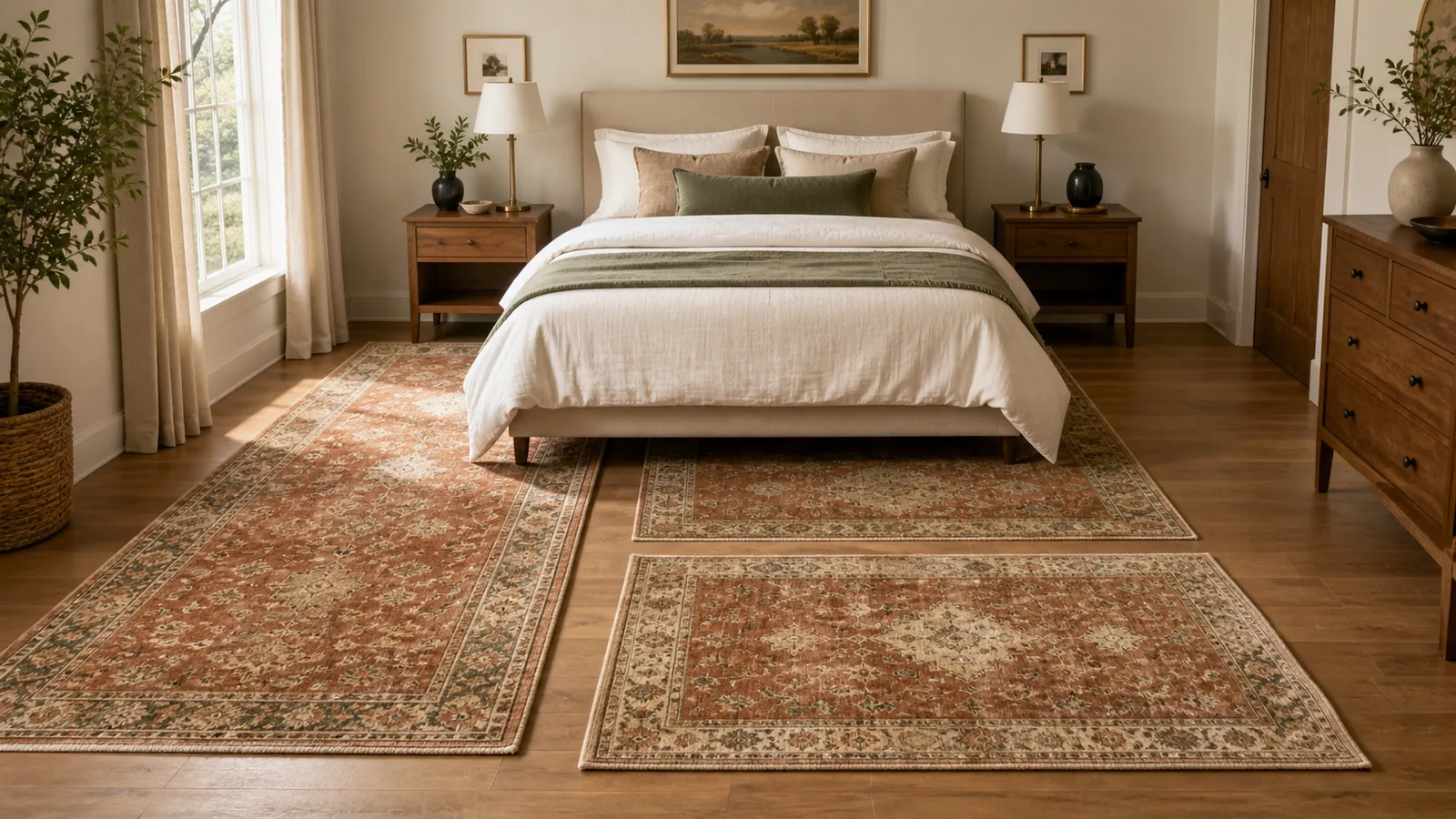
- Two runners: One on each long side of the bed, typically 2×6 or 2.5×8, running parallel to the mattress. Rugs.com explicitly endorses this: "experiment with smaller rugs just at the side of your bed or runners on either end." Two coordinating runners can cost less than one large rug and give you the bedside-softness experience without consuming floor space.
[Image: Top-down floor plan diagram — queen bed with 5x8 foot-of-bed rug, plus runner alternative layout]
Bedroom rug placement rules: lower two-thirds, full under-bed, or side runners
The three placement styles serve different room sizes and budget levels. Here's how to choose based on your room, not just your preference.
Decision rule: lower-two-thirds placement maps to an 8x10 for a queen bed; full under-bed placement maps to a 9x12 when you want all four legs on the rug; side runners are the smart alternative when budget or floor space rules out a large rug entirely. Each placement style is documented in Rugs.com's guidance for queen and king beds, and the size choice should follow the room rather than the other way around.
Lower two-thirds placement for a queen bed
Rugs.com is specific: "An 8′ × 10′ rug is the perfect size to sit under 2/3 of the way under a king- or queen-sized bed." In practice, this means sliding the rug in from the foot end so that:
- The back two bed legs (headboard side) rest on bare floor
- The front two bed legs (footboard side) rest on the rug
- The rug front edge extends beyond the footboard
- The rug back edge sits approximately at the midpoint of the mattress length, visible on both sides of the frame
This positioning puts soft textile where you actually need it — the foot and sides of the sleeping zone — and avoids the visual awkwardness of a rug that gets mostly hidden under the bed. The two headboard-side legs on bare floor create no visual problem because the headboard and pillows draw the eye upward.
When side runners are better than one large rug
Side runners beat a single large rug in three situations: when the room is too narrow for an 8-foot-wide rug with adequate wall clearance, when the budget makes a quality 8x10 a stretch, or when the floor under the bed is wall-to-wall carpet and only the bedside areas need a style or texture change.
As Rugs.com suggests, you can "experiment with smaller rugs just at the side of your bed or runners on either end to get a full-size rug look on a budget." Two 2×6 runners, one on each side of the queen, placed so they begin at the headboard and end just past the footboard, give you soft landings on both sides and frame the bed without consuming the center floor space.
Runners are also one of the easiest renter-friendly swaps: they're lightweight, easy to roll up, non-adhesive, and far simpler to move out than a large area rug. Pair each with a cut-to-size non-slip pad and they stay put even on smooth hardwood.
Renter-friendly bedroom rug setup with rug pads and no permanent installation
A rug pad is the only "installation" a queen bedroom rug needs, and it leaves zero marks. No adhesive, no floor anchors, no hardware — just a pad cut to match the rug's dimensions, placed flat beneath it.
At a Glance: - Investment: $20–$60 for a quality rug pad in 8x10 - Time: 5 minutes to set up - Tools needed: scissors or a utility knife to trim the pad to size - Lease-safe: Yes — no adhesives, no floor contact beyond the pad itself
Why a rug pad matters for grip and longevity
A rug pad does three things that matter in a bedroom: it keeps the rug from shifting when you step onto it in the dark, it adds a layer of cushion underfoot, and it protects the rug's pile over time.
Pottery Barn's product guidance puts it plainly: "Nonskid pad prolongs the life of your rug. Lightweight and pliable. Keeps rugs smooth and flat, making vacuuming easier." And from their rug care guide: "Investing in a good quality rug pad can also extend the life of your rug by preserving the pile and helping it hold its shape."
For a bedroom rug under a queen frame, the pad also stabilizes the rug against the weight of the bed legs pressing on it. Without a pad, the rug can creep outward over time as the bed legs anchor the center, wrinkling the edges. A pad eliminates that movement entirely.
Rugs.com adds the surface-specific case: their pads "are designed to keep your rugs in place and prevent them from slipping and sliding on hardwood, tile, or other smooth surfaces." Size your pad about 1 inch smaller than your rug on all sides — that keeps it hidden while still gripping the full rug footprint.
Damage-free tips for renters with hardwood, laminate, or carpet
On hardwood or laminate: A non-slip rug pad is your entire protection strategy. Pottery Barn's how-to guidance recommends exactly this: "it is a good idea to stick a non-slip rug pad underneath if your entryway floor is a slick material such as hardwood or tile." The same logic applies to your bedroom. Choose a pad marketed specifically for hard floors — these typically use a felt-and-rubber construction that grips without leaving residue.
On wall-to-wall carpet: Standard non-slip pads don't grip carpet the way they grip hard floors, because there's nothing smooth to create friction against. For carpet-on-carpet situations, look for a carpet-to-carpet pad (often a spiked rubber mesh design) that grips the carpet fibers. These are available at most home goods retailers and cost roughly the same as hard-floor pads. No adhesive is involved — the grip is purely mechanical.
No-permanent-installation checklist: - Use a rug pad cut 1 inch short of the rug edges on all sides - Choose pads rated for your specific floor type (hard surface vs. carpet) - Avoid double-sided tape on floors — it can lift finish from hardwood when removed - If the rug needs extra anchoring at the foot of the bed, tuck the pad's front edge under the footboard legs for added resistance
What size rug goes under a queen bed in a small bedroom?
In a small bedroom, the goal shifts from full visual framing to practical coverage. You don't need 18 inches of rug on all sides — you need soft landings where you actually step and a size that doesn't fight the walls for space.
The source-backed first option is a 5x8 positioned foot-forward, which Rugs.com documents as the purpose-built queen-bed use case for that size: "great for small living rooms, offices, or under the foot of a queen-sized bed." The second option is paired runners on each bedside. Both work in rooms where an 8x10 would feel too large for the layout.
How to make a 5x8 rug work in a tight queen bedroom
The positioning rule for a 5x8 in a tight room: keep the rug foot-forward, not centered. Slide it so the back edge aligns roughly with the midpoint of the mattress, and let the front edge land past the footboard.
With this placement, the rug's 8-foot length runs parallel to the queen mattress's 80-inch (6′8″) length, and its 5-foot width matches the 60-inch mattress width almost exactly — meaning the rug sits cleanly within the bed's footprint from side to side. Nothing extends beyond the bed frame on the sides, which is the right call in rooms where side clearance is limited.
This setup doesn't give you bedside softness as you step out from the sides of the bed. If that matters, supplement with two small accent rugs (think 2×3) at each bedside rather than trying to stretch the 5x8 into a job it can't do.
When a 6x9 rug beats an 8x10 in a small room
A 6x9 can be the better choice than 8x10 when your bedroom is compact enough that a larger rug would crowd the walls or make traffic flow awkward. That sub-12-inch clearance isn't just a style issue — it's a daily-use problem. Furniture legs catching on rug edges, doors swinging and catching the rug, no visual breathing room between furnishings.
At 6 feet wide, the 6x9 preserves more open floor around the bed than an 8x10 would in a tighter room, giving you a walking path that feels like a choice rather than a squeeze. You're trading some of the bedside extension in exchange for livable traffic clearance.
Position the 6x9 identically to how you'd position an 8x10: foot-forward, extending past the footboard, with the rug centered on the width of the bed. The narrower width simply means less textile visible on each side of the frame — a reasonable trade-off for a room where the alternative is a rug that competes with the walls.
Where to shop queen-bed rugs by budget and style
The source set in this article does not verify under-$100 queen-bedroom rug listings across multiple retailers, so the most responsible shopping advice here is to compare size, pile height, and return policy rather than assume a price floor. For the source-backed listings in this guide, Rugs.com is the only retailer with current product and placement evidence tied directly to queen-bed sizing.
Best under-$100 rug options for a queen bedroom refresh
The source set does not verify under-$100 queen-bed-appropriate rugs at publication time, so avoid treating this as a current price bucket. If you are shopping on a strict budget, the practical move is to start with 5x8 footprints, watch for sales, and compare total cost with a pair of runners instead of assuming a large rug will land under a specific price.
Watch Out: Under-$100 rugs in 8x10 often skimp on knot density and use a thin pile that compresses quickly under bed legs. Pull up a corner in-store or check customer photos online — if the backing shows through, it won't age well.
Style-forward rug sources for a queen bed bedroom
For readers prioritizing aesthetics alongside function, the most defensible shopping source set in this draft is the Rugs.com listing family already cited above, since the live product and size pages are tied to the placement guidance used throughout this guide. Use those pages to compare 5x8, 8x10, and 9x12 sizing before you buy.
Pro Tip: Low-pile rugs (under ½ inch) work better under beds than high-pile or shag styles. Thick pile under bed legs compresses unevenly and can cause the frame to rock slightly — not a structural issue, but noticeable. Save the shag for the foot-of-bed or runner positions where no heavy furniture presses down.
Queen bed rug size FAQ
What size rug goes under a queen bed?
The most practical size for a standard bedroom is an 8x10, which Rugs.com documents as fitting under approximately two-thirds of a queen bed while meeting the 12-to-18-inch bedside extension guideline. For larger bedrooms where nightstand coverage matters, a 9x12 is the size that places all four bed legs on the rug. For small bedrooms, a 5x8 positioned at the foot of the bed is the source-backed option.
Should a rug go under nightstands in a bedroom?
Only if the rug is large enough to do it cleanly — which means 9x12 or larger for a queen bed. Placing nightstand legs half-on and half-off a rug edge creates an uneven, unstable look. When using an 8x10, let the nightstands sit on bare floor alongside the rug. It's a deliberate design choice, not a mistake.
Is a 5x8 rug too small for a queen bed?
It depends on how you position it. Centered under the queen bed, yes — a 5-foot-wide rug barely extends beyond a 5-foot-wide mattress and looks undersized. Positioned foot-forward (foot-of-bed style), it works well in tight rooms and is exactly the use case Rugs.com documents for this size. If you want soft landings on both sides of the bed, consider two small runners instead of a 5x8.
What size rug is best for a small bedroom?
A 5x8 positioned at the foot of the bed, or two 2×6 runners placed on each side of the queen frame. Both approaches keep floor clearance open while adding texture and warmth where you need it. If the room can handle it, a 6x9 in the lower-two-thirds position is a strong upgrade — you gain side coverage without crowding the walls.
Do bedroom rugs need a rug pad?
Yes, and especially under a queen bed where heavy furniture is pressing on part of the rug. A quality rug pad grips the floor to prevent slipping, adds cushion underfoot, and — as Pottery Barn notes — "extends the life of your rug by preserving the pile and helping it hold its shape." Size the pad about 1 inch smaller than your rug on all sides and choose a type matched to your floor surface: felt-and-rubber for hard floors, spiked mesh for carpet.
Sources & References
- Rugs.com — Bedroom Rug Size & Placement Guide — Primary source for the 12-to-18-inch extension rule and queen-bed size guidance
- Rugs.com — Area Rug Size Guide Blog — Source for 5x8 foot-of-bed placement documentation
- Rugs.com — 8x10 Bedroom Rugs — Source for two-thirds placement rule and runners alternative
- Rugs.com — 9x12 Bedroom Rugs — Source for all-four-legs placement threshold
- Rugs.com — 8x10 Theia Area Rug Product Page — Ground truth source per Research Brief
- Sleep Foundation — Queen Size Bed Dimensions — Source for standard queen mattress measurements (60 × 80 inches)
- Pottery Barn — Nonskid Rug Pad — Source for rug pad longevity and grip performance
- Pottery Barn — Living Room Rug Guide — Source for rug pad pile preservation guidance
- Pottery Barn — How to Choose an Entryway Rug — Source for non-slip pad on hard floor surfaces
Keywords: 5x8 area rug, 6x9 area rug, 8x10 area rug, queen bed dimensions, nightstands, lower two-thirds placement, rugs.com rug-size guidance, rug pad, low-pile rug, non-slip rug pad, rental-friendly styling, wall-to-wall carpet, bedside clearance, under-bed placement, runner rug