Pet urine odor comes back because surface cleaning rarely reaches the actual contamination. The smell isn't in the carpet fibers you can see — it's in the padding underneath, the upholstery foam inside your couch cushions, or the mattress core your pet soaked while you were at work. Until you treat the full depth of the stain, the odor will return every time humidity rises or the sun warms the floor.
Why pet urine smell keeps coming back after cleaning
At a Glance: - Root cause: Uric acid crystals embedded in carpet pad, upholstery foam, or mattress layers - Trigger: Heat or humidity reactivates dormant crystals - What doesn't work: Surface-only cleaning, ammonia cleaners, steam, deodorizing sprays - What works: Enzyme cleaners applied to the full contaminated depth with adequate dwell time; padding or foam replacement for severe cases
The answer is chemistry. Per the PetSmart Learning Center stain-and-odor guide, "pet urine contains uric acid, a compound that binds tightly to surfaces and doesn't dissolve in water. When it dries, it forms crystals that reactivate with heat or humidity." That's exactly why a spot can smell clean after a cold, dry morning and hit you like a wall after your thermostat kicks on in the afternoon — the crystals never left.
The second part of the problem is footprint size. When a dog or cat urinates on carpet, the liquid doesn't stay where it lands. It spreads outward through the fibers and then wicks down through the carpet backing into the pad. A puddle the size of a quarter at the surface can soak a pad area closer to a dinner plate. The same physics applies to couch cushions: fabric absorbs quickly, but the foam insert holds the bulk. A pet stain remover applied only to the visible surface has almost no chance of reaching the source.
Enzyme cleaners work differently from sprays that mask odor. Instead of perfuming the area, they deliver live enzymes and bacteria cultures that break down the organic compounds in urine — including uric acid — at the molecular level. The enzymes continue working as long as uric acid remains present. But they can only work where they physically reach, which means surface spraying an enzyme cleaner onto a carpet that has pad contamination underneath is still not enough.
If your odor keeps coming back despite multiple cleanings, you have a depth problem. That's the diagnosis this article helps you fix. If DIY hasn't solved it, a professional carpet cleaning service or restoration service may be the only path to permanently eliminating the source.
What not to use on urine stains: ammonia, steam, and heat
Three common cleaning instincts actively make pet urine odor worse.
Watch Out: - Ammonia-based cleaners: Urine already contains ammonia compounds. Adding more ammonia doesn't neutralize the odor — it reinforces the scent marker, which can encourage your pet to re-soil the same spot. The PetSmart guide explicitly warns against ammonia-based cleaners on urine stains. - Steam cleaners on urine stains: Heat bonds uric acid more tightly to carpet fibers and pad materials, making future enzyme treatment less effective. Do not steam-clean a urine area before enzyme treatment is complete. The PetSmart guide warns against steam on urine stains for this reason. - Dryer heat on washable fabrics: Cushion covers, pet blankets, and machine-washable upholstery panels should never go into a hot dryer until you are certain the odor has been eliminated. Heat locks the remaining uric acid into the fabric permanently. Air-dry first, smell-test, and only use heat once the odor is gone.
The safest first-response pet stain remover for fresh accidents is an enzyme-based product at room temperature, applied liberally. Everything else — including hot water, steam mops, and enzyme-masking sprays — risks setting the stain rather than removing it.
How to remove fresh pet urine smell from carpet step by step
Fresh accidents are the easiest to treat if you act before the urine dries into the pad. Speed matters: the longer urine sits, the deeper it wicks.
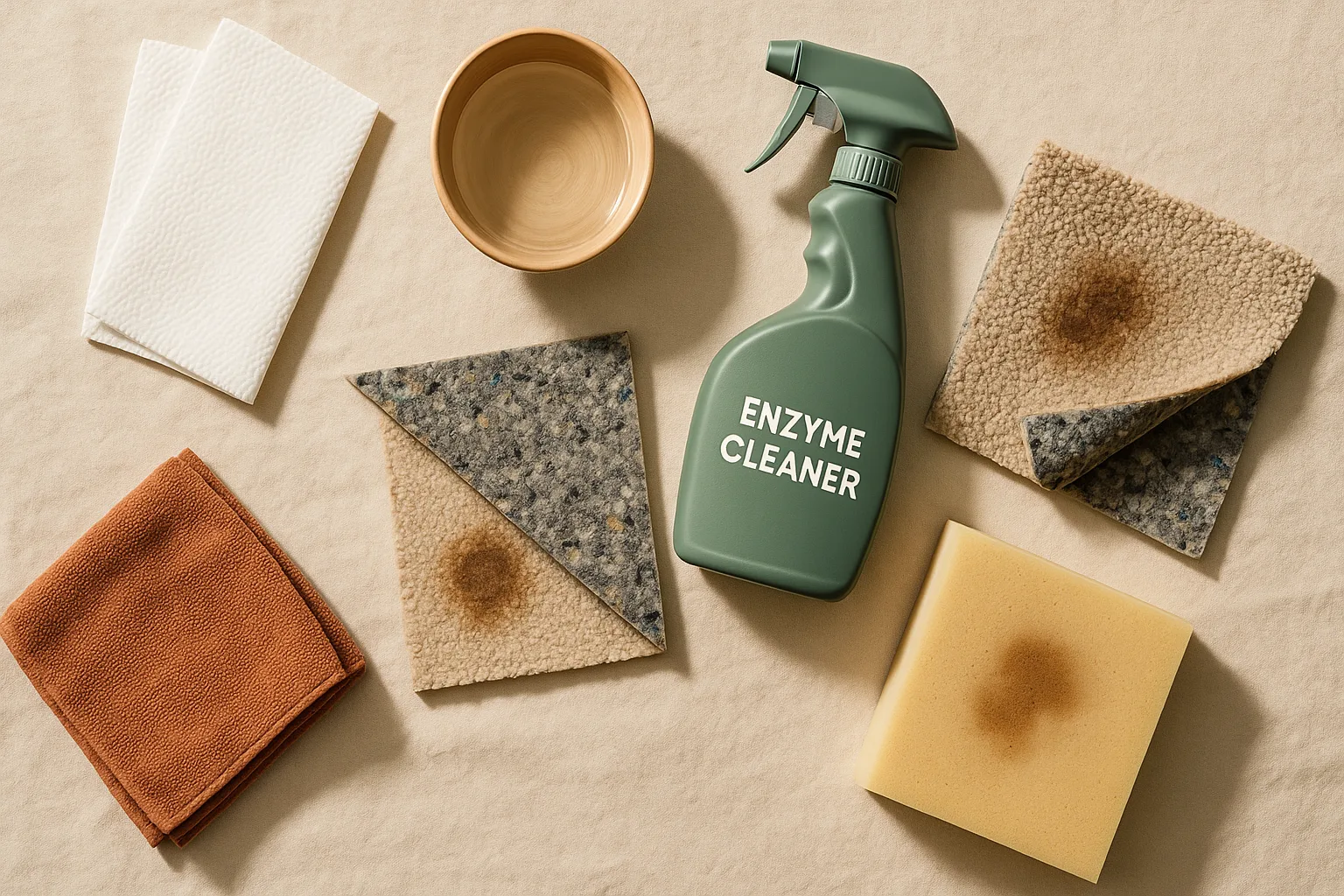
What you'll need: - Clean white cloths or paper towels (lots of them) - An enzyme cleaner: Nature's Miracle Advanced Stain & Odor Eliminator, Bissell PET PRO OXY Urine Eliminator Formula, or Folex Instant Carpet Spot Remover for colorfast carpets - A heavy book or weighted object for the blotting step - A wet-dry vac (optional but helpful)
StepCard: Fresh Carpet Urine
- Blot solids and liquid immediately — don't scrub. Press clean white cloths firmly onto the wet area and hold them down with your body weight. Lift and replace with dry cloths until no more moisture transfers. Scrubbing spreads the contamination and pushes urine deeper into the pad.
- Saturate with an enzyme cleaner. Apply enough cleaner to reach the same depth the urine did, not just the visible stain. For a fresh spot, that usually means wetting the carpet surface and then some so the solution can travel through the backing.
- Cover loosely with a damp cloth. This slows evaporation so the enzymes can keep working. Do not seal the area airtight.
- Allow full dwell time. See the timing guidance below — do not rush this step. As Nature's Miracle explains, the enzymatic cleaner continues working as long as the food source is present.
- Blot again. Use dry cloths or a wet-dry vac to pull residual cleaner and broken-down urine compounds out of the fibers. Press firmly; don't scrub.
- Air-dry completely. Point a fan at the area, open windows, or run the HVAC. Do not apply heat. Do not walk on the area until it's completely dry.
Folex works well for colorfast carpet and requires no rinsing, which reduces over-wetting risk. The Bissell PET PRO OXY formula is designed for carpets, upholstery, and auto interiors. Both are widely available at Petco, PetSmart, Target, and Amazon.
How much enzyme cleaner to use on carpet padding
The amount of enzyme cleaner you apply should match the amount of urine that soaked in — not just the visible stain size.
CarpetPadCoverage: Treat an area roughly twice the diameter of the visible stain. If the spot looks like a 4-inch circle, apply cleaner across an 8-inch radius. Apply enough to feel the carpet compress slightly and become uniformly wet to the touch, because the cleaner has to travel through the carpet backing and into the pad where the uric acid crystals are concentrated.
Per the PetSmart stain-and-odor guide, carpet accidents may require saturation down into the padding — surface-only treatment is a documented failure mode. Nature's Miracle's dog urine formula is specifically described as penetrating down into carpet to power out urine messes, which reinforces the saturation-through-the-fibers approach.
If you can peel back a corner of the carpet to check the pad after treatment, do it. A properly treated pad will be visibly damp with enzyme cleaner. If the pad looks dry after your surface application, you haven't applied enough.
How long to let enzyme cleaner dwell before blotting again
TimingGuidance: - Fresh stains (treated within 30 minutes): Minimum 10–15 minutes dwell time; 20–30 minutes is better - Stains a few hours old: 30–45 minutes minimum; re-wet with cleaner if the surface starts to dry out - Dried or set-in stains: At least 45 minutes per application; plan for multiple applications over 24–48 hours - General rule: The area should feel damp throughout the dwell period. If it dries out, the enzymes stop working before the job is done.
Because enzymes continue working as long as the uric acid remains present as a "food source," you want to maintain moisture without flooding the area. Covering the spot loosely with plastic wrap or a damp towel during dwell time slows evaporation without trapping the enzymes. Avoid covering so tightly that no air exchange can occur — enzymes need some oxygen to remain active.
Don't rush the dwell time to get back to normal life. A 10-minute shortcut on a set-in stain is the most common reason the odor returns a week later.
How to get old cat urine smell out of carpet
Old cat urine is harder to eliminate than dog urine for two reasons: cats produce a more concentrated form of uric acid, and repeated accidents in the same spot create layered contamination that a single treatment can't fully reach.
The process is the same as fresh stains — blot any surface residue, saturate with enzyme cleaner, cover to maintain moisture, dwell, blot, air-dry — but you should plan for multiple treatment cycles rather than expecting a single application to fix it.
RepeatApplication sequence for old cat urine:
- Locate the full contamination zone. Use a UV black light ($15–$30 at hardware stores) in a darkened room. Cat urine fluoresces under UV light, revealing the actual footprint, which is often two to three times larger than the visible stain.
- Pre-wet the area with cold water. This rehydrates the dried uric acid crystals slightly, which helps the enzyme cleaner reach them.
- Saturate with enzyme cleaner — same depth saturation as described above, covering the full UV-revealed zone.
- Allow a full 45-minute minimum dwell time, re-wetting if needed.
- Blot and extract thoroughly.
- Air-dry completely — this can take 12–24 hours with good airflow.
- Repeat the process 24–48 hours later. On old cat urine, a second or third treatment is normal, not a sign that the product is failing.
WhenToReplacePadding: If you've completed three or more full treatment cycles with a quality enzyme cleaner and odor returns each time the room warms up, the pad is beyond DIY treatment. PetSmart's stain-and-odor guide states plainly that for set-in or repeated cat-urine spots, padding replacement may be the most effective solution. At that point, a pet stain remover product alone isn't the answer — you need to address the contamination source physically.
A restoration service can assess whether the carpet itself is salvageable or whether replacement of both pad and carpet is the economical choice. For large areas or heavy multi-year contamination, replacement often costs less long-term than repeated professional cleaning attempts.
When carpet padding has to be removed or replaced
Carpet padding holds onto urine the way a sponge holds water. It's designed to be dense and absorbent — great for cushion underfoot, terrible when it becomes a urine reservoir.
Decision tree: DIY treatment vs. pad replacement
[Image: Padding replacement decision tree — DIY enzyme treatment vs. pad replacement vs. restoration service]
- DIY enzyme treatment is appropriate when: The accident is fresh or less than a few days old, the affected area is smaller than roughly 12 inches in diameter, and one to three enzyme treatment cycles eliminate the odor completely.
- Pad replacement is appropriate when: Odor returns after three or more full treatment cycles, you can detect ammonia smell when pressing on the carpet surface, the UV light shows a large merged contamination zone from repeated accidents, or the carpet has been wet from urine for an extended period without treatment.
- Call a restoration service when: Odor is detectable even after pad removal and carpet cleaning, which indicates urine has reached the subfloor or wall baseboards.
DIY vs Pro: Replacing carpet padding yourself is achievable — pull back the carpet, cut out the contaminated pad section, treat the exposed subfloor with an enzyme cleaner or a diluted antimicrobial sealer, install new pad, and re-tack the carpet. The cost is roughly $0.50–$1.50 per square foot for basic pad plus your time. If the subfloor is concrete, look for discoloration or salt deposits indicating urine soaked through and treat before re-padding. If the subfloor is plywood and has structural damage or heavy saturation, call a restoration service rather than re-padding over the problem.
When to Call a Pro: Urine has reached the wall baseboards (visible staining at the base of the wall), odor persists after pad removal and subfloor treatment, or the contaminated area spans more than a few square feet. A professional carpet cleaning service with truck-mounted extraction equipment can treat both the subfloor and the carpet simultaneously. A restoration service can assess structural damage and apply antimicrobial sealers rated for subfloor contamination.
How to remove pet urine smell from upholstery and couch cushions
Upholstery is trickier than carpet because the contamination layers — fabric, foam insert, sometimes a platform base — are harder to access and slower to dry. Applying enzyme cleaner only to the fabric surface while the foam underneath remains saturated with uric acid is the same mistake as surface-treating carpet while ignoring the pad.
StepCard: Couch Cushion and Upholstery Urine Treatment
- Remove the cushion from the couch. Take it outside or to a tiled area where you can work without worrying about runoff.
- Remove the cushion cover if it's zippered or otherwise removable. Set it aside — see the cover-washing section below.
- Blot the foam insert surface with dry cloths to remove as much liquid as possible before applying cleaner.
- Apply enzyme cleaner to the foam insert. Use Nature's Miracle Advanced Stain & Odor Eliminator or Bissell PET PRO OXY Urine Eliminator directly on the foam. Press the bottle's sprayer into the foam slightly to help the cleaner penetrate the cell structure rather than just coating the surface. Apply until you feel the foam resist — it's holding cleaner at depth.
- Allow 30–45 minutes dwell time minimum. Lay the cushion on its side so cleaner can distribute through the foam by gravity.
- Press and blot the foam repeatedly using towels and firm pressure to extract the cleaner and dissolved uric acid. A wet-dry vac pressed against the foam surface works well here.
- Treat the fabric cover separately (see below) and allow both the cover and foam insert to air-dry completely before reassembling.
Nature's Miracle is described as penetrating deep into carpet and upholstery fibers to remove deep-set pet stains and odors — but the foam insert is where the real contamination lives, not the fabric layer.
Fixed upholstery (fabric you cannot remove) requires the same process in place. Work in sections, blot aggressively between passes, and use fans to accelerate drying. If the cushion or chair base has absorbed repeated accidents over time, the internal foam may need replacement — foam inserts are inexpensive ($15–$50 depending on cut size) and available at fabric stores and online.
How to clean removable cushion covers the right way
Removable cushion covers can go in the washing machine — but heat is the enemy until the odor is fully gone.
WashCare: 1. Check the care label. If the cover is machine-washable, proceed. If it says dry-clean only or spot-clean only, skip the washer and treat it in place with enzyme cleaner and cold water only. 2. Pre-treat the soiled area with enzyme cleaner and let it dwell for 15–20 minutes before loading the machine. 3. Wash in cold water on a gentle cycle. 4. Remove and smell the cover before drying. If any urine odor remains, repeat the enzyme pre-treatment and wash again. 5. Once odor-free, air-dry or tumble-dry on a no-heat or very low-heat setting.
Watch Out — Dryer Heat Warning: Putting a cushion cover in the dryer on high heat before the urine odor is completely eliminated will permanently bond any remaining uric acid crystals to the fabric fibers. At that point, no enzyme cleaner will fully remove the odor. Always confirm the cover is odor-free before applying heat, even if it looks clean.
Do not reassemble the cushion insert and cover until both are completely dry. Trapping residual moisture between the cover and foam creates a mildew problem on top of the urine problem.
How to treat seams, welting, and grout-like creases in upholstery
Urine finds every crevice. The seams along cushion edges, the welting cord that outlines couch arms, the tufting buttons on a chesterfield, zipper tracks, and the gap where the cushion sits against the couch back are all spots that standard surface-cleaning misses entirely — and where uric acid crystals concentrate and hide.
Seam and crease cleaning checklist:
- Seams and stitching lines: Use a soft-bristle toothbrush or detailing brush dipped in enzyme cleaner to work the cleaner into the seam channel. Blot along the seam with a cotton swab after dwell time.
- Welting (the cord-trimmed edge): Welting absorbs urine and dries quickly, making it a hidden odor source. Saturate with enzyme cleaner using the brush, let dwell, then blot with a dry cloth pressed firmly along the welt.
- Zipper tracks: Urine can wick into the zipper teeth and the fabric on either side. Remove the cover first, then treat the zipper track with a small amount of enzyme cleaner.
- Tufting and button depressions: Each depression creates a reservoir. Press enzyme cleaner in with a finger or brush; don't just spray over the top.
- Couch-back gap: The crease where a cushion meets the back panel is a common accident zone. Remove the cushion, treat the base fabric and any exposed frame fabric with your pet stain remover, and let it dry before replacing the cushion.
Folex Instant Carpet Spot Remover works on colorfast upholstery and is useful for detail work in seams because it's non-foaming and requires no rinsing — it won't leave residue that traps in a welt or seam. For deeper contamination in seams, a targeted application of Nature's Miracle enzyme cleaner with a brush gives you the enzymatic action needed to break down embedded uric acid.
How to remove urine smell from mattresses without soaking the bed
A soaked mattress is difficult to dry and the prolonged moisture creates mold and mildew in the interior foam layers. The goal is to treat the contaminated depth without applying so much liquid that moisture becomes the new problem.
MattressStepCard:
- Strip bedding immediately and treat the covers separately using the cold-wash method described above — no dryer heat until odor-free.
- Blot the mattress surface with dry towels using firm pressure. Remove as much liquid as possible before applying any cleaner.
- Apply enzyme cleaner in controlled amounts. Spray Nature's Miracle or Bissell PET PRO OXY directly onto the stained area until the surface is uniformly damp — not pooling, not dripping through the mattress. For a surface accident, this is typically 8–12 oz spread across the affected zone.
- Cover lightly with a dry towel and press down to help the cleaner penetrate without letting it spread sideways.
- Allow 30–45 minutes dwell time. Lay the mattress on its side if the accident soaked deep enough to reach the mattress core — gravity will help the cleaner distribute.
- Blot and extract. Use a wet-dry vac on a mattress surface to pull dissolved urine and cleaner out before drying begins.
- Air-dry with fans and open windows. Elevating the mattress to allow airflow underneath speeds drying significantly. A mattress can take 6–12 hours or longer to dry internally — do not cover it with sheets or a mattress protector until it's completely dry to the touch and smell-free.
- Protect going forward. A waterproof mattress protector under your fitted sheet is the single best investment for pet owners with bed-sharing habits.
When to Call a Pro: If the mattress absorbed a large volume of urine (a puppy accident overnight, for example) or if odor returns after two or three treatment cycles, the contamination has likely reached the mattress core. At that point, the economics often favor mattress replacement over restoration service — but a restoration service can assess whether extraction equipment can salvage it before you discard the mattress.
When to call a carpet cleaning service or restoration service
Multiple enzyme treatment cycles with quality products and no lasting result means DIY has reached its limit. This isn't a product failure — it's a depth problem that consumer tools can't fully reach.
WhenToCallProAlert: - Recurring odor after three or more full enzyme treatment cycles on carpet or upholstery, with correct saturation and dwell time each session - Very old cat urine — multiple years of repeated accidents in the same area, especially on carpet with original pad - Odor detectable from the pad or subfloor when you press your face near the floor surface or when the carpet is peeled back - Urine has reached wall baseboards — staining, discoloration, or odor at the base of adjacent walls means contamination has wicked beyond the carpet and pad into wall framing or drywall - Urine on subflooring — especially plywood subflooring, which is porous and absorbs urine the way carpet pad does - Large contamination zones revealed by UV light that span several square feet or represent years of unreported accidents in a newly purchased home
For any of these situations, contact a professional carpet cleaning service with pet urine remediation experience, or a restoration service if structural materials (subfloor, baseboard, drywall) may be involved.
What a pro extraction or restoration visit should do
A legitimate pet urine remediation service does more than steam-clean — and if a company's proposal sounds like they're only going to clean the surface, ask specifically about the steps below before hiring.
ProServiceChecklist — what to expect and demand:
- UV inspection first. A professional should use a UV black light to map the full contamination zone before cleaning. The size of that zone drives the treatment plan and should be communicated to you.
- Deep extraction, not just surface cleaning. Truck-mounted hot-water extraction with pet enzyme pre-treatment penetrates the pad and pulls dissolved urine out mechanically, not just chemically.
- Pad evaluation. After extraction, the technician should check whether the pad is still contaminated. If it is, the recommendation should be honest: pad removal and replacement, not another pass of surface cleaning.
- Subfloor treatment if indicated. For severe cases, the subfloor should be treated with an enzyme cleaner or sealed with a shellac-based primer (like Zinsser BIN) before new pad and carpet are installed. The sealer traps residual odor compounds in the wood so they can't off-gas through the new flooring.
- Documentation. A restoration service should provide before-and-after UV photos and a written scope of work so you understand what was treated, what was replaced, and what the expected outcome is.
Be cautious of any carpet cleaning service that guarantees 100% odor elimination on a single visit without inspecting the pad and subfloor. Honest professionals assess depth first, then set expectations.
Best pet stain remover products and tools to keep on hand
Having the right tools available before an accident happens means you can act within minutes rather than making a drugstore run while urine soaks deeper.
AffiliateProductCard:
-
Nature's Miracle Advanced Stain & Odor Eliminator — The most widely used enzyme cleaner for cat and dog urine. Available in formulas specific to cats or dogs, both suitable for carpets, hard floors, furniture, and fabrics. Keep a 32-oz spray bottle accessible and a gallon refill for saturation work. Sold at PetSmart, Petco, Target, Amazon, and most grocery stores.
-
Bissell PET PRO OXY Urine Eliminator Formula — Combines enzyme action with oxygen-based cleaning. Rated for carpets, upholstery, and auto interiors, making it a good all-surface option. The 48-oz bottle is a practical size for treating cushions and multiple carpet spots. Available at Bissell.com, Target, Walmart, and Chewy.
-
Folex Instant Carpet Spot Remover — No rinsing required, no residue, safe on colorfast carpet and upholstery that can tolerate dampening. Works on fresh spots fast and is useful for detail cleaning in seams and creases. Not an enzyme cleaner, so pair it with Nature's Miracle or Bissell for old or deep stains. Available at Home Depot, Walmart, and Amazon.
-
Absorbent microfiber towels or terry cloths — Buy a pack of 12 or more and keep them dedicated to pet accidents. Paper towels work in a pinch but aren't as effective at pulling moisture from carpet fibers. Wash in cold water; don't use fabric softener, which reduces absorbency.
-
Wet-dry vac — The single biggest upgrade to DIY pet urine cleanup. A wet-dry vac can extract liquid from carpet pad and foam far more effectively than blotting alone. The Shop-Vac 5-gallon is a common household option; if you have pets and carpet, it pays for itself quickly.
-
UV black light — A 365nm UV flashlight (under $20 on Amazon) reveals the full contamination footprint that your eyes cannot see. Use it before treating to know where to apply enzyme cleaner, and after drying to confirm the odor source has been eliminated.
Pet urine odor FAQ for carpet, upholstery, and mattresses
Why does pet urine smell keep coming back after cleaning?
Because the cleaning didn't reach the full contamination depth. As the PetSmart Learning Center explains, urine dries into uric acid crystals that "reactivate with heat or humidity" — which is "why a spot can smell fine after cleaning, then return to full strength on a warm or humid day." Surface cleaning removes visible residue but leaves crystals in the carpet pad, upholstery foam, or mattress core where moisture and warmth can reactivate them indefinitely. The fix is to saturate the full contaminated depth with enzyme cleaner, maintain adequate dwell time, and extract thoroughly — not just blot the surface.
Can you use a steam cleaner on pet urine stains?
No — not before enzyme treatment is complete. Steam heat bonds uric acid more tightly to carpet fibers and backing materials, making it harder for enzyme cleaners to break down afterward. Per the PetSmart stain-and-odor guide, steam is not recommended on urine stains. If you want to steam-clean a room for general sanitizing after the urine odor is confirmed gone, that's acceptable — but using a steam mop or steam cleaner as a first response to an accident makes the underlying problem harder to solve.
What gets urine smell out of carpet padding?
An enzyme cleaner applied in enough volume to physically penetrate through the carpet fibers and backing and into the pad. Treat beyond the visible stain boundary — use a UV black light to find the real footprint and saturate that full area. For fresh accidents, one or two treatment cycles with Nature's Miracle or Bissell PET PRO OXY is often enough. For old cat urine or heavy repeated contamination, the pad may need to be physically removed and replaced, with the subfloor treated before new pad is installed. PetSmart's guide confirms that for repeated cat-urine spots, padding replacement is often the most effective solution.
How do you get pet urine smell out of upholstery?
Remove the cushion cover if possible, treat the foam insert directly with enzyme cleaner until it's saturated to the contaminated depth, allow full dwell time, blot and extract thoroughly with dry towels or a wet-dry vac, and air-dry both the cover and insert completely before reassembling. Don't forget the seams, welting, and tufting where uric acid hides. Wash the cover in cold water only, and don't use dryer heat until the odor is completely gone — heat permanently sets any remaining uric acid into fabric fibers. For fixed upholstery that can't be disassembled, work in sections and use fans to prevent the foam from staying wet too long, which can cause mildew on top of the urine problem.
When does carpet padding need to be replaced instead of treated?
When enzyme treatment has failed after three or more thorough applications, when you can smell ammonia by pressing your face near the carpet surface, when a UV light reveals a merged contamination zone from years of repeated accidents, or when the pad has been wet for an extended period without treatment. If the odor persists even after pad removal — meaning you can still detect it from the subfloor — contact a restoration service rather than relaying new padding over a still-contaminated surface.
Sources & References
- PetSmart Learning Center: The Ultimate Stain and Odor Removal Guide for Pet Parents — Primary source for uric acid chemistry, enzyme cleaner mechanism, ammonia and steam warnings, carpet pad saturation requirements, and padding replacement guidance
- Nature's Miracle Stain and Odor Remover for Cats — Enzyme cleaner dwell time and mechanism documentation
- Nature's Miracle Urine Remover for Dogs — Carpet penetration and upholstery application specifications
- Nature's Miracle Carpet Shampoo — Deep-fiber penetration claims for carpet and upholstery
- Bissell PET PRO OXY Urine Eliminator Formula — Product surface compatibility documentation
- Bissell PET Stain & Odor Remover + Sanitize Pretreat — Carpet and upholstery pretreat documentation
- Folex Instant Carpet Spot Remover — Surface compatibility and no-rinse application documentation
Keywords: enzyme cleaner, uric acid crystals, carpet padding, upholstery foam, cushion insert, steam cleaner, ammonia-based cleaner, Nature's Miracle, Bissell pet stain remover, Folex, PetSmart stain-and-odor guide, blotting, dwell time, carpet extraction, subfloor