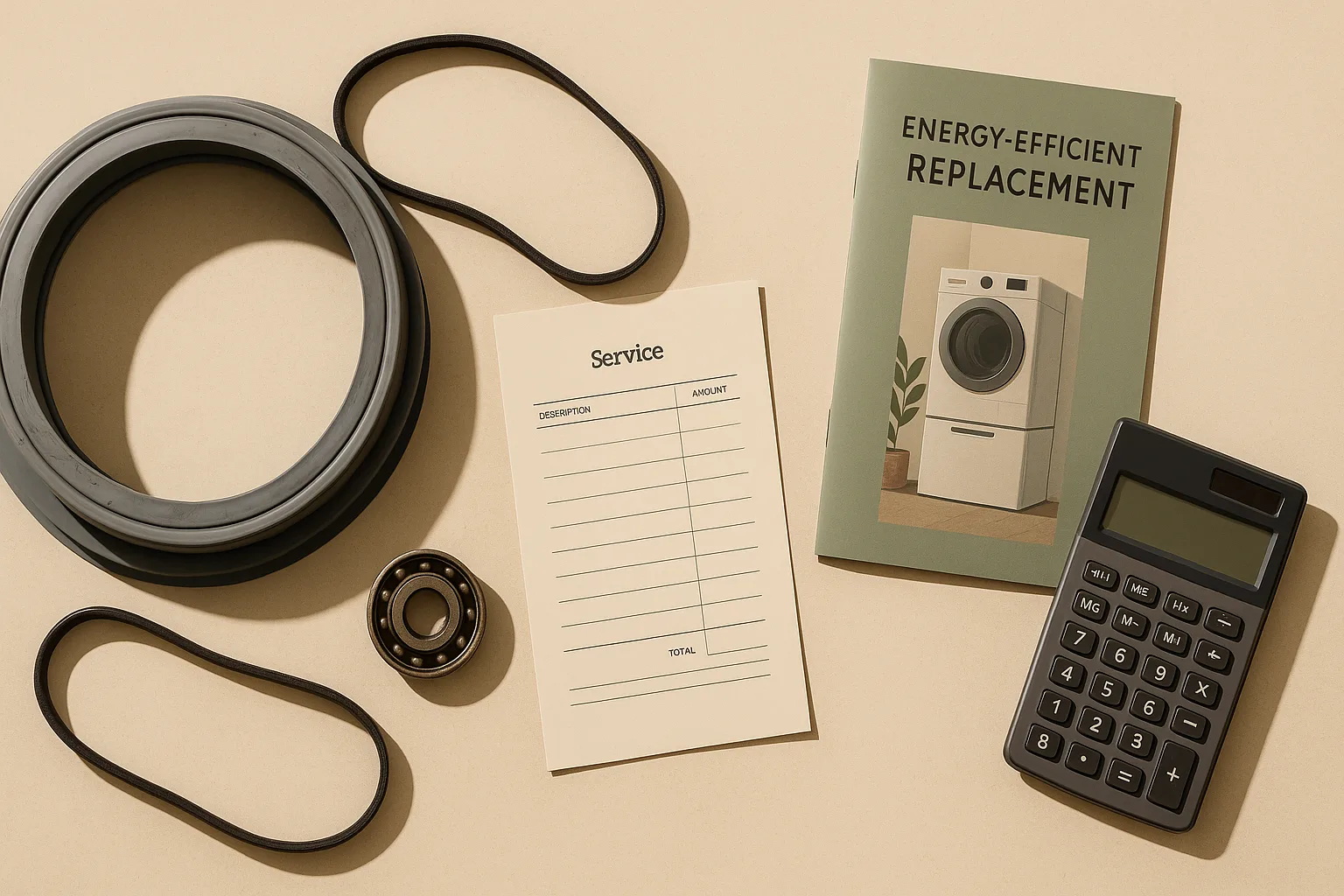
Should you repair or replace a broken washer or dryer?
The quick answer is simple: for a washer, pay the $200–$500 service call if the machine is under about 7 years old, the failure is a discrete part, and the all-in repair is still well below the cost of replacement. For a dryer, that same service call is usually worth it through roughly year 8, especially when the problem is a belt, fuse, roller, or heating element. Once the appliance is older, has already had repeated repairs, or needs a major component like a motor or control board, replacement usually wins.
At a Glance: - Washers: Repair younger machines and higher-priced models; lean toward replacement after 8 years, especially on budget units. - Dryers: Repair is often the better move through the first 8 years because the machines are simpler and the fixes are usually cheaper. - Rule of thumb: A $200–$500 diagnosis and repair bill is worth paying when it buys several more years of service, not just a short postponement. - Separate logic: Washers and dryers should be judged differently because their failure patterns, lifespans, and repair costs are not the same.
The honest answer depends on three numbers: how old the machine is, what you originally paid for it, and what the technician quotes you to fix it. A $300 repair on a two-year-old, $1,200 front-load washer is almost always worth it. The same $300 repair on an eight-year-old, $500 top-loader is almost always not. The problem is that most of us face a decision somewhere in the messy middle, and the generic "repair if it costs less than half the replacement price" rule doesn't hold up once you account for age, failure type, and what a new machine actually costs after delivery, haul-away, and installation.
The Consumer Reports repair-or-replace tool uses product cost, depreciation rates, and large owner-survey data to guide decisions across major appliances — including washing machines and dryers. The key distinction CR makes is that this is appliance-specific logic, not a single universal formula. Washers and dryers fail in different ways, have different lifespans, and carry very different repair economics. This article uses separate decision frameworks for each, walks through the real cost of a $200–$500 out-of-warranty appliance repair service call, and tells you exactly when washer replacement or dryer replacement is the smarter financial move.
Washer repair vs replacement: age, original price, and failure severity
Washers are mechanically complex — they handle water, spin heavy loads, and rely on motors, pumps, bearings, control boards, and in many models, a transmission. That complexity means failures vary widely in cost and severity, and the decision to repair or replace is rarely obvious.
If you want the cleanest answer for a broken washer, use this framework: repair most failures on machines under 4 years old, judge carefully in the 4- to 7-year window, and replace most budget models once they hit 8 years or start needing major parts. Consumer Reports' washing-machine repair-or-replace guidance (published February 1, 2024) is clearest exactly where homeowners get stuck: in that middle period, when a good machine can still justify a repair but a cheap one often cannot.
The table below is the primary washer decision framework, not just a side note. Start here before you call anyone.
WasherDecisionTable
| Washer Age | Original Price Under $700 | Original Price $700–$1,200 | Original Price Over $1,200 |
|---|---|---|---|
| 0–3 years | Repair (minor or major) | Repair (minor or major) | Repair (minor or major) |
| 4–7 years | Repair minor issues only | Use repair quote to decide | Repair unless transmission/tub |
| 8–10 years | Replace | Repair minor issues only | Repair minor; replace if major |
| 10+ years | Replace | Replace | Replace unless nearly new purchase |
"Minor" = belt, lid switch, door latch, drain pump, door boot seal. "Major" = drum bearing, washer transmission, outer tub, control board on older machines.
The 4-to-7-year window is where the Consumer Reports framework earns its keep. A six-year-old LG WM4000HWA front-loader that originally cost $1,100 and needs a new drain pump at $150–$250 in parts and labor? Repair it. The same machine needing a drum bearing replacement that quotes at $400–$500? Now you're weighing a $500 fix on a machine with perhaps four good years left — that's a harder call, and the answer depends on whether you can get a comparable replacement delivered and installed for under $900 all-in.
When a newer washer is usually worth repairing
An almost-new washer — under three years old, especially if it's a mid-range or premium model — is almost always worth repairing per CR's guidance, even if the service call runs $300 or more. The machine still has the bulk of its useful life ahead, and the repair cost represents a small fraction of what you'd spend replacing it.
Pro Tip: If your washer is under three years old and out of warranty on parts but still within a manufacturer service window, call the brand's customer service line before scheduling a third-party technician. LG, Samsung, Whirlpool, and GE Appliances have all extended goodwill repairs on known issues — it costs you nothing to ask.
FailureSeverity callout — what matters most on a newer machine:
- Minor parts failures (repair-friendly): Lid switch, door latch switch, door boot seal, drain pump, drive belt, inlet valve, door latch switch. These are discrete components, typically $30–$150 in parts, and a competent technician fixes them in one visit.
- Mid-tier failures (repair if quote is proportional): Drum bearing, heating element, main control board on machines under five years old. Parts run $80–$300 and require more labor, but the machine still has meaningful life left.
- Major life-limiting failures (pause before repairing): Washer transmission, outer tub cracking, motor failure, or a control board replacement on a machine that's already had two prior repairs. These signals often indicate a machine in systemic decline, not a one-time fix.
For front-load washers specifically, the door boot seal ($50–$150 for the part) is a common failure that looks alarming — water pooling on the floor — but is fully rational to repair on almost any machine under eight years old. The appliance repair service call pays for itself fast compared to buying new.
When an older washer is usually a replace-now case
CR's framework is direct: an old washer — particularly a low-end model at the end of its useful life — is usually not worth repairing. The practical threshold for most budget-tier machines ($400–$700 original price) is around the eight-year mark. At that point, even a successful repair often delays the inevitable by only a year or two, and you'll likely face another service call before you've recouped the cost of the first one.
Watch Out: When a technician quotes a repair on a 10-year-old washer, ask specifically whether the parts are still readily available and whether there are any secondary components that show wear. A machine that needs a pump today may need a motor in six months.
EndOfLife alert — replacement is likely the right call if: - The washer is 8+ years old and the repair quote exceeds $200 - The machine is a budget-tier model (under $600 original price) that has already needed one prior repair - The failure involves the transmission, outer tub, or motor on any machine over six years old - Replacement parts are backordered or discontinued (common on budget brands after 7–8 years)
One cost most people don't factor in: washer replacement is not just the sticker price. Delivery, haul-away of the old machine, and installation with new hoses can add $100–$250 to the out-of-pocket total. Factor that into the comparison — a $699 washer at Home Depot or Best Buy becomes roughly $850–$950 all-in by the time it's running in your laundry room.
Dryer repair vs replacement: why dryers often last about a decade
Dryers are mechanically simpler than washers — no water management system, no transmission, no tub bearings working against a heavy water-saturated load. Consumer Reports covers clothes dryers as a distinct test category and generally treats them as simpler appliances than washers. That simplicity translates directly into repair economics: most common dryer failures involve inexpensive, accessible parts and are worth fixing on a machine that hasn't reached end of life.
The CR repair-or-replace framework uses roughly a decade as the baseline lifespan for a dryer. That's a meaningful number for your decision: a five-year-old dryer is at the midpoint of its expected life, and a repair that costs $150–$300 is almost always rational. A dryer at year nine or ten, however, is approaching the point where you're investing in a machine that may not deliver the remaining life to justify the cost.
DryerDecisionTable
| Dryer Age | Failure Type | Repair-or-Replace Call |
|---|---|---|
| 0–5 years | Any common failure | Repair |
| 5–8 years | Belt, rollers, thermal fuse, heating element | Repair |
| 5–8 years | Control board, motor | Get quote; repair if under $300 |
| 8–10 years | Minor (belt, fuse, door switch) | Repair if quote under $200 |
| 8–10 years | Major (motor, control board) | Replace |
| 10+ years | Any | Replace |
Dryer problems that usually justify a repair quote
Most common dryer failures are not structurally significant — they're discrete components that a technician can swap in one visit. Getting an appliance repair service quote on these is almost always worth it if the machine is under eight years old.
CommonFailure list — repair-friendly dryer problems:
- Drive belt: The belt connects the motor to the drum. When it snaps, the drum stops spinning but the machine powers on. Belt replacement typically runs $75–$150 all-in for parts and labor — a straightforward fix.
- Drum support rollers: Worn rollers cause a loud thumping or squealing during operation. Roller kits for most Whirlpool, Maytag, and Samsung dryers cost $20–$50 in parts; labor brings the total to $100–$200.
- Heating element: An electric dryer that runs but doesn't heat is often a failed heating element ($20–$60 for the part on most models). Total repair cost typically lands in the $100–$200 range. This is one of the most economical fixes in appliance repair.
- Thermal fuse: A blown thermal fuse — usually triggered by a clogged dryer vent — stops the heating circuit entirely. The fuse itself costs $5–$15, and the repair (including diagnosing and clearing the vent blockage) runs $80–$150. Critically: if the vent caused the failure, schedule a professional dryer vent cleaning as part of the repair to prevent recurrence.
- Door latch switch: A faulty door switch means the dryer won't start even though the drum is fine. Parts run $10–$30; total repair is typically under $120.
Pro Tip: A dryer that takes two cycles to dry a normal load is almost never a mechanical failure — it's almost always a clogged dryer vent. Clean the vent run from the back of the machine to the exterior wall before calling a technician. A simple vent cleaning kit ($20–$30 at any hardware store) handles most single-floor runs.
Dryer problems that usually favor replacement
Some dryer failures are expensive enough — or signal enough systemic decline — that dryer replacement makes more financial sense than repair.
ReplaceNow: Skip the repair and buy new when: - The repair quote exceeds $300–$350 on a dryer that's eight or more years old - The machine has already had two or more service calls in the past three years (repeated breakdowns signal systemic wear) - The main control board has failed on a machine over seven years old — board replacements can run $200–$400 in parts alone, and the board failure often signals broader electrical degradation - A major electrical fault has caused internal damage beyond the single failed component - The motor has failed on a machine over eight years old
For comparison: a basic 7.4-cu.-ft. electric dryer from Whirlpool, GE, or Maytag runs $600–$800 before delivery and haul-away. Adding installation brings the realistic total to $750–$1,000. A $350 repair quote on a nine-year-old dryer means you're spending 35–47% of replacement cost to extend a machine that may fail again within a year. That math rarely works in repair's favor.
How a $200–$500 diagnosis and repair bill changes the decision
The service-call reality for US homeowners: an out-of-warranty appliance repair typically involves a diagnosis fee, parts, and labor — and the total almost always lands somewhere between $150 and $500. ConsumerAffairs puts the range for washing machine repairs at $150–$500, while U.S. News Home Services reported typical washer repair costs of roughly $100–$400 in 2026. Dryer repairs tend to run slightly lower because parts are cheaper and access is easier.
ServiceCallEconomics breakdown:
- Diagnosis fee: $75–$150, typically applied toward the repair if you proceed. Some companies charge a flat trip fee; others charge separately for diagnosis and labor. Ask before scheduling.
- Parts: $15–$300 depending on the component. Belts, fuses, and door switches are cheap. Control boards and motors are expensive.
- Labor: $50–$150 per hour; most repairs run one to two hours.
- Total realistic range: $150–$500 for most common failures. Control board or motor repairs on higher-end machines can push past $500.
The question isn't whether $200–$500 is a lot of money — it is. The question is what that money buys you in terms of remaining appliance life, and how it compares to the all-in cost of replacement.
When a service call is rational on a newer machine
Paying for an appliance repair service call makes clear financial sense when the machine is young enough that a successful repair delivers meaningful remaining life at a fraction of replacement cost.
RemainingLife checklist — a service call is rational when:
- The appliance is under 5 years old, regardless of original price
- The appliance is 5–8 years old and the original purchase price was $800 or more
- The repair quote is less than 30–35% of the all-in replacement cost (including delivery, haul-away, and install)
- The failure is a discrete component (belt, pump, heating element, thermal fuse) rather than a structural or multi-system problem
- The machine is Energy Star certified and replacing it would not yield a meaningful energy savings upgrade (newer models in the same tier use roughly similar energy)
- You haven't had a prior repair on this machine in the last two years
Example: A 4-year-old Samsung front-load washer originally purchased for $950 needs a new drain pump. The repair quote comes in at $220 all-in. Replacing it with a comparable machine would cost $950 + $150 delivery/install = $1,100 minimum. The repair at $220 is 20% of replacement cost on a machine that should have six or more years of life remaining. That service call is rational.
When you should stop after the diagnosis and buy new
Sometimes the diagnosis fee is the only money worth spending. If the technician's quote pushes washer replacement or dryer replacement into clearly superior territory, pay the diagnosis fee, thank the technician, and start shopping.
StopHere decision rule: If the repair quote exceeds 50% of the all-in cost of a comparable new machine — and the existing appliance is more than 5 years old — replacement wins. If the quote is 40–50% of replacement cost on a machine 7+ years old, replacement still wins in most cases. Only on a younger machine (under 5 years) or a high-original-price appliance does a quote at 40–50% of replacement cost still favor repair.
Concretely: a $400 repair quote on an 8-year-old washer you bought for $600, when a new comparable machine costs $700 + $150 to install = $850 all-in, means you'd be spending 47% of replacement cost on a machine that's 80% through its expected life. Buy the new washer.
DIY vs pro repair: what homeowners can safely check themselves
Before spending $75–$150 on a diagnosis fee, there's a checklist of safe, no-tools-required checks you can run yourself. But there's a hard line between basic inspection and repairs involving electricity, gas, water supply, or sealed mechanical systems — cross it and you're creating a safety hazard or voiding any remaining warranty.
DIY vs Pro: Basic inspection — power, vents, hoses, load balance, reset — is safe for any homeowner. Anything involving opening the electrical system, replacing gas components, accessing the motor or drum assembly, or dealing with active water leaks inside the machine requires a licensed appliance technician.
Safe DIY checks before you call appliance repair service
Run through these steps before you schedule appliance repair service. You may solve the problem for free.
- Unplug and wait 60 seconds. Many modern washers and dryers run software-based control boards that develop temporary faults. A full power cycle — plug pulled from the wall, not just the power button — clears them. Plug back in and test.
- Check the circuit breaker. Electric dryers and washers run on dedicated 240V circuits (dryers) or 120V circuits (washers). A tripped breaker looks partially flipped — reset it fully off, then back on. If it trips again immediately, stop and call a pro.
- Inspect the power cord and outlet. Look for visible damage, scorch marks, or a loose connection at the wall. If you see any, call a pro — do not use the machine.
- Check the drain hose (washer). A kinked or blocked drain hose causes water backup and error codes. Straighten any kinks and make sure the hose end isn't pushed too far into the standpipe (it should sit 4–6 inches deep, not fully inserted).
- Inspect and clean the dryer vent. Disconnect the vent from the back of the dryer and check for lint blockage. A clogged vent causes overheating, thermal fuse failures, and slow drying. This is the single most common dryer "failure" that isn't a mechanical failure at all.
- Check load balance (washer). An unbalanced load triggers vibration cutoffs on front-loaders and some top-loaders. Redistribute the load manually, run a drain-and-spin cycle, and see if the machine resumes.
- Verify the door latch is fully engaged. Both washers and dryers won't run with an improperly closed door. Check that the door clicks fully shut and the latch is physically intact.
Red flags that mean stop and call a pro
When to Call a Pro: Stop immediately and call a licensed appliance technician if you notice any of the following: - Burning smell from inside the machine or from the electrical components — potential motor, wiring, or control board fault - Sparking or visible arcing at the outlet, cord, or inside the machine - Gas odor near a gas dryer — evacuate the area, do not touch the appliance, call your gas utility and then a technician - Active water flooding inside or under the washer — do not reach inside; shut off the water supply valves behind the machine first - Breaker that trips repeatedly when you run the appliance — indicates a short circuit or ground fault requiring electrical diagnosis - Any repair involving the drum bearing, motor, transmission, or internal wiring — these require disassembly that creates safety risks if done incorrectly
What replacement really costs in the US: delivery, haul-away, and install
Sticker price is the starting point, not the finish line. A washer or dryer purchase involves logistics costs that add $100–$350 to what you actually pay out of pocket — and those costs make repair look more attractive than the retail tag alone suggests.
CostBreakdown — realistic US replacement total:
- Purchase price: $600–$1,800 for a mid-range washer or dryer; budget models start around $500, premium models (LG, Samsung, Bosch, Speed Queen) can exceed $1,500
- Delivery: $0–$100 (many retailers offer free delivery on appliances over $399, but confirm this — some charge $50–$100 delivery on sale-priced machines)
- Haul-away of old appliance: $15–$50 at most retailers; some include it free with delivery, others charge separately. Home Depot and Best Buy typically charge $25–$30 for haul-away
- Installation and hookup: $50–$150 for standard hookups (connecting to existing water lines and drains for washers; plugging in or connecting gas for dryers). If new hoses or a new dryer cord are needed, add $20–$40
- Sales tax: Typically 5–10% of purchase price depending on state; some states exempt appliances
- Total realistic all-in cost: $750–$2,200 depending on machine tier, retailer, and what's already in place
The gap between sticker price and all-in cost is why the repair-vs-replace math requires the full number. A $799 washer that costs $75 to deliver, $30 to haul away the old one, $100 to install, and $64 in sales tax is actually a $1,068 purchase decision.
Washer replacement cost factors to watch
WasherCostNote: Several washer-specific variables can push your replacement cost higher than expected: - Water hookup condition: If your existing hot and cold supply valves are old, corroded, or the wrong type, a plumber may need to update them before the installer can connect the new machine. Budget $75–$200 for this if your laundry connections haven't been touched in a decade. - Pedestal options: Front-load washers are often paired with matching storage pedestals that raise the machine to a comfortable height. Pedestals from LG, Samsung, or Whirlpool run $200–$350 each — that's an add-on cost on top of the washer itself. - High-efficiency model requirements: Energy Star certified front-loaders and high-efficiency top-loaders require HE detergent. If you're switching from a standard agitator top-loader, your laundry supplies change too. - Stacking configurations: If you're replacing a standalone washer in a stacked laundry setup, verify the new machine is stacker-compatible and that stacking hardware (typically $15–$30) is included or ordered separately.
Dryer replacement cost factors to watch
DryerCostNote: Dryer replacement has its own cost variables that regularly surprise buyers: - Electric vs. gas hookup: If you're switching from electric to gas or vice versa, installation complexity and cost jump significantly. Adding a gas line runs $200–$1,000 depending on distance from the main; adding a 240V outlet for an electric dryer runs $150–$300. Stick with your existing fuel type unless you have a strong reason to switch. - Dryer cord: Most electric dryers ship without a power cord. A 4-prong cord (required in most US installations built after 2000) costs $20–$30 at any hardware store — ask the retailer to include installation or buy one before delivery day. - Venting: A new dryer in a new location may require a new vent run. Rigid metal duct is preferred over flexible foil (better airflow, lower fire risk). Materials run $30–$80; professional installation for a simple run adds $75–$150. - Haul-away access: Tight laundry rooms, narrow hallways, or second-floor installs add to delivery and installation fees. Confirm access dimensions before you order.
Best repair-or-replace rules for US homeowners
These rules combine age, original price, repair quote, and remaining-life logic — because no single threshold fits every situation.
RuleList:
- Under 3 years old: Repair almost any failure that isn't a manufacturing defect (which may be covered by warranty — check first). The machine is nearly new and repair cost is almost always a small fraction of replacement.
- 3–7 years old, original price over $800: Repair discrete component failures (belt, pump, heating element, thermal fuse, door switch). Get a quote for mid-tier failures (drum bearing, control board) and repair if the quote is clearly proportional to the machine's remaining life. Replace if the quote exceeds the value of several more years of use or if the failure is structural (transmission, motor, outer tub).
- 3–7 years old, original price under $700: Apply the same logic but be more conservative; repair if the quote is modest relative to the all-in replacement cost and the machine still has several good years left. Budget machines have lower remaining value, and replacement gets you a more efficient model for a smaller premium.
- 7–10 years old: Repair only minor, inexpensive failures (under $200 all-in) on mid-range and premium machines. For budget machines or any machine over 8 years old, default toward replacement unless the repair is truly trivial (a $30 belt or $15 thermal fuse).
- 10+ years old: Replace. The expected lifespan for both washers and dryers has been reached. Even a successful repair puts you one failure away from this decision again, and modern Energy Star certified washers and dryers use meaningfully less water and energy than machines from 2015 or earlier.
- Any age, repeated breakdowns: If the machine has needed appliance repair service twice in the past two years, treat it as end-of-life regardless of age and replace. Repeated failures signal systemic decline.
- Never skip the all-in replacement cost. Always add delivery ($0–$100), haul-away ($15–$50), installation ($50–$150), and applicable sales tax before comparing to the repair quote. A $699 washer is a $900+ decision.
Repair or replace washer and dryer FAQ
How long should a washer last?
Most washing machines are designed for roughly 10–14 years of use under normal household conditions, though that range depends heavily on brand, build quality, and maintenance. Budget-tier machines (under $600) tend to land at the lower end of that range; mid-range and premium machines from LG, Whirlpool, Speed Queen, or Bosch often reach or exceed the upper end. Consumer Reports' large owner-survey data informs their repair-or-replace guidance for washers, and that data consistently shows the 4-to-7-year window as the critical decision zone.
How long should a dryer last?
A well-maintained dryer typically lasts about a decade, sometimes longer. Because dryers are mechanically simpler than washers — no water systems, no transmission, no tub bearing under load stress — they tend to fail less frequently and at lower repair cost when they do. Regular dryer vent cleaning (at least once a year) is the single most effective maintenance step for extending dryer lifespan and preventing thermal fuse failures.
Is it worth fixing an appliance that is out of warranty?
Yes, in many cases — especially on newer or higher-end machines. Being out of warranty doesn't change the appliance's remaining useful life; it just means you're paying for parts and labor out of pocket. The Consumer Reports repair-or-replace framework focuses on age, original price, and failure type rather than warranty status. A 3-year-old premium washer that's out of its 1-year manufacturer warranty is still a strong candidate for repair on most failures.
Should you repair or replace a broken washing machine?
If the washer is under three years old, repair it. If it's 4–7 years old, the answer depends on original purchase price, failure type, and the specific repair quote — use the table in this article as your guide. If it's over 8 years old and the repair exceeds $200, replacement is usually the better financial decision. Always calculate the all-in cost of a new machine (purchase + delivery + haul-away + install) before comparing to the repair quote.
Should you repair or replace your broken clothes dryer?
Dryers are worth repairing through most of their first eight years, especially for common failures like drive belts, drum rollers, heating elements, thermal fuses, and door switches — repairs that typically run $75–$250 all-in. If the dryer is over eight years old and the repair quote exceeds $200–$250, or if the machine has needed multiple repairs recently, replacement is usually the better call. A new mid-range electric dryer from Whirlpool, GE, or Maytag runs $600–$900 before delivery and installation.
Which appliance is usually repaired more often — washer or dryer?
Dryers are generally repaired more often relative to their failure rates because the repairs are cheaper and simpler. Washer repairs involve more complex diagnostics, more expensive parts (especially for front-loaders), and a higher risk that the root failure is a sign of broader mechanical decline. When a washer breaks, the economic case for replacement tends to arrive sooner than it does for a comparable dryer of the same age.
Sources & References
- Consumer Reports Repair-or-Replace Tool — CR's appliance-specific framework using owner-survey data and depreciation rates
- Consumer Reports: Should You Repair or Replace Your Broken Washing Machine? — Published February 1, 2024; primary source for washer age-window guidance
- Consumer Reports: Clothes Dryers — CR's dryer test and review category
- ConsumerAffairs: Cost to Repair a Washing Machine — Repair cost range data ($150–$500 for most washer repairs)
- U.S. News Home Services: Cost to Repair a Washing Machine (2026) — 2026 pricing data showing $100–$400 typical range
Keywords: Consumer Reports repair-or-replace tool, Energy Star certified washer, Energy Star certified dryer, out-of-warranty diagnosis, drum bearing, drive belt, drain pump, control board, door latch switch, heating element, lid switch, washer transmission, front-load washer, top-load washer, vented dryer, dryer vent cleaning