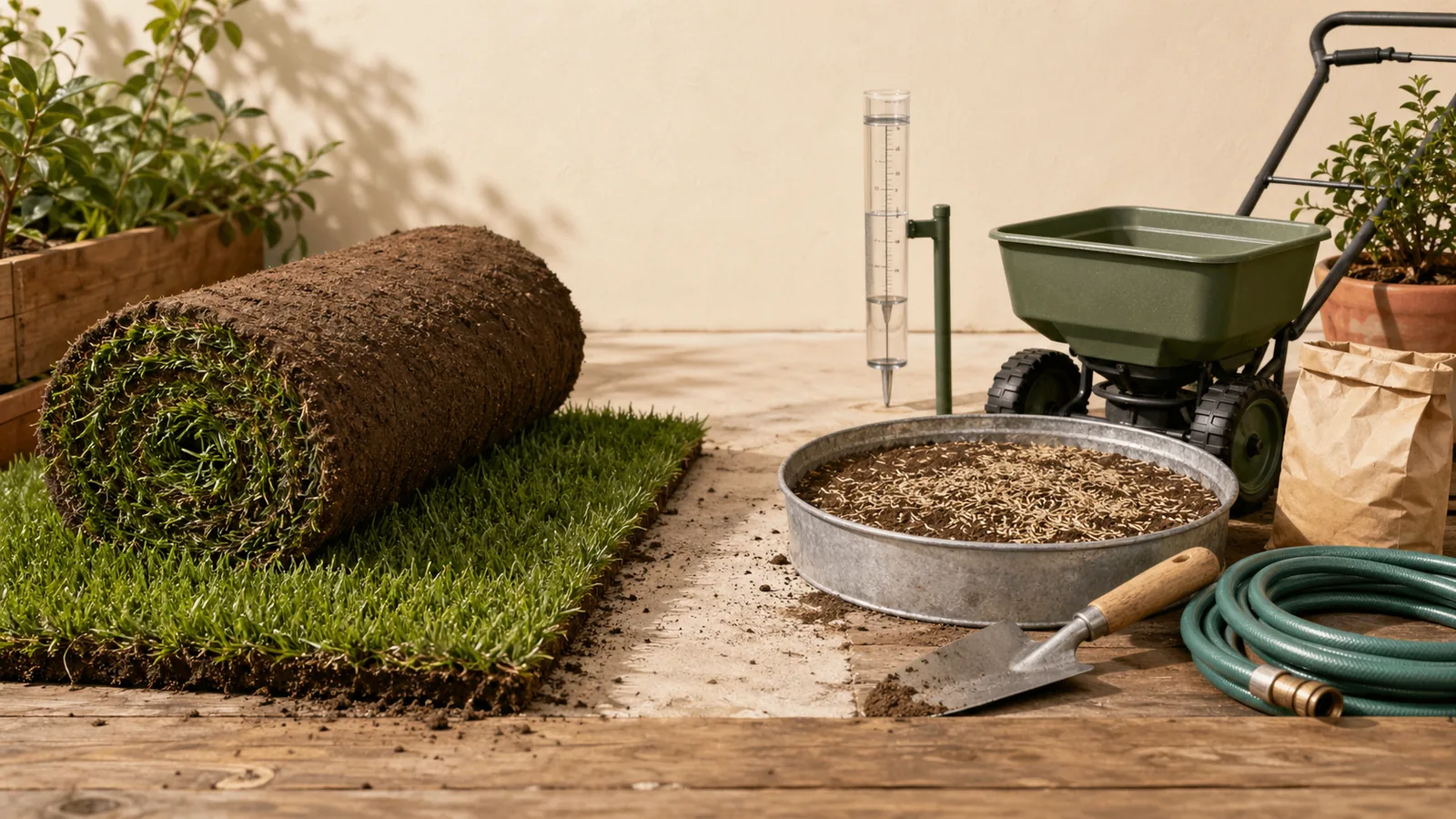
Sod costs far more than seed to install in 2026 — but for most suburban front yards, that premium buys something seed simply cannot: a finished lawn the same afternoon. Whether that trade-off makes sense depends on your slope, your timeline, and how honestly you can commit to a watering schedule that leaves almost no margin for error. Here is what both options actually cost in 2026, what they demand from you, and which one wins for your specific yard.
Sod vs. seed cost in 2026: what a 5,000-square-foot lawn actually costs
The short answer, according to Fixr's sod-vs-seed comparison: installed sod runs $1.29 per square foot and installed seed runs $0.24 per square foot. Scale those numbers to a standard 5,000-square-foot suburban lot and the estimate lands at about $6,450 for sod and $1,200 for seed materials and installation at the published per-square-foot rate. That gap is real, but it is not the complete picture. Seed's lower sticker price comes with a hidden price tag: two growing seasons of consistent moisture, patient weed control, and a real chance you will be buying a second bag of grass seed if the first attempt fails. Homeowners comparing notes on Bob Vila and Forbes Home tend to ask the same question: whether the lower upfront number is actually the lower all-in cost.
Every landscaping service quotes based on local labor rates, soil conditions, and grass variety availability, so treat the figures below as a reliable estimate — not a contractor's bid. For lawn fertilizer planning, products such as Milorganite can also affect your budget if you are timing a seeding or sod establishment program around soil-building applications.
Installed sod cost per square foot vs. seeded lawn cost per square foot
Seed is cheaper. Full stop. But the per-square-foot comparison deserves a closer look before you call it a decision.
Cost Snapshot: - Installed sod: $1.29/sq ft — materials, labor, soil prep included - Installed seed: $0.24/sq ft — professional spreading and prep included - Seed materials only (DIY): roughly $0.08/sq ft, or $65–$105 for a 5,000 sq ft lawn
The $1.29 vs. $0.24 gap is a clear upfront spread that makes sod the more expensive install. What you are paying for is instant coverage, instant erosion control, and a lawn that is usable — carefully — within two to three weeks. Seed at $0.24/sq ft (installed) or $65–$105 total for materials on a 5,000-square-foot lot sounds like an obvious win until you factor in the months of establishment risk between germination and a lawn that can handle foot traffic.
If you are comparing the two for a grass seed purchase at Home Depot or Lowe's — Pennington and Scotts Turf Builder both offer widely available options for cool- and warm-season varieties — the materials-only price drops even further. But "cheap to buy" and "cheap to establish" are two different things.
5,000-square-foot project estimate: materials, labor, and total price
The table below is built from Fixr's published unit costs and their overall project range estimates. Line-item splits between soil prep and labor are estimates based on published per-square-foot figures, since those line items are not broken out separately in the source data.
| Line Item | Seeded Lawn | Sodded Lawn |
|---|---|---|
| Grass materials | ~$65–$105 | Included in delivery/material handling |
| Soil prep | Estimate only; depends on grading and existing soil condition | Estimate only; depends on grading and existing soil condition |
| Labor | Estimate only; depends on site size and prep needs | Estimate only; depends on site size and prep needs |
| Total estimated project | $550–$1,200 | $5,800–$7,200 |
Estimates based on Fixr's lawn seeding and sod installation cost data. Actual bids from a landscaping service in your area will reflect local labor rates and current sod pricing from your regional supplier.
Pro Tip: Sod prices spike in spring and early fall when demand peaks. If your project is flexible, getting quotes in late winter (February–March) can shave 10–15% off material costs before the seasonal rush.
Why the first quote is not the real total cost of ownership
The seed quote looks great on paper. The sod quote stings. But the first invoice is not the end of the story for either option, and seed carries significantly more financial risk over a two-year horizon.
Here is what competitors consistently skip: the total cost of ownership for a seeded lawn includes the realistic probability that you will spend money twice.
The re-seeding risk is real. A newly seeded lawn fails when the top inch of soil dries out during germination — even once, during the first 30 days. A single missed watering window, a heatwave, or a heavy rain that washes seed into low spots can leave you with bare coverage. Buying another $65–$105 bag of Pennington Kentucky Bluegrass or Scotts Turf Builder Dense Shade is not catastrophic, but when you add a second labor pass, extra irrigation costs, and a replacement bag of Milorganite for the next round of feeding, your "cheap" seeding project starts climbing toward the upper end of the project range.
Weed pressure is part of the establishment window. An establishing seeded lawn cannot be treated with pre-emergent herbicide — the same chemistry that prevents crabgrass from germinating will also stop your grass seed. That means bare and thin areas are open ground for opportunistic growth throughout the establishment period. Sod eliminates most of that window: as Pennington notes, "Fast establishment. Handled and installed properly, new sod generally takes just two to three weeks to root well and become established."
Drought vulnerability. The University of Minnesota Extension notes that Kentucky bluegrass can begin showing stress after roughly seven days without water during dry conditions. For an establishing seedling — with a root system measured in fractions of an inch — that window is even shorter. One dry week in June and months of work can go brown.
The honest TCO comparison for a 5,000 sq ft lot:
| Scenario | Seed | Sod |
|---|---|---|
| Best case (perfect establishment) | $550–$1,200 | $5,800–$7,200 |
| Realistic case (one re-seed of 25% area) | $900–$1,600 | $5,800–$7,200 |
| Worst case (full re-seed + additional watering and recovery materials) | $1,400–$2,200+ | $5,800–$7,200 |
Sod's cost is a ceiling. Seed's cost is a floor.
How much maintenance sod and seed need during the first 30 days
Both methods require consistent moisture to succeed — but the watering discipline they demand is not even close to equivalent. The EPA's WaterSense program explicitly frames the seed-vs-sod decision as site-specific, emphasizing that a landscape professional should evaluate conditions before recommending either method. That is sound advice, because the maintenance commitment for each is genuinely different.
Success Checklist: - Sod: confirm irrigation, keep the site moist through the early rooting period, and avoid foot traffic while seams knit together. - Seed: prepare a clean seed bed, keep the surface evenly moist through germination, and protect the site from drying out or heavy use while seedlings establish.
If you do not have an in-ground irrigation system or a programmable sprinkler timer already in place, budget for one before you commit to either option — hand-watering a 5,000-square-foot lawn twice a day is not sustainable for most households.
Sod watering schedule: daily watering for 14 days
New sod needs water immediately after laying and consistently for the first two weeks. The root system has been cut from the soil at the sod farm and needs to re-establish contact with your prepared ground before it can draw moisture on its own.
Sod watering checklist — Days 1–14:
- Installation day: Water thoroughly after each section is laid so the sod and the prepared soil make solid contact.
- Days 1–7: Water frequently enough to keep the sod and the top 2 inches of soil beneath it consistently moist, adjusting for heat, wind, and sun exposure.
- Days 8–14: Continue a frequent irrigation pattern; in cooler fall conditions, extend the interval only if the soil is staying moist between cycles.
- Days 15+: Begin extending intervals gradually — water every 2–3 days, then every 3–4 days as roots anchor into the soil.
- Root-check test: At Day 14, gently tug a corner of sod. If it resists, roots are establishing. If it lifts cleanly, keep the frequent watering going.
Lake Havasu City's municipal watering guidelines confirm this staged approach: establish on a frequent schedule through the first two weeks, then gradually extend the time between irrigations as root contact develops.
Watch Out: The most common sod failure is drought stress in the first week — not disease, not bad soil. If you cannot commit to frequent irrigation during a summer installation, either install an automatic sprinkler timer before the sod arrives, or delay your project until fall when cooler temps reduce evaporation stress.
A quality sprinkler timer — brands like Orbit, Rain Bird, and Hunter all offer homeowner-grade models available at Home Depot — is a worthwhile investment before sod delivery. An irrigation system install that automates your zones removes the single biggest source of new-sod failure.
Seed watering schedule: multiple waterings daily for the first month
Germinating grass seed is more demanding than new sod in one specific way: the seed must never dry out during the germination window. The top quarter-inch of soil needs to stay consistently moist — not waterlogged, not bone dry — from the moment seed makes soil contact until germination is visible.
Seed watering checklist — Month 1:
- Pre-seeding: Lightly moisten the seed bed the day before planting so seed contacts moist soil immediately.
- Days 1–14 (germination phase): Keep the surface evenly moist with light irrigation as needed; avoid runoff that washes seed into low spots.
- Watch for runoff: If water runs off before absorbing, reduce duration and increase frequency — short pulses work better than long soaks on a freshly seeded surface.
- Days 15–30 (post-germination): As seedlings appear, begin shifting toward deeper, less frequent watering to encourage root development downward.
- Mowing readiness: Do not mow until seedlings reach at least 3–4 inches; a sharp mower blade on immature grass pulls seedlings from shallow soil.
Watch Out: Authoritative extension sources caution against stating a single universal watering frequency for all seed types and climates. Cool-season grasses like Kentucky bluegrass (common in Minnesota and the Upper Midwest) have different germination moisture requirements than warm-season bermudagrass in Florida. Always check your seed bag or the UMN Extension lawn care guides for region-specific guidance.
A programmable irrigation system install or a smart sprinkler timer is even more valuable for seeding than for sod, because the watering windows are shorter and more frequent. Missing an afternoon watering during the germination phase — even once during a hot week — can kill an entire seed bed.
For seed selection, Pennington and Scotts Turf Builder both offer regional blends matched to cool- and warm-season zones, available at Home Depot, Lowe's, and Tractor Supply.
Weed management, foot traffic, and failure points during establishment
This is where the hidden cost of seeding becomes physical. A seeded lawn is not just slow — it is vulnerable in ways that compound your time and financial investment.
Foot traffic timeline comparison:
| Milestone | Sod | Seeded Lawn |
|---|---|---|
| Initial rooting | 2–3 weeks (Pennington) | N/A |
| Light foot traffic OK | ~3–4 weeks | 10–12 weeks |
| Normal use resumable | 4–6 weeks | 3–4 months |
Saratoga Sod's installation guidance puts it plainly: a newly seeded lawn may not be ready for even light foot traffic for 10 to 12 weeks. If you have kids, dogs, or a backyard that sees regular use, that is a three-month shutdown.
Failure-risk checklist for seeded lawns:
- Dry-out: A single missed watering during germination can kill emerging seedlings — the top quarter-inch has almost no moisture buffer
- Washout: One heavy rain event on a slope or compacted soil can carry seed to the low end of your yard, leaving bare patches at the top and seed piles at the bottom
- Uneven germination: Seed applied at inconsistent rates, or on a patchy soil prep, germinates unevenly — leaving thin areas that invite general weed pressure
- Traffic damage: Even light foot traffic before 10–12 weeks can uproot shallow seedlings that haven't yet developed secondary root systems
Sod avoids most of these failure points by design. As Pennington states, "Immediate erosion control. On slopes or areas with erosion problems, sod works as a blanket to help hold soil in place from the start." That blanket effect eliminates washout risk from day one.
When sod beats seed for erosion control, slopes, and immediate curb appeal
Sod is the clear winner when timing, slope, or function are non-negotiable. The price premium is easier to justify when the alternative — seed — carries a long vulnerability window during which your yard can wash, thin, or simply fail to germinate.
[Image: Decision matrix diagram — sod vs. seed use cases by slope, timeline, and traffic level]
Best use cases for sod in suburban yards
Choose sod when any of these scenarios apply:
- Slopes and drainage areas: Pennington explicitly identifies slopes and erosion-prone sites as prime sod territory — the interlocked root mat holds soil in place before a single raindrop can displace it. Seed on a slope is a gamble; sod is not.
- Front yards with curb appeal deadlines: Selling a home, hosting an event, or just arriving from a renovation and wanting the yard finished — sod delivers a complete lawn the day it goes down
- Households with kids and dogs: A seeded lawn that can't handle foot traffic for 10–12 weeks is not compatible with an active backyard. Sod becomes usable in weeks, not months
- Areas with drainage or washout history: If your yard has low spots, clay soil, or a history of runoff, seed will move. Sod won't
For any of these scenarios, getting quotes from a landscaping service before committing to DIY is worth the hour — professional sod installers carry the materials, handle grading, and coordinate the install in ways that help the project move quickly.
Best use cases for seed when budget matters most
Seed makes the most financial sense when you have time, a flat or gently rolling site, and the irrigation discipline to see establishment through.
Choose seed when:
- Budget is the primary constraint: At $65–$105 in materials for 5,000 square feet (per Fixr), seed is accessible for homeowners who simply cannot absorb a $6,000+ sod project
- Large backyards with low traffic: A 10,000–15,000 square foot rear yard that doesn't need to be usable for months is a strong seed candidate — the savings are substantial and the establishment risk is manageable on flat ground
- Phased lawn renovations: Overseeding thin areas or renovating one section at a time keeps costs low and allows you to apply what you learned from the first section to each subsequent one
- Fall timing in cool-season regions: In general, cool-season grasses like Kentucky bluegrass and tall fescue are more forgiving in milder weather than in peak summer heat; always match the seed to your region and planting window
- New construction final grade: If the builder has left you with bare, freshly graded soil and a month of mild weather ahead, seed is a cost-effective starting point
A quality bag of Pennington or Scotts Turf Builder grass seed matched to your region is a legitimate path to a full lawn — it just requires honest commitment to the first 30-day watering routine.
Regional cost differences across the US that change the sod vs. seed decision
Labor rates, sod availability, and the grass variety you need vary enough by region that the national averages above are a starting point, not a final budget. Fixr's landscaping cost data confirms that companies charge based on yard size and local conditions — a sod install in one part of the country will carry different labor costs than the same job elsewhere. The EPA's WaterSense guidance frames it the same way: site conditions — which are inherently regional — should drive the seed-vs-sod decision.
Two regions illustrate how dramatically local conditions change the calculus.
Florida and the Southeast: St. Augustine grass, bermudagrass, and warm-season timing
In Florida and across the Southeast — roughly USDA zones 8–10 — the grass types and the decision logic both shift. St. Augustine grass and bermudagrass dominate residential lawns here, and both are warm-season grasses with establishment timing that depends on local climate and moisture management. The EPA's WaterSense program lists both as major turfgrass species, and the USDA NRCS maintains a technical guide on establishing warm-season grasses that underpins regional extension recommendations.
What this means practically:
- St. Augustine grass is commonly used in warm-season Southern lawns and is a natural fit where sod or plugs are the preferred installation methods
- Bermudagrass can be seeded in some settings, but warm-season grasses need establishment timing that fits the local growing season rather than a one-size-fits-all calendar
- Sod and plugs are often the practical choice when a homeowner wants a dense lawn quickly and the site will support frequent watering during establishment
- Year-round growing seasons in zones 9–10 mean a fall sod install can root fully before the dry season — an advantage not available in northern climates
If your Florida front yard is thin, weedy, or damaged, getting quotes from a local landscaping service familiar with St. Augustine installation timing is worth doing before spring.
Minnesota and the Upper Midwest: Kentucky bluegrass, dormancy, and spring seeding windows
Minnesota and the Upper Midwest (USDA zones 3–5) present nearly opposite conditions. Cool-season grasses — primarily Kentucky bluegrass, fine fescues, and tall fescue — are the standard, and installation timing is tightly constrained by temperature and freeze risk. The USDA Plant Hardiness Zone map is the official reference for confirming your actual zone before you buy seed or schedule a sod install.
The University of Minnesota Extension confirms that dormant seeding — applying seed in late fall after the ground cools but before hard freeze — works for all cool-season turfgrasses grown in Minnesota, including Kentucky bluegrass, fine fescues, and tall fescue. The seed overwinters and germinates in early spring as soil temperatures rise, often producing excellent results with less summer drought stress.
Upper Midwest considerations:
- Kentucky bluegrass is the prestige option for Upper Midwest lawns but germinates slowly — 14–28 days under ideal conditions — and is unforgiving of moisture lapses
- The best seeding windows in the Upper Midwest are the ones identified by local extension guidance for cool-season turf, especially late-summer and dormant-seeding approaches
- Sod can be installed in the Upper Midwest during the active growing season when root growth can keep pace with the weather
- Labor costs in the Twin Cities metro run higher than some rural markets, which can compress the cost advantage of sod slightly compared with lower-cost areas
- The USDA Plant Hardiness Zone map (planthardiness.ars.usda.gov) is the official reference for confirming your zone and aligning variety selection to your actual climate
An irrigation system install matters even more in Minnesota's dry July and August — newly seeded bluegrass in a dry summer is the most common expensive lawn failure in the region.
DIY vs. hire a pro for sod or seeding
Whether this is a DIY project depends on the size of the job, your site conditions, your equipment access, and your tolerance for a failed outcome. The EPA WaterSense program explicitly recommends that a landscape professional evaluate site conditions before recommending seed or sod — that is not bureaucratic caution, it is practical advice for any yard with slopes, drainage issues, or a tight timeline.
DIY vs Pro: Seeding a flat 5,000 sq ft backyard with a sprinkler system already in place is a reasonable weekend project. Laying 5,000 sq ft of sod on a front yard with a 3:1 slope, in July, without a grading plan, is not.
When DIY makes sense for seeding
DIY seeding is genuinely feasible when the conditions align:
- Flat to gently sloped terrain — seed stays where you put it and water absorbs evenly
- Existing irrigation system install: A working sprinkler system or programmable timer removes the biggest failure risk
- Flexible timeline: You can wait 10–12 weeks before the lawn needs to be usable, and you can monitor it through the critical first month
- Cool-season region with a fall planting window: Fall seeding of cool-season grasses can work well when timed to local conditions, but always defer to your seed label and extension guidance rather than a rigid calendar
- Small to medium yard size: Under 5,000 sq ft, the labor investment is manageable; above 10,000 sq ft, the time commitment starts to rival the cost of hiring help
When to hire a landscaping service for sod installation
When to Call a Pro: - Your yard has slopes greater than 10–15% — improper grading before sod install leads to sod that lifts, slides, or drains poorly - You are on a hard deadline (home sale, event, HOA notice) and cannot risk a failed first attempt - Your site needs grading work before installation — laser-grade leveling is not a DIY skill for most homeowners - You are installing more than 3,000–4,000 sq ft — sod is heavy (a standard pallet covers 450–500 sq ft and weighs 1,500–3,000 lbs), and moving it quickly enough before it dries out is a real physical challenge - Your soil needs amendment or significant prep — professional soil prep mistakes are costly to fix after sod is laid
Professional sod installation also typically includes seam rolling — pressing seams and edges into soil contact — which reduces the air pockets that dry out sod edges in the first week. On a large or complex site, that step alone justifies the labor cost. Fixr's sod installation cost data shows that professional sod jobs are priced by scope for exactly this reason: site complexity is the variable that separates a straightforward install from a difficult one.
As Pennington states, sod provides "Immediate erosion control. On slopes or areas with erosion problems, sod works as a blanket to help hold soil in place from the start." — but only if it is properly graded, laid tight, and rolled into soil contact. Getting those details right on a slope is where professional installation earns its price.
DIY tools and supplies that can change the budget
Whether you are seeding or sodding, the right equipment reduces failure risk and often pays for itself versus renting repeatedly.
For DIY seeding: - Slit seeder or spreader: A slit seeder cuts small grooves in soil and deposits seed directly, while a broadcast spreader can handle overseeding thin areas and smaller lawn touchups. - Starter fertilizer or soil amendment: A starter product can help a new lawn get moving, and homeowners sometimes pair seed with products such as Milorganite when building a soil-improvement routine around their lawn care plan. - Straw mulch or erosion blanket: Light straw or paper mulch over seeded slopes retains moisture and helps prevent washout. - Programmable sprinkler timer: Any basic model from Orbit, Rain Bird, or Hunter compatible with your existing hose bibs runs $25–$60 and is essential for the first-month watering schedule and any irrigation system install.
For DIY sod: - Lawn roller: Rolling sod into soil contact after laying is a useful best practice for many DIY installs. - Garden spade and edger: For cutting sod pieces to fit borders and curves - Soil pH test kit: Scotts or Luster Leaf test kits (available at Lowe's or Tractor Supply) confirm your soil is in range before you spend $6,000+ on sod - Sprinkler timer: Same as above — automate the first-14-day watering to remove human error
Pro Tip: The single highest-ROI tool for either project is a programmable sprinkler timer. At $30–$60, it costs less than one day's water bill on a manual watering schedule and eliminates the most common cause of failed establishment.
Success checklist for sod vs. seed: what must happen before and after installation
Grass seed and sod both fail for the same reason: rushed or incomplete preparation. The checklist below reflects what the research actually supports, not an idealized scenario.
Sod success checklist: soil prep, seam rolling, and the first two weeks
Pre-installation: - [ ] Test soil pH (target 6.0–7.0 for most grass types) - [ ] Till or loosen compacted soil to 4–6 inches depth - [ ] Remove debris, rocks, and old vegetation - [ ] Grade to positive drainage away from structures — this is the step most DIYers skip and most regret - [ ] Apply starter fertilizer and work into top 2 inches of soil - [ ] Confirm irrigation system or sprinkler timer is operational before sod arrives
Installation day: - [ ] Begin laying sod within 24 hours of delivery — sod begins to decline quickly off the pallet - [ ] Stagger seams (brick-pattern layout) to avoid long continuous joints - [ ] Press seams firmly together — no gaps, no overlaps - [ ] Roll the installed sod with a water-filled lawn roller if needed to ensure full soil contact - [ ] Water immediately after each section is laid so the sod and the prepared soil make solid contact
Post-installation (Days 1–14): - [ ] Water frequently; during the first two weeks, keep the sod and soil beneath it evenly moist - [ ] Keep off the lawn except to water — foot traffic before rooting lifts seams - [ ] At Day 7, check edges and corners — these dry out first - [ ] At Day 14, perform the tug test: rooted sod resists lifting - [ ] After rooting is confirmed, gradually extend irrigation intervals per the staged schedule above
Per Pennington, "Fast establishment. Handled and installed properly, new sod generally takes just two to three weeks to root well and become established." Those two to three weeks are the entire game.
Seed success checklist: topsoil, moisture control, and first-month care
Pre-installation: - [ ] Test soil pH and amend if needed — seed establishment is pH-sensitive - [ ] Loosen soil to 2–3 inches; break up any crust or clods - [ ] Remove weeds and debris — do not seed into existing weed competition - [ ] Apply a thin layer (1/4–1/2 inch) of quality topsoil or compost over the seed bed if existing soil is poor - [ ] Confirm irrigation setup; a programmable sprinkler timer is strongly recommended
Installation: - [ ] Select seed variety matched to your region and sun exposure (UMN Extension recommends Kentucky bluegrass, fine fescues, or tall fescue for Minnesota cool-season lawns; Pennington and Scotts both offer regional blends for warm- and cool-season zones) - [ ] Apply seed at the rate recommended on the bag — over-seeding doesn't improve germination, it creates crowded weak seedlings - [ ] Rake lightly to press seed into soil contact — seed sitting on top of dry soil will not germinate reliably - [ ] Apply light mulch on slopes or exposed areas to retain moisture
Post-installation (Month 1): - [ ] Keep the top inch of soil consistently moist — adjust watering based on weather and soil response until germination is visible - [ ] Adjust watering based on weather: hotter and windier days require more frequent passes - [ ] Do NOT apply pre-emergent herbicide during establishment — it will kill germinating seedlings - [ ] Stay off the lawn for 10–12 weeks — premature foot traffic uproots shallow seedlings - [ ] At 30 days, evaluate coverage: thin or bare patches need a second seed pass before weed pressure fills them in - [ ] Materials budget for 5,000 sq ft: plan for the verified seed material cost range of $65–$105 for the initial seed application, with any re-seeding treated as a separate contingency if needed
FAQ: sod vs. seed installation cost and maintenance questions homeowners ask
Is it cheaper to lay sod or seed?
Seed is significantly cheaper. Fixr's data puts installed seed at $0.24 per square foot versus $1.29 per square foot for installed sod — a price difference that scales to roughly $5,250 on a 5,000-square-foot lawn. Grass seed materials alone run $65–$105 for that same area. The trade-off is time, risk, and ongoing maintenance commitment. Sod's higher upfront cost comes with faster establishment, immediate erosion control, and a much lower risk of paying twice.
How often should you water new sod?
During the first two weeks, water frequently enough to keep the sod and the top 2 inches of soil beneath it moist. Then gradually extend intervals every few days as roots establish. In hot, windy weather, the interval may need to stay short; in cooler conditions, it can be extended sooner. Municipal watering guidelines from Lake Havasu City outline a staged reduction approach: frequent irrigation through the first two weeks, then gradually extending intervals as root contact develops. The goal is to keep the sod and the top 2 inches of soil beneath it moist — not flooded, not dry.
How long does it take for seeded grass to grow?
Visible germination for most cool-season grasses (Kentucky bluegrass, fescues) takes 7–21 days under ideal conditions. Kentucky bluegrass is on the slower end of that range. A newly seeded lawn is not ready for even light foot traffic for 10 to 12 weeks, so plan around that shutdown period. If a dry spell interrupts moisture during the first 30 days, the timeline resets and may require re-seeding.
Is sod worth the extra cost?
For most front yards, sloped areas, and households with kids or pets: yes. The price premium buys immediate coverage, immediate erosion control, and a lawn that becomes usable in weeks rather than months. Pennington frames it directly: sod provides fast establishment and instant erosion control that seed simply cannot match on a slope or in a time-sensitive situation. For large flat backyards where a 3-month establishment period is acceptable and budget is the primary constraint, seed is the smarter option.
What is the best time to put down sod or seed?
For cool-season grasses (Kentucky bluegrass, fescues, ryegrass) in USDA zones 3–6: use local extension guidance to time seeding around cooler weather and adequate soil moisture. The University of Minnesota Extension also supports dormant seeding in late fall after soil temperatures cool below 50°F. Sod can be installed in cool-season regions during the active growing season when rooting conditions are favorable. In the Southeast (zones 8–10), warm-season grasses like bermudagrass and St. Augustine grass need timing that matches local heat and moisture patterns rather than northern lawn calendars.
Sources & References
- Fixr: Sod vs. Seed Comparison — Primary source for per-square-foot installation cost data ($1.29/sq ft sod, $0.24/sq ft seed, $65–$105 seed materials for 5,000 sq ft)
- Fixr: Lawn Seeding Cost — Project range data ($550–$1,500 for seeding)
- Fixr: Sod Installation Cost — Project range data ($5,800–$7,200 for sod)
- Fixr: Landscaping Cost — Regional labor rate variability
- Pennington: Grass Seed vs. Sod — Fast establishment timeline (2–3 weeks), immediate erosion control on slopes
- University of Minnesota Extension: Dormant Seeding — Cool-season species suitability, fall and dormant seeding windows for Kentucky bluegrass, fine fescues, tall fescue
- University of Minnesota Extension: Seeding and Sodding Home Lawns — Cool-season species recommendations for the Upper Midwest
- University of Minnesota Extension: Conserving Water in Drought-Affected Lawns — Kentucky bluegrass drought response and moisture requirements
- EPA WaterSense: Turfgrass and Water Efficiency — Professional site-condition guidance for seed vs. sod decisions; St. Augustine and bermudagrass as major turfgrass species
- Lake Havasu City Watering Guidelines — Staged irrigation schedule for new lawn establishment
- Saratoga Sod: Sod vs. Seed — 10–12 week foot traffic restriction for seeded lawns
- USDA NRCS: Establishing Warm-Season Grasses — Federal technical reference for warm-season grass establishment
- USDA Plant Hardiness Zone Map — Official US hardiness zone reference
Keywords: Fixr, Bob Vila, Forbes Home, Pennington, Scotts Turf Builder, Milorganite, St. Augustine grass, Kentucky bluegrass, USDA hardiness zone, soil prep, re-seeding, erosion control, irrigation system install, sprinkler timer, pre-emergent herbicide