Water damage restoration in the U.S. runs anywhere from $450 for a small clean-water extraction to $50,000 or more when a finished basement or contaminated sewage loss requires gut-and-rebuild work. According to HomeAdvisor's contractor cost database, most homeowners spend between $1,383 and $6,381, with a national average near $3,863. Angi pegs its average closer to $3,500 but notes the range extends from $450 to $15,000.
That spread exists because "water damage restoration" actually describes several distinct phases — emergency mitigation, structural drying, demolition, and reconstruction — and the final bill depends entirely on which phases your loss requires. A supply-line leak caught in two hours in an unfinished basement stays at the low end. A sewage backup in a finished basement found three days later lands at the high end, or beyond it.
What a water damage restoration bill includes: mitigation, drying, demolition, and rebuild
The IICRC — the Institute of Inspection, Cleaning and Restoration Certification, the industry's primary standards body — defines water damage restoration under its S500 standard, which governs procedures for residential, commercial, and institutional buildings. Practically, every water damage restoration job moves through three phases:
- Mitigation — stopping the loss from getting worse: pumping out standing water, extracting moisture from carpets and subfloors, protecting contents
- Remediation — drying the structure, removing damaged materials, and addressing mold if it has already grown
- Restoration (reconstruction) — returning the property to its pre-loss condition: new drywall, insulation, flooring, paint
Competitors frequently quote a single average and call it done. That number is nearly useless on its own. A mitigation-only job (extraction and drying, no demolition, no rebuild) might be $1,500. The same footprint requiring drywall removal, mold prevention, new insulation, and rebuilt walls becomes a $12,000 to $20,000 project. Below is a realistic line-item breakdown for a mid-sized residential loss.
Typical water damage restoration cost breakdown (mid-range residential loss):
| Line Item | Labor | Materials / Equipment | Typical Range | Notes |
|---|---|---|---|---|
| Emergency callout / mobilization | $100–$300 | $50–$200 | $150–$500 | Higher after hours or on weekends |
| Water extraction / pump-out | $200–$700 | $100–$500 | $300–$1,200 | Per truckload / scope of standing water |
| LGR dehumidifiers + air movers (per day) | $40–$120/day | $60–$180/day | $100–$300/day | Equipment rental built into contractor rate |
| Drywall removal | $0.75–$2/sq ft | $0.25–$1/sq ft | $1–$3/sq ft | More if multiple layers or tile |
| Insulation removal | $0.50–$1.50/sq ft | $0.50–$1/sq ft | $1–$2.50/sq ft | Batt vs. blown-in affects labor |
| Antimicrobial treatment | $100–$300 | $100–$500 | $200–$800 | Required for Category 2 and 3 losses |
| Contents cleaning / pack-out | $250–$1,500 | $250–$1,500+ | $500–$3,000+ | Depends on volume and contamination |
| Reconstruction (drywall, insulation, flooring, paint) | $1,500–$10,000 | $1,500–$10,000+ | $3,000–$20,000+ | Largest variable; finish level drives cost |
| Total | $2,740–$14,920 | $2,740–$14,920+ | $5,480–$29,840+ | Labor typically runs 40–60%; materials/equipment make up the rest |
Labor typically accounts for 40–60% of a restoration invoice; materials and equipment make up the remainder. Sewage and black-water losses add containment, PPE surcharges, and specialized disposal that push that ratio and total cost higher.
Emergency callout and extraction costs
The first truck to arrive handles water extraction — pumping out standing water and using truck-mounted or portable extractors to pull moisture from carpet, pad, and subfloor. Expect to pay $150–$500 for the emergency callout fee alone, with water extraction adding another $300–$1,200 depending on volume. After-hours, weekend, or holiday dispatch carries a premium, often 1.25–1.5× the standard rate. For burst-pipe-related water damage repair, Angi's water-damage guide states the typical total falls around $1,000 to $4,000 for the extraction and early drying phase before demolition or reconstruction is factored in.
The most important thing to understand at this stage: speed matters enormously. Wet structural materials that sit for more than 24–48 hours begin supporting mold growth, and porous materials that cross that threshold often need removal rather than drying. Every hour the water sits, the mitigation scope — and the invoice — grows.
When to Call a Pro: Call a restoration company immediately if you have standing water more than an inch deep, water that has contacted electrical panels or outlets, any sewage involvement, or water that has been sitting for more than 24 hours. Do not wait to see if it dries on its own.
LGR dehumidifiers and air movers for structural drying
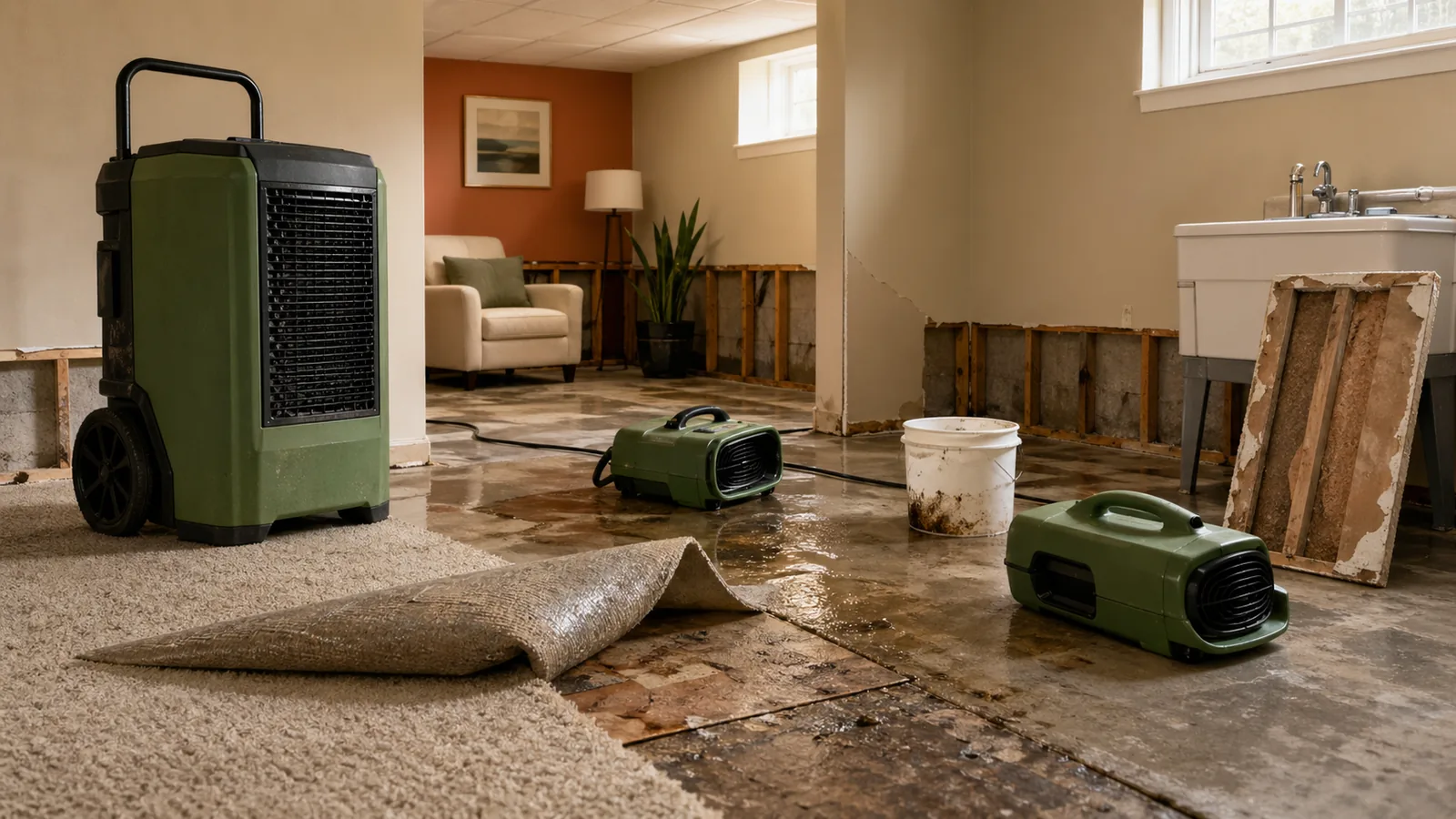
After extraction, the crew sets up drying equipment: LGR (low-grain refrigerant) dehumidifiers — the commercial-grade units that pull far more moisture per kilowatt-hour than the box-store dehumidifiers you'd rent — and air movers (high-velocity fans that accelerate evaporation from walls, subfloors, and framing).
A typical 200–400 square foot affected area might require 2–4 air movers and 1–2 LGR dehumidifiers running continuously for 3–5 days. Contractors generally price this as a daily equipment rental built into their scope: expect $100–$300 per day for the equipment setup, with technicians returning daily to take moisture readings and adjust placement. Total drying costs for a modest loss commonly run $500–$1,500.
The IICRC S590 draft standard emphasizes immediate extraction for Category 1 water damage in affected materials whenever possible — reinforcing why delayed response that requires longer drying cycles directly increases this line item.
Pro Tip: Ask the contractor to provide daily moisture-reading logs. These readings — taken with a calibrated pin or pinless moisture meter — document that drying targets were actually met, which matters both for mold prevention and for insurance documentation.
Drywall removal, insulation removal, and antimicrobial treatment
Not every water loss requires demolition — but many do, and this is where costs jump sharply. Angi notes that remediation includes removing damaged materials and addressing mold growth. The decision to demo is based on what the IICRC S590 assessment process calls a component-by-component evaluation: if a material shows no event-related contamination and can be dried to acceptable moisture levels, it stays. Drywall that absorbed gray or black water, or that sat wet long enough to grow mold, comes out.
Drywall removal runs $1–$3 per square foot. Insulation removal (fiberglass batt or blown-in) runs $1–$2.50 per square foot — blown-in tends to cost more because it requires vacuum extraction. For a 500 sq ft basement with finished walls, demo alone can run $2,000–$5,000 before reconstruction begins.
Antimicrobial treatment is applied to exposed framing and subfloor after demolition, particularly for Category 2 (gray water, such as a sump pump overflow) and Category 3 (black water — sewage, flood water with contamination) losses. Expect $200–$800 for treatment, more if the affected area is large or if structural wood required a fungicide application.
Watch Out: Contractors sometimes skip antimicrobial treatment on Category 2 losses to save a line item. Under IICRC S500 protocols, this is the wrong call — gray water can contain bacteria and fecal indicators. If it's not on the estimate, ask why.
The line between clean water damage and sewage cleanup costs is significant. Category 1 (clean water from a burst supply pipe) demo and treatment costs roughly 30–40% less than the same square footage affected by Category 3 sewage, which requires full PPE, containment barriers, and regulated disposal for contaminated materials.
Contents cleaning and reconstruction after the structure dries
Once the structure is dry and cleared, salvageable contents get cleaned — furniture, clothing, documents, electronics — either on-site or via pack-out to a climate-controlled warehouse. Contents cleaning ranges from $500–$3,000+ depending on volume and what the contamination class requires. Sewage-affected soft goods (mattresses, upholstered furniture, carpet) are almost always non-salvageable and go to disposal.
Reconstruction — hanging and finishing new drywall, installing replacement insulation, laying new flooring, painting — is the largest variable in the entire bill. A small bedroom repair might cost $3,000–$5,000. A full finished-basement rebuild with LVP flooring, 8-foot finished walls, and new paint can reach $15,000–$25,000 or more. Angi's remediation guidance states the remediation plan should include build-back work to restore the property to its previous condition — meaning reconstruction is a legitimate, expected part of the scope, not an upsell.
Basement flood cost breakdown by scenario
Basement flood costs swing from under $2,000 to well over $20,000 depending on one question above all others: how far did the water get, and into what?
Clean-water basement flood: likely line items and total
A clean-water (IICRC Category 1) basement flood — washing machine supply line, water heater connection, or burst copper pipe — in an unfinished or lightly finished basement is the best-case scenario. Extraction happens quickly, drying is straightforward, and if no finished materials were affected, reconstruction may be minimal or zero.
| Scenario | Water Category | Estimated Total |
|---|---|---|
| Clean-water basement flood in unfinished or lightly finished space | Category 1 | $450–$2,900 |
| Gray-water sump pump failure with partial demo | Category 2 | $2,900–$8,500 |
| Finished-basement rebuild after Category 2 or 3 loss | Category 2 or 3 | $13,500–$36,000+ |
This aligns with the lower end of HomeAdvisor's national range, where lower-end jobs can be as low as $450 when the homeowner acts fast and finished materials were not involved.
Sump pump failure or gray-water basement flood
A sump pump failure during heavy rain, or water backing up through a floor drain, is a Category 2 (gray water) event — meaning the water may contain biological or chemical contaminants that make direct skin contact a health risk. Because gray water can carry bacteria, detergents, fertilizers, and drain residue, cleanup protocol escalates immediately: technicians wear full PPE, apply antimicrobial treatment, and remove any porous material (carpet, drywall, fiberglass insulation) that absorbed the water rather than trying to dry it in place.
| Line Item | Estimated Cost |
|---|---|
| Emergency callout + extraction | $500–$1,200 |
| LGR dehumidifiers + air movers (4–5 days) | $600–$1,200 |
| Carpet + pad removal and disposal | $300–$800 |
| Drywall removal (partial) | $500–$2,000 |
| Insulation removal | $300–$1,000 |
| Antimicrobial treatment (required) | $400–$800 |
| Contents cleaning or disposal | $300–$1,500 |
| Total (mitigation only, no rebuild) | $2,900–$8,500 |
Insurance.com identifies sewer backups and water entering through foundation cracks among covered loss scenarios — but coverage depends entirely on your specific policy and endorsements. A standard HO-3 policy may or may not cover sump pump failure without a water backup endorsement. Check before assuming it's covered, and see Insurance.com's homeowners insurance endorsements page for the backup endorsement referenced in many policies.
Pro Tip: If your sump pump has failed before or you live in a flood-prone area, add a water-and-sewer-backup endorsement now — before the next event. Insurance.com notes this endorsement covers damage from backed-up drains and sump pumps.
Finished basement with demolition and rebuild
A finished basement hit by a Category 2 or Category 3 event — or any basement where water sat for more than 48 hours — typically becomes a gut-and-rebuild project. Drywall comes off the studs. Framing gets inspected and treated. Flooring (LVP, tile, carpet) is removed. Insulation is replaced. Then the rebuild begins.
| Line Item | Estimated Cost |
|---|---|
| Emergency callout + extraction | $600–$1,500 |
| LGR dehumidifiers + air movers (5–7 days) | $800–$2,000 |
| Full drywall removal (500–800 sq ft) | $1,500–$4,000 |
| Insulation removal and replacement | $1,000–$3,500 |
| Antimicrobial treatment | $600–$1,200 |
| Contents cleaning / pack-out | $1,000–$4,000 |
| Reconstruction (drywall, finish, flooring, paint) | $8,000–$20,000+ |
| Total | $13,500–$36,000+ |
For severe long-standing losses — think a vacation property discovered weeks after a pipe burst — HomeAdvisor notes that Class 4 water damage can run $20,000 to $100,000, reflecting the full cost of structural drying, rot remediation, and gut reconstruction.
Roof leak repair and interior water damage cost
A roof leak creates a two-part bill: the roofing repair itself (flashing, shingles, decking) plus the interior restoration for any water that reached attic insulation, drywall, or living space below. The Insurance Information Institute (III) confirms that standard homeowners and renters insurance covers wind-driven rain and ice-dam roof damage, making roof leaks one of the more frequently approved insurance claims.
The interior restoration side of a roof leak follows the same phases as any water damage job — but the ceiling and attic add specific line items.
| Component | Roof Repair | Interior Mitigation / Restoration | Total |
|---|---|---|---|
| Flashing, shingles, or decking repair | $300–$3,000+ | $0 | $300–$3,000+ |
| Attic blown-in insulation removal and replacement | $0 | $2,000–$5,500 | $2,000–$5,500 |
| Attic drying and antimicrobial treatment | $0 | $400–$1,000 | $400–$1,000 |
| Ceiling drywall removal and repair | $0 | $500–$2,500 | $500–$2,500 |
| Interior paint (ceiling + affected walls) | $0 | $300–$1,200 | $300–$1,200 |
| Total | $300–$3,000+ | $3,200–$10,200 | $3,500–$13,200+ |
Ceiling stain, attic insulation, and drywall repair costs
A ceiling stain from a slow roof leak is the most common call — a brownish water mark on drywall that signals moisture has been sitting in the ceiling cavity. If the leak was caught quickly and the drywall is structurally sound, a stain-block primer (Zinsser BIN or Kilz Original), fresh paint, and a ceiling texture touch-up can resolve visible damage for $200–$600 as a DIY repair.
When the drywall has softened, blistered, or sagged — or when blown-in insulation above it has absorbed significant moisture — replacement is necessary. Attic insulation removal runs $1,000–$3,000 for a typical section; replacing it with new R-38 or R-49 blown-in adds another $1,000–$2,500 depending on attic square footage and local labor rates.
Per IICRC S590 assessment protocols, insulation showing visual fraying, eroding surfaces, or moisture infiltration requires further assessment — meaning a restoration contractor should evaluate the attic, not just the ceiling below it.
When a roof leak becomes mold or rebuild work
A slow leak that went unnoticed for weeks or months is a different problem than a storm-event leak caught the same day. Wet wood framing in a warm attic is an ideal mold environment; visible mold growth typically appears within 24–72 hours of sustained moisture. When it does, the scope shifts from IICRC S500 (water damage) to IICRC S520 (mold remediation) — a different certification, different protocols, and a higher cost.
Mold remediation adds $1,500–$9,000+ to an already open interior restoration scope. Angi notes that mold growth in the affected area is among the largest single cost drivers in water damage pricing.
When to Call a Pro: If you smell a musty or earthy odor in the room below a known roof leak, if drywall is sagging or crumbling when pressed, or if you can see dark staining on attic framing — stop. Do not disturb the materials. Call an IICRC-certified water damage or mold remediation contractor for an assessment before any demo work begins.
Sewage backup cleanup cost and why black water costs more
Sewage backup is the most expensive residential water damage scenario, dollar for dollar. HomeGuide's sewage cleanup data puts the average at $7–$15+ per square foot, with total costs typically ranging from $2,000–$15,000 and extensive losses reaching $15,000–$50,000+. Modernize reports that most homeowners in 2026 spend $3,000–$7,000 for a typical sewage backup, with the range topping out at $10,000 for moderate to significant losses.
The reason sewage costs more than clean-water damage of the same square footage comes down to contamination class. Sewage is IICRC Category 3 (black water) — by IICRC's 2026 weather-related position statement, this includes contaminated water entering or affecting the indoor environment. Category 3 requires full containment, respirators and Tyvek suits for crews, regulated waste disposal, and a multi-step disinfection protocol. None of that is required for a clean water pipe leak.
Clean water vs. sewage backup: cost comparison for a 300 sq ft basement
| Scenario | Category | Estimated Total |
|---|---|---|
| Burst supply pipe, caught same day | Category 1 (clean) | $1,200–$3,500 |
| Sump pump failure, gray water | Category 2 (gray) | $3,500–$8,000 |
| Sewage backup, finished basement | Category 3 (black) | $8,000–$25,000+ |
Category 3 black water cleanup line items
Every Category 3 loss carries extra line items that don't appear on a clean-water estimate:
- Containment setup (poly sheeting, negative air pressure): $200–$600
- PPE and crew hazard surcharge: $150–$500 per crew day
- Extraction of sewage-contaminated water: $400–$1,200 (biohazard handling adds cost vs. clean water)
- Removal and regulated disposal of contaminated porous materials (drywall, carpet, insulation): $1,500–$6,000
- Multi-step antimicrobial and disinfection treatment: $500–$1,500
- Post-remediation clearance testing (air and surface sampling): $300–$800
Mold removal, if the backup was not caught immediately, adds another $15–$30 per square foot per HomeGuide. On a 300 sq ft basement, that's an additional $4,500–$9,000 layered onto an already expensive cleanup.
When sewage backup needs immediate mitigation crews
Do not attempt DIY cleanup of a sewage backup. Full stop.
IICRC WRT (Water Restoration Technician) certification specifically covers sewer backflows, contamination, and mold — this is specialist work. The pathogens present in sewage (E. coli, Hepatitis A, Norovirus, and others) can cause serious illness through skin contact, inhalation of aerosols, or contact with mucous membranes.
When to Call a Pro: Call a restoration company — not a plumber, not a general contractor — immediately after any sewage backup if: the sewage has contacted walls, flooring, or furniture; there is standing water of any depth; or the backup originated from the municipal main rather than a fixture clog. If you have sewage in contact with electrical outlets or your HVAC system, do not enter the space until utilities are confirmed off.
III notes that for homes rendered uninhabitable by sewage, loss-of-use coverage may apply — a critical policy benefit to verify before you check in to a hotel.
What pushes water damage restoration costs up or down
The same physical event — say, 200 gallons of water in a basement — can cost $3,000 or $30,000 depending on six variables. Understanding these lets you have a realistic conversation with your contractor and your insurance adjuster.
Square footage, finish level, and how long water sat
Size and finish level multiply every line item. Angi's per-square-foot data shows Portland, Oregon restoration pricing at $3–$7.50/sq ft, while Denver runs $2–$5.25/sq ft — and those ranges widen further depending on finish level. An unfinished utility basement costs far less per square foot to restore than a finished basement with LVP flooring, painted drywall, and built-in cabinetry.
Time is the most controllable variable. A 200 sq ft clean-water event caught in two hours might stay under $2,000. The same 200 sq ft left wet for 72 hours escalates to Category 2 or 3 territory — the moisture penetrates subfloor and framing, mold risk increases, and the scope shifts from extraction-and-dry to full demo. That same footprint can now cost $8,000–$15,000.
| Cost Driver | How It Pushes Cost | Why It Matters |
|---|---|---|
| Square footage | More area means more extraction, drying, and demo | Every machine and labor hour scales with affected size |
| Duration / water-sat time | Longer saturation increases drying days and demolition scope | Wet materials can cross into mold-risk territory after 24–48 hours |
| Materials / finish level | Finished walls, flooring, cabinetry, and insulation cost more to remove and replace | Rebuild labor and finish materials drive the biggest swing |
| Water category | Category 2 and 3 require PPE, containment, treatment, and disposal | Contamination changes both protocol and price |
| Accessibility | Crawlspaces, tight utility rooms, and finished basements slow crews down | Hard-to-reach areas add labor hours and equipment moves |
| Labor rates | Metro markets and storm zones charge more per technician hour | Local demand and wage levels change the invoice |
Contamination class, hidden moisture, and mold risk
Category 1 losses follow the simplest protocols. Category 2 (gray water) and Category 3 (black water, sewage, flood contamination) require escalating PPE, containment, treatment, and disposal — all of which appear as additional line items.
Hidden moisture is equally costly. Water that wicks into wall cavities, under cabinets, or beneath tile flooring often isn't discovered until a moisture meter reads elevated readings in materials that look dry to the naked eye. Crews sometimes need to open additional walls to chase moisture, adding demolition scope that wasn't in the original estimate. This is legitimate — not an upsell — but it's worth asking for moisture readings before and after drying to confirm the scope was warranted.
Angi confirms mold growth is among the biggest cost factors in water damage pricing. Mold found during demo adds the S520 remediation protocol to the project.
Watch Out: If a contractor gives you an estimate without taking any moisture readings — no meter, no documentation — that's a red flag. Restoration pricing should be tied to measured data, not guesswork.
Urban metros, coastal storm areas, and regional pricing swings
Location shifts cost significantly. Angi's city-level data shows Portland running about 5% below the national average, while Denver comes in 29% below and Baltimore about 28% below.
Regional Cost Note: High-cost metros — New York City, San Francisco, Boston, Seattle, Miami — trend 20–40% above the national midpoint, driven by labor rates, equipment costs, and demand after storm events. Coastal storm markets (Gulf Coast, Carolinas, Florida) see additional surge pricing immediately after hurricanes and major rain events when qualified crews are in short supply. If you're getting estimates in the week after a named storm, expect to pay peak-market rates and prioritize IICRC-certified contractors over storm-chaser crews that appear from out of state.
Will homeowners insurance cover water damage restoration or sewage backup?
The short answer: it depends on the source of the water, not the damage itself. A standard HO-3 homeowners policy covers sudden and accidental water damage from internal sources — burst pipes, appliance failures, wind-driven rain, and ice-dam roof damage are all covered under the III's guidance. What it does not cover is flooding (water that enters from outside during a storm), gradual leaks (a slow drip behind a wall that you didn't report), or sewer backup — unless you've added specific endorsements.
| Water Event | Standard HO-3 Coverage | Endorsement Needed |
|---|---|---|
| Burst supply pipe | ✅ Covered | None |
| Ice dam roof damage | ✅ Covered | None |
| Wind-driven rain through window | ✅ Covered | None |
| Appliance leak (water heater, washer) | ✅ Covered | None |
| Sump pump failure / drain backup | ❌ Not covered | Water/sewer backup endorsement |
| Sewage backup from municipal main | ❌ Not covered | Water/sewer backup endorsement |
| Flood (rising water from outside) | ❌ Not covered | Separate NFIP flood policy |
| Gradual/slow leak ignored over time | ❌ Not covered | None (maintenance issue) |
III confirms flood damage is excluded from standard homeowners and business insurance — a flood policy through the NFIP or a private carrier is the only coverage for rising-water losses.
What deductibles and ALE can mean after a water loss
Most HO-3 policies carry a single flat deductible — commonly $500, $1,000, or $2,500. You pay that amount before insurance pays anything on a covered loss. On a $12,000 restoration job with a $1,000 deductible, you're out $1,000 and insurance pays $11,000. On a $3,500 mitigation-only job with a $2,500 deductible, you net only $1,000 from your insurer — making the claim barely worth filing if it risks a rate increase.
If your home is uninhabitable during restoration — a finished basement that's also your only bedroom, or sewage contamination that makes the whole structure unlivable — your policy's Additional Living Expenses (ALE) coverage kicks in. III notes that ALE reimburses hotel costs, meals above your normal grocery spending, and other displacement costs while your home is being restored. Keep every receipt. ALE has a daily or total cap that varies by policy.
Insurance.com reminds that sewer backup endorsements — which add coverage for drain backups and sump pump failures — typically cost just $40–$50 per year added to your premium. For a $7,000–$25,000 exposure, that's among the most cost-effective coverage decisions a homeowner can make.
What photos, receipts, and moisture readings to document
Your claim file is your leverage. Build it from the moment you discover the loss.
Claim documentation checklist:
- Photos — wide shots of every affected room, close-ups of the water source, standing water depth, and any visible damage to walls, flooring, and contents
- Videos — slow walkthrough footage showing the overall extent of the loss and how water moved through the space
- Receipts — hotel, meals, laundry, emergency supplies, and any mitigation invoices if you're displaced under ALE
- Moisture-meter readings — ask the restoration contractor for a copy of their initial moisture map and daily drying logs; these are the objective data your adjuster needs
- Time-stamped files — your phone's native camera embeds GPS and timestamp data; export in full resolution
- Written scope from contractor — the estimate should list every line item, square footage affected, and the water category determination
- Contents inventory — list every damaged or destroyed item with make, model, age, and approximate replacement cost; photos of serial number plates help
- Communications log — write down every call to your insurer: date, time, rep name, and what was discussed
Angi explicitly notes that each phase of restoration should include specific testing and inspection details to ensure costs are not denied by the insurance provider — meaning the documentation burden is real, and thorough records protect your claim. FTC guidance also advises contacting your insurer before signing any contractor authorization to understand exactly what your policy covers.
DIY water cleanup vs hiring a restoration company
DIY vs Pro: DIY is only appropriate for clean water, very small area (under 10 sq ft), and no structural materials involved. Any standing water, any sewage contact, any wet drywall, or any uncertainty about hidden moisture means you need a pro — not eventually, but now.
If any of the following are true, mitigation crews should be called immediately: standing water, wet drywall, sewage, hidden moisture, or any material that has already wicked water into wall cavities, subfloors, or insulation. Once water has reached those materials, the clock on mold and demolition starts.
Safe DIY cleanup for very small clean-water spills
If a glass of water tipped onto a wood floor, a plant overwatered and pooled on tile, or a toilet overflowed clean water onto a bathroom floor with no wall or cabinet contact — yes, you can handle that yourself.
Small incident guidance:
- Wear rubber gloves and waterproof boots even for clean-water cleanup
- Extract standing water with a wet/dry shop vac (a 5- or 6-gallon unit handles small spills fine)
- Lift area rugs and dry them outdoors in sun
- Run a box fan and open windows for ventilation — note this is not a substitute for an LGR dehumidifier on a structural event, but it works for truly minor spills
- Monitor the area daily for 72 hours; press on baseboards and check for musty odor
If any of those checks reveal soft drywall, a musty smell, or moisture under flooring — escalate to a professional immediately.
Red flags that make professional mitigation non-negotiable
When to Call a Pro: Call a restoration company, not a handyman, if you encounter any of the following: - Standing water more than 1 inch deep anywhere in the structure - Water that has contacted drywall, insulation, subfloor, or framing - Any sewage involvement — even a partial backup from a floor drain - A musty or earthy odor anywhere near the water event - Water near or in an electrical panel, outlets, or wired appliances - Visible mold growth (any color — black, white, green, pink) - Water that has been present for more than 24 hours - You're a renter and the source of the damage is unclear — document and notify your landlord immediately, then call the insurer on record
Angi advises calling a local water damage restoration company immediately after finding evidence of water damage, and notes a plumber may be appropriate first only if the issue clearly stems from a specific plumbing pipe. For anything else, restoration comes first.
How to choose a reputable water damage restoration company
The restoration industry attracts a meaningful number of storm-chasers and under-qualified crews after major weather events. Vetting your contractor before you sign anything is worth the 15 minutes it takes.
Company vetting checklist:
- IICRC WRT certification (Water Restoration Technician) — this is the baseline credential for anyone performing water damage work; crews working on sewage or mold should additionally hold the ASD (Applied Structural Drying) and AMRT (Applied Microbial Remediation Technician) certifications
- 24/7 emergency dispatch — legitimate restoration companies answer calls around the clock; if you reach voicemail only, keep calling
- Proof of general liability and workers' comp insurance — ask for a certificate of insurance before work begins; the cert should name your property address
- Local, verifiable references — ask for two or three recent local jobs and actually call those homeowners
- No high-pressure assignment of benefits (AOB) — some contractors pressure homeowners to sign over insurance benefits immediately; this can complicate your claim and your options; consult your insurer first
- Itemized written estimate — scope should list square footage, equipment count, water category, and every line item; a one-page "we'll take care of everything" proposal is insufficient
- Coordination with your insurance adjuster — reputable companies work with adjusters routinely; if a contractor tells you to hide information from your insurer, walk away
Questions to ask before you approve work
Before signing any authorization or work order, ask these directly:
- What IICRC certifications do your technicians hold, and can I see their certification cards?
- What water category have you determined this loss to be, and why?
- Will you provide daily moisture logs showing readings before and after each drying day?
- What is your estimate for the number of drying days, and what happens to the price if it takes longer?
- Who will be on-site daily — your employees or subcontractors?
- Will you submit your scope directly to my insurance adjuster, or do I need to coordinate that?
- What is the process if you discover additional damage (hidden mold, wet framing) once demo begins?
Angi's guidance stresses that each phase should include specific testing and inspection details — these questions make sure the contractor's process actually delivers that. FTC guidance echoes the importance of confirming with your insurer what the policy will pay for before approving contractor work.
Red flags in a restoration estimate
Watch for these in any estimate you receive:
- No water category listed — every legitimate scope identifies whether the loss is Category 1, 2, or 3; this drives every protocol decision
- Equipment listed as a single lump sum — you should see specific equipment counts (e.g., "4 air movers, 2 LGR dehumidifiers") and a daily rate, not just "drying equipment: $2,400"
- No moisture-reading protocol mentioned — drying without documented moisture targets is guesswork
- Reconstruction scope written before demo is complete — a reputable company cannot give you a fixed rebuild price until they've seen what's behind the walls; be wary of a guaranteed total that seems oddly precise before demo
- Pressure to sign before you call your insurer — your insurer has the right to inspect the loss before major work begins on a covered claim; a contractor who wants to start demo in the next hour before your adjuster can respond is not acting in your interest
- Vague labor descriptions — "water damage labor" without a technician-hour breakdown makes it impossible to verify the bill against actual work performed
Frequently asked questions about water damage restoration costs
How much does water damage restoration cost on average?
The national average is approximately $3,863, with most homeowners spending $1,383–$6,381 per HomeAdvisor. Angi pegs the midpoint near $3,500 with a $450–$15,000 range. Those averages collapse mitigation-only and full reconstruction jobs into a single number, which is why they're not particularly useful on their own. Use the scenario tables in this article — basement flood, roof leak, or sewage backup — to get a number that actually matches your situation.
What is the difference between water mitigation and water restoration?
Mitigation is the emergency work that stops the loss from getting worse: extraction, equipment setup, and initial drying. Restoration (or reconstruction) is the rebuild phase that returns your home to its pre-loss condition. Angi's framework places a remediation phase between the two, covering structural drying, material removal, and mold prevention. You may need all three phases, or only the first two, depending on your loss.
Does homeowners insurance cover water damage from a burst pipe or roof leak?
Yes. A standard HO-3 policy covers sudden and accidental water damage from burst pipes, appliance failures, wind-driven rain, and ice-dam roof damage, per the Insurance Information Institute. Coverage does not apply to flood damage (water entering from outside) or gradual leaks that were left unaddressed over time. Your deductible applies, and the payout is typically actual cash value or replacement cost value depending on your policy.
Is sewage backup covered by homeowners insurance?
Not under a standard HO-3 policy. Sewage backup and sump pump failure require a separate water-and-sewer-backup endorsement, which III reports typically costs $40–$50 per year in added premium. Without that endorsement, the full cost of sewage cleanup — which can easily run $7,000–$25,000 — comes out of pocket. If you don't currently have this endorsement, call your insurer today.
How much does it cost to clean up a flooded basement?
It depends on the water source and how finished the basement is. A clean-water event in an unfinished basement with fast response runs $800–$2,900. A gray-water sump pump failure with partial demolition runs $3,000–$8,500. A sewage backup in a finished basement requiring gut-and-rebuild commonly reaches $13,500–$36,000+. The single biggest factor in your basement flood cost is how quickly you called a professional — every additional hour the water sits escalates both the mitigation and reconstruction scope.
Sources & References
- HomeAdvisor — Water Damage Repair Cost Guide — national average cost data, scenario ranges, and class-based pricing
- Angi — Water Damage Restoration Cost — three-phase remediation framework, cost factors, and DIY vs. pro guidance
- Angi — Portland Water Damage Repair Cost — city-level pricing and per-square-foot data
- Angi — Denver Water Damage Repair Cost — regional cost comparison
- Angi — Baltimore Water Damage Repair Cost — regional cost comparison
- IICRC S500 Standard for Water Damage Restoration — professional restoration standard governing procedures and property owner responsibilities
- IICRC S590 Draft Standard — Substantive Changes — assessment protocols for water, fire, and mold damage
- IICRC 2026 Weather-Related Position Statement — Category 3 black water definition and contaminated water guidance
- IICRC WRT Certification — Water Restoration Technician credential requirements
- IICRC Standards Overview — S500 (water), S520 (mold), and related standards
- HomeGuide — Sewage Cleanup Cost Guide — sewage-specific per-square-foot pricing and mold add-on costs
- Modernize — Sewage Cleanup and Restoration Cost 2026 — current sewage restoration cost ranges
- Insurance Information Institute — How to Protect Your Home from Water Damage — covered vs. excluded water events under standard homeowners policies
- III — Sewer Backup Coverage Press Release — endorsement costs and loss-of-use coverage details
- III — Yuck, Are You Insured for Sewer Backup? — flood exclusion and sewer backup coverage explanation
- Insurance.com — Water Damage Insurance Claims — covered scenarios and claim scenarios
- Insurance.com — Homeowners Insurance Endorsements — water-and-sewer-backup endorsement details
- FTC Consumer Alert — Storm Damage and Scammers — guidance on insurer coordination and contractor vetting after storm events
- Forbes — Best Restoration Companies — editorial overview of national restoration contractors
Keywords: IICRC, Category 1 clean water, Category 2 gray water, Category 3 black water, LGR dehumidifier, air movers, antimicrobial treatment, drywall removal, insulation removal, contents inventory, HO-3 homeowners policy, additional living expenses (ALE), deductible, mitigation, reconstruction