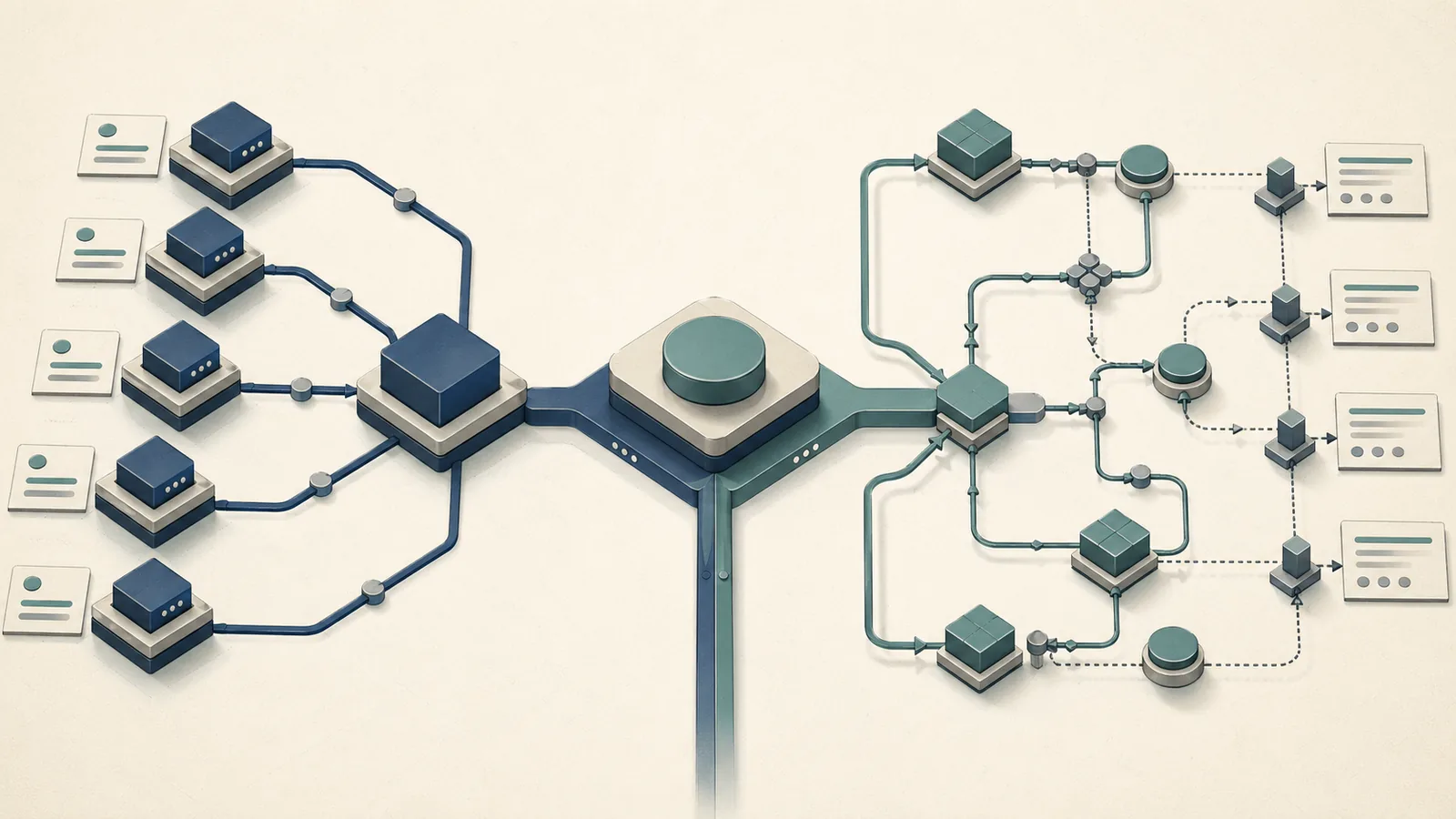
Bottom line up front: build vs buy depends on operating burden, not raw capability
Bottom Line: Managed agent platforms — including Amazon Bedrock AgentCore, Claude Managed Agents, and CrewAI Enterprise — have matured into production-capable systems that bundle orchestration, memory, tooling, tracing, guardrails, and evaluation into a single operational surface. For teams without existing platform engineering investment, they compress time-to-production and shift operational risk to the vendor. But as ML6's 2026 Agent Builders Guide states directly: "They are not a universal solution. Custom agent solutions are still required when teams need advanced observability, custom evaluation, strict cost control, portability, or complex orchestration." The decision isn't about which path is more capable — both can run five-plus-agent workflows in production. The decision is about which operating burden your team can sustain: the vendor lock-in and runtime spend of a managed enterprise AI platform, or the staffing cost and complexity debt of a custom orchestrator.
Why multi-agent workflows changed the build-vs-buy equation
Single-agent systems were hard enough to operationalize — multi-agent workflows multiplied the problem surface across every layer. Production deployments now require persistent memory that survives context-window limits, inter-agent handoffs that don't corrupt state, evaluation harnesses that run across agent chains rather than single model calls, and tracing that follows a task across five or more agents over minutes or hours.
AWS acknowledged this directly in its Bedrock Agents positioning: "Agents now includes memory retention for seamless task continuity and Amazon Bedrock Guardrails for built-in security and reliability." OpenAI's agent tooling documentation frames the same requirements from the developer side: "Tracing & Observability: Visualize agent execution traces to debug and optimize performance." Anthropic's production checklist for managed agents includes sandboxed code execution, checkpointing, credential management, scoped permissions, and end-to-end tracing — none of which ship automatically with a base model API call.
flowchart LR
  subgraph Managed[Managed agent platform]
    A1[Orchestration]
    A2[Memory]
    A3[Tooling / MCP]
    A4[Tracing]
    A5[Guardrails]
    A6[Evaluation]
  end

  subgraph Custom[Custom assembly]
    B1[Workflow engine]
    B2[Vector store + session DB]
    B3[MCP servers + routing]
    B4[OpenTelemetry + spans]
    B5[Policy code + classifiers]
    B6[Custom eval harness]
  end

  Managed --> P1[Bundled operational surface]
  Custom --> P2[Separate systems to build and maintain]
The build-vs-buy equation changed because these requirements used to be assembled manually, tool by tool, and that assembly work now has a direct commercial alternative.
What managed platforms bundle that teams used to stitch together
A managed agent platform is a cloud-managed operating environment that removes the need to manually assemble infrastructure for orchestration, memory, tooling, tracing, guardrails, and evaluation. The alternative — custom assembly — requires owning each of these layers independently.
| Capability | Managed platform (example) | Custom-build equivalent |
|---|---|---|
| Orchestration | Bedrock AgentCore, Claude Managed Agents | LangGraph, Temporal, CrewAI Flows |
| Memory / session state | Durable session log outside context window (Anthropic) | Custom vector store + Redis / Postgres |
| Tooling / MCP integration | Native MCP server gateway (Bedrock, OpenAI) | Self-hosted MCP servers + JSON Schema routing |
| Tracing | Built-in execution trace visualization (OpenAI) | OpenTelemetry + custom spans, Langfuse |
| Guardrails | Bedrock Guardrails, Claude safety layer | Custom classifiers + policy enforcement code |
| Evaluation | Bedrock AgentCore Evaluations — automated task performance, edge case, and consistency assessment | Custom eval harness per workflow |
Anthropic's engineering blog captures the memory architecture precisely: "The session provides this same benefit, serving as a context object that lives outside Claude's context window." That one sentence represents weeks of engineering work when self-built — durable serialization, session routing, and retrieval logic that persists across agent turns without inflating the active context.
AWS documents that Amazon Bedrock AgentCore Evaluations provides automated assessment tools to measure task performance, edge cases, and consistency before and after deployment, which is the practical difference between a bundled platform and a hand-assembled stack.
The enterprise AI platform value proposition is real: all six of these layers ship pre-integrated. The question is whether that integration fits your operating constraints.
Why custom builds still win in specific operating environments
The five constraints that break managed platform assumptions are not edge cases — they appear regularly in any workflow that spans regulated data, multi-cloud infrastructure, or bespoke business logic.
Pro Tip: Build a custom orchestrator when at least one of these constraints is non-negotiable: (1) Advanced observability — you need span-level traces routed to your own monitoring stack (Datadog, Honeycomb, internal tooling) not the vendor's UI; (2) Custom evaluation — your quality metric is domain-specific and can't be expressed as a standard task-success score; (3) Strict cost control — per-session runtime fees compound unpredictably at scale and you need deterministic per-task budgeting; (4) Portability — your compliance posture, multi-cloud strategy, or acquisition risk means you cannot embed deep platform dependencies; (5) Complex orchestration — your agent topology requires dynamic DAG construction, conditional branching across more than three agent types, or tight coupling to existing product infrastructure that predates agentic patterns.
As ML6's guide states, "Custom agent solutions are still required when teams need advanced observability, custom evaluation, strict cost control, portability, or complex orchestration." OpenAI's own SDK documentation acknowledges this operating mode: teams often need "direct control over tools, MCP servers, and runtime behavior" when integrating tightly with existing product logic. Frameworks like LangGraph, LlamaIndex AgentWorkflow, and Temporal give you that control at the cost of owning the entire operational surface.
Market landscape: where managed platforms and custom stacks are converging
The market has bifurcated into two segments that are moving toward each other without yet meeting. Hyperscaler-backed platforms (AWS, Anthropic, OpenAI) are adding developer control features — MCP gateways, custom storage hooks, modular service selection — to reduce the portability argument against them. Custom-stack tooling (LangGraph, CrewAI Flows, Temporal) is adding managed hosting and pre-built connectors to reduce the operational burden argument against them. Neither segment has eliminated the other's core trade-off.
| Platform / stack | Segment | Primary buyer | Deployment complexity |
|---|---|---|---|
| Amazon Bedrock AgentCore | Managed hyperscaler | Enterprise, regulated industries | Low (managed), High (if customized) |
| Claude Managed Agents | Managed hyperscaler | Rapid-prototyping to mid-market | Low |
| OpenAI Swarm / Agents SDK | Developer-first managed | Engineering teams, startups | Low–Medium |
| CrewAI Enterprise | Framework + managed hosting | SMB to mid-market | Medium |
| LangGraph (self-hosted) | Open-source custom | Platform engineering teams | High |
| LlamaIndex AgentWorkflow | Open-source custom | ML teams with existing infra | High |
| Temporal (orchestration layer) | Infrastructure custom | Backend-heavy orgs | High |
| Sierra | Vertical SaaS managed | Customer experience orgs | Low (vertical-specific) |
| Cognition | Vertical SaaS managed | Software engineering workflows | Low (vertical-specific) |
| Lindy | No-code managed | Non-technical buyers | Very Low |
AWS positions Bedrock AgentCore explicitly as "an agentic platform for building, deploying, and operating effective agents securely at scale," targeting the enterprise governance buyer. Anthropic's positioning is faster and lighter: "Build and deploy agents 10x faster." These are different buyers with different constraints — a fact the vendor segment map reveals more clearly than feature checklists.
Vendor signals: what Sierra, Cognition, Crew Enterprise, and Lindy imply about demand
The presence of multiple funded, segment-specific vendors signals that no single managed agent platform satisfies all buyer archetypes. Each vendor's positioning reveals a demand pattern.
| Vendor archetype | Buyer signal | Deployment complexity | Managed vs custom lean |
|---|---|---|---|
| Sierra (vertical CX agents) | Enterprises outsourcing agent deployment entirely | Low — fully managed vertical | Pure managed |
| Cognition (software engineering agents) | Dev teams adopting AI-native development workflows | Low-Medium — hosted, opinionated | Managed with SDK control |
| CrewAI Enterprise ($99/month entry per Lindy's pricing analysis) | SMB / mid-market teams moving from prompt chains to agent workflows | Medium — framework plus hosting | Hybrid: framework + managed runtime |
| Lindy (no-code agent builder) | Non-technical buyers automating workflows | Very Low — point-and-click | Pure managed |
| AWS Bedrock AgentCore (pay-as-you-go) | Enterprise teams needing governance, audit trails, secure scaling | Low operational burden, high integration complexity | Managed with enterprise controls |
CrewAI's $99/month entry point signals that the market expects low-friction onboarding for smaller teams experimenting with multi-agent patterns. AWS's consumption-based "pay for what you use" model signals that enterprise buyers want predictable per-unit billing rather than seat licenses. Both pricing signals converge on the same insight: the managed platform market is competing on operating burden reduction, not raw feature parity.
Open-source and engineering-blog references show where the canonical reference lives
Engineering blogs from Anthropic, AWS, and OpenAI, combined with the ML6 guide and framework documentation for LangGraph and LlamaIndex AgentWorkflow, constitute the canonical implementation reference for multi-agent systems in 2026. GitHub repositories for these frameworks show active production use — not just demos. The SERP for this topic surfaces Reddit threads and tutorial posts because practitioners are actively debugging production deployments, not evaluating theoretical architectures.
Watch Out: Demo-quality implementations and production-grade operating models look identical in a blog post or GitHub README. A managed platform demo with five agents completing a task in a notebook does not prove the platform handles credential rotation, agent failure recovery, evaluation drift over time, or cost predictability at 10,000 daily sessions. Before committing to a managed platform or a custom orchestrator based on a proof-of-concept, verify the operational checklist — session durability, tracing completeness, guardrail enforcement under load, and evaluation coverage — against production traffic patterns, not demo scenarios.
Cost and ROI: hidden operating costs are the real decision lever
The direct cost comparison between a managed agent platform and a custom orchestrator is misleading on its face. Managed platforms appear cheaper because they eliminate infrastructure provisioning. Custom builds appear cheaper because they avoid per-session runtime fees. Neither framing captures the full picture.
A 2026 unified benchmark of multi-agent LLM frameworks published on Semantic Scholar found that framework-level design choices alone can increase latency by over 100x, reduce planning accuracy by up to 30%, and collapse coordination success from above 90% to below 30%. Those numbers are not a cost line — they are a revenue and reliability line. A custom orchestrator built on the wrong framework architecture can generate more incident response cost than any managed platform subscription.
Direct cost stack: subscription, API usage, and infrastructure spend
| Cost layer | Managed platform | Custom orchestrator |
|---|---|---|
| Platform / subscription fee | $0–$99/month entry (CrewAI); consumption-based for AWS, Anthropic | $0 open-source frameworks; hosting cost for self-managed services |
| Model / API usage | Standard token rates — e.g., Claude Opus: $5 input / $25 output per million tokens | Same token rates — no discount for self-hosting model APIs |
| Runtime / session fee | $0.08 per active session-hour (Claude Managed Agents) | None — but compute, memory, and network costs replace this |
| Infrastructure | None (vendor-managed) | Cloud compute, vector store, message queue, caching layer — estimated $500–$5,000/month for a five-agent workflow at moderate volume |
| Observability tooling | Bundled (vendor trace UI) | Langfuse, OpenTelemetry collector, dashboarding — $200–$800/month SaaS or self-hosted engineering time |
AWS's modular pricing lets teams "mix and match services, use them independently or together, and pay for what you use." That flexibility is real, but it also means cost scales directly with session volume and agent turn count — a workflow that runs 50,000 session-hours per month at $0.08/hour generates $4,000 in runtime fees before model tokens. A custom orchestrator running the same workload on cloud compute might cost $1,200–$2,000 in infrastructure, but adds 0.5–1 FTE in operational maintenance.
People cost stack: platform engineering, SRE, and governance overhead
The staffing cost of a custom orchestrator is the most frequently underestimated line item. Anthropic's own documentation for production agents lists the required components: "sandboxed code execution, checkpointing, credential management, scoped permissions, and end-to-end tracing." Each of these is an ongoing product surface, not a one-time build.
| Operational capability | Managed platform burden | Custom orchestrator burden |
|---|---|---|
| Orchestration maintenance | Vendor-owned (zero engineering hours) | 0.25–0.5 FTE ongoing (framework upgrades, topology changes) |
| Memory / session state | Vendor-owned | 0.25 FTE (storage schema, eviction policy, retrieval tuning) |
| Tracing + observability | Vendor UI (analyst time only) | 0.25–0.5 FTE (instrumentation, alerting, dashboard maintenance) |
| Guardrails + compliance review | Vendor layer + internal policy review | 0.5 FTE (classifier maintenance, policy updates, audit logging) |
| Evaluation harness | Vendor tooling + configuration | 0.5–1 FTE (eval design, dataset curation, regression testing) |
| SRE / incident response | Vendor SLA covers infrastructure | 0.5 FTE minimum for five-plus-agent workflows |
| Total estimated people cost | 0.25–0.5 FTE (governance + config) | 2–3.5 FTE (platform engineering + SRE + eval) |
These are qualitative ranges, not sourced headcount studies — treat them as order-of-magnitude directional estimates. The point is structural: custom orchestrators don't eliminate the operational work, they internalize it. OpenAI's SDK documentation frames this as "direct control over tools, MCP servers, and runtime behavior," but that control comes with a maintenance contract that doesn't appear in a GitHub star count.
Where ROI flips by org size and workflow complexity
| Org profile | Likely ROI outcome: Managed | Likely ROI outcome: Custom |
|---|---|---|
| Small team (1–5 engineers), <10 agent workflows | Strong positive — eliminates platform build cost entirely, direct cost manageable | Negative — platform build consumes disproportionate engineering capacity |
| Mid-market (10–50 engineers), 10–50 agent workflows at scale | Positive if governance needs are standard; watch runtime cost at volume | Positive if team has platform engineering capacity and portability is required |
| Regulated enterprise (50+ engineers, compliance requirements) | Mixed — managed reduces operational burden but may fail audit portability and data residency requirements | Positive when custom satisfies data sovereignty, audit trail customization, and vendor independence requirements |
| High-complexity orchestration (dynamic DAGs, 5+ agent types, bespoke evaluation) | Negative — platform constraints force workarounds that negate the operational savings | Positive — custom pays for itself in workflow fidelity and observability depth |
ML6's guide identifies "strict cost control, portability, or complex orchestration" as the explicit triggers where custom solutions remain necessary. AWS acknowledges the other side: managed economics are strongest where "enterprise-grade security and dynamic scaling" are the primary requirements and operational simplicity outweighs customization depth.
Decision framework: match your operating model to the right path
The decision reduces to four thresholds. Score your workflow against each one before committing to either path.
| Threshold | Favor Managed | Favor Custom |
|---|---|---|
| Observability depth | Vendor trace UI sufficient for debugging and compliance | Span-level traces required in your own monitoring stack |
| Portability | Single-cloud or vendor-committed strategy acceptable | Multi-cloud, M&A risk, or data residency requires stack independence |
| Cost control | Consumption-based billing predictable at your session volume | Per-session fees unpredictable at scale; deterministic per-task budgeting required |
| Orchestration complexity | Linear or lightly branched agent topologies; standard handoffs | Dynamic DAG construction, conditional multi-type branching, tight coupling to existing product systems |
Choose managed when speed, standardization, and lower upfront burden matter most
Managed platforms win when the cost of building and maintaining an enterprise AI platform internally exceeds the cost of vendor runtime fees plus the governance overhead of a managed relationship.
Concretely: if your team lacks platform engineering capacity, your agent topology is linear or hub-and-spoke, your compliance requirements don't mandate data-residency portability, and time-to-production is the primary constraint — managed is the correct default. Anthropic's "Build and deploy agents 10x faster" claim reflects a real compression of the initial deployment timeline. AWS's "no infrastructure management needed" framing reflects a real reduction in the operational surface your team must own.
The managed path is not the passive or less-sophisticated choice. It is the strategically correct choice when your team's marginal engineering hour is worth more applied to product differentiation than to orchestration plumbing.
Choose custom when observability, portability, or bespoke workflows are non-negotiable
Custom orchestrators — built on LangGraph, LlamaIndex AgentWorkflow, CrewAI Flows, or Temporal — win when at least one of the four thresholds above is a hard requirement rather than a preference.
"Custom evaluation, strict cost control, portability, or complex orchestration" are ML6's named triggers. Portability deserves specific emphasis for enterprise AI platform decisions: a managed platform that stores session state, tool configurations, and evaluation baselines in proprietary formats creates migration friction that compounds with workflow maturity. The longer a workflow runs on a managed platform's native memory and tracing primitives, the more expensive the eventual migration becomes — not because the data can't be exported, but because the operational assumptions baked into the workflow logic reference vendor-specific behaviors.
OpenAI's SDK documentation acknowledges this directly: teams requiring "direct control over tools, MCP servers, and runtime behavior" need a custom stack regardless of what managed platforms bundle.
Risks and counterarguments that can change the answer
Watch Out: Three assumptions routinely produce the wrong build-vs-buy decision. First: managed always means cheaper — false. Anthropic's runtime fee of $0.08 per active session-hour plus standard token rates means a high-volume managed deployment can exceed equivalent custom infrastructure costs without providing cost predictability. AWS's pay-as-you-go model has the same scaling dynamic. Second: custom always means more control — false at the team level. A custom orchestrator built on an immature framework can collapse coordination success from above 90% to below 30% depending on design choices alone, per the unified multi-agent benchmark. Control without expertise produces worse outcomes than managed defaults. Third: governance drift — managed platforms evolve their APIs, pricing, and bundled policies on vendor timelines. A workflow compliant today may require re-certification after a platform update. Custom orchestrators drift in the opposite direction: your internal evaluation harness and guardrails degrade if the team that built them moves to other work.
Lock-in and portability risks with managed platforms
Watch Out: Portability loss on a managed agent platform is not a hypothetical risk — it is a structural feature of the integration. Managed platforms store session state in proprietary formats (Anthropic's durable session logs, Bedrock's memory store), route tool calls through vendor-controlled MCP gateways, and bake guardrail enforcement into the platform layer rather than the application layer. When migration becomes necessary — due to pricing changes, an acquisition, a compliance ruling, or a multi-cloud mandate — the migration cost is not just data export. It is re-instrumenting tracing, re-integrating tooling, rebuilding evaluation baselines, and re-validating guardrail equivalence against a new stack. ML6 names portability as an explicit reason custom solutions remain necessary. OpenAI's own documentation acknowledges the custom-storage need: "custom storage or server-managed conversation strategies" are legitimate requirements, not edge cases.
Complexity debt and maintenance risk with custom orchestrators
Pro Tip: Treat your custom orchestrator as a product, not a project. The operational surface for a production multi-agent system — sandboxed execution, checkpointing, credential management, scoped permissions, end-to-end tracing — does not stabilize after initial deployment. It expands as agent count grows, as workflow topologies change, and as evaluation requirements evolve with the business. The evaluation harness is particularly expensive to maintain: it must track quality across agent chains, not single model calls, which means test dataset curation and regression coverage grow superlinearly with workflow complexity. The teams that successfully operate custom orchestrators at scale treat orchestration infrastructure, evaluation harnesses, and tracing instrumentation as first-class engineering products with dedicated ownership — not shared responsibilities bolted onto feature teams.
FAQ: the questions buyers ask before approving the budget
What is a managed agent platform? A managed agent platform is a cloud-operated environment that packages orchestration, memory, tooling, tracing, guardrails, and evaluation into a single managed service — eliminating the need to assemble and operate these capabilities independently. Examples include Amazon Bedrock AgentCore, Claude Managed Agents, and CrewAI Enterprise. The defining characteristic is that the vendor owns the infrastructure and operational surface; the buyer configures and deploys agents without managing the underlying runtime.
Are managed agent platforms worth it? For most teams under 20 engineers building agent workflows without strict portability or custom evaluation requirements, yes — the reduction in time-to-production and operational staffing justifies the runtime spend. The caveat is volume: at high session counts, consumption-based runtime fees can exceed equivalent self-hosted infrastructure costs. Evaluate against your expected session-hour volume before committing. Anthropic's claim that teams can "Build and deploy agents 10x faster" reflects a real acceleration, but that acceleration degrades as workflow complexity and customization requirements increase.
When should you build a custom orchestrator? Build custom when at least one of these applies: you need span-level traces in your own observability stack; your compliance posture requires vendor-independent infrastructure; your per-task cost budget is deterministic and can't absorb per-session runtime fees; or your agent topology requires dynamic DAG construction, conditional multi-type branching, or deep coupling to existing systems. "Custom agent solutions are still required when teams need advanced observability, custom evaluation, strict cost control, portability, or complex orchestration," per ML6's 2026 guide.
What are the hidden costs of multi-agent workflows? The two most underestimated cost categories are people and evaluation. Staffing a custom orchestrator for a five-plus-agent workflow realistically requires 2–3.5 FTE across platform engineering, SRE, and evaluation — costs that don't appear in framework licensing or cloud compute line items. For managed platforms, the hidden cost is governance overhead: internal policy review, platform-update re-validation, and the eventual migration cost if portability becomes necessary.
How do you choose between a managed platform and custom build? Run the four-threshold test: observability depth, portability requirement, cost control precision, and orchestration complexity. If any threshold is a hard constraint rather than a preference, the custom path is indicated. If all four thresholds are soft, the managed path reduces operating burden without a meaningful capability trade-off. The decision hinges on operating burden, not raw capability — both paths can deliver production multi-agent workflows; what differs is who owns the operational cost and where it shows up.
Sources & References
- ML6 Agent Builders Guide 2026: Managed vs Custom AI Agent Solutions — Primary source; defines managed vs custom trade-offs and names the five explicit cases where custom remains necessary
- Amazon Bedrock AgentCore — AWS product page; positioning as enterprise-grade managed agentic platform with secure scaling and no infrastructure management
- Amazon Bedrock Agents — AWS product page; documents memory retention, Bedrock Guardrails, and multi-agent collaboration features
- Amazon Bedrock AgentCore Evaluations — AWS developer documentation; describes automated assessment tools for task performance, edge cases, and consistency
- Amazon Bedrock AgentCore Pricing — AWS pricing page; usage-based modular pricing model
- Anthropic: Scaling Managed Agents — Decoupling the brain from the hands — Anthropic engineering blog; architectural primitives including durable session logs and $0.08/session-hour pricing
- Claude Managed Agents — Anthropic product blog; production agent checklist including sandboxed execution, checkpointing, credential management, and scoped permissions
- OpenAI: New tools for building agents — OpenAI announcement; tracing, handoffs, sandboxing, and MCP integration
- OpenAI Agents SDK documentation — OpenAI developer docs; direct control over tools, MCP servers, runtime behavior, and custom storage
- Anthropic Claude Opus 4.6 pricing — Anthropic announcement; $5 input / $25 output per million tokens
- Lindy: CrewAI Pricing, Features, & Alternatives Explained (2026) — Market pricing reference; CrewAI starting at $99/month
- Understanding Multi-Agent LLM Frameworks: A Unified Benchmark — Semantic Scholar listing; framework-level design choices increase latency by over 100x and reduce coordination success from above 90% to below 30%
Production Note: Vendor documentation and official engineering blogs (Anthropic, AWS, OpenAI) represent authoritative claims about platform capabilities and pricing — but they reflect vendor incentives. The ML6 guide and the unified multi-agent benchmark provide practitioner-oriented and empirical counterweights respectively. When evaluating vendor capability claims for production planning, cross-reference against the benchmark evidence on latency and coordination degradation under real framework constraints, and against practitioner case studies from engineering blogs that describe operating, not just deploying, multi-agent workflows at scale.
Keywords: Amazon Bedrock Agents, LlamaIndex AgentWorkflow, Temporal, LangGraph, crewAI 0.1, CrewAI Flows, Claude Managed Agents, Sierra, Cognition, Lindy, OpenAI Swarm, AWS Lambda, GitHub Actions, Model Context Protocol, JSON Schema