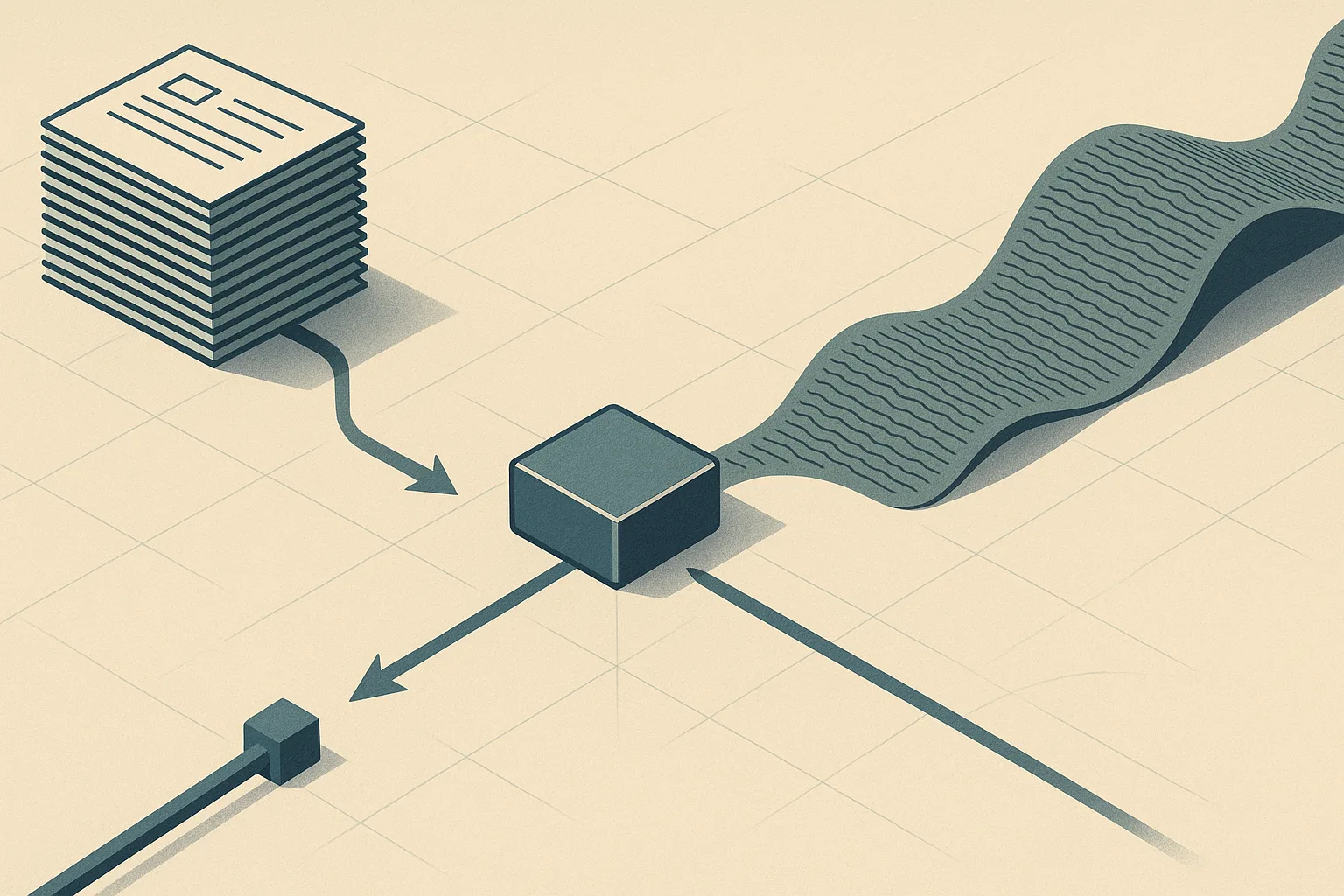
Bottom line for long-context teams
Bottom Line: Context extension is the right first move for retrieval-heavy workloads with modest budgets, but RULER and LongBench v2 together show that extended windows do not automatically produce better reasoning. RULER evaluated 17 long-context language models across 13 tasks and found that "despite achieving nearly perfect accuracy in the vanilla NIAH test, almost all models exhibit large performance drops as the context length increases." LongBench v2 — 503 multiple-choice questions spanning 8k to 2M word contexts across six task families — puts the ceiling in sharper relief: the best direct-answer model reaches only 50.1% accuracy, and o1-preview with extended reasoning reaches 57.7%. Human experts under a 15-minute time limit land at 53.7%. The decision between extending context, continued pretraining, and full retraining therefore depends on whether your workload is bottlenecked by window size or by reasoning depth — two failure modes that require different investments to fix.
Why vanilla needle-in-a-haystack is not enough
Vanilla needle-in-a-haystack (NIAH) tests single-point retrieval: hide a string in a document, ask the model to find it, measure exact-match recall across context positions. It is the most widely reported long-context metric precisely because almost every model scores well on it — which is exactly the problem.
RULER was designed to expose what vanilla NIAH conceals. The benchmark expanded evaluation from single-point retrieval to 13 representative tasks across 17 long-context models, and it demonstrated that near-perfect vanilla recall coexists with large performance drops at scale. "The needle-in-a-haystack (NIAH) test … has been widely adopted to evaluate long-context language models (LMs)" — but the RULER authors found that strong performance on that test is not evidence of robust long-context capability.
Pro Tip: A model that scores 99% on vanilla NIAH at 32k tokens can still fail badly on multi-hop retrieval, aggregation, or complex comprehension at the same context length. RULER exposes this gap by adding task categories that vanilla NIAH structurally cannot test. If your current eval suite is NIAH-only, your reported long-context numbers are almost certainly optimistic.
What RULER adds beyond simple recall
RULER's core contribution is taxonomic: it treats long-context evaluation as a family of distinct behaviors, not a single scalar. The benchmark covers four primary categories — needle retrieval (expanding the vanilla case to multi-needle and multi-key variants), multi-hop tracing, variable tracking, and aggregation — across 13 tasks in total.
The multi-hop and aggregation categories are particularly diagnostic. As the RULER abstract states: "RULER introduces new task categories multi-hop tracing and aggregation to test behaviors beyond searching from context." These tasks require the model to chain retrievals or synthesize across multiple positions in the context — behaviors that vanilla NIAH, which asks for a single pre-planted fact, cannot measure.
| Task Type | What it Measures | Can Vanilla NIAH Test It? | RULER Coverage |
|---|---|---|---|
| Single needle retrieval | Exact recall of one planted fact | Yes | Yes (expanded variants) |
| Multi-key / multi-needle retrieval | Recall under distractor density | No | Yes |
| Multi-hop tracing | Chain of references across positions | No | Yes |
| Aggregation | Synthesis across multiple context spans | No | Yes |
Vanilla NIAH occupies exactly one cell of that table. A model that saturates vanilla NIAH has passed the easiest test in the taxonomy, not the most representative one.
Why long context length and task complexity fail together
The failure is not simply that models degrade at long contexts — it is that the degradation is invisible unless you test it with harder tasks. RULER reports that almost all evaluated models exhibit large performance drops as context length increases, even models that perform nearly perfectly on vanilla NIAH. The paper states this directly: "almost all models exhibit large performance drops as the context length increases."
The mechanism is compounding: harder tasks amplify the attention noise that longer contexts introduce. A multi-hop trace that requires three retrievals at 128k tokens fails not because any single retrieval is impossible, but because the joint probability of all three succeeding drops as attention patterns spread across a longer sequence. Continued pretraining on long-context data can partially address this by teaching the model to attend selectively at scale, but it is not guaranteed to close the gap — and it does not help when the root failure is architectural rather than distributional.
Watch Out: Silent degradation is the primary operational risk. A model evaluated only at 8k–16k on vanilla NIAH will appear production-ready, then degrade materially at 64k or 128k on real tasks. RULER's finding that only about half of models advertised as supporting 32k contexts maintain satisfactory performance at 32k should calibrate expectations for any model whose long-context claims rest on NIAH scores alone.
What LongBench v2 says about real long-context reasoning
LongBench v2 shifts the evaluation axis from controlled synthetic retrieval to realistic multitask comprehension. The benchmark consists of 503 multiple-choice questions across six major task categories — single-document QA, multi-document QA, long in-context learning, long-form code, long structured data, and long mixed-type tasks — with contexts ranging from 8k to 2M words.
| System | Accuracy | Context Scale | Reasoning Mode |
|---|---|---|---|
| Human experts (15-min limit) | 53.7% | Full benchmark | Direct reading |
| Best direct-answer LLM | 50.1% | Full benchmark | Single forward pass |
| o1-preview | 57.7% | Full benchmark | Extended chain-of-thought |
| Random baseline (4-choice) | 25.0% | — | — |
"LongBench v2 consists of 503 challenging multiple-choice questions, with contexts ranging from 8k to 2M words, across six major task categories…" The project page describes it as "designed to assess the ability of LLMs to handle long-context problems requiring deep understanding and reasoning across real-world multitasks."
The benchmark deliberately avoids trivially extractable answers. Questions require reasoning across multiple document sections, reconciling conflicting evidence, or tracking state across very long structured inputs — the behaviors RULER's aggregation and multi-hop categories also stress-test, but here in realistic rather than synthetic conditions.
| Source | Headline figure | Scale / coverage | Role |
|---|---|---|---|
| LongBench v2 paper | 503 questions; 50.1% direct-answer; 57.7% o1-preview; 53.7% human | 8k to 2M words; six task families | Primary benchmark source for the accuracy ceiling |
| LongBench v2 project page | Task taxonomy and benchmark description | Real-world long-context multitasks | Benchmark overview and usage context |
| RULER paper | 17 models; 13 tasks; large performance drops with longer contexts | Synthetic long-context evaluation | Retrieval and aggregation failure analysis |
| RULER abstract | "almost all models exhibit large performance drops as the context length increases" | Long-context stress test | Source for degradation claim |
Why direct-answer models stall near 50 percent
The 50.1% ceiling for direct-answer models against a 25% random baseline represents meaningful capability — but the gap between 50.1% and o1-preview's 57.7% is the operational finding. That 7.6-point gap is not explained by window size: both systems have access to the same context. The difference is inference-time reasoning budget.
As the LongBench v2 paper states: "the best-performing model, when directly answers the questions, achieves only 50.1% accuracy. In contrast, the o1-preview model, which includes longer reasoning, achieves 57.7%." The implication is that long-context tasks at realistic complexity are often reasoning-bottlenecked, not retrieval-bottlenecked. Giving a model a longer window without giving it more reasoning budget produces diminishing returns.
Pro Tip: Before investing in continued pretraining or retraining to improve long-context scores, test whether extended inference-time reasoning (chain-of-thought prompting, step-back prompting, or a reasoning-focused model) closes the gap on your specific task mix. If it does, the bottleneck is deliberation, not the model's weights — and compute at inference may be cheaper than a training run.
What the human baseline changes in the decision
Human experts at 53.7% under time pressure is the calibration anchor that changes how model scores should be interpreted. The best direct-answer model at 50.1% is within 3.6 points of humans who have access to the full document and domain expertise. o1-preview at 57.7% modestly exceeds humans.
| Workload type | Human baseline | Direct-answer LLM | Reasoning-heavy model | Recommended choice |
|---|---|---|---|---|
| Retrieval-heavy document lookup | Often near ceiling with search support | Usually sufficient if NIAH and multi-hop both hold | Rarely needed | Direct-answer model plus context extension |
| Multi-document synthesis | Time-constrained experts stay near 53.7% on LBv2-style tasks | Acceptable only if gap to human is small | Better choice when multi-step reasoning matters | Reasoning-heavy model or continued pretraining |
| Legal / scientific analysis | Human error tolerance is low; time pressure still matters | Not enough if evidence reconciliation is weak | Preferred when the task needs stepwise reasoning | Reasoning-heavy model, then retraining if gap persists |
| Safety-critical review | Below-human performance is unacceptable | Avoid if accuracy remains near the 50.1% ceiling | Use only if validated above human baseline | Retraining with full evaluation suite |
| Agent | LongBench v2 Accuracy | Advantage Over Random | Notes |
|---|---|---|---|
| o1-preview | 57.7% | +32.7 pp | Extended reasoning; exceeds human baseline |
| Human expert | 53.7% | +28.7 pp | 15-minute time limit; full document access |
| Best direct-answer LLM | 50.1% | +25.1 pp | Single forward pass |
| Random (4-choice) | 25.0% | Baseline | — |
The human baseline reframes expectations for Retrieval-Augmented Generation (RAG), summarization, and code-review workloads: tasks where humans with time constraints are already near their ceiling. For workloads where human accuracy under time pressure is the practical target, a direct-answer model at 50.1% may already be sufficient — and the investment required to push to 57.7% must be weighed against whether that incremental accuracy has production value.
Where the gap matters is in high-stakes multistep reasoning tasks — legal contract analysis, scientific literature synthesis, or multi-document audit trails — where even a 7-point accuracy difference translates into unacceptable error rates. Those workloads are the primary case for reasoning-augmented inference or, eventually, retraining.
Extend context, continue pretraining, or retrain
The three paths differ in objective, cost structure, and failure risk. RULER and LongBench v2 together map which failure modes each path can and cannot address.
| Path | Primary Objective | Data Requirement | Benchmark Risk Addressed | Core Failure Risk |
|---|---|---|---|---|
| Context extension (YaRN / LongRoPE) | Shift usable window length | Minimal (fine-tuning only) | Retrieval at longer windows | Does not improve reasoning depth |
| Continued pretraining | Internalize long-context patterns | Large, long-doc corpus | RULER multi-hop + LBv2 comprehension | Data scarcity; silent regression on short-context tasks |
| Full retraining | Rebuild attention + positional encoding | Full pretraining corpus | Both retrieval and reasoning failures | Cost; architectural assumptions may still limit ceiling |
Context extension using YaRN or LongRoPE modifies the positional encoding schedule — RoPE interpolation in YaRN's case, progressive rescaling in LongRoPE's — without changing model weights at scale. This addresses the window-length failure mode but not the reasoning-depth failure mode. Continued pretraining on long-document data teaches the model to reason across long windows rather than just to attend at longer positions. Full retraining rebuilds both from scratch, which is justified only when the base model's architecture itself is the constraint.
RULER's result that roughly half of advertised-32k models fail at 32k is the evidence base for why context extension alone is not enough: those models already had position encodings that nominally supported the claimed length; the problem was insufficient exposure to reasoning tasks at that scale during training.
When context extension is the right first move
Context extension is the correct starting point when the workload is primarily retrieval-intensive — document lookup, citation grounding, long-form code navigation — and the task does not require multi-hop synthesis across widely separated spans. It is also the right move when engineering budget is constrained: YaRN extends LLaMA-family models to several times their original training length with a comparatively small fine-tuning step, and LongRoPE reports reaching 2,048k tokens "with up to only 1k fine-tuning steps at within 256k training lengths." As the YaRN abstract states: "Using YaRN, we show that LLaMA models can effectively utilize and extrapolate to context lengths much longer than their original pre-training would allow."
Watch Out: Vendors and researchers frequently report context extension results using vanilla NIAH or single-document retrieval. RULER shows that these benchmarks overstate success on harder tasks. Before declaring an extended model production-ready, evaluate it on RULER's multi-hop and aggregation tasks at the target context length — not just on position-sweep recall.
When continued pretraining earns its cost
Continued pretraining earns its cost when retrieval is already functional but the model fails at RULER's multi-hop and aggregation tasks or at LongBench v2's comprehension tasks. The signal is a model that scores well on single-needle NIAH and poorly on chained retrieval or aggregation at the same context length — indicating that the positional encoding is adequate but the attention patterns have not learned to suppress noise across long documents.
| Tier / scenario | Context extension | Continued pretraining | Full retraining | Validation burden |
|---|---|---|---|---|
| Retrieval-only workloads | Lowest-cost path; small fine-tune | Not usually needed | Not justified | RULER at target length |
| Multi-hop / aggregation gaps | May improve window access but not reasoning | Best next step when NIAH is strong | Only if reasoning remains flat after adaptation | RULER + LongBench v2 + short-context regression |
| Domain-shifted long documents | Useful as a first pass | Strong fit when corpus exists | Consider if domain adaptation fails | RULER + LBv2 + domain holdouts |
| Safety-critical or below-human performance | Insufficient if any degradation remains | Possible intermediate step | Preferred when error tolerance is very low | Full regression suite and production holdouts |
| Investment Dimension | Context Extension | Continued Pretraining | Full Retraining |
|---|---|---|---|
| GPU-hours | Internal estimate: hundreds | Internal estimate: tens of thousands | Internal estimate: hundreds of thousands |
| Data scarcity | Minimal fine-tune corpus | Large long-doc corpus is required and unevenly distributed | Full pretraining-scale corpus |
| Engineering effort | Low — encode schedule modification | Medium — data pipeline, curriculum design | High — full training infra |
| Short-context regression risk | Low | Medium — requires regression eval | High |
| Evaluation overhead | RULER at target lengths | RULER + LongBench v2 at multiple lengths | RULER + LongBench v2 + domain holdouts |
GPU-hour estimates above are internal modeling assumptions; no standardized public benchmark covers these costs across hardware generations. Teams should use them for order-of-magnitude planning, not procurement.
The data scarcity problem is the underappreciated constraint in continued pretraining. High-quality long-document corpora — books, legal filings, scientific papers, lengthy codebases — are finite and unevenly distributed across domains. A model continued-pretrained on generic long-document data may not generalize to domain-specific long-context tasks.
When retraining is justified despite the expense
Full retraining is justified when both retrieval and reasoning failures are present across multiple context lengths — that is, when RULER shows degradation even at moderately long windows and LongBench v2 scores fall well below the 50.1% direct-answer baseline on your domain's task mix. That combination indicates the base model's attention architecture or positional encoding scheme is architecturally misaligned with the workload, not merely undertrained.
| Decision factor | Continue extending / pretraining | Retrain |
|---|---|---|
| Task mix | Retrieval-heavy or moderate multi-hop | High-stakes multistep reasoning, domain shift, or safety-critical review |
| Error tolerance | Some misses are acceptable | Below-human errors are unacceptable |
| Evaluation burden | RULER plus targeted LongBench v2 slices | Full RULER, full LongBench v2, and domain holdouts |
| Outcome after adaptation | Window gains without reasoning gains | Persistent reasoning ceiling after pretraining |
The practical threshold: if context extension brings RULER retrieval tasks to acceptable performance but multi-hop and aggregation scores remain flat, continued pretraining is the next step. If continued pretraining closes the RULER gap but LongBench v2 reasoning scores do not materially improve, the ceiling may be architectural — which is the retraining case.
RULER's finding that "almost all models exhibit large performance drops as the context length increases" and LongBench v2's evidence that "the best-performing model, when directly answers the questions, achieves only 50.1% accuracy" jointly support retraining only when the workload requires deeper reasoning rather than a longer window. Retrain to fix architectural constraints; do not retrain because NIAH scores plateau.
| Failure Pattern | RULER Signal | LBv2 Signal | Recommended Path |
|---|---|---|---|
| Window too short | Degradation above training length | Low scores on 128k+ examples | Context extension first |
| Retrieval chains failing | Multi-hop / aggregation drops | Multi-doc QA low | Continued pretraining |
| Reasoning ceiling | All RULER tasks plateau | Direct-answer stalls; reasoning model gap > 8 pp | Retraining or inference-time reasoning |
| Error tolerance is very low | Any meaningful RULER degradation | Below-human scores on production task mix | Retraining |
Cost, risk, and validation burden by path
The direct monetary and time costs of each path are order-of-magnitude separable: context extension is a fine-tune, continued pretraining is a mid-scale training job, and retraining is a full pretraining campaign. But the validation burden is a cost variable that teams consistently underestimate.
| Scenario | Path | Compute Cost | Data Collection | Engineering Effort | Validation Burden |
|---|---|---|---|---|---|
| Baseline window increase | Context extension | Low | Minimal | Low | RULER at target lengths |
| Long-doc adaptation | Continued pretraining | Medium–High | High (long-doc corpus) | Medium | RULER + LongBench v2 + short-context regression |
| Architecture reset | Full retraining | Very High | Very High | Very High | RULER + LongBench v2 + domain holdouts + regression suite |
| High-confidence production sign-off | Any path | Depends on adaptation path | Depends on corpus | Depends on integration | Cross-benchmark validation plus production holdouts |
LongBench v2 spans 503 questions across six task families; RULER covers 13 tasks across 17 model configurations. Running both across multiple context lengths and model checkpoints is a non-trivial compute expense in its own right — and the LongBench team has documented the cost pressure explicitly: "We are fully aware of the potentially high costs involved in the model evaluation process, especially in the context of long context scenarios (such as manual annotation costs or API call costs). Therefore, we adopt a fully automated evaluation method."
Automated evaluation reduces per-run cost, but cross-benchmark validation is not optional: RULER and LongBench v2 were created precisely because each prior benchmark exposed only a subset of failure modes. Running only RULER misses the realistic comprehension failures LongBench v2 surfaces; running only LongBench v2 misses the structured multi-hop and aggregation degradation RULER isolates.
The hidden cost of proving long-context quality
The validation cost compounds with model iteration. A team running context extension experiments on Llama 3.1 or Qwen2.5 with three or four candidate window targets will spend as much compute on evaluation as on the adaptation itself, because long-context inference is expensive and robust evaluation requires full-length inputs.
Production Note: Treat cross-benchmark validation as a first-class line item in your training budget, not an afterthought. Establish a RULER baseline at your target context lengths before any adaptation, run LongBench v2 on the adapted checkpoint, and track both benchmarks across every subsequent checkpoint. Silent degradation — the failure mode RULER was built to detect — does not announce itself; it shows up only in a benchmark suite that includes harder tasks. Regression tracking against short-context holdouts is equally necessary: continued pretraining and retraining both carry risk of degrading performance on tasks well within the original training window.
Decision framework for research and product teams
The decision reduces to three variables: workload reasoning depth, target context length, and evaluation evidence from RULER and LongBench v2 on your task mix. Models like Llama 3.1 and Qwen2.5 provide the base for context extension and continued pretraining experiments; the benchmark results determine which path is warranted.
| Workload Type | Reasoning Depth | Window Target | RULER Result | LBv2 Result | Recommended Action |
|---|---|---|---|---|---|
| Document lookup / RAG | Low (retrieval) | 32k–128k | NIAH ≥ multi-hop | N/A or moderate | Context extension (YaRN / LongRoPE) |
| Multi-document synthesis | Medium | 64k–256k | Multi-hop degradation | Multi-doc QA low | Continued pretraining |
| Legal / scientific reasoning | High (chain-of-thought) | 128k+ | Aggregation failures | Direct-answer stalls | Continued pretraining + inference-time reasoning |
| Domain-shifted generation | High + domain shift | Any | Broad degradation | Broad comprehension failure | Retraining or domain-specific continued pretraining |
| Safety-critical / zero-error | Any | Any | Any degradation | Below human baseline | Retraining with full evaluation suite |
The benchmark evidence does not support a one-size-fits-all action. RULER's 13-task coverage and LongBench v2's six task families exist to distinguish these cases — use them to classify your workload before committing to a training path.
A simple rule-set for choosing the next experiment
Bottom Line: Run experiments in this order. First, evaluate your current model on RULER at your target context length — if multi-hop and aggregation tasks are within acceptable performance ranges, context extension is the right adaptation and you can proceed with YaRN or LongRoPE. Second, if RULER shows multi-hop or aggregation failures after extension, run LongBench v2 on your domain's most representative task families; if comprehension scores are materially below 50%, continued pretraining on long-document data is the next investment. Third, if continued pretraining closes the RULER gap but LongBench v2 reasoning scores remain flat and inference-time reasoning (chain-of-thought, step-back) does not recover the gap, escalate to retraining — the bottleneck is architectural, not distributional. Each step adds cost non-linearly; the benchmarks exist to tell you whether the next step is necessary before you pay for it.
FAQ
What is the RULER benchmark in long-context language models?
RULER is a synthetic long-context benchmark that expands vanilla needle-in-a-haystack evaluation to 13 representative tasks across four categories: needle retrieval (single and multi-needle variants), multi-hop tracing, variable tracking, and aggregation. It evaluated 17 long-context language models and found that near-perfect vanilla NIAH accuracy coexists with large performance drops as context length increases. RULER's role is to detect silent degradation that NIAH cannot surface.
What is LongBench v2 used for?
LongBench v2 measures realistic multitask long-context comprehension. Its 503 multiple-choice questions span six task families and context lengths from 8k to 2M words, and it is designed to require deep understanding and reasoning rather than simple retrieval. The benchmark is used to evaluate whether a model can handle the kinds of long-context problems that appear in production — legal analysis, multi-document synthesis, long-form code review — rather than synthetic retrieval tasks.
Does extending the context window improve model performance?
Extension improves usable window length but does not reliably improve reasoning quality. RULER shows that even models with nominally large windows fail on multi-hop and aggregation tasks at the claimed lengths. LongBench v2 confirms that the best direct-answer model reaches only 50.1%, and o1-preview with extended reasoning reaches 57.7% — a gap that context window size alone cannot explain.
Pro Tip: Measure "improvement" against the task category that matters for your workload. Context extension can close retrieval failures; it does not close reasoning failures. Use RULER to distinguish between them before investing in larger windows.
When should you retrain instead of extending context?
Retraining is justified when both RULER's retrieval-and-reasoning tasks and LongBench v2's comprehension tasks show material failures after context extension and continued pretraining — indicating an architectural constraint, not a distributional one. Practically: if inference-time reasoning (chain-of-thought, reasoning models) recovers the LongBench v2 gap but weight-level adaptation does not, the model's architecture may be limiting reasoning depth at scale, and retraining with improved positional encoding or attention architecture is the appropriate response.
Sources & References
| Source | Type | Role |
|---|---|---|
| RULER: What's the Real Context Size of Your Long-Context Language Models? | Primary paper | Synthetic long-context benchmark; 17 models, 13 tasks, degradation findings |
| LongBench v2 | Primary paper | 503-question benchmark; 8k–2M word contexts across six task families |
| LongBench v2 ACL 2025 paper | Primary paper | Headline accuracy figures: 53.7% human, 50.1% direct-answer, 57.7% o1-preview |
| LongBench v2 project page | Benchmark page | Benchmark description and task taxonomy |
| LongBench GitHub repository | Implementation reference | Evaluation methodology and automated scoring approach |
| YaRN: Efficient Context Window Extension of Large Language Models | Implementation reference | RoPE-based context extension method for LLaMA-family models |
| LongRoPE: Extending LLM Context Window Beyond 2 Million Tokens | Implementation reference | Progressive RoPE rescaling to 2,048k tokens with minimal fine-tuning steps |
| Meta Llama 3.1 announcement | Implementation reference | Base model reference for context extension and continued pretraining programs |
| Qwen2.5 blog | Implementation reference | Base model reference for long-context adaptation programs |
Keywords: RULER, LongBench v2, continued pretraining, extend context window, retrain long-context LLM, YaRN, LongRoPE, RoPE, ALiBi, Llama 3.1, Qwen2.5, o1-preview, NVIDIA H100, multi-hop reasoning, needle-in-a-haystack, long-context evaluation, inference-time compute, long-context language models