Background: why educational pre-training data changes benchmark outcomes
The central finding in arXiv:2406.17557 is not that more data helps — it is that a carefully filtered 1.3-trillion-token educational slice of a 15-trillion-token crawl produces models that substantially outperform models trained on the unfiltered mix on MMLU and ARC. That distinction between filtering for quality and adding volume is the benchmark story most summaries underemphasize.
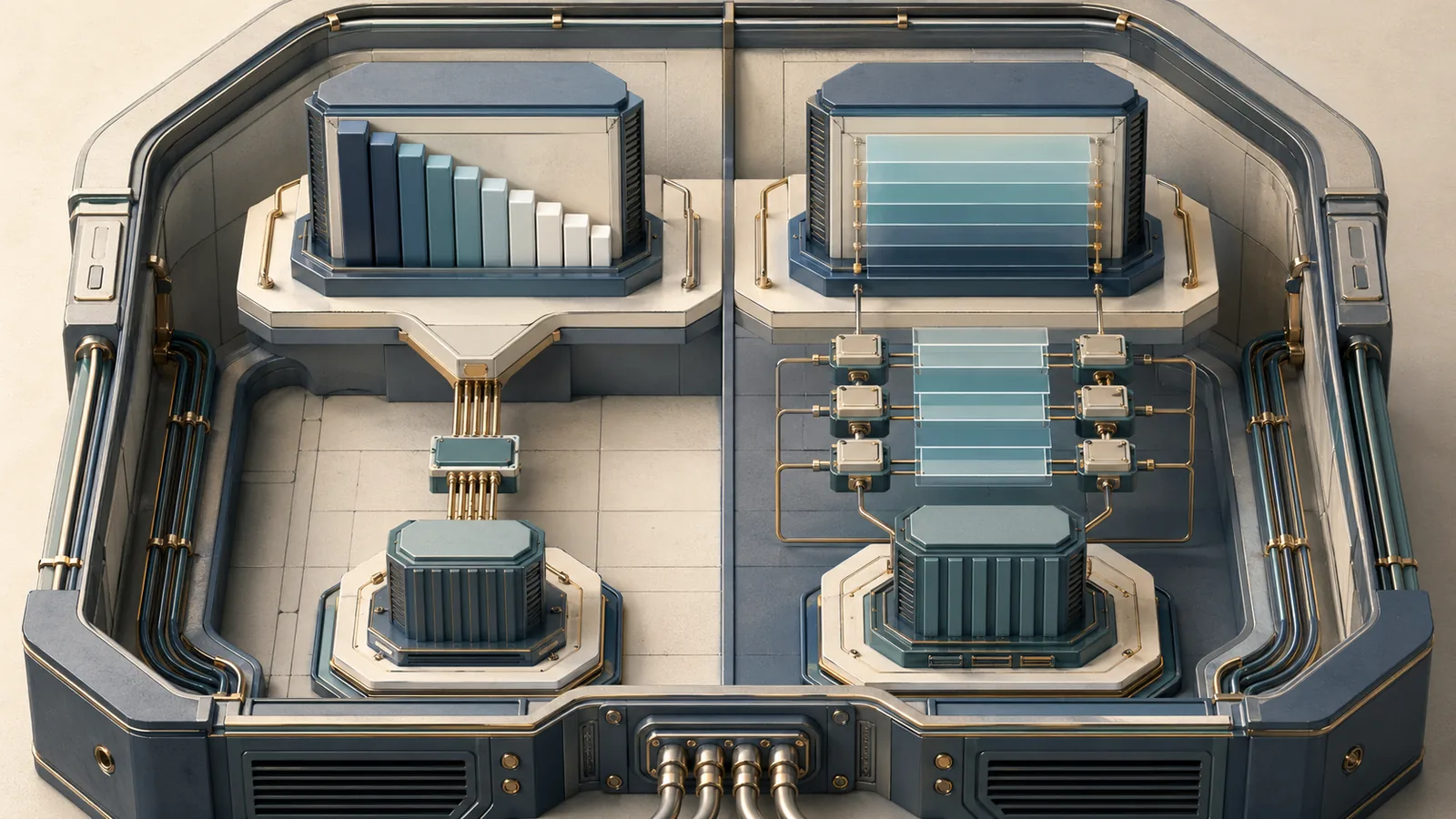
FineWeb-Edu is a 1.3-trillion-token educational subset derived from FineWeb, which is itself a 15-trillion-token web corpus built from 96 Common Crawl snapshots. The Hugging Face team constructed it by training an educational-quality classifier on Llama 3 70B annotations, applying that classifier to all 15T tokens of FineWeb, and retaining only documents that scored above a quality threshold. As the paper states directly: "The resulting dataset, FineWeb-Edu, contains 1.3 trillion tokens."
The mechanism connecting corpus composition to benchmark scores is distributional. MMLU and ARC both lean heavily on factual recall and structured reasoning — the same capabilities reinforced by textbooks, lecture notes, problem sets, and encyclopedic reference material. Exposing a model to a higher density of that content per token shifts the learned distribution toward the knowledge representations those benchmarks probe.
Bottom Line: FineWeb-Edu is not an alternative crawl or an augmented dataset — it is a precision-filtered slice of FineWeb that concentrates educational content at the cost of 91.3% of the original token pool. The benchmark gains on MMLU and ARC reported in the paper are a direct consequence of that redistribution, not of any architectural change or instruction-tuning step.
How FineWeb-Edu was created from FineWeb
FineWeb-Edu's construction pipeline starts from FineWeb, a corpus assembled from 96 Common Crawl snapshots and described in the paper as containing approximately 15 trillion tokens. The educational subset is produced not by sourcing different documents but by scoring every document in the existing corpus and discarding what falls below the threshold.
| Property | FineWeb (base) | FineWeb-Edu (≥3 threshold) | FineWeb-Edu-score-2 (≥2 threshold) |
|---|---|---|---|
| Token count | ~15T | ~1.3T | Larger than 1.3T |
| Source crawl | 96 CC snapshots | Same | Same |
| Selection signal | Heuristic + dedup | Educational classifier | Educational classifier |
| Relative quality | Baseline | Higher | Lower than ≥3 |
The classifier scoring run over the 15T FineWeb tokens required 6,000 H100 GPU hours, which quantifies the non-trivial compute budget of educational filtering at web scale. The resulting dataset and its lower-threshold companion are published as HuggingFaceFW/fineweb-edu and HuggingFaceFW/fineweb-edu-score-2 respectively.
The filtering signal: educational quality classification
The educational quality score is produced by a classifier — released as HuggingFaceFW/fineweb-edu-classifier — trained on annotations generated by Llama 3 70B. The classifier outputs a continuous score; converting that score to a binary keep/remove decision at a threshold of 3 yields an F1 of 82%, as documented in the dataset commit history: "When converted to a binary classification using a score of 3 as a threshold for keeping and removing files, the model achieved an F1 score of 82%."
The score-2 variant lowers the threshold to 2, retaining more documents at the cost of educational precision. The dataset card for fineweb-edu-score-2 is explicit that this version provides more documents but lower quality than the 1.3T release.
Pro Tip: The released classifier lets you apply the same educational scoring to your own domain-specific crawl, not just to FineWeb. If your corpus intersects with textbook-style or explanation-heavy web content, running the scorer and ablating on threshold values (2 vs. 3) can characterize your quality-recall trade-off before committing compute to a full pre-training run.
What the 1.3T-token slice represents relative to the full crawl
Retaining 1.3T tokens from a 15T-token source implies roughly 8.7% of the original token pool passes the educational threshold. That figure deserves direct attention: the model trained on FineWeb-Edu is not getting more data — it is getting a 91.3%-smaller dataset with a very different topic and register distribution. Any benchmark delta therefore conflates two effects: higher educational density per token, and the removal of content types that the educational filter excluded.
Watch Out: Treating FineWeb-Edu gains as purely "quality improvements" is imprecise. At 8.7% token retention, the corpus has undergone a substantial topical redistribution. Gains on MMLU and ARC may reflect both better-quality educational content and the absence of content that dilutes the relevant signal — making it harder to attribute credit to either factor alone without a controlled mixing ablation.
Methodology: how the benchmark comparison was controlled
The FineWeb paper measures benchmark performance using a fixed evaluation suite applied consistently across dataset variants. All comparisons — FineWeb base, FineWeb-Edu, and competitor datasets including DCLM — are evaluated under the same setup, making the dataset the sole varying dimension. The paper reports that "Models trained on FineWeb-Edu exhibit significantly better performance on knowledge- and reasoning-intensive benchmarks like MMLU and ARC."
A key data point from the v1 preprint illustrates the efficiency dimension: FineWeb-Edu reaches 33.6% MMLU accuracy at 38 billion training tokens, a level that requires approximately 300 billion tokens from a comparator dataset to match. This compression of the sample-efficiency curve is precisely what practitioners care about: reaching a given benchmark level in fewer training FLOPs.
| Dataset | MMLU (reported example, ~350B tokens) | ARC (reported example, ~350B tokens) |
|---|---|---|
| FineWeb base | ~33% | ~46% |
| FineWeb-Edu | ~37% | ~57% |
| Delta | +4 pp | +11 pp |
Values from a secondary aggregation via Emergent Mind; primary-source table values should be verified against the full paper before downstream citation.
The ARC delta (+11 pp in the reported example) is substantially larger than the MMLU delta (+4 pp), consistent with the hypothesis that ARC's requirement for multi-step science reasoning is more directly trained by structured educational text than MMLU's broader factual recall.
Training setup, ablations, and checkpoint release context
The paper's ablation setup controls tokenizer, optimizer, and token budget across dataset variants. Checkpoints from the ablation runs are released alongside the datasets and classifier: "We release these two datasets as FineWeb-Edu and FineWeb-Edu-score-2 along with the classifier. You will find all the ablation models in this collection." Training and inference code are also available on GitHub, which allows researchers to probe individual checkpoints at intermediate token counts rather than relying solely on final-run numbers.
Pro Tip: The released intermediate checkpoints are particularly valuable for scaling-law analysis. If you want to estimate whether FineWeb-Edu's sample efficiency advantage holds at your target compute budget, plotting MMLU accuracy against tokens-seen using the released checkpoints gives you a cheap proxy before committing to a full run.
Why benchmark parity matters when comparing data mixes
The shared evaluation setup — same benchmarks, same prompting format, same model architecture — is necessary for the comparison to be interpretable. FineWeb-Edu and FineWeb base share the same parent crawl and deduplication pipeline, so format-level differences in the evaluation documents are minimized. The key remaining confound is token budget: if the training runs for FineWeb-Edu and FineWeb base used different token counts or batching strategies, the delta would be partially attributable to training dynamics rather than corpus composition.
Watch Out: Even with shared evaluation infrastructure, data-mix comparisons can be confounded by token-count differences. A model trained on 1.3T FineWeb-Edu tokens is not directly comparable to one trained on 1.3T FineWeb tokens drawn from the same 15T pool — the FineWeb sample represents a random slice of the full distribution, while FineWeb-Edu represents the top 8.7% by educational score. Treat any stated delta as a data-mix effect, not a sample-size effect, only if the paper's training runs held total tokens constant.
Reported results on MMLU, ARC, and related benchmarks
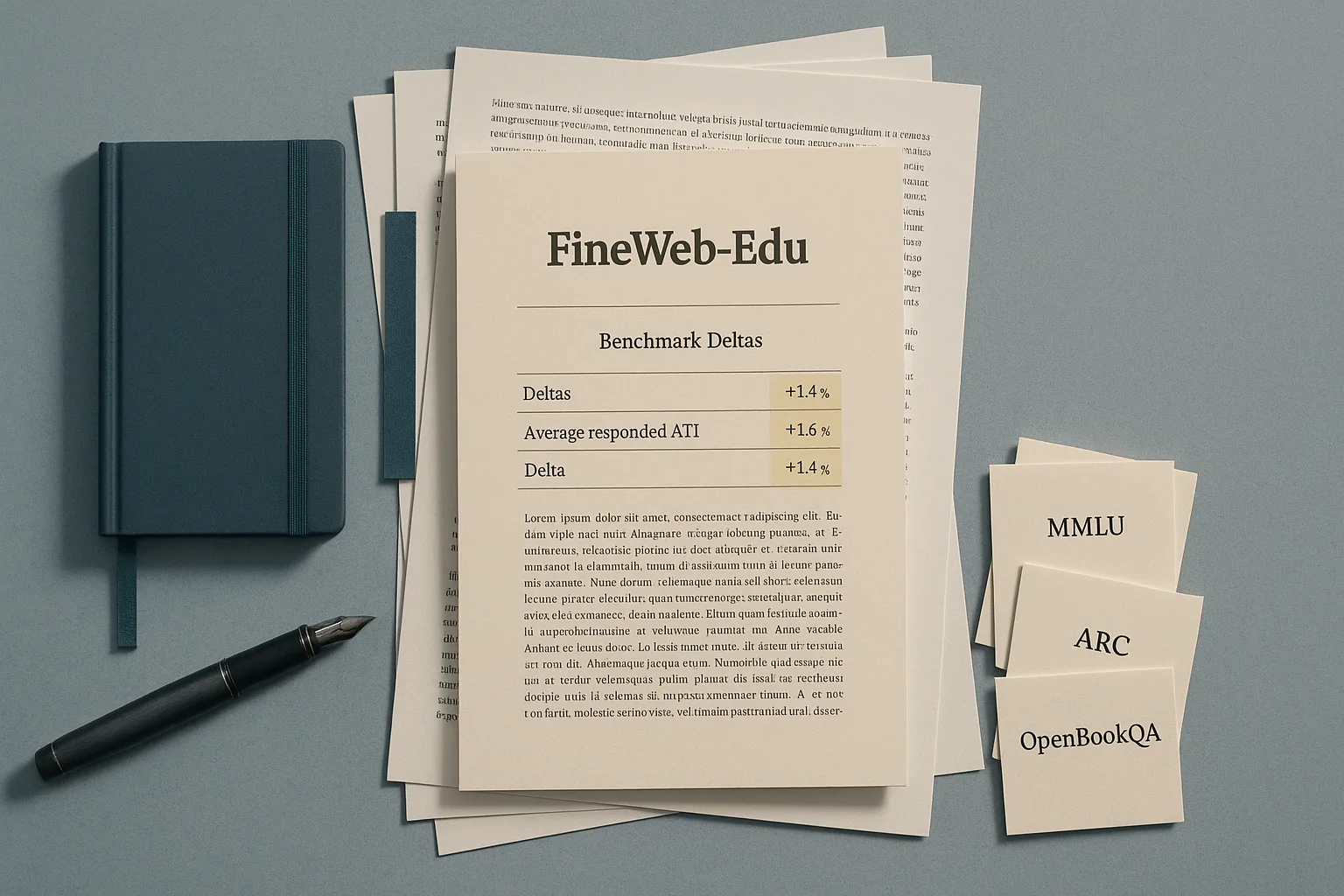
FineWeb-Edu's largest reported gains are concentrated on knowledge- and reasoning-intensive benchmarks. The paper states directly: "FineWeb-Edu is specifically optimized for educational content and outperforms all openly accessible web-based datasets on a number of reasoning- and knowledge-intensive benchmarks such as MMLU, ARC, and OpenBookQA by a significant margin."
The benchmark movements across key tasks, based on available reported figures, look like this:
| Benchmark | FineWeb base | FineWeb-Edu | Reported delta | Task type |
|---|---|---|---|---|
| MMLU | ~33% | ~37% | +4 pp | Knowledge recall, multi-subject |
| ARC | ~46% | ~57% | +11 pp | Science reasoning, multi-step |
| OpenBookQA | — | Higher | Significant | Open-domain science QA |
| HellaSwag | — | Mixed/smaller | Smaller | Commonsense completion |
The MMLU gain at 38B tokens (33.6% accuracy) is notable because it exceeds what a comparator dataset achieves at roughly 300B tokens — an 8× sample-efficiency advantage on that benchmark at that evaluation point. Whether this efficiency advantage compounds or narrows at larger token counts is a question the released checkpoints can help answer, but the paper does not claim the advantage is monotonic across all scales.
Where FineWeb-Edu gains are strongest
The gains concentrate on benchmarks where the answer depends on structured factual knowledge or multi-step scientific reasoning — MMLU, ARC, and OpenBookQA. This pattern is mechanistically consistent: educational text (textbooks, course materials, encyclopedias, worked examples) contains dense co-occurrence of concepts with their definitions, examples, and derivations. Pre-training on such text builds stronger associative representations between concepts and their structured relationships, which is exactly what exam-style benchmarks probe.
Pro Tip: If your downstream evaluation includes heavy knowledge-recall or science-reasoning tasks (e.g., MedQA, BioASQ, SciQ), FineWeb-Edu's composition is directly relevant to your training data decision. The benchmark profile of gains — concentrated in structured-knowledge tasks — is a strong signal about where the distributional shift is operating.
Where the signal is weaker or mixed
Commonsense-heavy and generative tasks such as HellaSwag, CommonsenseQA, and open-ended generation do not show the same magnitude of gain. This is structurally predictable: commonsense completion depends on broad coverage of informal register and diverse situational contexts — the type of content that the educational filter actively excludes. The lower-threshold fineweb-edu-score-2 variant retains more of that coverage at the cost of educational precision, illustrating that the quality-coverage trade-off is continuous rather than binary.
Watch Out: A model pre-trained exclusively or heavily on FineWeb-Edu may regress on commonsense-heavy benchmarks and multilingual tasks relative to a model trained on the full FineWeb distribution. The paper's results do not establish that educational filtering helps, or is neutral, across code generation, long-context reasoning, multilingual benchmarks, or instruction following. Treating the MMLU/ARC lift as evidence of universal improvement is not supported by the reported evidence.
What the benchmark gains actually imply for pre-training data design
The core implication is that token allocation matters more than token volume in the regime the paper studies. Compressing 15T tokens to 1.3T through educational filtering and achieving higher benchmark scores than the full set means the 13.7T discarded tokens were, in the MMLU/ARC context, noisy signal at best and dilution at worst. This is a direct argument for quality-weighted data mixing rather than corpus expansion.
| Design Question | FineWeb-Edu Evidence | Strength of Evidence |
|---|---|---|
| Does filtering beat volume for knowledge benchmarks? | Yes — 1.3T filtered > 15T unfiltered on MMLU/ARC | Strong (controlled ablation) |
| Does educational content specifically drive the gain? | Likely — classifier targets educational register | Moderate (classifier is a proxy) |
| Does the gain hold across all benchmark types? | No — commonsense tasks show weaker benefit | Strong (structural argument + mixed results) |
| Does the gain generalize to all model scales? | Unknown — paper covers specific scale range | Weak |
| Is tokenizer choice implicated? | No — tokenizer is held constant across variants | N/A — not an independent variable |
The design lesson is not "use FineWeb-Edu for everything." It is that a classifier capable of identifying educationally dense content can identify approximately the top 8.7% of a web crawl that punches far above its weight on knowledge benchmarks — and that this selection can be reproduced on other corpora using the released classifier.
Educational content versus generic web text
More generic web text is not the same as more educational text. The token volume difference between FineWeb base (15T) and FineWeb-Edu (1.3T) is large, but the benchmark direction still favors the smaller corpus.
| Dimension | Generic web text (FineWeb base) | Educational text (FineWeb-Edu) |
|---|---|---|
| Token volume | ~15T | ~1.3T |
| Register diversity | High | Lower |
| Factual density | Variable | High |
| Structured reasoning examples | Sparse | Dense |
| Coverage breadth | Broad | Narrow |
| MMLU/ARC performance | Lower | Higher |
This table encodes the core trade-off: FineWeb-Edu sacrifices register diversity and topical breadth to concentrate factual and reasoning-heavy signal. Whether that trade-off is net positive depends entirely on what the target model must do.
What practitioners should infer about data mixing and tokenizer choices
The study's causal intervention is a data-mix decision, not a tokenizer change. Tokenization is held constant across the FineWeb and FineWeb-Edu training runs, so no tokenizer inference is warranted from this paper. The actionable conclusions are about corpus composition.
- Choose educational filtering when your benchmark targets resemble MMLU and ARC, your token budget is constrained, and you can afford the classifier inference cost (6,000 H100 GPU hours for 15T tokens).
- Choose broader web coverage when your downstream tasks require commonsense coverage, multilingual breadth, or long-tail topical recall that educational content systematically underrepresents.
- Consider a mixed strategy — e.g., upsampling FineWeb-Edu tokens within a larger FineWeb base run — when you want both knowledge-benchmark lift and coverage preservation. The released classifier makes this straightforward to operationalize.
- Do not swap tokenizers based on this paper's evidence; no tokenizer comparison was conducted and no tokenizer recommendation follows from the results.
Limitations and caveats in reading the FineWeb-Edu story
FineWeb-Edu produces documented, controlled improvements on MMLU, ARC, and OpenBookQA. What the paper does not establish is equally important to state clearly: these are benchmark improvements under a specific experimental protocol, not a proof that educational filtering is the optimal strategy for pre-training generally.
The constraints are structural. First, the evaluation suite is narrow relative to the full range of capabilities a production model requires. MMLU, ARC, and OpenBookQA are useful proxies for knowledge and reasoning but do not cover code generation, multilingual competence, instruction following, or long-context retrieval. A corpus optimized for those three benchmarks may underperform a broader corpus on the tasks that those benchmarks don't cover.
Second, the 8.7% token retention rate introduces a strong topical selection effect. The "gains" from FineWeb-Edu include the effect of removing content types — informal discussion, social media text, product reviews, low-quality HTML — that may train capabilities not captured in MMLU and ARC. Without ablations that add back individual content types, the gain cannot be attributed cleanly to the educational content rather than to the removal of noise.
Watch Out: The benchmark claims in this paper are robust within their stated scope — controlled comparisons on MMLU, ARC, and OpenBookQA across dataset variants from the same source crawl. They do not establish FineWeb-Edu as universally superior for all pre-training objectives, all model scales, or all benchmark suites. Practitioners who prioritize code, multilinguality, or long-context tasks should validate on their specific target benchmarks before committing to an educational-heavy data mix.
Benchmark overfitting, selection effects, and evaluation scope
MMLU and ARC are among the most commonly used benchmarks in the NLP literature, which creates a real risk of indirect benchmark overfitting: if the educational classifier was trained on annotations that reflect the same latent knowledge structure as MMLU/ARC questions, then scoring high on the classifier may correlate with scoring high on the benchmarks for reasons that don't generalize. The classifier is a proxy measure derived from human-annotated educational quality, not from benchmark labels — but the conceptual proximity of "educational quality" to "answers exam questions correctly" is non-trivial.
Pro Tip: Before treating MMLU and ARC gains as general-purpose signals of pre-training data quality, test the same data mix against at least one benchmark that is structurally different from exam-style tasks — WinoGrande, HellaSwag, or a generative evaluation. If gains persist across structurally different benchmarks, the educational filtering hypothesis gains credibility. If gains are limited to exam-style tasks, the selection effect hypothesis becomes more plausible.
Why released models help, but do not settle the question
The release of ablation models, classifier weights, and training code is a genuine contribution to reproducibility. The dataset README states: "We release these two datasets as FineWeb-Edu and FineWeb-Edu-score-2 along with the classifier. You will find all the ablation models in this collection." This lets independent researchers replicate the benchmark trajectory, probe intermediate checkpoints, and test the classifier on their own corpora.
Watch Out: Reproducibility of the reported results does not imply generalizability. The released checkpoints confirm what happened under the paper's specific tokenizer, optimizer, compute budget, and model architecture. They do not guarantee the same delta magnitude under a different model family, a different learning rate schedule, or a substantially different token budget. Treat the released models as a strong baseline and a methodological reference, not as a universally transferable recipe.
Implications for researchers choosing a pre-training mix
The FineWeb-Edu paper provides actionable evidence for a specific class of decision: choosing a web-crawl-derived pre-training corpus when knowledge and reasoning benchmarks are primary evaluation targets and compute efficiency matters. The main empirical lesson — that an educationally filtered 1.3T-token subset outperforms 15T tokens of unfiltered web text on MMLU and ARC — directly informs that decision.
| Scenario | Recommended approach | Rationale |
|---|---|---|
| Target: MMLU/ARC/OpenBookQA improvement, constrained token budget | Prioritize FineWeb-Edu | Maximum benchmark lift per token; consistent with paper's controlled result |
| Target: general-purpose base model, broad topical coverage | Mix FineWeb base with FineWeb-Edu upsampling | Preserves coverage; educational upsampling recovers some knowledge-benchmark lift |
| Target: code, multilingual, long-context tasks | Use FineWeb base or domain-specific corpora | FineWeb-Edu systematically underrepresents these content types |
| Target: domain-adapted base (medical, legal, scientific) | Apply the released classifier to your domain crawl | Classifier transfers; threshold tuning for domain-specific educational text is feasible |
The 6,000 H100 GPU hours required for classifier inference over 15T tokens is the primary compute cost of the filtering step. For a smaller crawl, that cost scales proportionally and is typically far below the pre-training compute cost, making the filtering step economically defensible in most regimes.
When an educational subset is worth prioritizing
Educational filtering pays off most clearly when the following conditions hold: the downstream model must answer factual, multi-subject, or science-reasoning prompts; the pre-training token budget is constrained relative to the available crawl; and the benchmark evaluation set overlaps structurally with MMLU, ARC, or OpenBookQA. The sample-efficiency gain documented in the paper — reaching MMLU parity at 38B tokens versus ~300B tokens for a comparator — is the clearest argument for prioritizing FineWeb-Edu when tokens are expensive.
Bottom Line: If your training objective produces a model that will be evaluated on knowledge-recall and science-reasoning tasks, the FineWeb-Edu evidence strongly supports preferring an educational subset over an unfiltered crawl at the same token budget. The case weakens proportionally as your target tasks diverge from exam-style knowledge benchmarks.
When broader web coverage may still be the better trade-off
The 13.7T tokens excluded from FineWeb-Edu are not worthless — they encode language variety, commonsense context, domain diversity, and topical long-tail content that educational filtering systematically removes. The fineweb-edu-score-2 variant captures this trade-off in microcosm: a lower threshold retains more documents, but the dataset card explicitly notes: "Note: this version uses a lower educational score threshold = 2, which results in more documents, but lower quality compared to the 1.3T version."
- Prefer broader coverage when your model must handle informal conversational inputs, multilingual queries, or tasks with diverse output registers.
- Prefer broader coverage when topical long-tail recall matters — product knowledge, pop culture, current events — content that educational pipelines structurally underweight.
- Prefer broader coverage when your MMLU/ARC targets are already met by an existing base model you are continuing to train, and the marginal benchmark gain from educational filtering is smaller than the potential regression on coverage-dependent tasks.
FAQ: FineWeb-Edu, MMLU, and ARC
What is FineWeb-Edu?
FineWeb-Edu is a 1.3-trillion-token educational subset filtered from FineWeb, a 15-trillion-token web corpus built from 96 Common Crawl snapshots. It is produced by scoring every FineWeb document with a Llama 3 70B-derived classifier and retaining documents that score 3 or above on the educational quality scale. It is published on Hugging Face as HuggingFaceFW/fineweb-edu under an ODC-By License.
How does FineWeb-Edu improve MMLU? Models trained on FineWeb-Edu learn from a higher density of factual, structured-reasoning text per token. The paper reports that this distribution shift yields models that outperform those trained on the full FineWeb base on MMLU and ARC, with FineWeb-Edu reaching 33.6% MMLU accuracy at only 38B tokens versus approximately 300B tokens needed by a comparator dataset.
Is ARC a good benchmark for pretraining data quality? ARC (AI2 Reasoning Challenge) is a useful but narrow proxy. Its multi-step science-reasoning structure correlates with educational text exposure, making it sensitive to the kind of distributional shift FineWeb-Edu introduces. However, it does not measure multilingual capability, code, or open-ended generation — significant gaps for evaluating general pre-training data quality. ARC gains are informative about the knowledge-reasoning axis but should be complemented with structurally different benchmarks before drawing broader conclusions.
How was FineWeb-Edu created? A Llama 3 70B-based educational quality classifier was applied to all 15T tokens of FineWeb at a cost of 6,000 H100 GPU hours. Documents scoring ≥3 were retained, yielding the 1.3T-token release. The classifier, datasets, and ablation checkpoints are all publicly released.
What are the limitations of FineWeb-Edu results? The gains are benchmark-specific (MMLU, ARC, OpenBookQA), conducted under one experimental protocol, and involve a strong topical selection effect. Results may not transfer to code, multilingual, or commonsense-heavy tasks. The classifier introduces a proxy for educational quality that may correlate structurally with MMLU/ARC labels, creating a non-trivial risk of selection-driven benchmark inflation.
Pro Tip: When incorporating FineWeb-Edu findings into your own dataset curation decisions, treat the MMLU and ARC deltas as signal about knowledge-benchmark coverage rather than a general measure of corpus quality. Cross-validate on at least one held-out benchmark from a structurally different family before treating educational filtering as the default choice.
Sources and references
- The FineWeb Datasets: Decanting the Web for the Finest Text Data at Scale (arXiv:2406.17557v2) — Primary paper; source of all benchmark claims, corpus statistics, and methodology descriptions cited in this article.
- FineWeb-Edu dataset card — HuggingFaceFW/fineweb-edu — Official dataset card with corpus statistics, license information (ODC-By), and links to ablation models and classifier.
- FineWeb-Edu-score-2 dataset card — HuggingFaceFW/fineweb-edu-score-2 — Lower-threshold variant dataset card; source of the F1 = 82% at threshold-3 statistic and quality-quantity trade-off documentation.
- FineWeb blog post (HuggingFace static hosting) — Source of the 6,000 H100 GPU hour classifier inference figure and classifier release announcement.
- FineWeb-Edu dataset README (mirror) — Source of the ablation model collection release statement.
- Emergent Mind — FineWeb topic page — Secondary aggregation; source of the illustrative MMLU (~33% → ~37%) and ARC (~46% → ~57%) example values cited as indicative figures pending full-table verification.
| Source | Type | Primary claim covered |
|---|---|---|
| arXiv:2406.17557v2 (PDF + HTML) | arXiv preprint | All benchmark claims, corpus sizes, methodology |
| HuggingFaceFW/fineweb-edu (dataset card) | Official dataset documentation | Token count, license, classifier release |
| HuggingFaceFW/fineweb-edu-score-2 (dataset card + commit) | Official dataset documentation | F1=82%, threshold=3, score-2 trade-off |
| FineWeb blog post | Official engineering blog | H100 GPU hours, classifier availability |
Keywords: FineWeb-Edu, FineWeb, MMLU, ARC, OpenBookQA, HellaSwag, CommonsenseQA, DCLM, Llama-3 70B, HuggingFaceFW/fineweb-edu, arXiv:2406.17557v2, Llama 3, tokenization, deduplication, classifier filtering