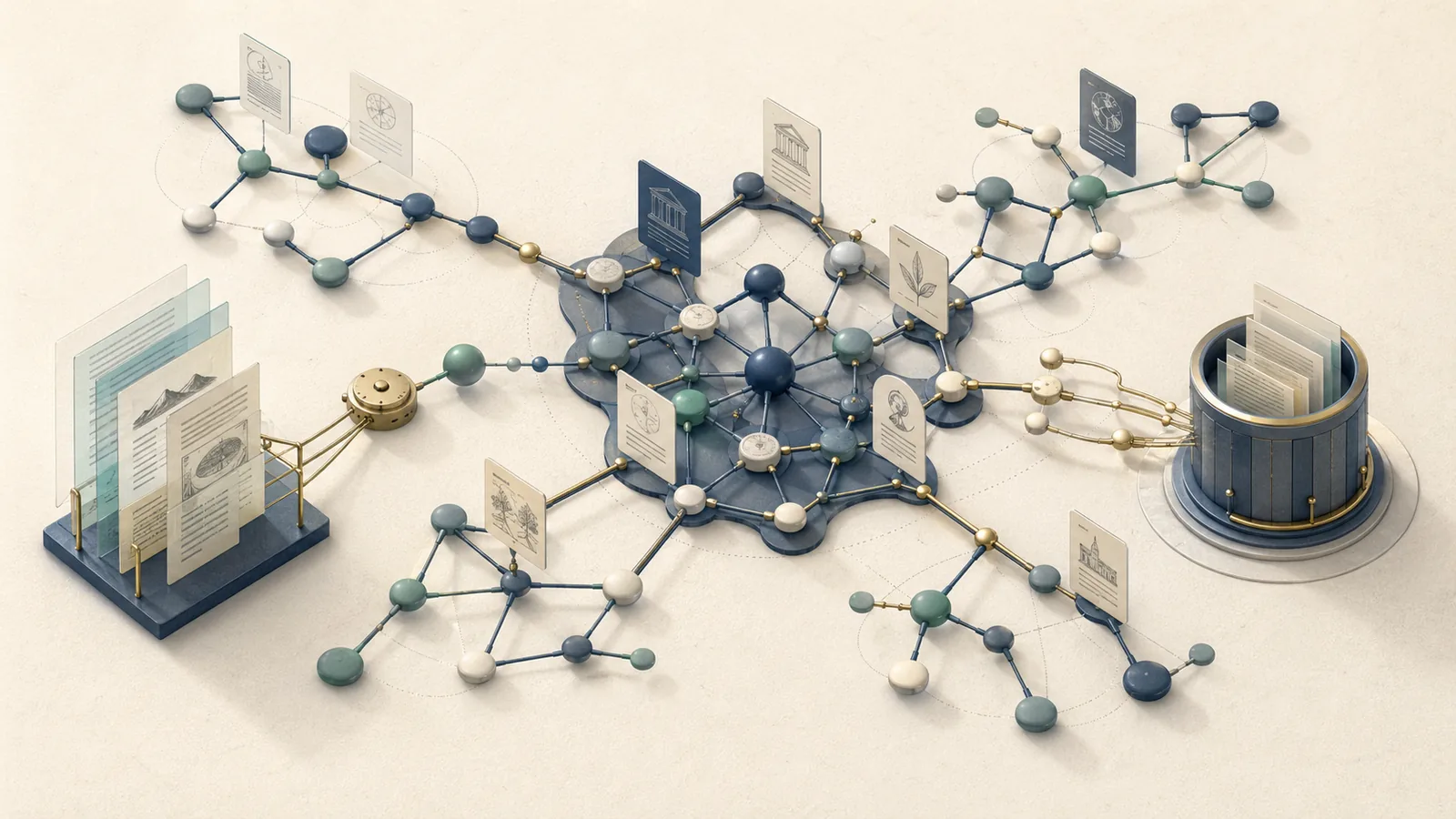
GraphRAG converts enterprise text corpora into structured knowledge graphs and uses graph traversal — not just embedding similarity — to assemble multi-hop context before generation. The result is a retrieval pipeline that trades higher ingestion and query-time overhead for better handling of compositional questions. This article names every component in the production pipeline, explains the traversal mechanics, and gives a decision framework for when that complexity pays off.
What GraphRAG solves in enterprise retrieval
Plain vector search retrieves chunks whose embeddings are semantically close to the query embedding. That works well when the answer lives in a single passage. It fails systematically when the answer requires chasing a definition through one document, tracking its amendment in another, and applying a cross-reference buried in a third.
Microsoft Research characterizes GraphRAG as "a structured, hierarchical approach to Retrieval Augmented Generation (RAG), as opposed to naive semantic-search approaches using plain text snippets." The key mechanism is that the system "creates a knowledge graph based on an input corpus," and that graph — along with community summaries and graph ML outputs — is used to augment the prompt at query time. Per the Microsoft Research blog, this "vastly improves the 'retrieval' portion of RAG, populating the context window with higher relevance content, resulting in better answers and capturing evidence provenance."
Bottom Line: Vector-only RAG breaks on scattered definitions, cross-references, and amendments because cosine similarity over isolated chunks cannot preserve the logical connections between those chunks. GraphRAG encodes those connections explicitly as edges in a knowledge graph, making them traversable at query time rather than inferred by the LLM from disconnected snippets.
GraphRAG reference architecture for multi-hop reasoning
The end-to-end pipeline has five named stages that an enterprise team must implement as distinct systems: an ingestion stage, an extraction stage, a graph store with co-located vector index, a query planner, and a synthesis stage. In Microsoft's methods page, graph extraction is estimated to constitute roughly 75% of indexing cost, which is why ingestion design drives most of the build-versus-run trade-offs.
flowchart LR
    A[Raw Documents] --> B[Chunker & Provenance Tagger]
    B --> C[Entity & Relation Extractor\nLLM-based triplet extraction]
    C --> D[Graph Store\ne.g. Neo4j]
    B --> E[Vector Index\nembedding fallback]
    D --> F[Query Planner]
    E --> F
    F --> G[Graph Traversal\nneighborhood expansion]
    G --> H[Annotated Subgraph\nwith provenance]
    H --> I[LLM Synthesis\nGPT-4 Turbo / Llama 3.1]
    I --> J[Final Answer + Evidence Chain]
Microsoft's GraphRAG indexing overview describes the indexing package as "a data pipeline and transformation suite that is designed to extract meaningful, structured data from unstructured text using LLMs," composed of configurable workflows, prompt templates, and I/O adapters. This is not a monolithic service — it is a pipeline you configure and run against your corpus, with graph extraction constituting roughly 75% of total indexing cost. That 75% figure alone drives most of the build-versus-cost decisions covered below.
Watch Out: Microsoft explicitly cautions that "GraphRAG can consume a lot of LLM resources!" and recommends starting with a small tutorial dataset and inexpensive models before committing to a full corpus indexing run. Factor this into capacity planning before you commit to a production deployment.
Document ingestion, chunking, and provenance tagging
The difference between GraphRAG and vanilla RAG begins at ingestion. Both systems chunk documents, but GraphRAG's chunker must also emit provenance metadata — source document ID, section, page, and version — that travels with every extracted triplet through the entire pipeline.
In a standard RAG pipeline, a chunk is a retrieval unit: embed it, store the vector, retrieve it when the query is similar. In GraphRAG, the chunk is a graph construction unit: the dataflow documentation confirms that entity and relationship extraction processes each text unit individually, producing a subgraph per text unit. For FastGraphRAG, claim extraction is skipped, which reduces cost but removes a provenance-rich extraction step from the pipeline. Provenance metadata is what links a graph edge back to its originating chunk, enabling downstream citation of the exact clause, amendment, or policy section that grounded a relation.
Production Note: In legal and enterprise support workloads, provenance metadata is not optional decoration — it is the audit trail that compliance teams require. A claim extracted from document v2.1 that contradicts document v3.0 is only detectable when both the graph edge and its source chunk carry version-level provenance tags. Stripping provenance to save storage defeats the explainability advantage that justifies GraphRAG's cost. For FastGraphRAG variants, note that claim extraction is always skipped by design, which removes the richest provenance-capture step from the pipeline.
Entity and relation extraction into triplets
Entity and relation extraction is the core graph construction step: the LLM reads each text unit and outputs structured triplets of the form (entity_A, relation, entity_B). These triplets are the edges of the knowledge graph.
Microsoft's dataflow documentation confirms that this step processes each text unit and "extract[s] entities and relationships out of the raw text using the LLM," producing "a subgraph-per [text unit]." Those per-chunk subgraphs are merged into the global graph during indexing.
The quality of extraction directly determines multi-hop fidelity. A missed entity means a traversal dead end. A hallucinated relation is a false edge that can produce plausible-sounding but incorrect answers. Microsoft's methods page is explicit: "FastGraphRAG is therefore much cheaper, but the tradeoff is that the extracted graph is less directly relevant for use outside of GraphRAG, and the graph tends to be quite a bit noisier."
Extraction quality depends on three interacting variables: the extraction model, the prompt template, and the ontology (the pre-defined set of entity types and relation types the extractor targets). All three must be co-designed.
Watch Out: Ontology drift is the most common silent failure in production GraphRAG deployments. If the entity schema evolves after initial extraction — for example, a new regulatory regime introduces a new entity type — previously extracted subgraphs become incompatible with new ones. Traversal across the schema boundary either fails silently or produces spurious neighbors. Plan for schema versioning and incremental re-extraction from day one. Open-source extractors (such as those built on Llama 3.1 with generic NER prompts) produce higher drift rates than proprietary extraction pipelines because their output formats are less constrained and harder to validate at scale.
Graph storage and indexing layers
The extracted graph requires two co-located storage systems: a graph database for structural traversal and a vector index for semantic fallback. These are not interchangeable — they serve distinct query patterns.
| Layer | Role | Representative options | Enterprise strength |
|---|---|---|---|
| Graph database | Stores nodes, typed edges, and provenance metadata; supports multi-hop traversal queries | Neo4j, Amazon Neptune, TigerGraph | Multi-hop path queries, relationship filtering |
| Graph index | Community summaries, graph ML embeddings for global-level queries | Built into Microsoft GraphRAG pipeline | Broad thematic queries across large corpora |
| Vector index | Dense embedding search for semantic fallback when graph traversal yields sparse results | pgvector, Pinecone, Weaviate | High recall on single-hop factual queries |
Microsoft's project page describes the full augmentation stack: "This graph, along with community summaries and graph machine learning outputs, are used to augment prompts at query time." Community summaries are hierarchical cluster-level summaries generated over the graph during indexing, enabling global queries (e.g., "what are the main themes in this corpus?") that neither raw graph traversal nor vector search alone handles well.
The storage layer is implementation-specific. Microsoft's indexing pipeline is configurable with standard and custom I/O adapters, meaning teams can pair Neo4j for graph traversal with a separate vector store for fallback — or use a unified graph-vector database if one meets their scale requirements. Teams that orchestrate this with LangChain GraphRAG typically separate extraction, traversal, and synthesis into explicit chain components so the fallback path remains observable.
Query planning and traversal strategy
The query planner is the routing layer that decides whether an incoming query needs graph traversal, vector fallback, or both. This is where GraphRAG's structural advantage over plain vector search becomes concrete.
The arXiv paper on GraphRAG (arXiv:2501.00309) states the underlying motivation precisely: "Real-world queries are often complex and encode multi-aspect intentions, possess structure patterns, and desire multi-hop reasoning that the aforementioned basic retrievers struggle to address." The planner's job is to detect these patterns and route accordingly.
A typical planner implementation operates as follows. The query is parsed for named entities. If those entities exist in the graph, the planner issues a traversal query from each entry-point entity, expanding to its neighbors up to a configurable hop depth. The resulting neighborhood — the set of nodes and edges reachable within that hop limit — forms the candidate subgraph. If entity matching returns no results, or if the traversal neighborhood is sparse (fewer than a threshold number of relevant edges), the planner falls back to the vector index and retrieves the top-k semantically similar chunks. Microsoft also warns in its getting started guidance that GraphRAG can consume a lot of LLM resources, so the fallback path is not just a precision choice; it is also a resource-control choice.
Pro Tip: Multi-hop benefit concentrates in queries that chain two or more facts that are not co-located in any single document — for example, "What penalty applies to a contract party that violates clause 7, given the amendment filed in exhibit B?" Clause 7 lives in document 1, the amendment lives in document 2, and the penalty schedule lives in document 3. A vector search over any one document retrieves an incomplete answer. A graph traversal from "clause 7" through "amended by" to "exhibit B" through "governs" to "penalty schedule" assembles the complete evidence chain in one pass. The connected subgraph is what makes the assembled context coherent rather than juxtaposed.
How multi-hop context assembly works
After traversal, the planner holds an annotated subgraph: a set of nodes and typed edges, each carrying provenance metadata pointing back to the source chunk and document. The synthesis stage converts this subgraph into a prompt context.
The assembly process proceeds in four steps. First, the traversal layer returns the seed entities matched to the query and expands their neighborhoods to a configured hop depth, collecting nodes, relation types, and provenance tags. Second, the assembler serializes the subgraph into a structured context representation — typically a combination of relation triples, node summaries, and community summaries for any detected cluster membership. Third, this structured context is inserted into the prompt alongside the original query. Fourth, the LLM (GPT-4 Turbo in high-fidelity deployments, Llama 3.1 in cost-sensitive configurations) synthesizes the answer, grounded in the assembled context.
Microsoft's project page describes the augmentation: "This graph, along with community summaries and graph machine learning outputs, are used to augment prompts at query time." The critical property is that the context window receives structured, connected evidence rather than a bag of ranked chunks. The LLM is not asked to infer relationships — the relationships are explicit in the context it receives.
Why scattered definitions and cross-references fail in plain RAG
In a plain RAG pipeline, vector search retrieves the top-k chunks most similar to the query embedding. When a legal definition appears in section 2, is narrowed by an amendment in an appendix, and determines liability in a separate clause, no single chunk is simultaneously close to all three aspects of the query. Each chunk, in isolation, matches one aspect while omitting the connective tissue.
The arXiv GraphRAG paper frames this as a fundamental limitation: basic retrievers "struggle to address" queries that "encode multi-aspect intentions" and "desire multi-hop reasoning." Microsoft's project page draws the same contrast explicitly, positioning GraphRAG as a "structured, hierarchical approach … as opposed to naive semantic-search approaches using plain text snippets."
Watch Out: Semantic similarity is brittle precisely when facts are intentionally distributed across documents by domain convention — which is the norm in legal, regulatory, and policy corpora. Amendments are authored to modify, not restate. Cross-references are written to point, not to embed the target clause's content. A similarity-based retriever cannot bridge these gaps because the bridging information (the relation type, the amendment direction, the cross-reference target) is structural, not lexical. Raising the top-k from 5 to 20 retrieves more chunks but does not recover the missing structure.
How annotated subgraphs preserve evidence chains
An annotated subgraph is the audit artifact that distinguishes GraphRAG outputs from opaque LLM answers. Each node in the subgraph carries a label (entity type, canonical name) and a provenance pointer (source document, chunk ID, section heading). Each edge carries a relation type and the provenance of the text unit from which it was extracted.
When the LLM synthesizes an answer from this subgraph, every claim in the answer is traceable to a specific edge in the subgraph, which is traceable to a specific chunk, which is traceable to a specific document version. Microsoft's research blog confirms that the system achieves "better answers and capturing evidence provenance" — a property that plain RAG cannot replicate structurally.
Pro Tip: Treat the annotated subgraph returned by the traversal layer as the primary audit artifact, not the final LLM answer. Legal, compliance, and regulated-industry teams reviewing GraphRAG outputs should inspect the subgraph directly — the edges and their provenance pointers are the verifiable evidence chain. The LLM answer is the summary; the subgraph is the proof. Storing subgraphs alongside generated answers enables post-hoc audits without re-querying.
Component-by-component trade-offs in production
GraphRAG's production costs concentrate in three places: ontology design (a one-time but high-effort upfront investment), extraction quality (an ongoing LLM cost and accuracy variable), and traversal latency (a query-time penalty for every request). None of these disappears with scale — some worsen with corpus growth.
Microsoft quantifies the ingestion cost directly: "We estimate graph extraction to constitute roughly 75% of indexing cost." For a large enterprise corpus, this means the majority of both token spend and wall-clock indexing time is consumed before a single query is answered.
Bottom Line: GraphRAG is worth its complexity when your workload has three properties simultaneously: queries span multiple documents, the correctness of the answer depends on following explicit relationships between entities, and your organization needs a verifiable evidence chain for each answer. If any one of these three conditions is absent, the cost-to-benefit ratio tips toward vector search or a lightweight hybrid.
Ontology design and schema maintenance
The entity schema — the set of entity types (e.g., Clause, Party, Obligation, Amendment) and relation types (e.g., amends, obligates, references, supersedes) — is the design contract that the extraction prompts, the graph store, and the traversal queries all depend on. A change to the schema after initial indexing invalidates the affected portions of the graph unless re-extraction is performed.
Microsoft's indexing overview exposes schema design through configurable pipelines with custom prompt templates: "Indexing Pipelines are configurable. They are composed of workflows, standard and custom steps, prompt templates, and input/output adapters." This flexibility is necessary but shifts schema maintenance responsibility to the implementing team.
Production Note: Keep entity schemas stable across document types within a domain before extending to a new domain. Mixing a legal contract schema with a technical specification schema in a single graph creates traversal noise — the relation type
referencesmeans something structurally different in each domain. Separate graphs with a federated query layer are operationally cleaner than a merged graph with an overloaded schema. Schema changes in a live production graph require a migration plan that includes re-extraction of affected text units and validation of impacted traversal paths.
Cost-quality trade-offs in proprietary versus open-source extraction
The extraction model is the single largest lever on both cost and graph fidelity. Microsoft's methods page documents two extraction modes that represent opposite ends of the cost-quality spectrum.
| Extraction approach | Fidelity | Cost | Operational complexity |
|---|---|---|---|
| Standard GraphRAG (GPT-4 class) | High — rich entity/relation descriptions | Higher | Moderate |
| FastGraphRAG | Lower — noisier edges, fewer relation types | Lower | Lower |
| Open-source extraction (Llama 3.1, custom NER) | Variable — prompt-sensitive | Lowest | Highest without validation |
Microsoft's own guidance is direct: "Standard GraphRAG provides a rich description of real-world entities and relationships, but is more expensive than FastGraphRAG," while "FastGraphRAG is therefore much cheaper, but the tradeoff is that the extracted graph is less directly relevant for use outside of GraphRAG, and the graph tends to be quite a bit noisier." The recommendation for teams starting out is equally direct: "We strongly recommend starting with the tutorial dataset … and consider experimenting with fast/inexpensive models first before committing to a big indexing job."
The practical implication: for high-stakes enterprise knowledge retrieval — legal, compliance, support escalation — the fidelity loss from open-source extraction materially degrades multi-hop accuracy, which defeats the primary reason for choosing GraphRAG over vector search. The 47Billion production pattern for legal reasoning confirms this: proprietary LLMs and embeddings produce higher-fidelity graphs, while open-source extraction reduces cost but may materially degrade multi-hop precision.
Latency, traversal depth, and fallback thresholds
Graph traversal is structurally slower than vector search for single-hop queries. A vector search issues one ANN query and returns top-k results in milliseconds. A graph traversal issues one or more Cypher (or equivalent) queries, expands neighborhoods hop by hop, deduplicates nodes, resolves provenance, and serializes the subgraph before any LLM call begins. At hop depth 1–2 over a well-indexed graph, this overhead is measurable but acceptable for workloads where latency is secondary to accuracy. At hop depth 3+ over a dense graph, neighborhood expansion can return thousands of nodes, most of them irrelevant — a condition called over-traversal.
Watch Out: Over-traversal occurs when the hop depth limit is set too permissively or when the seed entity is highly connected (e.g., a root legal concept referenced by hundreds of clauses). The resulting neighborhood is noisy, the assembled context overflows the LLM's context window, and the synthesis quality degrades. Set a maximum neighborhood size (node count) as a secondary termination condition alongside hop depth, and test both thresholds against your specific graph density before production deployment. Fallback to vector search should trigger not only when entity matching fails but also when traversal yields a neighborhood above the noise threshold.
Decision criteria for enterprise adoption
The adoption decision maps workload characteristics — query complexity, explainability requirements, corpus structure, and latency tolerance — to retrieval architecture. Microsoft’s getting started docs explicitly frame GraphRAG as resource-intensive and recommend starting with a small tutorial dataset first, so adoption is best justified by high-value workloads where multi-hop retrieval and provenance matter enough to absorb the indexing cost.
| Workload pattern | Query complexity | Explainability need | Recommended architecture |
|---|---|---|---|
| Legal / regulatory Q&A with amendments | Multi-hop, cross-document | Audit trail required | GraphRAG |
| Policy compliance checking | Multi-hop, cross-reference | Audit trail required | GraphRAG |
| Enterprise knowledge base with version control | Multi-hop possible | Moderate | Hybrid RAG (graph + vector) |
| Developer docs Q&A (single-library scope) | Mostly single-hop | Low | Vector search |
| Customer support deflection (FAQ-style) | Single-hop, high volume | Low | Vector search |
| Incident post-mortem analysis across services | Multi-hop, structured logs | Moderate | Hybrid RAG |
Hybrid RAG — maintaining both a graph index and a vector index, with the query planner routing to the appropriate backend — is the pragmatic middle position for teams whose corpus has both structured relational content and high-volume low-complexity queries.
When GraphRAG is the right fit
GraphRAG earns its complexity overhead when the corpus has explicit relational structure that matters for answer correctness, when queries routinely chain three or more facts across document boundaries, and when the output must be auditable to a source document and clause.
Pro Tip: The strongest fit signal is the simultaneous presence of scattered definitions, cross-references, and amendments in the same corpus. If a user querying your system would naturally say "given the definition in section 2, as modified by amendment 3, does clause 7 apply?" — that is a three-hop traversal. No vector search configuration retrieves all three nodes reliably. GraphRAG with a well-designed ontology for that domain does.
Additional strong fit indicators: the corpus is private narrative data (contracts, internal policies, engineering specs), the enterprise needs provenance-linked answers for regulatory compliance, and the query distribution skews toward complex compositional questions rather than simple lookup.
When vector search is still enough
Microsoft's GraphRAG project explicitly positions itself as an alternative to naive semantic search — not a universal replacement. Vector search remains the correct architecture when queries are predominantly single-hop and factual, when the corpus is relatively flat (no deep cross-reference structure), when latency is a hard constraint, or when the cost of graph extraction and maintenance exceeds the quality gain.
Watch Out: Over-engineering low-entropy Q&A with GraphRAG is a common and expensive mistake. A developer docs chatbot answering questions like "what are the parameters of the
/v1/completionsendpoint?" does not benefit from a knowledge graph — it benefits from well-chunked, well-indexed documentation and a fast ANN index. Adding GraphRAG to this workload adds ontology design, extraction cost, traversal latency, and maintenance burden without improving answer quality. Measure retrieval failure modes in your specific workload before committing to graph infrastructure.
FAQ
What is GraphRAG and how does it work?
GraphRAG converts a document corpus into a knowledge graph of entities and typed relations, then uses graph traversal to assemble connected subgraphs as context for an LLM. At query time, the query planner identifies entity entry points, traverses the graph to collect multi-hop neighborhoods, and passes the annotated subgraph to the LLM for synthesis. The result includes both the generated answer and the evidence chain that produced it.
What is the difference between GraphRAG and RAG?
Standard RAG embeds text chunks and retrieves the top-k most similar chunks at query time — the retrieval unit is a flat text passage. GraphRAG additionally extracts entities and relations from those chunks during ingestion, builds a knowledge graph, and retrieves connected subgraphs at query time. The retrieval unit is a structured neighborhood of entities and edges, not a bag of ranked passages.
Is GraphRAG better than vector search?
It depends entirely on query structure. For multi-hop queries that require chaining facts across documents — the domain of legal, regulatory, and policy corpora — GraphRAG retrieves materially more relevant and coherent context than vector search. For single-hop, high-volume, low-latency queries, vector search is faster, cheaper, and comparable in accuracy.
Bottom Line: GraphRAG is not universally better than vector search. It is specifically better on multi-hop, cross-document queries where the relationship between facts determines the correct answer. On simpler queries, vector search wins on cost and latency. The retrieval architecture decision is a workload decision, not a technology preference.
When should you use GraphRAG?
When your corpus has interconnected relational structure (definitions, amendments, cross-references), your queries require chaining multiple facts across documents, your organization requires an auditable evidence chain for generated answers, and you can absorb the upfront costs of ontology design, LLM-based extraction, and graph infrastructure maintenance.
Sources & References
Production Note: The references below are organized by canonical authority. Microsoft's official GraphRAG project page and methods documentation are the primary specification sources for pipeline mechanics. The Microsoft Research blog post is the canonical public introduction. The arXiv paper (2501.00309) is the academic framing of the GraphRAG paradigm. The 47Billion engineering blog documents a production deployment pattern. When citing GraphRAG behavior in design reviews, distinguish between the Microsoft project specification (canonical) and secondary implementation commentary (informational).
- Microsoft GraphRAG project page — canonical project overview, architecture description, and retrieval approach definition
- Microsoft GraphRAG indexing overview — configurable pipeline architecture, component descriptions
- Microsoft GraphRAG default dataflow — entity and relation extraction step, text-unit processing, subgraph-per-unit output
- Microsoft GraphRAG methods page — Standard vs. FastGraphRAG comparison, cost estimates (75% indexing cost for extraction), noise/fidelity trade-offs
- Microsoft GraphRAG getting started — resource consumption warnings, model selection guidance
- Microsoft Research blog: GraphRAG unlocking LLM discovery on narrative private data — public introduction, evidence provenance framing, retrieval improvement claims
- Microsoft Research GraphRAG project page — formal description as text extraction + network analysis + LLM summarization system
- arXiv:2501.00309 — Retrieval-Augmented Generation with Graphs (GraphRAG) — academic framing of multi-hop retrieval limitations in basic retrievers
- 47Billion: GraphRAG for legal reasoning — multi-hop knowledge graphs and LLMs — production pattern for legal corpus, cost-quality trade-offs between proprietary and open-source extraction, vector fallback design
Keywords
GraphRAG, knowledge graph, vector search, Microsoft GraphRAG, Neo4j, LangChain GraphRAG, LLM-based entity extraction, triplet extraction, provenance tagging, graph traversal, hybrid retrieval, GPT-4 Turbo, Llama 3.1, arXiv 2501.00309, retrieval-augmented generation, multi-hop reasoning, enterprise knowledge retrieval