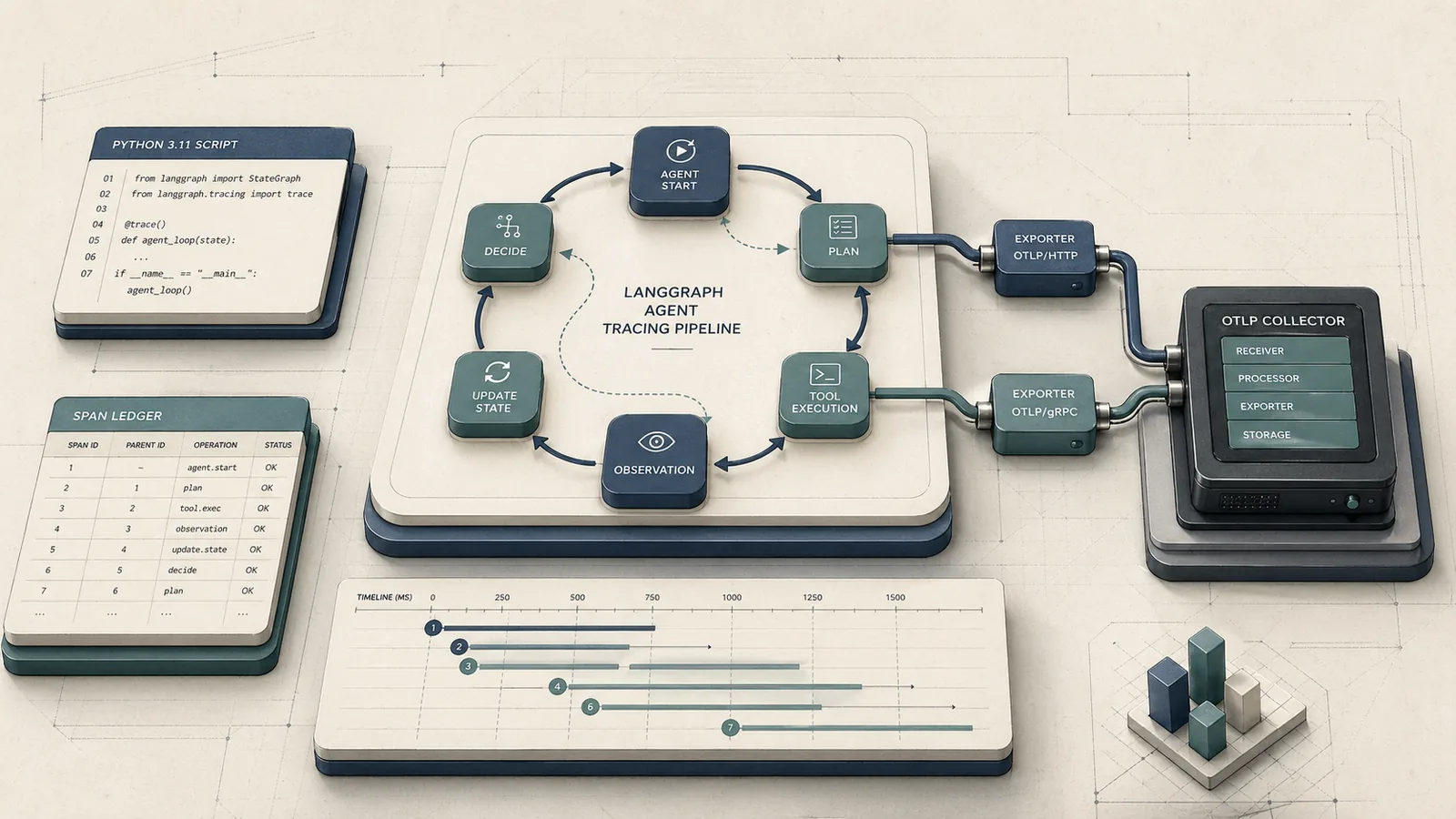
How We Compared LangSmith, Langfuse, and Arize Phoenix
No single tool wins across all production configurations. LangSmith wins for teams already deep in LangChain who need evaluation loops fast. Langfuse wins when trace volume is high and you want self-host control without per-seat billing surprises. Arize Phoenix wins when your team needs OpenTelemetry-native tracing with the freedom to build custom failure analysis on top of raw spans.
| Criterion | LangSmith | Langfuse | Arize Phoenix |
|---|---|---|---|
| SDK footprint | LangChain-native SDK | OpenTelemetry + Langfuse wrappers | OpenInference + Phoenix OTEL wrapper |
| Trace sampling controls | Limited in-product controls | Configurable server-side sampling | Configurable via OTEL sampler |
| Self-hosting | Not publicly available | Full self-host, all core features free | Phoenix is free to self-host with no feature limitations. |
| OpenTelemetry compatibility | Partial; proprietary tracing model | Native OTEL ingestion + custom collector | Built on OTEL; OpenInference instrumentation |
| Evaluation loops | First-class; integrated eval workflows | Scoring API + annotation queues | Evals available; less integrated by default |
| Entry-level pricing | 1 free seat; 5k base traces/month included; $39/seat/month for additional seats | Free self-host; Cloud plans vary | Free self-host; no per-trace pricing published |
| Ideal team fit | LangChain/LangGraph-heavy teams | High-volume production logging; cost-sensitive teams | OSS-first teams; custom trace analysis |
Evaluation criteria that matter in production
If an agent running overnight on GPT-4o burns $400 in tokens and you only discover it the next morning, your observability layer has already failed you. The criteria that separate these tools in production are not feature checklists — they are operational realities: how quickly you can instrument a new agent, what sampling controls you have before costs spiral, whether you own your data, and what you pay when trace volume grows.
Pro Tip: Evaluate these four axes before committing to any tool: (1) Integration complexity — does the SDK instrument your existing stack in under an hour, or does it require wrapping every LLM call? (2) Latency overhead — no vendor publishes a hard per-span overhead benchmark, so instrument a staging endpoint and measure p99 before rollout; OpenTelemetry provides the vendor-neutral tracing baseline, while LangSmith pricing, Langfuse pricing, and Phoenix docs document the product constraints you can verify directly. (3) Cost per 1M traces — LangSmith's Developer plan includes 1 free seat and 5k base traces/month before usage-based billing applies; Langfuse self-hosting pricing and Phoenix self-hosting docs show that both can run free at any trace volume when self-hosted. (4) Self-host vs. SaaS constraints — self-hosting trades infra ownership for data sovereignty and predictable cost at scale.
What we treated as hidden cost
Feature parity is not the competitive gap in this space. The real gap is exit cost. LangSmith's tracing model is tightly coupled to the LangChain SDK. If you later want a vendor-neutral OpenTelemetry pipeline that routes to Datadog, Honeycomb, or a Grafana stack, you face SDK replacement work, not just configuration changes. Langfuse's observability docs and Arize Phoenix's OpenTelemetry docs both sit on top of OpenTelemetry, which means spans can be re-routed to any OTEL-compatible collector without rewriting your instrumentation.
Watch Out: Three hidden costs that feature-list comparisons omit: (1) Proprietary SDK lock-in — LangSmith's tracing is coupled to LangChain primitives; migrating to a neutral OTEL pipeline requires reworking instrumentation, not just updating a config variable. (2) Data retention limits — cloud SaaS plans impose retention windows; verify current limits on each vendor's pricing page before assuming logs persist long enough for monthly incident reviews. (3) Migration friction — Langfuse's homepage explicitly states "Langfuse won't lock in your data, ever," while Langfuse self-hosting pricing confirms the core self-hosted feature set remains free; LangSmith pricing does not make an equivalent portability promise.
At-a-Glance Comparison Table
| Dimension | LangSmith | Langfuse | Arize Phoenix |
|---|---|---|---|
| Tracing model | Proprietary LangChain trace format | OpenTelemetry spans + Langfuse schema | OpenTelemetry + OpenInference |
| Sampling controls | UI-level filtering; limited server-side sampling | Configurable sampling rates + collector routing | OTEL sampler configuration |
| Self-hosting | SaaS only (as of Q1 2026) | Docker/Kubernetes; all core features free | Docker, Kubernetes, or cloud; Phoenix is free to self-host with no feature limitations. |
| OpenTelemetry support | Partial ingestion; not OTEL-native output | "Langfuse uses OpenTelemetry to provide observability into the application" | "Phoenix is built on top of OpenTelemetry and is powered by OpenInference instrumentation" |
| Ideal fit | LangChain/LangGraph teams, eval-first workflows | Production logging at scale, cost-sensitive, OTEL-first | OSS-first, custom embedding analysis, research teams |
All three tools answer "Can you use OpenTelemetry?" differently. Phoenix was built on it from the start. Langfuse routes spans through it natively and can push to your own collector via environment variables. LangSmith pricing and the surrounding LangChain documentation show a proprietary tracing model that ingests some OTEL-formatted data, but its core tracing surface remains coupled to the LangChain SDK — it is not a drop-in replacement for a standard OTEL pipeline.
LangSmith: strongest when LangChain eval loops are the priority
LangSmith is the right default for teams already standardized on LangChain or LangGraph. Its evaluation workflows are first-class citizens in the product, not bolted on. Prompt versioning, dataset management, and regression testing against trace history are integrated into the same UI where you review traces. That integration removes the friction that otherwise forces teams to build eval pipelines outside their observability tool.
The cost structure follows the product positioning. LangSmith's pricing page states the Developer plan includes 1 free seat and 5k base traces/month, with $39 per additional seat/month and usage-based billing as trace volume grows. For a small team running evaluation loops against a curated dataset, that pricing is manageable. For a production system pushing millions of traces, the math changes.
Is Langfuse better than LangSmith? For teams living in LangChain, the honest answer is no — LangSmith's evaluation UX is more integrated, and the friction of wiring Langfuse's scoring API to match LangSmith's built-in eval workflows is real. The calculus inverts the moment your team moves off LangChain or your trace volume makes per-trace billing a line item that competes with your inference budget.
Where LangSmith wins
LangSmith's strongest feature is the tight loop between trace capture and evaluation. "Every Fleet run is automatically traced in LangSmith." which means regression testing against live agent behavior requires no additional instrumentation. Prompt versioning is built into the same product, so A/B testing prompt changes against a held-out evaluation set takes minutes, not an afternoon of plumbing.
Pro Tip: If your team runs LangChain agents and needs to answer "did this prompt change hurt task completion rate?" faster than a sprint cycle, LangSmith's built-in eval loops are the fastest path. The combination of automatic trace capture, prompt versioning, and dataset-anchored evaluation is the product's primary differentiator — and it is difficult to replicate at equivalent speed with Langfuse or Phoenix without custom pipeline work.
Where LangSmith becomes expensive
LangSmith's usage-based billing ties directly to trace volume. The Developer plan's 5k base traces/month is adequate for development but exhausted quickly in a production system handling thousands of agent invocations daily. Beyond the base quota, costs scale with both seats and trace volume — confirm exact overage formulas on the current pricing page before projecting production spend, because published rates can change.
Watch Out: LangSmith's proprietary tracing SDK creates a harder migration path than it appears. Switching from LangSmith to a Langfuse or Phoenix deployment is not a configuration change — it requires replacing the instrumentation layer across every agent and chain in your codebase. Teams that standardize on LangSmith early and later want OTEL-compatible pipelines (to feed Datadog, Honeycomb, or Grafana dashboards alongside LLM traces) will encounter this friction directly. Budget time for SDK replacement, not just config updates.
Langfuse: best fit for high-volume trace sampling and self-host control
Langfuse answers the question "how much does LLM observability cost?" with a credible answer for cost-sensitive teams: at any trace volume, you can self-host all core features for free without limitations. That zero marginal-cost-per-trace model changes the economics of production logging compared to a SaaS tool with usage-based billing.
The tracing model is built on OpenTelemetry. Langfuse's observability overview and self-hosting configuration docs show that Langfuse can ingest OTEL spans and export them to your own collector via environment variables, which means your observability pipeline is not captive to a single vendor. For teams already running Grafana dashboards or forwarding traces to Datadog, Langfuse fits into that architecture without replacing it.
Cloud pricing for Langfuse exists for teams that prefer managed infrastructure, but the published snippet from Langfuse pricing does not expose a per-1M-traces dollar rate — consult the current pricing page for exact Cloud tier math.
Why Langfuse is attractive for production logging
Langfuse describes itself as "open source application tracing and observability for LLM apps". In practice, that means the instrumentation model does not force you to choose between observability and cost control. Server-side sampling reduces ingestion volume before traces hit your storage backend, which is the lever production teams need when an agent runs at scale and logging every span becomes its own budget line item.
Pro Tip: Langfuse's trace sampling controls and OTEL export path are the features that reduce observability spend at scale. Configure server-side sampling rates to capture 100% of error traces and a fraction of success traces — this preserves full fidelity for failure analysis while cutting storage costs on nominal runs. Combined with Langfuse's homepage claim that "Langfuse won't lock in your data, ever," you get trace context that maps directly to the prompt version that produced it, which is the data you need for post-incident review.
Where Langfuse needs more operational ownership
Self-hosting Langfuse shifts infra ownership to your team. Running a production Langfuse deployment on Docker or Kubernetes means your team owns the collector, the storage backend, and retention policy management. The self-hosting configuration docs show OTEL collector integration via environment variables, which implies operator-managed telemetry plumbing — not a managed SLA.
Watch Out: "Free to self-host" is accurate for Langfuse's core features, but the total cost of ownership includes the engineers who run and maintain the deployment. Some add-on features may require a license key even in self-hosted mode — verify current self-host licensing terms before planning your deployment. If your team does not have platform engineering capacity to maintain a telemetry pipeline, Langfuse Cloud removes that burden at the cost of per-trace pricing.
Arize Phoenix: open-source extensibility for custom failure analysis
Yes, Arize Phoenix is open source. The Phoenix documentation states it is "built by Arize AI and the open-source community" and is free to self-host with no feature limitations. Deployment is supported on Docker, Kubernetes, or your cloud of choice. There is no feature-gated enterprise tier blocking access to the tracing or analysis capabilities.
Phoenix's architecture is OpenTelemetry-native, powered by OpenInference instrumentation. OpenInference is an open standard for LLM observability built on top of OTEL semantic conventions — it defines span attributes for prompt/completion pairs, token counts, embedding vectors, and retrieval context. That schema is what makes Phoenix's embedding-based clustering of trace failures possible: spans carry enough structured metadata to cluster failures by semantic similarity without custom preprocessing.
Phoenix is distinct from Arize AX, Arize's enterprise ML monitoring platform. The Phoenix setup docs are explicit about this: confirm which product path you need (phoenix.otel vs arize.otel) before implementing, because the initialization paths differ.
Why Phoenix stands out for engineers
Phoenix's primary differentiator for engineers is the combination of OTEL-native tracing and OpenInference's rich span schema. The Phoenix OTEL SDK "provides a lightweight wrapper around OpenTelemetry with sensible defaults for Phoenix" — which means you can instrument a new agent in minutes using auto-instrumentation, then drop to raw OTEL configuration when you need custom span attributes.
Pro Tip: Phoenix's OpenInference instrumentation captures embedding vectors as span attributes, which enables clustering of trace failures by semantic distance in the Phoenix UI. For teams debugging retrieval-augmented generation failures — where a GPT-4o completion is wrong because the retrieved context was semantically off — this clustering surfaces patterns that latency-only dashboards miss entirely. No other tool in this comparison ships this capability out of the box without custom pipeline work.
Where Phoenix is less turnkey
Phoenix requires more setup investment to reach a production-ready workflow than LangSmith. The tracing configuration exposes two paths — the Phoenix OTEL wrapper and direct OTEL setup — and choosing between them requires understanding your deployment topology before writing instrumentation code.
Watch Out: Phoenix's flexibility is also its operational cost. Turning raw traces into team workflows (alert routing, annotation queues, incident dashboards) requires assembly work that LangSmith handles with built-in UI surfaces. Phoenix does not publish a managed SaaS with an equivalent turnkey experience to LangSmith's evaluation UI — the self-hosting path gives you the data, but dashboard design and workflow tooling are your responsibility. Budget implementation time accordingly.
Benchmarks: latency overhead, sampling control, and cost per 1M traces
No vendor in this comparison publishes an official latency-overhead benchmark with per-span or per-trace request overhead numbers. The following table reflects documented product constraints and pricing structures rather than synthetic benchmarks — do not treat these as measured latency figures.
| Metric | LangSmith | Langfuse | Arize Phoenix |
|---|---|---|---|
| Official latency overhead benchmark | Not published | Not published | Not published |
| Trace sampling (server-side) | Limited; primarily UI filtering | Configurable sampling rates; OTEL collector routing | OTEL sampler configuration |
| Self-host cost per 1M traces | SaaS only; usage-based pricing | Free (self-hosted); Cloud pricing varies | Free (self-hosted); no per-trace pricing published |
| Free trace quota (SaaS) | 5,000 traces/month (Developer plan) | Cloud plan; see current pricing | Not published as of Q1 2026 |
| OTEL-native export | No | Yes (environment-variable-configured collector) | Yes (built on OTEL) |
For teams projecting production spend: LangSmith's Developer plan includes 1 free seat and 5,000 traces/month, and at higher volumes the plan shifts to usage-based billing. Langfuse self-hosting pricing and Phoenix self-hosting docs both indicate zero per-trace cost when self-hosted; the cost is infrastructure (compute and storage for the backend) and engineering time for maintenance. As an illustrative example, if a production system processes 10 agent invocations per minute around the clock, LangSmith's 5k trace/month Developer quota is exhausted quickly and you should verify current overage rates on the pricing page.
What the benchmark numbers mean for agent teams
OpenTelemetry's vendor-neutral standard for distributed traces and metrics gives teams a baseline for sampling policy across all three tools. The practical takeaway from the benchmark gap is architectural: if you cannot get a vendor-published latency overhead number, instrument your own.
Pro Tip: Before deploying any of these tools to production, run a controlled test: send 1,000 sequential requests to a staging endpoint with observability enabled, then 1,000 without. Compare p50 and p99. This gives you a real overhead floor for your specific model and network topology — far more useful than a vendor claim. For sampling policy: start with 100% capture in staging, drop to 10–20% capture for nominal production traces, and hold 100% capture for any trace that hits an error status or exceeds your token-cost alert threshold. Both Langfuse and Phoenix support the OTEL sampler configuration to implement this; LangSmith's sampling controls are less granular.
Decision matrix: which tool to choose by team shape
| Team profile | Infra model | Sampling needs | Budget sensitivity | Best fit |
|---|---|---|---|---|
| LangChain/LangGraph-heavy, eval-first | SaaS acceptable | Low volume, eval datasets | Moderate | LangSmith |
| Polyglot stack, high trace volume | Self-host preferred | Granular server-side sampling | High | Langfuse |
| OSS-first, custom failure analysis | Self-host required | Full OTEL sampler control | High | Arize Phoenix |
| OTEL-first platform team (Datadog/Grafana existing) | Hybrid | OTEL collector routing | High | Langfuse or Phoenix |
| Research / experimentation | Self-host | Flexible | Minimal budget | Arize Phoenix |
Choose LangSmith when evaluation speed matters most
Bottom Line: LangSmith is the fastest path to useful LLM observability for teams already running LangChain or LangGraph. Automatic trace capture of every Fleet run, built-in prompt versioning, and integrated evaluation workflows eliminate the pipeline assembly work that slows down teams using Langfuse or Phoenix for eval-first use cases. Accept the LangChain ecosystem coupling and usage-based cost as the price of that integration speed.
Choose Langfuse when trace volume and control matter most
Bottom Line: Langfuse is the better production default when trace volume is high, your team wants self-hosted data sovereignty, or you need OTEL collector routing to an existing observability stack. "Langfuse won't lock in your data, ever" is a verifiable structural commitment — the self-hosted deployment is free at any trace volume for core features, and OTEL export paths mean your instrumentation investment is not captive to Langfuse's product roadmap.
Choose Arize Phoenix when extensibility and analysis depth matter most
Bottom Line: Phoenix is the right fit for teams that need to go deeper than latency and token-cost dashboards — specifically when diagnosing retrieval failures, clustering semantically similar errors, or building custom analysis workflows on top of raw spans. The OpenInference schema and OTEL-native tracing give you the data richness to build those workflows; Phoenix is "built by Arize AI and the open-source community" with no feature gates on self-hosted deployments. Accept the extra setup and workflow-assembly time as the cost of that extensibility.
What page-one competitor articles miss
Most comparisons of these tools reduce to feature lists: "LangSmith has eval, Langfuse has prompt management, Phoenix has clustering." That framing omits the criteria that determine total cost of ownership and exit flexibility.
| What competitors cover | What this article adds |
|---|---|
| Feature checklist (eval, prompts, tracing) | Trace-based billing math and self-host economics |
| SDK installation instructions | SDK coupling and migration friction |
| OpenTelemetry mention | OTEL-native vs. partial vs. wrapper architecture |
| Pricing tier names | Free trace quota exhaustion timeline in production |
| Self-hosting availability | Infra ownership burden and retention policy responsibility |
LangSmith charges by trace volume with 5k base traces/month on the Developer plan; Langfuse and Phoenix both support free self-hosting for core features at any trace volume. That single structural difference dominates cost projections for production systems — and most competitor articles leave it as a footnote.
Why feature lists are not enough
Engineers familiar with Datadog, Honeycomb, and Grafana already know that the right observability tool is not the one with the most features — it is the one whose telemetry model fits your existing data pipeline and whose cost scales predictably with your workload.
Pro Tip: Reframe the choice around two questions: (1) Does this tool's tracing model emit spans I can route to my existing OTEL collector, or does it require a parallel pipeline I have to maintain separately? (2) Does cost scale with traces, seats, or infra? For LLM systems with unpredictable token consumption, a tool that charges per trace creates cost risk that a self-hosted free tool eliminates. OpenTelemetry's vendor-neutral standard for distributed tracing means the instrumentation layer and the storage/analysis layer can be decoupled — Langfuse and Phoenix take advantage of that; LangSmith's proprietary model does not.
The canonical sources to trust
Watch Out: Community blog posts and tutorial videos about these tools go stale quickly — plan structures, trace quotas, and self-hosting requirements change with each product release. Trust manufacturer documentation for hard limits. Specifically: for LangSmith, use LangSmith pricing for current trace quotas and seat pricing; for Langfuse, use Langfuse self-hosting and Langfuse self-host pricing; for Phoenix, the Arize Phoenix docs are authoritative — and the setup docs explicitly warn: "Before implementing, confirm which product you need: Phoenix (phoenix.otel) or Arize AX (arize.otel)". The OpenTelemetry documentation is the reference standard for the tracing model all three tools build on or interface with.
FAQ
Is Langfuse better than LangSmith?
Langfuse is the better choice for teams running high trace volumes, preferring self-hosted data sovereignty, or operating outside the LangChain ecosystem. LangSmith is better when your team builds on LangChain or LangGraph and needs integrated evaluation workflows without custom pipeline assembly. See the decision matrix above for team-profile-specific guidance.
Is Arize Phoenix open source?
Yes. Phoenix is free to self-host with no feature limitations and is built by Arize AI and the open-source community. It deploys on Docker, Kubernetes, or cloud infrastructure. The codebase is community-contributed and the self-hosting docs confirm no feature gates at Arize Phoenix self-hosting.
Can you use OpenTelemetry with LangSmith or Langfuse?
Langfuse is fully OTEL-compatible: it ingests OpenTelemetry spans natively and can export to your own OTEL collector via environment variable configuration. Phoenix is built on OTEL from the ground up, using OpenInference instrumentation for LLM-specific span attributes. LangSmith's compatibility is partial — it can ingest some OTEL-formatted data, but its core tracing model is proprietary and coupled to the LangChain SDK. Teams wanting a full OTEL pipeline should default to Langfuse or Phoenix.
How much does LLM observability cost?
At scale, cost depends on deployment model. LangSmith pricing shows a Developer plan with 1 free seat and 5,000 traces/month plus $39 per additional seat/month, with usage-based billing on trace volume beyond the base quota. Langfuse and Phoenix are both free to self-host core features at any trace volume — your cost is infrastructure and engineering time. Langfuse Cloud and Phoenix managed tiers have their own pricing; consult current pricing pages before projecting production spend, as rates change.
What is the best LLM observability tool?
There is no single best tool. LangSmith is best for LangChain-heavy eval teams. Langfuse is best for production systems with high trace volume and cost constraints. Phoenix is best for teams that need custom failure analysis and full OTEL-native extensibility. Use the decision matrix in this article to match tool to team shape.
Sources & References
- Arize Phoenix Tracing Documentation — Primary source for Phoenix tracing architecture and OpenInference instrumentation
- Arize Phoenix Self-Hosting — Confirms free self-hosting with no feature limitations; Docker, Kubernetes, and cloud deployment
- Arize Phoenix OTEL Setup — Phoenix OTEL SDK wrapper documentation; Phoenix vs Arize AX product path guidance
- Arize Phoenix Overview — Top-level Phoenix documentation; OpenInference and OTEL architecture overview
- LangSmith Pricing — Authoritative source for Developer plan trace quota (5k/month), seat pricing ($39/seat/month), and usage-based billing model
- Langfuse Homepage — Source for data portability commitment ("Langfuse won't lock in your data, ever")
- Langfuse Self-Hosting Pricing — Confirms all core features free to self-host without limitations
- Langfuse Self-Hosting Configuration: Observability — OpenTelemetry ingestion and OTEL collector routing via environment variables
- Langfuse Observability Overview — "Open source application tracing and observability for LLM apps"
- OpenTelemetry Documentation — Vendor-neutral standard for distributed tracing and metrics; reference for OTEL compatibility claims
Pro Tip: Re-verify all pricing pages on the day you make your tool decision. LangSmith, Langfuse, and Phoenix all change plan structures, trace quotas, and self-hosting licensing terms on their own release cadences. The manufacturer documentation linked above is the authoritative source for current limits — not this article, and not any community post.
Keywords: LangSmith, Langfuse, Arize Phoenix, OpenTelemetry, OpenInference, LangChain, LangGraph, NVIDIA H100, JSON Schema, MCP, Datadog, Honeycomb, Grafana, SWE-bench, GPT-4o