Bottom line: when merging checkpoints is rational
Bottom Line: Merge when you already hold two or more fine-tuned checkpoints on a shared base model, your inference budget is strained by serving them separately, and your evaluation suite can detect capability regressions. In every other scenario — one checkpoint, incompatible base models, or unresolved data quality problems — merging adds governance overhead without a proportional return.
NVIDIA's technical blog frames the value proposition plainly: merging "combines the weights of multiple customized LLMs, increasing resource utilization and adding value to successful models" while it "reduces experimentation waste by repurposing 'failed experiments'." That framing is correct but conditional. GPU serving cost and MLOps cost reduction are real benefits only when the preconditions hold — compatible architecture, overlapping task domains, and a test gate rigorous enough to catch the merges that quietly degrade one capability while improving another.
What model merging changes in the cost model
Model merging, as Hugging Face's merge tutorial defines it, is "a technique that combines two or more LLMs into a single model." The operational implication of that single sentence is significant: one artifact, one serving endpoint, one set of infrastructure costs.
Without merging, a team that ran five LoRA or QLoRA fine-tuning experiments on Llama 3.1 70B and produced three deployable checkpoints faces a choice between serving three separate endpoints or retraining a single unified model from scratch. Both carry ongoing GPU serving cost and MLOps cost. Merging offers a third path: compose those checkpoints into one, pay the serving cost once, and absorb a one-time evaluation overhead instead of a recurring infrastructure tax.
| Cost dimension | Retrain from scratch | Serve separately | Merge checkpoints |
|---|---|---|---|
| Training compute | High (full run) | None after initial fine-tunes | None after fine-tunes |
| Serving endpoints | 1 | N (one per checkpoint) | 1 |
| GPU serving cost | Single model | Multiplied by N | Single model |
| Evaluation labor | Moderate (one eval run) | Low per model, but N runs | High (merge validation required) |
| MLOps overhead | Low (one artifact) | High (N pipelines) | Low–medium (one artifact + merge tooling) |
| Time to ship | Slowest | Fast per model | Fast after merge tooling is set up |
The mergekit repository describes itself as "tools for merging pretrained large language models" and supports multi-stage workflows including tokenizer transplantation — signaling that the tooling is capable but not trivial. MLOps cost reduction from merging is real on the serving side; the savings on the engineering side depend on how disciplined the team's evaluation process already is.
Why the same fine-tuning result can be cheaper to package than to retrain
Retraining to consolidate capabilities requires reproducing both datasets, aligning their formats, rebalancing sampling ratios, and running a full training job. When fine-tuning runs already exist — even runs that performed below expectations — merging can extract residual value without that cost.
NVIDIA's framing captures this precisely: merging "reduces experimentation waste by repurposing 'failed experiments'." A run that underperformed on the primary task but quietly learned something about a secondary task becomes an input to a merge rather than a sunk cost. The packaging cost of a merge is bounded: run the merge operation, evaluate against the target task suite, and ship if the gate passes.
Pro Tip: Before scheduling a retraining job, audit your checkpoint registry for runs on the same base model that came within 10–15 percent of target performance. Even a weak specialist checkpoint can improve a merged model's performance on secondary tasks without degrading the primary — but verify this empirically, not by assumption.
The break-even calculation tilts toward merging when retraining would require more than a few GPU-days and when at least two checkpoints already show non-overlapping strengths on different task slices.
Where the hidden cost shows up: evaluation labor, storage duplication, and platform overhead
NVIDIA positions merging as a way to increase "resource utilization," which is accurate for inference infrastructure. Where the savings erode is in the evaluation and platform layers that the GPU cost argument glosses over.
Storage duplication is a minor line item: a 70B model checkpoint runs roughly 140 GB in BF16, so three checkpoints cost ~420 GB before the merged artifact. The real cost is not disk space; it is the metadata, versioning, and lineage tracking overhead for each artifact in the model registry.
Platform-engineering overhead scales with merge complexity. The mergekit repository documents multi-stage merging and tokenizer transplantation as supported workflows — each stage is a reproducible experiment that needs its own run record, diff, and regression check. Teams without a disciplined MLOps pipeline discover this overhead after the first merge, not before.
Evaluation labor is the cost that most cost analyses omit entirely. A merged model must be evaluated on the full task suite of every contributing checkpoint, not just the primary task. A merge of a coding specialist and a summarization specialist needs coverage of both domains, plus any emergent failures at the intersection. That evaluation pass is not free, and it must be repeated for every merge configuration explored.
Watch Out: The GPU serving cost savings from merging one endpoint instead of two are straightforward to model. The evaluation labor — potentially doubling the test coverage required per release — is not. Teams that underestimate evaluation overhead discover that their MLOps cost reduction on infrastructure is offset by an increase in pre-release labor.
The merge landscape: retrain, serve separately, or compose checkpoints
Three operating modes exist for teams that produce multiple fine-tuned variants of the same base model. None dominates universally; the right answer is determined by task overlap, serving scale, and release isolation requirements.
| Operating mode | Best fit | Primary cost driver | Main risk |
|---|---|---|---|
| Retrain from scratch | Tasks are tightly coupled, data can be merged cleanly | Training compute | Long iteration cycle |
| Serve separately | Tasks are independent, release schedules diverge | GPU serving cost × N | Infrastructure sprawl |
| Merge checkpoints | Tasks overlap, checkpoints share base model | Evaluation labor | Silent capability regression |
This ComparisonTable makes the decision shape explicit: retraining buys fresh optimization, separate serving buys isolation, and checkpoint composition buys consolidation. "Model merging is a technique that combines two or more LLMs into a single model," as Hugging Face states, but that definition masks the operating constraint: both models must share the same base architecture and tokenizer for standard merge methods to apply without additional tooling.
Merging Mistral 7B Instruct checkpoints against each other is straightforward. Merging a Mistral 7B Instruct checkpoint against a Llama 3.1 70B checkpoint is not — the parameter shapes, layer counts, and token embeddings are incompatible without architectural surgery that no current production merge workflow makes routine.
When separate serving is still the right choice
Separate serving preserves release isolation, which matters when fine-tunes have independent compliance requirements, different SLA tiers, or release schedules that cannot be coordinated. A customer-facing summarization model and an internal code-review model may both run on Mistral 7B Instruct, but if their release cadences, regulatory review cycles, or failure tolerances differ, merging them creates a joint release dependency that separate serving would avoid.
GPU serving cost for two Mistral 7B models is manageable on modern A100 or H100 infrastructure, particularly with quantized serving. The breakeven point shifts when the team is running five or more variants — at that scale, the serving infrastructure multiplier justifies the evaluation overhead of a merge.
Pro Tip: If your fine-tunes have independent release approval workflows — compliance sign-off, security review, or separate product owners — keep them separate. Merging creates a new artifact that is neither checkpoint and must pass all applicable reviews as a new model, not as an update to either parent.
When retraining beats merging even if training is expensive
Retraining is the correct answer when the problem is task mismatch at the data level rather than capability packaging at the model level. If two checkpoints underperform because neither was trained on the right distribution, composing their weights via any merge method — including TIES-Merging, which its authors demonstrate "outperforms several existing methods in diverse settings" — cannot recover capabilities that were never trained in. Better data and a fresh fine-tuning run will dominate merge optimization in this regime.
Retraining also wins when the target task requires capabilities that are tightly coupled in a way that sequential specialization fragments. A model fine-tuned to reason step-by-step and a separate model fine-tuned on domain-specific terminology may produce a merge that has diluted reasoning fidelity precisely where the domain terminology matters most.
Watch Out: Model merging is a packaging strategy, not a data strategy. When your eval results show that both contributing checkpoints fail on the same failure modes, merging will not fix those modes — it will average them. Spend the training budget on better data before optimizing the merge configuration.
Cost and ROI framework for a merge decision
The ROI case for merging rests on three cost drivers: training spend avoided, inference duplication eliminated, and evaluation burden added. The net value is positive only when the first two exceed the third over the artifact's serving lifetime.
No retrieved source provides a universally applicable break-even formula — the numbers depend on the team's GPU serving cost, model size, utilization rate, and evaluation complexity. What follows is a template built from the cost structure described across NVIDIA, mergekit, and the OpenAI API pricing reference that teams commonly use as a baseline when deciding whether to self-host or call an API.
Inputs that matter: training spend, inference duplication, and evaluation burden
| Cost input | How to measure | Notes |
|---|---|---|
| Training spend per fine-tune | GPU-hours × per-hour rate | Compare A100/H100 spot pricing versus reserved |
| Serving cost per checkpoint | GPU-hours/month × utilization rate | Scales with N checkpoints linearly for separate serving |
| Merge operation cost | Negligible (CPU-hours, < 1 hour for 7B) | Scales slightly for 70B models |
| Evaluation labor per merge | Eng-hours × hourly cost, per task domain | Often 2–4× a single-checkpoint eval pass |
| API baseline (if applicable) | OpenAI API pricing per 1M tokens | Use as floor for "what hosted inference costs" |
This CostROITable can be read as a budget line item summary: if your merge operation is cheap, your serving horizon is long, and your evaluation burden is bounded, ROI improves quickly. NVIDIA's framing — "increasing resource utilization" — translates directly to the serving cost row. If two 7B checkpoints each occupy a dedicated GPU at 30 percent utilization, merging them into one artifact and serving from a single GPU at 60 percent utilization halves the serving cost. At current A100 spot pricing (approximately $2–3/hour depending on region and provider, though teams should verify current rates before budgeting), the monthly saving for two continuously running endpoints versus one is material for small teams operating on constrained compute budgets.
A simple break-even lens for small teams
The operational comparison between merging and ensembling clarifies the economics. Ensembling routes each request to multiple models and aggregates outputs — it multiplies inference cost by the ensemble size and adds latency. Merging routes each request to one model — it preserves single-model inference cost but pays the evaluation overhead once at release time rather than at every inference call.
For a small team, the break-even question is whether the one-time evaluation overhead of a merge amortizes faster than the ongoing serving duplication cost of separate endpoints.
| Scenario | Merge viable? | Primary reason |
|---|---|---|
| 2+ checkpoints, same base, >3 months serving horizon | Yes | Serving savings exceed evaluation cost within weeks |
| 2 checkpoints, divergent tasks, short serving horizon | Marginal | Evaluation cost may not amortize before deprecation |
| 5+ checkpoints, same base model | Strong yes | Infrastructure simplification alone justifies the merge |
| Ensemble currently in production | Yes, replace with merge | Merge eliminates per-request serving duplication entirely |
| Single checkpoint | No | Nothing to merge; evaluation overhead is pure cost |
| Checkpoints on different base models | No | Incompatible architectures require retraining, not merging |
This DecisionMatrix turns the trade-off into an operational rule: choose merge when long-lived duplication is the real problem, choose ensembling when you need multi-model inference behavior and can afford the multiplier, and choose neither when there is only one checkpoint or when the artifacts are not comparable. Merging beats ensembling on operating economics for any team that can afford the upfront evaluation pass — ensembling "combines two or more LLMs" at inference time, merging does so at packaging time, and packaging cost amortizes across every subsequent inference call.
Why merges fail to create value
Merges fail in two distinct ways: silent capability regression, where one task degrades without the metric suite catching it, and architectural incompatibility, where the checkpoints should never have been combined. A 2025 empirical survey on model merging algorithms warns directly that "inappropriate merging methods may lead to the degradation of important linguistic abilities." The failure is not hypothetical.
| Failure mode | Cause | Detection |
|---|---|---|
| Capability averaging | Task vectors partially cancel in weight space | Eval on each contributing task, not just the primary |
| Silent regression | One capability degrades below threshold unnoticed | Multi-domain eval suite with per-task pass/fail gates |
| Tokenizer mismatch | Checkpoints from different base model families | Architecture audit before attempting merge |
| Over-merged noise | Too many checkpoints merged without DARE sparsification | Ablation: compare 2-way vs. N-way merge quality |
| Task conflict | Fine-tunes trained on contradictory objectives | Review training data distributions before merging |
This DecisionMatrix makes the response explicit: if the failure mode is silent regression, expand evaluation coverage; if the issue is tokenizer mismatch or base-model incompatibility, stop the merge attempt and retrain or keep artifacts separate; if the problem is task conflict, fix the training data before revisiting composition. The ROI case for merging collapses when the merged model requires additional fine-tuning to recover degraded capabilities. At that point the team has paid for the original fine-tunes, the merge evaluation, and now a correction fine-tune — more total spend than a single joint fine-tune would have required.
Compatibility problems: when checkpoints are too different to combine safely
The NVIDIA blog's framing — merging "combines the weights of multiple customized LLMs" — presupposes that the checkpoints share a compatible architecture and tokenizer. This is a structural requirement, not a configuration option. Fine-tuned Llama 3.1 70B checkpoints can be merged against each other. A Llama 3.1 70B checkpoint cannot be merged with a Mistral 7B Instruct checkpoint using standard weight-space methods — the parameter shapes are incompatible at every layer.
Within a model family, further constraints apply. Checkpoints fine-tuned with significantly different data distributions — one trained on legal documents, another on Python code — may share architecture but have weight tensors that diverge enough to produce destructive interference under linear interpolation methods. The task-arithmetic literature describes this as sign conflict in the task vectors; TIES-Merging was designed specifically to address it by trimming low-magnitude parameters and resolving sign conflicts before merging.
Watch Out: Before attempting a merge of fine-tuned Llama 3.1 or Mistral checkpoints, verify that all contributing checkpoints were fine-tuned from the same base model revision. A merge between a checkpoint fine-tuned from Llama-3.1-70B-base and one fine-tuned from Llama-3.1-70B-Instruct may succeed technically but will produce unpredictable behavior because the instruction-tuning alignment is not uniformly distributed across the merged weights.
Evaluation discipline: how bad merges slip through without a strong test gate
The TIES-Merging paper demonstrates that "outperforms several existing methods in diverse settings" — but "diverse settings" requires that the team actually evaluate across those settings. A merge that performs well on the primary benchmark while quietly failing on a secondary task will pass a narrow test gate and ship.
The evaluation discipline required for safe merging is categorically different from single-checkpoint evaluation. Every merged artifact must be tested against the full task coverage of every contributing checkpoint. A team merging a summarization specialist with a classification specialist needs summarization benchmarks, classification benchmarks, and tests for cross-domain inputs that neither specialist saw in training.
Pro Tip: Treat each merge configuration as a new model release, not as an update to either parent. Assign it a distinct model ID, run the complete eval suite, and require the same sign-off threshold as any other production model. The merge operation itself takes minutes; the evaluation pass protects against the failure modes that cost more to fix in production than in staging.
Where model soup, SLERP, task arithmetic, and TIES fit
The merge method family shapes what kinds of capability combinations are achievable and at what risk of regression. Hugging Face's merge tutorial notes that it "will implement [these methods] using the mergekit library" — mergekit is the standard tooling surface for all four families. The mergekit repository describes itself as "tools for merging pretrained large language models" and lists SLERP and model-soup-style merging among its supported approaches.
| Method | Mechanism | Best fit | Primary risk |
|---|---|---|---|
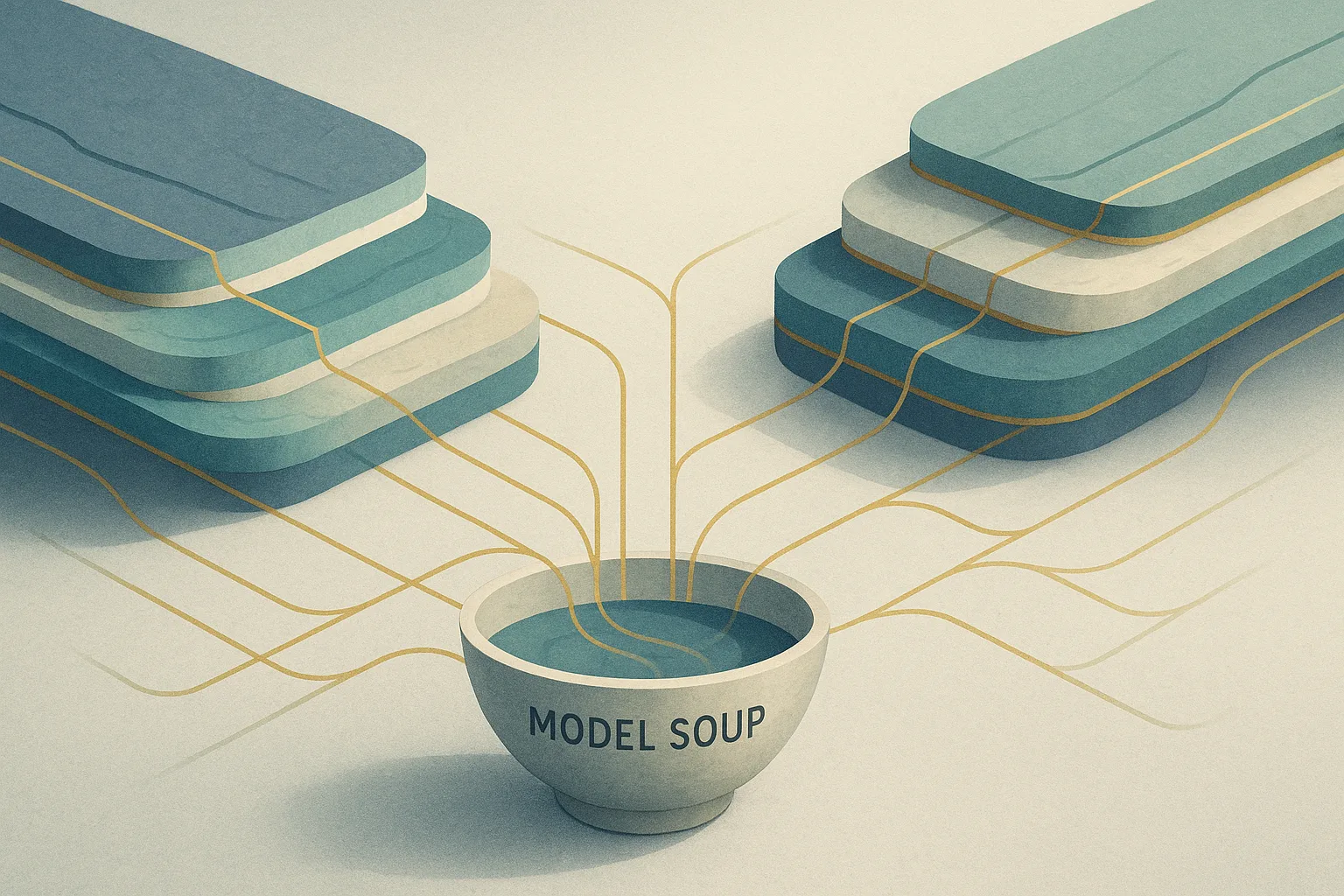
| Model Soup (NVIDIA's framing) | Uniform or weighted average of weights | Same task, different fine-tuning runs | Dilutes the strongest specialist |
| SLERP | Spherical linear interpolation between two checkpoints | Two-checkpoint blend with smooth interpolation | Only supports 2 models natively |
| Task Arithmetic | Adds task vectors (fine-tuned − base) to a base model | Multiple tasks with orthogonal objectives | Sign conflicts degrade shared parameters |
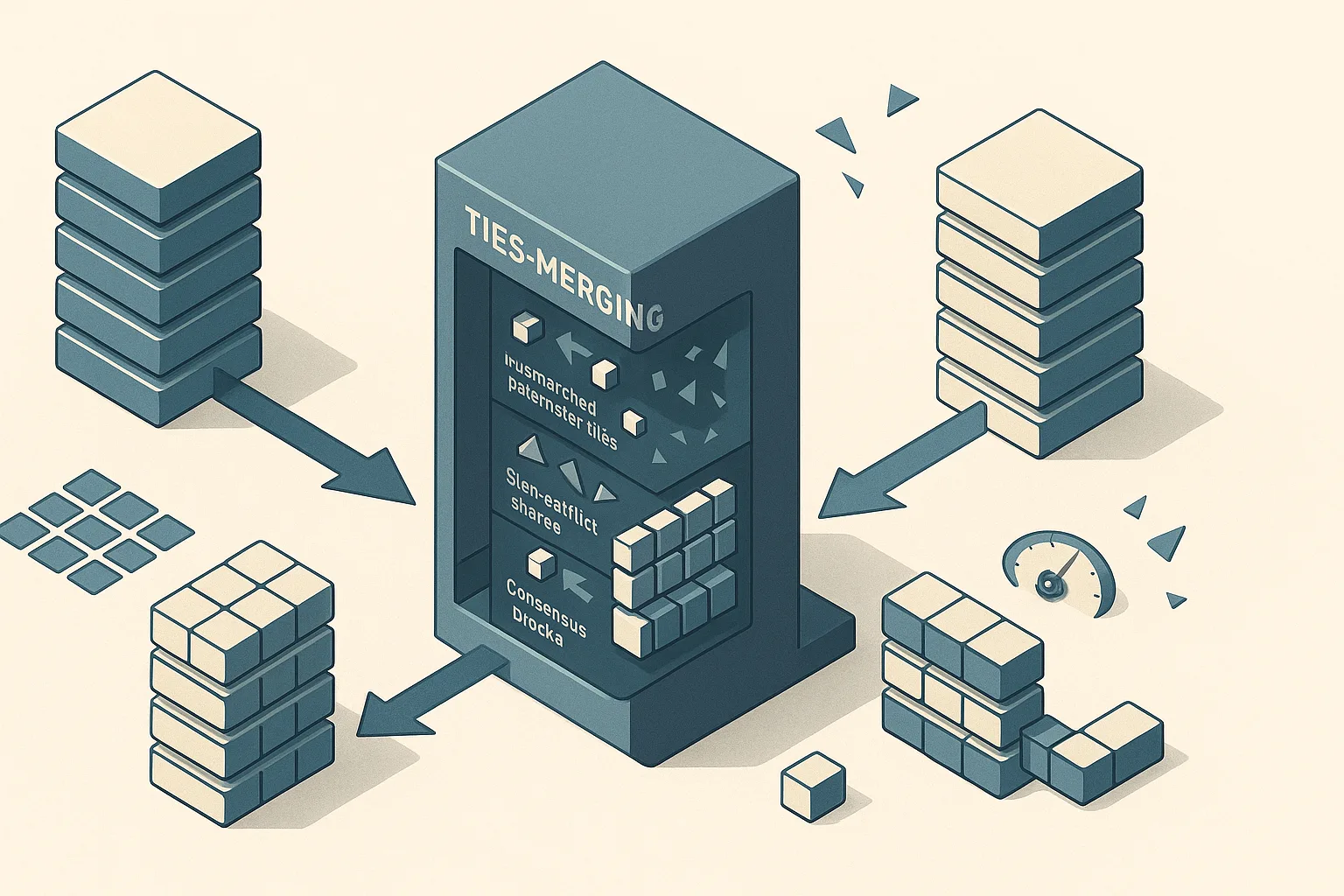
| TIES-Merging | Trims low-magnitude params, resolves sign conflicts, then merges | Multiple tasks, especially when task arithmetic degrades quality | More hyperparameters to tune |
| DARE | Randomly drops delta parameters before merging to reduce interference | High-parameter-count merges with many contributors | Requires calibration of drop rate |
This ComparisonTable shows the method family in compact form: soup is simplest, SLERP is smoothest for pairwise blends, task arithmetic is the cleanest conceptual extension of deltas, TIES is the most conflict-aware, and DARE is the most aggressive about reducing interference. The cost-first question is not which method sounds cleverest; it is which method can be evaluated and repeated without pushing the merge workflow into research-grade complexity.
Which merge method is most defensible for a cost-first team
For a team whose primary constraint is operating cost rather than maximum benchmark performance, TIES-Merging is the most defensible starting point. Its paper demonstrates it "outperforms several existing methods in diverse settings" across modalities, domains, task counts, model sizes, and fine-tuning configurations — the breadth of that claim means it is less likely to fail catastrophically on an unfamiliar task combination than simpler averaging methods.
| Method | Evaluation cost | Tooling maturity | Recommended when |
|---|---|---|---|
| Model Soup | Low | High (mergekit, HF) | Same task, multiple runs of same fine-tune |
| SLERP | Low | High (mergekit) | Two checkpoints, want smooth capability blend |
| Task Arithmetic | Medium | High (mergekit) | Tasks are clearly separable, low sign conflict |
| TIES-Merging | Medium–high | High (mergekit) | Multiple tasks, want published empirical backing |
| DARE | High | Medium (mergekit) | Many contributors, reducing parameter interference |
This ComparisonTable keeps the choice tied to deployment economics: low-cost teams should start with the method that is easiest to validate, not the method with the most elaborate name. For a cost-first team, "defensible" means reproducible and evaluable, not theoretically optimal. Any method available in mergekit with documented behavior and an active evaluation suite qualifies. DARE is worth considering when merging five or more checkpoints, where parameter interference becomes the dominant failure mode.
Decision framework: should your team merge or not?
The operating decision reduces to three questions: Do you hold compatible checkpoints? Is serving duplication the actual cost problem? Can your evaluation process detect regressions across all contributing task domains?
NVIDIA frames merging as "a practical response to the high cost of running many fine-tuning experiments that produce only one useful model." That framing is the right lens for the go/no-go decision. If your team's primary waste is experiment waste — checkpoints that captured partial capabilities and then sat unused — merging directly addresses the problem. If your primary waste is inference cost on a hosted API like OpenAI's API, merging a self-hosted model solves a different problem and requires a separate build-versus-buy analysis.
| Condition | Merge | Serve separately | Retrain |
|---|---|---|---|
| 2+ compatible fine-tunes, same base, overlapping tasks | ✅ | — | — |
| Tasks independent, release schedules diverge | — | ✅ | — |
| Data quality is the primary performance bottleneck | — | — | ✅ |
| 5+ checkpoints, serving cost is material | ✅ | — | — |
| Only 1 checkpoint exists | — | ✅ | — |
| Base models differ across checkpoints | — | ✅ | Consider joint training |
| Regulatory or compliance isolation required per model | — | ✅ | — |
This DecisionMatrix gives the go/no-go rule in operational form: merge when compatible checkpoints and duplicated serving cost dominate, serve separately when release isolation or heterogenous tasks dominate, and retrain when the data pipeline is the true bottleneck. The green-light threshold is not subtle; it becomes visible once you compare serving duplication against evaluation overhead with the same discipline you would use for any production release.
Choose merge when you already own several compatible checkpoints
The green-light criterion is straightforward: if the team's checkpoint registry holds two or more fine-tunes from the same base model revision — whether Llama 3.1 70B, Mistral 7B Instruct, or another open-weights model available on Hugging Face Hub — and those fine-tunes show non-overlapping strengths on different task slices, merging is the rational next step.
Bottom Line: Merging delivers positive ROI when: (1) at least two compatible checkpoints already exist, (2) serving them separately creates a duplicated GPU or API cost that persists for months, and (3) the team has the evaluation coverage to validate capability retention across both task domains. All three conditions must hold. One or two is insufficient.
The MLOps cost reduction from consolidating N endpoints to one is immediate and recurring. The evaluation overhead is one-time per merge configuration. For a team with a three-month or longer serving horizon on multiple checkpoints, the economics favor merging in almost every scenario where compatibility is confirmed.
Skip merge when the real bottleneck is data quality, not model packaging
If the team's fine-tuned checkpoints underperform because the training data was noisy, too small, or misaligned with the target distribution, checkpoint merging will not recover that performance. NVIDIA's framing — "adding value to successful models" — contains the implicit constraint: the models must already be successful on their individual tasks before merging can add cross-task value.
Teams actively paying OpenAI API inference costs while their fine-tuning pipeline remains in an early iteration are likely better served by investing in data quality and evaluation infrastructure before merging becomes the relevant optimization. Merging is a packaging decision for a mature fine-tuning workflow, not a shortcut through an immature one.
Watch Out: Merging two weak checkpoints produces one weak checkpoint. If your eval scores on individual fine-tunes are below the deployment threshold, the path to production runs through better data and retraining — not through merge configuration search. MLOps cost reduction from merging is only available downstream of a working fine-tuning pipeline.
Questions teams should answer before adopting checkpoint merging
Merging introduces a new artifact class into the model registry. MergeKit's support for multi-stage merging and tokenizer transplantation signals that non-trivial operational questions arise before adoption. Treat these as pre-flight checks, not retrospective audits.
-
Do all contributing checkpoints share the same base model revision? Architecture and tokenizer compatibility are prerequisites. Verify model card provenance, not just model family name.
-
Does the team have eval coverage for every contributing task domain? A merged model must pass the test suites of all parent checkpoints. If coverage gaps exist, fill them before merging.
-
What is the serving horizon for the merged artifact? Evaluation overhead only amortizes if the model serves long enough. Short-lived experiments are better served separately.
-
Does the release process support a new model ID? A merged checkpoint is a new model. It should carry its own ID, lineage record, and approval status — not be treated as an update to either parent.
-
Is serving duplication the actual cost problem? If GPU utilization is low, consolidation savings are low. Quantify the serving cost before assuming merging closes a material gap.
-
How many checkpoints are in scope? Two-checkpoint merges are operationally simple. Five-checkpoint merges using DARE require more careful hyperparameter search and more extensive evaluation. Scale the evaluation investment accordingly.
-
Who owns the merged model? Merging checkpoints from different product areas or teams creates a governance question. Establish ownership before the merge runs, not after a regression is found in production.
Pro Tip: Run a dry-merge evaluation on a held-out validation set before committing to checkpoint merging as a workflow. A single SLERP or TIES merge followed by a full eval pass takes hours, not days, and either confirms the ROI case or surfaces the compatibility problem before it enters the release pipeline. This is the cheapest validation step in the entire decision process, and teams that skip it consistently discover the incompatibility at the worst possible moment — after the serving infrastructure has already been consolidated.
Sources & References
- NVIDIA Technical Blog: An Introduction to Model Merging for LLMs — Primary engineering reference; frames merging as a resource utilization and experimentation waste reduction strategy
- mergekit GitHub repository (arcee-ai) — Canonical open-source tooling for LLM weight merging; supports SLERP, TIES, DARE, model soup, and multi-stage workflows
- Hugging Face: Merge LLMs with mergekit — Practitioner tutorial covering four merge methods implemented via mergekit
- Model Soups (Wortsman et al., 2022) — Original paper demonstrating accuracy improvement via weight averaging without inference cost increase
- TIES-Merging (Yadav et al., 2023) — Paper introducing sign-conflict resolution for multi-task weight merging; demonstrates empirical superiority across diverse settings
- Empirical Survey on Model Merging Algorithms (2025) — Survey documenting failure modes including linguistic ability degradation from inappropriate merge method selection
- OpenAI API Pricing — Reference for hosted inference cost baseline; verify current prices at publication time before using in cost models
Keywords: mergekit, SLERP, TIES-Merging, DARE, GPU serving cost, NVIDIA Model Soup, Task Arithmetic, OpenAI API pricing, MLOps cost reduction, Llama 3.1 70B, Mistral 7B Instruct, GPT-4o mini, Hugging Face Hub, LoRA, QLoRA