Bottom line for adopting Mamba-style models
Bottom Line: Teams running high-volume, long-context workloads — document processing, streaming inference, or sustained summarization at 100K+ tokens — should actively pilot Mamba-style selective state space models now, because the paper reports 5× higher throughput than Transformers, linear scaling in sequence length, and improved performance on real data up to million-length sequences. The workload-fit caveat is firm: any workflow where exact token recall, needle-in-haystack retrieval, or dense cross-document lookup is a primary requirement should either stay with attention-based models or evaluate a hybrid architecture like Jamba before committing. The adoption case is economic, not architectural idealism — and it only holds when context length and throughput cost are the dominant cost drivers, not accuracy-sensitive retrieval fidelity.
The OpenAI API pricing page as of August 2026 lists GPT-5.6 Terra at $2.00 per 1M input tokens and $12.00 per 1M output tokens with a 1.05M context window. For teams already spending meaningfully at that price tier, the infrastructure economics of self-hosting a Mamba-class model — with its linear memory footprint — become a defensible comparison. For teams moving fewer than tens of millions of long-context tokens per month, the migration cost likely exceeds the savings. That threshold shapes every decision this article frames.
Why long-context economics changed the evaluation
Mamba addresses the core scaling asymmetry in production serving: standard Transformer attention scales quadratically in both compute and memory with sequence length, while Mamba's selective state space model scales linearly. As context windows have grown from 8K to 128K to over one million tokens, this asymmetry shifted from academic footnote to a real line item in infrastructure budgets.
The practical consequence: a Transformer serving 1M-token inputs requires a KV cache that grows proportionally with sequence length multiplied by the number of layers and attention heads. Mamba maintains a constant-size recurrent state regardless of sequence length. When OpenAI API pricing is $2.00 per 1M input tokens, the cost of repeatedly injecting long context into a hosted API is directly proportional to token count — every request at full context costs the same. Self-hosting a model that handles the same sequence length at lower memory pressure per request changes the per-query economics.
| Dimension | Transformer attention | Mamba (selective SSM) |
|---|---|---|
| Compute scaling with sequence length | Quadratic O(L²) | Linear O(L) |
| Memory scaling with sequence length | Quadratic (KV cache grows) | Constant (fixed recurrent state) |
| Inference throughput (paper-reported) | Baseline | ~5× higher |
| Native content-based retrieval | Strong (attention over all tokens) | Weaker (compressed state, no explicit lookup) |
| API cost model (external hosting) | Per-token metered | Per-token metered (same if using API) |
The evaluation changed because token window growth exposed the quadratic cost regime. Teams that kept context short never felt this pressure. Teams scaling into 100K–1M token ranges now encounter it directly.
Where transformer costs compound as context grows
KV-cache pressure is the primary driver of long-context serving cost — not parameter count and not FLOPs in isolation. In a Transformer serving long sequences, each layer materializes a key-value cache for every token in the sequence. At inference time, generating each output token requires attending over the entire cached sequence. Memory bandwidth and on-device memory capacity become the binding constraints before compute does.
Pro Tip: When evaluating your serving spend for long-context workloads, measure KV-cache memory footprint per request, not just model parameter memory. A 7B-parameter Transformer serving 200K-token contexts can exhaust H100 HBM faster than a 13B model on short sequences, because the cache — not the weights — is what scales with input length. OpenAI API pricing is per-token, so you pay for the length regardless of whether you're managing the cache yourself.
The Mamba paper's hardware-aware recurrent algorithm sidesteps this by avoiding materialization of a growing latent state. The paper says, "We design a hardware-aware parallel algorithm in recurrent mode." The recurrent state remains fixed in size. This is the architectural property that converts a quadratic memory curve into a flat one — and it is the operational basis for Mamba's cost argument at long context.
Why linear sequence scaling matters for production budgets
The Mamba paper reports fast inference with 5× higher throughput than Transformers, linear scaling in sequence length, and improved performance on real data up to million-length sequences. Translated into budget terms: a self-hosted Mamba-class model can process proportionally more long-context requests per GPU-hour than an equivalent Transformer, and memory pressure does not spike with each increase in context length.
| Scenario | Hosting model | Est. infra pressure at 500K tokens | Engineering migration effort | Net ROI signal |
|---|---|---|---|---|
| High-volume, 100K–1M token pipelines | Self-hosted Mamba/Mamba-2 | Low (constant state size) | High (validation, tooling, monitoring) | Positive at sufficient volume |
| Moderate volume, 32K–100K tokens | Self-hosted hybrid (Jamba-style) | Medium | Medium | Marginal — evaluate carefully |
| Low volume or short context (<32K) | API (e.g., OpenAI GPT-5.6 Terra) | N/A (managed) | None | Negative — API wins on simplicity |
| Retrieval-centric at any context length | Transformer or hybrid | Varies | Avoided | SSM migration not recommended |
No public source has produced a universal cost-per-1M-tokens figure for self-hosted Mamba deployments — throughput cost depends on batch size, sequence length distribution, serving stack, and hardware. The table above uses qualitative ranges; your actual numbers require a scoped pilot with your workload profile.
Where Mamba-style models fit best in a production portfolio
Mamba supports long context explicitly: the paper reports performance improvements on real data up to million-length sequences, making it one of the few architectures that has demonstrated usable behavior at that scale. The paper also states, "On language modeling, our Mamba-3B model outperforms Transformers of the same size and matches Transformers twice its size, both in pretraining and downstream evaluation." But supporting long context and excelling at every long-context task are different claims. The architecture's constant-size recurrent state compresses sequence information progressively — which is highly effective for tasks that benefit from accumulated state but creates recall degradation for tasks requiring pinpoint retrieval of specific earlier tokens.
| Workload type | Mamba-style fit | Rationale |
|---|---|---|
| Streaming inference (continuous input) | Strong | Constant state, no cache growth, stable latency |
| Long-document summarization | Strong | Accumulated context compression maps naturally |
| Fixed-pattern long inputs (logs, telemetry) | Strong | Predictable structure, no random-access lookup |
| Multi-document QA with exact citation | Weak | Exact token recall degrades with compressed state |
| Needle-in-haystack retrieval | Weak | Attention-based models handle explicit lookup better |
| Code completion at long file context | Moderate | Depends on how far back the relevant symbol appears |
| RAG pipeline reranking | Weak | Retrieval fidelity is the primary requirement |
The million-token context capability is real, but its value is task-conditional. A model that can process a million tokens with linear memory pressure and summarize them well is different from a model that can recall any specific token from position 847,392.
Streaming, summarization, and fixed-pattern long inputs
Selective state space models gain their efficiency advantage from compressing history into a fixed-size learned state — an operation that suits workloads where the model needs to accumulate and distill information continuously rather than retrieve specific prior tokens on demand. Streaming inference, where new tokens arrive continuously and the model must maintain a coherent running state, is the highest-fit scenario. The constant recurrent state eliminates the need to re-attend over a growing context on each new input, which is precisely the throughput cost that compounds in Transformer serving.
Long-document summarization benefits for the same reason: the model integrates information across the full sequence without materializing attention over all prior positions. Fixed-pattern inputs — server logs, sensor telemetry, structured document templates — further simplify the state-space dynamics, because the model learns stable compression pathways for repeated structures.
Production Note: Mamba-style selective SSMs deliver their most predictable latency and lowest memory pressure when input patterns are sustained and structurally regular. Workload profiles with high variance in sequence length or with sudden structural discontinuities in the input stream may show less consistent throughput gains than the paper's benchmarks suggest. Measure latency distribution (p50, p95, p99) in your pilot, not just average throughput.
Retrieval-heavy workflows and explicit lookup tasks
The Mamba paper itself flags that a key weakness in prior structured sequence models was their inability to perform content-based reasoning — the exact gap that Mamba's input-dependent SSM parameters are designed to partially address. The operative word is "partially." Making SSM parameters input-dependent improves content sensitivity but does not replicate the explicit all-pairs attention mechanism that makes Transformers reliable for precise token-to-token lookup.
For workflows where the answer to a query is a verbatim span from a long document — legal contract retrieval, regulatory compliance citation, code symbol lookup across large codebases — the compression inherent in recurrent state becomes a liability. The model cannot guarantee that a specific token from deep in the sequence remains recoverable, because the state evolves to prioritize recent and high-salience content.
Watch Out: If your production task requires exact recall of specific tokens from arbitrary positions in a long context — contract clause extraction, precise code reference, regulatory citation — do not treat Mamba's million-token benchmark as evidence of equivalent retrieval fidelity to attention-based models. The Transformer KV cache, for all its memory cost, preserves explicit access to every prior token. Hybrid attention architectures are the operationally safer fallback when that property is business-critical.
What competitors miss about production-readiness
Most existing coverage of Mamba describes the architecture accurately and notes its limitations in broad strokes. What that coverage omits is a production-readiness framework: the specific conditions under which migration cost, validation burden, and hybridization overhead change the ROI sign.
The key framing gap is treating Mamba adoption as a binary architecture choice rather than a portfolio position decision. The relevant questions are not "Is Mamba better than Transformers?" but rather: At what context length and request volume does the throughput advantage outweigh integration risk? What validation suite does your team need to confirm accuracy parity on your specific task distribution? And when does a hybrid model like Jamba — which combines attention layers with SSM layers — give you enough retrieval fidelity to avoid revalidating the entire application stack?
| DecisionMatrix | Green-light | Pilot only | Hold |
|---|---|---|---|
| Migration effort | High initial integration accepted because savings are material | Moderate integration only if a scoped pilot can bound risk | Avoid migration work when context lengths stay short |
| Validation burden | Full task-distribution testing and rollback planning funded up front | Limited pilot harness with clear regression thresholds | No room for evaluation means no adoption |
| Hybridization overhead | Not needed if the workload is dominated by summarization or streaming | Acceptable if retrieval is mixed and accuracy uncertainty remains | Unacceptable when the extra complexity outweighs savings |
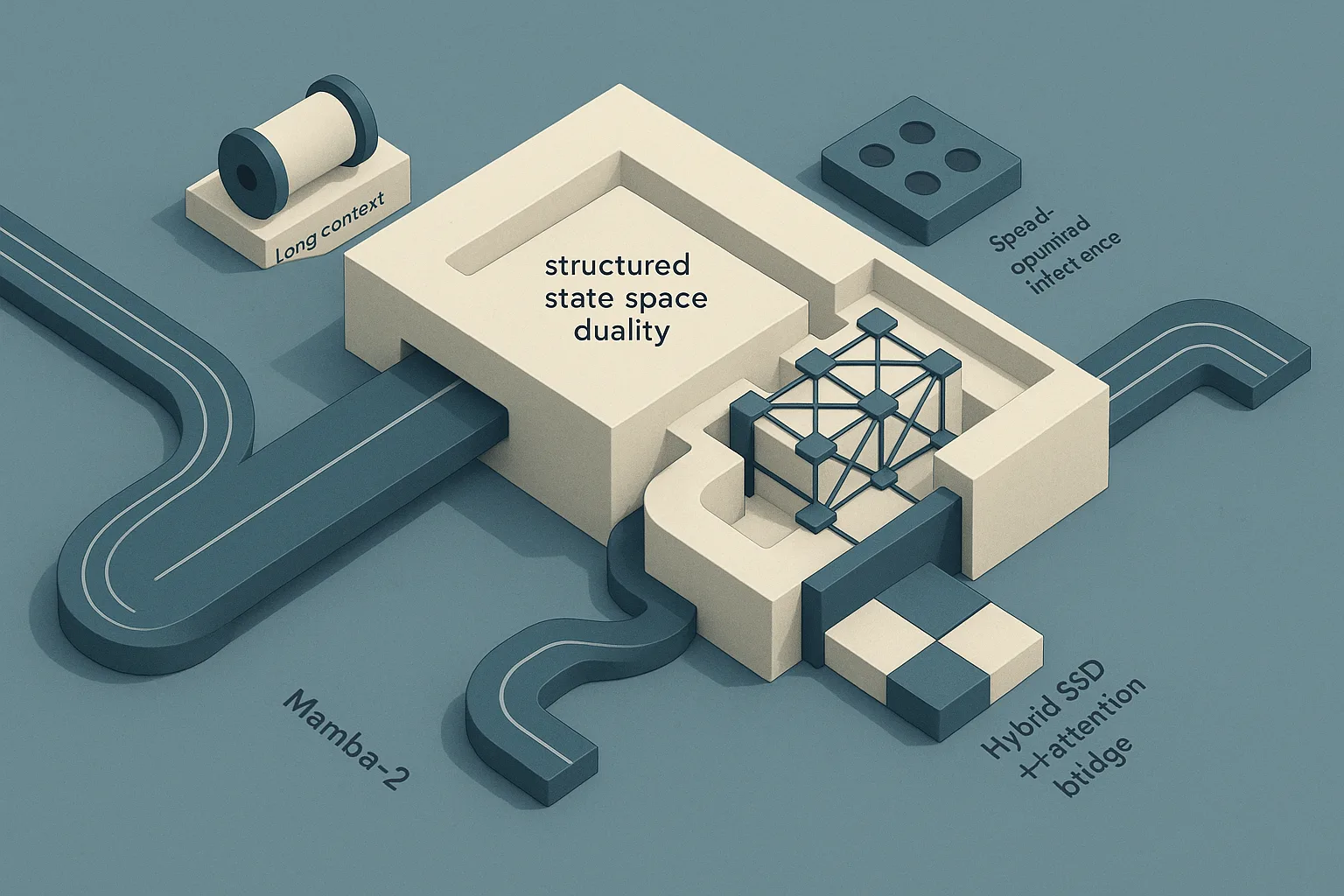
Mamba-2 extends the original architecture with structured state space duality, providing stronger theoretical grounding and some practical training efficiency improvements. Neither Mamba-2 nor Jamba has a publicly verified production benchmark suite that settles the retrieval fidelity question across arbitrary task distributions. The decision framework must therefore be built on workload-specific pilots, not paper benchmarks.
Against OpenAI API pricing at $2.00–$12.00 per 1M tokens, the migration to self-hosted Mamba-style models only makes financial sense when volume is high enough that the infrastructure savings exceed the total engineering cost of integration, validation, monitoring, and maintenance. That threshold varies by organization but is rarely met at fewer than tens of millions of long-context tokens per month.
Why hybrid models often win the deployment decision
Jamba, which interleaves Transformer attention layers with Mamba-style SSM layers in a Mixture-of-Experts architecture, represents the practical middle path that pure-SSM advocates often discount. The deployment logic is straightforward: attention layers preserve explicit retrieval fidelity for the minority of positions where exact lookup matters, while SSM layers handle the majority of sequence processing at linear cost. The result is a model that avoids the worst-case memory profile of a pure Transformer at long context while retaining enough attention capacity to handle content-based retrieval.
| Dimension | Pure Mamba-style | Jamba-style hybrid |
|---|---|---|
| Memory scaling at long context | Best (constant state) | Better than Transformer (partial KV cache) |
| Retrieval fidelity | Weaker | Stronger (attention layers preserved) |
| Operating complexity | Lower (uniform architecture) | Higher (attention + SSM + MoE routing) |
| Serving infrastructure maturity | Emerging | Emerging (less mature than pure Transformer) |
| Best fit | Streaming, summarization | Mixed workloads, retrieval-inclusive tasks |
For many teams evaluating production adoption in mid-2026, Jamba-style hybrid attention architectures can reduce accuracy risk relative to a pure SSM bet when retrieval fidelity matters, but they also add architectural complexity and less mature serving tooling. Teams should not treat this as a settled question — both ecosystems are moving.
How open limitations shape operational risk
The strongest verified claim about Mamba is performance on benchmarks up to million-length sequences during training and evaluation. What remains unresolved in public literature — and what matters operationally — is how selective state space models degrade on in-context learning tasks as training horizon grows, and whether the compressed recurrent state creates systematic forgetting patterns on specific content types that benchmark suites do not expose.
The paper reports 5× higher throughput than Transformers, linear scaling in sequence length, and improved performance on real data up to million-length sequences. Peak benchmark scores at million-token context do not prove stable performance across arbitrary task distributions at production runtime. A model that achieves strong summarization scores on held-out documents may still exhibit selective degradation on unusual input patterns, adversarial sequences, or out-of-distribution content types that your production traffic contains.
Pro Tip: Pilot evaluations for Mamba-style models must measure performance degradation over sequence depth, not just aggregate accuracy. Specifically: test your actual task at 10K, 100K, 500K, and (if relevant) 1M token contexts and plot accuracy as a function of position. If performance drops nonlinearly at depths your production traffic reaches, that degradation is an operational risk that no paper benchmark will have captured for your workload.
Cost, migration effort, and platform maintenance
The ROI calculation for migrating from OpenAI API pricing (or equivalent managed inference) to self-hosted Mamba-style models has three terms: inference cost savings, one-time migration cost, and ongoing platform maintenance cost. Teams systematically undercount the second and third terms.
Inference cost savings are real when throughput cost at long context is the dominant spend — Mamba's reported 5× throughput advantage and linear memory scaling translate directly into more requests per GPU-hour when the workload fits. Platform maintenance — model updates, serving infrastructure upgrades, monitoring, incident response — is a recurring cost that managed API providers absorb and self-hosters own entirely.
| Migration scenario | Inference cost trajectory | One-time migration cost | Ongoing maintenance | Net ROI at 12 months |
|---|---|---|---|---|
| High-volume, long-context, summarization workload | Significant reduction | High (validation, integration, monitoring) | Moderate (maturing ecosystem) | Likely positive above ~50M tokens/month |
| Mixed workload (retrieval + summarization) | Moderate reduction | High + hybridization overhead | High (dual architecture) | Uncertain — pilot required |
| Low-volume or short-context workload | Minimal reduction | High relative to savings | Moderate | Negative — stay on API |
| Retrieval-centric workload | Minimal reduction (wrong fit) | High + accuracy regression risk | High | Negative |
No public source quantifies total migration cost in dollars universally — it depends on team size, existing infrastructure, and task complexity. Use this table as a directional filter, not a financial model.
What the migration work usually includes
A Mamba-style production migration is not a model swap. Because Mamba's architecture eliminates attention and MLP blocks entirely in favor of selective SSMs, the surrounding components — tokenization pipelines, prompt formatting assumptions, output post-processing, and any attention-based interpretability tooling — require review and likely modification. The paper explicitly says, "We integrate these selective SSMs into a simplified end-to-end neural network architecture without attention or even MLP blocks (Mamba)."
The standard migration work includes: accuracy validation on your task distribution (not just paper benchmarks), integration testing of the serving layer, latency profiling under realistic batch sizes and sequence length distributions, monitoring and alerting for output quality drift, and rollback planning for regression scenarios. Each of these is engineering time that does not appear in inference cost comparisons.
Watch Out: Teams that scope migration as "swap the model endpoint" routinely discover mid-rollout that their evaluation harness, output format assumptions, or downstream processing logic was implicitly tuned to Transformer-style attention behavior. Validate your full application stack — input to output — on the new model before any production traffic shift. Rollback capability must be in place before you route live traffic, not added afterward.
Mamba-2 introduces architectural changes from the original that may require revalidation even for teams that piloted Mamba. Treating each model generation as a clean slate for validation is the operationally conservative posture.
When the ROI case is weak or negative
Low-volume workloads do not generate enough inference savings to recover migration costs. Short-context workloads — under 32K tokens — do not meaningfully stress Transformer memory scaling, so the linear-vs-quadratic argument doesn't apply. Retrieval-centric tasks where hybrid attention is necessary for accuracy introduce hybridization complexity that erodes the throughput advantage.
| Scenario | Recommended posture | Rationale |
|---|---|---|
| Short context (< 32K tokens) | Hold | Quadratic cost regime not reached; API is simpler |
| Low token volume (< 10M tokens/month) | Hold | Migration cost exceeds inference savings |
| Primary task: exact retrieval or citation | Hold | SSM compression reduces recall fidelity |
| Mixed workload, unclear accuracy profile | Pilot only | Validate before committing infrastructure |
| Jamba-style hybrid needed for accuracy | Pilot only | Higher complexity; ecosystem maturity still maturing |
Decision framework for teams evaluating adoption
The adoption question — should teams adopt Mamba-style state space models for long-context production workloads — resolves to three scenarios based on workload fit and cost pressure. Mamba-2 and hybrid variants expand the option set but do not change the underlying decision logic. OpenAI API pricing provides the external cost baseline against which self-hosting economics are compared.
| Signal | Green-light | Pilot only | Hold |
|---|---|---|---|
| Context length | >100K tokens dominant | Mixed (32K–100K) | <32K tokens |
| Monthly token volume | >50M long-context tokens | 10M–50M | <10M |
| Primary task type | Summarization, streaming | Mixed retrieval + summarization | Exact retrieval, citation |
| Accuracy risk tolerance | High (with validation plan) | Medium (with fallback) | Low (any regression is unacceptable) |
| Team infra capacity | Dedicated ML platform team | Partial capacity | No ML platform capacity |
| Ecosystem maturity requirement | Tolerant of emerging tooling | Requires hybrid fallback | Requires mature tooling |
Green-light conditions
Teams meet green-light conditions when long-context serving is the dominant cost driver, the primary task is summarization or streaming inference, token volumes justify infrastructure investment, and the team has the platform capacity to own model hosting and monitoring.
Bottom Line: The strongest case for adopting Mamba-style models today is a high-volume, long-context pipeline where throughput cost on current infrastructure is a material budget item and the workload does not depend on exact token recall. At 100M+ long-context tokens per month against OpenAI API pricing rates, the inference economics of self-hosted linear-scaling models become a defensible infrastructure investment — provided your team funds a real validation and monitoring program alongside the migration.
Pilot-only conditions
Teams in the pilot-only zone have real cost pressure but face uncertainty about accuracy parity, mixed workload types, or incomplete benchmark coverage for their specific task distribution. The right move is a scoped pilot — a defined traffic slice, a full evaluation harness, and a clear regression threshold — before any production commitment.
Watch Out: If exact recall remains important for any meaningful portion of your traffic, do not treat a pure Mamba-style model as the pilot target. Run the pilot on a hybrid attention architecture like Jamba instead — it gives you the memory scaling benefit on the majority of sequences while preserving attention-based retrieval where it matters. A pilot that discovers accuracy regression after full migration is not a pilot; it's a rollback incident.
Hold conditions
Teams should hold when evaluation data is sparse, workloads are predominantly short-context or retrieval-centric, or the organization lacks platform capacity to manage a self-hosted model serving stack. The ecosystem around Mamba-2 and hybrid SSM architectures is maturing rapidly, but "rapidly maturing" is not the same as "mature." Benchmarks that didn't exist six months ago will exist six months from now.
Pro Tip: If you cannot yet answer these three questions with data — What is my average and p95 context length in production? What is my retrieval-versus-summarization task split? What does a 5% accuracy regression cost my application? — you do not have enough information to make a sound adoption decision. Delay adoption, instrument your current system to capture these numbers, and re-evaluate with real workload data. OpenAI API pricing changes over time; recheck the current rates before finalizing any build-vs-buy model.
FAQ
What is Mamba used for?
Mamba is used for long-context sequence modeling where linear memory and compute scaling matter more than exact token-level retrieval. It is best fit for summarization, streaming, and high-volume long-document processing.
Is Mamba better than Transformers?
It is better on inference speed and long-context memory efficiency, but not on retrieval fidelity. The answer depends on whether you prioritize throughput cost or exact token recall.
Does Mamba support long context?
Yes. The paper demonstrates performance up to million-length sequences, but retrieval accuracy at extreme depths remains task-dependent.
Why is Mamba faster than Transformers?
The constant-size recurrent state eliminates KV-cache growth, and the paper's hardware-aware parallel algorithm reduces memory traffic. At 500K tokens, Transformer KV cache memory scales with sequence length; Mamba state does not.
Is Jamba better than Mamba?
For retrieval-inclusive workloads, hybrid attention can be the safer choice; for pure throughput-maximizing workloads, the hybrid overhead can reduce the advantage. The right choice depends on your task mix.
"On language modeling, our Mamba-3B model outperforms Transformers of the same size and matches Transformers twice its size, both in pretraining and downstream evaluation." — Mamba paper abstract, arXiv:2312.00752
That result holds for general language modeling benchmarks. It does not transfer to retrieval-specific tasks or guarantee accuracy parity on workloads outside the paper's evaluation suite. For buyers, "better than Transformers" is a regime-conditional statement, not a universal claim.
Sources & References
- Mamba: Linear-Time Sequence Modeling with Selective State Spaces (arXiv:2312.00752) — primary architecture paper and source for throughput, scaling, benchmark, and migration claims cited in this article.
- OpenAI API Pricing — official vendor documentation used as the cost baseline for build-vs-buy economics.
Keywords: Mamba, Mamba-2, Jamba, RWKV 7, Striped Hyena 2, OpenAI API pricing, arXiv 2312.00752, selective state space models, Mixture-of-Experts, Transformer KV cache, hybrid attention, million-token context, H100, throughput cost