Moving fraud is built around time pressure. Scammers know you're juggling lease deadlines, job start dates, and a truck that needs to be back by noon — and they exploit every second of that urgency. The good news: every common scam pattern has a concrete counter-move, and most of them take less than 15 minutes to execute before you hand over a dollar.
This guide closes a gap the current top-ranking resources miss: it gives you the full verification workflow — not just a list of warning signs, but the exact steps to confirm a mover is licensed, insured, and complaint-free before you sign anything.
How to spot moving company scams before you book
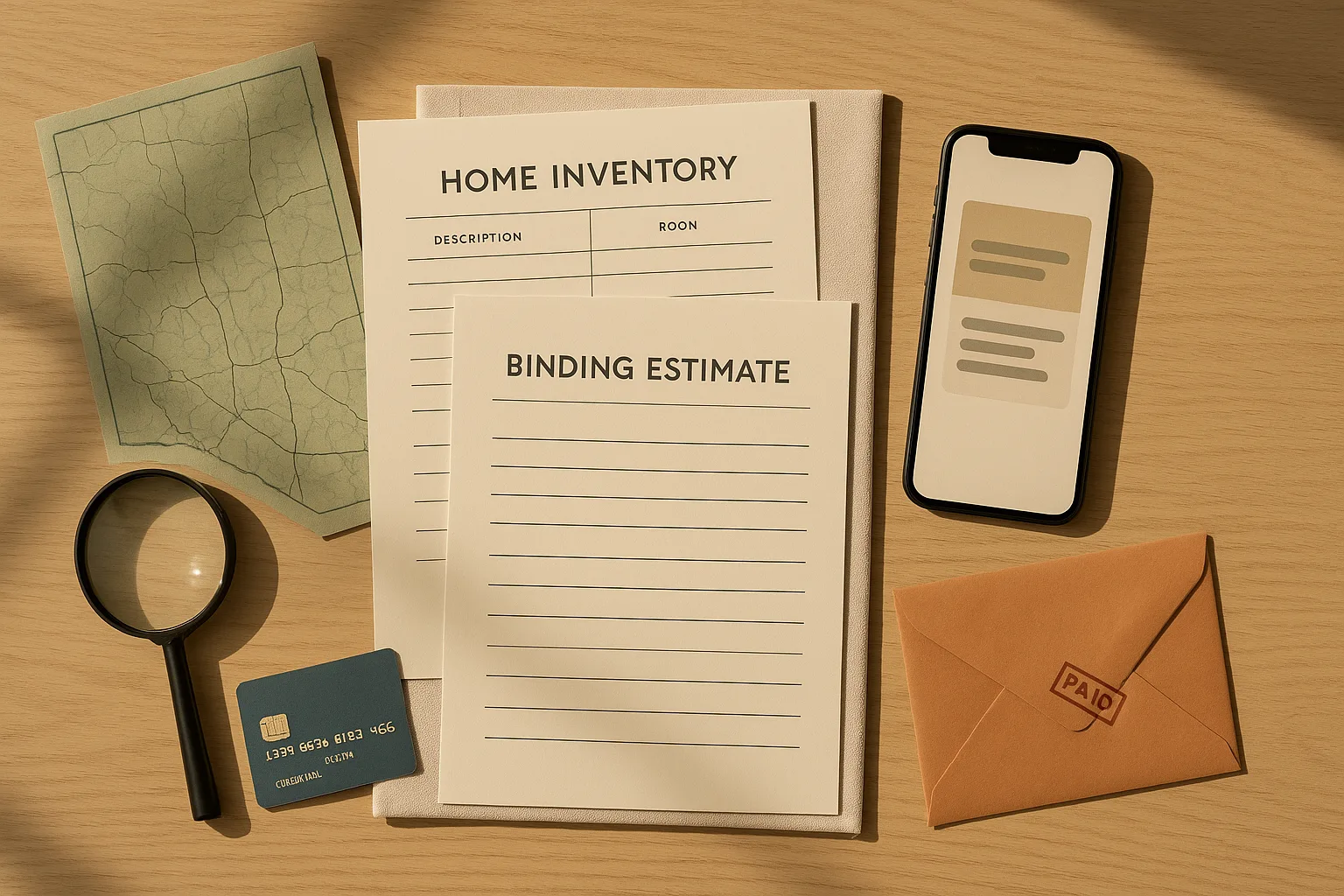
The fastest screen for a legitimate moving company is four things: a USDOT number you can look up, a physical street address, a written binding estimate, and willingness to accept a credit card. Any mover that fumbles on even one of those before asking for money deserves a hard pass.
Moving company comparison sites and mover quote platforms can connect you with vetted carriers, but the lead they send you is a starting point — not a guarantee. You still need to run your own FMCSA verification before you pay a deposit. According to FMCSA's Protect Your Move program, all interstate household goods movers and brokers must be registered with the FMCSA. If a company can't produce a USDOT number, stop the conversation.
FMCSA's National Consumer Complaint Database lets you pull six years of complaint history on any carrier using its name, USDOT number, or Docket number. Running that search takes about two minutes and can save you thousands of dollars and a lot of heartache.
Watch Out: First-time renters booking their first apartment move and buyers closing on a home for the first time are the highest-risk groups — not because they're less intelligent, but because they've never been through the process and don't know what "normal" paperwork looks like. If this is your first interstate move, the checklist in the verification section below is non-negotiable.
Last-minute bookings also thin out your legitimate options, which is exactly when fraudulent companies swoop in with suspiciously fast availability and unusually low quotes.
At a Glance: Spot the basics first: missing USDOT number, no physical address, vague or non-binding paperwork, pressure for cash, and a quote that is far below the others. FMCSA puts it plainly on Protect Your Move: "Stop Moving Scams in their Tracks. File a complaint." The step-by-step verification workflow below is the article’s competitive advantage because it shows you how to confirm each detail before you book.
Why moving scams spike during long-distance and last-minute moves
Distance and deadline pressure are the two ingredients that let scammers operate. When you're moving across state lines, you can't easily drive over to inspect the company's warehouse. When you're booking two weeks out instead of two months, you lose the luxury of getting three competing quotes and sleeping on the decision.
Watch Out: First-time renters booking their first apartment move and buyers closing on a home for the first time are the highest-risk groups — not because they're less intelligent, but because they've never been through the process and don't know what "normal" paperwork looks like. If this is your first interstate move, the checklist in the verification section below is non-negotiable.
Last-minute bookings also thin out your legitimate options, which is exactly when fraudulent companies swoop in with suspiciously fast availability and unusually low quotes.
Moving company scam red flags: bait-and-switch, hostage freight, and fake companies
The table below covers the six scam patterns that account for the overwhelming majority of moving fraud complaints. Cross-reference any mover you're considering against every row.
| Scam Type | How It Works | The Tell |
|---|---|---|
| Bait-and-switch pricing | Low quote upfront; inflated invoice on moving day | Estimate is non-binding or vague on scope |
| Hostage freight | Mover loads your goods, then demands more money before unloading | Driver won't release goods without a cash payment not in the contract |
| No-show movers | Company takes a deposit, then disappears or sends no crew | No verifiable physical address; USDOT not found |
| Fake companies | Shell company with a real-looking website but no operating authority | Name doesn't match FMCSA record; no MC number |
| Blank contract traps | Hands you a contract with open fields that get filled in later | Any signature line with blank price, weight, or service fields |
| Large cash-only deposits | Demands cash or wire transfer before move begins | Refuses credit card; asks for 25–50% upfront in cash |
According to FMCSA guidance on movers vs. brokers, a broker does not transport your goods and does not own trucks or employ movers — they arrange transportation on your behalf. That's a legitimate model, but it adds a layer of risk: brokers are required to use only FMCSA-registered movers. If a broker can't tell you the name and USDOT number of the actual carrier showing up at your door, that's a red flag regardless of how professional their website looks.
Bait-and-switch pricing and lowball quotes
A lowball estimate is the entry point for the most common moving scam pattern consumers encounter. Here's how it plays out in practice:
You call three moving companies for a two-bedroom apartment move, roughly 800 miles. Company A quotes $2,400. Company B quotes $2,800. Company C quotes $1,350. Company C shows up, loads your furniture, and hands you a new invoice for $3,100 at the destination — citing extra packing materials, a fuel surcharge, and a "long carry" fee from the street to your door that wasn't disclosed upfront.
That jump from $1,350 to $3,100 is bait-and-switch pricing. It works because Company C's original quote was non-binding and vague on scope, meaning the contract language didn't lock in the final number.
Pro Tip: When comparing mover quotes, a quote that's more than 20–25% below the next-lowest bid deserves serious scrutiny. Legitimate movers compete on price, but their operating costs — fuel, crew wages, insurance, equipment — don't vary enough to justify a quote that's half the market rate.
Hostage freight and sudden price increases on moving day
Hostage freight is the most financially damaging moving scam because by the time it activates, your belongings are on a truck you don't control. Here's the step-by-step pattern:
- Mover provides an attractively low estimate (usually non-binding).
- Crew arrives, loads all your goods, and you sign the bill of lading.
- Truck arrives at the destination — or doesn't arrive on schedule.
- Driver calls and says the weight came in higher than estimated, or that new "accessorial" charges apply.
- Driver demands cash payment of the difference before unloading. No cash, no furniture.
Watch Out: If a mover demands cash you didn't agree to in writing before they'll unload your belongings, you are in a hostage freight situation. Do not pay. Document everything immediately and escalate — the steps are in the final section of this article.
Federal law (49 CFR Part 375) limits what a mover can collect on a non-binding estimate shipment: they cannot require you to pay more than 110% of the original non-binding estimate at delivery. Anything beyond that collected demand is illegal. A binding estimate eliminates this exposure entirely — the mover cannot charge more than the quoted amount at delivery.
No-show movers, fake companies, and blank contract traps
Fake moving companies have improved their surface legitimacy considerably. Many operate professional-looking websites with stolen photos of trucks, fabricated "A+ BBB ratings," and fake Google reviews. The tells are in the paperwork and the verification databases — not the website design.
Contract red flags — never sign if you see: - Any price, weight, or service field left blank - A company name on the contract that doesn't match the name on the website or quote - No USDOT or MC number printed on the contract header - No physical street address (P.O. boxes don't count) - An "authorization" field that allows the mover to add charges without your signature
Identity and data risk: When you request a moving quote, you're sharing your home address, your move date (i.e., when your home will be empty), and sometimes your phone number, email, and payment details. Fake companies use this information. Before requesting quotes from any company you haven't verified through FMCSA, consider running your contact information through a reputable identity theft protection service — if your data shows up in a broker database you didn't authorize, you'll want to know. This is especially relevant if you've submitted quotes to multiple sites during a frantic last-minute search.
Binding estimate vs non-binding estimate for movers
The single document that separates protected consumers from vulnerable ones is the binding estimate. Per FMCSA's official guidance: "A binding estimate guarantees that you do not have to pay more than the estimated amount at the time of delivery." The same source defines a non-binding estimate as one that "A non-binding estimate helps you determine the cost of your move, but it is not a guarantee of your final costs."
| Binding Estimate | Non-binding Estimate | |
|---|---|---|
| Definition | Written agreement locking in the total cost | A cost projection, not a guarantee |
| Final charges | Cannot exceed the quoted amount | Based on actual shipment weight, services provided, and the mover’s tariff provisions in effect; see FMCSA Subpart D |
| Scam resistance | High — eliminates hostage-freight overcharge | Low — driver can present a higher invoice |
| When to demand it | Always, especially for interstate moves | Acceptable only if you add it to a binding later |
Per FMCSA's Rights and Responsibilities documentation, a binding estimate must be a written agreement made in advance and must be based on the quantities and services listed on the estimate. If the actual move requires services not listed (e.g., you added a piano that wasn't on the inventory), the mover can charge for those additions — but only for the additions, and only with your prior written agreement.
What a binding estimate should include in writing
A binding estimate that's missing any of these fields is incomplete and shouldn't be signed:
- Complete inventory list — every item, including boxes counted by room
- Origin and destination addresses — full street addresses, not just city/state
- Pickup and delivery date windows — exact or range dates, not "TBD"
- Access conditions — stairs, elevator availability, distance from truck to door
- Total estimated weight — for weight-based pricing
- Itemized charges — base rate, fuel surcharge, packing materials if applicable
- Accessorial services — any shuttle, long carry, appliance service, or assembly listed separately with individual prices
- Mover's full legal company name, USDOT number, and physical address
- Your signature and the mover's authorized signature
- A statement that it is a binding estimate
Which estimate details should never be blank or vague
Open-ended charges are how scammers bridge the gap between the low quote you accepted and the inflated invoice they hand you on moving day. Never sign an estimate that leaves these fields open:
- Labor hours — "TBD" or "as needed" is not acceptable; a range or not-to-exceed figure must be specified
- Packing materials — if the mover is packing for you, the material charges must be listed, not "cost + 15%"
- Shuttle fee — if your neighborhood requires a smaller vehicle to reach your door, the fee must be pre-disclosed
- Stair carry charge — per-flight rates must be stated upfront, not assessed on delivery day
- Long carry fee — if the truck can't park within a standard distance of your door, the per-foot or flat charge must appear in writing
- Fuel surcharge — must be a fixed percentage or flat dollar amount, not "market rate"
- Storage fee — if delivery is delayed, the per-day or per-week storage rate must be specified in advance
How to verify a moving company with USDOT and MC numbers
This is the section that the current top-ranking search results don't give you in enough operational detail. Run this protocol on every interstate mover before you pay a deposit. It takes about 15 minutes total and gives you a defensible paper trail if something goes wrong.
The complete quote-check protocol:
- Get the USDOT number — ask the company directly; any legitimate mover will provide it without hesitation
- Look up the USDOT number on FMCSA's SAFER database
- Confirm operating status — should read "Authorized for HHG" (household goods); anything else is a problem
- Check the MC number — this is the motor carrier number; confirm it's active and matches the company name on your quote
- Run the complaint search at FMCSA's National Consumer Complaint Database — six years of history, searchable by name, USDOT, or Docket number
- Confirm insurance — ask for a certificate of insurance naming your household goods; the mover's operating authority requires it
- Verify a physical street address — Google Street View the address; it should be a warehouse or office, not a residential property or empty lot
- Match the company name across the website, the quote document, and the bill of lading before you sign anything
If the name on the bill of lading differs from the name on the quote, stop and ask for an explanation in writing. According to FMCSA guidance, the bill of lading is the legally binding contract between you and the mover — the name on that document is the entity responsible for your goods.
How to look up a USDOT number in the FMCSA database
Go to SAFER database and enter the USDOT number in the search field. The record will return:
- Legal name — must match the name on your quote exactly
- Operating status — must be "Active"
- Entity type — Carrier, Broker, or Both; a broker-only entity cannot physically move your goods
- Operation classification — should include "HHG" (household goods) for residential moving
- Carrier Safety Rating — "Satisfactory" or "None" (unrated) is normal; "Conditional" or "Unsatisfactory" is a hard stop
Cross-reference the same company in the FMCSA complaint database. A handful of complaints over six years at a large carrier is less alarming than three complaints in the past 90 days at a small operation. Read what the complaints say — "damage to goods" is different from "held goods hostage for extra payment."
How to confirm insurance, complaint history, and a real physical address
Verification checklist before you pay a deposit:
- [ ] Certificate of insurance received and reviewed (confirms cargo liability and general liability coverage)
- [ ] Policy active and not expired
- [ ] Complaint history reviewed — note any complaints involving hostage freight, non-delivery, or fraud
- [ ] Physical street address confirmed via Google Maps satellite view
- [ ] Company name on website = company name on quote = company name on FMCSA record
- [ ] Phone number resolves to a business, not a forwarding service
- [ ] Mover can name the specific carrier if they are a broker
Watch Out: Submitting your personal information to unverified quote aggregators carries real data exposure risk. Your name, current address, move date, and destination are enough for identity fraud. Pairing your pre-move research with a service like LifeLock or Aura gives you real-time alerts if your data shows up where it shouldn't. This matters most during a move because your address history is in flux and credit monitoring is often the last thing on your mind.
How much deposit is normal for movers and how to pay safely
A legitimate interstate mover typically collects no deposit at booking or a small deposit — generally under $500 — to secure your date. Full payment for most interstate moves is due at delivery, not before the truck rolls. Per FMCSA's payment guidance, the standard payment model is Cash on Delivery (COD): "payment is required at the time of delivery at the destination residence."
If a moving company demands 25%, 50%, or 100% of the total cost upfront, treat that as a significant warning sign — especially if they insist on cash, wire transfer, or a cashier's check.
Normal deposit range: $0–$500 for most interstate moves booked through legitimate carriers
Red-zone deposit demands: Anything above 20% of the total estimate paid before the truck is loaded
Before you pay any deposit — even a small one — your mover quote and contract paperwork must be complete. Per FMCSA requirements, a bill of lading is legally required before transport begins. Don't pay anything to a company that can't produce complete paperwork first.
Why credit card is safer than cash, wire, or cashier's check
| Payment Method | Dispute Protection | Recovery if Scammed | Recommended? |
|---|---|---|---|
| Credit card | Strong — FTC-backed chargeback rights | High — dispute within 60 days | ✅ Yes |
| Debit card | Limited — bank policy dependent | Moderate | ⚠️ Caution |
| Check | None once cashed | Very low | ❌ No for deposits |
| Cashier's check | None once cashed | Near zero | ❌ No |
| Wire transfer | None | Near zero | ❌ No |
| Cash | None | Zero | ❌ Never |
The FTC's guidance on billing errors specifies that credit card billing disputes must be filed in writing within 60 days of the date the first statement containing the error was sent. That 60-day window is your most powerful financial protection — but only if you paid by credit card. Cash, wire, and cashier's check offer no equivalent mechanism.
Use a credit card for every moving-related payment you can. If the mover refuses credit card entirely, that refusal is itself a red flag worth taking seriously.
When a large upfront deposit is a scam signal
A company that insists on a large deposit before paperwork is finalized is structuring the transaction to maximize their take if they disappear. Here's the logic: once your goods are loaded and you've paid 50% upfront in cash, you have limited leverage. A legitimate mover doesn't need that leverage position — they have your goods, a legal contract, and COD payment at delivery.
Watch Out: No mover should pressure you to pay before the binding estimate is signed, the inventory is complete, and the bill of lading is prepared. If you hear "we just need a deposit to hold your date and we'll sort out the paperwork later," walk away.
Questions to ask a moving company before you book
These questions accomplish two things simultaneously: they screen for legitimate operators, and they put inexperienced companies on notice that you know what you're looking for. Most scammers will fumble or deflect on at least two or three of these. Use these alongside mover comparison tools to vet any moving company that makes your shortlist.
Questions about licensing, ownership, and who will actually show up
- "What is your USDOT number and MC number?" — A legitimate carrier answers immediately. A broker should also provide the carrier's USDOT, not just their own.
- "Are you a carrier or a broker?" — If they're a broker, ask: "Who is the actual carrier, and what is their USDOT number?"
- "Will your company's employees be handling my move, or will you subcontract to a third party?" — Subcontracting isn't automatically bad, but you need to know who is actually showing up.
- "Can you provide a physical street address for your company headquarters or operations depot?" — Get it in writing and verify it.
- "Can you provide proof of insurance, including cargo liability coverage?" — Ask for a certificate of insurance, not a verbal assurance.
- "What is your cancellation policy, and what happens to my deposit if I cancel?" — Reputable movers have a written policy.
Questions about estimates, inventory, and extra fees
- "Will you provide a binding estimate?" — Any hesitation or redirection to "non-binding" for an interstate move is worth pushing back on.
- "Will you conduct an in-home or virtual walkthrough before quoting?" — A mover who quotes from a phone description alone is more likely to add charges on moving day.
- "Are there stairs at my origin or destination, and how is that charged?" — Get the per-flight rate in writing.
- "Does my neighborhood require a shuttle vehicle, and what does that cost?" — Shuttle fees can run $150–$400 and are often sprung on delivery day if not pre-disclosed.
- "How do you calculate fuel surcharges, and is that included in the estimate?" — It should be itemized, not estimated verbally.
- "What happens if my goods go into storage — what's the daily or weekly rate?" — Required disclosure for interstate moves.
- "What is your process if actual weight differs from estimated weight?" — On a binding estimate, additional weight shouldn't increase your bill unless you added items after signing.
What to do immediately if movers hold your belongings hostage
If a driver demands additional money — especially in cash — before unloading your goods, you are in a hostage freight situation. Act on every step below as fast as possible, in this order.
Immediate action steps:
- Document everything in real time — photograph every piece of paperwork, record the driver's name and the truck license plate, and screenshot every text or call log.
- Do not pay the additional demand in cash. If you must pay something to get your goods released, use a credit card and dispute the unauthorized charge immediately afterward.
- File a complaint with FMCSA — call 1-888-368-7238 and use FMCSA's complaint portal the same day.
- Contact your state's consumer protection office or state moving regulator — many states have their own moving regulations that parallel FMCSA's and can act faster on in-state carriers.
- Call local law enforcement if the driver threatens to leave with your goods or refuses to negotiate. Holding goods without legal authority can constitute theft under state law.
- Contact your credit card issuer to open a dispute on any charges you paid beyond the binding estimate.
As FMCSA acknowledges openly on its Protect Your Move page: "FMCSA does not have the authority to resolve claims against a moving company." That means regulators can investigate and fine the company, but they can't force immediate release of your goods. Your strongest immediate lever is law enforcement, your credit card dispute, and documentation.
What evidence to save before you file a complaint
The quality of your evidence determines whether your credit card dispute succeeds and whether regulators can act. Preserve all of the following:
- [ ] Original quote or estimate document (screenshot or PDF)
- [ ] Signed binding estimate (if applicable)
- [ ] Bill of lading — both the copy you signed and any amended version the driver presents
- [ ] All written communications: emails, texts, chat logs with timestamps
- [ ] Photos of your inventory before loading and any damage found after delivery
- [ ] Photo of the truck license plate and DOT number on the truck cab
- [ ] Screenshots of the company's website and any online listings — these can disappear fast
- [ ] Credit card or bank statements showing every payment made
- [ ] Names and contact information of any witnesses
Watch Out: Scam operations often pull their websites within hours of a dispute. Screenshot the homepage, About page, contact page, and any pages showing the company name and address the moment you suspect fraud. Use your phone or a service like the Wayback Machine to preserve a dated record.
If you shared personal information with a fraudulent company, monitor your credit proactively. Your name, Social Security number, move-out date, and new address together constitute a meaningful identity theft risk. Services like Aura or IdentityForce provide real-time credit monitoring that can catch unauthorized accounts quickly.
Where to report an interstate mover scam in the US
Report to every agency below — the more complaints on file, the faster regulators can build a case:
- FMCSA — fmcsa.dot.gov/protect-your-move/file-a-complaint — the primary federal authority for interstate movers
- FTC — reportfraud.ftc.gov — handles consumer fraud broadly; FTC complaints feed into a law enforcement database
- Your state attorney general's office — most states have a consumer protection division; find yours at naag.org
- Your state's moving regulatory agency — some states (California, Texas, Florida, New York) regulate intrastate movers separately from FMCSA
- BBB — bbb.org/file-a-complaint — complaints are public and can warn other consumers
- Your credit card issuer — open a chargeback dispute within 60 days of the statement date; the FTC-backed dispute window is your strongest financial recovery tool
Moving scam FAQ: legitimacy checks, estimates, and reports
How do I know if a moving company is legit?
Look up their USDOT number at safer.fmcsa.dot.gov. The record should show "Active" operating status and authorization for household goods (HHG). Cross-check the company name on the FMCSA record against the name on your quote and on any contract you're asked to sign — they must match exactly. Then run a six-year complaint history search at FMCSA's National Consumer Complaint Database. A legitimate mover will also have a verifiable physical street address, accept credit card payment, and provide a binding estimate without pressure.
Any moving company that can't produce a USDOT number, refuses to provide a written estimate, or demands a large cash deposit before you've seen complete paperwork is not operating legitimately.
What is a binding estimate for movers?
A binding estimate is a written contract that locks in the total cost of your move based on a specific inventory and list of services. Per FMCSA, it "guarantees that you do not have to pay more than the estimated amount at the time of delivery." That's the critical distinction: a non-binding estimate is a projection, and the final charge can legally differ based on actual weight and services. A binding estimate caps your liability.
Always request a binding estimate for interstate moves. If a mover will only offer non-binding estimates, get the scope of services as detailed as possible in writing, and understand that your final cost could be higher than quoted.
What are the red flags of a moving scam?
The six to watch for: a quote that's suspiciously below market rate (bait-and-switch setup), refusal to provide a binding estimate, a contract with blank fields, inability or unwillingness to provide a USDOT number, demands for a large cash or wire-only deposit before paperwork is complete, and a company name that doesn't match across the website, quote, and contract. Any single one of these warrants immediate skepticism. Multiple flags from the same company means walk away and find another mover.
How do I report a moving company scam?
File with FMCSA at fmcsa.dot.gov/protect-your-move/file-a-complaint first — this is the primary federal channel for interstate moving fraud. Also report to the FTC at reportfraud.ftc.gov and your state attorney general. If you paid by credit card, file a billing dispute with your card issuer within 60 days of the statement date — this is your fastest financial recovery path. Note that as FMCSA states directly, "FMCSA does not have the authority to resolve claims against a moving company" — regulators can investigate and penalize, but your credit card dispute is what actually gets your money back.
Sources & References
- Moving.co — How to Avoid Moving Scams — Primary source guide citing FMCSA and DOT guidance on common scam patterns
- FMCSA Protect Your Move — Federal Motor Carrier Safety Administration consumer protection hub for moving fraud
- FMCSA Tips for Success — FMCSA guidance on interstate mover registration requirements
- FMCSA Movers vs. Brokers — Explanation of the legal and operational distinction between carriers and brokers
- FMCSA — What Is a Binding Move Estimate? — Official definition and consumer protections for binding and non-binding estimates
- FMCSA Rights and Responsibilities (2013) — Full regulatory document defining binding estimates, bill of lading requirements, and mover obligations
- FMCSA Subpart D — Non-binding Estimate Rules — Regulatory detail on how non-binding estimates are calculated and enforced
- FMCSA Subpart E — Bill of Lading Requirements — Legal requirement for bill of lading on every interstate shipment
- FMCSA Subpart A — COD Payment Guidance — Standard interstate payment model defined
- FMCSA National Consumer Complaint Database — Six-year complaint history search tool for carriers and brokers
- FMCSA File a Complaint — Official complaint portal for moving fraud
- FTC — What to Do If You're Billed for Things You Never Got — FTC guidance on 60-day credit card dispute window
Keywords: USDOT number, FMCSA, MC number, binding estimate, non-binding estimate, bill of lading, hostage freight, bait-and-switch pricing, interstate mover, complaint history, credit card chargeback, physical address, moving broker, state moving regulator