The single biggest performance gap between a purifier that actually cleans wildfire smoke and one that just looks like it does comes down to two numbers and one material: smoke CADR, room square footage, and the weight of activated carbon inside the unit. Get those three things right and you'll breathe measurably cleaner air. Get them wrong and you'll own an expensive fan.
Per the EPA's Guide to Air Cleaners in the Home, "the higher the CADR, the more particles the air cleaner can filter and the larger the area it can serve." That's your north star for every purchase decision below. One important note before we start: the EPA does not certify, recommend, or maintain a list of specific air cleaner brands or models — you have to compare products yourself using published specs and the sizing guidance here.
Measurement note: This guide uses U.S. residential units throughout — square feet, cfm, watts, and feet — so the sizing math stays consistent from room to room.
How to choose an air purifier for wildfire smoke and allergies
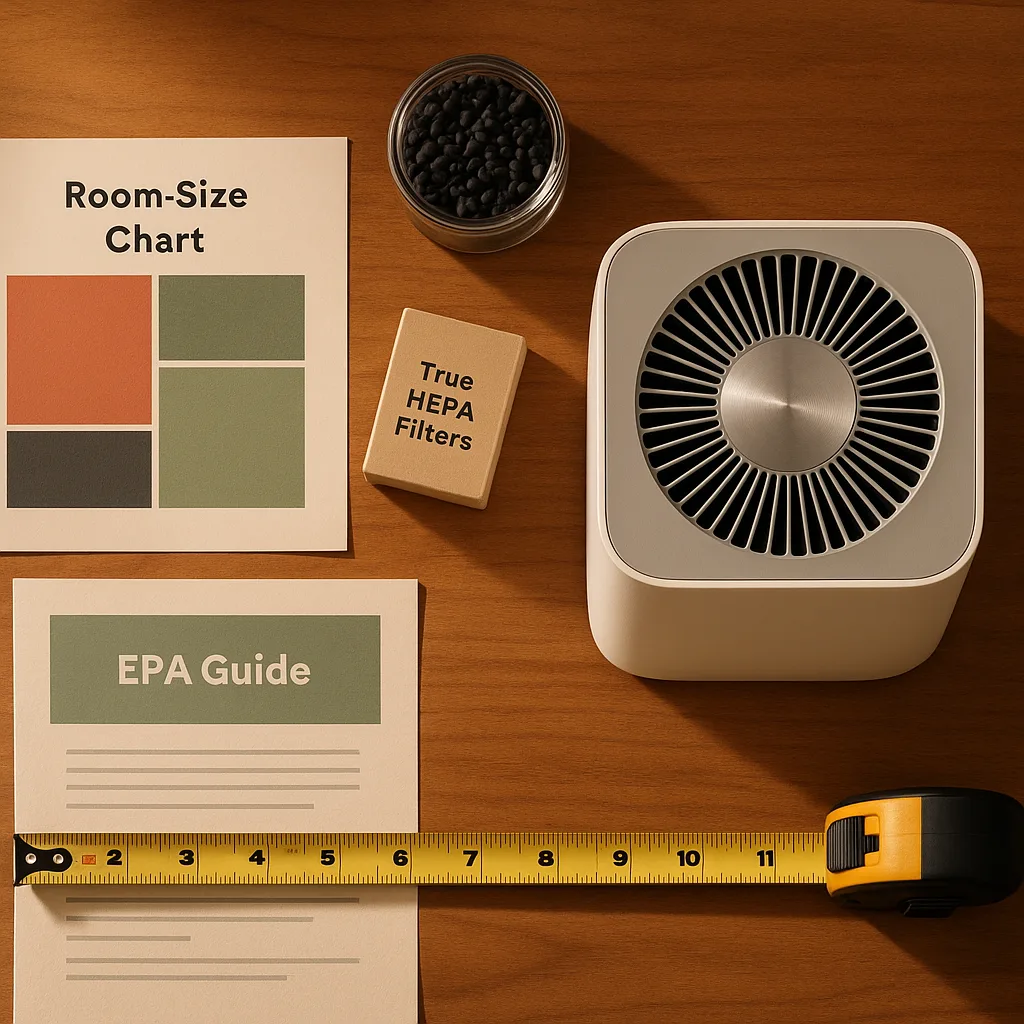
Start with room size, not brand name. Match the purifier's smoke CADR to your square footage, confirm the unit contains True HEPA (not "HEPA-type"), and verify the carbon stage is substantial enough to matter for odors and VOCs. Everything else — app connectivity, design finish, UV lights — is secondary.
Your quick-answer buying framework:
- Step 1: Measure your room in square feet (length × width).
- Step 2: Look up the EPA minimum CADR for that room size in the table below.
- Step 3: For wildfire season, add 25–50% to that minimum (oversizing is cheap insurance).
- Step 4: Confirm True HEPA certification on the spec sheet, not just the box.
- Step 5: Check that the carbon stage is described as a granular or pellet-bed carbon filter, not a "carbon-coated pre-filter."
- Step 6: Calculate the filter replacement cost per year before you buy — that's your real annual expense, not the device price.
As the EPA makes clear, portable air cleaners "are designed to filter the air in a single room or area" and no air cleaner or filter will eliminate all air pollutants. That means placement matters as much as the unit itself.
EPA room-size CADR chart for bedrooms and apartments
The EPA's sizing benchmark gives you a direct, math-based answer to "what CADR do I need?" — something most buying guides skip entirely in favor of vague "medium rooms" language. The table below is drawn directly from the EPA's Guide to Air Cleaners in the Home, calculated for standard 8-foot ceilings.
| Room Size (sq ft) | Minimum Smoke CADR (cfm) | Typical Use Case |
|---|---|---|
| 100 | 65 | Small bedroom, nursery |
| 200 | 130 | Standard bedroom, home office |
| 300 | 195 | Large bedroom, studio apartment |
| 400 | 260 | Small open-plan apartment |
| 500 | 325 | Medium apartment, living room |
| 600 | 390 | Large apartment, open living/dining |
The formula behind this table is straightforward: multiply your square footage by 0.65 to get the minimum CADR in cfm. A 350-square-foot studio needs at least a CADR of 228 cfm for particles. During active wildfire smoke events, target 1.5× the minimum — so that same studio ideally needs a unit rated at around 340 cfm smoke CADR.
Pro Tip: CADR is tested for three pollutants separately — smoke, dust, and pollen. Always look at the smoke CADR specifically, since it's typically the lowest of the three and is the most relevant for wildfire and fine-particulate events.
How to calculate square footage and ceiling height before you buy
- Measure the room: Multiply length by width in feet (e.g., 12 ft × 14 ft = 168 sq ft).
- Check your ceiling height: The EPA's table assumes exactly 8 feet. If your ceiling is 9 or 10 feet, multiply your square footage by the ceiling-height ratio. A 168 sq ft room with a 10-foot ceiling has the air volume of a 210 sq ft room with an 8-foot ceiling (168 × 10/8 = 210).
- Look up the adjusted square footage in the EPA table above to find the true minimum CADR.
- Account for open doors: If you plan to run the purifier with bedroom doors open to a hallway, add the hallway's effective area to your calculation. Air purifiers are designed for enclosed single spaces — an open door to a 600 sq ft apartment significantly undercuts a unit sized for a 150 sq ft bedroom.
- Apply your wildfire multiplier: During smoke season, target 1.5× the calculated minimum.
Watch Out: If you're in a newer apartment with 9- or 10-foot ceilings, the EPA table will undersize you by 12–25% if you don't adjust. This mistake is behind most "it didn't seem to do much" reviews.
Why oversizing the purifier helps during wildfire season
During clean-air days, a right-sized purifier is sufficient. During wildfire smoke events, oversizing becomes a practical hedge for three reasons the EPA identifies: higher fan speeds increase filtration, longer run times increase filtration, and filters load faster under heavy particulate burden.
A unit rated for a 400 sq ft room running in a 250 sq ft bedroom gives you two benefits: it can run at a quieter, lower fan speed and still hit your air-cleaning target, and when smoke loads the filter faster than normal, you have headroom before filtration degrades. A practical rule: if your room falls in the 150–250 sq ft range and you live in a wildfire-prone region, buy a unit with a smoke CADR rated for 300–400 sq ft. The price difference between adjacent CADR tiers is often $30–60 on the device — less than one replacement filter cycle.
For overnight bedroom use with doors closed, a right-sized unit run on medium speed is generally fine during moderate air quality days. On days when AirNow or PurpleAir shows AQI above 150 (Unhealthy), bump to high speed and consider keeping the door sealed.
True HEPA vs HEPA-type: what actually captures smoke particles
True HEPA and HEPA-type are not the same standard, and the difference matters directly for wildfire smoke. True HEPA filters are tested and rated to capture at least 99.97% of particles 0.3 microns in diameter — the worst-case size for filter penetration. Wildfire smoke particles range from roughly 0.1 to 1 micron, which means a True HEPA filter catches them effectively.
"HEPA-type" is a marketing label, not a tested standard. It typically describes a filter that captures somewhere around 85–99% of particles, depending on the manufacturer and particle size. For allergies alone — pollen at 10–100 microns, most dust at 1–10 microns — HEPA-type might perform adequately. For the fine particulate matter (PM2.5) in wildfire smoke, the penetration difference between 99.97% and 90% can be significant in a room where you're sleeping.
One critical clarification from the EPA guidance: CADR is a particle-performance metric. It does not rate gas removal and should not be used as a proxy for odor or VOC control. A purifier with an excellent smoke CADR of 300 cfm can have zero ability to remove the acrid smell of wildfire smoke if it lacks a real carbon stage.
Pro Tip: When reading a spec sheet, look for "True HEPA" as a defined standard. If the listing uses "HEPA-like," "HEPA-style," or any variation without "True," treat it as unverified and compare CADR numbers instead — a high CADR from an independently verified unit tells you more than a marketing label.
Smoke, dust, pollen, and pet dander: what one filter can and cannot do
A single purifier with True HEPA handles particles across the full allergen and wildfire spectrum. Where it stops is gases and odors. Here's the practical mapping:
| Pollutant | Size Range | Handled by True HEPA? | Needs Carbon? |
|---|---|---|---|
| Wildfire smoke (PM2.5) | 0.1–1 µm | Yes | For odor/VOCs only |
| Pollen | 10–100 µm | Yes | No |
| Dust mite debris | 0.5–50 µm | Yes | No |
| Pet dander | 2.5–10 µm | Yes | No |
| Wildfire VOCs / smoke odor | Gas phase | No | Yes |
| Cooking odors, VOCs | Gas phase | No | Yes |
| Mold spores | 1–30 µm | Yes | No |
As the EPA notes, portable air cleaners can reduce indoor air pollution, but they cannot remove all pollutants — gases and VOCs require a dedicated gas-removal stage. For wildfire events, that means you need both a high-CADR True HEPA stage and a meaningful carbon stage in the same unit.
Activated carbon for wildfire smell and VOCs
The smell of wildfire smoke — that sharp, acrid odor that lingers in clothes and furniture — is not a particle. It's a mix of volatile organic compounds (VOCs) including benzene, formaldehyde, acrolein, and dozens of others released by burning vegetation and structures. A True HEPA filter does nothing to these gases. The EPA is direct on this point: "To filter gases, choose a portable air cleaner with an activated carbon filter or other filter designed to remove gases."
Activated carbon works through adsorption — VOC molecules bond to the porous surface of carbon granules as air passes through. The more carbon surface area present, the more gas molecules can be captured before the carbon saturates. The EPA also notes that effective gas filtration generally requires a large amount of carbon, which is why a thin carbon sheet is not equivalent to substantial gas-removal media; at best it is a short-lived odor reducer, not a real VOC solution.
The EPA adds an important caveat: effective gas filtration generally requires a large amount of carbon. There is also no widely used performance rating system for portable air cleaners or filters designed to remove gases — meaning there's no CADR-equivalent score you can compare across brands for odor removal. Your only reliable signal is the physical quantity of carbon in the filter stage, which manufacturers sometimes disclose as weight (look for 1–5+ lbs of carbon in serious smoke-duty units) and sometimes don't disclose at all.
When shopping, look for these carbon descriptors on spec sheets: - "Activated carbon pellet filter" or "granular activated carbon" — substantial - "Activated carbon filter" with stated weight — evaluate by weight - "Carbon-coated fiber pre-filter" or "activated carbon mesh" — minimal
If the product page doesn't specify the form of carbon or give a weight, contact the manufacturer before buying if odor removal is a priority.
Why a thin carbon pre-filter is not the same as real gas filtration
Watch Out: A thin carbon pre-filter — the kind that looks like a flat gray sheet placed in front of the HEPA layer — typically contains only a few grams of activated carbon. At that quantity, it may reduce odor slightly for a few days, then saturates and provides essentially no gas-removal benefit. This is not a design flaw; pre-filters are designed to extend HEPA life by catching large particles, not to remove VOCs.
Carbon loading is the critical concept here. When activated carbon adsorbs enough VOC molecules to fill its available surface sites, it's spent — and unlike particle filters, you can't always tell visually when it's exhausted. A spent thin carbon sheet may look identical to a fresh one.
Real gas filtration requires sufficient carbon mass to handle the volume of VOCs in your air over the expected filter cycle. For reference, a purifier running continuously in a smoke-affected room for 2–3 months is processing far more VOC-laden air than the same unit running seasonally. Because no gas-performance rating standard exists, the writer cannot give you a universal "minimum carbon weight" benchmark — but if a manufacturer won't tell you what's in their carbon stage, that's a reason to look elsewhere.
Best air purifier features for a bedroom, nursery, or apartment
For overnight use or a nursery, the features that actually matter are different from what matters for a living room. Here's what to prioritize:
Feature checklist for bedroom/nursery/apartment use:
- Sleep mode / night mode: Fan drops to its quietest speed, display dims or turns off. Essential for bedroom use. Verify the noise level in dB at the lowest speed — 20–30 dB is near-silent, 35 dB is noticeable at night.
- Auto mode with air quality sensor: The unit adjusts fan speed based on real-time particle detection. Particularly useful during wildfire events when indoor AQI can spike unexpectedly.
- Timer: Lets you run on high for an hour before sleep, then auto-off or step down. Reduces noise and filter wear.
- Filter access and replacement ease: Front-loading filters are easier to change than base-mounted designs. Verify replacement filter availability before buying the unit.
- Child lock: Important in homes with toddlers. Prevents accidental fan-speed or mode changes.
- Compact footprint: In a bedroom or apartment, floor space matters. Check unit dimensions, not just coverage area.
- Certifications: AHAM Verified (independent CADR testing), ENERGY STAR (power efficiency). Energy draw matters if the unit runs 24/7 — the Levoit Core 400S is rated at 38W, which is modest for continuous operation.
Which features do not solve smoke well on their own
Ionizers, UV-C lights, PECO (Photo Electrochemical Oxidation), and HEPA-type filters are frequently marketed in the context of air quality, wildfire, and allergen removal. None of them substitutes for room-matched CADR and a real carbon stage.
Watch Out: - Ionizers release charged particles that cause airborne particles to clump and fall to surfaces — they don't remove particles from the air, they relocate them. Some ionizers produce ozone as a byproduct, which is itself a respiratory irritant. The EPA maintains a dedicated resource on ionizers and ozone-generating air cleaners for this reason. An ionizer alone is not a solution for wildfire smoke. - UV-C lights are designed to inactivate biological contaminants (bacteria, mold spores, some viruses) in the air stream. They do not capture particles, do not filter VOCs, and do not contribute to CADR. As a supplemental feature in a unit that already meets your CADR and carbon requirements, UV-C is neutral. As a selling point in place of those requirements, it's a distraction. - PECO (used by Molekule and similar brands) uses UV light plus a coated filter to oxidize pollutants. Independent third-party testing results for PECO have been mixed, and PECO-based units should be evaluated by AHAM-verified CADR data if available, not by the technology name alone. - "HEPA-type" — as covered above, this is not a standardized performance claim. Always verify against CADR data from an independent source.
HEPA filter replacement cost and total ownership cost
The device price is a one-time cost. The filter is your annual subscription — and for most mid-range purifiers, it's where the real money goes. This is the calculation most buying guides skip.
A typical air purifier filter has three stages: a pre-filter (often washable), a True HEPA layer, and a carbon layer. Some units package the HEPA and carbon together as a combo filter; others sell them separately. Combo filters are convenient but mean you replace the carbon on the same schedule as the HEPA, even if one stage is more spent than the other.
Total cost of ownership framework (US buyers):
- Device purchase price: $80–$350 for most credible bedroom-to-apartment units
- Replacement filter price: Typically $30–$60 per filter set, depending on brand and unit size
- Replacement cadence: 6–12 months under normal conditions; see the table in the section below
- Annual filter cost estimate: $60–$120 for standard use; $90–$180 for wildfire-season-heavy or heavy-allergen homes running on high speed
- 3-year total cost: Device + (annual filter cost × 3). A $120 device with $80/year filters costs $360 over three years. A $250 device with $50/year filters costs $400. The "budget" unit often costs more.
For the Levoit Core 300-P (a compact unit marketed for smaller rooms), Levoit sells replacement filters in a 2-pack, though current pricing should be confirmed on Levoit's site at time of purchase. The Core 400S carries a 2-Year Limited Warranty and a 30-Day Money Back Guarantee per Levoit's product page — terms worth noting because filter warranty coverage differs from device warranty coverage.
Pro Tip: Before buying any purifier, search the replacement filter part number independently (not just through the brand's site) to confirm ongoing availability and competitive pricing. Some brands discontinue filter SKUs within a few years of a model launch, leaving owners without replacements.
How often to replace filters in smoky or high-allergen homes
The EPA is clear: all filters need regular replacement, and higher fan speeds and longer run times increase filtration — but they also load filters faster. Always verify the specific cadence on your model's official spec sheet; the ranges below are general guidance.
| Use Condition | Estimated Filter Life |
|---|---|
| Normal residential (low pollution, 8 hrs/day) | 10–12 months |
| Allergy/asthma household, pets, 12+ hrs/day | 6–8 months |
| Active wildfire season (high speed, 24/7) | 3–5 months |
| Urban apartment, continuous use, no smoke | 8–10 months |
| Nursery or baby's room, continuous use | 6–8 months |
During wildfire events specifically, check your filter visually after every 4–6 weeks of heavy use. A filter that looks visibly gray or discolored before its stated end-of-life has likely loaded significantly and may need early replacement. Some units have filter-replacement indicator lights — treat these as prompts to check, not guarantees that the filter is still performing at spec.
Brand and model examples with official specs
The following examples are drawn from official manufacturer spec pages. The EPA does not endorse any of these brands or models.
Levoit Core 300-P Per Levoit's product page, this unit features a "3-stage filtration" system and is described as removing "dust, smoke, pollen, pet dander, and odors." It's a compact form factor suited for bedrooms in the 100–200 sq ft range. Replacement filters are sold as a 2-pack and fit the Core 300-P, Core 300S-P, and Core P350-P — model compatibility matters, so verify your specific unit's suffix before ordering. Confirm current replacement filter pricing at Levoit's site at the time of purchase.
At a Glance: The Levoit Core 300-P is the compact pick for a small bedroom or nursery, with a verified replacement path through the Core 300 replacement filter 2-pack. Check the exact suffix on your purifier before buying so the filter matches the unit.
- Best for: Small bedrooms, nurseries, offices under 200 sq ft
- Trade-off: Compact carbon stage; for heavy wildfire smoke, the larger carbon bed in a bigger unit will outperform it on odor
Levoit Core 400S Levoit's product page lists this unit at 120V/60Hz, 38W rated power — modest enough for continuous 24/7 operation. It carries a 2-Year Limited Warranty and a 30-Day Money Back Guarantee. The 400S targets larger rooms (verify CADR on the spec sheet) and includes smart connectivity for auto mode and app control.
At a Glance: The Levoit Core 400S is the step-up bedroom or small-apartment option, with 120V/60Hz input, 38W rated power, a 2-Year Limited Warranty, and a 30-Day Money Back Guarantee on the official product page. Use the manufacturer CADR and room-coverage data to confirm fit before checkout.
- Best for: Bedrooms 300–400 sq ft, small apartments, wildfire season with continuous use
- Trade-off: Smart features add cost; if you don't want app connectivity, consider a simpler model at the same CADR
Levoit Core 600S-P Levoit's replacement filter page identifies this model as covering rooms as large as 635 sq ft — putting it in apartment or open-plan living use. For wildfire season, this is a unit worth considering as a second unit in a larger apartment or as the primary unit in an open-concept living/dining space.
At a Glance: The Levoit Core 600S-P is the larger-room option, and Levoit ties the model to room coverage up to 635 sq ft on the official replacement-filter page. That makes it a sensible fit for an open-plan apartment or a shared living/dining area when you need more room coverage.
- Best for: Apartments 500–635 sq ft, open-plan spaces, wildfire season in larger rooms
- Trade-off: Larger unit, higher device cost and filter cost
Pro Tip: Levoit is among the more widely available brands at major US retailers, which makes replacement filter sourcing straightforward. For other brands (Coway, Winix, Blueair, Austin Air), apply the same verification process — check CADR on the AHAM Verified database, confirm carbon stage details on the spec sheet, and price replacement filters before committing.
What to verify on the spec sheet before you click buy
Use this checklist for every model you're considering:
- [ ] Smoke CADR (cfm): Listed separately from dust and pollen CADR? Matches your room size per EPA table?
- [ ] Room coverage (sq ft): Based on what ceiling height? Matches your actual room with adjustments?
- [ ] Filter type: "True HEPA" explicitly stated? Not "HEPA-type" or "HEPA-style"?
- [ ] Carbon stage: Granular/pellet activated carbon? Weight or volume disclosed?
- [ ] Noise at lowest speed: dB level listed? Under 30 dB for bedroom use?
- [ ] Replacement filter price: Currently available? Price known? Part number verified for your model suffix?
- [ ] Power draw: Wattage listed? (The Levoit Core 400S is listed at AC 120V, 60Hz and 38W on the manufacturer page, which is reasonable for 24/7 use.)
- [ ] Certifications: AHAM Verified? ENERGY STAR?
- [ ] Warranty: Device warranty period? Filter covered separately?
How to size an air purifier for wildfire smoke in a bedroom versus an apartment
The bedroom and the apartment are fundamentally different air-cleaning challenges — not because the technology differs, but because the room geometry, door state, and pollution pathway are different.
| Factor | Bedroom (door closed) | Small Apartment (open plan) |
|---|---|---|
| Typical size | 120–250 sq ft | 300–650 sq ft |
| Recommended smoke CADR | 78–165 cfm (minimum) | 195–423 cfm (minimum) |
| Wildfire-season CADR target | 120–250 cfm | 295–635 cfm |
| Door assumption | Closed at night | Open between spaces |
| Placement | Corner or nightstand | Central to main living area |
| Second unit needed? | Rarely (closed door) | Often yes, for bedroom |
| AQI monitoring tool | AirNow or PurpleAir | Same — check before bed |
For the bedroom use case, close the door during wildfire smoke events and run the purifier on high for 30–60 minutes before sleep to pre-clean the room, then drop to medium or auto. This approach uses less filter life than continuous high-speed overnight operation.
For an apartment, a single unit placed in the main living area will clean that space, but the bedroom with the door closed is a separate air mass. Check outdoor AQI via AirNow or PurpleAir (PurpleAir uses real-time neighborhood sensors and often shows localized smoke conditions faster than official monitoring stations) to decide when conditions are severe enough to warrant both a living-room unit and a bedroom unit running simultaneously.
When to add a second purifier or move up a size
Add a second purifier when:
- Your apartment has a separate bedroom and the living-room unit's CADR doesn't match the bedroom's square footage when the door is closed
- AirNow or PurpleAir shows AQI above 150 and your single unit is already running on high
- You have an infant, an asthma patient, or anyone with compromised respiratory health who spends extended time in a specific room
- Your current unit's room-coverage rating is smaller than the space it's actually serving (a 200 sq ft unit in a 400 sq ft room isn't a cost savings — it's a performance failure)
The decision rule for second-unit placement: put the primary high-CADR unit in the space where the most vulnerable person spends the most time, usually the bedroom at night. Place the second unit in the main living area during active smoke events, not as a permanent fixture if budget is a constraint.
FAQ: CADR, HEPA, carbon, and wildfire smoke
What CADR do I need for my room?
Multiply your room's square footage by 0.65 to get the minimum smoke CADR in cfm. A 200 sq ft bedroom needs at least 130 cfm. Adjust upward if your ceilings are above 8 feet (use the ratio: actual ceiling height ÷ 8, then multiply by square footage). During active wildfire smoke, target 1.5× the calculated minimum for meaningful headroom. Always verify the smoke-specific CADR, not dust or pollen CADR, since smoke CADR is typically the lowest of the three and most relevant for wildfire fine particulate.
Do air purifiers remove wildfire smoke smell?
A True HEPA filter removes smoke particles, which reduces visible haze and PM2.5. The smell — caused by VOCs like benzene and acrolein — requires activated carbon. A purifier with only a HEPA stage will noticeably reduce smoke concentration but leave odor behind. For meaningful odor control, confirm the unit contains granular or pellet-bed activated carbon, not just a thin carbon-coated pre-filter. The EPA's guidance is unambiguous: gas and odor removal requires a dedicated gas-removal filter, and effective gas filtration requires a substantial amount of carbon.
Is activated carbon better than HEPA for smoke?
Neither is "better" — they handle different parts of the problem. True HEPA captures smoke particles (PM2.5 and larger). Activated carbon captures odors and VOCs (gas phase). For wildfire smoke specifically, you need both working together in the same unit. A purifier with excellent HEPA but minimal carbon will clean the air but leave the smell. A purifier marketed on carbon alone with no CADR-rated particle filtration won't adequately clear particulates.
Are ionizers bad for air purifiers?
Ionizers don't capture particles — they cause them to settle on surfaces, which means the particles aren't gone, they've just moved to your furniture and floor. More concerning, some ionizers produce ozone as a byproduct. The EPA maintains dedicated guidance on ionizers and ozone-generating air cleaners because ozone at elevated levels irritates the respiratory system. An ionizer is not a substitute for CADR-rated particle filtration, and in sensitive households (asthma, infants, respiratory conditions), ozone-producing ionizers can worsen air quality rather than improve it.
How often should I replace air purifier filters?
Under normal residential use, most True HEPA filters last 10–12 months. In homes with pets, allergies, or daily 12+ hour operation, plan for 6–8 months. During wildfire season with 24/7 high-speed operation, filters can load enough to need replacement in 3–5 months. Higher fan speeds and longer run times increase filtration effectiveness but also accelerate filter loading, per EPA guidance. Check your specific model's filter-life guidance and treat indicator lights as prompts to inspect, not guarantees. Replace on schedule — a spent filter can reduce CADR substantially without any visible indicator.
Should I run an air purifier all day during wildfire season?
Yes. The EPA is clear that higher fan speeds and longer run times increase filtration, and the guidance in its Guide to Air Cleaners in the Home supports continuous operation when smoke is present. During active wildfire smoke events — especially when AirNow or PurpleAir shows AQI above 100 — run your purifier continuously, ideally on high or auto mode. Accept that this will shorten filter life and budget for earlier replacement. The cost of an early filter replacement is significantly less than the health impact of sustained PM2.5 exposure.
Can one purifier help both allergies and wildfire smoke?
A single well-chosen unit can handle both. Allergy triggers — pollen, pet dander, dust mite debris, mold spores — are all particles that True HEPA captures effectively. Wildfire smoke particles are also captured by True HEPA. The only limitation is that VOC odor from smoke requires the carbon stage, which allergen control alone doesn't need. A unit with room-matched CADR, True HEPA, and a real carbon stage covers the full spectrum. Size it for your worst-case scenario (wildfire smoke), and it will handle allergy season comfortably.
What to do next when wildfire smoke gets worse
When smoke conditions escalate — AQI above 150 on AirNow or PurpleAir — your purifier is only part of the response. Here's the complete action checklist:
- Check AQI in real time. AirNow pulls from official monitoring stations, and PurpleAir aggregates neighborhood-level sensor data that often reflects localized conditions faster. Check both during active smoke events.
- Seal gaps at windows and doors. Foam weatherstripping tape (available at any hardware store) applied around window frames significantly reduces smoke infiltration. Door draft stoppers help for doors facing outdoors. This directly reduces the particle load your purifier must handle.
- Close all windows and exterior doors. Obvious but critical — a running purifier in a room with an open window is cleaning outdoor air continuously.
- Bump the purifier to high speed or set auto mode so it responds to AQI sensor readings.
- Check your filter. If you're entering heavy smoke season and your filter is past 6 months old, replace it now — don't wait for the indicator light.
- Run the unit continuously during smoke events. Overnight is the minimum; 24/7 is better when AQI is elevated.
- Monitor filter loading. During a multi-week smoke event, visually inspect the filter every 3–4 weeks. Heavy gray discoloration before the rated end-of-life means early replacement is warranted.
- Ventilate only when AQI recovers. Once AirNow shows AQI below 50, open windows to flush accumulated VOCs and replenish fresh air before resealing.
Sources & References
- EPA Guide to Air Cleaners in the Home — Primary source for CADR sizing table, carbon guidance, and filter replacement recommendations
- EPA: Air Cleaners and Air Filters in the Home — Overview of portable air cleaner limitations and pollutant removal scope
- EPA: What Are Ionizers and Other Ozone Generating Air Cleaners? — EPA guidance on ionizer risks and ozone byproducts
- EPA: Ozone Generators Sold as Air Cleaners — Detailed EPA resource on ozone-generating devices
- Levoit Core 300-P product page — Official specs for Core 300-P 3-stage filtration unit
- Levoit Core 300-P replacement filter page — Compatibility confirmation for Core 300-P, 300S-P, P350-P
- Levoit Core 400S product page — Official specs including 38W power draw, 2-Year Limited Warranty, 30-Day Money Back Guarantee
- Levoit Core 600S-P replacement filter page — Room coverage up to 635 sq ft confirmation
- AirNow — Official US government AQI monitoring tool
- PurpleAir — Real-time neighborhood air quality sensor network
Keywords: EPA Guide to Air Cleaners in the Home, CADR (Clean Air Delivery Rate), AHAM Verified, True HEPA, activated carbon, AirNow, PurpleAir, wildfire smoke, volatile organic compounds (VOCs), ionizer, UV-C, PECO, HEPA-type, filter replacement cost