Are cordless blinds safer for children? CPSC guidance parents should follow
Cordless blinds are safer for children — not marginally safer, but categorically safer. The U.S. Consumer Product Safety Commission is direct about this: cordless window coverings are the only option to eliminate the strangulation hazard. That's the agency's strongest possible language, and it means no retrofit, no cord cleat, and no safety kit on a corded blind achieves the same level of protection.
If children are present in your home, the CPSC's guidance is simple: buy cordless window coverings. This applies to nurseries, bedrooms, playrooms, and any shared living space where a young child could be alone, even briefly. The recommendation isn't about reducing the odds — it's about removing the hazard entirely. Every other option leaves some risk in place.
Watch Out: Many parents assume that tucking cords behind furniture or tying them up is enough. The CPSC is explicit that these steps only reduce risk — they do not eliminate it. The only path to eliminating the hazard is replacing corded products with cordless ones.
Why corded window coverings are a strangulation hazard
The CPSC states that children have strangled to death on cords of window blinds, shades, draperies, and other coverings — and that this can happen in mere moments, even with an adult nearby. That last detail matters. Parents often assume proximity protects a child. It doesn't, because strangulation can occur faster than a caregiver can respond.
Any cord that dangles or forms a loop is a potential hazard. That includes:
- Standard pull cords on mini blinds and horizontal blinds
- Inner lift cords that run through blind slats and can form a hidden loop
- Continuous-loop systems on roller shades and vertical blinds without proper fasteners
- Drapery cords and tiebacks at accessible heights
The hazard isn't limited to one product type. Blinds, shades, cellular shades, and draperies all carry the same underlying risk when cords are accessible.
Watch Out: The CPSC specifically advises that many blinds sold prior to November 2000 should be replaced. Products that old predate modern safety improvements, and no retrofit kit can bring them to current standards.
What CPSC means by the safest cordless option
A cordless window covering has no accessible lift cords, pull cords, or loops for a child to reach. That's the operational definition that earns the CPSC's endorsement. Instead of pulling a cord, you raise or lower the shade by moving the bottom rail directly — pushing it up, pulling it down, or pressing a button on a motorized version.
As The Shade Store describes it: "Cordless Cellular Shades allow you to open and close your shades by lifting and lowering the bottom bar, with no dangling cords, chains or strings." That absence — no dangling cords, chains, or strings — is precisely what the CPSC identifies as hazard elimination rather than hazard reduction.
Cordless vs. cord-management accessories: cordless operation removes the accessible cord entirely; cord stops, hold-down devices, shortened cords, and similar accessories only manage a cord that still exists. If a product has no cord stops, consumers can contact the Window Covering Safety Council for a free kit, and cord stops should sit within 1 to 2 inches of the head rail when the blind is fully lowered. That's a useful interim measure if replacement isn't immediately possible, but it remains interim.
Best cordless blinds and shades by room, opacity, and control type
Choosing the right cordless shade comes down to three filters: the room's light needs, how the shade is operated, and your budget. The table below maps those decisions.
| Room | Opacity | Control Type | Priority |
|---|---|---|---|
| Nursery | Blackout | Cordless bottom-bar or motorized | Sleep darkness + zero cord access |
| Kids' bedroom | Blackout | Cordless bottom-bar | Sleep darkness, daily ease |
| Playroom | Light-filtering | Cordless bottom-bar | Soft light, daytime privacy |
| Living room | Light-filtering | Cordless bottom-bar or motorized | Privacy, natural light, aesthetics |
| Home office (shared) | Light-filtering | Cordless or motorized | Glare control, easy adjustment |
SelectBlinds lists cordless blackout cellular shades starting at $117.99 and cordless light-filtering cellular shades at $122.99 — both are cut-to-size custom options, not standard sizes. The Shade Store offers cordless cellular shades in both blackout and light-filtering configurations, with Day/Night cellular shades that include cordless control as standard. Neither brand requires cords to control opacity — the choice between blackout and light-filtering is purely about light control, not safety level.
Best cordless blackout shades for nurseries and kids' bedrooms
For nurseries and kids' bedrooms, cordless blackout cellular shades are the right call. SelectBlinds' cordless blackout cellular shades block up to 98% of incoming light, which translates to real-world nap and nighttime sleep improvement — an east-facing nursery window at 6 a.m. won't flood the room with light and wake a sleeping infant.
If light gaps around the edges are a concern, SelectBlinds also makes Click2Fit Cordless Total Blackout Cellular Shades with integrated side and bottom tracks that seal out edge light. These are worth considering for rooms with irregular window trim or shallow window seats where standard inside-mount shades leave visible gaps.
The Shade Store carries cordless blackout cellular shades in its main lineup as well, with custom sizing to the quarter-inch. Both brands ship custom-cut products, so you're not limited to stock sizes that may not fit your window openings correctly.
Pro Tip: For nurseries, prioritize the blackout and the ease of one-handed operation. You'll raise and lower these shades multiple times a day with a baby in your other arm. Cordless bottom-bar operation — where you just grip the bottom rail and push or pull — is faster and quieter than any cord system.
Best light-filtering cordless shades for living rooms and playrooms
Light-filtering cordless shades are the practical choice for living rooms and playrooms where you want natural light during the day without losing privacy from the street. SelectBlinds describes their cordless light-filtering cellular shades as products that "gently diffuse sunlight, creating a warm and inviting atmosphere while maintaining privacy" — meaning the fabric softens direct sunlight into an even, glare-reduced glow rather than blocking it outright.
For playrooms specifically, light-filtering cordless shades serve two purposes: they keep the room bright enough for play and reading without harsh glare on screens or floors, and they remove every cord from a space where children are unsupervised. The Shade Store's cordless cellular line includes light-filtering options in the same collection as blackout, so if you're outfitting multiple rooms in one order, you can mix opacities without switching brands or measuring systems.
SelectBlinds prices cordless light-filtering cellular shades starting at $122.99 per shade for custom sizing. The per-shade cost is higher than a basic roller shade from a big-box store, but you're buying a product that eliminates the hazard rather than managing it.
When motorized shades make sense for child safety and convenience
Motorized shades are worth the extra cost in two specific situations: windows that are hard to reach (high above a bed, over a couch, or spanning a wide wall), and households where you want smart-home integration for consistent daily routines like automatically closing nursery shades at nap time.
From a child safety standpoint, motorized shades remove the need for a manual lift cord, which reduces accessible cord hazards in the room. SelectBlinds offers motorized cellular shades that are compatible with the Matter smart-home standard, allowing them to connect to Apple Home, Google Home, Amazon Alexa, and Samsung SmartThings from a single setup. That compatibility matters if you already have a mixed smart-home ecosystem — you won't need a separate bridge or hub per brand.
Pro Tip: SelectBlinds warrants the motor and wand control on its E-Series motorized shades for 2 years from the date stamped on each product. Check that date when your shades arrive and register the product if the manufacturer offers it.
One important caveat: motorization isn't available across every product line. The Shade Store confirms that motorization is only available for Light-Filtering and Blackout Cellular Shades — it's not compatible with Day/Night Cellular Shades in that collection. Always verify motorization availability for the specific shade style you want before ordering.
How to choose cordless blinds that fit your windows correctly
Measurement errors are the most common reason cordless shades fail in the home — not the product itself, but the fit. The safest approach is to measure each window individually and follow the brand's measurement instructions exactly. Windows in the same room are often slightly different sizes, even in newer construction.
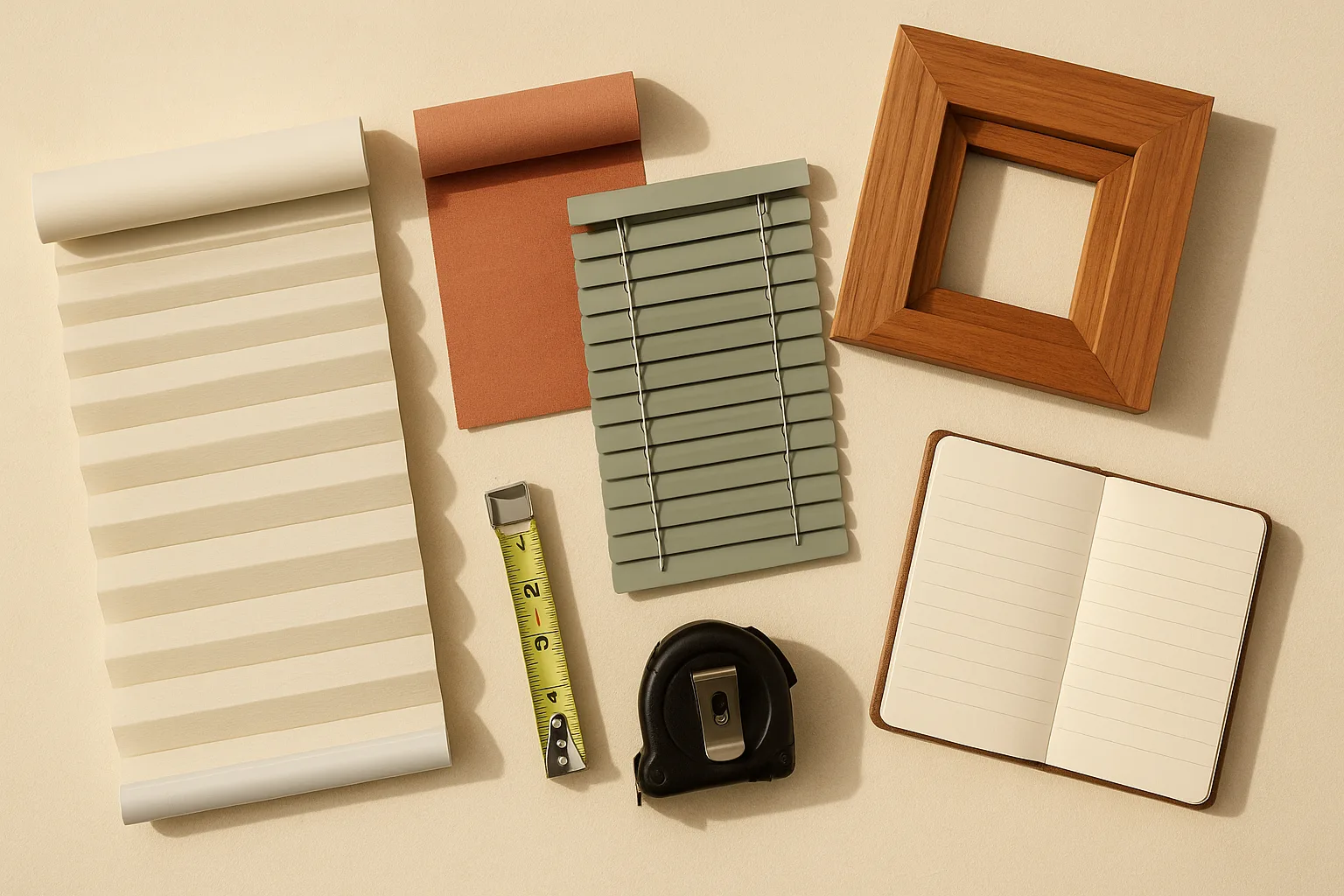
Use a steel tape measure, not a cloth or retractable plastic tape, which can bow mid-span on wider windows. Measure width at three points — top, middle, and bottom of the opening — and record the narrowest measurement. Measure height at three points — left, center, and right — and record the shortest. Before you submit an order, confirm whether the manufacturer wants the exact opening size or a deduction for inside-mount clearance.
Inside mount vs outside mount for cordless blinds
Inside mount means the shade sits inside the window frame, flush with or recessed into the opening. Outside mount means the shade hangs on the wall above and beyond the window frame.
| Inside Mount | Outside Mount | |
|---|---|---|
| Appearance | Clean, architectural, shows window trim | Covers window trim, makes window look larger |
| Light control | Some light gap at edges | Can overlap the frame to improve edge coverage |
| Depth requirement | Needs mounting depth set by the manufacturer | No depth requirement |
| Measurement | Measure to the narrowest point of the opening | Measure to desired coverage and overlap per brand instructions |
Inside mount is the cleaner look for most rooms, but it requires adequate mounting depth in the window frame. Shallow windows — common in older homes and some apartment construction — may not have enough depth for a cellular shade's head rail. If your window frame is shallower than the manufacturer's minimum, outside mount is the better practical choice, and it can provide stronger light blockage because the shade can cover more of the frame.
For nurseries, outside mount is often the smarter call regardless of frame depth, because the wider coverage reduces edge light leakage — which matters when you're trying to block a 6 a.m. sunrise.
Cordless lift types parents will see when shopping
The cordless category is simple once you narrow it to the feature that matters most: no accessible cords. Most parents will see cordless bottom-bar operation, where you lift or lower the shade by hand. Some motorized versions add remote, app, or voice control, but the child-safety point is the same: there is no dangling cord for a child to reach.
For nurseries and kids' rooms, cordless bottom-bar or motorized operation is the right choice — simpler operation, fewer parts to manage, and nothing extra for small hands to grab.
Can you make corded blinds safe for kids? What retrofit kits can and cannot do
The CPSC answers this clearly: if you cannot immediately replace corded window coverings with cordless ones, you should take interim steps — but understand that these steps only reduce risk. They do not eliminate it.
Safety callout: shortening cords, installing cord stops, moving furniture away from windows, and using hold-down devices all reduce the hazard; they do not remove it. The strangulation risk still exists as long as a cord exists in the room.
The interim measures the CPSC identifies are:
- Make pull cords as short as possible to eliminate dangling lengths
- Move cribs, beds, and furniture away from windows so children cannot climb close to cords
- Properly install and adjust cord stops to limit inner lift cord movement (cord stops should sit within 1 to 2 inches of the head rail when the blind is fully lowered)
- Use hold-down devices to anchor cords against the wall or window frame
If your corded blinds have no cord stops, the Window Covering Safety Council offers a free safety kit — you can contact them directly through the CPSC's resource page. Installing that kit is better than doing nothing. But it's a bridge measure, not a permanent solution.
The honest bottom line: retrofit kits, cord cleats, and shortened cords are tools for managing a hazard that cannot be engineered away while the cord still exists. The moment you can replace a corded product with a cordless one in a room used by children, do it.
Red flags that mean immediate replacement, not repair
Some conditions move a corded blind from "retrofit candidate" to "replace today." These are not judgment calls — they are situations where the risk of harm while waiting for a replacement is unacceptably high.
Replace immediately if you see any of these:
- Dangling cords that cannot be shortened or secured — a cord that reaches below the window sill or furniture-top height is accessible to a standing or climbing toddler
- Continuous-loop systems without proper fasteners — the loop itself is a strangulation hazard; if the tensioner or floor anchor is missing or broken, this is an immediate-replacement situation
- Damaged hardware — cracked cord stops, broken head-rail components, or frayed cords that cannot be repaired without specialized parts
- Any blind in a room used by infants or toddlers — regardless of condition, the CPSC's guidance treats rooms with the youngest children as highest priority; the margin for error is zero in a room where a child sleeps or plays unsupervised
Watch Out: Don't cover a continuous-loop system with tape or a furniture arrangement and consider the problem solved. The loop still exists and a child can access it when furniture is moved or when they climb.
Why older blinds sold before November 2000 should be replaced
Watch Out — Pre-2000 Blinds: The CPSC specifically states that many blinds sold prior to November 2000 should be replaced. Products from that era predate industry safety improvements introduced in response to child strangulation incidents, and they were designed without the cord-management features added afterward. If you move into a home with blinds that look like they've been there for 25 or more years — original builder blinds, older apartment blinds, inherited window treatments — treat them as replacement candidates, not retrofit candidates.
There's no safety kit that updates a 1997 mini blind to current practice. If the product is more than 25 years old and still in place, prioritize replacing it in rooms where children are present before doing anything else.
What features matter most when buying child-safe window treatments
When filtering cordless window treatments before purchase, these are the decisions that actually change what you receive:
- Cordless lift type — bottom-bar or motorized; for children's rooms, simple bottom-bar or motorized are the most practical
- Opacity — blackout (up to 98% light block) for sleep rooms, light-filtering for shared daytime spaces
- Mount style — inside mount for clean aesthetics (requires manufacturer-specified frame depth), outside mount for better light control and shallow frames
- Room use — nursery/bedroom needs blackout + easy daily operation; playroom/living room needs light-filtering + daylight privacy
- Motorization compatibility — verify at the collection level, not just the brand level; not all shade types accept a motor
Blackout vs light-filtering: which opacity works in each room
| Room | Opacity | Why |
|---|---|---|
| Nursery | Blackout | Blocks up to 98% of light for naps and overnight sleep |
| Kids' bedroom | Blackout | Sleep quality and early-morning light control |
| Living room | Light-filtering | Natural light with street-facing privacy |
SelectBlinds' cordless blackout cellular shades are designed to block up to 98% of incoming light, which is the performance spec to look for in any sleep room. Their light-filtering line gently diffuses sunlight — suitable for rooms where you want the brightness without a direct beam across the floor.
The practical takeaway: blackout and light-filtering are not safety-level distinctions — both are available in cordless configurations. Match opacity to the room's function, and make sure cordless operation is present in both.
Materials and price tiers from IKEA to custom Hunter Douglas
Cordless blind pricing spans a wide range, and the most useful comparison is the verified product pricing plus installation cost.
- SelectBlinds cordless blackout cellular shades: starting at $117.99 per shade
- SelectBlinds cordless light-filtering cellular shades: starting at $122.99 per shade
- Fixr window blind installation cost: average installation cost of $151 per window, with a range of $109 to $198
- Fixr window shade installation cost: similar pre-made shade installation pricing for homeowners comparing DIY versus pro labor
For installation, Fixr estimates the average cost at $151 per window, with a range of $109 to $198 — that's labor for a professional installer on top of the product cost. For most homeowners doing a whole-room refresh, DIY installation of cordless cellular shades is straightforward and eliminates that labor cost.
Child-safe window covering checklist for bedrooms, nurseries, and playrooms
Use these room-specific checklists before you finalize any purchase. They're short because the decisions aren't complicated — the priority is making sure you haven't skipped anything that matters.
Bedroom window treatment checklist
- [ ] Cordless operation only — no pull cords, no lift loops, no chains accessible in this room
- [ ] Blackout opacity — select a shade rated for sleep-darkening if the bedroom gets early morning sun
- [ ] Inside or outside mount chosen for fit — measure carefully and follow the brand's instructions for the opening you have
- [ ] Easy single-hand operation — bottom-bar or motorized; you will use this shade every day
- [ ] Furniture placement — keep the bed and any climbable furniture away from the window
- [ ] No decorative cord or tassel accents — some valances and drapery panels come with decorative cords; remove or avoid them in this room
- [ ] Check for any secondary corded product in the room — sheers, valances, or blackout liner panels sometimes have their own cords
Nursery window treatment checklist
- [ ] Cordless operation only — no pull cords, no lift loops, no chains accessible in this room
- [ ] Blackout opacity — select a shade rated for sleep-darkening (look for 98%+ light block for east- and south-facing windows)
- [ ] Outside mount or full-coverage inside mount — minimize edge light leakage; consider integrated side tracks if available
- [ ] Easy single-hand operation — bottom-bar or motorized; you will operate this shade holding a baby
- [ ] Crib and furniture placement — keep the crib and any climbing furniture away from the window, even after installing cordless shades
- [ ] No decorative cord or tassel accents — some valances and drapery panels come with decorative cords; remove or avoid them in this room
- [ ] Check for any secondary corded product in the room — sheers, valances, or blackout liner panels sometimes have their own cords
Playroom and living room checklist
- [ ] Cordless operation — same requirement as nursery; no cords accessible at child height
- [ ] Light-filtering opacity — diffused natural light is appropriate for play and shared daytime use
- [ ] Durable material — polyester cellular shades resist dust and spot-clean more easily than natural fabrics in high-traffic rooms
- [ ] Top-down/bottom-up option (optional) — useful in street-facing living rooms where you want light from the top and privacy at the bottom
- [ ] Check all windows in the room — don't forget smaller side windows, transoms, or sliding door panels that may still have original corded coverings
- [ ] Furniture layout — keep play areas away from window zones regardless of shade type
FAQs about cordless blinds and child safety
Are motorized shades safer than cordless blinds?
Motorized shades remove the need for a manual lift cord, which can reduce accessible cord hazards in hard-to-reach windows. They are a good convenience choice for nursery schedules, high windows, and smart-home routines, but the main safety question is still whether a child can reach any cord or loop. A well-chosen cordless bottom-bar shade and a motorized shade both keep lift cords out of reach; the best choice depends on the window and how you want to use it.
SelectBlinds' motorized cellular shades support the Matter standard with connections to Apple Home, Google Home, Amazon Alexa, and SmartThings — a real convenience benefit for smart-home households. If the extra cost fits your budget and the convenience matters, motorized is a fine choice. If budget is the constraint, a manual cordless bottom-bar shade achieves the same room-level cord-free setup.
Do cordless blinds still need child safety precautions?
Yes — cordless shades eliminate the cord hazard, but good room layout habits still matter. The CPSC advises keeping cribs and furniture away from windows even when the window covering itself is safe, because children who can reach a window can encounter other hazards: glass, screens that don't support a child's weight, or falls. Keep sleeping and play areas away from window zones as a general practice, independent of what's covering the glass.
Also check every window covering in a room, not just the primary shade. Sheers, valances, and drapery panels sometimes carry their own cords or decorative tassels. A room isn't fully addressed until every textile near a window is cord-free.
Sources & References
- CPSC Window Covering Cords — GoCordless
- CPSC News Release: Nearly Half of Incidents with Kids and Corded Window Coverings Resulted in Death
- SelectBlinds — Cordless Blackout Cellular Shades
- SelectBlinds — Click2Fit Cordless Total Blackout Cellular Shades
- SelectBlinds — Cordless Light-Filtering Cellular Shades
- The Shade Store — Cellular Shades
- The Shade Store — What Are Cellular Shades?
- Fixr — Window Blind Installation Cost
- Fixr — Window Shade Installation Cost
Keywords: CPSC Window Covering Cords, Window Covering Safety Council, cordless cellular shades, corded mini blinds, continuous-loop system, cord stops, hold-down devices, inside mount, outside mount, blackout shades, light-filtering shades, motorized shades, Matter, Apple HomeKit, Amazon Alexa