Can you claim insulation, windows, and a heat pump in the same year?
Yes — you can claim all three in the same tax year, and doing it right can put up to $3,200 in federal tax credits on your return. The Energy Efficient Home Improvement Credit (sometimes called the 25C credit) is structured with two separate annual buckets that stack on top of each other, so insulation, windows, doors, and a heat pump are not competing for the same pot of money. The rules that trip people up are the category caps, the principal-residence requirements, and the need to claim the credit in the installation year — not the year you bought the equipment.
The IRS is explicit that "You must claim the credit for the tax year when the property is installed, not merely purchased." Buy the windows in December but install them in January and you're in the next tax year.
How the $3,200 annual federal cap breaks into $1,200 plus $2,000
Think of the credit as two distinct buckets that refill every January 1.
Bucket 1 — Envelope improvements: up to $1,200 This covers insulation and air-sealing materials or systems, exterior doors, windows, and skylights. Per IRS Form 5695 instructions, "A 30% credit, up to a maximum of $1,200, may be allowed for: Insulation material or air sealing material or systems; Exterior doors; Windows and skylights."
Bucket 2 — Heat pump equipment: up to $2,000 This covers any combination of air source heat pumps, heat pump water heaters, and biomass stoves or boilers. Per ENERGY STAR's federal tax credit guidance, these are subject to an annual total limit of $2,000.
Both buckets can be used in the same calendar year, for a combined ceiling of $3,200. The buckets do not bleed into each other — spending $4,000 on a heat pump does not borrow from your $1,200 envelope room, and vice versa.
Pro Tip: The annual reset is a planning tool. Improvements that push you over one bucket's cap in a single year don't roll over to the next year — they're simply lost. Staging projects across years can preserve credit room you'd otherwise forfeit.
Which improvements share the same envelope credit bucket
Insulation, air sealing, exterior doors, windows, and skylights all draw from that same $1,200 pool — they each do not get their own $1,200 limit. Here's how the items stack:
- Insulation materials or systems — bulk rolls, batts, spray foam, blown-in insulation
- Air-sealing materials or systems — caulk, weatherstripping, house wrap, foam sealants applied specifically for air sealing
- Exterior doors — must be ENERGY STAR certified to qualify
- Windows and skylights — must meet ENERGY STAR Most Efficient criteria, which is a higher bar than standard ENERGY STAR certification
- Certain HVAC equipment (central air conditioners, gas furnaces, and boilers meeting specific efficiency thresholds) also competes for this $1,200 bucket — worth knowing if you're replacing a furnace the same year you're doing windows
Per IRS Form 5695 instructions, "A 30% credit, up to a maximum of $1,200, may be allowed for: Insulation material or air sealing material or systems; Exterior doors; Windows and skylights."
If you spend $3,000 on qualifying windows and $2,000 on qualifying insulation in the same year, your 30% credit on those costs would be $1,500 — but the $1,200 cap cuts it to $1,200. Plan accordingly.
Which home improvements qualify for the federal energy efficiency tax credit?
The credit covers two broad categories of improvements. As ENERGY STAR summarizes, "These energy efficient home improvement credits are available for 30% of costs — up to $2,000 — and can be combined with credits up to $1,200 for other qualified upgrades made in one tax year."
Envelope and building-shell improvements (30% up to $1,200 combined): - Insulation materials or systems - Air-sealing materials or systems - Exterior doors - Windows and skylights - Select HVAC equipment (certain furnaces, boilers, and central AC units)
Equipment upgrades (30% up to $2,000 combined): - Air source heat pumps - Heat pump water heaters - Biomass stoves and biomass boilers
Not everything labeled "energy-efficient" qualifies. Each category has product-specific criteria — a new refrigerator or standard washing machine, for example, is not eligible under this credit.
Insulation, air sealing, windows, doors, and skylights
The 30% credit applies to the cost of qualifying insulation and air-sealing materials — think blown-in fiberglass, spray foam, rigid foam board, and products like 3M's Fire Barrier Sealant or Owens Corning's EcoTouch batts when installed as part of a qualifying system. Per IRS Form 5695 instructions, "A 30% credit, up to a maximum of $1,200, may be allowed for: Insulation material or air sealing material or systems; Exterior doors; Windows and skylights." These fall under the $1,200 envelope bucket alongside exterior doors and windows.
Product eligibility checklist — envelope items:
- [ ] Insulation materials: confirm manufacturer's documentation states the product meets IECC standards for your climate zone or qualifies under the IRS definition of insulation material
- [ ] Air-sealing materials: confirm documentation identifies them as air-sealing materials or systems, not just general caulk
- [ ] Windows and skylights: must appear on the ENERGY STAR Most Efficient list — standard ENERGY STAR alone is not enough
- [ ] Exterior doors: must be ENERGY STAR certified
- [ ] For windows, doors, and skylights installed in 2025: a valid Qualified Manufacturer Identification Number (QMID) must be reported on the applicable Form 5695 lines — collect this paperwork before installation day
One residence requirement applies specifically here: for insulation and air-sealing materials, the home must be in the United States and must be your principal residence. More on that below.
Heat pumps and heat pump water heaters
An air source heat pump absolutely can be claimed alongside envelope upgrades in the same year — it lives in the separate $2,000 bucket and doesn't disturb your $1,200 envelope room. As ENERGY STAR states, "Starting January 1, 2025, air source heat pumps that are recognized as ENERGY STAR Most Efficient are eligible for this credit." That's an important threshold change — ENERGY STAR-certified alone is no longer enough for heat pumps starting in 2025; the unit must be on the ENERGY STAR Most Efficient list specifically.
A heat pump installer should confirm that the specific model they're proposing carries ENERGY STAR Most Efficient recognition for the year of installation before you sign the contract. Brands like Mitsubishi, Carrier, Bosch, and Trane publish ENERGY STAR Most Efficient product lists, but individual model eligibility can shift between model years. Ask for the documentation in writing — you'll need it when filing.
Watch Out: Heat pump water heaters and biomass stoves share this same $2,000 bucket with air source heat pumps. If you install both a heat pump water heater and a heat pump in the same year, they compete for that $2,000 ceiling together, not separately.
Who qualifies: principal residence rules, second homes, and U.S. location requirements
Whether a given improvement qualifies depends on both the product's eligibility and where the home is and how you use it. The rules are not uniform across all improvement categories.
| Improvement | Home must be in the U.S.? | Principal residence required? |
|---|---|---|
| Insulation materials or systems | Yes | Yes |
| Air-sealing materials or systems | Yes | Yes |
| Windows and skylights | Yes | Verify current IRS instructions |
| Exterior doors | Yes | Verify current IRS instructions |
| Air source heat pumps | Yes | Verify current IRS instructions |
| Heat pump water heaters | Yes | Verify current IRS instructions |
Watch Out: The table above reflects guidance current as of this article's publication date (April 2026). Residence requirements can differ by category and can change with new IRS instructions. Always check the current IRS Form 5695 instructions for the specific tax year you're filing before you purchase.
Why insulation and air sealing have stricter residence rules
In plain English: if you're insulating your vacation cabin or a rental property you own, you cannot use the federal credit for those insulation or air-sealing costs. The property needs to be where you actually live as your primary home — your main address, the one on your driver's license and tax return. This is a category-specific rule for insulation and air sealing, not a blanket rule for every improvement type.
Why some equipment categories can be different for second homes
Other equipment categories can have category-specific residence rules, so do not assume one answer applies across the board.
Watch Out: Do not assume that because a heat pump qualifies at your primary home, it automatically qualifies at your rental property or vacation home. The residence treatment differs by category and can change year to year. Verify the current IRS Form 5695 instructions and ENERGY STAR product eligibility pages before purchase. This article is not a substitute for current IRS guidance or a tax professional's advice.
Year-by-year claim example: bundling insulation, windows, and a heat pump
The energy efficiency tax credit resets every year, which makes sequencing your projects a real planning decision. Because you must claim the credit in the installation year, not the purchase year, the two examples below show how the math plays out whether you do everything at once or stage projects across tax years.
Example A: maxing out envelope credit room before adding heat pump costs
Suppose you complete all of these projects in the same calendar year, all properly installed at your principal residence:
IRS Form 5695 instructions allow the $1,200 envelope cap, and ENERGY STAR's overview confirms the separate $2,000 equipment bucket used in this example.
| Improvement | Project cost | 30% of cost | Bucket | Credit claimed |
|---|---|---|---|---|
| Blown-in insulation (attic) | $2,800 | $840 | Envelope ($1,200 max) | $840 |
| 3 ENERGY STAR Most Efficient windows | $3,500 | $1,050 | Envelope ($1,200 max) | $360 |
| Air source heat pump | $6,000 | $1,800 | Heat pump ($2,000 max) | $1,800 |
| Total | $12,300 | $3,000 |
Here, the insulation and windows together generate $1,890 in theoretical credits, but the envelope bucket caps at $1,200. You'd claim $840 on the insulation and $360 on the windows to reach $1,200 exactly — or you could allocate differently within that $1,200 ceiling, but you can't exceed it. The heat pump sits in its own $2,000 bucket and claims $1,800 untouched. Total credit for the year: $3,000.
Notice that $550 in potential window credits were forfeited because the insulation already filled most of the envelope bucket. That's the trade-off of bundling high-cost envelope projects in the same year.
Example B: spreading upgrades across two tax years for better credit use
By moving the windows to the following tax year, you preserve full envelope credit room for each project. The staging benefit follows the IRS installation-year rule and the separate annual caps described by ENERGY STAR.
| Year 1 | Year 2 | |
|---|---|---|
| Projects | Insulation + Heat pump | Windows |
| Envelope cost | $2,800 | $3,500 |
| Envelope credit (30%, cap $1,200) | $840 | $1,050 |
| Heat pump credit (30%, cap $2,000) | $1,800 | $0 |
| Total credits that year | $2,640 | $1,050 |
| Combined two-year total | $3,690 |
Versus the one-year bundle that yielded $3,000, staging the windows into Year 2 earns $690 more in total credits. The difference comes entirely from not losing the $550 in window credit room that gets squeezed out when insulation and windows compete for the same $1,200 envelope bucket in the same year.
The trade-off is real: you wait another year on the windows, which may mean a season of higher heating or cooling costs. But for a heat pump installer or contractor planning a phased upgrade, Year 1 for HVAC and weatherization, Year 2 for windows, is often a sensible sequence anyway — insulation and air sealing complement a heat pump immediately, while window replacement can follow.
Pro Tip: The credit is claimed in the installation year, not the purchase year. If your contractor installs the insulation in December and the windows in January of the following year, those naturally fall into separate tax years — no scheduling gymnastics required. Just make sure the installation dates are clearly documented on your invoices.
How to file Form 5695 for insulation, windows, and a heat pump
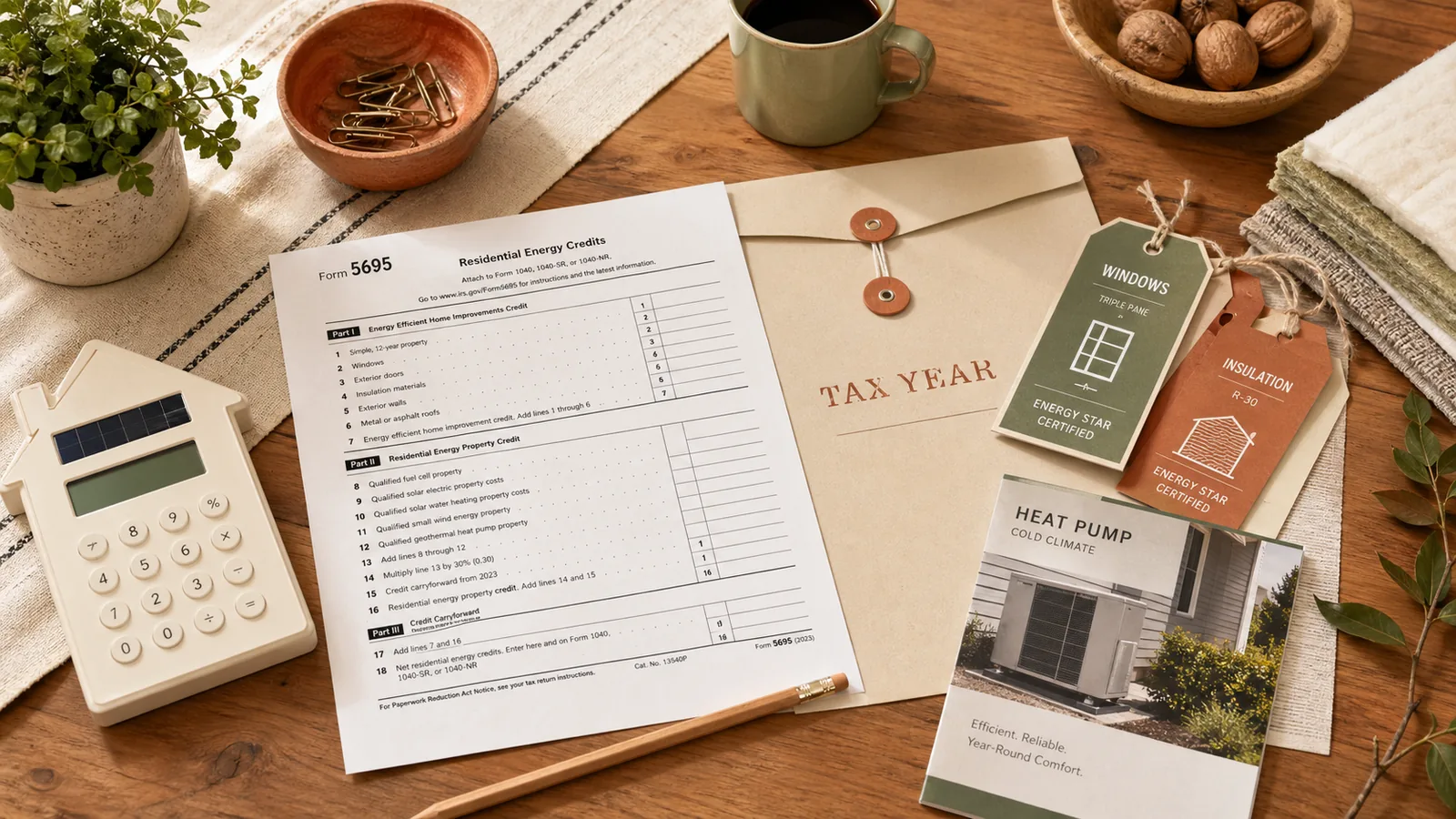
You file Form 5695, Residential Energy Credits, with your federal tax return. The IRS is direct: "File Form 5695, Residential Energy Credits Part II, with your tax return to claim the credit." Part II of Form 5695 is specifically for the Energy Efficient Home Improvement Credit — the 25C credit that covers insulation, windows, and heat pumps. Part I covers the Residential Clean Energy Credit (solar, battery storage), which is a separate credit entirely.
Form 5695 filing checklist:
- Confirm the installation date falls in the tax year you're filing — not the purchase date
- Enter your envelope improvement costs (insulation, windows, doors, skylights) on the applicable Part II lines for energy-efficient building envelope components
- Enter your heat pump costs on the applicable Part II lines for qualified energy property
- Report a valid QMID for any exterior doors, windows, or skylights installed in 2025 on the lines where the IRS instructions require it
- Calculate your 30% credit for each category
- Apply the $1,200 cap to envelope items and the $2,000 cap to heat pump equipment
- Carry the resulting credit to your Form 1040
The credit is nonrefundable, meaning it can reduce your federal income tax liability to zero but won't generate a refund check beyond what you already paid in. It also does not carry forward if you can't use it all.
What documents to keep before you file
Pull these together before tax season — you don't have to attach them to your return, but you'll need them if the IRS asks.
Document checklist:
- [ ] Itemized invoices showing the cost of each improvement separately (insulation vs. windows vs. heat pump — don't let a contractor give you one lump-sum receipt)
- [ ] Installation-date confirmation on every invoice — the date of installation, not just purchase or delivery
- [ ] Product labels and model-number documentation for each eligible category so you can match the installed item to the manufacturer certificate or ENERGY STAR list
- [ ] Manufacturer certification statements for insulation and air-sealing products confirming they meet applicable energy-efficiency criteria
- [ ] ENERGY STAR Most Efficient documentation for windows, skylights, and heat pumps (product specification sheets or printed ENERGY STAR product list pages with the model number highlighted)
- [ ] QMID paperwork from the manufacturer for any exterior doors, windows, or skylights installed in 2025 — this is a Form 5695 requirement per the IRS 2025 instructions
- [ ] ENERGY STAR certification label or documentation for exterior doors
- [ ] Contractor paperwork from your heat pump installer confirming model number and installation date
- [ ] Principal residence confirmation — for insulation and air sealing especially, keep documentation that the address is your primary home
Common Form 5695 mistakes that reduce or delay the credit
- Claiming in the purchase year instead of the installation year. Ordered equipment in November, installed in February? That's a February — next tax year — credit. The IRS is clear on this.
- Missing QMID documentation for 2025 windows, doors, and skylights. The IRS 2025 Form 5695 draft instructions require a valid QMID on the applicable lines for these products. A missing QMID can invalidate the claim.
- Misallocating costs between the two buckets. Some homeowners put heat pump costs on envelope lines or vice versa. The IRS categories are specific — heat pumps go on the equipment lines, not the building envelope lines.
- Treating the $1,200 cap as per-item rather than combined. You don't get $1,200 for insulation plus $1,200 for windows. The $1,200 is the ceiling for everything in that bucket combined in one year.
- Forgetting that the credit is nonrefundable. If your total tax liability is $1,800 and you claim $3,000 in credits, you only offset $1,800. The rest doesn't come back to you and doesn't carry forward.
- Using Part I instead of Part II of Form 5695. Part I is for the Residential Clean Energy Credit (solar, wind, battery). The Energy Efficient Home Improvement Credit is in Part II.
Before you buy: product eligibility lists, certification, and QMID checks
Buying a product and then discovering it doesn't qualify is one of the most preventable ways to lose a credit. Eligibility must be confirmed before purchase, not after installation.
A quick pre-purchase check against the ENERGY STAR federal tax credits page and the IRS 2025 draft instructions can save you from a failed claim.
Pre-purchase verification checklist:
- [ ] Check the ENERGY STAR federal tax credits page for the current eligible product lists in your category
- [ ] For windows and skylights: confirm the specific model appears on the ENERGY STAR Most Efficient list for the current year — not just ENERGY STAR certified
- [ ] For exterior doors: confirm ENERGY STAR certification for the specific door model
- [ ] For heat pumps: confirm ENERGY STAR Most Efficient recognition for the exact model number and installation year
- [ ] For insulation and air sealing: confirm product documentation states eligibility under IRS insulation material or air-sealing material definitions
- [ ] Collect manufacturer certification paperwork or QMID documentation from the seller or contractor before purchase or at the time of contract signing
- [ ] Verify current IRS Form 5695 instructions for the tax year of your planned installation — eligibility criteria and documentation requirements can change
How to confirm a window, door, or insulation product is eligible
For windows and skylights, the threshold is ENERGY STAR Most Efficient — not baseline ENERGY STAR. Ask your window supplier or contractor for the specific model's ENERGY STAR Most Efficient certificate or point to the model on the ENERGY STAR website's Most Efficient product list. Brands like Andersen, Pella, Marvin, and Simonton publish this documentation and can provide it at the quote stage.
For exterior doors, confirm ENERGY STAR certification on the product spec sheet. Most qualifying fiberglass and steel entry doors from Therma-Tru, JELD-WEN, or Masonite will carry this, but individual product lines vary — don't assume an entire manufacturer's catalog qualifies.
For insulation, the manufacturer's literature should identify the product as an insulation material that meets applicable energy standards. Get a written statement from the manufacturer or installer if the packaging alone isn't specific enough.
Watch Out: For any exterior door, window, or skylight installed in 2025, you'll need a valid QMID from the manufacturer to report on Form 5695. Request this documentation from your contractor or supplier before installation — tracking it down afterward can delay your filing.
How to confirm heat pump eligibility before signing with an installer
Ask these specific questions before signing with any heat pump installer:
- "Is this specific model number on the ENERGY STAR Most Efficient list for the current year?" Not just ENERGY STAR certified — Most Efficient specifically. As of January 1, 2025, that's the standard.
- "Can you provide the manufacturer's certification paperwork or spec sheet showing Most Efficient designation?" You need this for your records.
- "What is the model number, and will it be installed (not just ordered) within this tax year?" Installation date determines your credit year.
- "Will the installer documentation show the installation date separately from the equipment purchase date?" This protects your credit year claim.
- "Are there any associated electrical panel upgrades being proposed?" Panel upgrades may have their own eligibility rules under a different credit bucket — don't mix those costs into your heat pump line on Form 5695.
The installer should provide model-specific documentation you can attach to your tax file. If they can't confirm the model's ENERGY STAR Most Efficient status before signing, that's a red flag worth pausing on — switching to an ineligible model after installation means no credit.
Pro Tip: Ask for the QMID or Qualified Manufacturer documentation at the proposal stage, not on installation day. Manufacturers of eligible heat pumps — Mitsubishi, Carrier, Bosch, Trane, and others — publish this for their Most Efficient-listed models.
When does the federal energy efficiency credit end?
The termination language you'll see on ENERGY STAR and IRS pages as of this writing: ENERGY STAR states, "this tax credit is effective for products purchased and installed between January 1, 2023, and December 31, 2025." That language appears on the insulation page and several other category pages.
Today's date is April 30, 2026, which means the 2025 tax year has ended. If you installed qualifying improvements during 2025, you may still be able to claim the credit on your 2025 tax return (filed in 2026). If you're planning new projects now or later in 2026, the status of the credit for tax year 2026 and beyond depends on whether Congress has extended or modified the program.
Watch Out: Tax law changes. The information in this article reflects guidance available as of April 2026, but credit availability, eligibility thresholds, and documentation requirements can change with new legislation or IRS guidance. Before purchasing any qualifying improvement, verify the current status of the credit at IRS.gov, check the current IRS Form 5695 instructions, and confirm the eligible product lists on ENERGY STAR's federal tax credits page. Consider consulting a tax professional for your specific situation.
Federal tax credit FAQ for insulation, windows, and heat pumps
Can I claim insulation and a heat pump in the same year?
Yes. Insulation falls under the envelope bucket (up to $1,200 combined with other envelope items), and a heat pump falls under the equipment bucket (up to $2,000). They draw from separate credit pools, so claiming a heat pump does not reduce your insulation credit room. As [ENERGY STAR puts it](https://www.energystar.gov/about/federal-tax-credits), ["These energy efficient home improvement credits are available for 30% of costs — up to $2,000 — and can be combined with credits up to $1,200 for other qualified upgrades made in one tax year."](https://www.energystar.gov/about/federal-tax-credits) The combined ceiling for both buckets in one year is $3,200.Does the energy efficient home improvement credit apply to a second home?
It depends on the improvement type. For insulation and air-sealing materials, the answer is clearly no — [ENERGY STAR specifies](https://www.energystar.gov/about/federal-tax-credits/insulation) the home must be your principal residence. For other categories, the rules may differ. Do not assume a blanket answer applies to all improvement types. Check the [current IRS Form 5695 instructions](https://www.irs.gov/instructions/i5695) for the specific category and tax year before purchasing improvements for a second home.Do windows and insulation count toward the same $1,200 cap?
Yes, they compete for the same pool. Per [IRS Form 5695 instructions](https://www.irs.gov/instructions/i5695), a 30% credit up to a maximum of $1,200 covers insulation material or air-sealing material or systems, exterior doors, and windows and skylights — combined. If you spend $3,000 on windows and $2,500 on insulation in the same year, your 30% credit on $5,500 would be $1,650, but the cap cuts your actual credit to $1,200. Staging the projects across two tax years lets each project access a fresh $1,200 cap.How do I claim the credit on Form 5695?
File [Form 5695, Residential Energy Credits](https://www.irs.gov/credits-deductions/energy-efficient-home-improvement-credit), Part II with your federal tax return. The IRS instructs: ["File Form 5695, Residential Energy Credits Part II, with your tax return to claim the credit."](https://www.irs.gov/credits-deductions/energy-efficient-home-improvement-credit) Enter your eligible envelope costs on the building-envelope component lines and heat pump costs on the qualified energy property lines. Apply the respective caps. Carry the resulting credit to your Form 1040. Claim it for the tax year the property was installed — not ordered, not delivered, but installed.What is the maximum federal tax credit for energy-efficient home improvements?
The annual maximum is $3,200 if you use both credit buckets: up to $1,200 for envelope improvements (insulation, air sealing, windows, exterior doors) plus up to $2,000 for heat pumps, heat pump water heaters, or biomass stoves and boilers. These limits reset each tax year, so a homeowner who hits the $1,200 envelope cap in 2024 can claim another $1,200 in envelope credits for qualifying improvements installed in 2025.Sources & References
- ENERGY STAR Federal Tax Credits — Insulation — Primary source; principal residence rules, $3,200 annual credit ceiling, 2025 termination date
- ENERGY STAR Federal Tax Credits — Overview — $1,200 and $2,000 bucket structure, product category overview
- ENERGY STAR Federal Tax Credits — Air Source Heat Pumps — ENERGY STAR Most Efficient requirement effective January 1, 2025
- ENERGY STAR Federal Tax Credits — Windows and Skylights — ENERGY STAR Most Efficient criteria for 25C eligibility
- ENERGY STAR Federal Tax Credits — Exterior Doors — ENERGY STAR certification requirement for exterior doors
- IRS Energy Efficient Home Improvement Credit — Installation-year filing rule, Form 5695 Part II guidance
- IRS Form 5695 Instructions — $1,200 envelope bucket breakdown, QMID requirements for 2025
- IRS Form 5695 Draft Instructions (PDF) — QMID reporting requirements for exterior doors, windows, and skylights installed in 2025
Keywords: ENERGY STAR, IRS Form 5695, Energy Efficient Home Improvement Credit, principal residence, qualified manufacturer certification, Qualified Manufacturer Identification Number (QMID), insulation materials, air-sealing materials, windows and skylights, exterior doors, air source heat pump, heat pump water heater, biomass stove or biomass boiler, 2025 termination date, Residential Energy Credits Instructions