How much does it cost to build a pool in 2026?
The honest answer: plan for more than the shell. HomeAdvisor's cost data puts the average pool build at $41,936, with a typical range of $25,070 to $59,014 — but luxury in-ground projects can easily reach $135,000 or more once you add excavation, electrical, decking, fencing, a heater, and landscaping. Above-ground pools sit at the low end of the spectrum, starting around $1,000 for a basic installed setup.
At a glance, the numbers most homeowners want first are the average, the normal planning band, the low-end above-ground entry point, and the premium in-ground ceiling:
Cost Snapshot: Average pool build: $41,936 | Typical range: $25,070–$59,014 | Above-ground low end: ~$1,000 | Premium in-ground: $135,000+
All dollar figures in this article are US homeowner planning ranges, not contractor quotes. Your actual bid will depend on site conditions, local labor rates, permit requirements, and the add-ons you choose. Use these numbers to build a realistic budget before you start talking to builders.
Pool installation costs break down into shell/material, excavation, labor, electrical, plumbing, filtration, decking, fencing, heating, and permits. The shell is only the starting point. For most in-ground pools, "pool cost factors include size and location, materials used, labor costs, and additional features like heating or decking," per HomeAdvisor. If you're exploring pool financing options, you'll want the full installed number — not the shell-only number — before you apply.
In-ground pool cost in 2026: $44,300 to $86,500 installed
A realistic installed in-ground pool budget for a standard residential project in 2026 runs $44,300 to $86,500. That's the mid-market planning band that captures most 12×24 to 16×32-foot pools with a basic equipment package, modest decking, and code-required fencing.
Cost Snapshot: - Low budget (basic pool installation): ~$44,300 — small fiberglass or vinyl liner pool, minimal decking, standard filter, no heater - Mid budget (most homeowners): ~$60,000–$70,000 — mid-size concrete or fiberglass pool, ~400 sq ft of concrete decking, gas heater, safety fence, basic landscaping - Premium budget: $86,500–$135,000+ — large gunite pool, custom tile, resort-style deck, automation system, spa feature, professional landscaping
According to HomeAdvisor's in-ground pool guide, installed in-ground pools range from $14,000 on the low end to $135,000 or more, depending on material and installation requirements. The $44,300–$86,500 planning band reflects a middle slice of that wide range — small vinyl liner builds on accessible, flat lots can come in below it, while anything with a custom shape, steep slope, or premium finish will land above it.
At the per-square-foot level, in-ground pool installation runs roughly $50 to $125 per square foot. A 400-square-foot pool (a common 16×25 rectangle) at the midpoint of that range puts shell and installation at $30,000–$50,000 before you add decking, fencing, heater, or landscaping.
Above-ground pool cost in 2026: $1,000 to $6,000 installed
Above-ground pools are the most affordable path to backyard swimming, with installed costs running $1,000 to $6,000 for most projects. At $10 to $15 per square foot, a typical 12×24-foot oval above-ground pool (288 sq ft) costs roughly $2,900 to $4,300 installed — including the frame, liner, basic filter, and a standard set of stairs.
Watch Out: Above-ground pools cost less upfront, but they generally add less home value than in-ground pools. HomeAdvisor notes that in-ground pools can potentially increase home value; above-ground pools typically do not carry the same equity benefit. If resale value is part of your calculation, that matters.
What drives cost up in the above-ground category: adding a wood or composite deck surround ($1,500–$5,000+), upgrading to a saltwater chlorinator, installing a heat pump or gas heater, or putting in a code-required safety fence. A bare-frame pool with stairs and a filter is one budget. An above-ground pool with a full deck, fencing, and heater starts to approach $10,000–$15,000 — still less than most in-ground builds, but meaningfully more than the shell-alone number.
The $1,000–$6,000 installed range above-ground pools represent remains the cheapest type of pool you can build, but treat that number as the floor, not the ceiling, once you factor in the extras that make a pool genuinely usable and code-compliant.
In-ground pool cost breakdown by line item
The shell is the most visible line on a pool quote, but it's rarely the biggest one when you look at a fully installed project. Here's how the costs actually stack up for a mid-market in-ground pool:
| Cost Category | Typical Planning Range |
|---|---|
| Shell / material (fiberglass, vinyl, or gunite) | $10,000–$50,000+ |
| Excavation and site prep | $1,500–$10,000+ |
| Electrical (panel work, bonding, GFCI outlets) | $1,500–$5,000 |
| Plumbing (return lines, skimmer, main drain) | $1,000–$3,500 |
| Filtration / equipment pad (pump, filter, controls) | $1,500–$5,000 |
| Deck or patio surround | $3,000–$15,000+ |
| Safety fence or enclosure | $1,500–$6,000 |
| Pool heater (gas, heat pump, or solar) | $1,500–$5,000 |
| Pool cover (manual, automatic, or solar blanket) | $300–$3,000 |
| Landscaping (regrading, sod, plantings) | $1,000–$8,000 |
| Permits and inspections | $400–$2,500 |
| Estimated installed total (mid-market) | ~$44,300–$86,500 |
Add up those line items and you quickly see why the shell-only number misleads homeowners. A $20,000 fiberglass shell can arrive at your yard and still require $25,000–$40,000 in site work, equipment, and finishing to become a swimmable, code-compliant pool. Connecting with pool builder leads who will provide line-item bids — not just "pool + install" lump sums — is the only way to compare proposals fairly.
Fiberglass, vinyl liner, and concrete/gunite material ranges
The material you choose for your pool shell sets the foundation for the rest of your budget, your maintenance workload, and how long the pool holds up.
| Material | Installed Range | Durability Note |
|---|---|---|
| Fiberglass | $25,065–$48,995 | Factory-molded shell; limited size and shape options |
| Vinyl liner | Unverified range; request contractor pricing | Lowest shell cost; liner replacement adds long-term cost |
| Concrete / gunite | Unverified range; request contractor pricing | Most design flexibility; resurfacing adds long-term cost |
HomeAdvisor's fiberglass pool guide puts fiberglass installation at $25,065 to $48,995 — one of the more precisely documented ranges in the data. Concrete and gunite pools carry wider ranges because custom shapes, tile work, and finish options can push costs dramatically higher than a standard shell. Vinyl liner pools have the lowest shell cost but carry a recurring replacement expense that fiberglass and concrete don't.
Pro Tip: If you want the lowest long-term maintenance cost for a standard rectangular pool, fiberglass is worth the higher upfront price over vinyl liner.
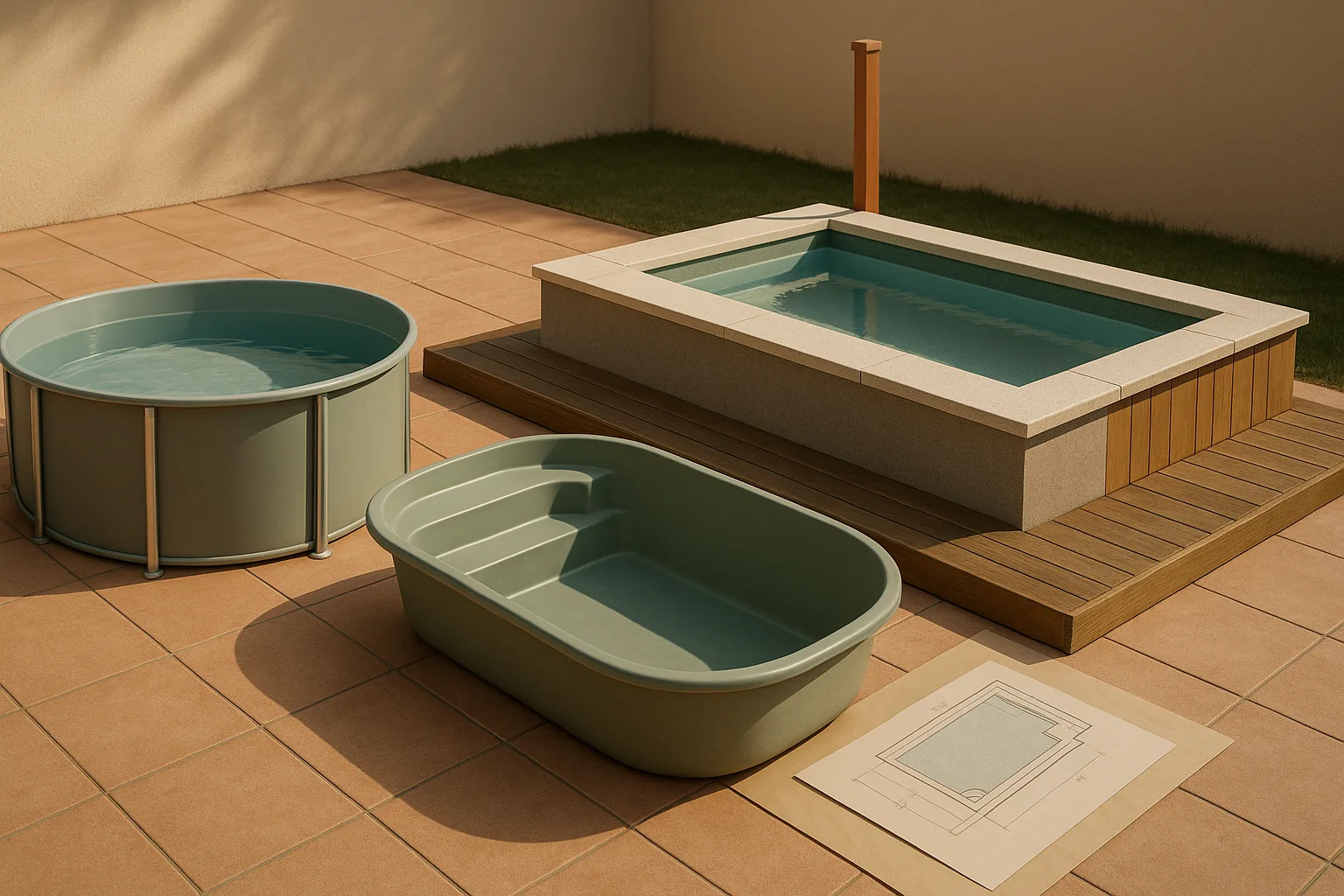
Popular in-ground pool materials — concrete, gunite, fiberglass, and vinyl — each have real trade-offs. The right choice depends on your budget, desired shape, local contractor expertise, and how much ongoing maintenance you're willing to do.
How labor and excavation affect the total installed price
Labor and excavation are where most pool budgets surprise homeowners. According to HomeAdvisor's cost data, excavation and labor together can account for 25% to 50% of total in-ground pool cost. On a $60,000 project, that's $15,000 to $30,000 going entirely to digging and hands-on work before a single tile is placed.
Watch Out: A builder who quotes you a low shell price but doesn't itemize labor may be hiding the real cost. Always ask for excavation, plumbing labor, electrical labor, and finishing labor as separate line items.
Standard pool excavation runs $500 to $3,020 for a typical project, at roughly $8 to $25 per cubic yard according to HomeAdvisor's excavation guide. A standard 15×30-foot pool excavated 6 feet deep displaces roughly 1,000 cubic yards of material — put that against the per-cubic-yard rate and you can see how quickly it adds up on larger pools.
The material-vs-labor split shifts by pool type. Fiberglass pools tend to have lower labor costs (the shell arrives in one piece; installation is faster) but higher material costs. Gunite pools invert that: the material is sprayed on-site, requiring significantly more skilled labor hours and a longer construction timeline.
Why difficult sites can push excavation much higher
Standard excavation ranges assume flat yards with easy machine access. Difficult sites break every one of those assumptions — and the cost impact is real.
Watch Out: Tight access, haul-away costs, utility conflicts, rocky or sloped yards, and high water tables can push excavation well above the standard $500–$3,020 range — in some cases to $10,000–$20,000 or more on the hardest sites.
Here's what actually raises excavation costs:
- Tight access: If an excavator can't reach your backyard directly, crews may need to hand-dig, use a compact machine, or remove fencing, gates, or landscaping to get equipment in. Each workaround adds hours and cost.
- Haul-away distance: Excavated soil has to go somewhere. Long haul distances or landfill fees add to the cubic-yard cost, particularly in dense suburban neighborhoods.
- Utility conflicts: Underground gas lines, water mains, irrigation systems, or electrical conduits require careful hand-work around the trench edges — and sometimes relocation.
- Rocky or clay soil: Solid rock may require jackhammering or blasting. Expansive clay can require additional structural reinforcement around the pool shell.
- Sloped yards: A sloped lot often requires a retaining wall in addition to the excavation, adding a separate structural cost category to the project.
As HomeAdvisor's excavation guide notes, pool size is a key driver in excavation price — but site conditions can outweigh pool size on difficult lots. Get a site-specific excavation estimate before you finalize your pool budget.
Above-ground pool cost breakdown by line item
Above-ground pool installation is cheaper than in-ground on every line, but the installed total is still meaningfully higher than the frame-and-liner kit price you see at a big-box retailer.
| Cost Category | Typical Planning Range |
|---|---|
| Frame / shell / liner kit | $500–$3,500 |
| Site prep (leveling, base material) | $200–$1,500 |
| Electrical (GFCI outlet, bonding) | $300–$1,500 |
| Filtration / equipment (pump and filter) | $200–$800 |
| Deck or stairs | $300–$5,000 |
| Safety fence or enclosure | $500–$3,000 |
| Pool heater (optional but common) | $800–$3,000 |
| Pool cover | $100–$500 |
| Landscaping / grading | $200–$1,500 |
| Permits and inspections | $100–$800 |
| Estimated installed total | ~$1,000–$6,000 (basic) |
The $1,000–$6,000 planning range covers a basic installed setup — frame, liner, filter, stairs, and minimal site prep. Add a full deck surround, heater, and safety fence and the total climbs to $8,000–$15,000. That's still well below most in-ground builds, which is why above-ground pools remain popular for homeowners focused on pool financing constraints or shorter-term ownership horizons.
Low, mid, and premium above-ground pool tiers
| Tier | What You Get | Estimated Installed Total |
|---|---|---|
| Low | 12-ft round or 10×18 oval, basic steel frame, standard filter, A-frame stairs | $1,000–$2,500 |
| Mid | 15×30 oval, resin or hybrid frame, cartridge filter, wood or composite step platform, safety fence | $3,000–$6,000 |
| Premium | 18×33 oval or Intex Ultra XTR-style steel frame, upgraded saltwater system, full wood deck surround, heat pump, auto cover | $8,000–$15,000 |
The biggest jump between tiers is the deck. A basic A-frame entry ladder costs under $100. A built-out wood deck surrounding a 15×30-foot oval pool can run $3,000–$7,000 depending on materials and local labor rates — and transforms the backyard experience entirely. At $10 to $15 per square foot for the pool itself, the shell is often not the most expensive element in a mid-to-premium above-ground project.
Why fencing and enclosures are essential safety costs
A pool fence is not optional. In most US jurisdictions it's legally required — and regardless of local code, it's a non-negotiable safety measure if children are anywhere near the property.
Watch Out: The Virginia Graeme Baker Pool and Spa Safety Act established federal anti-entrapment safety requirements for public pools and spas after a child died from suction entrapment from a faulty drain cover, per the CPSC's Pool Safely program. Residential pool owners should verify compliance with anti-entrapment drain cover standards, and every pool — above-ground or in-ground — should have a compliant barrier.
Budget $1,500–$6,000 for an in-ground pool enclosure or $500–$3,000 for an above-ground pool fence, depending on perimeter length and material. Aluminum pool fencing is the most common residential choice: durable, code-compliant in most municipalities, and available in self-closing, self-latching gate configurations that meet standard barrier requirements.
When you're talking to pool builders, ask specifically how fencing is handled — some contractors include it in the base bid, others treat it as a separate subcontract. Either way, it belongs in your budget from day one.
Factors that raise or lower pool cost in the Sun Belt
Florida, Texas, Arizona, and California account for a disproportionate share of US residential pool builds — and they share some cost dynamics that homeowners elsewhere don't always encounter.
Access and yard size: Sun Belt subdivisions often have smaller lot configurations with side-yard setbacks that limit machine access. Tight access raises excavation cost and can add days to the project timeline.
Soil conditions: Clay soils in parts of Texas can expand and contract seasonally, which affects both excavation difficulty and long-term structural considerations for concrete pools. Desert caliche in Arizona can require mechanical breaking. Sandy coastal soils can excavate easily but may require additional shell reinforcement in high-water-table areas.
Permit rules and timelines: Many Sun Belt municipalities have established specific pool fencing and barrier ordinances that go beyond state minimum requirements. Permit processing times can add weeks or months to a project timeline — budget time as well as money.
Safety enclosure requirements: Local pool barrier rules can add meaningful cost because fence height, gate hardware, and door alarms affect both material and labor budgets. These are easy to miss in a first quote.
Year-round use and equipment: In much of the Sun Belt, pools are used 8–10 months per year. Heater sizing matters more, and equipment must be specified for long cooling seasons and heavy runtime. In coastal California, a heat pump or solar heater can pencil better than gas depending on utility rates.
Material choice and contractor availability: In major warm-weather markets, gunite builders are often abundant and competitive. In smaller markets, fiberglass may be more accessible because it requires less specialized on-site labor.
Decking, patios, and landscaping costs to budget separately
Decking and landscaping routinely surprise first-time pool buyers because they're not part of the pool bid — they're a separate scope that can rival the shell cost on premium projects.
Pool decking: - Poured concrete (broom-finish): $6–$12 per sq ft installed - Pavers (brick, travertine, or concrete): $12–$25 per sq ft installed - Stamped concrete: $10–$18 per sq ft installed - A standard 500 sq ft deck surround runs $3,000–$12,500 depending on material
Landscaping: - Regrading and sod restoration after excavation: $500–$2,500 - Privacy plantings or screening shrubs: $500–$3,000 - Lighting (path lights, underwater pool lights): $500–$3,000+
Budget landscaping and decking as separate line items in your planning spreadsheet. Homeadvisor identifies decking as an additional feature that "affect[s] cost" — that's an understatement for most projects. On a $65,000 pool project, decking and landscaping alone can account for $10,000–$20,000 of the total.
Permits, inspections, and electrical code basics
Every in-ground pool in the US requires a building permit, and most above-ground pools above a certain depth (often 24 inches) require one too. Permit and inspection fees typically run $400–$2,500 depending on your municipality and project scope.
The 2024 International Residential Code (IRC) Chapter 42 is the residential pool code framework where it has been adopted, and local amendments may apply on top of that baseline. Pull your permit before any excavation starts; building without one creates liability issues and can complicate home sales.
On the electrical side, pools require dedicated circuits, bonding of all metallic components, and other local code-mandated protections. Your local code authority and a licensed electrician will specify the exact requirements for your jurisdiction. Do not let a general contractor skip this step — improper pool electrical work is a serious safety hazard. Budget the electrical scope according to your site plan and permit set, and confirm the details in writing before work begins.
Ongoing maintenance costs after the pool is built
Building the pool is a one-time cost. Owning the pool is an ongoing one — and a pool that costs $60,000 to build can easily cost $3,000–$5,000 per year to maintain properly. HomeAdvisor's pool maintenance guide puts recurring maintenance costs at an average of $236, with a range of $55 to $779 per service visit — and additional tasks like filter cleaning, acid washing, or chlorine washing can add $60 to $500 each.
Budget maintenance as part of your ownership cost when you're evaluating pool financing options. If you're stretching to afford the build, make sure the ongoing monthly cost is manageable too.
Monthly chemicals, electricity, and service costs
The day-to-day budget for a pool is a mix of consumables, power, and labor. Instead of relying on invented monthly averages, use the verified maintenance guidance above as the anchor and then ask contractors how often they recommend service for your size of pool, equipment package, and swim season length.
For many homeowners, the practical planning approach is simple: chemicals and balancing supplies recur most often, electricity rises with pump runtime and heater use, and service visits add the largest single out-of-pocket spikes. Those categories are already reflected in the maintenance guide’s average $236 service cost and $55 to $779 range, with extra tasks adding $60 to $500.
Professional service frequency varies by pool size and owner preference. Weekly service during peak season costs more than DIY upkeep, but it also reduces the chance of letting water chemistry drift long enough to damage finishes or equipment. If you plan to self-maintain, set aside time for brushing, skimming, testing, and filter attention on a regular schedule.
When financing a pool makes sense
Pool financing makes sense when you have the income to support the payment and plan to stay in the home long enough to use the pool for multiple seasons. Three common approaches:
- Cash: No interest cost, cleanest transaction. Best if you have liquidity and don't want to affect your mortgage.
- Home equity loan or HELOC: Uses your home's equity as collateral. Rates are typically lower than unsecured personal loans. Good option for homeowners with substantial equity and a stable income. The pool is a permanent home improvement, which supports this approach.
- Pool-specific financing: Many pool builders offer financing partnerships with consumer lenders. Convenient, but compare the APR carefully — some promotional rates convert to higher fixed rates after an introductory period.
Whatever path you choose, finance the full installed cost — not the shell-only number — so your monthly payment reflects reality. A $44,000 project financed over 10 years at a representative rate will carry a materially different monthly payment than a $28,000 shell-only estimate would suggest.
How to vet a pool builder before you get quotes
The right pool builder gives you a line-item bid, carries proper licensing and insurance, has verifiable local references, and doesn't pressure you to sign before you've compared at least two or three proposals.
Contractor checklist: - Licensed in your state for pool construction (licensing requirements vary; verify with your state contractor board) - General liability insurance and workers' compensation coverage — ask for certificates - Local references with pools you can see in person or view photos of - Clear written contract with scope, timeline, and payment schedule - Willingness to provide a line-item bid that breaks out shell, excavation, electrical, plumbing, enclosure, decking, heater, cover, permits, and inspections so you can compare bids category by category - Familiarity with your municipality's permit and inspection process
Get a minimum of three bids. When comparing them, line up each category side by side — shell, excavation, electrical, plumbing, equipment, deck, fence, heater, cover — rather than comparing total numbers. A low total bid often means something is missing from scope, not that the contractor is genuinely cheaper.
Questions to ask about excavation, fencing, and equipment
Use this checklist when reviewing bids with pool installation contractors:
Excavation and site prep: - What's included in your excavation estimate? Is haul-away included? - Have you done a site visit? What do you expect for soil conditions? - If we hit rock or utility conflicts, how is that priced?
Electrical and plumbing: - Is all electrical work (bonding, GFCI outlet placement, panel upgrade if needed) included in the bid? - Who handles the permit for electrical — you or the homeowner? - Are return lines, main drain, and skimmer plumbing in scope?
Enclosure and safety: - Does your bid include a safety fence or pool barrier? - What material and spec meets local code requirements?
Equipment: - What pump, filter, and control system are you specifying? (Get the model numbers.) - Is a heater included? What type and BTU rating? - What pool cover is included, or is that separate?
Inspections and handoff: - How many inspections does the permit require, and who schedules them? - What does your warranty cover and for how long?
If a builder won't answer these questions in writing, find one who will.
FAQ: pool build costs in 2026
How much does it cost to build a pool in 2026?
HomeAdvisor's 2025 cost guide reports an average pool build of $41,936, with a typical range of $25,070 to $59,014. Most mid-market in-ground pool projects land in the $44,300–$86,500 planning band once excavation, electrical, fencing, decking, and equipment are included. Luxury in-ground pools can reach $135,000 or more. Above-ground pools start around $1,000 and run up to $6,000 for a basic installed setup.
What is the cheapest type of pool to build?
Above-ground pools are the least expensive option, starting around $1,000 installed for a basic frame-and-liner setup. Among in-ground pool materials, vinyl liner pools typically carry the lowest shell cost, but liner replacement every 7–15 years adds to the long-term cost of ownership. Fiberglass is mid-range on upfront cost but lower on maintenance cost. Concrete/gunite is the most expensive to build and maintain.
How much does excavation add to pool cost?
Standard pool excavation runs $500 to $3,020 at roughly $8 to $25 per cubic yard, according to HomeAdvisor's excavation guide. Difficult sites — tight access, rocky soil, sloped yards, utility conflicts, or long haul-away distances — can push excavation to $10,000–$20,000. Budget conservatively until you have a contractor-assessed site estimate.
Do above-ground pools add value to a home?
Generally, no — not the way in-ground pools can. In-ground pools are recognized as a home improvement that can increase resale value in the right market. Above-ground pools are typically treated as personal property, not a structural improvement, and are less likely to recover their cost at resale. If home equity is part of your pool investment rationale, an in-ground build is the stronger choice.
What costs the most when building a pool?
The shell gets the attention, but excavation and labor are frequently the largest combined cost category. Per HomeAdvisor's data, excavation and labor can account for 25% to 50% of total in-ground pool cost. On a $65,000 project, that's $16,000–$32,000 going to labor-intensive work before you count decking, fencing, a heater, or landscaping. The line items that surprise most homeowners: the deck/patio surround, safety fencing, and the equipment package (pump, filter, heater, controls), which together can add $8,000–$20,000 to the shell price.
Sources & References
- HomeAdvisor: Cost to Build a Swimming Pool — Primary cost guide; average, range, and per-square-foot data
- HomeAdvisor: Cost to Install an In-Ground Pool — In-ground installed cost range: $14,000–$135,000+
- HomeAdvisor: Cost to Install a Fiberglass Pool — Fiberglass installed range: $25,065–$48,995
- HomeAdvisor: Pool Excavation Cost Guide — Excavation range: $500–$3,020; $8–$25 per cubic yard
- HomeAdvisor: Pool Maintenance Cost Guide — Maintenance average $236; range $55–$779
- HomeAdvisor: Local Pool Contractors — Port Orange, FL — Regional market reference
- CPSC Pool Safely — Virginia Graeme Baker Pool and Spa Safety Act — Federal pool safety law and anti-entrapment requirements
- 2024 International Residential Code, Chapter 42 — Swimming Pools — Governing residential pool construction code framework
Keywords: HomeAdvisor cost guide, fiberglass pool, vinyl liner pool, concrete/gunite pool, above-ground pool, excavation and site prep, GFCI electrical code, pool fence and enclosure, pool heater, pool filter and equipment pad, pool deck or patio, permit and inspection fees, saltwater chlorinator, pool cover, ongoing maintenance costs