How to tell if a musty basement needs a dehumidifier or a pro
A dehumidifier solves a humidity problem. It does not fix a water problem. Getting that wrong usually means buying equipment before you know what is making the basement smell.
At a Glance: - EPA humidity target: Keep indoor relative humidity below 60% RH — ideally 30% to 50% RH - What a dehumidifier does: Pulls moisture from the air, suppresses mold conditions, reduces musty odor caused by high humidity - What a dehumidifier does NOT do: Stop water seeping through foundation walls, fix drainage failures, remediate existing mold colonies, or repair structural damage - Decision rule: If the damp smell appears only in humid summer months and your basement has no visible water, staining, or white mineral deposits on walls, start with a dehumidifier. If you see any of those signs, the dehumidifier is a temporary fix — call a mold remediation service or a basement waterproofing service first.
A good place to start is a dehumidifier affiliate pick that is sized for basement use and carries the ENERGY STAR label, because the right machine can solve a humidity-only odor without turning into a costly trial-and-error purchase. As the EPA states plainly: "The key to mold control is moisture control." That means identifying where the moisture is coming from before buying equipment. A quality dehumidifier is a $200–$350 appliance. Waterproofing a basement can cost several thousand dollars. Spending money in the wrong order is common and avoidable.
What humidity level to set a basement dehumidifier to
Set your basement dehumidifier's humidistat to 50% RH as a starting point, then adjust down toward 45% RH if you still detect odor after two weeks of continuous operation.
TargetRH: For most basements, the practical target is 30% to 50% RH. Do not try to dry the space as much as possible; the goal is to stay below the mold-friendly range while avoiding overly dry air.
The EPA is specific on this: "Indoor relative humidity (RH) should be kept below 60 percent — ideally between 30 percent and 50 percent, if possible." That's the scientifically supported prevention window for mold, not a comfort preference.
Pro Tip: Buy a standalone hygrometer (a dedicated humidity sensor, separate from the dehumidifier's built-in display) and place it on the opposite side of the basement from the unit. The dehumidifier's own sensor reads the air immediately around it — often drier than the rest of the space. A $15–$25 hygrometer from ThermoPro or Govee gives you an honest reading of what's actually happening across the room.
Why 30% to 50% RH is the practical basement target
Mold doesn't need standing water to grow. As EPA's mold guidance explains: "Sometimes, humidity or dampness (water vapor) in the air can supply enough moisture for mold growth." This matters because basements accumulate humid air — warm, moist air from upstairs migrates down and condenses on cooler surfaces like concrete floors, drywall, wood framing, and stored cardboard boxes.
At 60% RH or above, you're outside EPA's preferred range and in territory where common mold species can establish within days on organic materials like wood, paper, and dust. The 30%–50% range suppresses that growth pathway without creating problems at the other extreme.
The target is a prevention window, not a comfort number. You're not aiming for 30% because it feels better — you're aiming for sub-50% because that's where mold conditions become unfavorable.
MoldRiskThreshold: Once basement RH climbs and holds above 60% RH, you're outside EPA's safe zone. At 70%+ RH, active mold growth on wood framing and drywall can begin within 24–48 hours following a moisture event.
When to adjust the setpoint in summer, winter, or an unfinished basement
Seasonal humidity loads differ substantially, and your dehumidifier runtime should reflect that.
| Season | Typical Basement RH Challenge | Recommended Setpoint | Expected Runtime |
|---|---|---|---|
| Summer (June–Sep) | High outdoor humidity infiltrating basement | 45–50% RH | 8–16 hrs/day or continuous |
| Shoulder season (Apr–May, Oct–Nov) | Moderate — varies by weather system | 50% RH | 4–8 hrs/day |
| Winter (Dec–Mar) | Cold air is naturally dry; condensation risk shifts | 40–50% RH or off | Minimal to none in most climates |
A critical note on unfinished basements: concrete and block walls are naturally porous and release ground moisture continuously in warm months. An unfinished basement will almost always run the dehumidifier longer than a finished one with vapor-barrier walls. Don't treat a high runtime as a sign the unit is malfunctioning — it's doing its job.
EPA guidance also emphasizes that water-damaged areas should be dried within 24 to 48 hours to prevent mold growth. If you've had any flooding or visible wetting event, running the dehumidifier continuously immediately afterward is the right call.
How to diagnose whether humidity, drainage, seepage, or hidden mold is causing the smell
The musty smell has four possible sources, and the fix is different for each one. Work through this sequence before buying anything.
[Image: Diagnostic flowchart — basement musty odor source identification]
flowchart TD
    A[Musty basement smell] --> B{RH above 60%?}
    B -- Yes --> C[Humidity likely contributing: set dehumidifier to 45-50% RH]
    B -- No --> D{Water appears after rain?}
    D -- Yes --> E[Drainage or seepage: call waterproofing contractor]
    D -- No --> F{Odor concentrated in one cavity or wall?}
    F -- Yes --> G[Hidden mold: call remediation pro]
    F -- No --> H[Check floor drain trap, sump pit, and storage items]
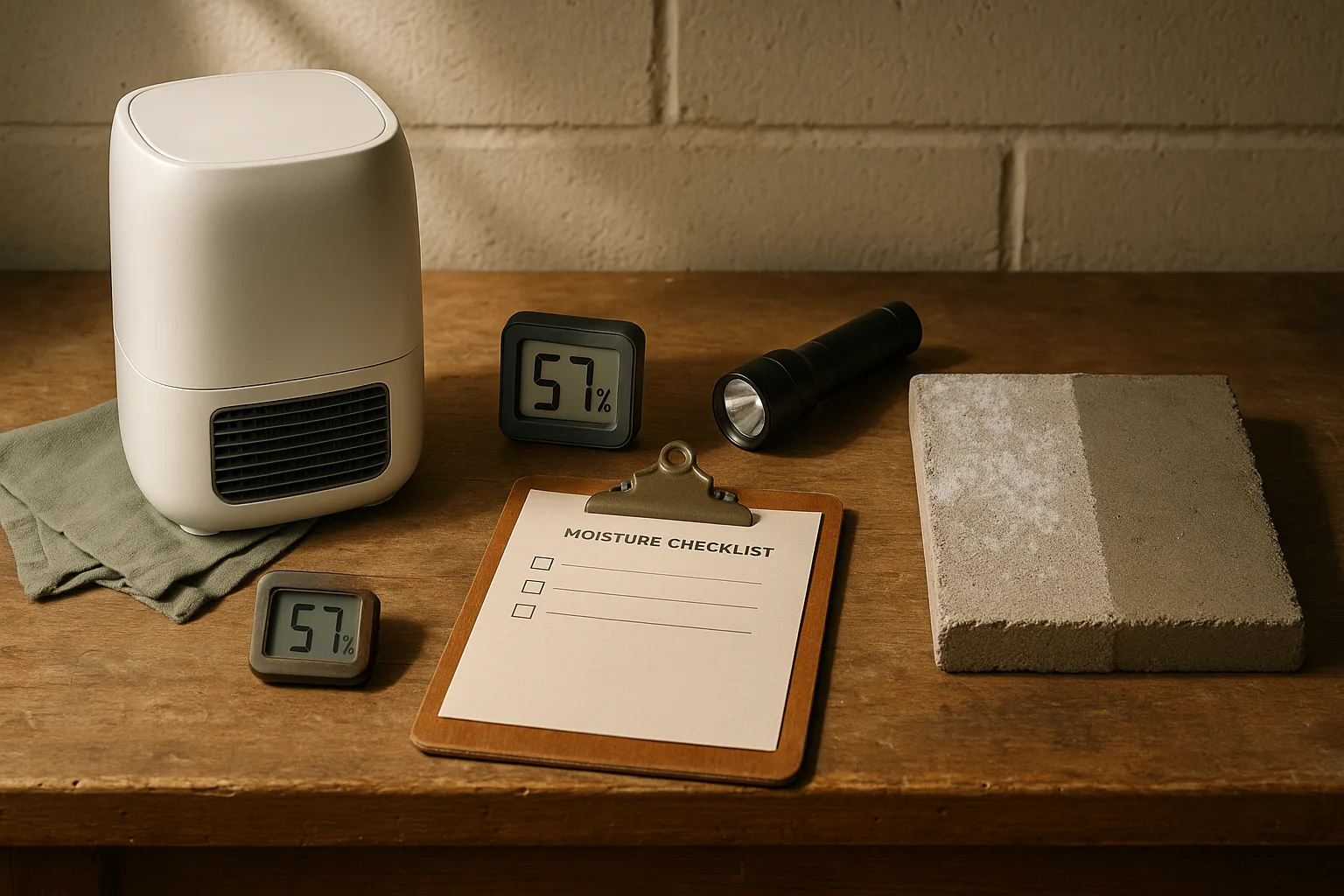
StepCard 1 — Measure the RH. Place a hygrometer in the basement for 24 hours. If it reads above 60% RH consistently, humidity is at minimum a contributing factor. If it reads below 55% and the smell is still strong, humidity is probably not the primary driver. If you monitor the space with a phone-connected sensor such as ThermoPro or Govee, the trend line is usually easier to read than one isolated number.
StepCard 2 — Check walls and floor after rain. Within 24 hours of a significant rainstorm, inspect the perimeter walls and floor-wall joint for visible water, damp patches, or wet spots. Mark any wet areas with painter's tape and note whether they appear after every rain or only after heavy events.
StepCard 3 — Look for efflorescence. Efflorescence is the white, powdery, or chalky mineral deposit left behind when water moves through concrete or masonry and evaporates. It looks like someone dusted chalk on the wall. Its presence tells you water has been migrating through the wall — repeatedly.
StepCard 4 — Inspect every dark cavity. Pull stored items away from walls. Check behind the furnace, under the stairs, inside any framed cavities. Smell directly at drywall seams and the base of wood framing. A concentrated musty odor in a specific zone points to hidden mold rather than generalized humidity.
StepCard 5 — Check the floor drain and sump pit. A dry floor drain trap or a neglected sump pit can emit sewer gas and biological odor that mimics mold. Pour a quart of water into any floor drain that hasn't been used recently, and inspect the sump pit lid for gaps.
As the EPA puts it: "Fix the source of the water problem or leak to prevent mold growth." The diagnostic work above tells you whether the source is air moisture, ground drainage, structural seepage, or biological growth — and that determines who you call next.
Clues the problem is high humidity only
High humidity as the sole cause is the best-case scenario — and it has a recognizable fingerprint.
- RH consistently reads above 55–60% in summer months
- The musty smell is diffuse, not concentrated in one wall or corner
- No visible water stains, efflorescence, or wet spots on walls or floor
- Stored cardboard boxes and fabric items feel slightly damp or clammy
- Condensation forms on cold-water supply pipes, the outside of the water heater, or windows
- The smell noticeably improves on dry, low-humidity days or after a dry stretch of weather
If your basement checks most of these boxes and none of the red flags below, a properly sized Energy Star-certified dehumidifier running at a 45–50% RH setpoint is a legitimate fix. Expect two to four weeks of continuous operation before the smell clears noticeably, because the dehumidifier needs time to pull moisture out of porous materials like concrete, wood framing, and stored goods — not just the air.
Clues you need waterproofing or drainage help instead
Watch Out — Red Flags for Foundation Seepage or Drainage Failure: - Water appears on walls or floor within 24–48 hours of rain — even if it dries quickly - Standing water anywhere on the floor, even in a small puddle at the wall-floor joint - Efflorescence (white mineral deposits) on block or concrete walls — indicates repeated water migration through the masonry - Rust stains at the base of walls, suggesting chronic wetting of metal components in the slab - Cracks in the foundation wall, especially horizontal cracks (those can indicate lateral soil pressure — a structural emergency) - Bowing or bulging walls — get a structural engineer on-site immediately; this is not a dehumidifier situation - The musty smell returns within days of drying out, regardless of dehumidifier operation
A dehumidifier running in a basement with active seepage is like mopping the floor while the faucet runs. The unit will run constantly, collect water rapidly, and fail to reach your target RH because new moisture is entering faster than it can be removed. EPA guidance is explicit: dehumidification cannot substitute for fixing the leak or drainage failure.
If you see any of these signs, contact a licensed basement waterproofing contractor for an assessment before purchasing or running a dehumidifier as a primary fix. Waterproofing solutions range from exterior grading corrections (often inexpensive) to interior drain tile systems (significant investment) — the right approach depends on where the water is entering.
Clues hidden mold may already be in the basement
Mold is often invisible long before it's a large problem. The EPA notes that "mold can grow on virtually any organic material as long as moisture and oxygen are present" — meaning wood framing, drywall paper, carpet, insulation, and even the dust on concrete surfaces are all potential substrates.
Indicators of hidden mold: - Strong musty odor concentrated near a specific wall, cavity, or structural member — not diffuse throughout the space - Odor is worst first thing in the morning before the HVAC or dehumidifier runs - Any past flooding or water event where materials weren't dried within 48 hours (per EPA's guidance) - Visible dark staining at the back of wood shelving, behind insulation, or at the base of wood-framed walls - Occupants experiencing allergy symptoms, respiratory irritation, or headaches specifically when spending time in or near the basement
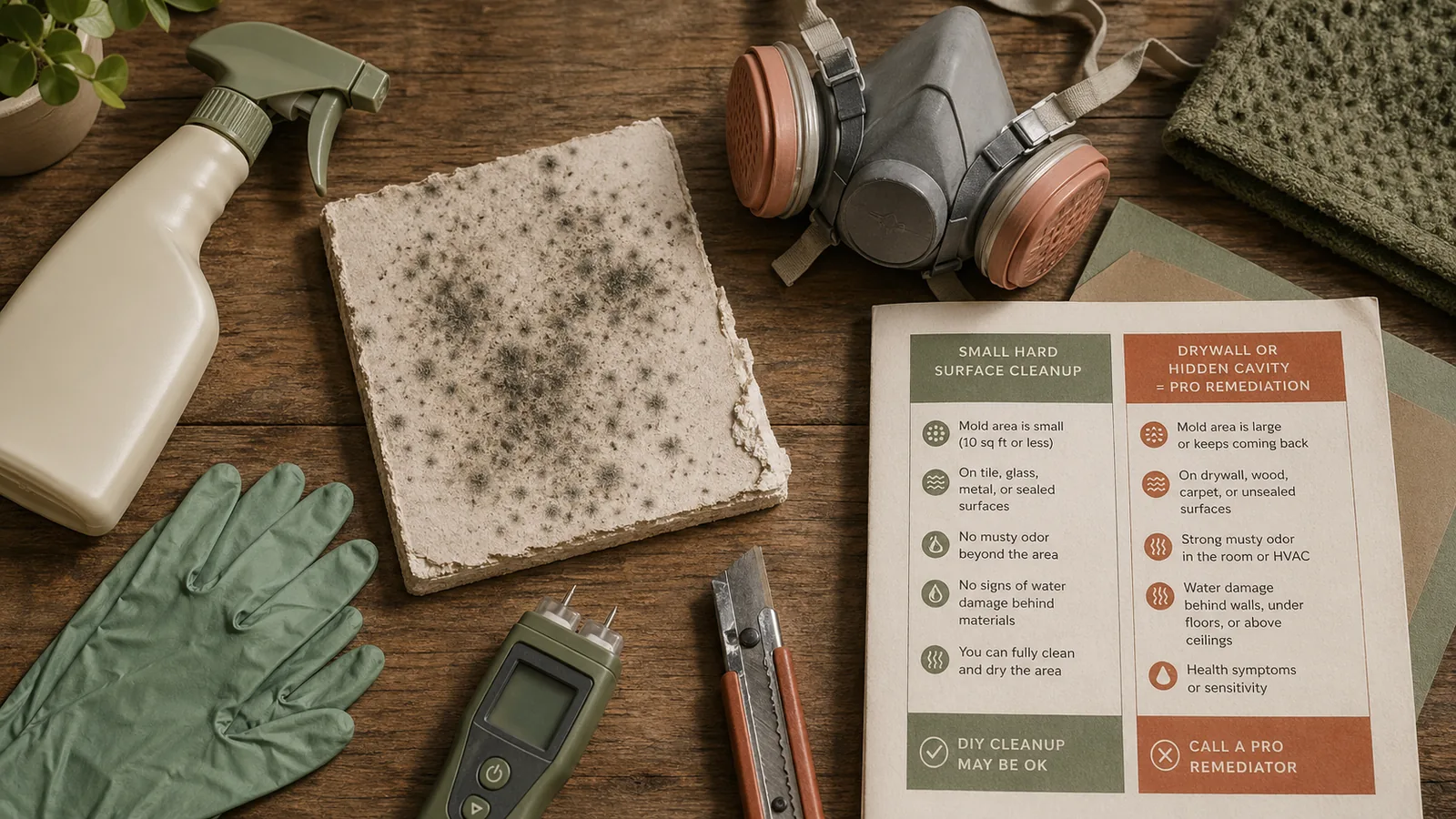
Visible mold threshold for professional remediation: The EPA and most remediation industry standards treat visible mold covering more than roughly 10 square feet as a job for a certified mold remediation professional rather than a DIY cleanup. If you find a patch of mold larger than approximately a 3×3-foot area, or if you find mold on HVAC equipment or inside wall cavities, contact a licensed mold remediation service. Disturbing large mold colonies without proper containment spreads spores through the house.
How to size a basement dehumidifier and choose the right type
For a basement, use a compressor-style dehumidifier — not a desiccant model. Compressor units are efficient at the moderate temperatures (55–75°F) typical of US basements, and they're what you'll find in the Energy Star certified dehumidifier listings. Desiccant dehumidifiers work better in very cold spaces (below 50°F) but cost more to run in a temperate basement.
Energy Star certification matters here because the label is tied to EPA efficiency specifications — meaning a certified unit pulls more moisture per kilowatt-hour than a non-certified one. Over a season of heavy use, that gap shows up on your electric bill.
AffiliateProductCard: A basement-sized model such as a Frigidaire 50-pint ENERGY STAR dehumidifier gives you the capacity most homeowners need, plus the lower operating cost that makes continuous summer use practical.
SizingGuide: Match the unit to square footage and dampness, not just the room count. Small basements under 500 square feet often do well with 30 to 35 pints per day, while larger or unfinished spaces need 50 to 70 plus pints per day to keep pace with basement moisture.
What capacity to buy for small, medium, and large basements
Dehumidifier capacity is rated in pints of water removed per day under standard test conditions. Size up if your basement is unfinished, has a history of flooding, or stays visibly damp.
| Basement Size | Condition | Recommended Capacity |
|---|---|---|
| Up to 500 sq ft | Moderately damp (musty smell, no visible water) | 30–35 pints/day |
| 500–1,000 sq ft | Moderately damp | 40–50 pints/day |
| 1,000–1,500 sq ft | Moderately damp | 50–60 pints/day |
| Any size | Wet (visible moisture, seepage history) | 60–70+ pints/day |
| Large open basement 1,500+ sq ft | Any condition | 70–105 pints/day |
Pro Tip: If your basement is below-grade on all four sides, uninsulated, and in a humid climate (the Southeast, Mid-Atlantic, or Midwest), add one size tier to whatever the square footage table suggests. These spaces work harder against outdoor humidity.
Energy Star's product finder lists units by pints/day alongside efficiency values — for context, a certified unit at the high end of the capacity range can be rated at 105 pints/day with an efficiency of 2.35 liters per kilowatt-hour, which is meaningfully more efficient than older or uncertified models at the same capacity.
When a drain hose or condensate pump is worth it
In a basement, continuous drainage is almost always worth setting up. Manually emptying a bucket on a dehumidifier running 8–12 hours a day gets old fast — and a full bucket trips the auto-shutoff, meaning the unit stops working while you're at work.
| Method | Best For | Maintenance Required |
|---|---|---|
| Bucket (built-in tank) | Occasional use, low humidity load, unit near where you'll remember to check | Empty daily during peak season; clean to prevent algae and odor |
| Gravity drain hose | Floor drain or utility sink nearby and lower than the unit's drain port | Flush hose with clean water periodically; Frigidaire notes that a blocked hose triggers the Full Bucket light and backs water into the tank |
| Built-in or add-on condensate pump | No floor drain nearby; unit below the level of any available drain | Clean pump and bucket to prevent blockage; pump adds one more component that can fail |
For most basements, a gravity hose to a nearby floor drain is the most reliable and lowest-maintenance setup. If you don't have a floor drain conveniently located, a unit with a built-in pump (like several models from Frigidaire, hOmeLabs, or Keystone in the 50-pint class) removes the daily emptying task entirely — but Frigidaire's own care guidance notes that pump models require regular bucket cleaning to prevent blockage from algae buildup.
How to place, drain, and run the dehumidifier for best results
Getting placement and drainage right is the difference between a unit that solves the problem and one that runs constantly without improving the numbers.
StepCard 1 — Placement: Position the unit in the center of the basement, or as close to it as the layout allows. Avoid pushing it into a corner — dehumidifiers need several inches of clearance on all sides for air intake and exhaust to flow freely.
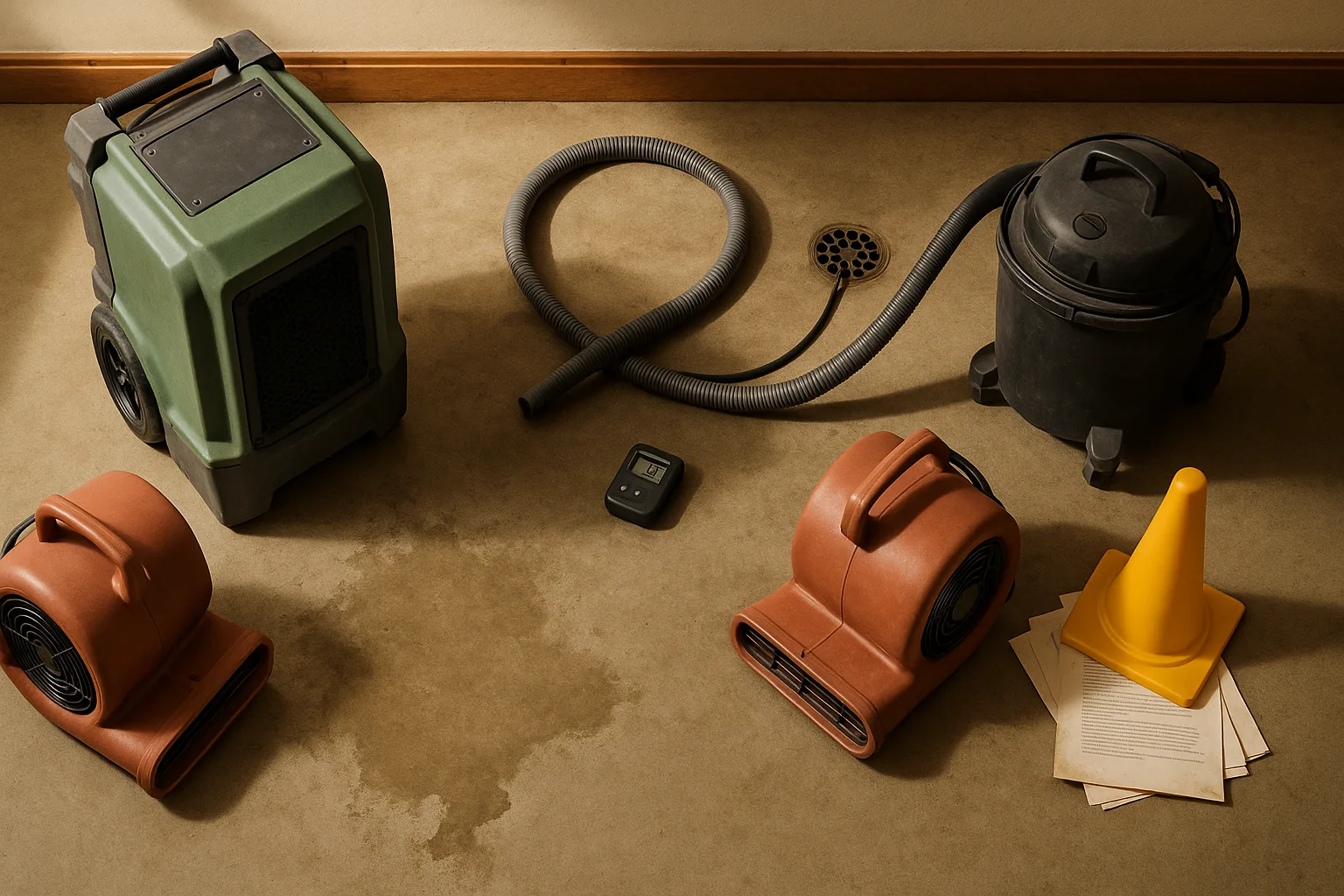
StepCard 2 — Drain routing: Route the drain hose before you plug in the unit. Gravity drain: the hose must slope downward continuously from the unit's drain port to the floor drain or utility sink — no loops or uphill sections.
StepCard 3 — Power safety: Plug the unit into a grounded 120V outlet rated for the unit's amperage draw. Do not use an extension cord for continuous operation; most manufacturers explicitly prohibit it and it's a fire risk.
StepCard 4 — Setpoint: Set the humidistat to 50% RH and run the unit continuously until the basement reaches that level — this initial drying phase can take several days to two weeks in a very damp space.
StepCard 5 — Verification: Check the hygrometer (not the unit's display) after 48 hours to verify the reading is dropping. If it hasn't moved, check for obvious moisture sources the unit can't overcome.
Where to place the unit so it actually dries the basement
[Image: Placement diagram — basement dehumidifier position relative to walls, storage, and drain]
The single biggest placement mistake is tucking the dehumidifier against a wall behind stored boxes. The unit pulls in humid air and pushes out drier air — if that airflow path is blocked, it's dehumidifying a small pocket of air around itself, not the room.
- Keep at least 6–12 inches of clearance on all sides with intake and exhaust vents
- If your basement has multiple rooms separated by walls or doors, either run a unit in each section or leave interior doors fully open and accept reduced performance in distant rooms
- Avoid placing it directly against an exterior foundation wall in winter — in very cold climates, the coils can ice up below about 65°F ambient temperature; most modern units have auto-defrost, but you'll still see reduced efficiency
- Keep it away from the furnace intake and return air vents — you don't want to be fighting the HVAC system for humidity control in the same air stream
How to route condensate safely to a floor drain, sink, or sump
- Confirm the floor drain is functional before connecting: pour a gallon of water in and watch it drain. If it backs up or drains slowly, clear the trap first.
- Use the drain hose that came with the unit, or a standard 5/8-inch garden hose fitting that matches your unit's port — check the manual.
- Secure the hose so it can't kink or be knocked out of the drain opening.
- Never route condensate into a sump pit that doesn't have a functioning pump — you'll add to the water problem you're trying to solve.
Watch Out: A blocked hose can cause water to back up into the bucket and trigger the unit's automatic shutoff — your dehumidifier will stop running without any visible indication that there's a problem. Frigidaire's guidance specifically recommends flushing the hose periodically with clean water to remove debris buildup.
How often to clean filters and expect seasonal run time
| Maintenance Task | Frequency |
|---|---|
| Check/rinse filter | Every 2–4 weeks during active season |
| Clean bucket/tank (if using bucket method) | Every 2 weeks minimum; weekly in high-humidity months |
| Flush drain hose with clean water | Every 4–6 weeks |
| Inspect coils for dust buildup | Each spring before starting seasonal use |
| Full cleaning before storage | Before shutting down for winter |
Always unplug the unit before cleaning — Frigidaire's care documentation states this explicitly, and it applies across brands. A clogged filter forces the compressor to work harder against restricted airflow, reducing efficiency and shortening the unit's lifespan.
Runtime expectations: In peak summer in a humid climate (Mid-Atlantic, Southeast, Great Lakes), expect continuous operation. In fall and spring, expect 4–8 hours of cycling per day once the basement reaches your target RH. In winter, most basements in cold climates don't require a running dehumidifier — cold air holds very little moisture, and running the unit in near-freezing conditions can damage the compressor.
When a dehumidifier is only temporary mitigation, not the fix
As EPA's guidance states, mold control requires fixing the source of water intrusion — dehumidification supports that goal but cannot substitute for it. If any of the conditions below apply to your basement, a dehumidifier is masking the problem, not solving it.
DIY vs Pro:
| Situation | DIY Dehumidifier | Call a Pro |
|---|---|---|
| Musty smell, RH above 55%, no visible water | ✅ Start here | Not yet |
| Occasional condensation on pipes/windows | ✅ Dehumidifier + better ventilation | Not yet |
| Visible mold patch under 10 sq ft, humidity-only cause | ✅ Clean + dehumidify | Monitor closely |
| Mold patch over 10 sq ft, or inside wall cavities | ❌ | ✅ Remediation pro |
| Water on floor or walls after rain | ❌ | ✅ Waterproofing contractor |
| Efflorescence on walls | ❌ (dehumidifier won't stop it) | ✅ Waterproofing assessment |
| Horizontal wall cracks or bowing walls | ❌ | ✅ Structural engineer immediately |
| Water near electrical outlets or panels | ❌ | ✅ Electrician + remediation |
When to Call a Pro: - Visible mold growth exceeds roughly 10 square feet in total - You find mold inside HVAC ducts, air handlers, or on the furnace - Mold on structural wood framing (joists, sill plates) behind finished walls - Musty odor persists after humidity is consistently held at 45–50% RH for more than 4 weeks - Any occupant has respiratory symptoms, persistent cough, or worsening asthma correlated with time spent in or near the basement
The EPA is direct on this point: "If mold is a problem in your home, you should clean up the mold promptly and fix the water problem." For contamination beyond the DIY threshold, a certified mold remediation professional provides containment, HEPA filtration during removal, and post-remediation verification testing — none of which a homeowner can replicate safely with a shop vac and bleach.
Contact a licensed mold remediation service when growth is extensive, when it's inside structural cavities, or when the moisture source is still active.
Red flags for basement waterproofing or foundation repair
When to Call a Pro — Waterproofing or Structural: - Water intrusion following rain events — any amount, any frequency - Efflorescence (white chalky mineral deposits) on masonry walls - Horizontal cracks in concrete block or poured concrete walls - Bowing or inward-leaning walls — call a structural engineer today, not next week - Sump pump running frequently even in dry weather (indicates high water table) - Rust stains or deteriorating mortar at the wall-floor joint
The EPA's mold course notes that "if left unchecked, mold eventually can cause structural damage to building materials" — meaning a chronic water intrusion problem that feeds mold growth can progress to compromised floor joists, rotted sill plates, and weakened foundation walls. Catching seepage early and addressing it with proper drainage or waterproofing is far less expensive than the structural repair that follows years of neglect.
Contact a basement waterproofing contractor for an assessment. Reputable contractors will offer free inspections — get at least two opinions before committing to interior drain tile or wall panel systems, as recommendations and prices vary.
Red flags for electrical or safety hazards
Watch Out — Electrical Emergency: If you find standing water anywhere near electrical outlets, the electrical panel, a water heater, furnace, or any plugged-in appliance: do not enter the space. Turn off the circuit breaker for the basement from a dry location, or call your utility to cut power before re-entering. Do not run a dehumidifier in standing water.
Water near electrical equipment is a life-safety issue before it's a mold issue. Once the space is safely de-energized and dried by a professional, then you address the moisture source. The dehumidifier comes after.
What the basement fix costs: dehumidifier vs waterproofing vs remediation
The cost gap between these solutions is wide, and spending in the wrong category first is a common and expensive mistake.
Typical dehumidifier appliance and operating costs
Cost Snapshot: - Entry-level 30–35 pint/day dehumidifier: roughly $150–$200 - Mid-range 50-pint Energy Star unit (most common for basements): roughly $200–$300 - High-capacity 70-pint Energy Star unit: roughly $280–$400 - Electricity cost: varies by local rate and runtime; a 70-pint unit draws roughly 700–750 watts — at the US average electricity rate, continuous summer operation adds approximately $30–$60/month to the electric bill depending on your utility rate - Filter and maintenance: minimal — filters are typically rinsed, not replaced; no recurring cartridge cost
Look for Energy Star-certified models when comparing — the EPA certification means you're getting verified efficiency, which compounds over a full season of use.
Typical waterproofing and remediation cost ranges
CostBreakdown: - Mold remediation (small area, accessible): Several hundred dollars for a contained DIY-scale job; professional remediation for a significant area typically runs into the thousands, depending on scope and affected materials - Interior basement waterproofing (drain tile + sump): Mid-four figures to low-five figures for a full perimeter system in an average home - Exterior waterproofing (excavation required): Generally the most expensive option; significant investment depending on foundation depth and access - Foundation crack injection (minor cracks): Often a few hundred dollars per crack from a specialist — one of the more affordable targeted fixes - Regional cost note: Prices vary by region, access difficulty, and scope, so comparable jobs can differ widely between a city lot, a suburban home, and a property with limited excavation access.
The pattern to remember: a dehumidifier is a maintenance appliance, not a repair. If the underlying problem is structural, the dehumidifier cost is sunk spending. Get the diagnosis right first.
Musty basement FAQ
Will a dehumidifier get rid of a musty smell in the basement?
Yes — if humidity is the main cause. When basement RH is consistently above 55–60%, airborne moisture feeds mold growth on organic materials throughout the space, and that microbial activity is what you're smelling. Bringing the RH down to the 45–50% range starves that process, and the odor fades over a few weeks as the space and its contents dry out.
The smell returns — or never fully leaves — when the source isn't humidity but active water intrusion or established mold colonies. The EPA is explicit: fixing the water source is required, not optional. A dehumidifier in a leaking basement keeps running hard without ever reaching your target RH, because new moisture enters as fast as the unit removes it.
If you've been running a properly sized dehumidifier for four or more weeks, your RH is consistently reading 45–50%, and the smell persists — stop troubleshooting the dehumidifier and start looking for hidden mold or a seepage source.
Can a basement be too dry?
Yes, technically, but getting there requires effort and is rarely a realistic concern for most basements. Below 30% RH, wood framing and furniture can dry out and crack, and occupants may experience dry skin and irritated sinuses. Standard hardwood floors and wood trim can also gap or shrink.
The EPA's preferred range — 30% to 50% RH — exists because the lower bound is a real consideration, not just a formality. Set your humidistat to 45–50% rather than the lowest possible number. "Drier is always better" isn't true once you've crossed below 40% RH; you're adding discomfort and potential material damage without meaningfully improving mold prevention.
When should I call a mold remediation professional?
Call a mold remediation professional when any of these apply:
- Visible mold growth exceeds roughly 10 square feet in total
- You find mold inside wall cavities, on structural wood joists, or on HVAC components
- You cannot identify or access the moisture source driving growth
- The musty smell persists after weeks of confirmed humidity control
- Anyone in the household has health symptoms that track with time in the basement
The EPA's position is that mold left unaddressed long enough causes structural damage: "If a mold and moisture problem goes unaddressed long enough, structural damage is likely to result." Remediation gets more expensive and invasive the longer growth is allowed to continue. Prompt action — cleanup plus moisture-source correction — is consistently the least expensive path.
Sources & References
- EPA Mold Resources — epa.gov/mold — Primary EPA hub for mold, moisture, and indoor air quality guidance
- EPA Mold Course Chapter 2 — Mold and Health — Source for indoor RH targets (30%–50%), mold growth conditions, and structural damage risk
- EPA: Key to Mold Control is Moisture Control (Infographic) — Source for "The key to mold control is moisture control" quote
- EPA: A Brief Guide to Mold, Moisture, and Your Home — Source for 24–48 hour drying guidance, fixing water sources, and remediation guidance
- EPA: Ten Things You Should Know About Mold — Source for "Fix the source of the water problem or leak to prevent mold growth"
- Energy Star Certified Dehumidifiers — Product Finder — Source for capacity ratings (pints/day) and efficiency data for certified units
- Frigidaire Dehumidifier Clean and Care Guide — Source for bucket cleaning, algae prevention, and pre-use filter guidance
- Frigidaire Dehumidifier Not Draining — Support Article — Source for hose blockage, Full Bucket light behavior, and drain hose flushing guidance
- HomeAdvisor Dehumidifier Lifespan — Source for common service-life range of whole-house dehumidifiers
Keywords: EPA mold guidance, relative humidity (RH), 30% to 50% RH, 60% RH mold threshold, hygrometer, humidistat, Energy Star dehumidifier, compressor dehumidifier, drain hose, condensate pump, efflorescence, foundation seepage, visible mold remediation, basement waterproofing, PurpleAir / AirNow