How much does pest control cost for fungus gnats and houseplant pests?
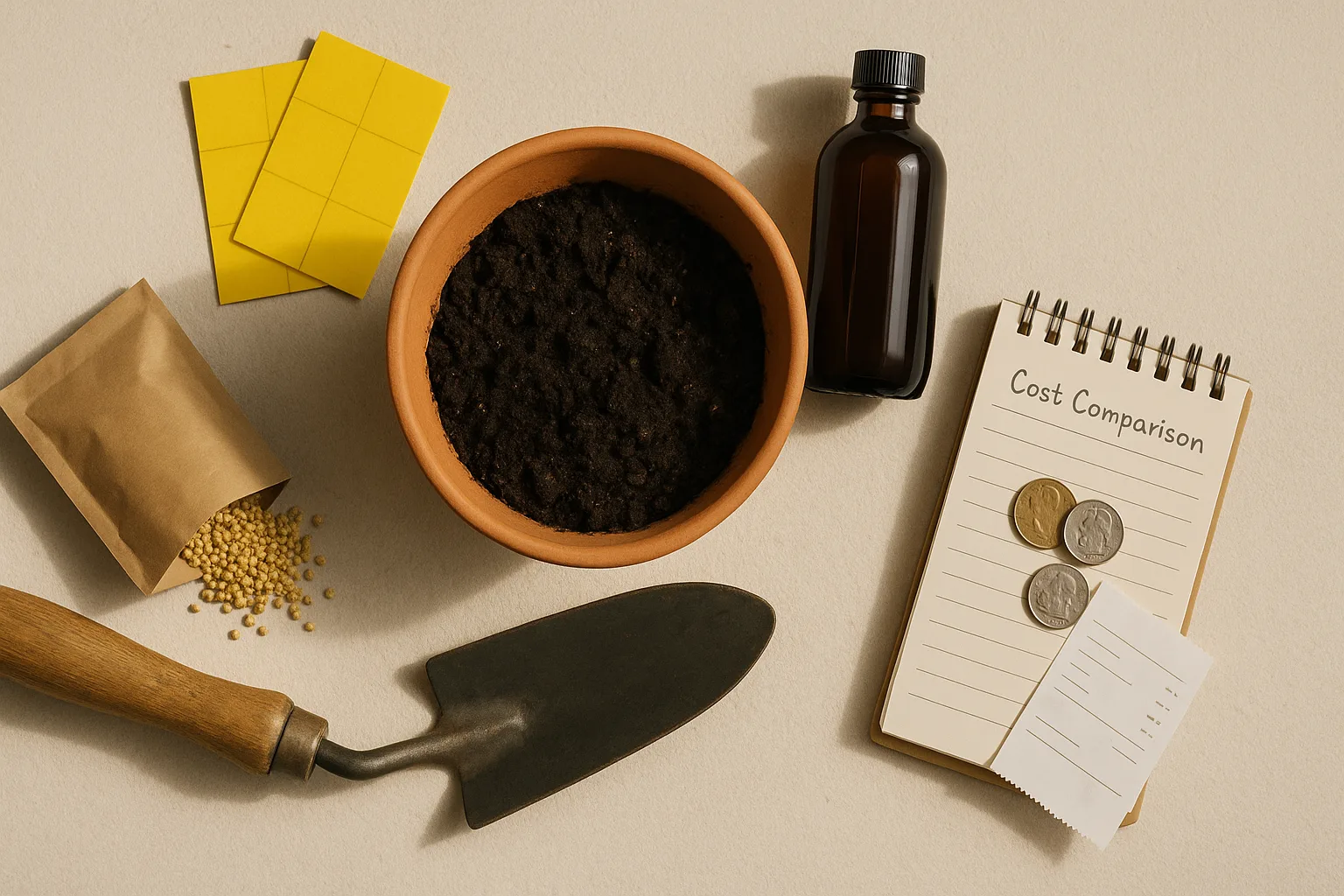
For most houseplant pest problems, you're looking at $10 to $80 in DIY supplies — sticky traps, a bag of BTI granules, and maybe a bottle of insecticidal soap. A professional pest control visit for a houseplant-specific issue typically starts around $100 to $200 if a local exterminator is even willing to take the call, but most will redirect you toward DIY options unless the infestation is tied to the home structure itself.
Quick cost snapshot: DIY houseplant pest treatment usually runs $10 to $80 total, with most fungus gnat kits landing in the $30 to $65 range once you buy sticky traps, BTI, and a few extra supplies. A pro visit, if one is even offered for indoor plant pests, usually starts around $100 to $200 and can climb higher if inspection time, follow-up visits, or structural moisture issues are involved. As a service-pricing benchmark only, HomeAdvisor's rodent-removal cost guide shows minor pest jobs starting around $80, average jobs landing near $395, typical ranges running $189 to $655, and severe or hard-to-reach infestations reaching $1,500.
To give you a honest benchmark on how pro pricing can scale: HomeAdvisor's rodent-removal cost guide shows minor pest jobs starting around $80, average jobs landing near $395, typical ranges running $189 to $655, and severe or hard-to-reach infestations reaching $1,500. That data is for rodent extermination — not a fungus gnat quote — but it accurately illustrates how inspection fees, treatment methods, and follow-up visits stack up in professional pest control, which is useful context if you're wondering whether a pro visit is worth it for your plants.
The honest answer for most fungus gnat situations: it isn't. A targeted houseplant pest treatment with the right supplies costs a fraction of a pro visit and works well when you execute it consistently.
Cost Snapshot: DIY houseplant pest treatment: $10–$80 total. Pro pest control visit (if applicable): $100–$400+, depending on scope. Most fungus gnat cases never need a pro.
What houseplant pest control actually costs: DIY supplies versus a pro visit
The gap between a $12 fix and a $200 pro visit comes down to one question: is the pest confined to your plants, or has it taken over your home? For fungus gnats, the answer is almost always the former — and OSU Extension notes that avoiding overwatering and using yellow sticky traps are the two cornerstones of control.
A representative sticky trap pack for houseplants gives you the low-cost monitoring tool most people need first, while BTI-based Mosquito Bits provide the larval control piece that keeps the cycle from restarting.
Here's a realistic DIY treatment breakdown at US retailers in 2026:
| Item | Typical Cost | What It Does |
|---|---|---|
| Yellow sticky traps | $6–$12 | Catches adult fungus gnats and helps you monitor whether treatment is working |
| BTI granules or dunks | $10–$20 | Targets fungus gnat larvae in moist potting mix |
| Insecticidal soap concentrate | $8–$16 | Handles soft-bodied pests such as mealybugs, thrips, and young scale crawlers |
| Horticultural oil | $10–$18 | Smothers scale, mealybugs, and thrips eggs on labeled plants |
| Replacement potting mix | $8–$20 | Fresh indoor mix for repotting badly infested plants |
| Optional repotting supplies | $5–$15 | New nursery pot, cache pot, or disposal bags if the old setup is contaminated |
| Estimated DIY total | $30–$65 | A solid multi-week treatment setup for most small collections |
A professional pest-control visit, by contrast, will likely include an inspection fee, one or more treatment applications, and possibly a follow-up visit — costs that add up quickly even for a small indoor job. Unless you have a large collection, repeated reinfestation you can't resolve, or a structural moisture problem driving the bugs, a DIY kit is the right first move.
DIY vs Pro: DIY wins for fungus gnats confined to one to five pots. The economics flip when you have 20+ plants showing signs of reinfestation, a rare-plant collection worth hundreds of dollars, or bugs emerging from drains or damp walls rather than the soil.
Sticky traps, BTI, and soil drenches: the low-cost fungus gnat starter kit
Sticky traps and BTI do different jobs, and understanding that split is why the two-item combo works better than either alone.
Yellow sticky traps catch adult fungus gnats — the small dark flies you see hovering near your plants. As OSU Extension explains, "Adult fungus gnats are attracted to these inexpensive traps and become stuck on them." Trapping adults reduces the breeding population, but adults are actually the lesser concern — they don't eat roots. Traps also serve as a monitoring tool: when catches drop to near zero, you know the infestation is winding down.
BTI (Bacillus thuringiensis israelensis) is a naturally occurring soil bacterium that specifically targets larvae. The EPA's Bti page confirms it affects only mosquito, blackfly, and fungus gnat larvae, with five registered strains across 48 approved pesticide products in the US. The EPA label for Mosquito Bits confirms BTI use for fungus gnat larvae in soil or potting mix. Mosquito Bits — a BTI granule product from Summit Chemical — are one of the most accessible formats: you sprinkle them on the soil surface or brew a BTI "tea" to use as a soil drench, following label directions for application rate and frequency.
Watch Out: Sticky traps are a monitoring and adult-control tool. BTI targets larvae in the soil. Neither one alone breaks the full fungus gnat lifecycle. Use both.
Product callout: Mosquito Bits are a practical starting point if you want one product that fits the label-backed larvae-control role without turning your whole routine into a chemical cabinet project.
A full starter kit — one pack of yellow sticky traps and one container of BTI granules — runs about $16–$32 at most retailers. That's your baseline houseplant pest treatment budget before you've touched anything else.
Insecticidal soap and horticultural oil for thrips, mealybugs, and scale
When the pest isn't a fungus gnat but a sap-sucker — thrips, mealybugs, or scale — the treatment cost and effort both increase, particularly on plants you care about.
Insecticidal soap works by disrupting the cell membranes of soft-bodied insects on contact. It's effective against mealybugs, young scale crawlers, and thrips when applied directly to the pest. Horticultural oil smothers insects and their eggs by blocking their breathing pores. Safer Brand's horticultural oil is labeled for houseplants and is OMRI-listed, which matters if you're growing edibles or prefer to minimize synthetic inputs. At $10–$18 per bottle of concentrate, it's affordable per application — but the catch is that sap-sucking pests require repeated treatments across multiple weeks.
Here's a practical comparison of what these treatments address and what they cost per use:
| Product Type | Target Pests | Cost per Bottle | Applications Needed |
|---|---|---|---|
| Insecticidal soap | Mealybugs, thrips, soft scale | $8–$16 | Every 5–7 days × 3–4 rounds |
| Horticultural oil | Scale, mealybugs, thrips eggs | $10–$18 | Every 7–14 days × 2–3 rounds |
| BTI granules | Fungus gnat larvae only | $10–$20 | Weekly × 3–4 weeks |
| Sticky traps | Fungus gnat adults (monitoring) | $6–$12 | Ongoing; replace as filled |
The reason sap-sucker treatment costs more in total is the repetition. A single spray misses eggs and crawlers that haven't hatched yet. Plan for three to four treatment rounds at minimum. If you're working on a variegated Monstera or a rare Philodendron worth $150+, close weekly inspections and consistent application are non-negotiable — one skipped round gives the pest population time to rebound.
Pro Tip: For scale insects specifically, adult armored scale is protected by a waxy shell that soap and oil can't penetrate well. Wipe adults off with a cotton swab dipped in 70% isopropyl alcohol before applying horticultural oil to the plant. This two-step approach is more effective than spray alone on established infestations.
Replacement potting mix, repotting, and the hidden cost of starting over
Sometimes the most cost-effective move is also the most drastic one: throw out the soil and start fresh.
OSU Extension notes that fungus gnat larvae live in the top half inch or so of potting soil and require moisture to survive. If a pot has been chronically overwatered, the soil itself has become a breeding habitat — and no amount of BTI treatment will fully resolve the problem as long as persistently wet, organically rich media sits in the pot. Repotting isn't optional cosmetic work in that scenario; it's source control.
Here's what a full repotting and cleanup run costs:
- Fresh indoor potting mix (1–2 qt bag for a 6-inch pot) — $5–$10
- Hydrogen peroxide soil flush (3% from the drugstore, used as a pre-repot soil soak to kill remaining larvae) — $2–$4
- New nursery pot (4- to 8-inch plastic) — $2–$6 at any US garden center
- Pot scrubbing supplies — dish soap and an old brush; $0 if you already have them
- Disposal bags for infested soil — $1–$3
Total repotting cost for one plant: $10–$23. For a collection of five heavily infested pots, that's $50–$115 — still well below a single professional pest-control visit, and it solves the root problem rather than treating its symptoms.
Watch Out: Don't reuse infested potting mix by baking it or "refreshing" it with BTI if you're dealing with a severe infestation. A clean start with fresh mix eliminates the breeding population more reliably than in-place treatment.
Why fungus gnats are usually cheaper than a full pest-control service
Fungus gnats occupy a specific and relatively benign position in the houseplant pest hierarchy — which is exactly why most infestations never need a professional exterminator.
Wisconsin Extension puts it plainly: "In most situations, fungus gnats are a cosmetic problem. However, on occasion, fungus gnat larvae can cause plant damage." That nuance is important for budgeting. If you're seeing adult gnats flying around your plants, the adults themselves aren't eating anything — they're annoying, but they're not hurting your pothos. The larvae are a different story, but even larval damage is conditional, not guaranteed.
Compare that to a full professional pest-control service, where you're paying for an inspection, a treatment method, and follow-up visits regardless of severity. That pricing structure makes sense for rodents, which require sealing entry points and confirming the problem is solved — but it doesn't map neatly onto a two-pot fungus gnat problem that a $15 BTI treatment can handle.
DIY vs Pro: Fungus gnats in one to three pots, no root damage visible, plants otherwise healthy → DIY with sticky traps, BTI, and watering adjustments. Multiple pests across a large collection, signs of root rot, or bugs appearing from non-plant sources → get a pro assessment.
Adult fungus gnats are annoying, but larvae are the real problem
The fungus gnat lifecycle is the reason control takes several weeks rather than a single treatment. Adults lay eggs in moist potting soil. Those eggs hatch into larvae that feed on decaying organic matter in the soil — and as Oregon State University Extension states, "The larval (immature) stage feeds on decaying organic matter in the potting soil and can even directly damage seedlings."
The damage risk escalates when:
- The plant is a seedling or young cutting with limited root mass
- The soil stays wet enough that larvae can reach deeper roots
- The infestation is large and feeding pressure is high
In a healthy, established plant, moderate fungus gnat larvae are often a nuisance rather than a crisis. But in a propagation tray of cuttings or a pot of recently rooted starts, the same larvae can wipe out an entire flat. Iowa State Extension confirms that the most common breeding areas in homes are overwatered houseplants — the moisture in the top layer of potting soil is what makes the difference between a breeding habitat and one that doesn't support larvae.
This is why treatment targets both life stages separately: traps for flying adults, BTI for soil-dwelling larvae.
How overwatering drives repeated infestations across houseplants
The single most common reason fungus gnats come back after treatment is that the watering habit that caused them hasn't changed. OSU Extension's first recommendation is blunt: "Avoid overwatering." Larvae require moisture in the top half-inch of potting soil to survive and develop. Eliminate that moisture and you cut the lifecycle off at its foundation.
A practical prevention checklist:
- Let soil dry down between waterings — for most tropical houseplants, the top inch to two inches should feel dry before you water again
- Bottom-water when possible — watering from a saucer lets roots draw up what they need while keeping the soil surface drier, reducing egg-laying opportunity
- Check drainage — pots without drainage holes trap moisture and accelerate fungus gnat breeding; repot into a draining container if needed
- Use well-aerated mix — a chunky, fast-draining potting mix (add perlite to standard mixes at a 1:4 ratio) dries faster than dense, peat-heavy soil
- Remove standing water from saucers within 30 minutes of watering
- Inspect new plants before bringing them home — gnats often arrive as eggs in nursery soil; a brief quarantine and soil surface check on new arrivals prevents spread to your existing collection
Pro Tip: If you're struggling to let soil dry down because you have a misting habit or a particularly moisture-retentive mix, switching to a peat-free or coco coir-based medium can reduce surface moisture and gnat pressure without stressing most tropical plants.
When it makes sense to hire a pest control pro for houseplant pests
Most houseplant pest problems don't need a professional exterminator. The situations that do share a common thread: the problem is too large, too persistent, or too structurally rooted to solve with a bottle of insecticidal soap.
When to Call a Pro: - Gnats or other pests are reappearing in multiple pots after two or more full treatment rounds - You have 15+ plants showing active infestation and can't keep up with manual treatment - Pests are emerging from drains, damp baseboards, or areas unrelated to your plant collection - You're finding scale, mealybugs, or thrips on valuable or rare plants and initial treatments haven't reduced the population after three weeks - There are signs of structural moisture (wet drywall, standing water in a crawlspace) that may be feeding an insect problem beyond your plants
If any of these apply, a pest-control professional can assess whether the source is structural and recommend treatments that go beyond what you can apply from a bottle.
Repeated reinfestation across many plants
One or two pots of gnats is a DIY project. Twenty pots of gnats that keep coming back after BTI treatment and watering adjustments is a different calculation entirely.
The tipping point for calling a pro comes down to three factors: time, collection value, and replacement cost. If you're spending 30 minutes every week treating plants that keep reinfesting, and your collection includes $50 to $300 plants you can't easily replace, the cost of a professional assessment starts to look reasonable compared to the risk of ongoing damage or the labor of endless DIY rounds.
OSU Extension's guidance implies a clear decision point: if yellow sticky traps and overwatering control aren't suppressing the population after a consistent multi-week effort, something about the environment is sustaining the infestation — and that usually requires a more thorough diagnosis than you can do with traps alone.
A concrete rule of thumb: if you've done three consecutive weeks of BTI soil treatments, adjusted your watering, and adult trap catches aren't declining, it's time to either bring in a professional or do a full collection audit, repotting every plant with fresh media.
Thrips, mealybugs, and scale on valuable or rare plants
Thrips, mealybugs, and scale insects raise the financial stakes in a way fungus gnats usually don't. These are sap-sucking pests that can spread rapidly through a collection and cause real, lasting damage — stunted growth, leaf drop, virus transmission (thrips are vectors for several plant viruses), and the eventual decline of a plant you may have spent years growing.
When the affected plant is a variegated Monstera, a rare aroid, or anything in your collection worth more than $75–$100, an inspection-first approach makes sense before you commit to DIY treatment. A houseplant-savvy horticulturist, a local plant shop with a consultation service, or a pest-control company familiar with interior landscaping can assess the severity, identify exactly what pest you're dealing with (misidentifying scale as normal leaf texture is common), and recommend a treatment schedule.
Safer Brand's horticultural oil is a legitimate starting point for scale and mealybugs on labeled plants — but the manufacturer explicitly indicates that repeated applications are required, and there's no single-spray resolution. For a $200 rare plant, the cost of a professional opinion ($50–$100 for a consultation) may be worth more than three weeks of uncertain DIY applications.
When the insect problem may be tied to the home structure instead of one pot
If gnats or other small flies keep appearing regardless of how many plants you treat, the source may not be your plants at all. Fungus gnats can breed in damp organic matter in drains, wet drywall insulation, or consistently moist areas under sinks and in crawlspaces. Drain flies (a common lookalike) breed in the organic film inside drain pipes. Neither of these has anything to do with your potting soil.
This is where the pricing structure from HomeAdvisor's rodent data becomes genuinely instructive — not as a fungus gnat quote, but as a model for how service costs escalate when a problem isn't localized. As HomeAdvisor notes, "Follow-up visits confirm that the plan worked and that no new rodents have moved in" — a description of the inspect-treat-confirm cycle that applies equally when a pest source is structural and not confined to a single pot.
When pests keep appearing from non-plant sources, you need a licensed pest-control professional to identify the breeding site, treat or seal it, and follow up to confirm the source is gone. That kind of structural work — the analog of exclusion and sealing, which HomeAdvisor prices at $200 to $600 for rodent jobs — is where DIY tools genuinely can't substitute for professional diagnosis.
How long fungus gnat treatment takes and what the timeline looks like
Fungus gnat control takes three to four weeks of consistent effort. That timeline isn't a failure — it's the biology. Adults and larvae are at different life stages simultaneously, and BTI only works on larvae currently in the soil. You cannot treat your way through a single application and expect the problem to be gone in a week.
EPA label guidance for BTI supports multi-application schedules, and OSU Extension's recommendations emphasize sustained overwatering avoidance alongside trap monitoring — which together confirm that this is a repeated-intervention project, not a one-day fix.
Week 1: trap adults and treat the soil
Your first week is about interrupting the cycle at both ends simultaneously.
- Place yellow sticky traps near soil level at the base of affected plants — one trap per pot for heavy infestations, one per cluster for lighter ones. Per OSU Extension: "Try yellow sticky traps."
- Apply BTI to the soil following label directions — for Mosquito Bits, the typical approach is to sprinkle granules on the soil surface and water them in, or to brew a BTI "tea" (soak Bits in water for 30 minutes, strain, use the liquid to water plants). Apply only when larvae are present or suspected; BTI works by being ingested by larvae feeding in the soil.
- Adjust your watering immediately — do not water again until the top inch to two inches of soil is dry to the touch. This is not optional; moist soil is what makes the treatment habitat hospitable for new larvae.
- Check traps after 48 hours to assess how many adults you're catching. High catch counts early in Week 1 are normal and expected.
Pro Tip: Place sticky traps horizontally on the soil surface, not vertically on a stake, for the first week — gnats crawl over the soil as they emerge from larvae, and horizontal traps catch more emerging adults than upright ones.
Weeks 2 to 4: repeat treatments until the life cycle breaks
Week 1 sets the trap and disrupts the current larval generation. Weeks 2 through 4 clean up the stragglers.
Repeat treatment checklist:
- Reapply BTI every 7 days following the product label — new eggs are hatching throughout this window, and each application targets the larvae present at that time
- Replace sticky traps when they're covered or no longer sticky (typically every 1–2 weeks)
- Maintain dry-down discipline — if you watered on schedule but the soil is still damp on Day 7, wait. Do not water just because it's watering day.
- Inspect every plant in your collection, not just the ones showing obvious gnats — adults fly freely between pots and can spread eggs broadly
- Watch trap catch numbers week over week; a declining trend means treatment is working
Realistic expectations: trap catches typically drop significantly by Week 2 or 3 if you're consistent. A few straggler adults in Week 4 are normal. If catches haven't dropped at all by Week 3, reassess your watering habit and consider whether soil replacement is needed.
Watch Out: Do not stop BTI treatments just because you stop seeing adults. Larvae develop in the soil for about two weeks before emerging as adults — you may not see the final generation until after they've already hatched from eggs that predate your treatment start.
What general pest-control pricing data can tell you about pro service costs
HomeAdvisor's rodent-removal cost guide is the most current and detailed publicly available US benchmark for how professional pest-control pricing is structured — even though it covers rodents, not houseplant pests. Its value here is architectural: it shows you how inspection, treatment method, and follow-up work each add to a service bill.
According to HomeAdvisor's data and HomeAdvisor's pest-control service context, rodent extermination runs $189 to $655 for a typical job, averages $395, starts around $80 for minor cases, and can climb to $1,500 for severe or hard-to-reach infestations. Add-on exclusion and sealing work runs $200 to $600 more. The pattern that emerges — a base treatment tier, an escalating severity tier, and a structural-work tier — mirrors what you'd encounter with any professional pest-control service, including one called in for a serious houseplant pest scenario.
Inspection fees, follow-up visits, and why hard-to-reach problems cost more
The cost drivers in professional pest control aren't just the chemicals — they're the labor of finding the source, confirming treatment worked, and returning when needed. As HomeAdvisor describes it, "Follow-up visits confirm that the plan worked and that no new rodents have moved in." That follow-up structure applies whenever the pest source isn't immediately visible or accessible.
For houseplant pest scenarios, the practical translation is:
- Inspection fee — if a pest-control company charges one (common for first visits), expect $50–$100 before any treatment happens
- First treatment — the base service cost; for a localized indoor job, often quoted as a flat fee
- Follow-up visit(s) — billed separately or included in a contract; necessary when the source isn't confirmed eliminated after one treatment
The reason hard-to-reach problems cost more is that each additional access point — under a raised floor, inside a wall void, in a drain system — requires more labor and sometimes specialized equipment. A gnat problem in a single pot never reaches this tier. A moisture issue feeding insects through a basement drain or a crawlspace can.
Why exclusion and sealing matter for recurring pests in the home
Exclusion and sealing is the structural end of pest control: physically blocking the routes pests use to enter or breed. HomeAdvisor defines rodent exclusion as sealing "every gap, vent, and crack that rodents use to sneak inside your home," pricing that work at $200 to $600 as an add-on service.
For houseplant pests, an equivalent intervention would be addressing a moisture source that isn't the plant — sealing a leaky pipe under a sink, fixing a drain that collects organic debris, or improving ventilation in a damp room. None of that is a plant treatment; it's environmental remediation that removes the conditions sustaining the infestation.
The key distinction: if the pest source is the plant (soggy potting soil, infested nursery stock), exclusion is irrelevant and DIY treatment handles it. If the pest source is something else in the home and your plants are incidental, structural fixes are the correct solution — and that's when professional service costs start to resemble the HomeAdvisor benchmark.
FAQ about fungus gnat treatment costs and houseplant pest control
How much does it cost to get rid of fungus gnats?
Most fungus gnat infestations in one to five pots cost $15 to $65 to treat with DIY methods — sticky traps ($6–$12), BTI granules such as Mosquito Bits ($10–$20), and optionally fresh potting mix for a badly infested pot ($8–$15). If you already have insecticidal soap on hand for other plants, the incremental cost can be under $20. A professional pest-control visit for a houseplant-specific problem is unusual and would likely cost $100 or more just for the initial visit, with no guarantee the company treats indoor plant pests at all.
Can fungus gnats damage plants?
Adults are nuisance pests and don't directly damage plants. Larvae are the real concern: as Oregon State University Extension notes, larvae "feed on decaying organic matter in the potting soil and can even directly damage seedlings." In healthy, established plants, moderate larval populations are often more cosmetic than catastrophic. In seedlings, cuttings, or heavily infested pots with persistent moisture, root damage is a real risk. Wisconsin Extension characterizes most infestations as a cosmetic problem, while noting that damage can occur in some situations.
What kills fungus gnats in houseplant soil?
BTI (Bacillus thuringiensis israelensis) is the most well-supported option for larvae in potting soil. The EPA confirms that BTI specifically targets fungus gnat larvae and is registered across 48 products in the US. Mosquito Bits from Summit Chemical are the most commonly available BTI granule product for home use. Follow the label for application rate and frequency. Hydrogen peroxide soil drenches (1 part 3% hydrogen peroxide to 4 parts water) are also widely used as a supplemental measure, though they're not a substitute for sustained moisture management.
When should I hire a pest control pro for houseplant pests?
Hire a pro when: (1) reinfestation is happening across a large collection despite consistent DIY treatment over three or more weeks; (2) you suspect thrips, mealybugs, or scale on rare or expensive plants and initial treatments aren't reducing the population; or (3) insects keep appearing from non-plant sources like drains, damp walls, or structural areas, suggesting a moisture or entry-point problem that requires professional diagnosis and repair. For a single pot of fungus gnats, professional pest control is almost never the right first step.
Sources & References
- HomeAdvisor Rodent Removal Cost Guide — Current US benchmark for professional pest-control pricing structure; used here as a service-cost analog only, not as a fungus gnat estimate
- HomeAdvisor Pest Control Rodents Near Me — Exclusion and sealing cost data ($200–$600 add-on) and rodent exclusion definition
- OSU Extension: Fungus Gnats on Houseplants — Sticky trap recommendations, overwatering as primary driver, larval feeding behavior
- Wisconsin Horticulture Extension: Fungus Gnats on Houseplants — Characterization of fungus gnats as primarily a cosmetic problem with conditional damage risk
- Iowa State Extension: Fungus Gnats on Houseplants — Overwatered houseplants as primary breeding site
- EPA: Bti for Mosquito Control — BTI registration, target pest specificity, and number of registered US products
- EPA BTI Pesticide Label (Reg. No. 101745-00002) — Label language confirming BTI use for fungus gnat larvae in soil or potting mix
- Safer Brand Horticultural & Dormant Spray Oil — OMRI-listed horticultural oil labeled for 131 plants including houseplants
- Safer Brand: All About Scale — Scale treatment context and repeated-application requirements
- Oklahoma State University Extension: Fungus Gnats — Characterization of sticky traps as low-cost monitoring tools
Keywords: HomeAdvisor rodent removal cost, BTI dunks, Mosquito Bits, sticky traps, insecticidal soap, horticultural oil, potting mix replacement, thrips, mealybugs, scale insects, overwatering, root damage, inspection fee, follow-up treatment, exclusion and sealing