Garage door spring replacement runs $120–$350 for most US homeowners, depending on whether you have torsion or extension springs. That range covers parts and labor for a standard single-car door with a straightforward installation. Add cables, heavier hardware, or an after-hours call, and the number climbs. Here's exactly what drives the price — and how to keep your quote honest.
Garage door spring replacement cost in the US: what homeowners pay today
Cost Snapshot: Torsion spring replacement: $150–$350. Extension spring replacement: $120–$200. Spring-and-cable combo: typically $200–$400+. Extension-to-torsion conversion: $400–$800+.
According to HomeGuide's 2026 garage door repair cost guide, replacing both torsion springs (the horizontal type mounted above the door opening) costs $150–$350, while replacing both extension springs (the side-mounted type that run alongside the tracks) costs $120–$200. HomeAdvisor's 2025 data puts the average repair at $250, with most homeowners landing between $150 and $350 regardless of spring type.
Those ranges assume a standard single-car garage door, a daytime appointment, and no additional hardware failures. Heavier insulated doors, double-wide openings, or emergency same-day service can push the total well past $350 before the tech finishes the job.
Quick cost snapshot by repair type:
| Repair Type | Typical Cost Range | Notes |
|---|---|---|
| Torsion spring replacement | $150–$350 | Both springs; includes labor |
| Extension spring replacement | $120–$200 | Both springs; includes labor |
| Spring + cable replacement | $200–$400+ | Varies by door size and cable condition |
| Extension-to-torsion conversion | $400–$800+ | Full hardware swap required |
Torsion spring replacement vs extension spring replacement costs
The biggest factor in your garage door spring replacement quote is which type of spring your door uses. These are not interchangeable — and the price difference reflects real differences in hardware, installation complexity, and long-term value.
| Factor | Torsion Springs | Extension Springs |
|---|---|---|
| Typical replacement cost | $150–$350 | $120–$200 |
| Mounting location | Horizontally above the door opening | Alongside the horizontal tracks |
| Lifespan (years) | 7–14 years | 4–10 years |
| Cycle life | 10,000–20,000 cycles | 5,000–15,000 cycles |
| Safety | Safer — controlled tension system | Higher risk if a spring breaks loose |
| Best for | Most modern doors; heavier doors | Older or low-headroom garages |
Torsion spring replacement cost and why it usually costs more
Torsion springs cost more upfront — $150–$350 versus $120–$200 for extension springs — for two concrete reasons: the parts are more substantial, and the installation requires more skill. A torsion spring sits on a steel shaft above the door opening and stores energy through twisting force. Setting the right tension on that shaft requires a trained technician, specific winding bars, and the experience to release stored energy without injury.
Per HomeGuide, torsion springs last 10,000–20,000 cycles, or roughly 7–14 years at typical residential use. At four door cycles per day, 20,000 cycles works out to about 14 years. That longevity largely offsets the higher upfront cost compared to extension springs.
Watch Out: Garage door spring replacement is high-tension work. The springs on a standard residential door are under hundreds of pounds of torque. HomeGuide explicitly warns this repair "is extremely dangerous and should be handled by a qualified professional." This is not a YouTube DIY project for most homeowners.
A legitimate garage door repair service will replace both torsion springs at the same time — not just the failed one — because the surviving spring is typically near the end of its life and replacing one alone creates uneven tension on the door.
Extension spring replacement cost and when it is still the cheaper option
Extension springs are the lower-cost repair at $120–$200, and they are still standard on many older homes and low-headroom garages where there isn't enough clearance above the door for a torsion shaft. They work by stretching — rather than twisting — as the door closes, and they hang alongside the horizontal track sections on each side of the door.
Per HomeGuide, extension springs last 5,000–15,000 cycles, or about 4–10 years. That shorter lifespan means you may replace them two or three times over the same period a torsion system goes untouched.
Before approving a garage door repair service quote for extension spring work, confirm whether the price covers one or both springs. Some quotes list a single spring to keep the number low; replacing just one creates a mismatched system and typically leads to a callback within months.
Garage door spring-and-cable replacement cost and common add-ons
Springs rarely fail in complete isolation. When a spring breaks, it often damages the cables at the same time — or reveals that the cables, drums, or bearings were already worn. A basic spring replacement that turns into a full hardware refresh can double the original quote, and some of that is legitimate. Knowing which line items are necessary protects you from inflated bills.
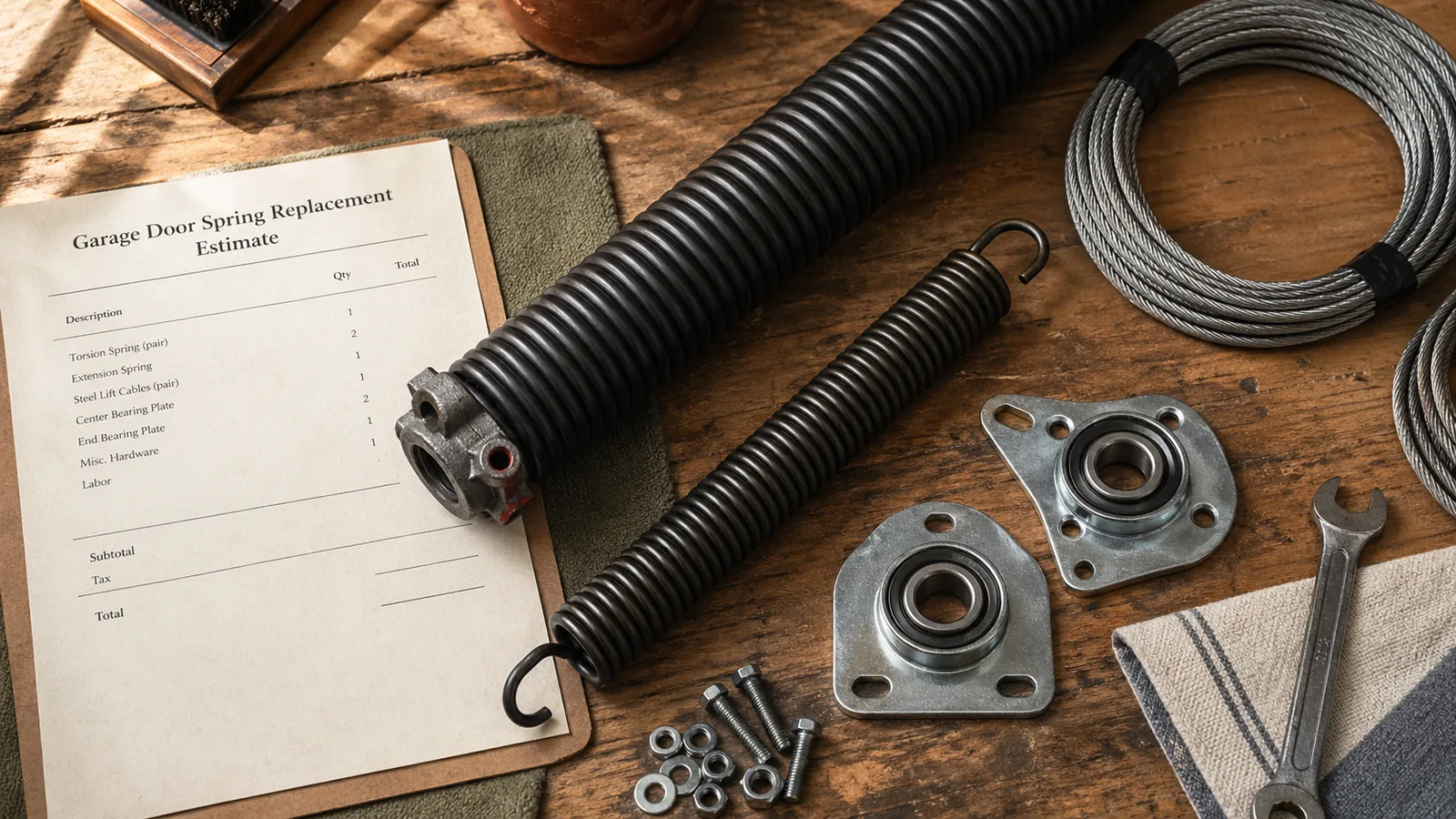
Typical line-item cost breakdown:
- Torsion or extension springs (parts): $30–$100 per spring, depending on quality and cycle rating
- Labor to replace springs: $75–$150 (typically included in the bundled quote)
- Lift cables: $90–$200 per pair (both sides replaced at once for balance)
- Drums: $50–$120 per pair
- Center/end bearing plates: $20–$60 each
- Rollers (set of 10–12): $30–$80
- Service call fee: $50–$100, sometimes waived if repair is performed
- Emergency/after-hours fee: $50–$150 added to base cost
Per HomeGuide's cable repair guide, technicians replace both lift cables at the same time to keep the door balanced — even when only one is visibly frayed. That is a legitimate best practice, not an upsell. However, a quote that bundles drums, bearings, and rollers without inspecting them on your specific door deserves a question.
Pro Tip: Ask the technician to show you the worn part before agreeing to replace it. A cracked drum or a visibly frayed cable is easy to identify. If they can't point to the damage, get a second opinion before approving the add-on.
What cables, drums, bearings, and hardware can add to the bill
Here is how to sort legitimate add-ons from questionable ones:
Legitimate add-ons (inspect before replacing): - Lift cables — fraying, kinking, or a snapped cable alongside a broken spring is common; HomeGuide confirms both are replaced together for balance - Drums — cracked or grooved drums cause cables to slip; visible damage confirms replacement need - Center and end bearing plates — worn bearings create grinding noise and add strain to the torsion shaft - Rollers — cracked or metal-on-metal contact is visible
Question these if your door otherwise functioned fine: - Full track realignment on a door that wasn't off-track before the spring broke - Immediate opener motor replacement without testing the opener with new springs installed - New weather seal or bottom seal added to a spring-replacement invoice without inspection
When a quote jumps because of emergency timing or a single service call
After-hours and same-day repairs legitimately cost more. HomeGuide identifies emergency timing as one of the primary cost drivers for garage door repair service pricing — and that premium is real, not a scam.
Watch Out: A single service call fee of $50–$100 is standard even when you proceed with the repair. Some companies waive it; many don't. Ask explicitly before booking whether the service fee is included in the repair quote or billed separately. An after-hours visit can add $50–$150 on top of that, pushing a $200 extension spring job past $350 before the tech touches the spring.
If your door fails on a Friday night, you have a genuine choice: pay the emergency premium to get your car out by morning, or manually disconnect the opener and use the emergency release handle to operate the door temporarily until a weekday appointment. That's a reasonable option for a door you can lift by hand — which leads directly to the next question most emergency readers ask.
Extension-to-torsion conversion cost: when the upgrade is worth it
Converting from an extension spring system to a torsion spring system costs $400–$800+, according to HomeGuide. The work involves removing the entire extension spring assembly — springs, cables, and pulleys — and installing a complete torsion system including new springs, a torsion shaft, cable drums, and end/center bearing plates. It is a significant job, roughly equivalent to replacing the entire mechanical drive of the door.
Pros and cons of converting to torsion:
- ✅ Longer lifespan: 10,000–20,000 cycles vs. 5,000–15,000 cycles for extension springs
- ✅ Safer failure mode: a broken torsion spring stays on the shaft; a snapped extension spring can whip across the garage
- ✅ Smoother, more balanced door operation — particularly noticeable on heavier insulated doors
- ✅ Compatible with standard high-cycle garage door spring replacement upgrades down the road
- ❌ Higher upfront cost: $400–$800+ versus $120–$200 for a straight extension spring swap
- ❌ Requires adequate headroom above the door (typically 10–12 inches minimum)
- ❌ Not always feasible in very low-clearance garages
The conversion makes the most financial sense when: your extension springs have broken more than once, you're replacing an older door with a heavier insulated model (Clopay, Wayne Dalton, Amarr, or Raynor), or you're already paying for labor on a related garage upgrade.
Safety and lifespan differences that favor torsion systems
The core safety difference comes down to what happens when a spring fails. Torsion springs are mounted on a steel shaft and constrained from end to end — when one breaks, the coil stays in place. Extension springs stretch across open space alongside the tracks, and a snapped spring can release sudden energy and become a projectile risk.
HomeGuide confirms torsion springs are "safer than extension springs" and explicitly states that all spring replacement "is extremely dangerous and should be handled by a qualified professional" — that warning applies even more urgently to extension systems under tension.
On lifespan: torsion springs deliver 10,000–20,000 cycles (7–14 years); extension springs deliver 5,000–15,000 cycles (4–10 years). Over a 20-year homeownership window, you might replace torsion springs once or twice and extension springs three or four times — so the higher upfront conversion cost often pays back through fewer service calls.
What makes garage door spring replacement cost more or less
HomeGuide and HomeAdvisor both identify the same core cost drivers: region, emergency timing, contractor experience, spring quality, door size and type, access difficulty, and whether additional hardware repairs are needed. Understanding each one helps you interpret quotes rather than just accept them.
HomeGuide and HomeAdvisor both tie pricing to US region/location, parts and labor, door size and type, problem complexity, and additional repair needs, so the estimate should match the door and the market — not a generic flat price.
Key cost factors at a glance:
- Spring type: Torsion costs more than extension (see above)
- Region: Urban coastal markets (NYC, LA, Seattle, Miami) run higher than rural Midwest and South
- Emergency timing: After-hours and same-day fees add $50–$150
- Contractor experience: Established companies with licensed technicians charge more than solo operators; the premium is usually worth it for high-tension work
- Spring quality/cycle rating: Standard 10,000-cycle springs cost less than high-cycle 25,000–100,000-cycle options
- Door size: Double-car (16-foot) doors require stronger, pricier springs and take longer to service
- Heavier insulated doors: Brands like Clopay and Wayne Dalton insulated steel doors weigh significantly more than non-insulated models, requiring beefier springs
- Access difficulty: Springs on a low-clearance door or in a cramped utility closet take longer to work around
- Additional repairs: Cables, drums, bearings, and rollers all add to the invoice
Region, contractor experience, and access difficulty
Labor rates vary meaningfully across US markets. A spring replacement that runs $175 in Indianapolis might run $275–$300 in San Francisco for the same parts and time, simply due to local labor costs and overhead. HomeGuide explicitly calls out regional variation as a primary pricing driver.
Contractor experience matters here because garage spring work is not like swapping an outlet. A technician setting torsion spring tension incorrectly can leave your door dangerously unbalanced — and a door that won't hold its position at mid-height (the classic balance test) is a safety hazard. Paying an extra $50–$75 for a company with verifiable reviews and licensed technicians is usually the right call.
Access difficulty is the least-discussed cost driver, but it's real. A door with springs mounted close to an adjacent wall, a finished ceiling, or low-profile headroom requires more time to work safely. Some contractors quote a flat rate and absorb the extra time; others add a line-item access surcharge. Ask upfront if your garage has unusual clearance constraints.
Standard-cycle vs high-cycle springs and why cycle count changes price
Standard residential torsion springs are rated for 10,000 cycles — which sounds like a lot until you do the math. Four garage door uses per day equals about 1,460 cycles per year, meaning a standard spring fails somewhere around year 6–7. High-cycle springs are a distinct product class that costs more per unit but lasts considerably longer.
Clopay — one of the largest US garage door manufacturers — publishes torsion spring options rated for 10,000 cycles (standard), 25,000 cycles, 50,000 cycles, and 100,000 cycles. A 50,000-cycle spring at four uses per day lasts roughly 34 years. The parts premium over a standard spring is real, and HomeGuide's garage door repair cost guide shows that higher-cycle hardware is part of the pricier end of the market.
When getting a garage door spring replacement quote, ask the technician which cycle rating they're quoting. "Standard springs" on an estimate typically means 10,000-cycle hardware. Upgrading to 25,000- or 50,000-cycle springs at the time of replacement adds cost upfront but is almost always the better investment — especially if you're already paying for labor.
Can you open a garage door with a broken spring?
Technically you can, but you shouldn't — and doing so risks damage and injury. The short answer: don't use a door with a broken spring until a professional has repaired it, per HomeGuide's spring replacement guide.
A garage door spring's entire job is to counterbalance the door's weight. A standard two-car door weighs 150–250 pounds. When the spring is intact, the door feels nearly weightless to lift. When the spring is broken, you are lifting that full weight — either manually or by forcing the opener motor to do it. Neither is safe.
When to Call a Pro: Call immediately if (1) the door won't open or only opens a few inches, (2) you hear a loud bang from the garage (characteristic sound of a spring snapping), (3) the door falls faster than normal when closing, or (4) the door hangs unevenly. These are all signs of spring failure, and operating the door in any of these conditions risks injury and additional equipment damage.
Why broken springs make the door unsafe to lift manually or with an opener
Forcing a garage door opener — whether a LiftMaster, Genie, or Chamberlain unit — to lift a door without spring support strains the motor, the drive chain or belt, and the trolley carriage beyond their design limits. Most residential openers are rated for doors balanced by springs, not for the full weight of a 200-pound unsprung door. Repeated attempts can burn out the motor, strip the drive gear, or damage the trolley — turning a $200 spring repair into a $400–$600 garage door opener repair as well.
Manual lifting is no safer. Even if you can muscle the door open, the lack of counterbalance makes the door unstable in the open position — it won't stay up on its own and can drop suddenly. If you need to access the garage while waiting for a repair appointment, use the emergency disconnect cord (the red cord hanging from the trolley carriage) to disengage the opener, then lift and prop the door with a sturdy support before working near or under it.
How long garage door springs last before replacement
Per HomeGuide, torsion springs last 10,000–20,000 cycles or 7–14 years, and extension springs last 5,000–15,000 cycles or 4–10 years under typical residential use. Those ranges are wide because cycle life depends heavily on how often you use the door — and whether the springs were properly sized for your door's weight.
A household that opens the garage four times per day accumulates about 1,460 cycles annually. At that pace:
- A standard 10,000-cycle torsion spring lasts roughly 6–7 years
- A 20,000-cycle torsion spring lasts roughly 13–14 years
- A 10,000-cycle extension spring lasts roughly 6–7 years
- A 5,000-cycle extension spring can fail in as few as 3–4 years
A household with six or more daily cycles (multiple drivers, business use, teenagers) will burn through springs at the lower end of those ranges. A vacation home or single-driver household may see springs outlast the upper end.
Signs your spring is near failure before it snaps
Most springs fail suddenly, but there are warning signs in the weeks before a complete break:
- Door feels heavy when opening manually — if lifting the door by hand requires real effort, the spring tension is decreasing
- Door doesn't stay open at mid-height — a properly balanced door should hold its position at the halfway point; if it drifts down, the springs are losing tension
- Visible gap in the coil — a torsion spring that is partially broken will show a visible separation in the coil, typically 1–3 inches wide
- Squeaking or creaking — metal fatigue before failure often produces noise, especially in cold weather when steel contracts
- Door opener strains or reverses — if the opener suddenly labors or triggers its auto-reverse safety feature on a door it handled easily before, check the springs first before diagnosing the opener
Catching these signs early means you can schedule a routine daytime appointment rather than an emergency after-hours call — a savings of $50–$150 in service fees alone.
How to vet a garage door repair quote before you pay
Most homeowners accept the first quote they get because the door won't open, the car is trapped, and the technician is standing right there. That's exactly the scenario some contractors exploit. A little preparation turns a reactive emergency into a controlled transaction.
Before approving any work, ask these questions explicitly:
Quote vetting checklist:
- "Is this quote for one spring or both?" A quote for a single spring looks cheaper but leaves the surviving spring near the end of its life. Reputable contractors replace both.
- "Are cables, drums, and bearings included — or separate?" Know whether the number on the invoice is for springs-only or the full hardware refresh.
- "Is labor included in this price, or is it billed separately?" Some contractors quote parts and labor bundled; others quote parts alone and add a labor line. Both are legitimate, but you need to know which applies.
- "Are these standard-cycle or high-cycle springs?" A quote for 10,000-cycle springs versus 50,000-cycle springs represents a very different long-term value.
- "Is there a service call fee, and is it included in this total?" Service call fees of $50–$100 are standard; emergency fees are additional. Confirm what's in the number.
- "What warranty do you provide on parts and labor?" Reputable companies stand behind their work.
Questions to ask about parts, labor, and warranty coverage
A clear quote itemizes parts and labor separately so you can compare apples to apples when getting multiple estimates. If a company refuses to break out the line items, that's a transparency problem.
On warranty: Clopay's dealer program states, "All of our Elite, Master Authorized and Advanced Authorized Dealers offer a minimum 1 Year Installation Warranty on Clopay replacement". That is a specific dealer-program benchmark, not a universal industry rule, so it is fair to ask whether the company you're considering offers a similar installation warranty on the products they install. Ask specifically: "What is your warranty on the springs you're installing, and what is your labor warranty if something is wrong with the installation?"
Also ask whether the warranty is voided if you use the door abnormally — some warranties exclude commercial-use scenarios even on residential doors.
Red flags for spring upsells and unnecessary opener diagnoses
A broken spring almost always presents as an opener that suddenly won't lift the door, a door that only moves a few inches, or a loud bang followed by a door that hangs unevenly. The spring is the problem — but some technicians use the moment to suggest your opener motor is also failing.
Watch for these red flags:
- "Your motor is fried" — a technician who diagnoses opener failure before replacing the spring and testing the opener under proper spring tension has skipped a diagnostic step. A strained opener may work perfectly once the spring is fixed. Don't approve garage door opener repair until the spring is replaced and the opener is tested with correct counterbalance in place.
- "All four rollers need replacing" — rollers do wear out, but a technician who quotes full roller replacement on a routine spring call without showing you cracked or metal-on-metal rollers is padding the invoice.
- "Your tracks are bent and need realignment" — broken springs can cause the door to drop unevenly, which can look like a track issue. Confirm the tracks are actually bent after the new springs are installed and the door is balanced.
- A written quote that lists vague line items like "misc hardware" — always ask what specific parts are being replaced.
DIY vs professional garage door spring replacement
DIY vs Pro: Skip the DIY here. Garage door springs are under hundreds of pounds of stored torsion or tension. HomeGuide explicitly states that spring replacement "is extremely dangerous and should be handled by a qualified professional." Unlike many home repairs where a confident DIYer can safely learn on the job, a mistake here — a winding bar slipping, a spring releasing unexpectedly — can cause broken fingers, broken arms, or worse. The $150–$350 professional cost is cheap insurance compared to an ER visit.
Some experienced DIYers do replace their own extension springs — the process is more forgiving than torsion work, and extension springs are under less concentrated tension. But extension springs still store significant energy and can whip violently if they slip during installation. If you have genuine mechanical experience, the right tools, and you've watched multiple professional demonstrations, extension spring replacement is the more accessible DIY option. Torsion spring work should stay in professional hands for nearly every homeowner.
The $150–$350 professional cost for garage door spring replacement covers labor, proper tools, and the technician's knowledge of your specific door's weight and spring specifications — not just the parts. That's the value of the service.
What a professional garage door repair service should do during the visit
A thorough garage door repair service visit includes more than swapping the spring and leaving. Here's what a legitimate technician should perform:
- Inspect both springs — confirm which failed and whether the other is near the end of its cycle life
- Inspect lift cables — check for fraying, kinking, and proper winding on the drums
- Inspect drums and bearing plates — look for cracking, wear grooves, and bearing play
- Install new springs — set correct tension for your door's specific weight (technicians use the door manufacturer's specs; Clopay, Wayne Dalton, Amarr, and Raynor doors all have published weight charts)
- Balance test — disconnect the opener, lift the door manually to mid-height (about 3–4 feet), and release it. A properly balanced door should hold that position without drifting up or down.
- Cable tension check — cables should have equal tension on both sides with no slack
- Opener test — reconnect the LiftMaster, Genie, or Chamberlain opener and run the door through three full cycles, confirming auto-reverse works correctly
- Lubrication — springs, hinges, and rollers should be lubricated with a garage door-specific lubricant (not WD-40, which attracts dirt)
If a technician installs springs and leaves without performing a balance test and opener check, ask them to complete the sequence before you sign off. Those steps catch installation errors before they become callbacks — or worse.
FAQ about garage door spring replacement costs
How much does it cost to replace garage door springs?
Most homeowners pay $150–$350 for torsion springs and $120–$200 for extension springs, including parts and labor, per HomeGuide's 2026 data. HomeAdvisor puts the average at $250. Emergency timing, larger doors, or additional hardware repairs can push totals to $400–$600.
Should both garage door springs be replaced at the same time?
Yes. When one spring fails, its partner is at or near the same point in its cycle life. Replacing only the broken spring leaves you with mismatched tension and typically leads to a second service call within months. The cost of replacing both springs at once is only marginally higher than replacing one, and you pay labor only once.
How long do garage door springs last?
Torsion springs last 7–14 years or 10,000–20,000 cycles; extension springs last 4–10 years or 5,000–15,000 cycles, per HomeGuide. High-frequency households (6+ daily uses) will fall toward the lower end of those ranges.
Can I open my garage door if the spring is broken?
Avoid it. Without a functioning spring, the door's full weight falls on you or your opener motor. Forcing the door risks personal injury from a sudden drop and can damage your opener. Use the emergency release only to move your car in a pinch, prop the door safely, and call a professional promptly.
Why do garage door spring replacement quotes vary so much?
Quotes vary because of spring type (torsion vs. extension), spring quality (standard 10,000-cycle vs. high-cycle), door size and weight, regional labor rates, emergency timing surcharges, whether cables and hardware are included, and the contractor's experience level. Those are the verified drivers HomeGuide and HomeAdvisor both point to, and they explain why a quote for the same door can land in different places.
Is it worth converting from extension to torsion springs?
For most homeowners replacing extension springs more than once, yes. The conversion costs $400–$800+ but delivers a longer-lived, safer system. It's especially worthwhile if you're also upgrading to a heavier insulated door from brands like Clopay or Wayne Dalton, since those doors benefit more from torsion counterbalancing.
Sources & References
- HomeGuide — Garage Door Spring Replacement Cost (2026) — Primary source for torsion vs. extension pricing, cycle life, and conversion costs
- HomeGuide — Garage Door Repair Cost (2026) — Cost ranges, cost drivers, regional variation
- HomeGuide — Garage Door Cable Repair Cost — Cable replacement best practices and pricing context
- HomeAdvisor — Garage Door Spring Repair Cost (2025) — Average cost benchmark and price range confirmation
- HomeAdvisor — Garage Door Repair Cost — Supporting cost driver analysis
- Clopay — Door Specification Pages — High-cycle spring options (10,000 / 25,000 / 50,000 / 100,000 cycle ratings)
- Clopay — Authorized Dealer Warranty Program — Minimum 1-year installation warranty benchmark
Keywords: torsion spring, extension spring, high-cycle springs, garage door cables, bearing plates, drums, LiftMaster, Genie, Chamberlain, Clopay, Wayne Dalton, Amarr, Raynor, UL 325, International Residential Code, overhead door