Outdoor Christmas light installation runs $240 to $650 for a typical home when a pro supplies the labor and the lights, or $2.50 to $5.00 per linear foot of roofline when pricing by footage. That range assumes a single-story home with a straightforward roofline. Add a second story, steep pitch, gables, dormers, or trees, and the price climbs — sometimes well past $1,500. Go full-service with a holiday lighting installation service that supplies, installs, maintains, and removes contractor-grade lights, and a mid-sized home easily hits $750 to $5,000 depending on display scope, per Angi.
At a Glance: DIY materials only: $75–$300 | Labor-only pro install (homeowner supplies lights): $150–$500 | Bundled pro install with lights: $240–$650 or $2.50–$5.00 per linear foot | Full-service seasonal package (contractor supplies lights + removal): $400–$5,000+
The number that matters most before you get quotes is your roofline's linear footage. Almost every pro prices by the foot, so knowing that number keeps estimates comparable.
How much does outdoor Christmas light installation cost in the US?
Cost Snapshot: DIY materials only: $75–$300 | Labor-only pro install (homeowner supplies lights): $150–$500 | Full-service seasonal package (contractor supplies lights + removal): $400–$5,000+
The biggest pricing split is whether you supply the lights or the installer does. When a holiday lighting installation service provides lights through a holiday light rental model — where you pay a seasonal fee rather than owning the strands — removal is almost always bundled into the package price. When you own the lights and hire a pro only to hang them, labor is the only line item, but you'll pay separately for takedown.
According to HomeGuide, professional installation averages $240 to $650 for lights and labor combined. Angi puts the basic roof-outline package range at $250 to $1,500, with larger homes or multi-feature displays running $750 to $5,000. Fees are roughly 20% higher for homes with two or more stories or steep roofs, per HomeGuide.
Average Christmas light installation cost by service type
A standard single-story home with a simple roofline — think a ranch or a small cape — is the baseline for every price you'll see advertised. Anything more complex is priced up from there.
| Service Type | What's Included | Typical Cost Range |
|---|---|---|
| DIY only | Homeowner buys lights, clips, extension cords, timer; installs and removes | $75–$300 in materials |
| Labor-only pro install | Pro hangs and removes homeowner-supplied lights | $150–$500 labor |
| Bundled pro install | Pro supplies lights and handles installation labor | $240–$650 or $2.50–$5.00 per linear foot |
| Full-service package | Installer supplies, installs, maintains, and removes lights | $400–$5,000+ |
| Permanent lighting system | Pro installs fixed outdoor LEDs with programmable control | $2,000–$8,000 |
Full-service packages through a holiday lighting installation service are where the holiday light rental model lives. The company owns the lights; you pay a seasonal lease that covers professional-grade commercial strands, installation, bulb replacement during the season, and post-holiday takedown. If a strand fails on December 23rd, the cost of fixing it is theirs, not yours.
What the average price includes and what it does not
Most quoted prices for professional installation cover hanging the lights and basic clip hardware. Fewer quotes automatically include everything else.
Typically included in a standard pro install quote: - Labor to attach clips and hang strands along roofline - Basic shingle or gutter clips - Connection to existing exterior outlets - One walk-through inspection
Typically NOT included unless specified: - Lights themselves (if you're supplying them) - Extension cords longer than a standard run - Timer or smart-plug programming - Tree and shrub wrapping - Takedown and removal - Off-season storage of lights
Angi reports removal after the season costs $100 to $400 when it isn't bundled. The exception is the rental/full-service model — when the installer owns the lights, removal is almost always included because they need the inventory back.
Watch Out: If a quote sounds cheap, check whether it excludes takedown. A $200 install that charges $175 for removal is a $375 project, not a $200 one.
Christmas light installation cost breakdown by line item
Breaking the full project cost into discrete line items is the only way to compare quotes intelligently. Two quotes that both say "$450" can include completely different scopes.
DIY Christmas light material costs
Going the DIY route means buying lights, clips, extension cords, and a timer yourself. Here's what each line item actually costs at retail — Lowe's, Home Depot, and Amazon are the most common sources.
| Material | Typical Cost | Notes |
|---|---|---|
| LED string lights (per 25-ft strand) | $8–$25 | UL-listed outdoor-rated; mini-bulb or C6 style |
| C7 or C9 replacement-bulb strands | $15–$40 per 25 ft | Heavier commercial look; bulbs replaceable individually |
| Shingle/gutter clips (100-pack) | $6–$15 | Check clip type for your gutter profile |
| Exterior-rated extension cord (25 ft) | $12–$25 | Must be rated for outdoor use; 16-gauge minimum |
| Outdoor timer or smart plug | $12–$35 | Smart plugs allow app scheduling; confirm outdoor-rated |
| Total materials, simple one-story home | $75–$200 | Assumes 100–150 ft of roofline |
The core question for buying vs. renting is lifespan. Quality UL-listed LED strings from brands like GE, Enbrighten, or Brite Star typically last five or more seasons if stored properly. If you spend $120 on materials and get six years out of them, that's a low annual cost compared with a full-service package. A holiday light rental through a full-service company might cost $400 to $600 per season but eliminates storage, setup, and the hassle of testing strands every November. For a single-story home you're comfortable climbing, buying is almost always cheaper long-term. For anything taller or more complex, the math shifts quickly.
Professional labor-only install pricing
When you own the lights and hire a pro only for installation, you're paying for their time, equipment, and expertise — not the product.
Cost Snapshot: Labor-only install: $1.50–$3.00 per linear foot for hanging | Bundled pro install: $240–$650 or $2.50–$5.00 per linear foot | Hourly rate: $50–$75/hr | Minimum service fee: $150–$200
HomeGuide reports that $240 to $650 is the average price for professional Christmas light installation when the lights and labor are bundled, or $2.50 to $5.00 per linear foot. For labor-only, expect the per-foot rate to fall on the lower end — roughly $1.50 to $3.00 per foot for hanging — but watch for the minimum service fee. According to Angi, lighting service pros charge $50 to $75 per hour with minimum service fees of $150 to $200. That means even a small 80-foot roofline on a single-story home will hit the minimum before the crew breaks a sweat.
Labor-only pricing makes the most sense when you already own commercial-quality lights, have a simple accessible roofline, and just want the safety and speed of a professional installation without paying for lights you'll never own.
Full-service seasonal packages with removal and storage
Full-service packages — where the installer supplies, installs, maintains, and removes everything — are the holiday lighting industry's subscription model.
| Package Tier | Typical Cost | What's Included |
|---|---|---|
| Basic roofline | $400–$800 | Eave and gutter line only; removal included |
| Standard roofline + accents | $750–$1,500 | Eaves, peaks, columns, entry; removal included |
| Premium/full property | $1,500–$5,000 | All architectural features + trees/shrubs; removal included |
| Off-season storage | $50–$150 add-on | If installer stores your lights at their facility |
Removal is usually scheduled after the season and is almost always included in a full-service package. If you want lights down on a particular day, confirm that timing before signing. Storage fees apply when the installer warehouses your lights at their facility rather than you storing them yourself; Angi notes standalone removal runs $100 to $400 if not bundled, making the storage add-on often worth it in comparison.
Bulb replacement during the active season should be included in any reputable full-service package — confirm this explicitly. If a strand burns out in December, the response time and whether replacement is at no cost are the clearest indicators of service quality.
What drives Christmas light installation costs up or down?
Home size and display scope set the floor. Architectural complexity, roof access, and the type of lighting system determine how far above that floor you land. HomeGuide says fees are about 20% more for homes with 2+ stories or steep roofs, and those are two of the fastest cost escalators.
| Cost Driver | Impact on Quote | Why |
|---|---|---|
| One-story vs. two-story | +20% for two-story | Taller ladders, more time, more fall risk |
| Steep roof pitch | +15–25% | Anchoring and safety equipment needed |
| Gables and dormers | +$50–$200 per feature | Extra clips, custom runs, repositioning |
| Tree wrapping (per tree) | +$75–$250 per tree | Wrap time scales with canopy size |
| Shrub wrapping (per shrub) | +$25–$75 per shrub | Faster but adds up on large beds |
| Custom programmable system | +$500–$3,000+ over standard | Hardware, programming, app setup |
| Permanent installed system | $2,000–$8,000 total | Fixed hardware, professional wiring |
One-story vs. two-story and steep roof pitch
HomeGuide says fees are about 20% more for homes with 2+ stories or steep roofs. That premium reflects real logistics, not just a markup. Reaching a second-story roofline safely requires a taller extension ladder — typically 28 to 32 feet — or a rented articulating ladder. On steep pitches (anything above 6:12 pitch), pro crews often use roof anchors or standoff brackets, and the time to set up that rigging comes off your job site.
Watch Out: Falls from ladders are one of the leading causes of home-improvement injuries. Thumbtack notes that hiring holiday lighting professionals specifically helps homeowners avoid ladder injuries — and that safety calculation is worth pricing into your decision, not just the aesthetics.
For a single-story home with a walkable pitch, a confident DIYer with a solid 24-foot extension ladder can handle standard roofline work. For anything above one story or with a pitch steeper than 6:12, the labor premium a pro charges is largely buying you safer access equipment and trained crew — not just convenience.
Gables, dormers, trees, and shrub wrapping
Gables and dormers are where simple roofline footage math breaks down. A cape cod with two front dormers can have 40% more linear footage than a flat-eaved ranch of the same square footage, and each dormer requires repositioning the ladder, re-routing extension runs, and adding extra clips in tight corners.
[Image: Annotated roofline diagram showing eave footage, gable runs, dormer wraps, and clip attachment points]
Tree and shrub wrapping adds cost primarily through labor time, not materials. A mature 20-foot oak wrapped floor-to-canopy can take 45 minutes to an hour on its own. Spiral-wrapping a columnar shrub takes ten minutes. When requesting quotes, ask installers to itemize each tree and shrub by size so you can cut scope intentionally if the total is over budget.
Pro Tip: If budget is tight, prioritize the roofline and front-facing trees. A cleanly lit eave line with one or two illuminated focal trees reads as a complete design — you don't need to wrap every shrub bed to make the display look finished.
Custom color-programmable systems and permanent lighting
Standard seasonal strands are single-color and manually switched. Custom color-programmable systems — sold as app-controlled permanent outdoor lighting — use individually addressable RGB LEDs that can be set to any color or animation pattern via an app. They're designed to stay on the house year-round and work for every holiday, not just Christmas.
Permanent holiday lighting of this type costs $20 to $40 per linear foot installed, or $2,000 to $8,000 total on average, per HomeGuide. The lights themselves are outdoor-rated LEDs designed for permanent mounting; many include color-changing technology and Wi-Fi control. That's a major jump from the $2.50–$5.00 per foot range for seasonal installation.
The programmable premium pays for itself if you're currently spending $500+ per season on a full-service holiday light rental, because permanent systems eliminate recurring seasonal labor costs after the initial installation. The break-even point for most homes is three to five seasons, depending on your local labor rates and whether you'd have paid for professional seasonal installation annually.
Regional timing, booking windows, and seasonal price swings
When you book a holiday lighting installation service matters nearly as much as who you hire. The holiday lighting season has a hard deadline — December 25 — and contractors know it.
Early-booking discounts vs. peak-season premiums
| Booking Window | Typical Price Impact | Notes |
|---|---|---|
| August–September | 10–15% discount common | Many companies offer early-bird pricing; widest date availability |
| October | Standard pricing; good availability | Best balance of price and scheduling flexibility |
| First two weeks of November | Standard to slight premium | Schedules filling; request firm install date in contract |
| Late November (post-Thanksgiving) | 10–20% premium possible | Rushed demand; some crews booked out entirely |
| December 1–10 | Premium + limited availability | Last-call pricing; accept remaining slots only |
| December 11+ | Very limited; surge pricing likely | Many quality crews fully booked |
The practical lesson: contact installers in October for a November install date. That window gives you the best combination of selection and reasonable pricing without chasing early-bird deals. If you're reading this in late November or December, call immediately — don't wait for a second quote if the first installer has your date available.
Pro Tip: Ask your installer whether they offer a repeat-customer rate for next season when they come to remove your lights. Many companies lock in returning customers at the prior year's rate during takedown.
When regional labor rates change the quote
HomeGuide and Angi publish national averages, not city-specific rates, so treat those ranges as a baseline rather than a local price guarantee. Labor costs in high cost-of-living metros like San Francisco, Seattle, Boston, or New York typically run 20–40% above the national average. Markets in the South and Midwest often come in at or below the national average. The best way to calibrate for your area is to collect three competing quotes from local installers rather than anchoring to a national number.
Safety rules for outdoor Christmas light installation
The NFPA treats the National Electrical Code as the benchmark for safe electrical work outdoors, including the outlets, circuits, and wiring that power your holiday lights. Most holiday lighting work doesn't require an electrician — but the product choices and outlet conditions you start with determine whether your install is safe.
Exterior-rated lights, extension cords, and GFCI outlets
Every product you use outdoors needs to be rated for outdoor exposure. This is non-negotiable.
Outdoor Christmas light safety checklist:
- Lights: Buy UL-listed LED string lights labeled for outdoor use. The UL listing means the product has been independently tested for electrical safety. Indoor-only strands are a fire and shock hazard when exposed to moisture.
- Extension cords: Use exterior-rated extension cords — look for "W" or "SJTW" in the cord designation, which indicates weather resistance. 16-gauge minimum for runs under 50 feet; 14-gauge for longer runs. Never daisy-chain indoor extension cords outdoors.
- Outlets: All outdoor outlets should be GFCI-protected (Ground Fault Circuit Interrupter). GFCI outlets have "Test" and "Reset" buttons and cut power within milliseconds of detecting a fault. Many older homes are missing this protection on exterior outlets.
- Load limits: Don't plug more strands into a single circuit than the strand's packaging recommends. Most LED strands allow 40–50 connected end-to-end; incandescent strands are typically limited to 3–5.
- Timers: Use a timer or smart plug rated for outdoor use. Indoor-rated timers in outdoor conditions degrade quickly and can arc.
Pro Tip: Test every GFCI outlet before the season by pressing "Test" — the outlet should cut power — then pressing "Reset" to restore it. If it doesn't trip and reset cleanly, the GFCI is faulty and needs replacement before you plug in lights.
When to hire an electrician instead of a holiday installer
Holiday lighting installers are skilled at hanging and connecting lights. They are not licensed electricians, and there are specific conditions where a licensed electrical service provider is required before or instead of a lighting crew.
When to Call a Pro (Electrician): - Your outdoor outlets have no GFCI protection and need retrofitting - An outlet trips a breaker repeatedly when lights are plugged in (overloaded circuit) - An outlet is visibly damaged, scorched, or intermittently dead - You want a dedicated outdoor circuit installed for holiday lights or permanent exterior wiring - You're installing a permanent programmable lighting system that requires hardwired connections - Any outlet near water (near a hose bib, under a dripping eave) shows signs of moisture intrusion
Per NFPA, electrical installation and repair work is NEC-regulated and must be performed by or under the supervision of a licensed electrician in most jurisdictions. A holiday lighting crew connecting extension cords to working, GFCI-protected outlets is well within their scope. Wiring a new circuit or replacing a damaged outlet is not.
What to ask for in a Christmas light installation estimate
A well-structured estimate protects you from surprise fees and makes comparing multiple quotes straightforward. HomeAdvisor advises looking for installers who provide clear per-foot or hourly rates — if an installer only gives you a lump-sum number with no line-item breakdown, that's a reason to ask more questions before signing.
Measurement method, bulb type, and warranty terms
Quote checklist — what to request in writing:
- Linear footage measured: Ask how they calculated the footage. A reputable installer measures actual roofline linear feet on-site or via satellite measurement tools — not just a rough guess by home square footage.
- Bulb type specified: C7 and C9 bulbs are larger and have a commercial look; mini-LED and M5 bulbs are smaller and denser. The quote should name the bulb type so you can confirm it matches what you want.
- Bulb count or strand count: Knowing the total number of bulbs or strands lets you verify the display density and compare apples-to-apples across quotes.
- Labor warranty: Ask how long the installation is guaranteed — meaning if clips fail or strands fall within a week of installation, who pays to re-hang them. Most reputable installers offer at least a short-term installation warranty.
- Bulb replacement policy: If a contractor-supplied strand fails mid-season, confirm they'll replace it at no charge and within what timeframe.
Removal date, storage, and repair policy
Takedown and post-season FAQ to confirm before you sign:
- When is the removal date? Most companies schedule takedown in early January. Confirm your specific date and what happens if weather delays it.
- Is removal included or billed separately? If billed separately, get the removal fee in the original contract. Angi reports standalone removal runs $100 to $400. If you're using a holiday light rental model where the company owns the lights, removal should be bundled automatically.
- Who stores the lights? If you own the lights and the installer is offering storage, get the storage fee in writing ($50–$150 is typical). Confirm whether lights are inspected and tested before storage.
- Who pays for mid-season repairs? If a strand fails in December and you own the lights, replacement is on you unless the installer's warranty covers installation defects. If the company owns the lights, replacement at no charge is standard.
DIY vs hire a pro for outdoor Christmas lights
| Factor | DIY | Labor-Only Pro | Full-Service Package |
|---|---|---|---|
| Upfront cost | $75–$300 (materials) | $150–$500 (labor) + materials you own | $400–$5,000+ |
| One-story home | Good fit | Good fit | Overkill for most |
| Two-story or steep roof | High risk | Good fit | Best fit |
| Time investment | 3–6 hours | 1–2 hours of your time | Near zero |
| Equipment needed | Extension ladder, clips | Installer brings equipment | Installer brings everything |
| Season-end hassle | You take it down | You arrange takedown | Included |
| Light quality | Consumer-grade retail | Depends on your purchase | Commercial-grade |
When DIY makes sense
DIY Christmas light installation makes financial and practical sense when all of these are true:
- Your home is one story with a walkable roof pitch (6:12 or less)
- You own or can borrow a solid 24-foot extension ladder
- Your exterior outlets are working and GFCI-protected
- Your roofline is a simple eave line without complex gables or dormers
- You're willing to spend a Saturday installing and another taking down in January
- You plan to reuse the same lights for several seasons
Per HomeGuide, pro fees jump about 20% for two-story homes and steep roofs — which means the labor savings of DIY on a simple one-story home are real and meaningful. Buying quality LED strands and spending four hours on a Saturday is a legitimate choice for the right home.
When hiring a pro is worth it
Professional installation — whether labor-only at $240–$650 or full-service — makes clear financial and practical sense when:
- Your home is two or more stories
- Your roof pitch is steep (above 6:12)
- Your display includes multiple gables, dormers, trees, or extensive shrub beds
- You want commercial-quality lighting that looks polished and professional
- Your time is genuinely limited between Thanksgiving and Christmas
- You'd rather not store and test lights every year
The holiday lighting installation service model is also worth it from a pure safety standpoint on multi-story homes. Falls from ladders are a documented source of serious holiday-season injuries, and a professional crew with the right equipment eliminates that risk entirely.
DIY vs Pro: One-story home with simple eaves? DIY is financially sound. Two-story home, steep pitch, or large display? The labor premium for a pro is worth it for both safety and quality of result.
How many feet of Christmas lights do I need for a house?
The starting point for any install — DIY or professional — is measuring your roofline's linear footage. Every quote should be anchored to this number, and it's the only way to verify that competing estimates are covering the same scope.
Estimate roofline footage for small, medium, and large homes
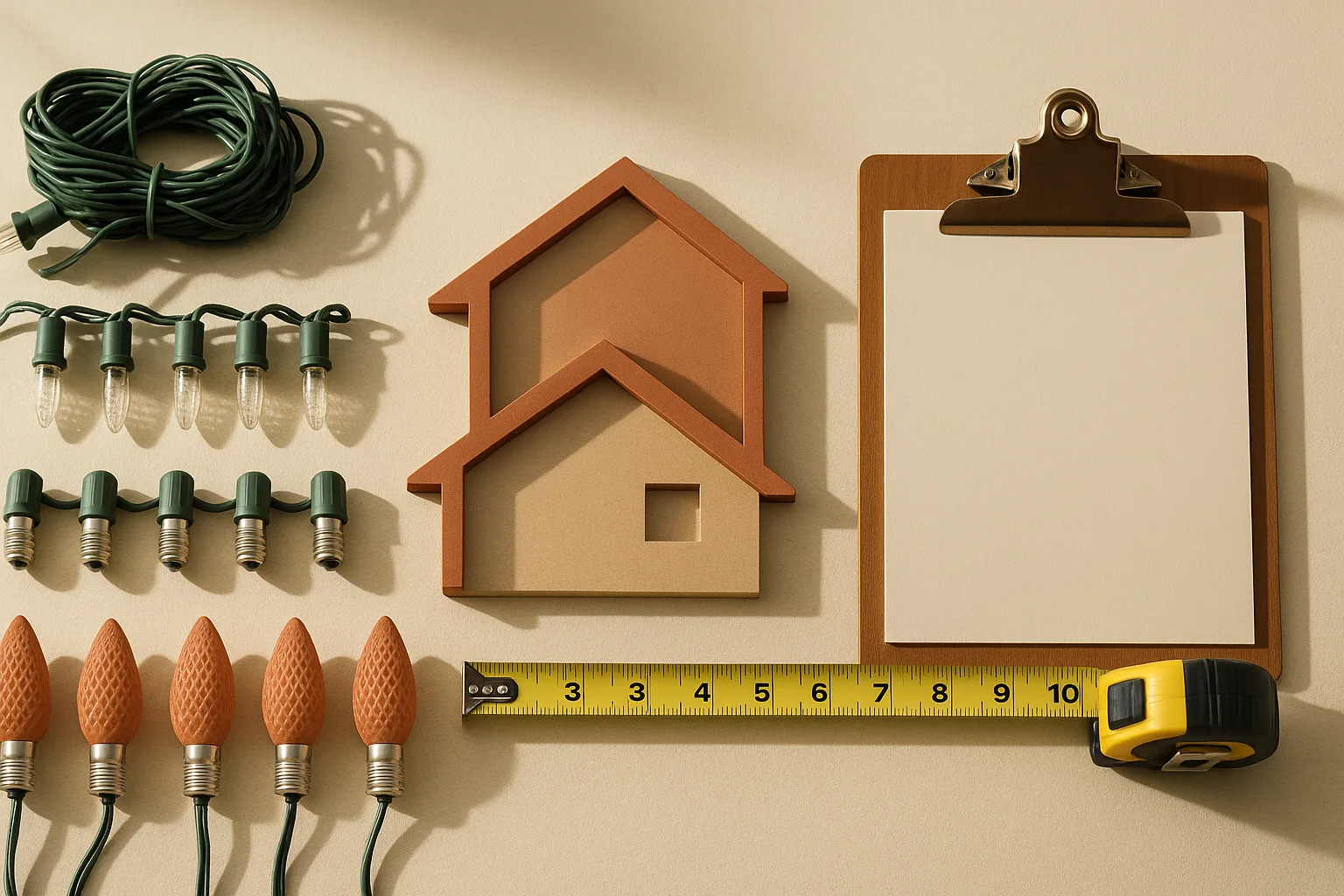
Roofline footage is the total length of every eave, rake, and peak you plan to light. For a basic eave-only outline (the most common approach), measure the perimeter of the home's footprint at roofline height.
| Home Size | Approximate Square Footage | Estimated Roofline Linear Feet | Estimated Light Strands Needed |
|---|---|---|---|
| Small (ranch, cottage) | Under 1,200 sq ft | 80–120 linear ft | 4–6 strands (25 ft each) |
| Medium (two-bedroom, cape cod) | 1,200–2,000 sq ft | 120–180 linear ft | 6–9 strands |
| Large (colonial, two-story) | 2,000–3,000 sq ft | 180–260 linear ft | 9–13 strands |
| Extra-large | 3,000+ sq ft | 260–400+ linear ft | 13–20+ strands |
Example calculation: A 1,500 sq ft single-story ranch with a 40 ft × 30 ft footprint has a perimeter of 140 linear feet. At $2.50–$5.00 per foot for a bundled professional install, that's $350–$700. At DIY retail prices (roughly $1.00–$1.50 per foot in materials), materials alone run $140–$210.
Pro Tip: When measuring for a quote, walk the foundation with a measuring tape rather than estimating from square footage. The actual roofline length often surprises homeowners — a 1,500 sq ft ranch with a hip roof or overhangs can have significantly more exposed eave footage than the basic perimeter suggests.
Always have the installer confirm linear footage on-site or via a satellite measuring tool before finalizing the quote. Disputes about footage are one of the most common sources of invoice surprises on holiday lighting jobs.
FAQ about outdoor Christmas light installation costs
How much does it cost to have Christmas lights installed on a house?
Professional installation averages $240 to $650 for a typical one-story home when the contractor bundles lights and labor, or $2.50 to $5.00 per linear foot. Larger homes or displays that include trees, shrubs, and multiple architectural features run $750 to $5,000, per Angi. Always ask whether the quote includes the lights or assumes you supply them — that single variable swings the number dramatically.
Is it cheaper to buy or rent Christmas lights?
Buying is cheaper over time for simple installs you handle yourself. A holiday light rental full-service package costs more per season ($400–$1,500 for most homes) but includes professional installation, mid-season bulb replacement, and removal — which has real value for complex displays or homeowners who don't want the time or ladder risk.
How much does it cost to remove Christmas lights?
If removal isn't included in your installation contract, expect to pay $100 to $400 for professional takedown, according to Angi. Full-service packages and rental models almost always include removal in the base price. Confirm removal terms in writing before the install — not after.
Do you need an electrician to install outdoor Christmas lights?
For standard holiday light installation — connecting strands to existing, working outdoor outlets — no electrician is needed. But you do need GFCI-protected outdoor outlets, exterior-rated extension cords, and UL-listed outdoor lights. If your outdoor outlets lack GFCI protection, are damaged, or your circuits are tripping under load, contact a licensed electrical service provider before proceeding. Permanent programmable systems with hardwired connections also require a licensed electrician.
How many feet of Christmas lights do I need for a house?
Measure your roofline's actual linear footage — the perimeter of eaves, rakes, and peaks you plan to cover. Small homes (under 1,200 sq ft) typically need 80–120 linear feet. Medium homes (1,200–2,000 sq ft) need 120–180 feet. Large homes over 2,000 sq ft can need 180 feet or more. At standard 25-foot strand lengths, divide your total footage by 25 to get strand count. Add 10–15% extra for overlap at connections and any gable or dormer runs.
Sources & References
- HomeGuide — Christmas Light Installation Cost — National average pricing by linear foot and project scope, home height premium data
- HomeGuide — Permanent Christmas Lights Cost — Permanent outdoor LED system pricing with installation
- Angi — How Much Does Christmas Light Installation Cost? — Hourly rates, minimum fees, removal costs, rental model details
- Thumbtack — Holiday Lighting Installation — Service scope descriptions, safety rationale for professional installation
- HomeAdvisor — Holiday Lighting Add or Remove — Pricing transparency guidance for consumers vetting contractors
- Lowe's — Outdoor Christmas String Lights — Consumer retail availability for homeowner-supplied materials
- NFPA — Understanding NFPA 70: National Electrical Code — NEC as the national benchmark for safe electrical installation in all 50 states
Keywords: UL-listed LED string lights, C9 bulbs, C7 bulbs, roofline linear footage, one-story vs two-story homes, steep roof pitch, GFCI-protected outlets, exterior-rated extension cords, timer setup, holiday light rental, takedown and removal, seasonal storage, permanent holiday lighting, custom color-programmable systems, NEC 210.8