Installing an outdoor kitchen in the U.S. costs anywhere from $7,000 to $35,000 on average — and the number that surprises most homeowners isn't the grill price. It's the utility hookups. A natural gas line, a GFCI-protected circuit, and underground trenching can easily add more to your total than the appliance package itself. This breakdown gives you the line-item ranges and decision logic you need before you talk to a single contractor.
Outdoor kitchen cost in the U.S. at a glance
HomeGuide says: "Installing an outdoor kitchen costs $7,000 to $35,000 on average." According to HomeGuide's 2026 outdoor kitchen cost guide, installed outdoor kitchens average $7,000 to $35,000 nationally. That spread is wide because four completely different project types share the same label — a basic grill island dropped onto an existing patio and a fully custom outdoor kitchen with a wood-fired pizza oven, bar fridge, and pergola are both called "outdoor kitchens."
At a Glance: - Basic grill island: $2,000–$6,000 (grill + simple stone surround, homeowner-assembled) - Pre-built modular kitchen: $7,000–$16,000 installed - Custom mid-range build: $15,000–$35,000 installed - Luxury custom build: $35,000–$80,000+ (full kitchen layout, roof structure, premium appliances) - Major backyard upgrade (pool + outdoor kitchen): can exceed $150,000
Installed cost ranges for basic, modular, custom, and luxury builds
| Build Type | Typical Installed Range | What It Usually Includes |
|---|---|---|
| Basic grill island | $2,000–$6,000 | Freestanding grill + masonry surround or prefab frame |
| Pre-built modular | $7,000–$16,000 | Modular cabinets, countertop, basic appliances, hookup to existing utilities |
| Custom mid-range | $15,000–$35,000 | Built-in grill, fridge, sink, custom countertop, new utility runs |
| Luxury custom | $35,000–$80,000+ | Full kitchen layout, premium appliances, pergola, fireplace, lighting |
HomeGuide's 2026 data pegs the pre-built modular range at $7,000 to $16,000 installed, which assumes modular pieces assembled on an existing patio with utilities already accessible nearby. The moment you need new gas, electrical, or water lines run from the house, costs climb — often past the midpoint of the custom range regardless of which build type you chose.
What homeowners usually get at each budget tier
Basic ($2,000–$6,000): A freestanding Weber or Traeger grill set into a concrete block or prefab steel frame, maybe a short run of countertop on either side. You handle propane tank swaps manually. No sink, no fridge, no utility trenching.
Pre-built modular ($7,000–$16,000): Think Costco-style or brand-configured outdoor kitchen kits — stainless steel or polymer-wrapped cabinets, a built-in grill (often 40,000–60,000 BTU), a small under-counter outdoor refrigerator, and basic countertop sections. Per HomeGuide's outdoor kitchen ideas page, "a simple outdoor kitchen with a grill and small refrigerator" is the archetypal entry-level package. This tier works well if your patio already has gas access or you're running a propane tank.
Custom mid-range ($15,000–$35,000): This is where most backyard entertainers land when they want a proper cooking setup — a Big Green Egg or high-BTU built-in grill, a side burner, a 24-inch outdoor fridge, an NSF-certified outdoor sink, granite or porcelain countertops, and weatherproof cabinetry. New utility lines are common at this tier and add $3,000–$8,000 on top of the appliance package.
Luxury ($35,000+): Pizza oven, two grills, outdoor dishwasher, bar setup, pergola with ceiling fans and lighting, natural stone countertops throughout, and potentially a covered structure requiring its own structural permit.
Outdoor kitchen cost breakdown by line item
Here is where the budget math gets real. Most contractor quotes are bundled, which makes it hard to know what you're actually paying for. Splitting the estimate into HomeGuide-style categories lets you compare quotes and identify where to cut — or where to invest.
| Line Item | Typical Installed Cost | Notes |
|---|---|---|
| Built-in grill | $800–$5,000+ | BTU rating, brand (Weber, Blaze, DCS), and burner count drive price |
| Side burner | $200–$600 | Often included in higher-end grill packages |
| Outdoor refrigerator | $500–$2,500 | Must be outdoor-rated; under-counter models are standard |
| Outdoor sink | $300–$1,200 | NSF-certified model required; faucet is separate |
| Base structure / frame | $500–$3,000 | Concrete block, steel stud, or pre-engineered frame |
| Weatherproof cabinets/drawers | $1,500–$8,000 | Marine-grade polymer or stainless preferred outdoors |
| Countertops | $40–$200 per sq ft | Granite, porcelain, concrete, or tile |
| Natural gas line | $600–$1,300 avg | More with longer runs or trenching |
| Electrical (wiring + GFCI outlets) | $500–$2,000+ | 12-gauge outdoor wiring; GFCI required at all outdoor circuits |
| Water line | $500–$2,500 | Depends on distance from home supply |
| Lighting | $200–$1,500 | LED strips, recessed, or hanging fixtures |
| Pergola / roof structure | $3,000–$20,000+ | Engineered covers with electrical add significantly |
| Permits | $150–$1,500 | Gas, electrical, plumbing, and structural each may require one |
| Labor | 30%–50% of total project | Higher for custom builds; lower for modular assembly |
Countertops installed outdoors cost $40 to $200 per square foot depending on material choice, per HomeGuide's outdoor kitchen cost guide. That means a 20-square-foot counter section can range from $800 on the low end to $4,000 on the high end before any fabrication extras.
Watch Out: Utility hookups — gas, electrical, and water — frequently cost more than the appliances themselves when new lines need to be run from the house. As HomeGuide notes, "outdoor installations typically cost more due to underground trenching requirements." Do not budget for appliances and assume utilities are free.
Grill, side burners, and appliance package costs
The grill is the centerpiece, but it's rarely the largest line item in a full build. A quality built-in grill from Weber, Blaze, or DCS runs $800 to $5,000 depending on BTU output and burner count — a 4-burner, 60,000-BTU unit sits in the $1,500–$3,000 range. Add a side burner at $200–$600 (often bundled in grill packages above $2,000), an outdoor-rated under-counter refrigerator at $500–$2,500, and an outdoor sink at $300–$1,200.
Budget separately for the gas hookup. Per HomeGuide's gas line installation data, running a natural gas line to the grill costs $600 to $1,300 on average — and that's before trenching costs if the line has to travel underground more than a few feet.
The key distinction: the appliance package (grill + fridge + side burner + sink) is a separate budget category from the grill island shell (the frame, cabinets, countertop, and base). Most quotes bundle them. Ask your outdoor kitchen contractor to price them separately so you can swap appliances without repricing the whole structure.
Base structure, cabinets, and drawers
The frame that holds your countertop and appliances is a bigger cost driver than most homeowners expect. Concrete block (CMU) construction is durable and fire-resistant but labor-intensive. Steel-stud frames wrapped in cement board are faster. Pre-engineered powder-coated steel frames are the fastest option and common in modular kits.
Weatherproof outdoor cabinets and drawer systems add significant cost. Using HomeGuide's cabinet installation benchmark, outdoor cabinetry runs $150 to $500 per linear foot installed, or roughly $4,500 to $15,000 total for a mid-size kitchen layout. Marine-grade polymer (HDPE) and 304-grade stainless steel are the most weather-resistant materials. Standard indoor cabinetry — even "water-resistant" varieties — deteriorates quickly when exposed to outdoor humidity, rain, and temperature swings.
Pro Tip: If you're in a humid climate like Florida, coastal Carolina, or the Gulf Coast, specify 316-grade stainless or marine polymer for every cabinet and drawer pull. 304 stainless handles most climates fine, but salt air will eventually pit it.
Countertops, sinks, and finish materials
Countertops installed outdoors cost $40 to $200 per square foot depending on material, per HomeGuide's outdoor kitchen cost guide. For a 20-square-foot counter section, that's $800 on the low end (concrete or tile) and $4,000 on the high end (premium granite or porcelain slab).
| Material | Installed Cost (per sq ft) | Outdoor Durability |
|---|---|---|
| Tile (porcelain or ceramic) | $40–$80 | Good; grout lines require sealing |
| Concrete | $50–$120 | Good; needs sealing every 1–2 years |
| Granite countertops | $70–$150 | Excellent; naturally heat- and scratch-resistant |
| Porcelain countertops (slab) | $80–$200 | Excellent; non-porous, frost-tolerant |
| Quartzite | $90–$200 | Excellent; harder than granite |
Granite countertops are the most popular choice for outdoor kitchens because they handle direct heat, don't absorb liquids, and resist UV fading better than engineered quartz (which can discolor outdoors). Porcelain countertops in large-slab format are a strong option in freeze-thaw climates because they're non-porous and easy to wipe down after rain.
For the sink, specify an NSF-certified outdoor sink — typically 16- or 18-gauge 304 stainless. The NSF certification matters because it indicates the materials are evaluated for food-contact safety in varied conditions. Budget $300–$1,200 for the sink unit plus $150–$400 for an outdoor-rated faucet with a deck plate to block rain infiltration.
Gas line, electrical, water line, and lighting costs
This is the section most homeowners underestimate, and it's where outdoor kitchen projects most often go over budget.
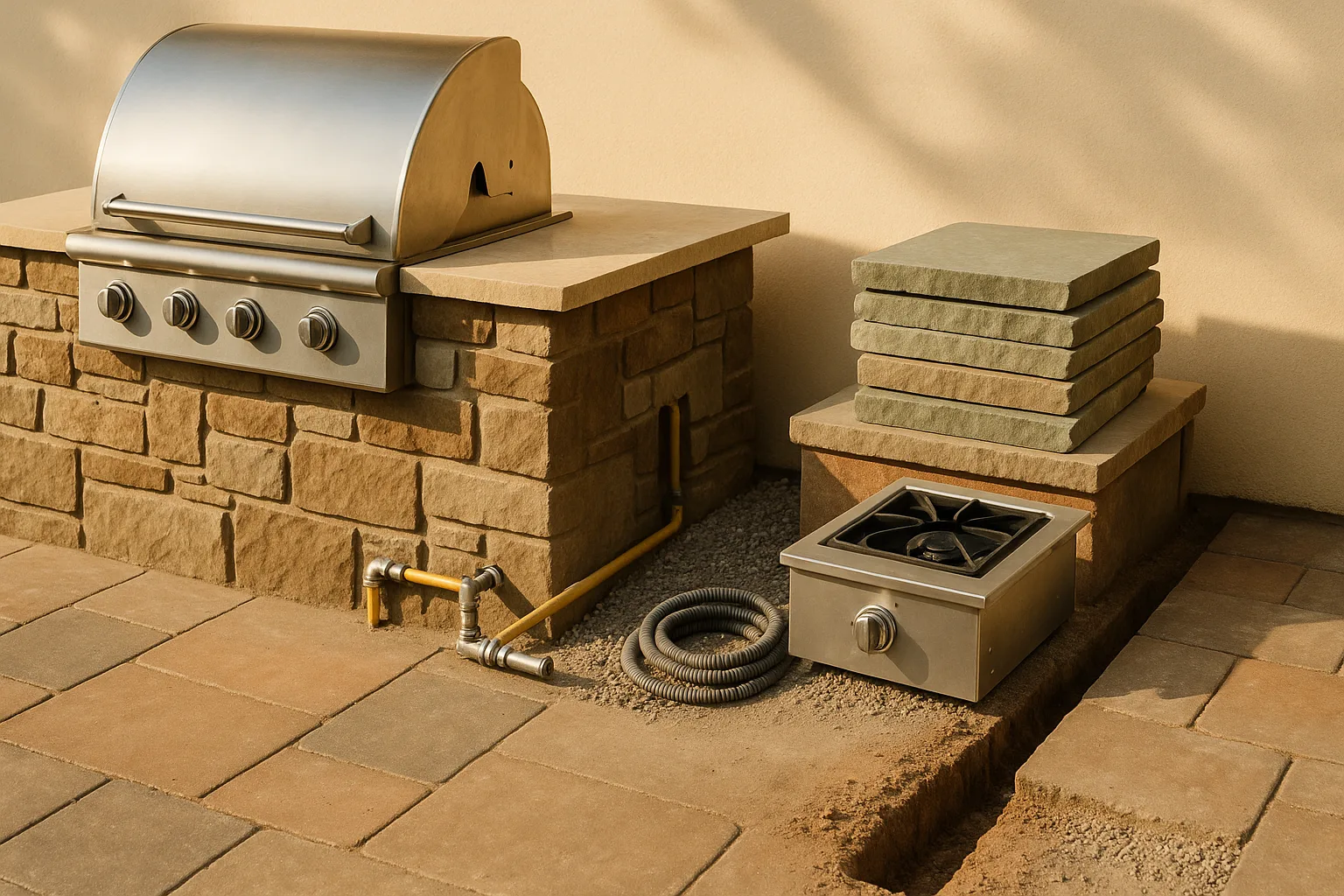
Natural gas line installation: Running a natural gas line to your outdoor grill costs $600 to $1,300 on average, per HomeGuide. That assumes a relatively short run from an existing gas main near the house. Longer runs, underground burial, and rocky or compacted soil push that number higher.
Trenching and conduit: Trenching costs $5 to $12 per linear foot, and underground conduit costs $5.50 to $25.00 per linear foot, per HomeGuide's trenching cost data. If your island sits 50 feet from the house, those numbers become very real very fast.
Propane hookup: If your home isn't on natural gas, a propane tank hookup is simpler to install but involves ongoing tank refills — typically 20-pound tanks for portable setups or a 100-to-500-gallon buried tank for permanent outdoor kitchens. Buried tank installation adds $1,000–$3,000 before the appliance hookup cost.
Electrical — 12-gauge outdoor wiring and GFCI outlets: Any outdoor outlet must be GFCI-protected (ground fault circuit interrupter) per the National Electrical Code. Running a dedicated 20-amp circuit in 12-gauge outdoor-rated wiring to your kitchen island typically costs $500 to $2,000, depending on distance from the panel and whether conduit must be buried. If you want under-counter refrigerator power, a garbage disposal, and lighting on separate circuits, budget accordingly.
Water line: Extending a water supply line outdoors costs $500 to $2,500 depending on how far it travels from the home's supply. In freezing climates, the line must be either insulated, buried below frost depth, or equipped with a shutoff and drain valve so you can winterize it — add $200–$500 for that winterization hardware and labor.
Lighting: LED strip lighting along the underside of cabinets runs $200–$600. Overhead pendant or recessed lighting in a pergola structure adds $500–$1,500 or more depending on fixture type and circuit routing.
Watch Out: "Outdoor installations typically cost more due to underground trenching requirements," per HomeGuide. A gas line that takes 2 hours to rough in inside a house can take a full day outdoors when trenching, conduit, and backfill are involved.
Permits, trenching, and labor charges
Permits and trenching are the two line items most frequently left out of early contractor estimates — and the two most likely to cause sticker shock.
Trenching: Running any utility underground requires a trench. HomeGuide's trenching cost data shows trenching runs $5 to $12 per linear foot for the trench itself, with underground conduit adding $5.50 to $25.00 per linear foot depending on conduit type and utility. Trenching labor is $35 to $65 per hour, and a 100-foot trench costs $500 to $1,200 on average. A kitchen at the back of a long yard — 80 feet from the house — can easily incur $800–$2,000 in trenching alone before a single appliance is installed.
Trenching costs vary by soil type (sandy soil is cheaper; rocky or clay-heavy soil costs more), depth required, and obstructions like tree roots, existing pipes, or sprinkler lines.
Permits: Per HomeGuide, "digging a trench requires a permit in some cities." Beyond trenching, gas line work, electrical panel connections, and any structural additions (pergola footings, roof structures) each potentially require their own permit. Permit fees range from $150 to $1,500 depending on the jurisdiction and scope of work. Ask every contractor to confirm whether permit fees are included in the quote or billed separately.
Labor: For a full outdoor kitchen build, labor typically represents 30%–50% of the total project cost. On a $25,000 project, that's $7,500–$12,500 in labor. Modular assembly is on the lower end; custom concrete-block construction with multiple utility trades is on the higher end. Your outdoor kitchen contractor will often coordinate subcontractors (plumber, electrician, gas tech) — confirm whether those trades are included in the quote or if you need to hire them separately.
What changes outdoor kitchen pricing the most
Five variables move the needle more than any individual appliance or finish choice:
- Whether new utility lines are needed — The single biggest cost driver. A kitchen with existing gas, electrical, and water access nearby is far cheaper than one requiring new trenched runs.
- Countertop material and square footage — The difference between tile at $40/sq ft and porcelain slab at $200/sq ft is $3,200 on a 20-square-foot counter.
- Patio condition and substrate — An existing level concrete slab is a zero-cost starting point. Pouring a new patio (typically $6–$12 per square foot) adds to the total.
- Layout complexity — An L-shaped or U-shaped island requires more cabinetry, more countertop, and more utility routing than a simple straight island.
- Roof or pergola addition — Adding a pergola or solid-roof structure is essentially a separate construction project and can add $3,000–$20,000+ depending on size and engineering requirements.
Existing utility access versus new gas, electric, and plumbing runs
If your patio already has a natural gas stub-out, a 20-amp outdoor circuit, and a water spigot within a few feet of the planned island, a pre-built modular kitchen install is relatively straightforward. If none of those exist, you're looking at:
- Natural gas line installation: $600–$1,300 average, more with long runs
- Trenching for the gas line: $5–$12/linear foot plus conduit at $5.50–$25/linear foot
- Electrical circuit with GFCI outlet: $500–$2,000+
- Water line extension: $500–$2,500
That's potentially $2,000–$8,000 in utility work on top of the kitchen package — and it's entirely separate from the appliances, cabinets, or countertop. As HomeGuide confirms, outdoor utility installations consistently cost more than indoor ones because of underground trenching requirements.
Pro Tip: Before you get a single quote, walk your property with a flashlight and locate your nearest gas shutoff, electrical panel, and main water supply. Knowing where your utilities emerge from the house gives every contractor the same information and prevents wildly inconsistent quotes.
Pre-built modular kitchens versus custom outdoor kitchens
Pre-built modular outdoor kitchens cost $7,000 to $16,000 installed and are the most straightforward path to a functioning outdoor kitchen on an existing patio with accessible utilities. Modular systems from brands like Coyote Outdoor Living, RTA Outdoor Living, or big-box retailers use factory-built cabinet sections that ship flat and assemble on-site in one to two days. The trade-off is fixed sizing, limited layout options, and materials that may not match your home's aesthetic.
Custom outdoor kitchens sit in the $15,000–$35,000 range on average and can go well beyond that. You choose the exact layout, every appliance, countertop material, and finish. A skilled mason or outdoor kitchen contractor builds the island from CMU block or steel studs, sets your chosen countertop, and integrates appliances. This takes weeks, not days, and requires coordinating multiple trades.
The cheapest way to build an outdoor kitchen is typically a modular kit on an existing patio where utilities are already at hand — or a basic DIY masonry island around a freestanding grill, which homeowners with masonry experience can execute for $2,000–$5,000 in materials.
Patio, roof, pergola, and weather protection upgrades
An existing level concrete slab costs you nothing as a base. Pouring a new patio typically runs $6–$12 per square foot depending on thickness, reinforcement, and finish. A 16×20-foot patio (320 sq ft) at $9/sq ft is $2,880 before the kitchen goes on top.
Pergolas are scope amplifiers. A basic wood pergola kit from a company like OZCO runs $1,500–$4,000 in materials. A custom-built cedar or aluminum pergola with integrated lighting, ceiling fan, and a corrugated metal or polycarbonate roof cover runs $5,000–$20,000 installed. In humid climates (Houston, Miami, New Orleans), a covered structure also protects appliances and cabinetry from rain damage and significantly extends their lifespan — making it a cost-effective addition over a 10-year horizon. Major backyard upgrade projects that combine pools, outdoor kitchens, and full landscaping can exceed $150,000, per HomeGuide's backyard renovation guide.
Pergola and covered-structure additions often require their own structural permit, separate from gas or electrical permits — especially if footings are poured or if the structure is attached to the house.
Labor versus materials in an outdoor kitchen quote
On a typical custom mid-range outdoor kitchen, expect labor to represent 30%–50% of the total installed cost. On a $25,000 project, that's $7,500 to $12,500 in labor. Modular assembly skews lower; complex custom masonry with multiple utility trades skews higher.
The challenge with most outdoor kitchen contractor quotes is that labor and materials are bundled into a single line item per phase. That makes apples-to-apples comparison between quotes difficult. Request itemized pricing by category before signing anything.
What to expect in materials pricing
Ask for separate line-item pricing for each of these material categories:
- Grill and appliances (grill, side burner, refrigerator, sink, faucet)
- Stone or masonry (CMU block, veneer, mortar)
- Countertop material and fabrication
- Weatherproof outdoor cabinets and drawer hardware
- Conduit, pipe, and wiring materials
- Concrete or paver base preparation
- Pergola or roof materials (if applicable)
Cabinetry and countertops are the two largest materials line items in most builds. HomeGuide's cabinet installation data shows outdoor cabinetry at $150–$500 per linear foot, and countertops range from $40–$200 per square foot installed. Knowing these numbers before you sit down with a contractor gives you a baseline to compare against.
What to expect in labor pricing
Labor on an outdoor kitchen quote typically covers:
- Site preparation (grading, layout, existing slab assessment)
- Frame or masonry construction (block-laying, steel stud framing)
- Cabinet and countertop installation and leveling
- Appliance integration and rough-in
- Utility hookup coordination (gas connection, electrical termination, water supply tie-in)
- Trenching and backfill (often subcontracted)
- Finishing work (veneer, caulk, grout, paint)
- Final inspection and cleanup
Trenching labor runs $35 to $65 per hour per HomeGuide and is often subcontracted by the general outdoor kitchen contractor. Confirm whether subcontractor markup is included in your quote.
How to compare outdoor kitchen contractor quotes
Get at least three quotes before you commit — HomeGuide specifically recommends this for utility-related work, and it applies to full outdoor kitchen projects even more. Quotes on the same project routinely vary by $5,000–$15,000 because contractors make different assumptions about utility access, finish level, and what is or isn't included.
Questions to ask about gas type, utility access, and trenching
Before signing any quote, get clear answers on these:
-
What fuel type does the quote assume? Natural gas line installation averages $600–$1,300 but varies with run length. A propane tank setup has different hardware costs and ongoing fuel expenses. Confirm which fuel type is planned and whether a natural gas-to-propane conversion kit is included if your grill comes in one configuration.
-
Does the quote include trenching? If any utility must go underground, trenching at $5–$12 per linear foot plus conduit at $5.50–$25 per linear foot can be a surprise $1,000–$3,000 line item. Ask specifically: "Is trenching included, and how many linear feet does your estimate assume?"
-
Does the quote include permit fees? Gas, electrical, plumbing, and structural work each may require a permit. Per HomeGuide, permit requirements vary by city. Some contractors include permit fees in their quote; others bill them as a pass-through. Know which situation you're in.
-
What utility-access assumptions are built into the price? A quote that assumes existing gas and electrical access is fundamentally different from one that assumes new runs from the panel and meter.
-
Is the electrical work GFCI-protected and to current NEC code? Outdoor outlets must be GFCI-protected. Ask whether the quote specifies 12-gauge outdoor wiring on a dedicated 20-amp circuit.
How to request separate pricing for the island and appliance package
Most bundled quotes make it impossible to swap one grill brand for another without repricing the whole project. Use this language when requesting quotes:
"Please provide separate line-item pricing for: (1) the island shell including frame, cabinets, and countertop; (2) the appliance package including grill, refrigerator, and sink; and (3) all utility work including gas line, electrical, and plumbing. I want to be able to compare these categories separately across multiple bids."
This approach also lets you verify your total against the national installed benchmark of $7,000–$35,000. If a quote for a modular setup comes in at $28,000 and the shell and utilities account for $22,000, you know where the cost is coming from — and you can decide whether to downgrade the countertop or negotiate the appliance package separately through a grill retailer like BBQGuys and have it delivered directly to the contractor.
When a DIY build makes sense and when it does not
DIY vs Pro: DIY is reasonable for the masonry shell, veneer work, tile installation, and cabinet assembly if you have basic construction skills and your patio already has utilities in place. Gas line connections, electrical panel hookups, GFCI circuit installation, and water line tie-ins are licensed-trade work in virtually every U.S. jurisdiction. Don't attempt those yourself — the cost of a licensed plumber ($75–$150/hr) or electrician ($80–$150/hr) is far less than the liability, permit complications, or insurance issues from unpermitted utility work.
For a homeowner with an existing patio, accessible propane, and a nearby outdoor outlet, a DIY modular kit assembly is realistic. The gas-line hookup at the appliance itself — connecting a flex line from a stub-out to the grill — is often a simple DIY task, but the line from the house to the stub-out is not.
Outdoor kitchen materials and appliances that survive weather
The biggest mistake homeowners make when building their first outdoor kitchen is treating it like an indoor kitchen that happens to be outside. Outdoor exposure is a completely different environment — UV radiation, humidity, rain, freezing temperatures, and temperature cycling degrade materials that work fine indoors.
Watch Out: Indoor refrigerators, indoor cabinetry, and standard indoor countertops are not equivalent substitutes for outdoor-rated products. Using indoor appliances outside voids manufacturer warranties, accelerates failure, and in the case of refrigerators, can create electrical hazards in wet conditions.
Weather-Durability Callout: Choose corrosion-resistant cabinets and hardware, include freeze protection for any water line or sink drain, and add covered storage or a roof structure if your climate sees frequent rain, salt air, or winter freeze-thaw cycles.
Why indoor appliances are not the same as outdoor-rated models
An indoor refrigerator is not built to handle ambient temperatures above 90°F or below 50°F — both of which are common in an outdoor kitchen during summer afternoons or early spring evenings. Its compressor will cycle constantly, wear out early, and may fail to maintain safe food temperatures. An outdoor-rated refrigerator (look for models specifically labeled "outdoor-rated" with operating ranges like 0°F to 110°F) uses a more robust compressor, sealed electrical components, and UV-resistant finishes designed for direct sun and weather exposure.
The same logic applies to grills. Built-in outdoor grills from Weber, Blaze, or DCS are constructed with 304 or 316 stainless interiors, sealed burner valves, and lid seals designed for outdoor use. A freestanding indoor range installed in an outdoor enclosure is a fire and weather hazard — and building-code violation in most jurisdictions.
Best-fit materials for humid, rainy, or freezing climates
| Climate Type | Best Countertop | Best Cabinet Material | Biggest Risk to Avoid |
|---|---|---|---|
| Humid / Coastal | Porcelain slab or granite | Marine polymer (HDPE) or 316 stainless | Steel corrosion, wood swelling |
| Rainy / Pacific NW | Porcelain slab or sealed concrete | Powder-coated aluminum or marine polymer | Water intrusion, finish breakdown |
| Freeze-thaw (Midwest, Northeast) | Granite or porcelain slab | Marine polymer or fully enclosed stainless | Water infiltration, cracked seals |
| Hot / Arid (Southwest) | Granite countertops or quartzite | Powder-coated aluminum or stainless | UV degradation, thermal expansion |
Granite countertops handle heat well and are a reliable choice in all U.S. climates when properly sealed every two to three years. Porcelain and sealed concrete are both commonly used outdoors because they resist moisture and clean up easily after storms.
For cabinets, marine-grade HDPE polymer is the most maintenance-free option in any wet or humid climate — it won't rust, warp, or absorb moisture. Powder-coated aluminum is lighter and also excellent. Stainless steel is durable but requires occasional wiping to prevent water staining and, in coastal climates, periodic inspection for pitting even on 304-grade panels.
In any climate that sees temperatures below 32°F, your water supply line to the outdoor sink needs a shutoff valve and a drain line so you can winterize it each fall. Skipping this step means a cracked line and a $500–$2,500 repair in spring.
FAQ about outdoor kitchen costs
Do outdoor kitchens add value to a home?
Yes — with caveats tied to your local market and climate. Per HomeGuide's home improvements guide, outdoor features including outdoor kitchens can yield ROIs up to 100%+ in some areas, particularly in warmer climates where outdoor kitchens function year-round. In Phoenix, Tampa, or San Diego, a well-built outdoor kitchen is a genuine selling point. In Minnesota or upstate New York, where the outdoor season is four months long, ROI is lower and buyers are less likely to pay a premium. A mid-range custom build in a neighborhood where comparable homes have outdoor kitchens is more likely to return value than an overbuilt luxury install in a neighborhood where outdoor kitchens are rare.
The outdoor kitchen cost also factors into the value equation: a $15,000 build that consistently gets used and is kept in good condition is a better investment than a $50,000 build that deteriorates from deferred maintenance.
Is natural gas better than propane for an outdoor kitchen?
Neither is universally better — the right choice depends on what's available at your property and your usage pattern. Natural gas is piped directly to the grill, so you never run out mid-cook, and natural gas is generally less expensive per BTU than propane where utility rates are normal. The trade-off is the upfront cost: natural gas line installation runs $600 to $1,300 on average per HomeGuide, plus trenching if the line must go underground.
Propane is the easier starting point if your home is on oil heat or if running a gas line is cost-prohibitive. A 20-pound tank handles several grilling sessions before needing a swap; a 100-gallon buried propane tank serves a full outdoor kitchen season without refills. If you plan to eventually convert to natural gas, buy a grill that ships with a conversion kit included — most Weber and Blaze built-in models do.
What permits are needed for an outdoor kitchen?
Permit requirements vary by city and county, but plan for permits on any work involving gas lines, electrical circuits, plumbing, or structural additions like pergola footings. HomeGuide specifically notes that "digging a trench requires a permit in some cities." Gas line work typically requires a gas permit and inspection by the local utility or building department. Electrical circuits require an electrical permit. A pergola attached to the house may require a building permit. The permit fees themselves usually run $150–$1,500 total depending on jurisdiction and project scope. Ask your contractor to pull all required permits — if a contractor suggests skipping permits to save money, that's a red flag.
Can you build an outdoor kitchen on an existing patio?
Yes — and an existing patio is the best starting point for cost control. HomeGuide's pre-built modular pricing of $7,000–$16,000 installed assumes simpler site conditions, which typically means an existing level concrete slab with utilities accessible nearby. Before confirming your existing patio works, check these conditions:
- Load capacity: A masonry outdoor kitchen island can weigh several thousand pounds. A standard 4-inch residential slab is generally adequate, but check for existing cracks or soft spots.
- Level surface: Modular cabinets require a flat base; significant slope requires grinding, shimming, or a new pour.
- Utility access: Locate your nearest gas stub-out, outdoor outlet, and water spigot. If utilities don't exist nearby, new trenched runs will add $2,000–$8,000 even on a perfect existing slab.
- Drainage: The kitchen area needs to shed water away from the structure; confirm your patio drains properly or plan for a small channel drain.
If new trenching for utilities is required, per HomeGuide, outdoor utility installations cost more than indoor ones — even on an otherwise ideal existing patio. Factor that into your budget before the first contractor visit.
Sources & References
- HomeGuide — Outdoor Kitchen Cost Guide (2026) — Primary source for installed cost ranges, countertop pricing, and modular vs. custom benchmarks
- HomeGuide — Gas Line Installation Cost — Natural gas line installation cost range ($600–$1,300) and outdoor trenching note
- HomeGuide — Trenching Cost — Trenching per-linear-foot pricing, labor rates, and permit requirements
- HomeGuide — Cabinet Installation Cost — Outdoor cabinetry benchmark ($150–$500/linear foot)
- HomeGuide — Outdoor Kitchen Ideas — Feature descriptions for entry-level outdoor kitchen scope
- HomeGuide — Backyard Renovation Cost — Major upgrade cost ceiling and pool-plus-kitchen project framing
- HomeGuide — Home Improvements That Add Value — Outdoor kitchen ROI and resale value context
Keywords: HomeGuide 2026 outdoor kitchen cost guide, pre-built modular outdoor kitchen, built-in grill island, custom outdoor kitchen, natural gas line installation, propane tank hookup, 12-gauge outdoor electrical wiring, GFCI outdoor outlet, NSF-certified outdoor sink, weatherproof outdoor cabinets, granite countertops, porcelain countertops, permit fees, trenching for utility lines, BTU rating