Quick fix for fitted sheets that keep popping off
QuickAnswerBox: Measure your mattress height plus any topper height, and only buy a fitted sheet whose pocket depth is greater than that total.
The fastest fix for a fitted sheet that keeps launching off the corners is checking pocket depth — not buying the right size. If your mattress height plus any topper height exceeds your sheet's stated pocket depth, the sheet will pop off every night regardless of whether you bought the correct Twin, Full, Queen, King, or California King.
At a Glance: - Root cause: Pocket depth too shallow for total mattress stack height - Fastest fix: Measure your mattress height, add any topper height, then compare that number to the pocket depth printed on your sheet's package - Rule of thumb: Total mattress stack height must stay below the fitted sheet's stated pocket depth — ideally with at least 1–2 inches to spare - Second fix: Add sheet clips or sheet straps to anchor loose corners once depth is corrected - When to replace: If elastic is worn or corners are baggy, no amount of tucking or clipping will hold
If you want to shop immediately, start with deep-pocket fitted sheets that state a numeric depth in inches, then add sheet clips or sheet straps only if the corners still loosen after the fit is corrected.
Brands that build deep beds understand this math precisely. Tempur-Pedic's help center states: "Our sheets are designed to fit mattresses with depths of either 13 inches or 15 inches, depending on the style you choose." Sleep Number's bedding is designed for mattresses up to 15 inches thick, using "a fully elasticized edge, elastic corner seams and anchor bands" to keep sheets in place. Those specs exist because both companies know a size label alone tells you nothing about whether the sheet will stay on.
Why fitted sheets come off deep mattresses and adjustable bases
Fitted sheets slip for four distinct reasons, and they are not equally common. Understanding which one is driving your problem tells you exactly what to fix.
Cause 1 — Wrong pocket depth (most common): The sheet's pocket is shallower than the mattress is thick. The elastic is stretched to its limit every time you make the bed, and it finally loses grip under the pressure of sleep movement.
Cause 2 — Pillow-top or topper volume: Your mattress height is technically within range, but an added pillow-top layer or separate topper pushes the total depth past the sheet's pocket limit. The corners look seated when the bed is freshly made but release within an hour or two.
Cause 3 — Adjustable base tension: When the head or foot of the bed rises, the mattress geometry changes, pulling fabric toward the flex point and yanking corners free — even when the flat-bed fit was fine.
Cause 4 — Worn or stretched elastic: The sheet has been laundered enough times that the elastic no longer rebounds. The bed size and pocket depth are both correct, but the sheet has lost the grip strength it had when new.
Separating these four causes matters because the fix for each is different. Causes 1 and 2 require deeper-pocket sheets. Cause 3 requires extra pocket allowance plus retention accessories. Cause 4 requires replacement, full stop.
Per Sleep Number's product guidance, a properly designed fitted sheet relies on a fully elasticized edge, elastic corner seams, and anchor bands to maintain grip: "A fully elasticized edge, elastic corner seams and anchor bands keep fitted sheets in place." If any of those elements fail — from wrong sizing or from wear — the sheet will not hold.
Pocket depth vs mattress height: the fit problem that matters most
Pocket depth is the measurement from the top of the mattress-contact surface down the side panel to where the elastic runs. It is the only number that tells you whether a fitted sheet will cover your mattress. A size label — Queen, King, Cal King — tells you the footprint, not the depth.
Here is where shoppers go wrong: suppose you have a Queen mattress that measures 13 inches tall. You buy a Queen fitted sheet. The sheet fits the footprint perfectly but the package says "fits mattresses up to 12 inches deep." That 1-inch difference means the elastic is being stretched beyond its design range every single night. The corners will pop.
As Tempur-Pedic's fit guidance confirms, their sheets are built around two specific depth thresholds — 13 inches and 15 inches — depending on the style. The ProAir line accommodates mattresses up to 15 inches deep. Sleep Number similarly designs its sheets to fit mattresses up to 15 inches thick. Both brands tie sheet selection to depth, not just size.
The practical rule: choose a deep-pocket fitted sheet whose stated maximum mattress depth meets or exceeds your measured mattress height. Standard-depth sheets typically cap at 9 to 12 inches. Deep-pocket sheets typically cover 13 to 17 inches. Extra-deep-pocket sheets go higher. Avoid going dramatically deeper than your mattress — too much extra fabric bunches under the mattress and reduces corner tension, which can also cause slipping.
Why pillow-top mattresses and mattress toppers add corner stress
A pillow-top mattress has an attached layer of cushioning sewn to the top of the standard mattress core. It looks like one mattress, but the effective depth the fitted sheet must cover includes that pillow layer. A 10-inch base mattress with a 3-inch pillow top has a total profile of 13 inches — and a sheet that fits the base alone will be stretched to failure every night.
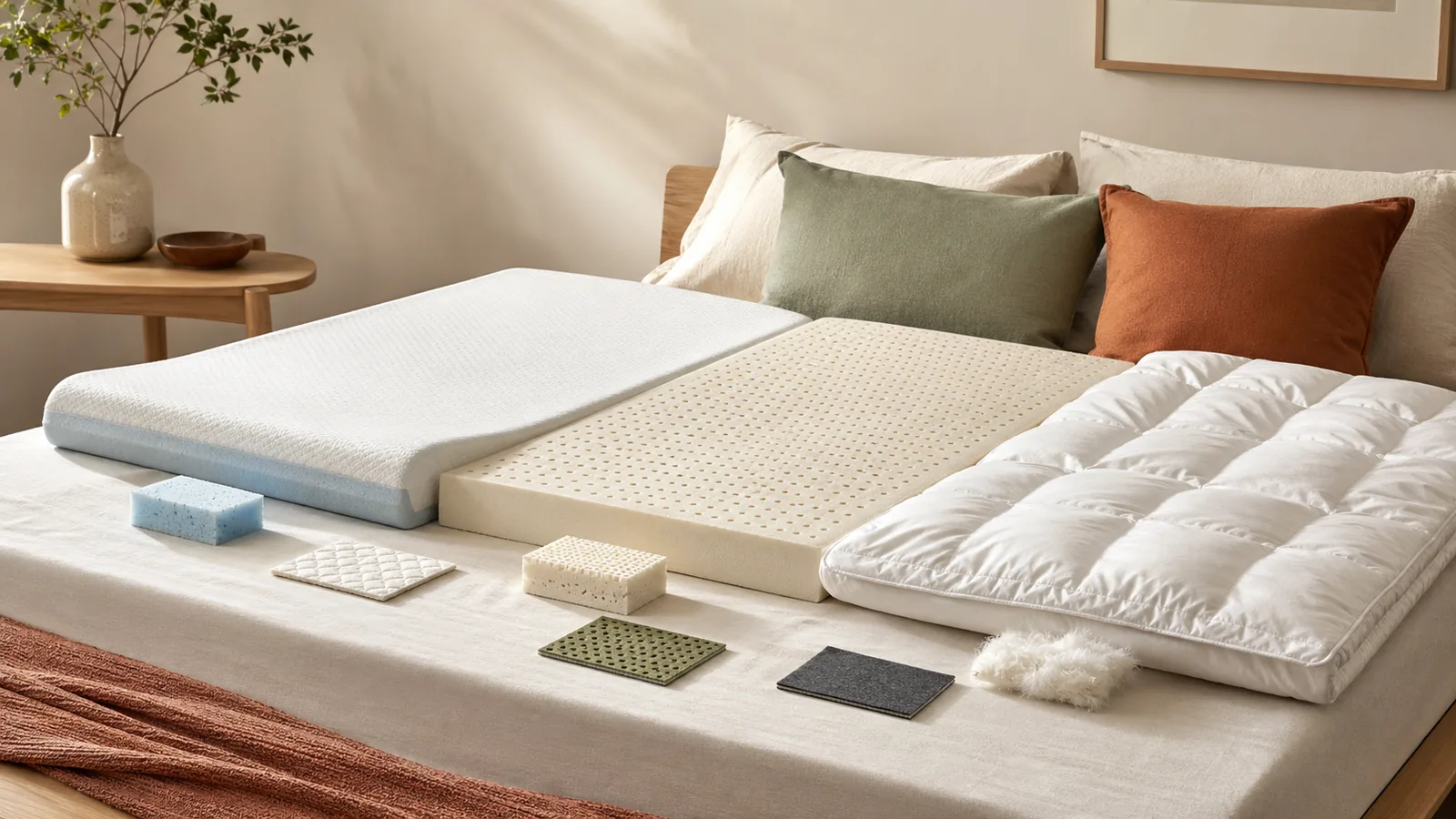
The same principle applies when you add a separate mattress topper. A 3-inch memory foam topper or 2-inch latex layer adds those inches directly to the depth the sheet must span. The corners are where this tension concentrates most. Each corner is pulled in two directions simultaneously — across the mattress width and along the mattress length — and when a pillow-top or thick topper puts the sheet at or beyond its pocket limit, corners are the first to release.
Consumer Reports' sheet testing methodology includes evaluating fit across mattresses of different depths, specifically because fit failure at the corners is a real and measurable problem. Their testing also found that bamboo viscose sheets shrank by more than 15 percent during fit testing — which means even a sheet that technically fits on purchase day can lose coverage after a few washes, tightening the margin even further on a pillow-top or topped mattress.
Pro Tip: Before buying new sheets for a pillow-top bed or topped mattress, measure with the topper in place at the thickest point of the mattress crown. This is the number that counts — not the mattress manufacturer's nominal spec.
Why adjustable bases make fitted corners slip when the bed raises
An adjustable base — whether you're on a Sleep Number smart bed, a Tempur-Pedic ERGO, or a third-party adjustable frame — creates a stress pattern that standard fitted sheets are not engineered to absorb. When the head section lifts to 45 degrees or the foot raises, the mattress surface pulls in a new direction and the sheet fabric must travel with it. Corners that were snug at flat become stretched diagonally, and the elastic — already at its limit if pocket depth is marginal — loses grip.
Sleep Number's bedding guidance says to "find the overall height of your bed by adding the mattress profile to the height of your base or furniture." Its integrated base measures 8 inches from floor to the top of the base without an optional frame, and 17 inches with a frame. This isn't just about getting in and out of bed — it's confirmation that the entire geometry of the sleep surface changes based on your setup, and your sheets must accommodate that geometry.
The mechanism is straightforward: when the head of the mattress rises, it shortens the horizontal distance between the head end and foot end of the top surface. The sheet fabric, already fitted to flat dimensions, is now being asked to bridge a shorter top surface while the sides extend downward. That pulls the foot corners upward and inward — and they pop.
Watch Out: A sheet that fits perfectly at flat can fail at 30 degrees of head elevation. Always test with the bed in your actual sleeping position — not just flat — before deciding a new set works.
For adjustable base owners, look for sheets specifically marketed as adjustable-base compatible, or choose sheets with fully elasticized edges rather than only corner elastic. Adjustable bed sheet accessories — including cross-strap systems designed specifically for articulating frames — add a layer of retention that static corner clips cannot match.
How worn elastic, baggy corners, and lost recovery make the problem worse
Worn elastic is a separate failure mode from fit mismatch, and the fix is different: replacement, not a deeper pocket. The tell is simple — pull the corner of the fitted sheet and watch what the elastic does. If it springs back tightly, the elastic has recovery. If it returns slowly, loosely, or barely at all, the elastic is done.
Worn elastic checklist: - Corner pocket feels loose on the mattress even when the sheet is new to the bed - Elastic channel along the hem has visible stretching, waviness, or bunching - The hem folds or crinkles rather than lying smooth around the mattress edge - After laundering, the corner no longer rebounds to its original diameter - The sheet pops off immediately after being seated, rather than after a night's sleep
As Sleep Number describes, a functioning fitted sheet relies on a fully elasticized edge, elastic corner seams, and anchor bands working together: "A fully elasticized edge, elastic corner seams and anchor bands keep fitted sheets in place." When those elements degrade, no amount of correct sizing or clip accessories compensates. The system needs to generate tension — and worn elastic cannot.
Consumer Reports' fit testing documented bamboo viscose sheets shrinking more than 15 percent after laundering. That level of dimensional change can turn a correctly sized sheet into an undersized one over time, and it can compromise the elastic channel's integrity along with it. If your sheets have been through several dozen wash cycles, laundering-related degradation is a real factor.
DIY vs Pro: There is no repair here. Replacing the elastic in a fitted sheet is technically possible but impractical — new elastic, new sheet. Once elastic loses recovery, retire the set.
How to measure mattress height, topper height, and pocket depth
This is the step most people skip, and it is why they keep buying the wrong sheets. Measuring takes four minutes and eliminates the guesswork entirely. As Tempur-Pedic explicitly instructs: "First, find a well-fitting pair of sheets — be sure to confirm the height of your mattress to ensure the set you choose fits properly."
The fit formula:
Mattress height (inches) + Topper height (inches) = Total covered depth → Choose sheets whose stated pocket depth exceeds this total by at least 1 inch.
Follow this sequence before you order any deep-pocket fitted sheets:
- Measure the mattress alone — side seam to crown.
- Measure any topper separately — compressed thickness, not marketed loft.
- Add both numbers together.
- Compare that total against the pocket depth printed on the sheet's package or product page.
- If the total equals or exceeds the sheet's stated maximum, size up or choose a deeper-pocket option.
Measure the mattress from seam to seam or floor to crown
Measure from the bottom seam of the mattress to the highest point of the sleeping surface. Use a flexible tape measure and press it against the side panel without compressing the foam. Record the number in inches.
Do not rely on the mattress manufacturer's stated dimensions. Sleep Number's own support documentation notes that mattress dimensions can vary slightly by model and may initially measure under stated dimensions based on the build. That variance can be the difference between a sheet that fits and one that barely holds. Measuring the actual mattress on the actual bed gives you the real number you need.
A standard mattress runs between 8 and 12 inches. A mid-range pillow-top or foam mattress typically measures 12 to 15 inches. Luxury models — including many Tempur-Pedic and Sleep Number configurations — can reach 13 to 15 inches on the mattress alone, before any topper.
Pro Tip: Measure at the thickest point of the mattress — usually the center of the sleeping surface. Some mattresses crown slightly in the middle and taper toward the edges, so the center measurement is your fit-critical number.
Measure the topper separately before adding it to the total depth
Take the topper off the mattress and measure it independently. Compressed topper height — the height under sleeping weight — is what matters for fit, but most people only have an uncompressed measurement available. Use the product's stated thickness as your working number and accept that the real compression might be slightly less.
Topper measurement checklist: - Record the topper thickness from the product spec sheet or the label on the topper itself - Common topper depths: 1-inch, 2-inch, 3-inch, and 4-inch toppers are the most widely sold - A 3-inch memory foam topper on a 13-inch mattress creates a 16-inch total depth — which exceeds what most standard deep-pocket sheets cover - If your topper is a split design (split Queen or split King for a dual-adjustable base), measure each half separately
As Tempur-Pedic's depth-specific sheet guidance makes clear, distinguishing between 13-inch and 15-inch sheet styles comes down to this combined depth calculation. If a topper pushes you past a 13-inch sheet's limit, the 15-inch style is not optional — it is the only sheet that will stay on.
Compare the total depth to the fitted-sheet pocket depth on the package
Most sheet packaging lists pocket depth in one of three formats: "fits mattresses up to X inches deep," "pocket depth: X inches," or buried under dimensions in the fine print on the product page. All three mean the same thing — that is the maximum stack height the fitted sheet is designed to cover.
Here is how to read it correctly:
Package says: "Queen Sheet Set — fits mattresses up to 14 inches deep" Your mattress: 13 inches + 2-inch topper = 15 inches total Result: Wrong sheet. The total depth exceeds the stated maximum by 1 inch. This sheet will pop off.
Both Tempur-Pedic and Sleep Number anchor their sheet recommendations to specific depth thresholds — 13 inches and 15 inches at Tempur-Pedic, up to 15 inches at Sleep Number — precisely because the size name (Queen, King) carries zero information about whether the sheet will hold. If the total stack height exceeds the package's stated maximum, treat that set as a confirmed fit failure before you ever put it on the bed.
Watch Out: "Deep pocket" on packaging is not a standardized term. One brand's "deep pocket" may cover up to 15 inches; another's may cover only 13. Always read the actual numeric spec, not just the label category.
Best fixes for fitted sheets that will not stay on
Work through this ranked fix ladder in order. Do not skip to step 3 without confirming step 1 — accessories cannot fix a depth mismatch.
- Verify pocket depth first — confirm your total stack height against your current sheet's stated maximum
- Switch to deep-pocket sheets if the current sheet's pocket depth is too shallow
- Add sheet straps or clips after pocket depth is confirmed and corners still slip
- Replace worn elastic or retire the whole set if the sheet is aged and has lost recovery
This sequence directly addresses the gap in most advice on this topic. The existing SERP is full of clip recommendations without any fit-first guidance — clips applied to an undersized sheet create brief compression followed by the same pop-off. Fix the depth, then use accessories if needed.
Switch to deep-pocket sheets for thick mattresses
Deep-pocket sheets are the first purchase to try when your mattress stack height exceeds what your current sheets cover. Look for a set whose stated depth limit is at or above your measured total depth — and leave a small margin (1 to 2 inches) so the elastic isn't working at its absolute maximum on every corner.
Product guidance for deep-pocket shopping: - Tempur-Pedic ProAir sheet sets accommodate mattresses up to 15 inches deep — the right choice for most 13-to-14-inch mattresses plus a thin topper - Sleep Number's fitted sheets are designed for mattresses up to 15 inches thick, with fully elasticized edges and anchor bands built in - For mattresses exceeding 15 inches total depth (common with thick foam toppers or luxury pillow-tops), look for extra-deep-pocket or "oversized" fitted sheets marketed for 16-to-21-inch depths
Browse deep-pocket fitted sheet sets and filter by the numeric depth spec, not just the "deep pocket" label. If the product listing doesn't state a maximum depth in inches, contact the seller before ordering or shop elsewhere.
Pro Tip: If your bed uses a topper or an adjustable base, add extra allowance beyond the mattress's nominal depth. A 13-inch mattress with a 3-inch topper needs a sheet rated for at least 16 inches — a standard "deep pocket" (14-inch) sheet will still fail.
Use sheet straps or sheet clips to anchor loose corners
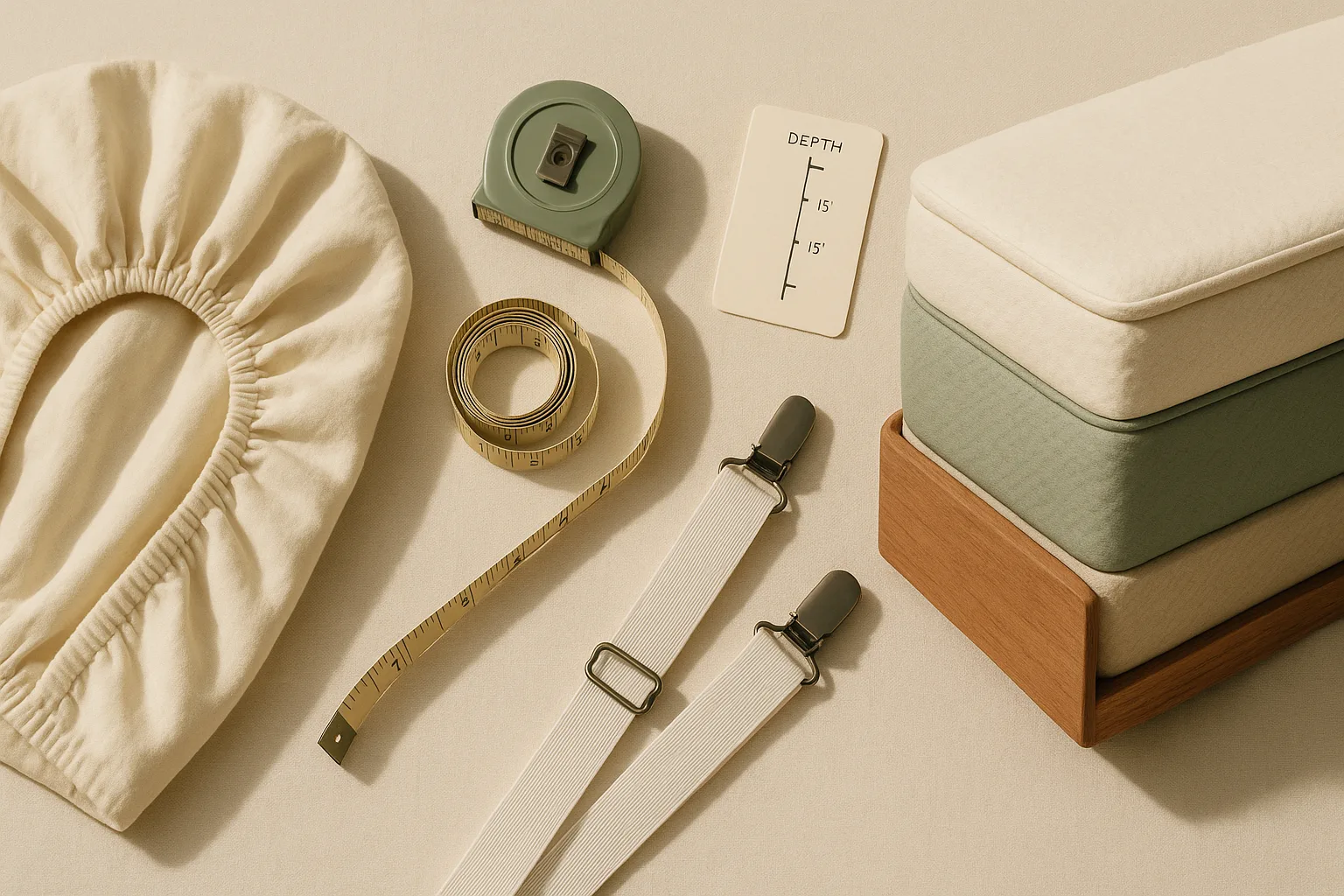
Sheet straps and clips work — but only when pocket depth is already correct. Used on an undersized sheet, they add temporary resistance before the sheet pops. Used on a correctly fitted sheet with minor slipping from movement, they keep corners seated through the night.
Straps vs. clips — quick comparison:
| Feature | Sheet clips | Sheet straps |
|---|---|---|
| Installation | Clip onto sheet edge at each corner | Run diagonally under mattress between opposite corners |
| Ease of setup | Fast — 30 seconds per corner | Requires lifting mattress to route strap |
| Best for | Minor corner slipping on static beds | Adjustable bases and high-motion sleepers |
| Adjustability | Fixed grip at the clip point | Adjustable tension across full corner |
| Price range | $8–$15 for a set of 4–8 | $12–$20 for a set of 4 straps |
Sheet clips and corner grippers are the faster option for a standard bed frame. For adjustable bases, diagonal under-mattress straps that connect opposite corners are more effective because they counteract the directional pull created when the bed articulates.
Sleep Number's design approach — elastic corner seams plus dedicated anchor bands — reflects how a manufacturer solves this problem in-fabric. When you're using third-party sheets, external straps replicate that anchoring function.
Try mattress encasement-style alternatives for slippery beds
When a correctly sized deep-pocket sheet still slips — particularly on foam mattresses with slick covers, on adjustable bases, or on memory foam with slow rebound — an encasement-style fitted sheet solves the problem by wrapping the mattress more like a zipper case than a standard pocket.
These styles have a skirt panel that wraps completely under the mattress rather than relying on corner elastic alone. The entire mattress is enveloped rather than just capped, eliminating the pop-off failure mode. They are particularly useful on adjustable bases where the mattress moves but cannot be secured with clips alone.
The trade-off: encasement-style sheets are harder to change because removing them requires full mattress lifting. They are best for beds that are difficult to sheet repeatedly or for households where slipping is a persistent problem despite correct depth selection. Consumer Reports' fit testing includes evaluating fit across different mattress depths — their findings confirm that fit failure is a real category of sheet failure, not just a user error.
Replace stretched elastic or retire the whole sheet set
If elastic is visibly worn, corners are baggy, or the fabric crinkles and bunches at the hem rather than lying flat, the set has reached end of life. A verified-fit sheet that has lost elastic recovery will pop off just as reliably as a sheet that was never the right size.
Consumer Reports documented bamboo viscose sheets shrinking more than 15 percent after fit testing — that is a dramatic dimensional change from laundering alone, and it illustrates how laundering degrades both fit and elastic recovery over time. Even cotton percale and sateen sets lose elastic strength after 50 to 100 wash cycles depending on water temperature and drying heat.
Replacement threshold: replace the set when: - Corner pockets feel loose before the sheet even wears in - Elastic returns slowly or incompletely after stretching - Corners pop within the first hour after making the bed - You can see the elastic channel waving or rippling at the hem - Laundering has visibly shortened the fitted panel, leaving less coverage on the side walls
How to keep fitted sheets on an adjustable bed at night
Adjustable beds — including Sleep Number smart beds, Tempur-Pedic ERGO bases, and third-party adjustable frames — require a specific approach to sheet fit because the geometry of the mattress changes every time the position changes. A sheet that holds through the night at flat may fail immediately at 35 degrees of head elevation.
Sleep Number's guidance instructs: "Find the overall height of your bed by adding the mattress profile to the height of your base or furniture." Their integrated base measures 8 inches from floor to the top of the base without an optional frame, and 17 inches with a frame. That context matters for understanding total geometry — but for sheet fit specifically, the key variable is how the mattress surface deforms as the base articulates.
The fix sequence for adjustable beds: 1. Confirm pocket depth covers the total mattress stack at flat 2. Test the sheet at head-up, feet-up, and flat positions before buying the full set 3. Add 2 inches of extra pocket allowance beyond that confirmed flat depth 4. Add under-mattress straps or cross-corner sheet strap systems as a retention layer
Test the sheet with the head raised before you commit to a new set
Before you buy a full sheet set for an adjustable bed, test a single fitted sheet with the base in your typical position — head at 30 or 45 degrees, feet slightly elevated, whatever you actually sleep in. A sheet that fits flat but pops at elevation does not fit your bed.
Before-buy test checklist for adjustable bases: - Put the fitted sheet on with the base at flat - Raise the head to your typical sleeping angle - Check all four corners — especially the foot corners, which receive the most pull when the head rises - Raise the foot section if your base includes that feature - Return to flat and check whether corners reseat without manual adjustment - If any corner released or is visibly strained, the sheet is too shallow or lacks sufficient elastic recovery for your setup
Per Sleep Number's specifications, their own sheets are designed specifically to handle this geometry through fully elasticized edges rather than corner-only elastic. When buying third-party sheets for an adjustable base, prioritize sets with elastic running the full perimeter of the fitted hem — not just at the corners.
Choose extra pocket allowance for adjustable frames and toppers
On an adjustable base with a topper, your effective depth requirement is higher than your mattress label implies, and the sheet must accommodate movement on top of that depth.
The practical rule: add 2 inches of extra allowance to your calculated total depth when shopping for adjustable-bed sheets. If your measured total depth is 14 inches (mattress plus topper), shop for sheets rated to 16 inches or more.
As Tempur-Pedic's sheet guidance confirms, their 13-inch and 15-inch depth thresholds are precise specifications — and when articulation stress is added on top of depth requirements, operating at the limit of the spec creates frequent pop-offs. Buying a sheet rated for slightly more than your measured depth is insurance against the motion-induced stretch that adjustable bases create.
Watch Out: US bed size alone — Twin, Full, Queen, King, California King — tells you nothing about whether a sheet will stay on an adjustable frame. The size label describes the footprint, not the depth or the elastic design. Always confirm both the pocket depth spec and the elastic construction before ordering.
Use straps, clips, or corner grippers after you confirm pocket depth
Once you have confirmed pocket depth is correct for your adjustable setup, add retention hardware as a secondary layer of protection.
Accessory comparison for adjustable bases:
| Accessory type | How it works | Best for | Adjustment | Cost |
|---|---|---|---|---|
| Corner clips | Clamp to sheet edge at each corner | Static beds with minor slipping | None — fixed grip | $8–$15 |
| Diagonal straps | Run under mattress corner to corner | Adjustable bases, high-motion | Adjustable buckle tension | $12–$20 |
| Full-perimeter band | Wraps mattress like a second fitted layer | Foam mattresses, slippery covers | N/A — size-dependent | $15–$30 |
| Gripper pad | Textured pad between mattress and sheet | All setups | None | $10–$25 |
For adjustable bases specifically, diagonal under-mattress sheet straps are the most effective accessory because they counteract the directional pull created when the head or foot section rises. Corner clips work for static resistance but cannot redirect the tension created by base articulation. Combine correctly fitted deep-pocket sheets with diagonal straps for the most reliable setup on a moving base.
When to replace fitted sheets instead of trying another fix
No accessory, clip, or strap overcomes a sheet that has lost its elastic integrity. If the elastic is gone, the fix is a new set — not a more elaborate retention system.
Consumer Reports' documentation of more than 15 percent shrinkage in bamboo viscose sheets after fit testing illustrates that materials change meaningfully with use and laundering. The same dynamic affects elastic recovery: repeated heat-drying degrades elastomer fibers, causing the elastic channel to lose tension even when the sheet dimensions stay roughly correct.
Signs the fitted sheet has lost its grip for good
Visual and physical signs that justify immediate replacement:
- Baggy corners: You can grab a handful of excess fabric at any corner even when the sheet is seated
- Wavy elastic channel: The hem folds and waves rather than lying flat against the mattress side panel
- Slow spring-back: Pull the corner and release — if elastic returns in more than 2–3 seconds or returns to a noticeably larger diameter than it started, recovery is compromised
- Wrinkling at the hem seam: The seam crinkles lengthwise rather than running taut
- Sheet releases during the first hour of sleep: Correctly sized sheets with good elastic hold through the night; a sheet popping off early is failing at grip, not pocket depth
- Fabric thinning or pilling at stress points: Corners and edge seams that have pilled or thinned are losing structural integrity alongside elastic performance
What to buy next: deep-pocket, better elastic, or a full set
Use this decision path to find the right replacement:
- Recalculate your total depth (mattress + topper in inches)
- Is your total depth above 12 inches? → You need a deep-pocket set rated for 13–15 inches minimum
- Is your total depth above 15 inches? → You need an extra-deep-pocket set rated for 16–21 inches
- Is your depth within range but the elastic is worn? → Replace with a same-depth set and prioritize fully elasticized (full-perimeter) construction over corner-only elastic
- Are you on an adjustable base? → Choose sheets explicitly rated for adjustable bases with full-perimeter elastic and consider adding diagonal straps
- Has the set failed despite correct depth and good elastic? → Retire the full set and start with Step 1 on a fresh purchase
Tempur-Pedic's ProAir sheets accommodate mattresses up to 15 inches deep, covering most mid-to-high-profile mattresses with or without a thin topper. For mattresses above 15 inches, browse extra-deep-pocket options with depth ratings clearly stated in the product spec.
Fitted sheet troubleshooting checklist for Twin, Full, Queen, King, and Cal King
The footprint labels — Twin, Full, Queen, King, California King — describe the surface dimensions of the mattress. They say nothing about how thick the mattress is or how deep the sheet pocket needs to be. Two Queen beds sitting side by side can differ by 7 inches in mattress height and require completely different sheet specifications.
What to check before you reorder sheets online
Run through this checklist before placing any order:
- Measure actual mattress height in inches (not the manufacturer's stated spec)
- Measure any topper separately and add to mattress height
- Calculate total covered depth (mattress + topper)
- Find the pocket depth spec on the sheet listing — in inches, not just "deep pocket"
- Confirm the sheet's stated maximum depth exceeds your total by at least 1 inch
- Identify your base type — standard platform/box spring, or adjustable frame
- If adjustable: add 2 inches of extra allowance and confirm fully elasticized construction
- Check elastic construction type — full-perimeter elastic outperforms corner-only elastic on deep and moving mattresses
- Sleep Number's sheets (designed for mattresses up to 15 inches, with elastic corner seams and anchor bands) illustrate what to look for in the product description of any brand
Do not buy by size name alone — a Queen label on the sheet packaging only confirms the sheet will cover a Queen-size footprint. It confirms nothing about depth.
How to match sheet depth to thick mattresses without overbuying
The right number is: measured total depth + 1 to 2 inches of clearance. Deeper is not always better — a sheet pocket that dramatically exceeds your mattress depth has too much excess fabric and can bunch under the mattress, reducing corner tension and paradoxically causing slipping.
Practical examples: - 12-inch mattress, no topper: Standard deep-pocket sheets (up to 14 inches) work well - 13-inch mattress, no topper: Choose sheets rated to 15 inches — right at the Tempur-Pedic ProAir spec - 13-inch mattress + 2-inch topper = 15 inches total: Choose sheets rated to 16–17 inches; a 15-inch-rated sheet is at its limit - 14-inch pillow-top + 2-inch topper = 16 inches total: Extra-deep-pocket sheets (rated 18 inches or more) are appropriate - Adjustable base, any depth: Add 2 inches to the calculated total and prioritize full-perimeter elastic
For deep-pocket fitted sheets, always read the specific depth rating in the product spec — not just the "deep pocket" category label, which is unregulated and inconsistently applied across brands.
FAQ about fitted sheets popping off mattresses
Why do fitted sheets keep coming off the bed?
The primary cause is a mismatch between your mattress height — including any topper — and your sheet's pocket depth. When the total stack height equals or exceeds the pocket depth, the elastic is permanently over-stretched and loses grip. As Sleep Number confirms, a properly performing fitted sheet relies on a fully elasticized edge, elastic corner seams, and anchor bands — and all of those elements fail prematurely when the sheet is the wrong depth for the mattress. Worn elastic on an aged sheet is the second most common cause. Measure your total depth first, then check your elastic before adding accessories.
Do sheet straps or clips really work?
Yes — but only after pocket depth is confirmed. Sheet clips and straps are genuine retention aids for loose corners, and they are especially useful on adjustable bases where bed movement loosens corners that were snug at flat. The important caveat: clips applied to a sheet that is too shallow for the mattress create brief resistance before the elastic fails again. Fix the depth first, then add clips or straps as a second line of defense. For adjustable bases, diagonal under-mattress straps outperform simple corner clips because they counteract directional pull rather than just gripping a single point.
Can adjustable beds make sheets pop off?
Yes. When an adjustable base raises the head or feet, the mattress geometry changes and the sheet fabric is pulled toward the flex point. Corners that were snug at flat receive diagonal tension that can exceed the elastic's holding capacity. Sleep Number notes that overall bed height must account for both mattress profile and base height, confirming that the geometry of an adjustable setup is fundamentally different from a static frame. A sheet that fits at flat but pops at elevation needs either extra pocket allowance or dedicated adjustable-base retention straps — or both.
When should I replace fitted sheets?
Replace fitted sheets when elastic is weak, corners are baggy, or the fabric no longer maintains tension after laundering. Consumer Reports documented bamboo viscose sheets shrinking more than 15 percent after fit testing, showing how dramatically laundering can alter sheet performance. The practical signal: if your sheet pops off within the first hour on a correctly sized mattress, and the elastic returns slowly or incompletely when you stretch and release it, the elastic has failed. No clip or strap will fix that — replace the set.
How do you keep fitted sheets on a deep mattress?
Work through three fixes in order. First, measure your total stack depth — mattress plus topper — in inches and compare it against your current sheet's stated pocket depth. If the sheet's maximum depth is at or below your total, that is your problem. Second, switch to deep-pocket fitted sheets whose stated maximum depth exceeds your measured total by at least 1 inch. Third, once depth is confirmed correct, add sheet clips or under-mattress straps if corners still slip from movement. Tempur-Pedic's ProAir sheets accommodate mattresses up to 15 inches deep — a useful benchmark for deep mattress shopping.
Sources & References
- Kite Linens — How to Stop Fitted Sheets from Coming Off the Bed — Core editorial reference for fit-based troubleshooting framework
- Tempur-Pedic Help Center — Which sheets should I buy to fit my mattress? — Primary source for 13-inch and 15-inch pocket depth specifications
- Tempur-Pedic — 5 Tips for First-Time Mattress Buyers — Source for "confirm the height of your mattress" instruction
- Sleep Number — Lyocell Ultra Sheets Set Product Page — Source for 15-inch maximum thickness spec and elastic construction details
- Sleep Number — Mattress and Base Specifications — Source for base height (8 inches without frame, 17 inches with frame) and mattress dimension variance notes
- Sleep Number Support — Mattress and Base Specifications — Supplementary base specification data
- Consumer Reports — Things to Know Before Buying Sheets — Source for fit testing methodology and bamboo viscose shrinkage data (>15 percent)
Keywords: deep-pocket sheets, standard-depth sheets, mattress pocket depth, mattress height, mattress topper, pillow-top mattress, adjustable base, sheet straps, sheet clips, fitted-sheet elastic, elastic recovery, mattress encasement, sheet suspenders, Tempur-Pedic, Sleep Number, Twin, Full, Queen, King, California King