How to keep your mattress from sagging: the fastest prevention checklist
Three habits prevent most premature mattress sagging: rotating on a consistent schedule, using a foundation your mattress brand actually approves, and covering the sleep surface with a quality waterproof protector. Sleep Foundation recommends doing so before wear becomes visible, and if you skip the support requirement you can risk voiding your warranty before the first body impression appears, as both Casper's FAQ and Saatva's Friends for Life Warranty make clear.
Here is the core prevention checklist:
- Rotate every 3–6 months. Sleep Foundation recommends doing so "every three to six months" to promote even wear, even before you notice sagging.
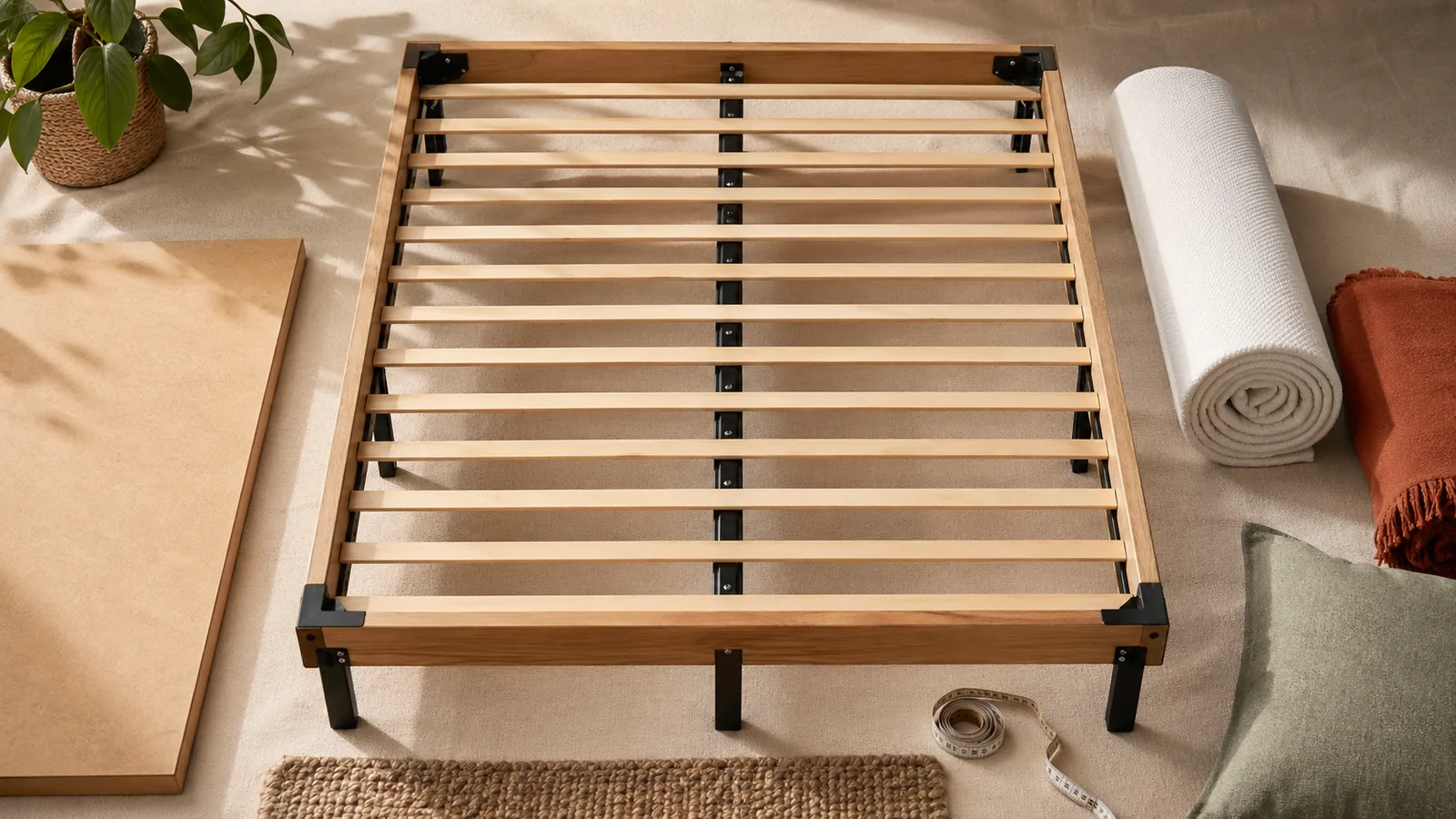
- Use a brand-approved support surface. Casper's FAQ specifies flat, wooden slats no more than 4 inches apart. Saatva's Friends for Life Warranty requires a platform bed with a solid surface or slats spaced less than 4 inches apart, plus center support for queen and larger sizes. Your brand's support spec governs warranty validity — not what came with your old bed frame.
- Add a waterproof mattress protector immediately. Moisture protection does not stop structural sagging on its own, but it keeps sweat, spills, and humidity out of layers that cannot be cleaned or dried once saturated, which slows the softening that often shows up as early body impressions.
- Check for center support legs on queen and king beds. Saatva's own metal frame ships with an additional 3-leg center support for queen, king, and Cal King sizes for exactly this reason. A queen-size mattress spanning 60 inches needs that mid-span reinforcement or the frame can bow and the mattress will follow.
- Never use an old coil box spring with a foam or hybrid mattress unless the manufacturer explicitly approves it. Most modern foam and hybrid beds require a flat, firm surface — not the springy give of a traditional box spring.
Watch Out: Mattress thickness varies by manufacturer and model — it is not standardized the way width and length are. A 13-inch memory foam mattress and a 9-inch hybrid may sit on the same queen frame, but their support requirements, sheet pocket depths, and warranty specs can be completely different. Always verify against your specific product page, not the size category alone.
What causes mattress sagging in memory foam, hybrid, and innerspring beds
Mattress sagging happens when the internal materials — foam layers, coil systems, or both — can no longer maintain their original shape under repeated compression. As Sleep Foundation notes, "A sagging mattress will provide uneven support, which can significantly reduce comfort and sleep quality." The cause, however, differs meaningfully by construction type, and mattress thickness still varies by manufacturer and model even within the same size.
MattressConstructionComparison:
| Construction | Primary Wear Mechanism | Where It Shows First | Avg. Vulnerability |
|---|---|---|---|
| Memory foam | Foam cell breakdown, density loss | Sleep position center | Moderate–High |
| Hybrid (foam + coils) | Foam layer compression + coil fatigue | Edges and sleep zones | Moderate |
| Innerspring | Coil fatigue, broken springs | Center and edge coils | Moderate |
| Latex (natural) | Slow oxidation, less cell collapse | Evenly across surface | Low |
Consumer Reports' mattress testing protocol evaluates how well a mattress maintains its original shape, height, firmness, and side/back sleeping support after 8 years of simulated use — which makes durability a construction and materials question, not just a size question. A well-supported latex mattress often outperforms a poorly supported hybrid on that 8-year benchmark.
Why foam softens and body impressions form over time
Memory foam softens because its open-cell structure compresses under the same pressure points night after night. Higher-density foams resist this longer, but no foam is immune. The comfort layers at the top of the mattress — the ones you feel first — compress faster than the support core beneath them.
The important distinction is between body impressions and structural sagging. As Saatva explains on their blog: "Body impressions are normal indentations that form where you sleep, and they're not a sign of a faulty mattress." These are shallow, localized imprints that correspond to your sleeping position. They differ from full-surface structural sagging, which involves loss of support across the entire mattress — not just where you sleep.
In practical terms: if you press on the impression and it slowly rebounds when you stand up, you are likely looking at a normal body impression. If the mattress stays deflected or visibly dips across a broader area when unloaded, that is structural failure — a different problem with a different solution.
Pro Tip: Consumer Reports uses an 8-year simulated-use standard to judge durability. When you're comparing mattresses, look for test data or owner reviews at the 5–7 year mark, not just the first year honeymoon period when every foam feels supportive.
Why hybrid and innerspring mattresses need stronger edge and center support
Hybrid and innerspring mattresses transfer more of the support load to the perimeter and center of the frame than all-foam beds do. The coil system spans the full width and length of the mattress, which means any sag or flex in the foundation translates directly into uneven coil compression. A bowed slat or an absent center leg doesn't just feel uncomfortable — it permanently distorts the coil geometry over time.
Casper's FAQ makes the engineering rationale explicit: "Having the correct support ensures the performance and longevity of memory foam/hybrid mattresses." Their requirement — flat, wooden slats no more than 4 inches apart — is designed to prevent the mattress core from bridging gaps and bending between supports.
Saatva's metal bed frame addresses this directly: it ships with a standard 4-leg configuration for twin, twin XL, and full sizes, and adds an additional 3-leg center support for queen, king, and Cal King sizes. If you're shopping for a bed frame to pair with a hybrid or innerspring mattress, that center support architecture is what you should look for — not just surface aesthetics.
How often to rotate a mattress to prevent sagging
Rotate most mattresses every 3 to 6 months. Sleep Foundation's guidance is direct: "It's good practice to rotate the mattress every 3 to 6 months to promote even wear, even before you start to notice sagging." Don't wait for a body impression to appear before you start — rotation is preventive, not remedial.
One firm rule: most modern mattresses are designed to be used right-side up only and should never be flipped. Sleep Foundation confirms that one-sided mattresses, which include virtually all foam, hybrid, and pillow-top models sold today, should not be flipped even if they can be rotated. Flipping a one-sided mattress puts the comfort layers on the bottom and the support core on top — you'll be sleeping on a flat slab with no cushioning. Rotation (180 degrees, head to foot) is the only movement most modern mattresses need.
Which mattresses should be rotated every 3 months versus every 6 months
Higher-use situations call for the shorter interval, but the exact schedule should follow the product page or care label. A mattress used by two adults of different body weights, a mattress in a guest room that occasionally takes an adult and a child, or any mattress that doubles as a daytime lounge surface should usually be rotated more often than a single-adult bed with a consistent sleep position.
| Construction Type | Rotation Interval | Can Be Flipped? |
|---|---|---|
| Memory foam (one-sided) | Every 3–6 months, depending on use | No |
| Hybrid (one-sided) | Every 3–6 months, depending on use | No |
| Pillow-top (one-sided) | Check manufacturer guidance; many use a 3–6 month rotation cadence | No |
| Traditional innerspring (two-sided) | Every 3–6 months if the manual allows flipping | Yes (check manual) |
| Latex (one-sided) | Every 3–6 months, depending on use | No |
Sleep Foundation notes that traditional innerspring mattresses can sometimes be flipped, though this is becoming rare as most modern versions are also one-sided. When in doubt, check the care label sewn into the mattress or the brand's product page — the manufacturer's instruction governs.
How to rotate without bending, dragging, or damaging the cover
Safe rotation takes two people and about 10 minutes. Never attempt it solo on a queen or king — the dead weight and awkward leverage make cover tears and core damage likely, and Sleep Foundation's handling guidance reinforces that modern mattresses should be handled right-side up and not folded.
SafeHandlingStepCard:
- Clear the bed completely. Remove all bedding, pillows, and the mattress protector so you can grip the mattress fabric directly.
- Stand on opposite sides of the bed. One person at the head, one at the foot.
- Lift, don't drag. Both people lift their end simultaneously and carry the mattress as a unit. Dragging tears the cover fabric and can compress the foam edge unevenly.
- Pivot 180 degrees on the frame surface. Keep the mattress flat and horizontal throughout — do not tilt it on edge unless you have no other option.
- Set it down centered on the foundation. Check that overhang is even on all sides before remounting the protector and bedding.
Watch Out: Do not fold or crease any modern foam or hybrid mattress during a rotation or move. Folding breaks internal foam cell bonds and can cause permanent soft spots at the crease line — damage that is not covered under most warranties. Casper's care guidance specifies keeping the mattress on a firm, flat surface throughout setup and adjustment, which applies equally to handling during rotation.
What kind of bed frame or foundation prevents mattress sagging
The verified support rules come first: Casper says memory foam and hybrid mattresses need flat, wooden slats no more than 4 inches apart, while Saatva's warranty requires a platform bed with a solid surface or slats spaced less than 4 inches apart, plus center support for queen and larger sizes.
FoundationCompatibilityChecklist:
- ✅ Confirm slat spacing meets your brand's maximum (Casper and Saatva both cap at 4 inches)
- ✅ Verify slats are flat (not bowed or warped) and made of solid wood or metal
- ✅ Confirm center support legs are present for queen, king, and Cal King sizes
- ✅ Check whether your mattress brand allows adjustable bases (not universal)
- ✅ Confirm box spring compatibility before assuming your existing one works
- ✅ Match foundation to mattress thickness — tall mattresses on low-profile frames can be ergonomically wrong
Watch Out: Improper support is one of the most common reasons warranty claims are denied. Saatva's warranty states explicitly that coverage remains valid "if the mattress has been used on a platform bed with either a solid surface or slats spaced less than 4\" apart and a center support for queen and larger sizes." Using an old box spring, a frame with missing slats, or a queen frame without center legs could disqualify your claim before the inspector even looks at the mattress.
Slatted bases, platform beds, box springs, and adjustable bases compared
| Foundation Type | Compatible With | Key Requirement | Warranty Risk |
|---|---|---|---|
| Slatted base | Most foam, hybrid, latex | Slats flat, wooden, ≤4 inches apart | Low if spec is met |
| Solid platform bed | Most foam, hybrid, latex | Even solid surface, good airflow | Low |
| Traditional box spring | Brand- and model-specific only | Verify exact mattress page before use | High for foam/hybrid if unapproved |
| Bunkie board | Twin/full on metal frames | 4-legged frame OK per Saatva | Low if used correctly |
| Adjustable base | Select foam and hybrid | Brand must explicitly approve | High if unapproved |
Casper recommends a firm, flat surface off the floor or appropriately spaced slats as the baseline. Saatva's warranty language frames it in terms of platform beds with solid surfaces or properly spaced slats. Neither brand defaults to box spring compatibility — that should tell you something about the industry direction.
Adjustable bases are a specific case: they are not universally compatible. Casper's warranty page notes that coverage applies to specific use cases, and adjustable base compatibility must be verified against the mattress model before purchase. A flex-capable hybrid like the Casper Wave Hybrid may be approved for an adjustable base; a pillow-top innerspring typically is not.
How close should slats be to support a mattress correctly
The verified threshold from both major US brands in the research data is 4 inches. Casper's FAQ states: "For slatted frames, we recommend using bed slats that are flat (not bowed), wooden, and no more than 4 inches apart." Saatva's warranty uses "less than 4 inches apart" as its threshold.
Pro Tip: When spacing is borderline, err tighter and confirm your model page before buying hardware. Adding a center slat to an existing slatted frame costs under $20 at most home improvement stores and takes 10 minutes.
The material matters too. Casper specifies wooden slats because they don't flex the way thin metal slats can. Thin metal slats over a wide queen or king span can bow under load over time, creating an uneven support surface that concentrates pressure in the center.
When queen and king beds need center support legs
Any queen, king, or California King frame needs at least one center support leg — and most need a full center rail with multiple legs. Saatva's own support documentation confirms that queen, king, and Cal King sizes require vertical center support as a warranty condition. Their metal bed frame addresses this with an additional 3-leg center support assembly for these sizes.
The engineering reason is straightforward: a queen mattress is 60 inches wide. A king is 76 inches. Without center support, the frame spans that entire width on two side rails alone. Under the weight of a mattress plus two adults — potentially 400–600 lbs of combined load — an unsupported center rail flexes downward, and the mattress follows.
If your current queen or king frame doesn't have center legs, adding a center support bar with legs (available at most furniture stores for $20–$40) is one of the cheapest and highest-impact mattress-longevity upgrades you can make.
Does a mattress protector help prevent sagging?
A mattress protector does not directly prevent the structural compression that causes sagging, but it plays a meaningful supporting role by keeping moisture out of the layers that degrade fastest when wet. Think of it as a barrier that slows one of the most common pathways to premature foam breakdown. For a mattress where a sagging warranty claim may hinge on condition, a protector also helps demonstrate that you maintained the mattress responsibly.
The Sleep Foundation recommends "rotating your mattress every 3 months or so (unless the manufacturer recommends otherwise) and utilizing a mattress protector" as standard long-term care practices. Those two habits together form the baseline of preventive maintenance.
How spills, sweat, and humidity shorten mattress life
Foam is an open-cell material that absorbs liquid the same way a sponge does. Once sweat, body oils, or spilled liquid penetrates through the fabric cover and into the comfort layers, it accelerates foam cell breakdown, creates conditions for mold and mildew, and causes persistent odor that no surface cleaning can fully address. Saturated foam can also lose density unevenly, which creates soft spots that mimic structural sagging even if the coil system or support core is still intact.
Beyond comfort, moisture damage can create warranty complications. Most mattress warranties explicitly exclude damage from improper use or maintenance — and a stained, moisture-damaged mattress is a difficult claim to support. A protector installed from day one is the simplest way to keep moisture damage off the table entirely.
Watch Out: Air circulation matters. A solid waterproof cover that traps heat without breathability will increase sweating, which partially defeats the moisture-control purpose. Look for protectors that are waterproof on the barrier layer but moisture-wicking and breathable on the sleep surface.
What to look for in a protector for memory foam and hybrid mattresses
Memory foam and hybrid mattresses tend to run warmer than traditional innerspring beds, and their thick profiles — often 10–14 inches — require deeper-pocket protectors. When selecting a protector, check for these specific features:
- Fitted depth of at least 15–18 inches to fully anchor on thick foam and hybrid mattresses without pulling loose during sleep
- Stretch knit top fabric (typically polyester-spandex blend) that moves with the mattress rather than bunching under pressure
- Quiet waterproof barrier — cheaper protectors use a crinkly plastic-feel membrane; better options use a thin polyurethane laminate or TPU layer that is silent and breathable
- Machine washable at warm temperatures without special detergents or treatments that could damage the waterproof layer
- Certified low-VOC materials if you're sensitive to off-gassing, particularly relevant for new foam mattresses that may already be releasing some odor
Pro Tip: Brands like SafeRest, Slumber Cloud, and Coop Home Goods make protectors specifically sized for thick foam mattresses. Verify the fitted depth on the product page against your mattress's actual height — mattress thickness is not standardized and varies by model.
How to tell if mattress sagging is cosmetic or structural
The diagnostic question that matters: does the entire mattress surface lack support, or are you seeing localized indentations where you sleep? These are different problems with different solutions, and confusing them leads to either premature mattress replacement or tolerating a genuinely failing sleep surface.
Saatva's blog draws the distinction clearly: "A sagging mattress is when the entire mattress sags and loses support due to a lack of material. Body impressions are normal indentations that form where you sleep, and they're not a sign of a faulty mattress."
DiagnosticDecisionTree:
[Image: Diagnostic flowchart — body impressions vs. structural mattress sagging]
Start here and follow the questions:
- Strip the mattress to bare foam/cover. Remove all bedding and the protector so you can see the actual surface.
- Look across the surface from eye level. Does the dip exist only where you sleep, or does the center (or a broad zone) look lower than the perimeter?
- Press the indentation firmly, then release. Does the foam slowly rebound toward its original height within 5–10 seconds? → Likely a body impression. Does it stay compressed or rebound partially and unevenly? → Structural concern.
- Check the foundation. Put your hand under the mattress at the center point. Is the slat or foundation surface flat and firm? If the foundation is flexing or bowed, the problem may be the frame — not the mattress.
- Sleep test. After rotating the mattress 180 degrees, does your sleep quality improve noticeably within 1–2 weeks? Improvement suggests uneven wear (fixable with rotation). No improvement despite good foundation suggests structural degradation.
What body impressions look like versus true sagging
Body impressions are shallow, localized, and position-specific. They look like a mild concave outline of where you sleep — your shoulder zone, your hip zone. The rest of the mattress surface remains level. When you stand up and look from the side, the impression gradually disappears as the foam slowly recovers.
True structural sagging, by contrast, creates a visible dip or bow across a broader section of the mattress regardless of whether anyone is on it. "A sagging mattress is when the entire mattress sags and loses support due to a lack of material," Saatva notes. You'll often feel it as a rolling sensation toward the center of the bed, or notice that lying near the edge feels noticeably firmer than lying in the center. A measuring tape or a straightedge ruler held across the surface will show the depth of the dip clearly.
VisualDiagnosticChecklist:
- ✅ Impression is localized to sleep positions only → body impression, monitor and rotate
- ✅ Foam rebounds slowly but returns to level when unloaded → normal compression
- ❌ Dip spans center of mattress or multiple zones → structural concern
- ❌ Surface doesn't rebound when standing up, or rebounds unevenly → foam failure
- ❌ Rolling sensation toward center regardless of sleep position → structural sagging
- ❌ Visible crease, lump, or asymmetry in mattress silhouette → coil damage or foam collapse
When a foundation issue is causing the mattress to sink
Before you replace the mattress, check the foundation. A bowed slat, a broken center leg, or an undersized frame can make a perfectly good mattress look and feel like it's sagging. Casper specifies that a proper support surface is firm and flat — if yours isn't, the mattress is simply conforming to the shape of the frame beneath it.
UpgradeOrReplaceCallout:
- Upgrade the foundation if: Slats are visibly bowed or warped, center support legs are missing on a queen or larger, slat spacing exceeds 4 inches, or the frame wobbles under load
- Replace the mattress if: Foundation is solid and level but the mattress still shows deep, non-rebounding impressions across multiple sleep zones
- Do both if: Foundation has failed and the mattress has significant structural impressions — a new mattress on a bad frame will sag again within months
A new slatted bed frame from brands like Saatva or a platform frame with solid wood construction typically runs $200–$600 for a queen — a fraction of a new mattress cost, and worth the diagnostic step before you spend $1,000+.
Replace now red flags: when a sagging mattress is beyond saving
Some sagging is structural damage that no rotation, topper, or foundation upgrade will fix. The mattress needs to go. These red flags mean it's time:
When to Call a Pro: - Visible body impressions that do not rebound when you stand up and leave the mattress for several hours unloaded - Sagging more than 1 inch deep measured with a straightedge — Casper's warranty identifies this as a covered defect threshold when the mattress has been properly supported - Broken or poking coils that you can feel through the comfort layers - Chronic low-back pain that worsens overnight and improves within an hour of getting up — this is a classic sign of lost support, not a minor fitness issue - A rolling-toward-center sensation that makes it difficult to maintain a side or back sleeping position - Visible asymmetry in the mattress silhouette — one side measurably lower than the other when viewed from the foot of the bed - Persistent musty odor that persists after airing, suggesting internal moisture damage
If you're experiencing chronic back pain that gets worse overnight, don't tolerate it while waiting to see if the mattress "breaks in" further. A structurally failed mattress actively works against spinal alignment during the 7–8 hours when your body should be recovering.
How long mattresses usually last before sagging becomes unavoidable
Durability varies by construction type, foam density, usage patterns, and the quality of the support system underneath. Consumer Reports uses an 8-year simulated-use benchmark in its testing protocol — that's roughly where most mattresses hit their inflection point between "aging well" and "declining noticeably."
General construction-based expectations:
| Construction | Typical Lifespan (with proper care) | Primary End-of-Life Sign |
|---|---|---|
| High-density memory foam | 8–10 years | Permanent soft spots |
| Budget memory foam | 5–7 years | Rapid body impressions |
| Hybrid (foam + coils) | 7–10 years | Edge collapse, center sag |
| Innerspring only | 7–9 years | Broken coils, reduced support |
| Natural latex | 10–15 years | Slow, even softening |
These ranges assume a proper foundation, regular rotation, and protection from moisture. Sleeping two adults on a mattress designed for one, never rotating, and using an undersized frame will compress that timeline significantly. The inverse is also true — disciplined maintenance with a well-matched platform bed or slatted frame routinely pushes mattress lifespan to the high end of these ranges.
What warranty language to check before you file a claim
Most mattress warranties look comprehensive until you read the fine print. Verify these specific elements before you assume your sagging is covered:
WarrantyChecklist:
- Support requirement: Does your foundation meet the brand's explicit spec? Saatva requires a platform bed with a solid surface or slats less than 4 inches apart, plus center support for queen and larger. Casper requires flat, wooden slats no more than 4 inches apart. An unsupported mattress will not qualify.
- Defect threshold: Casper's warranty language identifies sagging more than 1 inch — when properly supported — as a covered defect. Check your brand's specific depth threshold.
- Ownership eligibility: Casper's warranty applies to "mattresses purchased directly from Casper or Casper's authorized retailers, and located in the United States (not including US territories) or Canada." Saatva's warranty covers only the original purchaser and does not provide warranty replacements outside the continental United States.
- Proof of purchase and use: Keep your original receipt, order confirmation email, and photographs of the mattress and foundation. Claims without documentation are harder to process.
- Excluded damage: Moisture staining, physical damage, and "normal body impressions" (as defined by the brand) are typically excluded. A protector and rotation records help demonstrate you followed care instructions.
Pro Tip: Take photos of your mattress and foundation setup when you first set it up. A dated photo showing proper slat spacing and center support legs is evidence you maintained the warranty conditions from day one.
Mattress care checklist for moves, cleaning, and everyday weight distribution
Long-term mattress health is built in daily habits, not just annual maintenance. Beyond rotation and foundation setup, these ownership practices keep wear even and the sleep surface intact.
CareChecklist:
- Rotate on a calendar reminder. Set a recurring calendar event for every 3 months if two people share the bed, every 6 months for single sleepers.
- Use a quality waterproof mattress protector from the first night. Replace it if it loses waterproofing — a protector that's been through hundreds of washes may no longer be effective.
- Avoid sitting on the same edge spot repeatedly. The foot of the bed and one side rail are the most common targets for habitual edge-sitting. This concentrates foam compression and coil stress at one location.
- Keep pets off if possible — or rotate more frequently. A dog sleeping in the same corner every night creates localized compression that a biannual rotation won't fully undo.
- Air the mattress monthly. Strip all bedding and the protector for a few hours to allow moisture vapor to dissipate.
- Vacuum the mattress surface quarterly using a low-suction upholstery attachment. Removes dust mite allergens and debris that collect in the cover fabric.
- Don't use the mattress as a workspace, couch, or exercise surface. Prolonged concentrated load in the same spot — sitting cross-legged to work on a laptop, for example — creates uneven wear faster than sleeping does.
How to move a mattress without damaging the core or cover
Moving a mattress is when most physical damage happens. Foam cores can crack at crease points. Cover fabric tears on door frames. Coil geometry distorts if the mattress is left standing on one end without support.
MoveSafetyStepCard:
- Wrap the mattress in a mattress bag before moving. Disposable poly mattress bags (under $10 at U-Haul or Home Depot) protect the cover from dirt, tears, and moisture during transit.
- Move with at least two people. One person cannot safely carry or maneuver a queen or king without dragging it.
- Keep it flat if possible. Transporting flat in a pickup truck bed or moving van is safer than standing it on edge for extended periods.
- If you must move it on edge, keep it vertical — not tilted. Resting a mattress at a diagonal angle for hours can allow internal components to shift or compress unevenly.
- Do not fold any modern mattress. Sleep Foundation confirms that most modern mattresses are designed to be used right-side up. Folding breaks foam bonds and can cause permanent crease damage that no warranty covers.
- Don't drag across rough surfaces. Door thresholds, carpet, and concrete can abrade and tear the mattress cover fabric, which then requires re-covering or accelerates interior moisture exposure.
How to distribute weight so one side does not wear out faster
Uneven weight distribution is one of the most predictable causes of early body impressions — and one of the most preventable. In a couple's bed where one partner is significantly heavier, or where one person tends to sleep in one spot while the other moves around, you will see the heavier person's side develop impressions faster even with a consistent rotation schedule.
EvenWeightDistributionChecklist:
- Rotate 180 degrees on schedule (head to foot) — this shifts your heaviest sleep zone to a fresh area of the mattress
- Switch sides periodically if both partners are comfortable doing so — this is especially effective for couples with a significant weight difference
- Avoid habitual edge-sitting in the same spot: getting in and out of bed on the same corner every morning concentrates compression that rotation doesn't fully undo
- Don't let children or pets use the mattress as a trampoline — repeated high-impact compression on the same spot is far more damaging than static body weight
- Consider a mattress topper if one side is softer than the other — a quality latex or high-density foam topper can level out the sleep surface while you assess whether full replacement is warranted
Mattress sagging FAQ
How often should you rotate a mattress to prevent sagging?
Rotate every 3 months if two people share the bed or if one sleeper is on the heavier side, and every 6 months for a single adult at a stable weight, but always confirm the model-specific care page first. As Sleep Foundation puts it, "rotating your mattress every 3 months or so (unless the manufacturer recommends otherwise)" is standard practice. Set a calendar reminder — it's the kind of task that's easy to skip indefinitely without one.
What kind of bed frame prevents mattress sagging?
A platform bed with a solid surface or properly spaced slats is the most broadly compatible option for modern foam and hybrid mattresses. Slats should be flat, wooden, and no more than 4 inches apart (per both Casper and Saatva's verified guidance). Queen and larger beds need center support legs — a queen frame without a center rail will bow under load. Avoid using an old coil box spring with a foam or hybrid mattress unless your brand's product page explicitly approves it.
Can a mattress protector help prevent sagging?
A protector doesn't directly prevent structural sagging, but it protects the foam layers from moisture damage — one of the main ways comfort layers degrade prematurely. It also keeps the mattress surface clean and supports your case if you ever need to file a warranty claim. Choose a waterproof protector with a breathable top layer, sized to your mattress's actual thickness rather than just its width and length.
How do you know if a mattress is sagging or just body impressions?
Strip the mattress and press the low spot firmly, then step back. A body impression slowly rebounds when unloaded and is localized to your exact sleep position. Structural sagging creates a dip across a broader area of the mattress that doesn't rebound, is present whether or not you've been lying on it, and creates a rolling sensation toward the center when you're in bed. A straightedge or level held across the surface will show the actual depth of the dip.
When should you replace a sagging mattress?
Replace it when the sagging depth exceeds about 1 inch (Casper's defined defect threshold), when broken coils are palpable through the surface, when body impressions don't rebound after several hours unloaded, or when you wake up with back pain that improves within an hour of getting out of bed. That last signal — overnight pain that resolves after rising — is one of the clearest functional indicators that the mattress is no longer providing adequate support, regardless of how it looks. Depending on construction, most mattresses reach this point somewhere in the 7–10 year range, though poor support or lack of rotation can accelerate that timeline significantly. Quality options like the Saatva Classic and Casper mattresses both offer transparent warranty terms and support specifications that make it easier to make this call objectively.
Sources & References
- Sleep Foundation — How to Fix a Sagging Mattress — Rotation cadence, sagging prevention guidance
- Sleep Foundation — Mattress Sizes — Standardized US mattress dimensions; thickness varies by model
- Sleep Foundation — Should You Flip or Rotate Your Mattress? — One-sided vs. two-sided mattress handling
- Sleep Foundation — Signs of a Bad Bed — Rotation and replacement indicators
- Sleep Foundation — When Should You Replace Your Mattress? — Lifespan and maintenance guidance
- Casper FAQ — Slat spacing and support requirements
- Casper Adjustment Period Page — Proper surface and setup guidance
- Casper Mattress Warranty — Coverage eligibility and geographic scope
- Casper Warranty Blog — Sagging defect threshold (1 inch)
- Saatva Friends for Life Warranty — Foundation requirements, slat spacing, center support
- Saatva Metal Bed Frame Help — Center support leg configuration by size
- Saatva Foundation Lifetime Warranty — Queen and larger center support requirement
- Saatva Blog — Sagging Mattress vs. Body Impressions — Diagnostic distinction between structural sagging and normal impressions
- Consumer Reports — Mattress Test Protocol — 8-year simulated durability benchmark
Keywords: queen center support legs, slat spacing no more than 4 inches, bunkie board, platform bed frame, box spring compatibility, adjustable base, mattress warranty terms, body impressions vs structural sagging, memory foam, hybrid mattress, latex mattress, mattress protector, Saatva Classic, Casper, Sleep Foundation