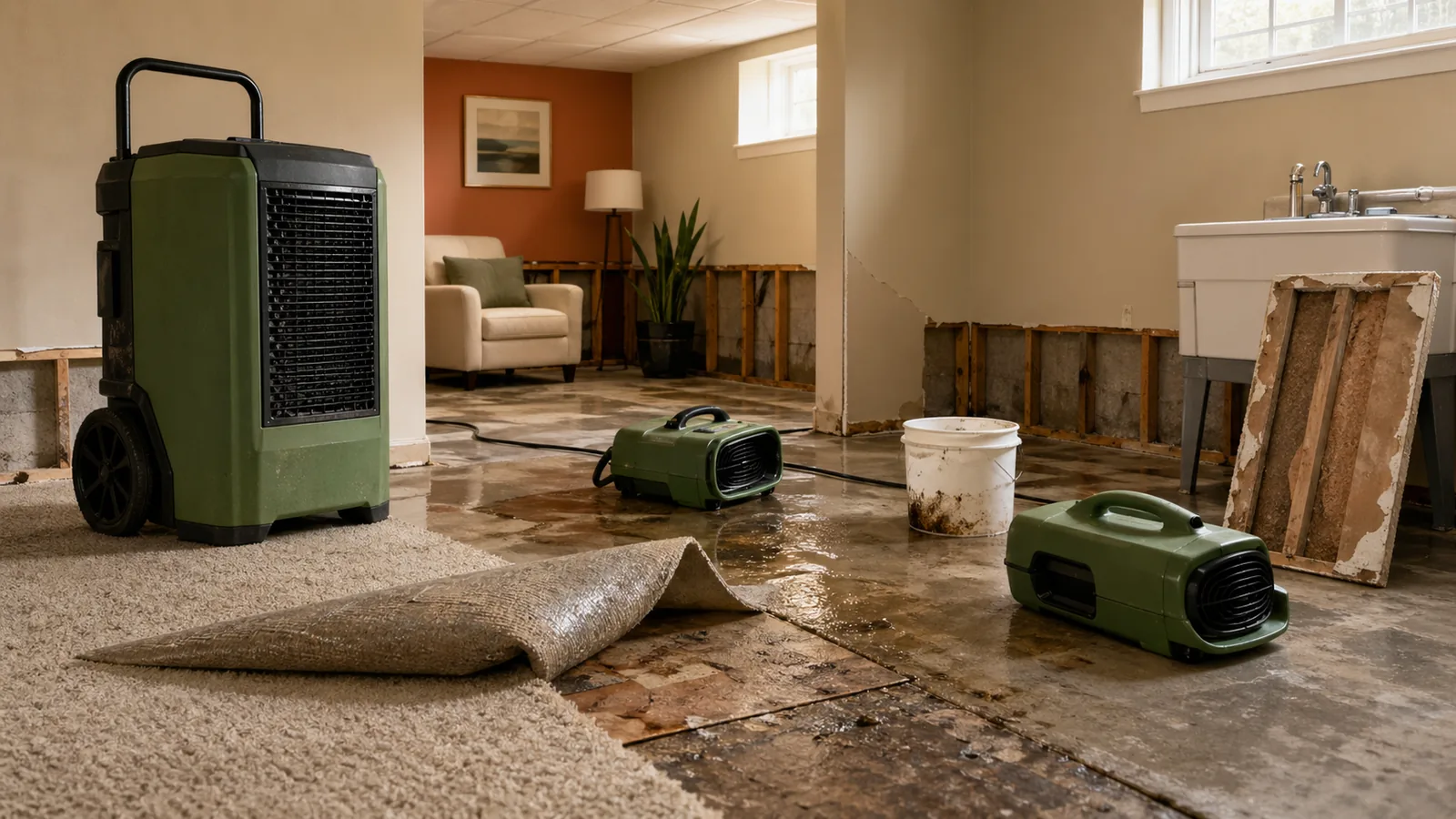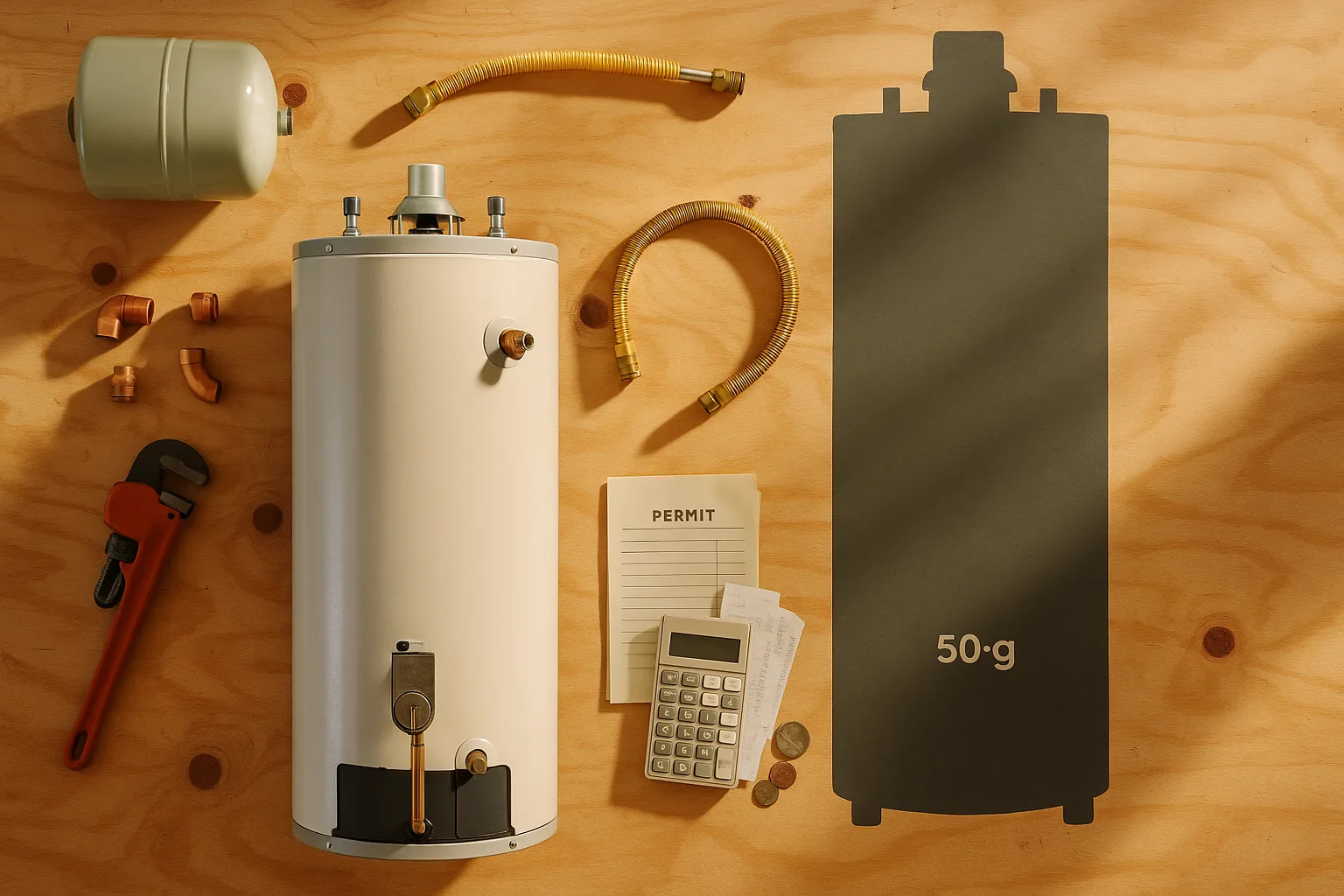
Most homeowners don't think about their water heater until something goes wrong — and by then, as Consumer Reports warns, "They notice a leak — or worse, they're surprised by a flood — and are forced into a fast, high-pressure decision on which new water heater to buy." That rushed purchase almost always costs more than a planned one. This guide breaks out exactly what you'll pay by scenario so you can budget before you're in crisis mode.
How much does water heater replacement cost in 2026?
A like-for-like tank water heater swap — same fuel type, same location, same size — typically runs $800–$1,500 fully installed in 2026, which aligns with Consumer Reports' buying guidance on choosing a replacement based on existing infrastructure and household demand. Switch to tankless or change fuel types, and the number climbs to $1,500–$3,500 or higher once venting, gas-line work, permits, and electrical upgrades enter the picture. Heat pump water heaters land in the middle at $1,200–$2,500 installed before rebates, according to the same Consumer Reports guidance and manufacturer installation constraints.
The single biggest price driver isn't the unit itself — it's whether your home needs code-triggered upgrades to accommodate the new heater. A $700 tank can balloon into a $2,200 job the moment an inspector requires an expansion tank, updated venting, or a new drip pan that wasn't there before.
Pro Tip: Per the Consumer Reports water heater buying guide (updated September 2025), account for your household's hot-water demand and existing infrastructure before you choose a replacement — not after the plumber arrives. Switching fuel types or sizing up may require electrical-capacity upgrades or more physical space than your current setup allows.
Water heater replacement cost by scenario: tank, tankless, heat pump, emergency
The table below is the scenario matrix most cost guides skip. Every range reflects full US installed cost in 2026 — unit, labor, standard connections, and haul-away of the old unit — as an editorial estimate grounded in Consumer Reports guidance and manufacturer install requirements. Add-ons like permits, expansion tanks, and electrical work are itemized separately in the sections that follow.
| Scenario | Unit Cost | Labor Only | Full Install Range |
|---|---|---|---|
| Standard 40–50 gal tank swap (same fuel) | $400–$900 | $300–$600 | $800–$1,500 |
| Tank-to-tankless conversion (gas) | $700–$1,500 | $500–$1,000 | $1,500–$3,500+ |
| Heat pump water heater (electric) | $900–$1,800 | $400–$700 | $1,200–$2,500 |
| Same-day / emergency replacement | $400–$900 | $500–$1,200 | $1,200–$2,200+ |
Emergency water heater installation commands a premium because you're paying for same-day dispatch, after-hours labor rates, and whatever unit the plumber happens to have on their truck. If you can wait even 24–48 hours to schedule, you'll almost always pay less and have more unit options.
Unit-only vs labor-only vs full-install totals
If you source the unit yourself — buying a Rheem Performance Plus or AO Smith Signature 500 directly from a big-box store like Home Depot or Lowe's — you can save the contractor markup on the unit, which typically runs 20–30% above retail, based on common contractor pricing structures and retail-appliance comparisons. The trade-off: most licensed plumbers charge slightly more labor when they don't supply the unit, and if there's a problem with the unit itself, the warranty resolution falls to you, not the contractor.
Here's how the numbers split out for a standard 40–50 gallon gas tank replacement:
- Unit only (homeowner supplies): $400–$900 (Rheem Performance, AO Smith Signature, Bradford White Defender series at retail)
- Labor only (contractor installs your unit): $350–$700 for a straightforward swap
- Full install (contractor supplies and installs): $800–$1,500, which includes contractor markup on the unit but often comes with a warranty backed by the plumbing service company
Watch Out: If you buy the unit yourself, confirm the plumber will honor it before you purchase. Some shops won't warranty labor on customer-supplied equipment. Get that in writing.
What does a standard 40–50 gallon tank swap cost?
A straight tank-to-tank replacement — same fuel (gas or electric), same location, same capacity — is the most affordable scenario most homeowners face. Expect $800–$1,500 fully installed, with the middle of that range ($950–$1,200) being the most common real-world outcome for a 40–50 gallon gas unit in a typical basement or utility closet.
The unit itself accounts for roughly half the total. A 40-gallon Rheem Performance Platinum gas water heater retails around $550–$650; a 50-gallon AO Smith Signature Select runs $600–$750. Labor for a clean, accessible swap usually runs $300–$600 depending on your region — plumbers in the Northeast and coastal California charge more than those in the Midwest or Southeast.
Cost Snapshot: Standard 40–50 gallon tank swap: $800–$1,500 installed. Labor alone: $300–$600. Expect the higher end in metros like NYC, LA, Seattle, or Boston.
Typical parts added on a tank replacement
A simple swap rarely stays simple once a licensed plumber gets eyes on the job. Most inspectors and plumbers will flag at least one of these items as required or recommended, and the pricing below should be treated as an editorial estimate informed by common US plumbing-market pricing and permit practices:
- Expansion tank: $100–$300 installed. Required in closed plumbing systems (most homes with a pressure-reducing valve) to absorb thermal expansion. If your current setup doesn't have one, many municipalities now require it at replacement.
- Drip pan: $25–$75 installed. A shallow metal or plastic pan under the unit to catch slow leaks before they damage the floor. Frequently required by code when the heater is located above finished living space.
- T&P (temperature and pressure) relief valve: $20–$60 installed. Often replaced proactively on a tank swap since the old valve may be aged or corroded, and it's a critical safety component.
- Haul-away / disposal: $50–$150. Most plumbing services include disposal of the old tank, but confirm this before you approve the job — some quote it separately.
- Permit fee: $50–$250 depending on municipality (covered in detail below).
Adding all these to a base job can push a "$950 tank swap" to $1,300 or more. That's not padding — those are legitimate code and safety items.
What changes the price of a tank replacement
Even within the "simple swap" category, five factors move the needle:
- Access constraints: A water heater tucked in a tight closet, up a narrow staircase, or in a crawl space takes longer to remove and install. Tight access can add $100–$300 in labor.
- Fuel source: Electric tank swaps tend to be slightly cheaper on labor since there's no gas-line work involved. Gas units require checking connections and may need new flex connectors or shutoff valves.
- Capacity: Stepping up from a 40-gallon to a 50-gallon unit is usually straightforward if the footprint fits. Going larger (75–80 gallons) may require a bigger space, upgraded gas supply, or a higher-amperage circuit.
- Local labor rates: Plumbing service rates vary significantly by region. A job that costs $400 in labor in Memphis might run $700 in Denver and $900 in San Francisco.
- Replacement location: Moving the heater to a different location — even across the same room — means new pipe runs and possibly new venting, which adds material and labor cost.
Why does a tankless water heater conversion cost more?
Converting from a tank to a tankless unit is a different project category entirely — not a swap, but an infrastructure change. The unit itself may cost $700–$1,500, but the full installed price for a gas tankless conversion commonly lands between $1,500 and $3,500, and can push past $4,000 when gas-line upsizing, new venting, or electrical work are required.
The reason is simple: a traditional 40-gallon tank heats water slowly and stores it. A tankless unit fires at high intensity on demand — a whole-house gas tankless typically requires a ¾-inch or even 1-inch gas supply line and fires at 150,000–200,000 BTU. Most homes currently have ½-inch gas lines running to the water heater location. Upsizing that line to the gas meter is real plumbing work.
Here's a realistic cost breakdown for a gas tankless water heater installation:
| Line Item | Typical Cost |
|---|---|
| Tankless unit (e.g., Rinnai RU199iN, Navien NPE-240A2) | $800–$1,500 |
| Labor (removal, mounting, connections) | $400–$700 |
| Venting (PVC or stainless concentric vent kit) | $200–$600 |
| Gas-line upsizing (½" to ¾" or 1") | $300–$800 |
| Electrical (new outlet or dedicated circuit) | $100–$400 |
| Permit | $75–$250 |
| Total | $1,875–$4,250 |
Rheem's installation documentation makes clear that venting on indoor tankless units is mandatory, not optional — the unit must be vented to the outside per the manufacturer's instructions, and Rheem explicitly states that if venting conditions are not corrected before completing installation, the water heater should not be put into service. That's not a preference — it's a hard stop.
Venting, gas-line, and electrical upgrades that raise tankless costs
These three items are where tankless budgets blow past initial quotes. Each one is a code requirement, not an upsell.
Venting: Indoor tankless water heaters require a sealed exhaust path to the outside. Depending on where your heater is located relative to an exterior wall, this can mean running 2-inch or 3-inch PVC concentric vent pipe through a wall, up through the ceiling, or along a wall chase. Per Rheem's installation documents, venting must follow the manufacturer's specifications exactly — this isn't something a plumber can improvise. Long vent runs, multiple elbows, or difficult routing through finished walls all add cost. Budget $200–$600 for typical residential venting; complex runs can exceed $1,000.
Outdoor tankless units sidestep the venting cost entirely — they don't require venting materials — which is worth considering if your climate allows and your plumber can mount the unit on an exterior wall.
Gas-line upsizing: A high-BTU tankless unit needs more gas flow than your existing ½-inch line can deliver. Upsizing from the meter or the branch point to the heater location typically costs $300–$800. If the meter itself needs upgrading (required by some utilities), the gas company usually handles that separately, sometimes free, sometimes not.
Electrical panel upgrade: Most tankless gas units need only a standard 120V outlet nearby for the electronic ignition. But whole-house electric tankless units are a different story — they commonly require 240V service at 150–200 amps, which may require a dedicated circuit or a full electrical panel upgrade if your current panel is already loaded. Panel upgrades run $1,500–$4,000 separately, which is why most cost guides on electric tankless conversions are dramatically underestimated.
Watch Out: Get a written scope of work before any tankless conversion. Ask the plumber specifically: "Does this quote include venting, gas-line work, and electrical? What's your estimate if the gas line needs upsizing?" Surprise add-ons are the number-one complaint in tankless conversion reviews on Reddit and Angi.
When a tankless conversion makes sense anyway
Despite the higher upfront cost, tankless makes genuine sense in certain situations. The Consumer Reports water heater buying guide frames the decision around three factors: household hot-water demand, existing infrastructure, and available space.
Tankless is worth the conversion cost when:
- You're running out of hot water regularly. A properly sized tankless unit (look at GPM flow rate, not just BTU) delivers hot water continuously — no "cold shower because someone else just finished" problem.
- Space is the constraint. A whole-house tankless unit mounts on the wall and frees up the floor space a 50-gallon tank currently occupies.
- You're staying in the home long-term. Tankless units typically last 20+ years versus 10–12 for a tank. The payback period on the higher install cost makes more sense over a long horizon.
- Your gas line and venting are already favorable. If the existing infrastructure happens to accommodate a tankless unit without major upgrades — especially if you're replacing an older tankless — the premium over a tank swap shrinks considerably.
If your home runs on propane, a gas tankless conversion often makes particularly strong financial sense since propane is expensive per BTU and tankless units use it only on demand.
How much does a heat pump water heater cost installed?
A heat pump water heater (HPWH) pulls heat from surrounding air and transfers it to the water — the same principle as a heat pump HVAC system, just applied to domestic hot water. They're dramatically more efficient than conventional electric resistance tanks. Installed cost typically runs $1,200–$2,500, with the unit itself accounting for $900–$1,800 of that (models like the Rheem ProTerra or AO Smith Voltex are common choices), according to Consumer Reports' buying guide and manufacturer installation guidance.
The catch is infrastructure. Per Consumer Reports, choosing a different fuel type or increasing capacity may require electrical-capacity upgrades or more space — and HPWHs need both in specific ways:
- Space: A heat pump water heater needs roughly 700–1,000 cubic feet of surrounding air volume to operate efficiently. A tiny utility closet won't work. Many are installed in basements, garages, or large laundry rooms.
- Electrical: Most HPWHs run on 240V/30-amp service. If your existing electric water heater is already on a 240V/30-amp circuit, the swap is relatively straightforward. If not, you're adding a circuit — budget $150–$400 for that, or more if the electrical panel upgrade is needed.
- Climate: HPWHs are less efficient in very cold spaces (below 40°F). An unheated garage in Minnesota in January reduces their efficiency advantage. A basement that stays 50–60°F year-round is ideal.
Heat pump water heater rebates and efficiency considerations
This is where HPWHs often win the math, even against a cheaper tank swap. Consumer Reports notes that newer water heater models are generally more energy-efficient than older units due to DOE standards — and HPWHs are the most efficient electric option available, using roughly 60–70% less electricity than a conventional electric resistance tank.
On the incentive side, ENERGY STAR-certified HPWHs have been eligible for the federal 25C tax credit (up to $300 under prior law) and, in many states, utility rebates ranging from $100 to $750 or more. Check your state energy office and your specific utility before purchasing — rebate availability changes and some utilities run out of funds mid-year. The ENERGY STAR rebate finder at energystar.gov is the most reliable starting point.
A homeowner replacing a standard electric resistance tank with a Rheem ProTerra HPWH, for example, might pay $1,800 installed but receive a $400 utility rebate, bringing the net cost to $1,400 — within shouting distance of a conventional tank swap — while cutting their water heating electricity bill by 60% going forward.
Do you need a permit to replace a water heater?
Yes, in most US jurisdictions — including most cities and counties — replacing a water heater requires a permit. This surprises many homeowners who think of it as a straightforward appliance swap, but from a code standpoint, it involves gas lines, electrical connections, venting, and pressure systems.
Permit requirements vary by municipality. Some cities require a permit for any water heater replacement regardless of scope; others only require one for fuel-type changes or new installations. A handful of rural jurisdictions have minimal requirements. The only way to know for certain is to check with your local building department or ask the plumbing service company — a licensed plumber operating in your area will know the local requirements.
Watch Out: Skipping a required permit isn't just a code violation. If your unpermitted water heater causes a flood or fire, your homeowner's insurance claim may be denied. When you sell the house, unpermitted work can surface during the buyer's inspection and complicate or kill the sale.
Permit fees, inspections, and code-triggered add-ons
Permit fees for water heater replacement typically run $50–$250 depending on jurisdiction — larger cities tend to charge more. The permit usually triggers a rough inspection (during installation) and a final inspection once the unit is operational.
Inspectors commonly check for:
- Expansion tank: Required in closed systems per most current plumbing codes. If you don't have one, you'll need to add it.
- Drip pan: Required when the heater is above finished living space or in certain locations per IRC (International Residential Code) standards.
- T&P relief valve: Must be correctly installed with a discharge pipe routed to a safe drain location. Old installations sometimes have this piped incorrectly.
- Venting: On gas units, inspectors check for proper flue size, slope, clearances, and connection integrity.
- Seismic strapping: In earthquake-prone states (California, Oregon, Washington, Nevada), code typically requires the tank to be strapped to the wall. If your old tank wasn't strapped, the inspector will require it on the new one.
These code-triggered add-ons are why a ballpark quote over the phone can be $200–$400 lower than the final invoice. A plumber quoting without seeing the installation site can't always anticipate what the inspector will require.
Repair or replace a water heater: the 8-year rule of thumb
The decision framework is straightforward: if your water heater is under 8 years old and not leaking, a repair is often worth pursuing. If it's over 10–12 years old, leaking from the tank body, or experiencing repeated failures, replacement is almost always the smarter financial move.
Consumer Reports is direct about the risk of waiting too long: the worst outcome is a flood that forces a rushed, high-pressure decision with no time to compare units, get multiple quotes, or plan for code upgrades. If your heater is 9–11 years old and showing warning signs, planning a proactive replacement now puts you in control of the timeline, the unit choice, and the plumbing service you hire.
The industry benchmark for tank water heater lifespan is roughly 10–12 years for gas units and 10–15 years for electric, assuming the anode rod was replaced periodically and the tank was flushed annually. Most homeowners do neither, which shortens practical life.
Signs a water heater is worth repairing
On a unit under 8 years old that isn't leaking from the tank body, these symptoms usually point to a repairable component:
- No hot water / pilot won't stay lit: On gas units, this often indicates a failed thermocouple — a $15–$30 part a plumber can swap in under an hour.
- Water not hot enough: Could be a faulty thermostat (electric) or a gas valve issue (gas). Thermostat replacement on an electric unit: $100–$200.
- No hot water (electric): One or both heating elements may have failed. Element replacement runs $150–$300 for parts and labor — well worth it on a 5-year-old tank.
- T&P valve dripping: The temperature and pressure relief valve may be faulty or triggered by high water pressure. A plumber can test and replace the valve for $100–$200 and check whether an expansion tank is needed.
- Sediment rumbling: Flushing the tank ($75–$150 service call) can extend life if the unit is otherwise sound.
Signs it is time to replace now
When to Call a Pro: Replace immediately — don't attempt repair — if you see any of these: - Leaking from the tank body or base (not the connections, not the T&P valve discharge — the tank itself). Internal corrosion that causes tank leaks cannot be repaired. The tank will fail catastrophically. - Rust-colored or metallic-smelling hot water from multiple fixtures, indicating the tank interior is corroding. - Tank age over 10–12 years (check the serial number — most major brands encode the manufacture date; search "[brand] water heater serial number date" for the decoder). - Third or fourth repair in 24 months — at this point, you're spending repair dollars on a unit with limited remaining life. - Active flooding or water damage — call a plumber and your insurance company simultaneously.
For water heater installation after a tank failure, plan for emergency pricing (see scenario matrix above) and reduced unit selection based on what your plumber has available.
How to reduce water heater replacement cost without cutting corners
The biggest savings come from decisions made before the plumber arrives, not during the job.
Savings checklist:
- Stay with the same fuel type. Gas-to-gas or electric-to-electric swaps avoid gas-line and electrical upgrade costs that can add $500–$1,500 to a job.
- Stay with the same location. Moving the heater across the garage or to a different floor requires new pipe runs, new venting, and more labor. Keeping it in place is the cheapest option.
- Prepare for access. Clear a path and a 3-foot work area around the heater before the plumber arrives. Tight or cluttered access can add billable labor time.
- Get at least three quotes. Water heater installation pricing is not standardized — two licensed plumbers in the same zip code can quote $400 apart for identical work. Use that range to negotiate.
- Ask about off-peak scheduling. Non-emergency, weekday appointments often carry lower labor rates than weekend or same-day calls.
- Research rebates before you choose the unit. Buying an ENERGY STAR-certified heat pump water heater with a $400 utility rebate available changes the cost comparison against a plain electric tank.
- Don't defer until failure. A planned plumbing service appointment always costs less than an emergency dispatch.
DIY-vs-pro: what homeowners can safely do
DIY vs Pro: Most of the physical water heater installation work — gas connections, electrical wiring, venting, permits — requires a licensed plumber or electrician in most jurisdictions. Attempting this work unlicensed may void your unit warranty, fail inspection, and create real safety risks. That said, there's meaningful prep work you can handle yourself.
What you can safely do:
- Shut off the gas supply valve or breaker to the heater before the plumber arrives
- Turn off the cold water supply to the tank
- Drain the tank via the drain valve at the base (connect a garden hose, run it to a floor drain or outside)
- Clear and clean the work area — remove storage, mop up existing drips, measure doorways if the new unit is larger
- Research and purchase the unit yourself from a big-box retailer to save contractor markup (confirm with your plumber first)
- Pull your local permit yourself (homeowners can often pull their own permit; the plumber does the work, you pulled the permit)
Leave this to a licensed pro:
- Gas line disconnection, reconnection, and pressure testing
- Venting disconnection and any new venting installation
- Electrical connections, new circuit installation, or electrical panel upgrade work
- T&P valve installation and discharge pipe routing
- Any work requiring a permit sign-off or inspection
Water heater replacement FAQ
How long does a water heater replacement take?
A straight tank-to-tank swap — same fuel, same location, good access — typically takes 2–3 hours from the time the plumber arrives to the time hot water is flowing again. That includes draining the old tank, disconnecting and removing it, setting and connecting the new unit, and testing.
A tankless conversion takes longer: plan for 4–8 hours minimum, and potentially a full day if venting runs are complex, gas-line work is needed, or electrical work is involved. Permit inspections may require a follow-up visit on a separate day if the inspector isn't available same-day.
Is it cheaper to repair or replace a water heater?
Repair is cheaper upfront — a thermocouple replacement or element swap runs $100–$300 versus $800–$1,500 for full replacement. But repair only makes financial sense if the unit is under 8 years old and in otherwise good condition. Spending $250 to repair a 12-year-old tank is usually money lost; that tank is approaching end of life regardless. A practical rule: if the repair cost exceeds 50% of the replacement cost, or if the unit is within 3–4 years of its expected lifespan, replace it.
Do you need a permit to replace a water heater?
In most US jurisdictions, yes. Permit requirements vary by municipality but are commonly required even for like-for-like replacements. A licensed plumber operating in your area will know the local rules. Skipping a required permit risks voiding your homeowner's insurance coverage for related water damage and can create problems when you sell the home.
What should I ask a plumber before I approve the job?
Get clear answers to these questions before signing anything:
- Is the permit included? Who pulls it, and who handles the inspection?
- Does your quote include haul-away of the old unit? Some contractors charge this separately.
- What code items might get added? Ask specifically about expansion tank, drip pan, and T&P valve — do they see anything in your current setup that will require upgrading?
- Is venting and gas-line work included? If you're doing a tankless conversion, this must be explicit. "Install the unit" and "run new venting" are different line items.
- What's your estimate if the gas line needs upsizing? Get a contingency range in writing.
- Do you warranty your labor? For how long, and does it apply if I supply the unit?
- Are you licensed and insured in this state? Ask for license number — you can verify with your state licensing board online.
For any job involving an electrical panel upgrade or new circuit work, confirm that a licensed electrician (not just a plumber's helper) will handle that portion of the work.
Sources & References
- Consumer Reports Water Heater Buying Guide — Updated September 15, 2025; core guidance on energy efficiency, infrastructure considerations, and choosing the right unit
- Consumer Reports: How to Choose a Water Heater — Updated April 16, 2025; includes warnings about emergency purchase decisions and rushed replacements
- Rheem Tankless Water Heater Venting 101 — Manufacturer guidance on venting requirements for indoor and outdoor tankless units
- Rheem RTGH Series Use and Care Manual — Includes hard installation constraint: venting conditions must be corrected before the unit is placed into service
- Rheem Tankless Piping Diagrams — Specifies that tankless units must be vented to the outside per manufacturer instructions
- Rheem Eagle Tankless Indoor/Outdoor Use and Care Manual — Details condensate drain requirements for venting compliance
Keywords: 40-gallon gas tank water heater, 50-gallon electric water heater, tankless water heater, heat pump water heater, expansion tank, drip pan, T&P relief valve, venting, gas-line upsizing, electrical panel upgrade, NEC, local permit fee, haul-away disposal, Consumer Reports water heater buying guide