What size heat pump do you need for a 2,000-square-foot house?
For a 2,000-square-foot U.S. home, the practical starting range is 2.5 to 4 tons — or roughly 30,000 to 48,000 BTUs per hour. That's the honest answer before anyone looks at your house. The moment a trained HVAC technician factors in your climate, insulation, windows, ceiling height, and air sealing, that number can shift by a full ton in either direction. Square footage gets you into the ballpark; a Manual J load calculation gets you to the right seat.
2.5 to 4 tons is the usual starting range
Most residential heat pumps fall between 1.5 and 5 tons, according to Burgeson's HVAC sizing guide. For a 2,000-square-foot home, the middle of that range — 2.5 to 4 tons — covers the majority of real-world installs before any adjustments for your specific house.
Here's what those numbers look like in BTUs:
| Tonnage | BTUs per Hour | Typical Fit |
|---|---|---|
| 2.5 ton | 30,000 BTU/h | Well-insulated home in mild climate |
| 3.0 ton | 36,000 BTU/h | Average construction, moderate climate |
| 3.5 ton | 42,000 BTU/h | Older construction or hot-humid region |
| 4.0 ton | 48,000 BTU/h | Leaky envelope, extreme climate, high ceilings |
The critical caveat: climate and house quality alone can move the final answer by a full ton or more. A well-sealed, well-insulated 2,000-square-foot home in Portland, Oregon can perform comfortably with a 2.5-ton unit. That same floor plan in Houston, Texas with single-pane windows and a vaulted great room might legitimately need 4 tons. Treat the table above as a conversation starter, not a purchase decision.
BTUs vs tons: what the numbers actually mean
A BTU (British Thermal Unit) is simply a measure of heat energy — specifically, the amount of heat needed to raise one pound of water by one degree Fahrenheit. In HVAC, we use BTUs per hour (BTU/h) to describe how much heating or cooling a system can deliver continuously.
A ton is the older shorthand that stuck around from the ice-delivery era. One ton of capacity equals 12,000 BTUs per hour — originally the cooling effect of melting one ton of ice over 24 hours. A 2-ton heat pump delivers about 24,000 BTU/h; a 3-ton delivers 36,000 BTU/h.
Pro Tip: Tons and BTUs measure capacity — how much work the system can do per hour. They say nothing about how efficiently it does that work. Efficiency is measured by SEER2 (cooling) and HSPF2 (heating). You need the right size and a good efficiency rating; they're separate decisions.
Why square footage is only a starting point for heat pump sizing
Two houses, both exactly 2,000 square feet, sitting side by side in the same city, can have load calculations that differ by 12,000 BTUs — an entire ton of capacity. One was built in 1978 with R-11 attic insulation, aluminum-frame single-pane windows, and gaps around every electrical outlet. The other was built in 2020 to modern energy codes with R-38 attic insulation, double-pane low-E windows, and a blower-door-tested air barrier. The first house leaks conditioned air constantly; the second holds it. Slapping the same heat pump in both based on square footage is a recipe for the wrong equipment in at least one of them — and probably both.
This is the core problem with estimate-based HVAC replacement advice you'll find most places online: they treat square footage as a proxy for load, when it's really just one input among many. The construction details matter at least as much, and in some cases more.
How Manual J load calculations replace guesswork
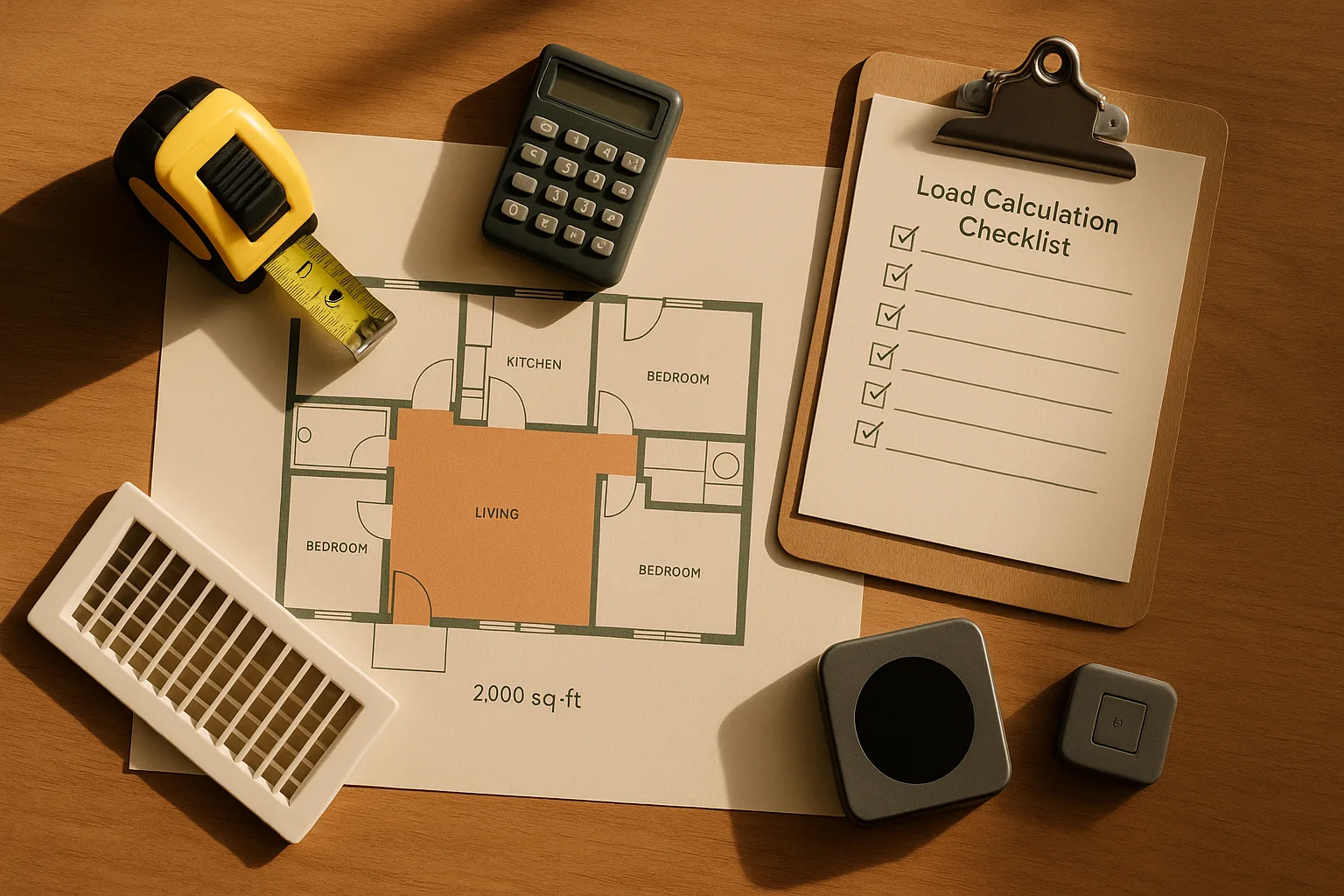
Manual J is the ACCA (Air Conditioning Contractors of America) standard calculation method that HVAC professionals use to determine exactly how much heating and cooling a specific home needs. It's not a guess — it's a structured engineering calculation that takes every meaningful variable into account.
A proper Manual J evaluation covers:
- Construction details — wall assembly, roof type, floor type, foundation
- Climate data — local design temperatures (hottest day in summer, coldest in winter) from ASHRAE tables
- Floor plan and layout — how rooms connect, where heat-generating equipment lives, how air moves through the space
- Insulation levels — R-value in attic, walls, floors, and crawlspace or basement
- Air sealing quality — how tight the building envelope is (measured in air changes per hour, or blower-door results if available)
- Window specifications — size, orientation, frame type, glazing type (single, double, low-E), and U-factor
- Ceiling height — vaulted or high ceilings dramatically increase conditioned volume
- Internal and solar heat gains — appliances, occupants, and how much sun pours through which windows
When a contractor hands you a quote based purely on square footage, ask directly: "Did you run a Manual J?" If the answer is no, you're buying a guess. Reputable installers — whether they work for Carrier, Trane, Lennox, or an independent shop — will run the calculation before recommending a size.
The house details that change size by a full ton or more
Here's a practical factor-by-factor breakdown of what pushes load up or down for a 2,000-square-foot home. These are the same inputs the Manual J software is evaluating:
Insulation R-value - Low attic insulation (R-11 or less): load goes up — often a half-ton or more on the cooling side - Modern spec (R-38 to R-60 attic): load stays lower, smaller system is adequate
Air sealing - Leaky older construction can add thousands of BTUs to both heating and cooling load because you're conditioning air that escapes constantly - A house that fails a blower-door test badly may need professional air sealing before sizing — not just a bigger heat pump
Window quality and area - Single-pane aluminum-frame windows in a warm climate can contribute as much load as poor attic insulation - Double-pane low-E windows reduce solar heat gain and conductive loss significantly - A west-facing wall of glass in Phoenix demands far more cooling capacity than the same floor area with a north-facing solid wall
Ceiling height - Standard 8-foot ceilings: baseline - Vaulted or cathedral ceilings at 12–16 feet: the conditioned volume increases significantly even though the floor area stays at 2,000 square feet — ductwork layout and air distribution become more complex too
Floor plan and layout - Open floor plans with few interior walls move air more easily and can be conditioned with less capacity - Segmented layouts with long duct runs, bonus rooms over garages, or sunrooms that are thermally isolated from the main house may need supplemental systems rather than a larger central unit
Sun exposure and orientation - South-facing home with good overhangs: manageable solar gain - West-facing home with large windows and no shade trees: meaningfully higher cooling load, pushes sizing up
How climate zone changes the right heat pump size
A 2,000-square-foot home in Savannah, Georgia, and an identical home in Minneapolis, Minnesota will need different heat pump configurations — not just different sizes, but potentially different equipment types. Climate and design temperatures are what drive the peak load, so the local weather data matters every bit as much as the floor plan.
HVAC replacement decisions absolutely must account for climate zone. An installer who doesn't ask where you live and what your local design temperatures are is not doing the job right.
Hot-humid, mixed, and cold-climate examples
Hot-humid climate (Zone 2: Houston, TX / New Orleans, LA) A well-built 2,000-square-foot home here likely lands at 3.5 to 4 tons (42,000–48,000 BTU/h). The sizing is driven by peak cooling load, not heating — summers are brutal and long. Humidity is a secondary sizing concern: an oversized unit will cool the air quickly but won't run long enough to pull moisture out, leaving the house cold and clammy. In this region, proper sizing is a comfort issue, not just an energy one.
Mixed climate (Zone 4: Charlotte, NC / Kansas City, MO) Average construction in this zone typically targets 3 to 3.5 tons (36,000–42,000 BTU/h). Heating and cooling loads are more balanced, which is where heat pumps perform best economically. A tighter, better-insulated home in this zone can often get by with a 2.5-ton unit.
Cold climate (Zone 6: Minneapolis, MN / Burlington, VT) Here sizing gets more nuanced. A heat pump in this zone might size to 2.5 to 3.5 tons for the cooling load, but the heating-season demand at design temperatures is the constraint. The key is confirming the unit's rated output at your actual design temperature and making sure the equipment selection matches the house after weatherization.
When cold-climate heat pumps and backup heat matter
Standard heat pumps lose efficiency and capacity as outdoor temperatures drop. At 0°F, a conventional unit may deliver only 50–60% of its rated heating capacity. Cold-climate models perform better at extreme temperatures, but they're not magic.
The U.S. Department of Energy's Building Science Education Center recommends a practical approach: "Apply the energy efficiency improvements to lower cooling and heating loads to allow for a smaller heat pump." In other words, weatherize first, then size. Tighter insulation and air sealing in a cold climate can meaningfully reduce the backup heat you need and may allow a smaller, less expensive heat pump to handle the full load down to lower temperatures.
In climate zones 5, 6, and 7, ask your installer whether a dual-fuel system (heat pump paired with a gas furnace that takes over below a balance point, typically around 25–35°F) makes more sense than a standalone heat pump with electric resistance backup strips.
How insulation, air sealing, and windows change heat pump capacity
The building shell — everything between the conditioned interior and the outdoor environment — determines how hard your heat pump has to work. Improve the shell, and you reduce the required capacity. Ignore the shell and just install a bigger unit, and you're paying more for equipment that runs harder to overcome preventable losses.
The right approach, especially if you're already planning an HVAC replacement or adding ductwork, is to assess the envelope first.
Insulation and air sealing: the easiest ways to lower load
The DOE Building Science Education Center puts it directly: "Apply the energy efficiency improvements to lower cooling and heating loads to allow for a smaller heat pump." This isn't just theoretical. A 2,000-square-foot home that adds R-20 of spray foam to a previously uninsulated crawlspace, and seals the attic bypasses before adding blown-in insulation to reach R-49, can realistically lower its heating load enough to move from a 4-ton requirement to 3.5 tons — saving thousands of dollars on equipment and reducing monthly energy bills for decades.
Air leakage is often the hidden culprit in oversized heat pump installs. Gaps around recessed lights, plumbing penetrations, and electrical panels let conditioned air escape constantly. The system never quite catches up, so an oversized unit gets specified to compensate. A properly air-sealed home with the same insulation values will run a correctly sized unit that cycles properly, maintains even temperatures, and dehumidifies effectively.
Before your Manual J, consider scheduling a blower-door test (usually $200–$400 from an energy auditor). The result tells both you and your installer how tight the house actually is — and that number goes directly into the load calculation.
Window quality, sun exposure, and ceiling height
Single-pane windows in a 2,000-square-foot home can have U-factors around 1.1 or higher, meaning they transfer heat nearly freely. Double-pane low-E windows typically reach U-factors of 0.25–0.30. In a hot climate, that difference can add or subtract thousands of BTUs from the cooling load, potentially shifting the required heat pump size by half a ton.
West-facing glass is the highest-risk exposure in summer. The afternoon sun at a low angle hits west-facing windows nearly head-on for hours. A home with substantial unshaded west glass in Phoenix or Dallas will have a meaningfully higher cooling load than the same home with that glass on the north or east sides.
Ceiling height matters because heat pumps condition volume, not area. A home with standard 8-foot ceilings has less conditioned volume than one with vaulted or cathedral spaces, and that extra volume can raise the required capacity. The Manual J accounts for this directly; a square-footage rule of thumb doesn't.
Why bigger is not always better with heat pumps
More capacity sounds safer — if a 3-ton might work, why not install a 4-ton and guarantee it can handle any hot day? The problem is that an oversized heat pump doesn't just waste energy. It actively makes your home less comfortable and can damage the equipment over time.
Short cycling, comfort swings, and humidity problems
An oversized heat pump hits its thermostat setpoint so quickly that it shuts off before completing a proper run cycle — a problem called short cycling. Instead of running for 10–15 minutes per cycle and moving steadily through the house, it blasts on for 4–5 minutes, satisfies the thermostat near the sensor, and shuts off — leaving the far rooms still warm or cold.
The comfort symptoms are recognizable: rooms that never quite reach an even temperature, a thermostat that reads 74°F while you feel warmer in the bedroom, and an air handler that seems to turn on and off constantly.
The humidity problem is more insidious. Heat pumps remove moisture from the air primarily during the long middle portion of a cooling cycle, when the evaporator coil has reached its coldest operating temperature and is condensing water vapor effectively. Short cycling means the coil barely chills before the system shuts off — so humidity stays high even though the air temperature drops. In a humid climate, this is the difference between a home that feels comfortable at 74°F and one that feels sticky and damp at the same reading.
Short cycling also stresses the compressor. Every startup draws a surge of electrical current and puts wear on the compressor bearings. A properly sized system that starts and runs longer will outlast an oversized unit that starts and stops hundreds of times per day.
When a smaller variable-speed system can outperform a bigger single-stage unit
A well-matched variable-speed heat pump — where the compressor modulates output from roughly 40% to 100% capacity — can outperform a larger single-stage unit on nearly every measure: comfort, humidity control, energy efficiency, and noise. Brands like Mitsubishi, Daikin, Carrier (Infinity series), and Trane (XV series) offer variable-speed compressors in their top-tier lines.
Here's the practical comparison: a correctly sized 3-ton variable-speed heat pump running at 60% capacity for long, quiet cycles will dehumidify better, maintain steadier temperatures, and use less electricity than an oversized 4-ton single-stage unit hammering on and off all day.
When a home has uneven loads — a bonus room over a garage that bakes in summer, a finished basement that stays cool, a sunroom that's essentially its own microclimate — a zoning system or multi-zone mini-split layout often beats a single central system. Ductwork can be zoned with motorized dampers, or you can use ductless heads in the problem zones and let the central system handle the main living areas. Either approach targets the actual load where it exists rather than guessing at a single central size.
How SEER2 and HSPF2 affect heat pump buying decisions
Once you know the right size, you still need to choose the right equipment within that size. That's where SEER2 and HSPF2 come in. These are efficiency ratings, not sizing tools — but they directly affect your operating costs and whether your heat pump qualifies for federal tax credits or utility rebates.
Per ENERGY STAR's heat pump specification, the SEER2 and HSPF2 ratings on split systems must match the levels reported to DOE and shown on the FTC EnergyGuide label — so the number on the yellow sticker is the number you use for comparisons and HVAC replacement incentive calculations.
SEER2 for cooling efficiency
SEER2 (Seasonal Energy Efficiency Ratio 2) measures how efficiently a heat pump cools over an entire season. The number is the ratio of total cooling output (in BTUs) to total electrical energy consumed (in watt-hours) under a standardized test that better reflects real-world conditions than the older SEER standard.
A higher SEER2 means lower electricity use per BTU of cooling delivered. The federal minimum for most split-system heat pumps is currently 14.3 SEER2 in northern states and 15.2 SEER2 in southern and southwestern states. ENERGY STAR-certified units typically start around 16 SEER2 and go up from there.
In practical terms: if you run your heat pump heavily in a warm climate and electricity costs $0.14–$0.18 per kWh (a reasonable national range), moving from a 15 SEER2 to an 18 SEER2 unit on a correctly sized 3-ton system can save $100–$200 per cooling season. Over a 15-year equipment life, that adds up — but only if the system is correctly sized in the first place.
HSPF2 for heating performance
HSPF2 (Heating Seasonal Performance Factor 2) is the heating-season counterpart to SEER2. ENERGY STAR defines it as the total space heating delivered during the heating season divided by the total electrical energy consumed, expressed in BTUs per watt-hour, referenced against ASHRAE Region IV conditions.
A higher HSPF2 means more heat delivered per dollar of electricity. For homeowners in climate zones 4–6 where the heat pump does serious winter work, HSPF2 matters more than SEER2 in terms of annual operating cost. ENERGY STAR-certified heat pumps currently require a minimum HSPF2 of 7.5 for split systems; cold-climate-rated units often exceed 9.
What to ask an installer before you approve a heat pump quote
Most HVAC replacement quotes arrive as a single number: equipment cost plus installation. What they often don't include is the documentation that proves the recommendation is correct. Ask for it explicitly before signing anything.
Load calculation, equipment model, and efficiency rating
A complete quote package for a heat pump installation should include all of the following. If an installer can't or won't provide any of these, get another bid.
Documentation checklist — require this in writing:
- Manual J load calculation report — the actual printed or PDF output from load-calculation software (ACCA-approved tools include Wrightsoft, Elite RHVAC, and Manual J by HVAC-Calc), not just the installer's handwritten estimate
- Exact equipment model number — not just "3-ton Carrier unit" but the full model string (e.g., Carrier 25VNA636A003) so you can verify the SEER2/HSPF2 yourself on the manufacturer's site or the AHRI directory at ahridirectory.org
- SEER2 and HSPF2 ratings — confirmed from the model's AHRI-certified performance data, not just from a sales brochure
- ENERGY STAR certification status — relevant if you're checking rebate eligibility through official program pages
- Manufacturer and labor warranty terms — typical heat pumps carry a 5–10 year parts warranty; labor warranty varies by installer and is often 1–2 years
- Disconnect and refrigerant handling — confirm the quote includes proper recovery of old refrigerant per EPA 608 regulations and correct handling of the refrigerant specified for the equipment
Ductwork changes, zoning, and line-set or plenum modifications
Ductwork condition is one of the most commonly overlooked line items in a heat pump quote — and one of the most expensive surprises when it's left out. An existing duct system designed for a gas furnace may not be sized correctly for a heat pump's lower supply-air temperatures and higher airflow requirements.
Ask your installer directly: "Will the existing ducts support this equipment's airflow at the rated static pressure?" A proper duct evaluation should check for:
- Duct sizing — undersized ducts reduce system efficiency and airflow to distant rooms
- Leakage — ducts in unconditioned attics or crawlspaces that leak conditioned air are essentially direct money losses; duct sealing with mastic or Aeroseal can meaningfully improve performance
- Plenum and line-set compatibility — if you're replacing a furnace-only system with a heat pump air handler, the supply and return plenum dimensions may need modification
- Zoning dampers — if you're adding zoning, motorized dampers, zone controllers, and potentially a bypass duct or variable-speed blower must all be scoped and priced
The quote should state explicitly whether duct modifications are included in the price or are a separate line item with a separate estimate. "Duct work as needed" is not a scope statement. Get the specific modifications listed.
Heat pump sizing checklist for a 2,000-square-foot home
Use this before you buy, before you sign, and before any installer leaves your house having done nothing but eyeball the old equipment and quote you a 3.5-ton system.
Use this homeowner checklist before you sign a contract
Before the installer visit:
- [ ] Start with the home's 2,000-square-foot floor area and note whether any additions, bonus rooms, or sunrooms change the conditioned space
- [ ] Locate insulation records or estimate current R-values in attic, walls, and crawlspace or basement
- [ ] Identify window types throughout the house (single-pane, double-pane, low-E, storm windows) and note which exposures have the most glass
- [ ] Measure ceiling heights room by room, especially any vaulted or two-story spaces
- [ ] Check duct condition — look for disconnected ducts, obvious gaps at joints, or flex duct that's kinked or compressed
- [ ] Note any rooms that are consistently too hot or too cold with your current system (these are red flags for duct problems that may need addressing alongside equipment replacement)
During the installer visit:
- [ ] Ask: "Will you run a Manual J before quoting a size?" If the answer is no, this is a dealbreaker
- [ ] Ask: "What are your local summer and winter design temperatures, and what software do you use for Manual J?"
- [ ] Ask: "Is the duct system sized for this equipment's airflow, and does the quote include any duct modifications?"
- [ ] Ask: "What SEER2 and HSPF2 does this model carry, and is it ENERGY STAR certified?"
Before signing:
- [ ] Confirm you have the Manual J report, exact model number, efficiency ratings, and warranty terms in writing
- [ ] Verify the model's ratings independently at the AHRI Directory
- [ ] Check official rebate and incentive eligibility through the manufacturer, utility, or government program pages
- [ ] Confirm whether duct work is included in scope and at what price
- [ ] Make sure the final quoted size matches the Manual J result rather than a square-footage guess
When to consider a multi-zone or dual-system layout
A single central heat pump serving a 2,000-square-foot home is the right answer most of the time. But there are real situations where splitting the load makes more sense than installing one large unit:
When a single system may not be the right answer:
- Severe duct limitations — if the existing ductwork can't be upgraded to serve the whole house at adequate airflow, adding ductless mini-split heads (Mitsubishi MXZ, Daikin MXS series) to problem zones can be more cost-effective than full duct replacement
- Extreme exposure differences — a home with a south-facing sunroom and a north-facing basement will have load swings that a single-zone system handles poorly; zoning or separate systems address each load directly
- Addition or ADU — a new room addition or accessory dwelling unit that can't connect to the existing duct system cleanly is a natural candidate for a dedicated ductless system rather than upsizing the central unit
- Occupancy differences — if half the house is unoccupied most of the time, a zoned system lets you condition only what you're using
Watch Out: Multi-zone mini-split systems typically cost more upfront than a single central replacement, but they eliminate duct losses entirely (which can account for 20–30% of heating and cooling energy in a home with uninsulated attic ducts). Get a side-by-side cost comparison that includes duct sealing versus ductless installation before deciding.
FAQ: heat pump size for a 2,000-square-foot house
How many BTUs do I need for a 2,000-square-foot house?
For a 2,000-square-foot home, the practical starting range is 30,000 to 48,000 BTUs per hour — equivalent to 2.5 to 4 tons. That means a 2.5-ton heat pump equals 30,000 BTU/h, and a 4-ton heat pump equals 48,000 BTU/h. That range assumes average construction and a moderate U.S. climate. A well-insulated, tightly sealed home in a mild climate may land at the low end (30,000 BTU/h); an older, leakier home in a hot-humid or very cold climate may reach the high end or beyond.
The only way to confirm the correct BTU figure for your specific home is a Manual J load calculation. Every other number you see — including this range — is an estimate.
Should I get a 3-ton or 4-ton heat pump for 2,000 square feet?
A 3-ton unit (36,000 BTU/h) is the right answer for a 2,000-square-foot home with decent insulation and double-pane windows in a mixed or moderate climate like the Carolinas, Mid-Atlantic, or Pacific Northwest. A 4-ton unit (48,000 BTU/h) becomes appropriate when the home has high ceilings, significant solar exposure, single-pane windows, poor air sealing, or sits in a hot-humid climate like the Gulf Coast or low desert Southwest.
Pro Tip: If your Manual J comes back at 38,000–40,000 BTU/h — between standard sizes — lean toward the 3.5-ton unit if it's available in the model you want, or discuss with your installer whether the 3-ton variable-speed will modulate high enough to cover peak load days. Do not automatically round up to the 4-ton.
The decision between 3 tons and 4 tons should be driven by your actual load calculation, not by a neighbor's recommendation or an installer's preference for the next size up.
Can a heat pump be too big for my house?
Yes — and it's one of the most common problems in residential HVAC. An oversized heat pump short cycles: it satisfies the thermostat so quickly that it turns off before completing a proper conditioning cycle. The result is uneven temperatures across rooms, high indoor humidity (especially in summer), more frequent compressor startups that wear equipment faster, and — paradoxically — higher energy bills than a correctly sized unit would produce.
Bigger is not safer with heat pumps. Matching capacity to the calculated load is the goal, and a Manual J is the only way to do that reliably.
Sources & References
- Burgeson's: What Size Heat Pump Do I Need for My Home? — Primary source for BTU/tonnage definitions, residential size ranges, and Manual J requirements
- U.S. DOE Building Science Education Center: HVAC Cold Climate Heat Pump Sizing — Source for the energy-efficiency-first sizing approach and quoted DOE recommendation
- ENERGY STAR: Air-Source Heat Pumps Key Product Criteria — Source for HSPF2 definition and ENERGY STAR efficiency thresholds
- ENERGY STAR: Heat Pump Version 6.2 Specification (February 2026) — Source for SEER2/HSPF2 FTC EnergyGuide label requirements
- ENERGY STAR: Essential Resources for Heat Pump Contractors — Source for installer documentation and quote requirements
- DOE BSESC: HVAC Systems — Balanced System — Source for ductwork balance and modification guidance
- ACEEE: Variable-Speed Heat Pumps and Grid Resilience (2024) — Source for variable-speed system performance and multi-zone layout benefits
Keywords: BTU, ton of cooling, Manual J load calculation, SEER2, HSPF2, short cycling, climate zone, insulation R-value, air sealing, double-pane windows, ductwork, zoning, variable-speed heat pump, ENERGY STAR