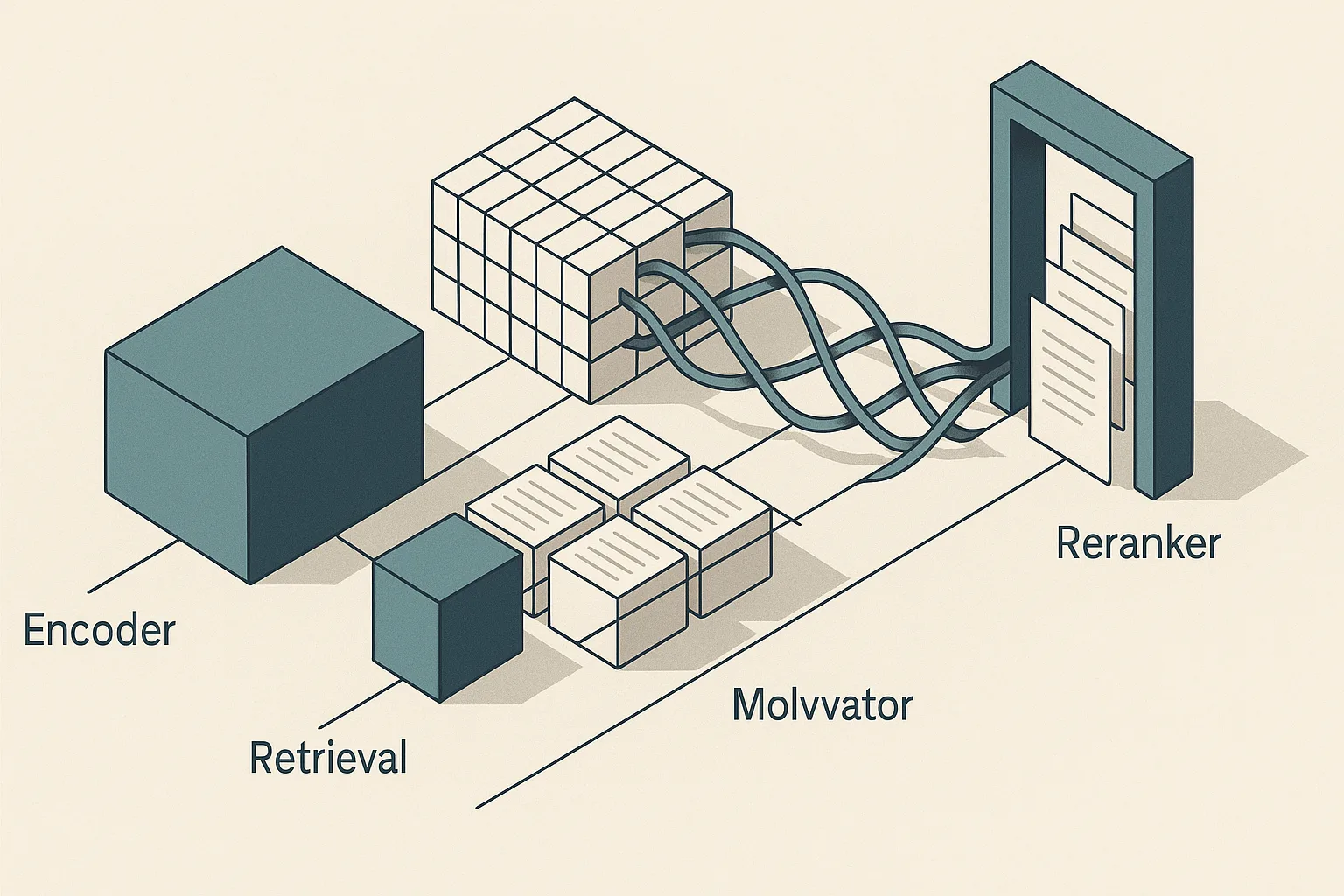
How we compared these rerankers
Three distinct options dominate reranker selection in 2026: AnswerDotAI/rerankers, a unified abstraction layer the project describes as "a lightweight, low-dependency, unified API to use all common reranking and cross-encoder models"; BAAI/bge-reranker-v2-m3, a locally deployable open-weight cross-encoder family that the Hugging Face model card calls "Lightweight reranker model, easy to deploy, with fast inference"; and Jina Reranker, a hosted API product that bills on token consumption and lets you "Try reranker API for free."
The comparison axes that actually matter for production decisions are not the ones most leaderboard screenshots capture. This article evaluates all three across five criteria: deployment model (local vs. hosted), dependency footprint, integration surface and pipeline changeability, multilingual and domain coverage, and latency/cost trade-offs.
| Criterion | AnswerDotAI rerankers | BGE Reranker (v2-m3) | Jina Reranker (v2/v3) |
|---|---|---|---|
| Deployment model | Local (wraps local + API backends) | Local (PyTorch/sentence-transformers) | Hosted API |
| Dependency footprint | Slim core; heavy deps are opt-in extras | Full transformers + PyTorch stack | HTTP client only |
| Integration surface | Single unified API, swap backends without code changes | Direct model call via sentence-transformers | REST API call |
| Multilingual coverage | Depends on selected backend | Strong (v2-m3 explicitly multilingual) | Strong (v2-base-multilingual, v3) |
| Code/domain coverage | Depends on backend family; supports cross-encoders, API rerankers, ColBERT, T5, multimodal, and layerwise LLMs | Open-weight model family for local domain tuning | Hosted model family with multilingual API coverage |
| Latency/cost trade-offs | Backend-dependent; local backends avoid per-token billing | Local serving cost only; latency depends on hardware and candidate count | Token-based billing plus network RTT |
At-a-glance comparison of the three options
For RAG pipelines in 2026, the right reranker depends on where your optimization pressure lies: integration speed, local ownership, or zero-infra launch time. If you want the lightest integration path, AnswerDotAI rerankers is the answer; if you want the strongest local model family, BGE is the default; if you want the hosted API option, Jina is the direct choice.
| Option | Best fit | Deployment | Latency profile | Cost model |
|---|---|---|---|---|
| AnswerDotAI rerankers | Platform and experimentation teams | Local (multi-backend) | Backend-dependent | Backend-dependent |
| BGE Reranker v2-m3 | Teams requiring on-prem or open-weight control | Local (GPU/CPU) | Higher at scale, predictable | Self-hosted infra only |
| Jina Reranker v2/v3 | Product teams prioritizing launch velocity | Hosted API | Low operational overhead | Per-token, scales with QPS |
AnswerDotAI rerankers wins on optionality — it is the lightest integration path because one Reranker class spans cross-encoders, FlashRank, Jina's own API, RankLLM, ColBERT, T5, and multimodal backends. BGE Reranker v2-m3 wins when you need an open-weight, auditable model with no external API dependency. Jina Reranker wins when you want to skip GPU provisioning entirely and ship in hours.
Deployment model and dependency footprint
The core rerankers package from AnswerDotAI carries a minimal dependency footprint by design. Heavy dependencies — PyTorch, Transformers, FlashRank, and others — are pulled in only when you install the matching extra: rerankers[transformers], rerankers[flashrank], rerankers[api], rerankers[rankllm], rerankers[monovlm], or rerankers[llmlayerwise].
Watch Out: An early README typo listed the FlashRank extra as
rerankers[fastrank]; GitHub issue #15 documents that the correct name isrerankers[flashrank]. Verify the current README before scripting your install.
BGE Reranker v2-m3 arrives as a standard Hugging Face checkpoint that requires the full PyTorch and sentence-transformers stack — no plugin mechanism, no slim core. That is acceptable overhead when local ownership is non-negotiable, but it means every deployment node carries those dependencies.
Jina Reranker externalizes all serving infrastructure. Your application only needs an HTTP client and an API key.
| Option | Core install | Optional extras | External runtime dependency |
|---|---|---|---|
| AnswerDotAI rerankers | Slim Python package | transformers, api, flashrank, rankllm, monovlm, llmlayerwise | None beyond chosen backend |
| BGE Reranker v2-m3 | Full PyTorch + sentence-transformers | — | GPU/CPU with enough VRAM/RAM |
| Jina Reranker | HTTP client | — | Jina API (network required) |
Latency and cost context that benchmarks rarely show
Published benchmarks report BEIR nDCG@10 — they rarely report the wall-clock cost of that quality gain. Research papers that evaluate retrieval systems jointly measure both quality and search latency, but vendor model cards and leaderboard screenshots seldom expose serving latency at realistic batch sizes or QPS targets.
The latency picture for each option follows a structural pattern rather than a single number:
| Option | Latency driver | Relative latency band | Cost model |
|---|---|---|---|
| BGE Reranker v2-m3 (local GPU) | Cross-encoder forward pass per candidate pair | Higher at large candidate sets; grows with N docs | Sunk infra cost, zero per-query variable |
| BGE Reranker v2-m3 (local CPU) | Same, but CPU-bottlenecked | Substantially higher; not suitable for latency-sensitive stacks | Same sunk infra, no GPU outlay |
| Jina Reranker API | Network RTT + hosted inference | Low operational overhead; local compute is offloaded to the API backend | Token-based; "API pricing is based on token usage — input tokens for standard APIs and output tokens for Reader API." |
| AnswerDotAI rerankers + local cross-encoder | Identical to BGE column above | Same as backend used | Backend-determined |
| AnswerDotAI rerankers + Jina API backend | Network RTT + hosted inference | Same as Jina column above | Same token-based pricing, as provided by the Jina API backend |
The BGE cross-encoder tax is structural: every query-document pair requires a full encoder forward pass. Jina's API removes that local compute from your stack but introduces network dependency and per-token cost that compounds with query volume. Neither dominates universally — the correct choice depends on your QPS ceiling, infrastructure budget, and tolerance for external dependencies.
Why AnswerDotAI rerankers is the lightest integration path
AnswerDotAI/rerankers solves one specific problem: retrieval teams need to experiment with reranking architectures without rewriting pipeline code each time they swap a backend. The library delivers a single Reranker class that dispatches to cross-encoders, FlashRank, RankLLM, ColBERT-style models, API rerankers (including Jina), T5 rerankers, and multimodal models — all through the same call interface. A release note confirming support for "BAAI's series of BGE layerwise LLM rerankers, based on Gemma and MiniCPM" illustrates how the abstraction keeps pace with SOTA model releases without requiring downstream API changes.
The README also enumerates the supported backend families explicitly: transformers, api, flashrank, rankllm, monovlm, and llmlayerwise, which is the source-backed reason one interface covers so many reranking modes.
| Backend family | Extra required | Model examples |
|---|---|---|
| Cross-encoder (transformers) | rerankers[transformers] |
BAAI/bge-reranker-v2-m3, cross-encoder/* |
| FlashRank | rerankers[flashrank] |
ms-marco-MiniLM-L-12-v2 variants |
| API rerankers | rerankers[api] |
Jina Reranker, Cohere Rerank |
| RankLLM | rerankers[rankllm] |
RankGPT, RankVicuna |
| Multimodal VLM | rerankers[monovlm] |
MonoVLM models |
| LLM layerwise | rerankers[llmlayerwise] |
BAAI BGE layerwise LLM rerankers |
Where the unified API helps retrieval teams
The unified API pays off most for platform and platform-adjacent teams who maintain a shared retrieval service used across multiple product surfaces. When quality requirements shift — say, a new domain demands ColBERT-style late interaction instead of a cross-encoder — the backend swap happens at configuration time, not in pipeline code. The library's name-based inference ("rerankers will always try to infer the model you're trying to use based on its name") accelerates prototyping, though for production deployments the official guidance recommends passing the model type explicitly to avoid misclassification.
| Scenario | Without unified API | With AnswerDotAI rerankers |
|---|---|---|
| Swap cross-encoder → FlashRank | Rewrite scoring function, update imports | Change extra install + model name |
| Add API reranker as fallback | New HTTP client code path | Pass api type at Reranker init |
| Benchmark ColBERT vs. cross-encoder | Separate codepaths, hard to A/B | Single interface, results directly comparable |
| Add multimodal reranking | New model class, new data preprocessing | monovlm extra + same rank() call |
When the extras matter more than the core package
The core package is intentionally thin — it handles routing and interface normalization but cannot score a document without a backend. Whether you need rerankers[transformers] depends on whether you serve a local model; rerankers[api] matters only if you route through Jina or another hosted endpoint; rerankers[flashrank] is the right choice when you need fast in-process CPU inference without full PyTorch overhead.
Watch Out: Some extras carry platform constraints. GitHub issue #71 documents that
flash-attn(a dependency path formonovlm) has reported issues on macOS. If you develop on macOS and deploy on Linux, test the monovlm extra in your CI environment, not just on your local machine.
| Extra | When you need it | Key dependency pulled in |
|---|---|---|
transformers |
Local cross-encoder or T5 reranker | PyTorch, HuggingFace transformers |
flashrank |
Fast in-process CPU reranking | FlashRank (no PyTorch) |
api |
Routing through Jina, Cohere, or similar | Minimal HTTP client |
rankllm |
LLM-based listwise reranking | LLM inference dependencies |
monovlm |
Multimodal (image + text) reranking | VLM inference stack; macOS caveat |
llmlayerwise |
BAAI BGE layerwise LLM rerankers | LLM inference stack |
When BGE Reranker is the safer local default
BAAI/bge-reranker-v2-m3 is the correct default for teams that need a production-grade reranker with full local ownership, no external API dependency, and auditable model weights. The model card describes it as a "Lightweight reranker model, easy to deploy, with fast inference" and explicitly recommends it, alongside BAAI/bge-reranker-v2-gemma, for multilingual retrieval scenarios. BGE is not better than Jina on every axis — it trades deployment overhead for data sovereignty and zero variable cost.
Strengths in local serving and evaluation workflows
Teams running offline evaluation harnesses — MTEB, BEIR, or domain-specific NDCG@10 sweeps — benefit from BGE's local access pattern. You control the inference environment, batch size, and hardware configuration, which means you can run the same model in evaluation and in production without latency variance from API availability. Research evaluations explicitly measure BEIR average nDCG@10 and search latency together because production-fit decisions require both dimensions.
| Evaluation requirement | OpenSearch fit | Elasticsearch fit | MTEB / BEIR / NDCG@10 fit |
|---|---|---|---|
| Reproducible offline BEIR sweep | Full control | Full control | Directly measures ranking quality |
| NDCG@10 tuning over proprietary corpus | No data egress | No data egress | Tune threshold and top-k offline |
| Post-retrieval reranking integration | Direct integration via sentence-transformers | Direct integration via sentence-transformers | Quality metric for the rescoring stage |
| CI/CD quality regression testing | No cost per run | No cost per run | Stable benchmark gate for each release |
For OpenSearch and Elasticsearch deployments, BGE integrates as a local model called within the pipeline after candidate retrieval. The sentence-transformers interface is well-supported across the Python ecosystem and connects directly to search framework plugins. Jina's API path requires an outbound HTTP call inside the search critical path, which adds a network hop and an external failure mode.
Where BGE can become the wrong answer
BGE becomes the wrong choice when your QPS target outpaces the throughput ceiling of your GPU fleet or when your operational team lacks capacity to manage model serving infrastructure. Cross-encoders process one query-document pair per forward pass — this is the source of their quality advantage (cross-encoders outperform other rerankers on semantically challenging tasks due to their fine-grained query-document interaction) and simultaneously their throughput ceiling.
| Constraint | BGE impact | When it becomes blocking |
|---|---|---|
| High QPS | Each request fans out to many forward passes across the candidate set | GPU fleet must scale horizontally; cost rises sharply |
| No GPU provisioning | CPU inference is viable but significantly slower | Latency-sensitive products will feel it |
| Small engineering team | Model serving, versioning, and monitoring owned by you | Ops overhead may outweigh cost savings vs. API |
| Rapid model iteration | New checkpoint requires re-deployment | Slows experimentation vs. API backend swap |
| Serving mode | Memory footprint | Throughput limit | Ops burden |
|---|---|---|---|
| Lower-scale local serving | Fits a single GPU or carefully sized CPU node, depending on checkpoint and batch size | Predictable for modest QPS and smaller candidate sets | Moderate; model load, health checks, and rollouts remain local |
| High-QPS local serving | Requires larger GPU memory headroom and tighter batching | Becomes constrained by candidate fan-out and encoder passes | High; scaling, monitoring, and failover are owned by your team |
When Jina-style API rerankers make more sense
Jina Reranker (currently v2-base-multilingual and v3) eliminates local serving infrastructure entirely. Reranking latency perceived by your application becomes network RTT plus hosted inference time rather than local GPU forward pass time — a structural shift that favors teams without GPU capacity or teams optimizing for time to first working system. The economic trade-off is explicit: Jina's "API pricing is based on token usage — input tokens for standard APIs and output tokens for Reader API.", and "once the free token limit is reached, users can easily purchase additional tokens".
Where hosted reranking wins on speed to production
The Jina API path reduces production readiness to three steps: obtain an API key, make an HTTP POST with your query and candidate documents, and consume the ranked results. There is no model loading, no VRAM allocation, no batching strategy to tune. Jina positions its reranker suite explicitly as part of a broader "best-in-class embeddings, rerankers, LLM-reader and prompt optimizers" platform with multilingual and multimodal coverage.
| Dimension | Jina API advantage |
|---|---|
| Time to first ranked result | Hours (API key + HTTP call), not days (GPU provisioning) |
| Multilingual support | Built into the hosted model (v2-base-multilingual, v3) |
| Infrastructure ownership | None — Jina operates the serving fleet |
| Free onboarding | Free token allocation before first purchase required |
Where API rerankers become a liability
The same token-based model that enables fast onboarding becomes a cost and reliability liability at scale. Jina's documentation explicitly states that "exceeding this limit will cause the request to fail" — hard token-per-request limits can produce silent ranking failures in production if not handled. Variable cost scaling is the other constraint: unlike sunk GPU infrastructure, every query in a high-volume system generates a direct billing event.
| Risk | Description | Mitigation |
|---|---|---|
| Vendor dependency | Reranking quality tied to Jina service availability | Circuit breaker + fallback to local model |
| Data egress | Query text and candidate documents leave your perimeter | Review DPA/data residency terms before shipping |
| Cost at scale | Per-token billing compounds with QPS × candidate count | Model cost at projected P95 QPS before committing |
| Token limit failures | Requests fail if per-request token limit exceeded | Enforce candidate document truncation client-side |
Benchmark snapshot for production-fit decisions
Top-ranking comparison pages list model names and BEIR scores. They rarely combine deployment footprint, API cost, multilingual coverage, and serving latency into a single decision surface. SciRerankBench explicitly categorizes both BGE and Jina as dense cross-encoder rerankers and confirms that "cross-encoders outperform other rerankers on semantically challenging tasks, due to their fine-grained query-document interaction" — a quality advantage that carries a throughput cost.
| Dimension | AnswerDotAI rerankers | BGE Reranker v2-m3 | Jina Reranker v2/v3 |
|---|---|---|---|
| Deployment model | Local (multi-backend wrapper) | Local (open-weight) | Hosted API |
| Latency driver | Determined by selected backend | Cross-encoder forward pass (GPU/CPU) | Network RTT + hosted inference |
| Multilingual fit | Backend-dependent | Strong (v2-m3 + v2-gemma) | Strong (v2-base-multilingual, v3) |
| Code/domain queries | Backend-dependent | Open-weight, fine-tunable | Closed model, not tunable |
| Operational complexity | Low (abstraction) + backend complexity | Medium (model serving owned by you) | Low (API client only) |
| Cost model | Backend-determined | Self-hosted infra only | Per-token, variable |
| Open weights | Backend-dependent | Yes (BAAI on Hugging Face) | No |
| Fine-tuning possible | If backend supports it | Yes | No |
What the benchmarks mean for real retrieval stacks
A leaderboard BEIR nDCG@10 number tells you how a reranker performs on a curated benchmark corpus under controlled conditions. It does not tell you what that number costs at your P95 query load, whether the model generalizes to your domain's vocabulary, or how latency degrades when you pass top-100 candidates instead of top-10.
Pro Tip: Before committing to any reranker in production, run your own offline evaluation using your actual query log and corpus against BEIR-style nDCG@10. The benchmark gap between models often compresses or inverts on domain-specific data. Pair every quality number with a serving latency measurement at your target batch size — papers and vendor pages that report only NDCG@10 without latency context are incomplete for production decision-making.
Research evaluations that measure both BEIR average nDCG@10 and search latency reflect the standard production requirement: quality and serving cost are inseparable. A reranker that improves NDCG@10 by two points but doubles your p95 response time may not be the right trade for a user-facing product.
Decision matrix: which reranker to choose for each scenario
The right reranker is not a universal answer — it is a function of your deployment constraints, team capacity, and optimization priority.
| Scenario | Recommended option | Reason |
|---|---|---|
| Lowest-friction integration with backend flexibility | AnswerDotAI rerankers | Single API, swap backends without pipeline changes |
| Strict on-prem or air-gapped deployment | BGE Reranker v2-m3 | Open weights, no external network dependency |
| Multilingual retrieval, no GPU infrastructure | Jina Reranker v2/v3 | Hosted multilingual model, API onboarding |
| RAG prototype, fastest path to ranked results | Jina Reranker | Free token tier, no infra setup |
| Offline BEIR/MTEB evaluation harness | BGE Reranker v2-m3 | Local access, no token cost per evaluation run |
| Platform team serving multiple retrieval products | AnswerDotAI rerankers | Backend swap at config layer isolates product teams from model changes |
| High QPS, want to defer infra scaling decision | Jina Reranker | No capacity planning required initially |
| Fine-tuning on domain-specific query-document pairs | BGE Reranker v2-m3 | Open weights, trainable with standard PyTorch tooling |
Choose AnswerDotAI rerankers when you need optionality
Platform teams maintaining a shared retrieval service benefit most from the unified abstraction. The library already spans BGE layerwise LLM rerankers, FlashRank, ColBERT, multimodal VLMs, and API backends — a breadth that would require separate integration code paths for each architecture without the wrapper. When your retrieval team runs regular model sweeps or when the best-performing architecture shifts between releases (as it has between cross-encoder, late-interaction, and LLM-based paradigms), AnswerDotAI rerankers absorbs that churn without forcing downstream pipeline edits.
Pro Tip: Pass the model type explicitly at
Rerankerinitialization in production. The library infers model type from name by default, but explicit type specification avoids misrouting if a model name is ambiguous between backends.
Choose BGE when control and locality matter most
The BAAI model card states plainly: "you can select the model according to your scenario and resource", with v2-m3 recommended for multilingual scenarios and v2-gemma for higher-quality multilingual use when resources allow. Open weights mean you can fine-tune on domain-specific pairs, pin a specific checkpoint for reproducibility, and run evaluation without network dependency or per-query billing.
BGE through the sentence-transformers interface integrates with OpenSearch and Elasticsearch in the post-retrieval stage — your search infrastructure fetches candidates using BM25 or dense vectors, then your Python pipeline loads BGE and resccores the candidate set. The model weights remain entirely within your perimeter.
Choose Jina-style APIs when latency to launch matters more than hosting
Jina Reranker's free trial removes the barrier to integration: add an API key, fire an HTTP request, and your reranked results return without GPU provisioning, Docker containers, or model weight downloads. For product teams validating whether reranking improves precision in their specific use case before committing to infrastructure, this is the correct starting point. The per-token cost model also means your initial evaluation is free, and cost scaling is visible and linear as you grow.
Questions engineers still ask before shipping reranking
Does reranking always beat dense-only retrieval?
No. Reranking improves precision when your first-stage retrieval returns a candidate set that is relevance-ranked imperfectly — which is true for BM25 on semantic queries and for dense retrievers on out-of-domain text. When your first-stage model already ranks the correct document at position one with high confidence, reranking adds latency without meaningful NDCG@10 gain.
Watch Out: Teams that apply reranking to already-strong candidate sets often see flat or marginally negative NDCG@10 because the reranker's scoring variance can push a correctly ranked document down. Test with and without the reranker on your actual query distribution, not just the BEIR benchmark datasets. Cross-encoders outperform other rerankers specifically on semantically challenging tasks — on well-specified factual queries, the gap often narrows.
Can I mix BM25, dense retrieval, and reranking in one pipeline?
Yes, and this is the standard production pattern for high-quality hybrid retrieval. BM25 or Elasticsearch/OpenSearch handles lexical matching at scale; a dense retriever adds semantic recall; a reranker operates as the final precision stage on the merged candidate pool.
Pro Tip: OpenSearch and Elasticsearch both support hybrid retrieval natively — BM25 scoring fused with dense vector similarity via their respective k-NN and hybrid search APIs. Position your reranker (BGE local or Jina API) as a post-retrieval rescoring step that receives the top-N merged candidates and returns a final ranked list. This keeps the search engine responsible for recall and the reranker responsible for precision — a clean architectural separation that also makes it straightforward to ablate reranking when debugging quality regressions.
Sources and references
- AnswerDotAI/rerankers — GitHub Repository README — Primary source for library architecture, extras, and unified API claims
- AnswerDotAI/rerankers — Releases page — Source for BGE layerwise LLM reranker support confirmation
- AnswerDotAI/rerankers — Issue #15 — Documents
fastrankvs.flashranktypo in README - AnswerDotAI/rerankers — Issue #71 — Documents macOS flash-attn constraint for monovlm extra
- BAAI/bge-reranker-v2-m3 — Hugging Face Model Card — Primary source for BGE deployment characteristics and multilingual guidance
- Jina AI Reranker product page — Source for hosted API positioning and free token onboarding
- Jina AI API pricing documentation — Source for token-based pricing model and free token limit mechanics
- SciRerankBench (arXiv:2508.08742) — Source for cross-encoder architecture categorization and quality-on-semantic-tasks finding
- OpenReview evaluation paper (ID: 50FRyvZAtpD) — Source for joint BEIR nDCG@10 and search latency evaluation methodology
Keywords: AnswerDotAI/rerankers, BAAI/bge-reranker-v2-m3, jina-reranker-v2-base-multilingual, jina-reranker-v3, sentence-transformers, PyTorch, FlashRank, RankLLM, ColBERT, OpenSearch, Elasticsearch, MTEB, BEIR, NDCG@10, Hugging Face