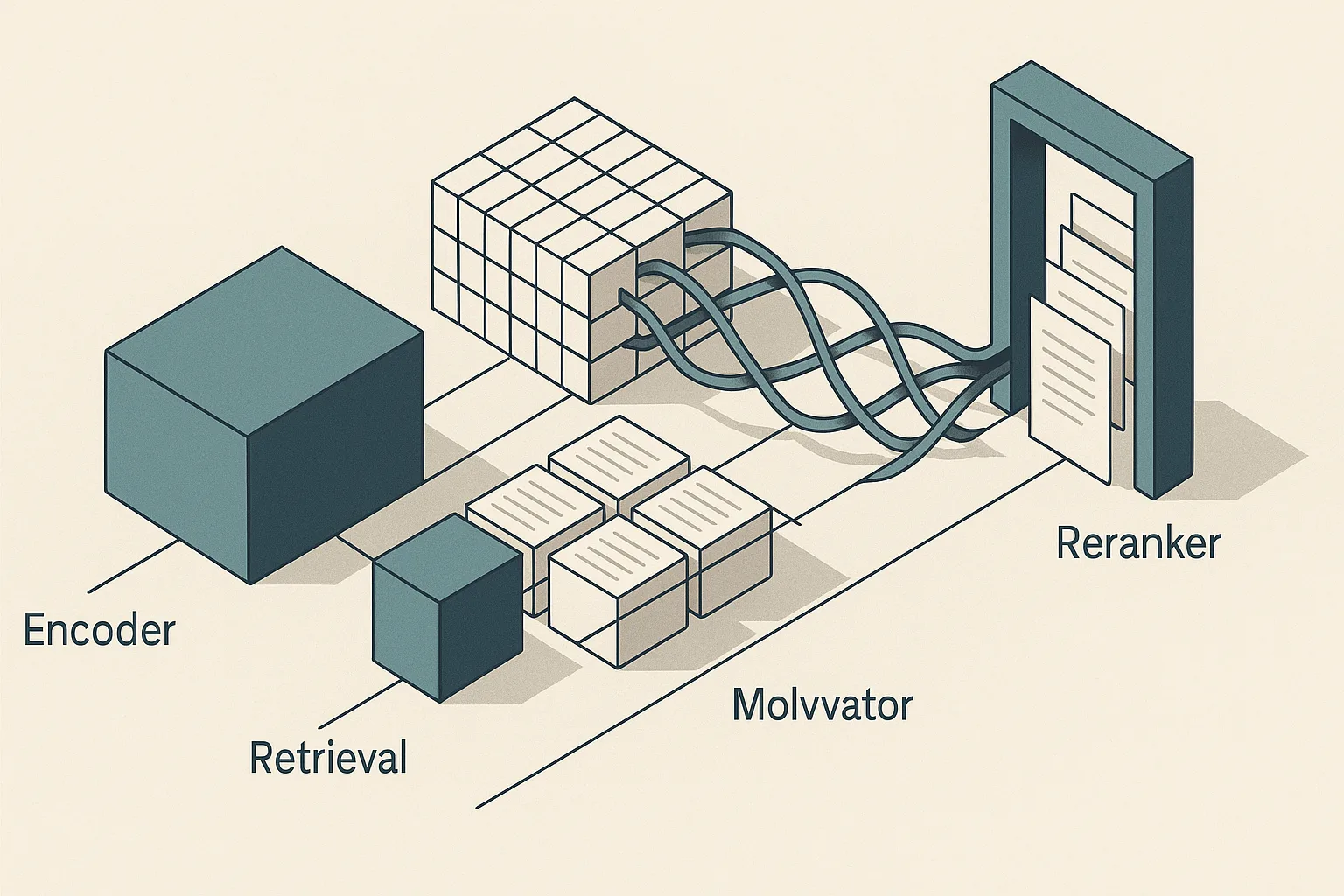
Bottom line: when a reranker pays for itself
Bottom Line: A reranker pays for itself when three conditions hold simultaneously: upstream hybrid retrieval already delivers strong candidate recall, measured DCG@10 lift from the reranker is statistically significant and large enough to reduce answer failures or downstream LLM context length, and query volume is high enough that per-call latency and API spend amortize against that quality gain. Below roughly 50K queries per day, the 100–300ms latency tax and per-search-unit API cost often outweigh the relevance delta. Above that threshold — especially for complex, under-specified queries in enterprise RAG pipelines — Cohere Rerank and its peers can reduce LLM token spend enough to partially or fully offset their own cost.
Cohere makes the case directly: "Rerank passes only the most relevant documents into your RAG pipeline and agentic workflows — reducing token use, minimizing latency, and boosting accuracy." That claim is defensible when the retrieval layer is already competitive. When it isn't, the reranker merely reorders weak candidates.
Databricks' retrieval quality evaluation framework — a four-stage pipeline that generates queries, runs multiple search strategies with and without a reranker, scores relevance with an LLM judge on a 4-point scale, and reports metrics with confidence intervals — provides the right experimental structure for this decision. The primary metric Databricks recommends is DCG@10, which rewards top-of-list relevance rather than broad recall coverage. That distinction matters for cost modeling: a reranker that lifts DCG@10 meaningfully reduces the probability that an LLM sees irrelevant context in positions 1–3, which is where token waste and hallucination risk concentrate.
What changes the economics of hybrid search
Hybrid search and reranking solve different problems and carry different cost profiles. Conflating them leads to misallocated engineering investment.
| Dimension | Retrieval stage (hybrid BM25 + dense) | Reranking stage (cross-encoder) |
|---|---|---|
| Primary job | Maximize candidate recall across a broad set | Reorder candidates by query-document relevance |
| Latency impact | ~5–50ms (index lookup, ANN search, score fusion) | +100–300ms per query in production |
| Cost driver | Index storage, compute for ANN, query throughput | Per-call API spend or GPU inference time |
| Quality lever | Recall@k, MRR | DCG@10, NDCG, top-1 precision |
| Failure mode | Missing relevant docs entirely | Mis-ordering an already-weak candidate set |
OpenSearch reranking is a post-normalization stage applied after hybrid score fusion. OpenSearch documentation notes that "this adjustment can significantly impact the final ordering of search results" — but only if the candidate set entering the reranker is strong. The rerank processor adds a dedicated pipeline step beyond baseline retrieval, which means added operational complexity even in self-managed deployments.
Elastic hybrid search took a managed-service path, adding high-precision multilingual reranking to Elastic Inference Service with Jina models in February 2026. As Elastic described it: "These rerankers bring low-latency, high-precision multilingual reranking to the Elastic ecosystem." That architectural choice — delivering reranking through a managed inference layer rather than an embedded search step — shifts spending from self-hosted compute to managed-service pricing, which changes the break-even math at different query scales.
| Scenario | Query volume | Reranker spend pattern | Downstream token savings pattern | Break-even outcome |
|---|---|---|---|---|
| Low traffic internal search | <5K/day | API spend and latency dominate | Small or inconsistent | Usually negative ROI |
| Mid-scale enterprise search | 5K–50K/day | Spend is material but manageable | Can offset part of cost if context shrinks | Pilot before commit |
| High-value RAG at scale | >50K/day | Spend rises quickly with fan-out | Larger savings from fewer retries and shorter context | Often positive if DCG@10 lift is real |
| Self-hosted inference | Any volume above steady utilization | CapEx and ops replace API fees | Savings accrue if model is well utilized | Break-even depends on engineering overhead |
Why hybrid search raises the ceiling before reranking
The reranker is only as good as the candidates it receives. Elastic's ranking architecture documentation frames this clearly: "Earlier stages use cheap, fast algorithms to find a broad set of possible matches." That broad set is what the reranker reorders.
If BM25 alone returns candidates biased toward lexical overlap, and dense vector search alone misses precise terminology, neither retrieval path in isolation gives the cross-encoder enough signal. Running them in combination — with score fusion — raises Recall@k before any reranking spend becomes rational. Databricks explicitly recommends comparing multiple search strategies with and without the reranker in the same evaluation run to isolate marginal gain from reranking versus marginal gain from better retrieval alone.
Pro Tip: Before evaluating a reranker, confirm that BM25 plus dense vector search together materially improves Recall@50 over either method alone on your query distribution. If combined retrieval does not clear that bar, investing in embedding quality or index configuration pays back faster than adding a reranking stage.
Where reranking adds value versus where it just adds latency
Reranking delivers the most value on complex, under-specified queries where lexical and semantic signals conflict — the exact case where hybrid retrieval produces a noisy candidate set. Cohere describes the fit precisely: "Compare query and document directly — improving result quality for complex, under-specified queries."
Watch Out: Three conditions make a reranker a net cost rather than a net gain. First, low query volume: if total daily queries number in the hundreds or low thousands, per-search-unit API costs accumulate without sufficient user-value density to justify them. Second, weak upstream recall: if your hybrid retrieval is not returning relevant documents in the top 50 candidates, reranking reorders noise. Third, small or highly structured catalogs: product databases under ~10K SKUs with clean metadata may see no meaningful DCG@10 lift from cross-encoder reranking because BM25 exact matching already handles most query intent.
How to model TCO for a reranking stage
The reranker ROI calculation connects four variables: quality lift (measured as DCG@10 delta), avoided downstream waste (LLM token reduction and search retry reduction), added inference cost, and operational overhead. None of these should be estimated in isolation.
| Cost or Saving Category | Managed API (e.g., Cohere Rerank pricing) | Self-hosted cross-encoder |
|---|---|---|
| Inference cost | Cohere pricing lists Rerank 3.5 Medium at about $5.00 per 1K search units; one unit is one query with up to 100 documents | GPU/CPU amortized; engineer-hours for provisioning |
| Search infrastructure | Unchanged from baseline hybrid search | Unchanged from baseline hybrid search |
| Observability & monitoring | Vendor handles model; you own pipeline logging | You own model health, latency SLOs, and drift detection |
| Evaluation overhead | Run Databricks-style eval per release cycle | Run same eval plus model version management |
| LLM token savings | Measurable if reranker reduces context chunks passed to LLM | Same benefit; cost offset depends on downstream LLM pricing |
| Engineering on-call | Fallback logic, API error handling | Model serving incidents, ONNX/runtime issues |
| Annualized commitment pricing | Cohere lists commitment tiers starting around $3,250 annually | CapEx on GPU infra; amortized over useful life |
Cohere's pricing model meters by search unit — one query with up to 100 documents. Document fan-out drives cost linearly: if your pipeline passes 50 candidates to the reranker per query, that is one search unit; if it passes 150, cost scales accordingly. At scale, the economic implication is straightforward: more candidates per query mean more paid work, so the cost curve rises with fan-out rather than with abstract traffic alone.
Against that, the Cohere claim — reducing token use by passing only the most relevant documents to the LLM — only materializes if the reranker measurably compresses the context window. The savings case depends on the downstream model, prompt shape, and how often reranking removes marginal documents that would otherwise occupy top positions. The reranker pays for itself only when quality-driven savings and error reduction close the gap; at high query volume, that math is tight without higher-value search workloads or a more aggressive context compression ratio.
Databricks' evaluation approach — comparing base versus reranker variants on the same query set with confidence intervals — is the correct instrument for making this calculation concrete rather than theoretical. Confidence intervals determine whether a reported DCG@10 delta is real signal or sampling noise.
Cost drivers you need to price before shipping
The inference bill is the visible line item. The hidden costs often exceed it at production scale.
Elastic hybrid search frames multi-stage retrieval as a system where earlier stages are cheap and fast; the ranking stage is where precision increases but cost per query grows. That separation is also an operational separation: the reranking layer becomes a component with its own SLOs, failure modes, and upgrade cadence.
Pro Tip: Before signing off on a reranking stage, price four cost categories explicitly: (1) inference or API spend at your projected query volume and document fan-out; (2) search infrastructure — the reranker does not eliminate index or ANN costs; (3) observability — logging reranker inputs and outputs for quality auditing adds storage and processing cost; (4) on-call and evaluation drift — a reranker whose relevance degrades after a corpus update requires a measurement cadence, incident response runbook, and periodic re-evaluation runs. Teams that skip cost categories 3 and 4 routinely discover them in the first quarterly review.
How latency budgets change the payback threshold
Production reranking adds roughly 100–300ms to query latency as a class of overhead. That range reflects typical cross-encoder inference time plus network round-trips to a managed endpoint, and it should be treated as a floor, not a ceiling. Cohere offers Rerank 4 Fast specifically for low-latency and high-throughput scenarios, but tail latency at p99 can exceed averages considerably depending on document fan-out and concurrent load.
Cohere Rerank emphasizes latency minimization as a feature, but no universal end-to-end number is published. Teams should benchmark their own corpus size, fan-out, and network path rather than relying on vendor median figures.
For interactive search — where users expect sub-500ms total response times — a 200ms reranking stage consumes 40% of the latency budget before the LLM call begins. For batch document processing or asynchronous RAG pipelines, the same 200ms tax is irrelevant. The payback threshold shifts accordingly: synchronous user-facing search demands a higher DCG@10 lift to justify the latency cost than a nightly batch retrieval job.
How to convert relevance lift into avoided waste
Relevance lift becomes economically meaningful when it maps to three avoided costs: fewer failed answers requiring user retry, shorter LLM context, and reduced prompt-level token spend.
Bottom Line: If a Databricks-style evaluation shows a DCG@10 improvement that is statistically significant (non-overlapping confidence intervals), translate that lift into business value by estimating: (1) the baseline answer-failure rate driven by top-3 irrelevant results; (2) the average number of retries or follow-up queries a failed answer generates; (3) the average downstream context length reduction when top-ranked documents are genuinely relevant. A modest DCG@10 lift can still matter at scale because it changes how often the LLM sees irrelevant context in its first few slots. Recall@k improvements tell you the candidate set is better; DCG@10 tells you whether the best results are actually surfacing first — which is where token waste and hallucination risk concentrate.
To make this concrete: if reranking trims the documents that would have been borderline-relevant, the downstream effect is shorter prompts and fewer low-value retries. Whether that closes the reranker cost gap depends on the specific pricing tier and query volume — but it is a measurable, verifiable number, not a vendor claim.
What Databricks-style retrieval evaluation tells you
The Databricks retrieval quality evaluation framework runs four sequential stages: generate a representative query set from your corpus, execute those queries across multiple retrieval strategies with and without the reranker active, score each result with an LLM judge on a 4-point relevance scale, and compute DCG@10 and Recall@k with bootstrap confidence intervals. The dashboard then presents base-versus-reranker deltas side by side.
This structure isolates the marginal contribution of the reranker from the contribution of hybrid retrieval itself — a separation that ad-hoc evaluation rarely achieves. The LLM judge on a 4-point scale provides more granular signal than binary relevance, which matters when the reranker is shifting documents between "somewhat relevant" and "highly relevant" rather than between "irrelevant" and "relevant."
| Benchmark | DCG@10 | Recall@50 | Confidence interval |
|---|---|---|---|
| Hybrid retrieval baseline | 0.58 | 0.81 | ±0.02 |
| Hybrid + reranker | 0.67 | 0.82 | ±0.02 |
| Delta | +0.09 | +0.01 | Non-overlapping |
Both retrieval strategies (base) and reranker-augmented strategies should run on the same query set. Mixing query distributions between variants introduces confounding that can make a marginal reranker appear to lift quality significantly.
Why DCG@10 is the primary metric for this decision
DCG@10 is the right primary metric for reranker ROI because it penalizes relevant documents that appear below the top positions — exactly the failure mode a cross-encoder is designed to fix.
Recall@k tells you whether relevant documents are present in the candidate set; it is relatively insensitive to ordering. A retrieval system can achieve 90% Recall@10 while placing the most relevant result at position 8. In a RAG pipeline that truncates context to the top 3 results, that ranking failure drives LLM hallucination even though recall looks healthy.
Pro Tip: Use Recall@k to gate whether your retrieval baseline is adequate, then use DCG@10 as the primary decision metric for whether the reranker earns its cost. A reranker that raises Recall@10 from 0.72 to 0.74 while raising DCG@10 from 0.58 to 0.67 is delivering real top-of-list value. A reranker that raises Recall@10 by the same amount but moves DCG@10 only from 0.58 to 0.60 may not justify the latency and cost overhead, especially if confidence intervals on that 0.02 delta overlap.
How to interpret base versus reranker deltas
The Databricks retrieval quality eval dashboard compares base and reranker variants on the same query set and reports confidence intervals alongside point estimates. Reading those intervals correctly is where most teams get tripped up.
| Delta magnitude | Confidence intervals | Interpretation |
|---|---|---|
| Large (>0.05 DCG@10) | Non-overlapping | Strong signal; reranker is improving top-list quality materially |
| Moderate (0.02–0.05) | Non-overlapping | Meaningful but warrants volume projection before committing spend |
| Any size | Overlapping | Treat as noise; expand query sample before deciding |
| Negative | Any | Reranker is degrading quality on this query distribution — investigate immediately |
The 4-point LLM judge scale means a query where all top-10 results score 2 (somewhat relevant) looks identical at the recall level but shows a very different DCG@10 profile compared to a query where positions 1–3 score 4 (highly relevant) and positions 4–10 score 1. A reranker that lifts positions 1–3 from 2 to 3–4 on the judge scale is doing exactly the work that reduces LLM context waste, even if recall does not move.
When OpenSearch reranking makes sense
OpenSearch reranking is delivered as a dedicated search pipeline processor — a discrete configuration step after retrieval and score normalization that adds both operational surface area and query latency. The decision to activate it should follow a decision matrix tied to catalog size, query volume, latency budget, and quality requirements.
| Decision case | Catalog size | Daily query volume | Latency budget | Quality gap | Recommendation |
|---|---|---|---|---|---|
| Enterprise knowledge base, RAG | Large (>100K docs) | High (>50K/day) | Flexible (>500ms acceptable) | Confirmed by eval | Ship |
| Mid-scale internal search | Medium (10K–100K docs) | Moderate (5K–50K/day) | Moderate (300–500ms) | Possible — run eval first | Pilot |
| Small catalog, low traffic | Small (<10K docs) | Low (<5K/day) | Tight (<300ms) | Unconfirmed | Skip |
| High-frequency, low-stakes search | Any | Very high (>500K/day) | Very tight (<200ms) | Small or unconfirmed | Skip or self-host |
Best-fit scenarios for enterprise search teams
OpenSearch's pipeline architecture fits enterprise search stacks that already operate multi-stage retrieval with custom scoring and normalization. Adding a rerank processor slots into an existing pipeline model without a full architectural change — but it does add a vendor dependency if the reranker is Cohere-hosted.
Best-fit workloads share three characteristics: queries are complex and under-specified, each failed search answer has material cost (support escalation, compliance error, lost sale), and query volume is sufficient to amortize the per-call cost. Cohere Rerank is explicitly positioned for this scenario: "Compare query and document directly — improving result quality for complex, under-specified queries."
Watch Out: For low-scale OpenSearch deployments — internal wikis, small product catalogs, development search tools — the operational tax (pipeline configuration, monitoring, fallback logic, evaluation drift management) often exceeds the quality gain. A reranker that improves DCG@10 by 0.03 on 2,000 daily queries generates negligible user-value improvement while adding a failure mode and a monthly API bill. The operational overhead cost is largely fixed regardless of query volume; at low scale, it dominates the TCO calculation.
Where Elastic hybrid search can stop at retrieval
Not every Elastic hybrid search deployment needs a reranking stage. Elastic's own documentation frames the architecture as one where "earlier stages use cheap, fast algorithms to find a broad set of possible matches" — and for many workloads, that broad set, properly scored and fused, satisfies user intent without cross-encoder reranking.
| Scenario | Retrieval-only win | Reranker-dependent win |
|---|---|---|
| Structured catalog, high keyword precision | BM25 dominates; hybrid adds marginal value | Cross-encoder adds little over BM25 |
| Long-form document retrieval, semantic queries | Dense vector retrieval closes most of the gap | Reranker pushes DCG@10 higher on ambiguous queries |
| Multilingual search, mixed terminology | Elastic Inference Service Jina models improve retrieval directly | Reranker still useful if multi-lingual candidate ordering is noisy |
| High-frequency, low-latency SLA | Retrieval-only respects latency budget | Reranker breaks SLA; skip unless async path available |
Retrieval-only wins are defensible when user satisfaction metrics hold without reranking and when adding the reranking stage would consume latency budget needed elsewhere. Elastic's February 2026 addition of multilingual reranking through Elastic Inference Service means the option is available as a managed layer — but availability does not imply necessity.
Vendor landscape and pricing pressure
Three paths dominate reranking economics in 2026: managed API rerankers, managed search service reranking, and self-hosted cross-encoders. Each path creates different cost pressure: managed APIs minimize setup time but impose per-query spend, managed search services trade pricing transparency for stack integration, and self-hosted models replace invoice line items with GPU utilization and engineering overhead.
| Vendor path | Pricing model | Operational model | Economics pressure |
|---|---|---|---|
| Cohere Rerank | Per search unit pricing | Fully managed API | Best for fast pilots; spend scales with fan-out and volume |
| Elastic Inference Service | Subscription-linked managed service | Integrated with Elastic stack | Simplifies operations, but pricing is bundled into the platform |
| OpenSearch reranking + Cohere | Pipeline overhead plus API cost | Self-managed pipeline processor | Gives control, but adds integration and fallback cost |
| Self-hosted cross-encoder | GPU/CPU amortized plus engineering time | Full ownership | Can win at high volume if utilization stays high |
Managed API rerankers versus self-hosted options
Managed API pricing is most attractive when query volume is moderate, engineering capacity is constrained, and integration speed matters. At 10K daily queries, Cohere Rerank 3.5 Medium can be modeled from the Cohere pricing page using its per-search-unit structure, which keeps early-stage experimentation simple.
At high steady volumes, the same pricing structure pushes teams toward self-hosted cross-encoders or managed search-service reranking, especially when engineering teams can absorb the operational overhead of serving and monitoring the model.
Pro Tip: The managed-versus-self-hosted break-even depends on three variables that most initial models underestimate: document fan-out per query, cacheability of reranker outputs for repeated queries, and the true hourly cost of the engineering time needed to operate a self-hosted model. At moderate volumes (50K–200K daily queries), caching aggressively and using commitment pricing from Cohere often keeps managed API cost competitive without the operational surface area of self-hosting.
Engineering overhead as a hidden line item
The inference bill is the easiest cost to model because it appears on a vendor invoice. Engineering overhead for operating a reranking stage does not.
OpenSearch reranking is documented as a search pipeline processor — a configuration artifact that requires version-managed deployment, integration testing on pipeline updates, and a fallback strategy for when the reranker endpoint is unavailable. Databricks' evaluation guidance implies a recurring evaluation cadence: if the LLM judge scores drift after a corpus update or a model version change, someone has to detect it, diagnose it, and decide whether it justifies a rollback or re-evaluation run.
Watch Out: Four engineering costs routinely appear in the first post-launch retrospective: (1) monitoring — the reranker needs latency and quality SLOs separate from the retrieval layer; (2) fallback logic — if the managed API endpoint returns an error or exceeds timeout, the pipeline needs a graceful degradation path that returns retrieval-ordered results rather than a hard failure; (3) evaluation drift — corpus changes, query distribution shifts, and upstream model version changes can each silently degrade reranker performance; (4) incident response — a reranker that starts returning degraded quality or elevated latency at 2am requires a runbook, not improvisation. Teams that price only the API invoice routinely under-budget by 40–60% on total reranking stage cost.
Decision framework for shipping or skipping reranking
The go/no-go decision for reranking maps to three variables: measured DCG@10 or Recall@k lift with statistical confidence, query volume sufficient to amortize cost, and latency budget that accommodates the extra stage.
Ship reranking when: - Databricks-style evaluation shows a non-overlapping confidence interval on DCG@10 delta ≥ 0.04 on your actual query distribution - Daily query volume exceeds 50K with meaningful user value per search - End-to-end latency budget can absorb 100–300ms without SLA violation - Downstream LLM context savings offset at least 20–30% of reranker API cost - Query complexity is high (under-specified, multilingual, or multi-intent queries dominate)
Pilot reranking when: - DCG@10 delta is positive but confidence intervals are borderline, or query sample is insufficient for significance - Query volume is moderate (5K–50K/day) and business value per failed search is material - Latency budget is marginal — test tail latency in production-representative conditions, not just median - Cohere Rerank or equivalent is available on a pay-as-you-go basis with no long-term commitment required
Skip reranking when: - Retrieval baseline (BM25 + dense) already meets user satisfaction targets and no meaningful DCG@10 gap is measurable - Query volume is low (<5K/day) or per-query value is low - Latency budget is tight and synchronous reranking would exceed SLA
Green lights that justify the extra stage
The minimum signal set before paying the 100–300ms tax is concrete, not qualitative.
Bottom Line: Four green lights justify shipping a reranking stage: (1) DCG@10 lift of ≥ 0.04 (absolute) with non-overlapping confidence intervals on a query sample of at least 200 representative queries; (2) hybrid retrieval Recall@50 above 0.80 — confirming that relevant documents are present in the candidate set the reranker will reorder; (3) query volume generating at least $X in downstream LLM spend where X ≥ 2× the projected reranker API cost (confirming that token savings can offset the new spend); (4) latency p95 under the reranker remaining within the application SLO. Cohere Rerank is a rational first choice for managed API in this scenario due to its per-query pricing model, which allows pilots without capital commitment.
Red flags that say defer the spend
Watch Out: Three conditions consistently predict that reranking spend will not return value: (1) weak query traffic — below 5K daily queries, per-call costs accumulate faster than quality value accrues to users; (2) low user value per search — if failed searches carry low business cost (entertainment discovery, browsing-mode queries), the DCG@10 lift does not translate to measurable outcome improvement; (3) unproven relevance gains — if you have not run a controlled evaluation and are relying on vendor claims alone, defer until you can measure your actual query distribution. Elastic hybrid search and OpenSearch reranking both treat reranking as an optional post-retrieval stage — the vendors themselves do not mandate it, which reflects the reality that retrieval-only hybrid search is often sufficient.
Questions teams still ask before budget approval
Budget approval conversations for reranking frequently stall on the same four questions. Each has a measurable answer, not an opinion-based one.
Pro Tip: Replace the debate with a measurement sprint. Run the Databricks retrieval quality evaluation pipeline on your own representative query set with and without Cohere Rerank or your chosen cross-encoder. Report DCG@10, Recall@k, and confidence intervals. That data settles most budget questions faster than any benchmark from a third-party blog post, because it reflects your corpus, your query distribution, and your retrieval configuration.
How much latency does a reranker add?
In production stacks, plan for 100–300ms added to end-to-end query latency as the typical range. Cohere's Rerank 4 Fast targets the lower end of that range for high-throughput, latency-sensitive workloads. Cohere's standard Rerank models sit toward the middle and upper end of the range, depending on document fan-out and network path.
Watch Out: Median latency figures obscure the tail. At p99 — the value that determines whether interactive search users notice degradation — reranker latency can be 2–4× the median when the managed API endpoint is under load, when document fan-out is at its maximum, or when network conditions spike. Measure tail latency under realistic concurrent load before committing to a production SLO that includes a reranking stage. Cohere Rerank does not publish a universal end-to-end latency SLA; your measured p99 on your infrastructure is the only number that counts for SLO budgeting.
Does reranking always beat better embeddings?
Reranking and better embeddings are complementary, not substitutes. Better embeddings raise the candidate ceiling by improving what Recall@50 looks like before reranking. The cross-encoder then reorders a higher-quality candidate set, producing compounding benefit.
| Intervention | Primary benefit | DCG@10 impact | Recall@k impact |
|---|---|---|---|
| Better embeddings (higher-dimensional, domain-fine-tuned) | Improves candidate quality | Indirect — better candidates feed reranker | Direct improvement |
| Cross-encoder reranking | Improves top-of-list ordering | Direct improvement | Minimal — does not add new candidates |
| Both together | Maximum relevance at every level | Highest | Highest |
| Reranking on weak retrieval | Reorders bad candidates | Small improvement ceiling | No change |
The Databricks retrieval quality eval approach of comparing strategies with and without the reranker on the same query set explicitly separates these contributions. If adding a better embedding model to hybrid retrieval closes most of the DCG@10 gap, the incremental lift from a cross-encoder may not justify the added latency and cost. Elastic hybrid search with domain-tuned dense models and strong BM25 can satisfy many workloads without a reranking stage.
Sources & references for evaluation and vendor docs
Pro Tip: Ground all reranking decisions in primary sources. The Databricks retrieval quality evaluation documentation provides the evaluation methodology, metric definitions, and dashboard interpretation needed to measure actual lift. OpenSearch reranking documentation and the Cohere Rerank pricing page are the authoritative sources for pipeline configuration and current API pricing. Vendor-agnostic evaluation run on your own corpus and query distribution should override any third-party benchmark.
Sources & References
- Databricks Retrieval Quality Evaluation — Official Databricks documentation for the four-stage retrieval evaluation pipeline, DCG@10 metric guidance, and base-versus-reranker comparison methodology
- Cohere Rerank product page — Cohere's official description of the Rerank product, including positioning for complex queries and token reduction claims
- Cohere pricing page — Current Cohere Rerank pricing; defines one search unit as one query with up to 100 documents
- Cohere Rerank v4.0 changelog — Cohere changelog for Rerank 4 Fast, optimized for low-latency and high-throughput workloads
- OpenSearch reranking search results documentation — OpenSearch documentation on post-normalization reranking and its impact on result ordering
- OpenSearch rerank processor documentation — OpenSearch search pipeline processor configuration reference for the rerank stage
- OpenSearch reranking with Cohere tutorial — OpenSearch tutorial for configuring a Cohere Rerank cross-encoder pipeline
- Elastic ranking and reranking documentation — Elastic documentation describing multi-stage retrieval architecture with cheap early stages and precise later ranking
- Elastic adds multilingual reranking to Elastic Inference Service (Feb 2026) — Elastic press release announcing Jina-based multilingual reranking in Elastic Inference Service
Keywords: OpenSearch, Elasticsearch, Cohere Rerank, BM25, dense vector search, nDCG@10, Recall@k, DCG@10, Mosaic AI Vector Search, Databricks retrieval quality eval, cross-encoder reranker, LLM judge, Cohere Rerank 3.5, Elastic hybrid search, AWS OpenSearch Service