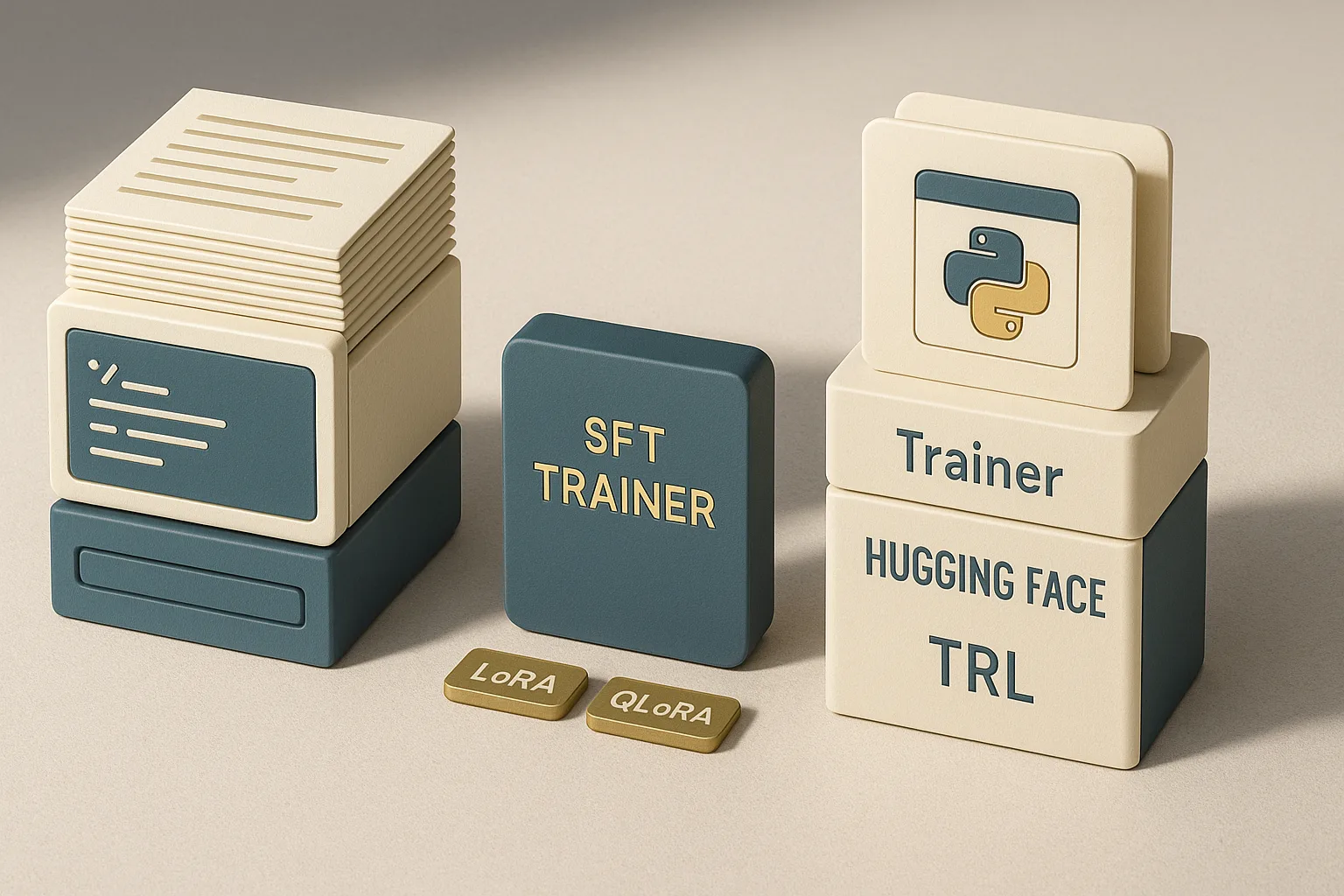
How we compared LLaMA Factory and TRL
If your decision is specifically about SFT, the split is simple: choose LLaMA Factory when you want a broader orchestration layer around instruction tuning, and choose TRL when you want a library-first SFT workflow inside Hugging Face with direct Python control. The comparison criteria below drive every recommendation in this article. Rather than listing features, the analysis maps each stack to workflow depth, tuning-method coverage, dataset handling, orchestration burden, and deployment path — the five dimensions that determine which tool fits your pipeline.
ComparisonTable
| Criterion | LLaMA Factory | Hugging Face TRL |
|---|---|---|
| Workflow depth | Turnkey: CLI, Web UI, YAML configs | Library: Python API, trainer classes |
| Tuning-method coverage | SFT, RM, PPO, DPO, KTO, ORPO, LoRA, QLoRA | SFT, DPO, GRPO, PPO, Reward Modeling |
| Dataset handling | Unified format converters + UI preview | Conversational and prompt-completion via SFTTrainer |
| Orchestration burden | Low (framework absorbs most config) | Higher (engineer owns config and glue code) |
| Deployment path | OpenAI-style API, vLLM worker, SGLang worker | Not included — training only |
| Hugging Face-native fit | Good (uses HF Hub, PEFT, transformers) | Native — same codebase and release cadence |
| Model coverage | 100+ advertised (LLaMA, Qwen3, DeepSeek, Gemma, Phi…) | Any HF-compatible model (no curated list) |
LLaMA Factory describes itself as a way to "easily fine-tune 100+ large language models with zero-code CLI and Web UI", positioning it as a broad orchestration layer above the training loop. Hugging Face TRL takes a different contract: "TRL is a full stack library where we provide a set of tools to train transformer language models with methods like Supervised Fine-Tuning (SFT), Group Relative Policy Optimization (GRPO), Direct Preference Optimization (DPO), Reward Modeling, and more." TRL hands you composable Python classes; LLaMA Factory hands you a configured system. No official head-to-head benchmark comparing time-to-first-run or cost-per-token exists in either project's public documentation, so the comparison stays structural.
QLoRA is available in both stacks. In LLaMA Factory it is a first-class option selectable from the CLI or Web UI without custom code. In TRL, QLoRA requires composing PEFT's LoraConfig with BitsAndBytesConfig yourself before passing the model to SFTTrainer.
At-a-glance comparison for instruction tuning teams
LLaMA Factory is the default pick for fast iteration across multiple models or tuning modes. A team that wants to run SFT on Qwen2.5-VL on Monday and DPO on DeepSeek-V3 on Wednesday, without writing orchestration glue each time, gets more from LLaMA Factory's unified surface than from assembling the equivalent in TRL.
TRL is the default pick for Hugging Face-native teams. If the training loop already lives inside transformers and Trainer, adding TRL is one import; adding LLaMA Factory is a new dependency layer with its own config schema, dataset format conventions, and release cadence to track.
The trade-off on orchestration burden is direct: LLaMA Factory absorbs it upfront, which accelerates setup but obscures what the framework is doing on your behalf. TRL exposes it, which slows initial setup but keeps every behavior inspectable.
Bottom Line: Choose LLaMA Factory as the fast-iteration default when you want orchestration included, broad model coverage, and preference-tuning breadth; choose TRL as the Hugging Face-native default when you want direct Python control and minimal abstraction. The trade-off is straightforward: LLaMA Factory lowers orchestration burden by absorbing setup, while TRL keeps the training loop more explicit and reviewable.
What each stack optimizes for
LLaMA Factory optimizes for breadth and setup speed. The repository wiki enumerates supported families including LLaMA, LLaVA, Mistral, Mixtral-MoE, Qwen3, Qwen3-VL, DeepSeek, Gemma 3, GLM, and Phi, alongside the full method menu. TRL optimizes for precision and composability within the Hugging Face ecosystem, with the SFTTrainer explicitly supporting "both language modeling and prompt-completion datasets" and automatic chat-template handling via the tokenizer.
ComparisonTable
| Fit dimension | LLaMA Factory | Hugging Face TRL |
|---|---|---|
| Zero-code setup | ✓ Web UI + CLI | ✗ Python required |
| Library-first customization | Partial (YAML + Python hooks) | ✓ Full Python control |
| Broad model coverage | ✓ 100+ curated | Depends on HF Hub availability |
| Minimal moving parts | ✗ Larger dependency surface | ✓ Single library install |
| Preference-tuning breadth | ✓ DPO, KTO, ORPO, PPO | ✓ DPO, GRPO, PPO |
Which reader profile each stack serves best
DecisionMatrix
| Reader profile | Recommended stack | Rationale |
|---|---|---|
| Solo engineer, new to fine-tuning | LLaMA Factory | Web UI and CLI surface removes boilerplate; faster time to first trained checkpoint |
| HF-native ML engineer | TRL | Same ecosystem, same release cadence; no new abstraction to learn |
| Applied researcher comparing alignment methods | Either, or both | TRL for clean DPO/GRPO baselines; LLaMA Factory for KTO/ORPO without extra code |
| ML engineer debugging chat templates | TRL | Direct tokenizer access; no framework indirection hiding template application |
| Multi-model lab (production fine-tuning pipeline) | LLaMA Factory | Unified YAML config across model families reduces per-model engineering |
| Team with strict code-review requirements | TRL | Smaller diff surface; every training behavior is in Python |
LLaMA Factory for broad, low-friction tuning workflows
LLaMA Factory supports QLoRA natively — yes, it is a first-class method selectable from the Web UI or CLI with a single flag, not a manual PEFT composition. For teams choosing between built-in support and manual wiring, the practical implication is simple: LLaMA Factory reduces setup friction when you need to turn on QLoRA, whereas TRL leaves that composition to the engineer. The repository wiki lists the complete method surface: "Integrated methods: (Continuous) pre-training, (multimodal) supervised fine-tuning, reward modeling, PPO, DPO, KTO, ORPO, etc." LoRA and QLoRA are both enumerated alongside full fine-tuning as adapter strategy options.
| Method / Feature | LLaMA Factory | Notes |
|---|---|---|
| Supervised Fine-Tuning (SFT) | ✓ | CLI, Web UI, YAML |
| Reward Modeling (RL) | ✓ | Integrated |
| PPO | ✓ | Integrated |
| DPO | ✓ | Integrated |
| KTO | ✓ | Integrated |
| ORPO | ✓ | Integrated |
| LoRA | ✓ | Selectable adapter |
| QLoRA | ✓ | Selectable adapter + quantization config |
| Zero-code UI/CLI | ✓ | llamafactory-cli train config.yaml |
| Web UI | ✓ | Gradio-based |
| Multimodal (VLM) | ✓ | Qwen2.5-VL, LLaVA, Qwen3-VL |
No official benchmark in the public documentation quantifies QLoRA memory savings specifically inside LLaMA Factory compared with TRL's PEFT composition path. What the repository does provide is a unified interface that eliminates the manual wiring between BitsAndBytesConfig, LoraConfig, and SFTTrainer that TRL requires.
Where LLaMA Factory reduces orchestration work
LLaMA Factory's orchestration reduction is concrete: the README enumerates deployment paths directly: "Faster inference: OpenAI-style API, Gradio UI and CLI with vLLM worker or SGLang worker." This means the pipeline from training to a served endpoint — training, exporting, serving — stays inside one framework's config surface. SGLang describes itself as a "high-performance serving framework for large language and multimodal models," and LLaMA Factory wraps it as a drop-in worker option alongside vLLM.
| Orchestration dimension | LLaMA Factory |
|---|---|
| UI/CLI for training | Web UI (Gradio) + CLI |
| Model family coverage | LLaMA, Qwen3, Qwen2.5-VL, DeepSeek, Gemma 3, Phi, GLM, Mistral, and others |
| Training method breadth | SFT, RM, PPO, DPO, KTO, ORPO |
| Adapter strategies | Full fine-tuning, LoRA, QLoRA |
| Post-training inference | OpenAI-style API, vLLM worker, SGLang worker |
The orchestration saving is real for teams that would otherwise write separate glue scripts for each of these steps. For teams that already have that glue and trust it, the saving is less compelling.
When LLaMA Factory is the safer default
LLaMA Factory is the safer default when the project scope spans multiple model families, multiple tuning methods, or both. A team iterating from SFT on Gemma 3 to preference-tuned DeepSeek-V3 does not want to re-implement dataset adapters, reward modeling pipelines, and deployment wiring for each model change.
DecisionMatrix
| Condition | LLaMA Factory | vLLM/SGLang dependency |
|---|---|---|
| Need KTO or ORPO (not in TRL) | ✓ Choose LLaMA Factory | Deployment via vLLM or SGLang worker |
| Serving trained model via OpenAI API | ✓ Built-in | vLLM or SGLang worker |
| 3+ model families in the same project | ✓ Unified config | Same deployment path |
| Non-engineer stakeholders need to trigger runs | ✓ Web UI | N/A |
| Multimodal SFT (VLMs) | ✓ Qwen2.5-VL, Qwen3-VL | Same deployment path |
The claim that LLaMA Factory is universally better than TRL is not supported by independent evidence. The selection remains conditional on the workflow and governance constraints your team operates under.
Where LLaMA Factory can be overkill
LLaMA Factory's breadth creates a proportionally larger abstraction surface. For a team running SFT on a single model family with a stable dataset pipeline, the framework introduces more abstraction than it removes work.
Watch Out: LLaMA Factory's abstraction layer can silently mask dataset and template bugs. When a dataset is malformed, the framework's conversion pipeline may apply a silent fix — or a silent wrong fix — that affects loss without producing a visible error. Template application for a model family not in LLaMA Factory's primary test matrix may also behave differently from what the base model's tokenizer applies by default. The repository also carries active development churn: config key names, dataset format specs, and supported model flags change between minor versions. Pin your version and diff the changelog before upgrading during an active training run.
Teams that want every training behavior to be explicit Python — reviewable, diffable, and unit-testable — will find TRL's surface easier to reason about despite the higher setup cost.
Hugging Face TRL for library-first instruction tuning
TRL is used for instruction tuning and alignment workflows inside the Hugging Face ecosystem: supervised fine-tuning, reward modeling, direct preference optimization, and reinforcement learning from human feedback via PPO or GRPO. The official documentation states: "TRL is a full stack library where we provide a set of tools to train transformer language models with methods like Supervised Fine-Tuning (SFT), Group Relative Policy Optimization (GRPO), Direct Preference Optimization (DPO), Reward Modeling, and more."
| Method | TRL support | Notes |
|---|---|---|
| SFT | ✓ SFTTrainer |
Conversational + prompt-completion datasets |
| DPO | ✓ DPOTrainer |
Paired preference data |
| PPO | ✓ PPOTrainer |
RLHF loop |
| GRPO | ✓ GRPOTrainer |
Group Relative Policy Optimization |
| Reward Modeling | ✓ RewardTrainer |
Bradley-Terry preference model |
| KTO | ✓ KTOTrainer |
As of recent releases |
| Deployment | ✗ Not included | Training library only |
Unlike LLaMA Factory, TRL does not advertise a supported model count because it operates as a training library rather than a model hub — any model accessible via transformers and the Hugging Face Hub is a valid target.
Why TRL fits teams already living in Transformers
ComparisonTable
TRL's import surface is narrow. A team already using AutoModelForCausalLM, AutoTokenizer, Trainer, and PEFT adds SFTTrainer or DPOTrainer as an incremental change, not a platform adoption. Every config option maps to a documented Python class; every training behavior traces back to Python code in the same release you pinned.
| Fit dimension | TRL |
|---|---|
| Installation surface | Single pip install trl on top of transformers |
| Python control | Full — all config via TrainingArguments and trainer kwargs |
| Hugging Face ecosystem fit | Native — same versioning, Hub integration, accelerate backend |
| Chat-template handling | Automatic via tokenizer's apply_chat_template |
| Code review surface | Small — trainers are thin wrappers over Trainer |
| Deployment | Not included; hand off to vllm, text-generation-inference, or other serving stack |
How TRL handles SFT datasets and chat templates
TRL's SFTTrainer explicitly handles two dataset formats. The SFT documentation states: "SFT supports both language modeling and prompt-completion datasets. The SFTTrainer is compatible with both standard and conversational dataset formats."
In conversational format, the dataset contains a messages column with a list of role-content dicts. SFTTrainer calls the tokenizer's apply_chat_template on each example, producing token IDs with the correct special tokens for that model family. In prompt-completion format, the dataset provides separate prompt and completion columns; the trainer concatenates and masks the prompt tokens from the loss.
| Dataset type | TRL handling | Chat-template involvement |
|---|---|---|
Conversational (messages column) |
apply_chat_template via tokenizer |
Template applied per model family |
| Prompt-completion (separate columns) | Direct concatenation + masking | No template applied unless explicitly configured |
| Language modeling (raw text) | Standard causal LM loss | No template |
| Tool-call / function-calling turns | Requires manual template verification | Model-family-specific; no automatic normalization |
The critical point: TRL delegates template application to the tokenizer's apply_chat_template method, which means template correctness depends entirely on whether the tokenizer packaged with your model checkpoint has an accurate Jinja2 template. LLaMA Factory handles this at the framework level for its curated model list, which can be an advantage or a risk depending on whether your model is in that list.
Where TRL is the leaner choice
DecisionMatrix
TRL suits the workflow where the engineer owns every degree of freedom in the training loop and wants the smallest possible abstraction between their dataset and the loss function.
| Decision factor | Choose TRL when... | Avoid TRL when... |
|---|---|---|
| Abstraction level | You want lower abstraction and direct tokenizer/model control | You need a framework that hides setup and orchestration |
| Code review | You want every training behavior visible in Python diffs | You prefer UI-driven or config-heavy workflows |
| Hidden behaviors | You need fewer framework-side transformations | You are comfortable with more automation in exchange for speed |
| Orchestration | You can own the glue code | Setup time is the bottleneck |
Choose TRL when:
- The model is already in transformers and the team has an existing Trainer-based pipeline
- Chat-template debugging is a primary concern — no framework layer between tokenizer and training signal
- The project uses DPO, GRPO, or standard SFT and does not need KTO, ORPO, or reward modeling in a single unified UI
- Code review standards require full Python traceability of every training parameter
- Deployment is handled by a separate team or separate stack
Choose TRL cautiously when: - You need KTO or ORPO — TRL has added these methods, but LLaMA Factory's integrated menu is broader - You need multimodal SFT across multiple VLM families — TRL is usable but requires more manual wiring than LLaMA Factory's VLM-aware pipeline
Instruction-tuning benchmarks and workflow trade-offs
No official benchmark in either project's retrieved public documentation reports a head-to-head time-to-first-run, throughput, or cost-per-token comparison between LLaMA Factory and TRL. Any comparison that produces a specific number for these metrics is either from an unpublished third-party experiment or fabricated. The evidence the sources do provide is structural: model coverage, method coverage, and deployment options.
BenchmarkTable
| Metric | LLaMA Factory | Hugging Face TRL |
|---|---|---|
| Advertised model coverage | 100+ LLMs/VLMs | Any HF-compatible model |
| Advertised tuning methods | SFT, RM, PPO, DPO, KTO, ORPO | SFT, DPO, GRPO, PPO, Reward Modeling |
| Inference worker options | vLLM, SGLang, OpenAI-style API | None (training only) |
| QLoRA support | ✓ First-class | ✓ Via PEFT composition |
| UI/CLI | Web UI (Gradio) + CLI | Python API only |
| Zero-code entry | ✓ | ✗ |
These indicators measure scope and interface — they are the proxies available before a team runs its own benchmark on its own hardware and dataset.
What to compare instead of raw feature counts
Feature counts favor the framework with the bigger README. The practical comparison measures operator burden, template handling fidelity, and deployment path integration.
| Comparison dimension | LLaMA Factory | Hugging Face TRL |
|---|---|---|
| Template handling | Framework-managed per curated model list | Tokenizer-native apply_chat_template |
| Deployment path | OpenAI API, vLLM, SGLang — built-in | Not included; external stack required |
| Operator burden (new model) | Low if model is in curated list; higher otherwise | Consistent across all HF-compatible models |
| Operator burden (new method) | Low — YAML flag | Medium — new trainer class and config |
| Debugging transparency | Lower — more abstraction layers | Higher — Python traceable |
| Multi-stage pipeline (SFT → RM → PPO) | Single framework, unified config | Separate trainer classes, same ecosystem |
What benchmark numbers actually matter for instruction tuning
Because no public benchmark compares the two stacks on throughput or latency, teams should instrument their own runs on the target model and dataset. The repo-level indicators that do exist — LLaMA Factory's 100+ model coverage and vLLM/SGLang inference workers, TRL's SFT/DPO/GRPO/PPO/Reward Modeling method coverage — determine setup cost, not runtime performance.
BenchmarkTable
| Observable | LLaMA Factory | Hugging Face TRL |
|---|---|---|
| Supported model count (advertised) | 100+ | Unrestricted (HF Hub) |
| Inference worker options post-training | vLLM, SGLang | None built-in |
| Preference-tuning methods | DPO, KTO, ORPO, PPO | DPO, GRPO, PPO |
| Quantization-aware training (QLoRA) | ✓ | ✓ via PEFT |
| Multimodal fine-tuning | ✓ Qwen2.5-VL, Qwen3-VL | Model-dependent |
Decision matrix for choosing the right stack
DecisionMatrix
| Team shape | Recommended stack | Key reason | QLoRA path |
|---|---|---|---|
| Solo engineer, fast iteration | LLaMA Factory | Web UI removes setup time; zero config boilerplate | Built-in flag |
| HF-native team (Transformers + PEFT) | TRL | Same ecosystem, minimum new surface | Manual PEFT composition |
| Multi-model lab | LLaMA Factory | Unified YAML across Qwen3, DeepSeek-V3, Gemma 3, Phi | Built-in flag |
| Preference-tuning project (DPO/KTO/ORPO) | LLaMA Factory | KTO and ORPO in single framework; DPO also available in TRL | Built-in flag |
| Alignment research (DPO/GRPO baselines) | TRL | Direct trainer access; cleaner ablation code | Manual PEFT |
| Team with strict code review | TRL | Full Python traceability; smaller diff surface | Manual PEFT |
Choose LLaMA Factory when you need orchestration out of the box
Choose LLaMA Factory when: - The project spans multiple model families (Qwen3, DeepSeek-V3, Gemma 3, Phi) and re-implementing dataset adapters per model would consume engineering time - The training pipeline requires preference-tuning beyond DPO — KTO or ORPO specifically - Non-engineers need to trigger or monitor training runs (Web UI) - The team wants a single framework for training and serving, with vLLM or SGLang as the inference backend
Avoid LLaMA Factory if: - The model is not in the curated list and chat-template accuracy is critical — the framework's template handling for that model may diverge from the tokenizer's native behavior - The team needs to diff and review every training behavior in Python - The project is simple enough that the framework's abstraction adds more confusion than it removes — a single-model SFT run with a stable dataset does not need an orchestration layer
Choose TRL when you want maximum control inside Hugging Face
TRL is the right tool when the training loop is itself a product: something the team audits, extends, and tests as first-class code. Its documented scope — SFT, DPO, GRPO, PPO, Reward Modeling — covers the standard alignment pipeline completely.
Choose TRL when:
- The entire ML stack is already Hugging Face — transformers, accelerate, datasets, PEFT
- Chat-template debugging is a primary activity; direct tokenizer access is non-negotiable
- The project runs standard SFT or DPO and does not need KTO, ORPO, or a training UI
- The team ships the training code as a reproducible artifact that others will audit
Avoid TRL if: - The project demands multimodal SFT across several VLM families and LLaMA Factory already supports them - Setup time is the bottleneck and no one on the team wants to own the orchestration glue
A practical default for 2026
Bottom Line: For most new instruction-tuning projects in 2026, start with LLaMA Factory if team size is small and method breadth is high; start with TRL if the team is already Hugging Face-native and the training loop needs to be auditable Python. Neither choice is permanent — both frameworks use HF Hub models and PEFT adapters, so migrating checkpoints between them is straightforward if the first choice proves wrong.
Common chat-template and dataset footguns
Chat-template bugs are the category of error most likely to produce a model that trains to low loss but generates broken outputs. The TRL SFTTrainer supports both conversational and prompt-completion datasets, which means the dataset format you choose determines whether the tokenizer's apply_chat_template runs at all.
Watch Out: The most common failure mode is using prompt-completion format when you intended conversational format. In prompt-completion mode, TRL does not call
apply_chat_template— the model trains on raw text without role markers, special tokens, or the EOS/EOT tokens the base model expects. The resulting model generates fluent text but ignores turn structure at inference time. Verify the format your dataset is in before training, not after evaluating outputs.
Chat-template mismatches that change training signals
Each model family ships its own Jinja2 chat template inside the tokenizer. Qwen3, DeepSeek-V3, Gemma 3, and LLaMA-family models all use different special token names, different role identifiers, and different end-of-turn signals. Using the wrong template trains the model on a systematically wrong token sequence — the loss can still converge, but the model will not follow the target template at inference time.
Watch Out: Two specific failure modes to check before every training run: (1) Assistant-only loss masking —
SFTTrainersupports masking prompt tokens from the loss, but this behavior depends on the dataset format and thedataset_text_fieldconfiguration. If masking is not applied, the model trains to predict user turns, which degrades instruction-following. Verify withtokenizer.decode(batch["labels"][0])that only assistant turns are unmasked. (2) Template version drift — model maintainers update the Jinja2 template in the tokenizer between checkpoint releases. If you pin the model weights but not the tokenizer revision, apip install transformers --upgradecan silently change the template applied during training. Pin tokenizer revision explicitly in production training runs.
Dataset construction choices that favor one stack over the other
| Dataset construction | TRL behavior | LLaMA Factory behavior |
|---|---|---|
Multi-turn conversational (messages column) |
apply_chat_template via tokenizer; correct for all HF-native models |
Framework applies template from curated model config; verify for non-curated models |
| Prompt-completion pairs | Direct concatenation; no template applied | Converts to internal format; template handling depends on model config |
| Tool-call / function-calling turns | No automatic normalization; requires model-specific template verification | Supported for curated VLMs; manual verification required for others |
| Sharegpt-format datasets | Supported via format converter | Native supported format with UI-based preview |
| Alpaca-format datasets | Supported via format converter | Native supported format |
For tool-use templates, neither stack offers automatic normalization across model families. TRL gives you direct access to the tokenizer's Jinja2 template so you can inspect and override it. LLaMA Factory abstracts this, which means a misconfigured tool-call template may fail silently. For any model family where tool-call formatting is load-bearing, run a dataset sanity check that decodes a batch of training examples and verifies the rendered tokens before launching a full training run.
FAQ
Is LLaMA Factory better than TRL?
Neither stack is universally better. LLaMA Factory is broader and lower friction to set up; TRL gives tighter control inside the Hugging Face ecosystem. The answer is conditional:
| Condition | Better choice |
|---|---|
| Fast setup, multiple models, preference-tuning breadth | LLaMA Factory |
| HF-native Python pipeline, chat-template debugging | TRL |
| Deployment (vLLM / SGLang) included in the framework | LLaMA Factory |
| Strict code review, minimal abstraction surface | TRL |
| KTO or ORPO required | LLaMA Factory |
| GRPO required | TRL (native) or LLaMA Factory |
No independent benchmark establishes one as globally superior; the correct answer depends on team workflow, governance requirements, and orchestration preferences.
What is Hugging Face TRL used for?
TRL is a Hugging Face library for training transformer language models with alignment methods. Its documented scope covers SFT, DPO, GRPO, PPO, and Reward Modeling. It does not include model serving — TRL is training only.
| TRL capability | Trainer class |
|---|---|
| Supervised fine-tuning | SFTTrainer |
| Direct Preference Optimization | DPOTrainer |
| Group Relative Policy Optimization | GRPOTrainer |
| Proximal Policy Optimization | PPOTrainer |
| Reward Modeling | RewardTrainer |
Does LLaMA Factory support QLoRA?
Yes. LLaMA Factory lists QLoRA as a first-class supported method alongside LoRA and full fine-tuning. It is selectable from the Web UI or CLI without writing any PEFT configuration code.
| Stack | QLoRA support | How to enable |
|---|---|---|
| LLaMA Factory | ✓ Native | CLI flag or Web UI selection |
| Hugging Face TRL | ✓ Via PEFT | Manual LoraConfig + BitsAndBytesConfig composition before passing to SFTTrainer |
No official benchmark in either project's public documentation quantifies the memory savings or throughput difference between the two QLoRA paths on the same hardware.
Sources and references
- LLaMA Factory GitHub Repository — Primary source for method coverage, model support, CLI/Web UI capabilities, and deployment paths (OpenAI-style API, vLLM worker, SGLang worker)
- LLaMA Factory Wiki: Performance Comparison / Datasets — Source for enumerated tuning methods (SFT, RM, PPO, DPO, KTO, ORPO) and supported model families
- Hugging Face TRL Documentation — Primary source for TRL method coverage, library scope, and ecosystem positioning
- Hugging Face TRL SFT Trainer Documentation — Source for dataset format support (conversational, prompt-completion) and chat-template handling behavior
- SGLang Documentation — Source for SGLang's description as a high-performance serving framework for large language and multimodal models
Keywords: LLaMA Factory, Hugging Face TRL, QLoRA, LoRA, SFT Trainer, DPO, PPO, KTO, ORPO, Qwen2.5-VL, DeepSeek-V3, Gemma 3, vLLM, SGLang, Hugging Face chat templates