What changed in 4-bit fine-tuning since QLoRA
The original QLoRA paper (Dettmers et al., arXiv:2305.14314) established the core insight that 4-bit quantization could compress a base model far enough to fit on a single GPU while LoRA adapters preserved training quality. That framing dominated practice for over a year. The problem it left unsolved was initialization: when you quantize a model's weights to NF4, you introduce a non-trivial quantization error, and naively initializing LoRA adapter matrices to zero or random noise ignores that error entirely. The adapters then spend early training compensating for a gap that a better initialization could have closed before the first gradient step.
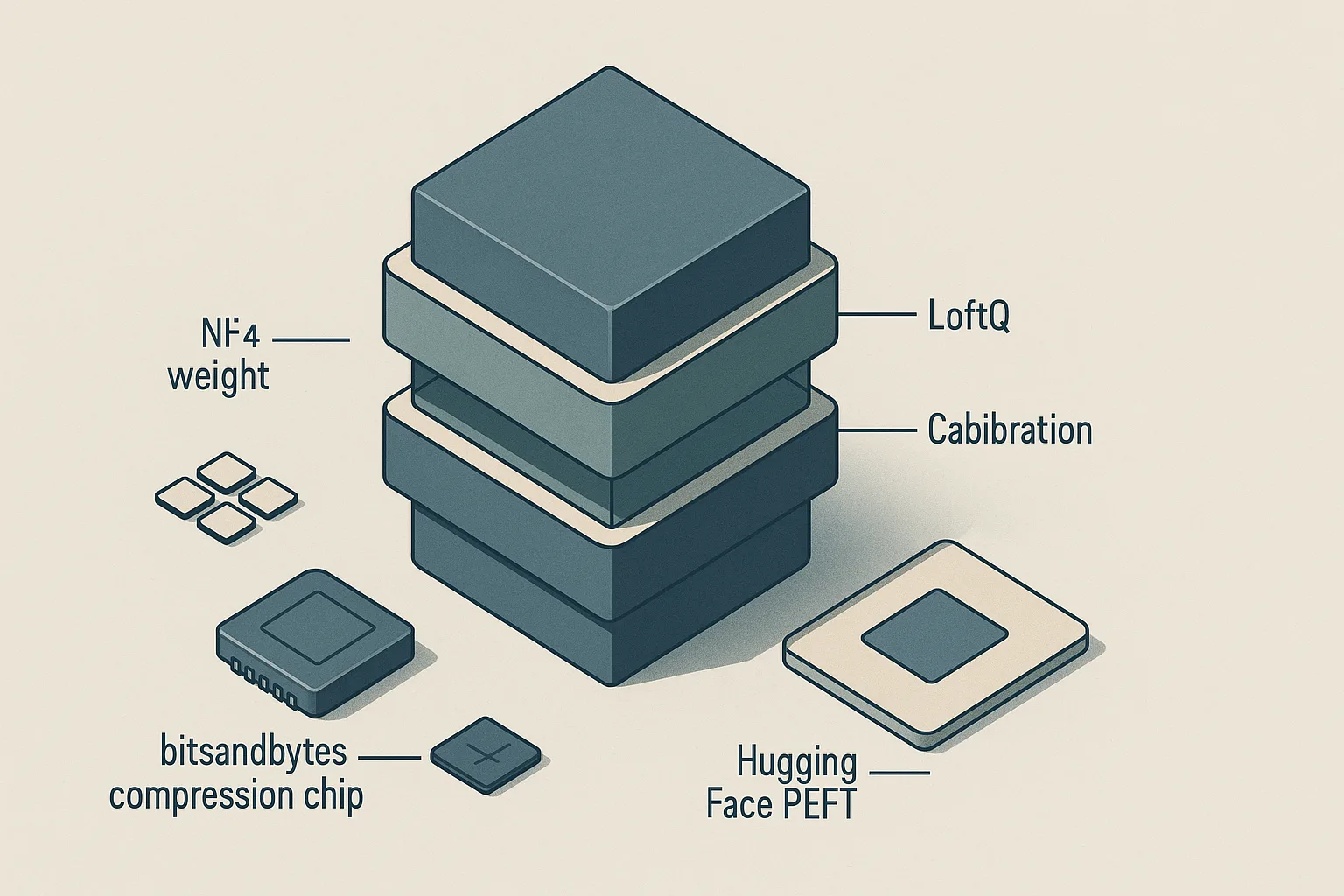
LoftQ (arXiv:2310.08659) addresses exactly this gap, and Hugging Face PEFT now treats LoftQ initialization as the recommended upgrade path for quantized fine-tuning. In the PEFT quantization guide, LoftQ is described as a way to initialize LoRA weights so quantization error is minimized, while the LoRA package reference exposes the setting directly through init_lora_weights="loftq".
Bottom Line: QLoRA established that 4-bit + LoRA makes single-GPU fine-tuning of large models feasible. LoftQ, as documented in PEFT, upgrades that baseline by initializing adapter weights to minimize quantization error rather than ignoring it. In the same PEFT docs, broader linear-layer targeting is recommended when using LoftQ, especially
target_modules="all-linear"in the v0.13.0 LoRA guide. LoftQ is an initialization technique within the PEFT/LoRA workflow, not a separate training stack.
How the PEFT LoRA guide reframes LoftQ
Hugging Face PEFT's quantization documentation now explicitly positions LoftQ as a first-class initialization strategy rather than an experimental add-on: "LoftQ initializes LoRA weights such that the quantization error is minimized, and it can improve performance when training quantized models." The LoRA package reference exposes this through a single argument — init_lora_weights="loftq" — alongside the older "gaussian" and default initialization path, making adoption a config-level change.
PEFT also ships replace_lora_weights_loftq, a convenience function in the PEFT package reference that replaces adapter weights post-initialization in one step. That function exists alongside the primary init_lora_weights path but carries hard constraints detailed below.
The table below summarizes how the documented PEFT surfaces compare at the API level:
| Dimension | Plain QLoRA (default init) | LoftQ (init_lora_weights="loftq") |
|---|---|---|
| PEFT config key | init_lora_weights=True (default) |
init_lora_weights="loftq" |
| Purpose | Standard LoRA initialization | Quantization-error-aware LoRA initialization |
| Requires bitsandbytes 4-bit | Yes | Yes |
| Requires safetensors model | No | Yes (for replace_lora_weights_loftq) |
| Recommended layer coverage | Narrow modules are common | target_modules="all-linear" |
| Additional complexity | Minimal | Low–medium (format constraints) |
LoftQ as quantization-error-aware initialization
LoftQ does not change what quantization format the base model uses. It changes what the adapter matrices look like at step zero. As the LoftQ paper defines it: "We propose LoftQ (LoRA-Fine-Tuning-aware Quantization), a novel quantization framework that simultaneously quantizes an LLM and finds a proper low-rank initialization for LoRA fine-tuning." Microsoft Research's summary frames the mechanism as: "LoftQ's strength lies in its ability to combine quantization and adaptive initialization during fine-tuning."
The practical consequence: a standard QLoRA run initializes LoRA A and B matrices independently of the quantization error introduced to the frozen base weights. LoftQ instead computes an initialization for A and B such that W_quantized + AB approximates W_full_precision as closely as the chosen rank allows. That tighter starting point means the adapter begins training closer to the full-precision model's behavior, which tends to matter most in low-data regimes or on tasks where the quantization error is relatively large compared with the fine-tuning signal.
LoftQ does not eliminate the need for a quantized base model, downstream training data, or sufficient adapter rank. It is an initialization decision that executes once before training begins.
Pro Tip: If your QLoRA runs plateau early or show a noticeable initial loss spike compared with a full-precision LoRA baseline, the gap is often quantization-error-related. Switching to
init_lora_weights="loftq"in yourLoraConfigis the lowest-friction first experiment before adjusting rank, alpha, or learning rate.
Why NF4 remains the recommended 4-bit quantization type
NF4 (Normal Float 4) is the 4-bit datatype that QLoRA's original design optimized around, and Hugging Face's bitsandbytes documentation continues to reference it as the operative datatype in QLoRA-style workflows. NF4 is information-theoretically optimal for weights drawn from a normal distribution, which matches the empirical distribution of most pretrained LLM weights closely enough to outperform standard INT4 on downstream task quality.
The LoftQ initialization path in PEFT assumes the base model is already quantized — and the official documentation surface is written around NF4 via bitsandbytes. The guidance in the PEFT quantization docs and bitsandbytes quantization docs remains centered on NF4 for general use.
Watch Out: PEFT's guidance is written for NF4, and LoftQ's error minimization at initialization works against the quantization error introduced by that setup. If you substitute a different 4-bit format without validating on your specific model family, you are outside the documented baseline.
What replace_lora_weights_loftq actually does
replace_lora_weights_loftq is a convenience function in the PEFT package reference, not the primary LoftQ API surface. It takes a model that has already been loaded with bitsandbytes 4-bit quantization and swaps in LoftQ-initialized weights for the LoRA adapter matrices in one call. Its appeal is a clean single-step path for scripts that load a pre-quantized model first and then apply PEFT on top.
The constraints are hard, not advisory. PEFT's LoRA guide mirror states explicitly: "At the moment, replace_lora_weights_loftq has these additional limitations: Model files must be stored as a safetensors file. Only bitsandbytes 4bit quantization is supported." If the model is in a .bin format or you are using a different quantization backend, this function will not work.
For most new models — Llama 3.1, Mistral-7B, and other recent Hugging Face releases — safetensors is now the default upload format, so the file constraint is rarely a blocker in practice. But legacy model weights or custom-converted checkpoints may still arrive as .bin, and that will require conversion before this path is usable.
Pro Tip: For new model checkpoints that ship as safetensors and use bitsandbytes 4-bit loading,
replace_lora_weights_loftqis the fastest way to bolt LoftQ initialization onto an existing QLoRA script with minimal refactoring. For everything else, setinit_lora_weights="loftq"inLoraConfigat construction time — that path has no file-format constraint.
Why target all linear layers when using LoftQ
The PEFT LoRA guide (v0.13.0) gives a direct recommendation: LoftQ "recommends targeting as many layers as possible, commonly with target_modules='all-linear'." This is a deliberate shift from the typical QLoRA practice of targeting only q_proj and v_proj — the attention query and value projections — which was the default recipe most tutorials carried forward from the original QLoRA paper.
The rationale is mechanistic. LoftQ's value comes from placing adapter matrices at every quantized linear layer so that initialization can compensate for the quantization error at each of those sites. If you restrict adapters to two modules per transformer block, the remaining quantized layers — k_proj, o_proj, and all MLP projections — accumulate quantization error with no initialization correction. The adapters at the targeted layers cannot compensate for error at layers where no adapter exists.
| Targeting strategy | Layers covered per block (typical decoder) | LoftQ compensation scope | Trainable params |
|---|---|---|---|
q_proj, v_proj only |
2 of ~7 linear layers | Partial — attention only | Lower |
q_proj, k_proj, v_proj, o_proj |
4 of ~7 linear layers | Partial — full attention | Medium |
all-linear |
7 of 7 linear layers | Full — attention + MLP | Higher |
The broader targeting recommendation is about coverage, not a claim that more parameters are always free. Adapter weights remain full precision, and expanding the set of targeted layers increases the optimizer-state burden even when the base model stays in NF4. If your VRAM budget is tight, the guidance is to manage that cost explicitly rather than assume broader coverage is costless.
What changes when adapters cover more layers
Broader linear-layer targeting changes both what LoftQ can compensate and what the adapters can express during training. With all-linear, every quantized linear projection has an initialization specifically computed to close its individual quantization error gap. The adapters then train from a starting point that is collectively closer to the full-precision model across the entire forward pass.
The downstream quality effect is most visible on tasks that require coherent reasoning through MLP layers — code generation, structured output, logical inference — rather than purely surface-level style matching. Style adaptation tasks that surface primarily in attention patterns may show smaller gains from full-layer coverage.
Watch Out: Broader targeting increases trainable parameter count and can modestly increase memory consumption from optimizer states, which are maintained in full precision even when the base model is in NF4. On a 24GB GPU with a 7B model,
all-linearwith AdamW will require more VRAM for optimizer state thanq_proj+v_projtargeting. If you are already near the VRAM ceiling, use paged optimizers or switch to 8-bit AdamW before expanding target modules — do not treatall-linearas a free win on severely constrained hardware.
When explicit module lists still make sense
target_modules="all-linear" works correctly for standard decoder-only transformer architectures (Llama, Mistral, Falcon, Phi series). It uses PEFT's internal model inspection to find all nn.Linear modules in the model and applies LoRA adapters uniformly. For most current open-weight models this is the right default.
Explicit module lists remain appropriate in two cases. First, nonstandard architectures that use custom linear implementations, mixture-of-experts routing layers, or embedding projections that should not carry full fine-tuning signal may behave unexpectedly when covered by all-linear. Second, when memory or latency constraints force a hard cap on trainable parameter count, a hand-picked list gives you deterministic control over which layers carry adapters.
Pro Tip: Before finalizing your
target_moduleslist on a new architecture, callprint(model)after loading and trace thenn.Linearnames manually. PEFT'sall-linearpath respects the same naming convention, so the output also shows you exactly which layersall-linearwould target — useful for verifying that no unexpected layers (embedding layers, LM head) are being included.
What the original QLoRA paper optimized for
QLoRA's primary engineering goal was memory reduction sufficient for single-GPU fine-tuning of models that previously required multi-GPU full fine-tuning setups. The paper's canonical benchmark is direct: "We present QLoRA, an efficient finetuning approach that reduces memory usage enough to finetune a 65B parameter model on a single 48GB GPU while preserving full 16-bit finetuning task performance." (arXiv:2305.14314) The method achieves this through NF4 quantization for the frozen base weights, double quantization of quantization constants, and paged optimizers to handle memory spikes, as described in the paper and summarized in the bitsandbytes documentation.
Quantization here is purely a memory reduction tool applied to the frozen base model. The trainable LoRA adapters remain in full precision throughout training. The gradient path flows through the quantized forward pass to the full-precision adapters, which means training quality is bounded by both the adapter capacity and the quantization error in the base weights — the precise gap LoftQ was designed to address.
| Configuration | Base model precision | LoRA adapters | Approx. GPU required (65B) | Approx. GPU required (7B) |
|---|---|---|---|---|
| Full fine-tuning (bf16) | bf16 | N/A | 8× A100 80GB | 1× A100 40GB |
| QLoRA (NF4 + paged optimizer) | NF4 4-bit | bf16/fp16 | 1× A100 48GB | model-size-dependent |
| LoftQ (NF4 + better init) | NF4 4-bit | bf16/fp16 | 1× A100 48GB | model-size-dependent |
The 65B case requires a 48GB GPU because even with NF4 compression the weight footprint alone exceeds 24GB consumer cards. The 7B case is model-size-dependent and materially more practical on consumer hardware than the 65B benchmark, but it is not equivalent to the paper's 48GB result. The RTX 4090's practical sweet spot for QLoRA-style fine-tuning with all-linear targeting is 7B–13B models with moderate sequence lengths.
Memory savings and why 4-bit made single-GPU fine-tuning possible
QLoRA's point is the aggregate reduction in memory pressure, not a fixed per-model footprint table. A 7B model in bf16 is large enough to make single-GPU fine-tuning difficult once activations, gradients, and optimizer states are included, while 4-bit compression lowers the frozen weight cost enough to leave room for LoRA training on a 24GB-class card. Hugging Face's bitsandbytes documentation describes QLoRA as "A 4-bit quantization technique that compresses models even further while maintaining trainability by inserting a small set of trainable low-rank adaptation (LoRA) weights." The "maintains trainability" claim holds because the adapter weights — the only parameters that receive gradient updates — are never quantized.
| Model | bf16 weight footprint | NF4 weight footprint | Headroom on 24GB-class GPU |
|---|---|---|---|
| 7B | model-dependent | model-dependent | enough for many QLoRA runs |
| 13B | model-dependent | model-dependent | tighter, often requires careful batching |
| 34B | model-dependent | model-dependent | usually requires more than 24GB |
| 65B | model-dependent | model-dependent | requires ≥48GB GPU (A100/H100) |
The 65B case requires a 48GB GPU because even with NF4 compression the weight footprint alone exceeds 24GB consumer cards. The RTX 4090's practical sweet spot for QLoRA-style fine-tuning with all-linear targeting is 7B–13B models with moderate sequence lengths.
Where the original recipe still holds up in 2026
QLoRA's core pattern — load a pre-trained model in NF4 via bitsandbytes, attach full-precision LoRA adapters, train with paged optimizers — remains valid and supported. PEFT and TRL both continue to document and use this stack as their baseline. A current Google Health MedGemma notebook describes its approach directly: "In this guide, you will use Hugging Face's Transformer Reinforcement Learning (TRL) library to train the model with Supervised Fine-Tuning (SFT), utilizing Quantized Low-Rank Adaptation (QLoRA) to reduce computational costs while maintaining high performance." This production-facing notebook confirms that TRL + QLoRA remains a practical SFT stack.
Pro Tip: If your model, task, and data pipeline are already running on a plain QLoRA + TRL recipe and producing acceptable results, the upgrade to LoftQ is a one-line change in your
LoraConfig. There is no reason to rebuild the training stack — LoftQ initialization integrates into the same PEFT + bitsandbytes workflow. Validate on a held-out eval set before committing to the longer initialization step, since LoftQ's pre-training SVD computation adds wall-clock time before the first training step.
How practitioners should choose between plain QLoRA and LoftQ
The choice between plain QLoRA and LoftQ is not a method substitution — it is a decision about whether to invest in initialization quality at the cost of slightly stricter setup requirements. Both methods use 4-bit NF4 base weights, bitsandbytes quantization, and full-precision LoRA adapters. The difference is whether the adapter matrices start from a quantization-error-aware position or from a naive initialization.
PEFT's guidance makes the hierarchy clear: QLoRA is the baseline, LoftQ is the upgrade when quantization error is the binding constraint on adapter quality. The practical decision factors are: how sensitive your task is to early-training dynamics, whether your model files are already in safetensors format, and whether your toolchain (TRL, Axolotl, Unsloth) makes passing init_lora_weights="loftq" straightforward.
| Decision factor | Choose plain QLoRA when | Choose LoftQ when |
|---|---|---|
| Setup simplicity | You need the fastest path to a working training run | You can absorb the extra initialization step |
| File format | Your checkpoint is not in safetensors format | Your checkpoint is already in safetensors format |
| Sensitivity to quantization error | Default initialization already matches your baseline | Early loss spikes or convergence gaps point to quantization error |
| Toolchain fit | You want the least-configured path in TRL or Axolotl | Your wrapper passes init_lora_weights="loftq" cleanly |
| Layer coverage | Narrow targeting is acceptable | You plan to use target_modules="all-linear" |
Choose plain QLoRA when: - You need the fastest path to a working training run with minimal setup debugging - Your model checkpoint is not in safetensors format and conversion adds friction - Your eval results with default initialization are already competitive with the full-precision LoRA baseline - You are running an initial data quality or hyperparameter sweep where initialization quality is not the binding variable
Choose LoftQ when:
- Your quantized fine-tuned model underperforms a full-precision LoRA fine-tuned model by a meaningful margin on your eval metric
- You are working in a low-data regime where early-training dynamics matter more
- Your model checkpoint is already in safetensors format (the default for all recent Hugging Face model releases)
- You are targeting all-linear modules and want initialization compensation across the full model
Avoid LoftQ when:
- Your model files are in .bin format and you cannot convert them before the training deadline
- You are using a quantization backend other than bitsandbytes 4-bit
- You are running a rapid iteration loop where the extra initialization time per run compounds
Use plain QLoRA when speed and simplicity matter most
Plain QLoRA via TRL's SFTTrainer with a BitsAndBytesConfig and default LoraConfig initialization requires no additional constraints beyond bitsandbytes installation and GPU availability. It is the lowest-friction path from a Hugging Face model hub checkpoint to a running fine-tuning job. For hyperparameter sweeps, dataset ablations, or initial feasibility checks on a new domain, the initialization quality difference between plain QLoRA and LoftQ is typically swamped by data and hyperparameter variance anyway.
Choose plain QLoRA when:
- Speed of iteration is the primary objective
- Data preparation, learning rate, or rank tuning is underway and initialization is not the suspected bottleneck
- The model is not in safetensors format
- TRL's out-of-box SFTTrainer examples match your use case without modification
Use LoftQ when initialization quality is the bottleneck
LoftQ is specifically designed for the case where quantization error suppresses adapter quality even after training converges. The PEFT documentation positions it precisely: "LoftQ initializes LoRA weights such that the quantization error is minimized, and it can improve performance when training quantized models." If your model converges to a gap relative to a bf16 full fine-tuning baseline that you cannot close by increasing rank, adjusting learning rate, or adding data, quantization-aware initialization is the next variable to isolate.
Choose LoftQ when:
- Eval performance consistently falls short of a full-precision LoRA baseline with equivalent rank and data
- You are fine-tuning for tasks sensitive to precision loss (mathematical reasoning, code synthesis, structured extraction)
- Your model is in safetensors format and your bitsandbytes installation supports 4-bit
- You are committed to all-linear targeting and want the initialization to act across the full coverage area
How this maps to TRL, Axolotl, and Unsloth workflows
Hugging Face PEFT is the adapter library underlying all three major fine-tuning wrappers — TRL, Axolotl, and Unsloth all construct LoraConfig objects and pass them through PEFT's adapter injection logic. LoftQ initialization is therefore accessible in any of them, but the integration depth varies.
| Toolchain | QLoRA support | LoftQ via init_lora_weights="loftq" |
Notes |
|---|---|---|---|
TRL (SFTTrainer) |
Native, documented | Pass LoraConfig(init_lora_weights="loftq") directly |
Cleanest PEFT-native path; LoftQ args pass through unchanged |
| Axolotl | Native via PEFT config YAML | Requires init_lora_weights: loftq in config |
Safetensors and bitsandbytes constraints apply as normal |
| Unsloth | Native, optimized kernels | Partial — verify whether the wrapper preserves PEFT init | Check release notes and confirm adapter norms at step zero |
A current Google Health MedGemma notebook provides production evidence for the TRL + QLoRA path in May 2026. The Unsloth caveat is operational rather than a documented incompatibility: Unsloth replaces several PEFT internals with fused CUDA kernels for throughput, so before relying on LoftQ initialization in an Unsloth-wrapped job, confirm that the adapter initialization actually runs the LoftQ SVD step by inspecting the adapter weight norms at step zero.
Failure modes, caveats, and when LoRA underperforms
The existence of LoftQ as a method documents that standard QLoRA initialization produces a measurable quality gap relative to a better-initialized alternative. That gap is the primary failure mode PEFT's guidance addresses. But LoRA's fundamental architecture — low-rank adapters added to a subset of frozen weights — also has limits that no initialization technique eliminates.
| Failure mode | Cause | Signal | Mitigation |
|---|---|---|---|
| Poor quantized init | Quantization error uncompensated at step zero | Loss spike at start; underperforms full-precision LoRA | Switch to init_lora_weights="loftq" |
| Insufficient adapter capacity | Rank too low for task complexity | Converges below full fine-tuning ceiling | Increase rank; expand target_modules |
| Insufficient layer coverage | Narrow target_modules with LoftQ |
LoftQ compensation only at targeted layers | Use target_modules="all-linear" |
| Large domain shift | Adapter bottleneck too small for distribution gap | Persistent task-specific eval failure | Full fine-tuning or larger rank |
Memory overflow at all-linear |
Optimizer state scales with trainable params | OOM during training | Use 8-bit AdamW, paged optimizer, or gradient checkpointing |
When small adapters are not enough for domain shift
LoRA is a parameter-efficient method by design, which means its expressivity is bounded by the chosen rank and the layers it covers. The QLoRA paper's benchmark claim — "while preserving full 16-bit finetuning task performance" — is task-specific, not a universal guarantee. For tasks where the fine-tuning distribution diverges substantially from the pretraining distribution (highly specialized legal jargon, domain-specific code in an internal language, medical terminology with precise semantic constraints), adapter capacity may be the binding constraint regardless of initialization quality.
Watch Out: Neither QLoRA nor LoftQ closes the gap between LoRA and full fine-tuning when the domain shift is large relative to the adapter's expressivity. If increasing rank to 64 or 128 and targeting
all-linearstill leaves a 10%+ gap against a full fine-tuning baseline on your task, the bottleneck is architectural, not initialization-related. Full fine-tuning on a smaller model may outperform high-rank LoRA on a larger model in this regime.
Practical constraints in LoftQ workflows
The constraints on LoftQ's convenience path are hard requirements, not configuration hints. PEFT documentation is unambiguous: "At the moment, replace_lora_weights_loftq has these additional limitations: Model files must be stored as a safetensors file. Only bitsandbytes 4bit quantization is supported." Both conditions must hold simultaneously.
Watch Out: If you are pulling a model from a private hub or a custom training run that saves checkpoints in PyTorch
.binformat,replace_lora_weights_loftqwill fail silently or raise an error at runtime rather than at config validation. Audit your model's file format before writing training scripts that depend on this function. Theinit_lora_weights="loftq"path onLoraConfighas no file-format restriction and is the safer default for pipelines where model file format is variable.
The bitsandbytes constraint means that GPTQ-quantized or GGUF-quantized model variants cannot use the LoftQ path in PEFT without conversion to a bitsandbytes-loadable format. This is a meaningful restriction for practitioners who source quantized models from community repositories where GPTQ and GGUF variants are common.
What this means for 2026 fine-tuning recipes
The 2026 update to PEFT's 4-bit fine-tuning guidance is additive, not a replacement. QLoRA's NF4 + bitsandbytes + LoRA adapter pattern remains the foundation. LoftQ adds a better initialization on top of that foundation, and the recommendation to use target_modules="all-linear" increases the surface area over which that initialization operates. Engineers who already have working QLoRA pipelines do not need to rebuild anything — they need to evaluate whether LoftQ initialization is worth adding and whether their module targeting is narrow enough to leave quantization error unaddressed.
Bottom Line: For 2026 constrained-GPU fine-tuning, the practical default is: load in NF4 via bitsandbytes, set
target_modules="all-linear", setinit_lora_weights="loftq"if your model is in safetensors format, and train with a paged or 8-bit optimizer. If you hit a hard incompatibility with LoftQ's constraints, fall back to plain QLoRA withall-lineartargeting — the layer coverage expansion alone recovers a meaningful fraction of LoftQ's benefit. The case for LoftQ is strongest on low-data tasks and precision-sensitive generation targets.
A minimal decision path for constrained-GPU engineers
Is your model in safetensors format?
- No → Use plain QLoRA with target_modules="all-linear". Convert to safetensors if LoftQ is needed.
- Yes → Continue.
Are your eval results with plain QLoRA within acceptable range of your full-precision LoRA baseline? - Yes → Plain QLoRA is sufficient; do not add LoftQ complexity. - No → Continue.
Is the gap most visible at early training steps (large initial loss) or after convergence?
- Early steps → LoftQ initialization is the most likely fix; set init_lora_weights="loftq".
- After convergence → Initialization is likely not the bottleneck; increase rank or expand data before switching to LoftQ.
| Condition | Recommended path |
|---|---|
| Fastest path to working run | Plain QLoRA + all-linear + TRL SFTTrainer |
| Initialization suspected bottleneck, safetensors model | LoftQ via init_lora_weights="loftq" + all-linear |
| Large domain shift, rank exhausted | Full fine-tuning on smaller model or QLoRA with rank 64+ |
| Non-safetensors model, LoftQ needed | Convert to safetensors, then LoftQ path |
| Unsloth workflow | Verify LoftQ init executes; fall back to plain QLoRA if uncertain |
What to verify before you start training
Pro Tip: Run this preflight checklist before your first training job on a new model: (1) confirm bitsandbytes is installed and can load the model in 4-bit NF4 —
load_in_4bit=True, bnb_4bit_quant_type="nf4"inBitsAndBytesConfig; (2) confirm your model checkpoint is in safetensors format if you plan to use LoftQ; (3) verify your installed PEFT version supportsinit_lora_weights="loftq"— check the PEFT changelog for your version against the PEFT v0.13.0 documentation; (4) inspect adapter weight norms at step zero to confirm LoftQ SVD ran if you are using Unsloth or a custom wrapper that may shadow PEFT's initialization logic.
Questions readers keep asking about QLoRA and LoftQ
What is LoftQ in PEFT?
LoftQ is an LoRA initialization strategy integrated into Hugging Face PEFT. It simultaneously quantizes the base model and computes LoRA adapter matrices that minimize the resulting quantization error, giving the adapter a better starting point before training begins. You activate it by setting init_lora_weights="loftq" in LoraConfig.
Is LoftQ better than QLoRA?
LoftQ is not a replacement for QLoRA — it is an enhancement to the initialization step within the same QLoRA framework. LoftQ can improve fine-tuning results when quantization error is the binding constraint on adapter quality, but it requires safetensors model files and bitsandbytes 4-bit quantization. For cases where plain QLoRA already matches the full-precision LoRA baseline, LoftQ adds initialization overhead without a commensurate quality gain. The answer is: better initialization where it matters, not unconditionally better.
Do you need 4-bit quantization for LoRA fine-tuning?
No. LoRA fine-tuning works on unquantized (bf16/fp16) or 8-bit models as well. 4-bit quantization is a memory reduction tool that makes large-model fine-tuning feasible on constrained GPUs. If your GPU budget is sufficient for the model in bf16, quantization is optional. QLoRA and LoftQ are relevant only when memory is the constraint.
What does target_modules="all-linear" do in PEFT?
It instructs PEFT to identify every nn.Linear layer in the model and attach a LoRA adapter to each one. For standard decoder-only transformers, this covers all attention projections (q_proj, k_proj, v_proj, o_proj) and all MLP projections (gate_proj, up_proj, down_proj), roughly seven linear layers per transformer block. PEFT's LoRA guide recommends this setting specifically when using LoftQ, so that quantization-error-aware initialization applies across the full model rather than a narrow subset.
Can QLoRA run on a single GPU?
Yes. The QLoRA paper's benchmark is a 65B model fine-tuned on a single 48GB GPU — an NVIDIA A100 class card. For more common 7B–13B models, a 24GB NVIDIA RTX 4090 is sufficient with appropriate sequence length and batch size settings. The memory footprint is dominated by NF4 base weights plus full-precision optimizer states for the LoRA adapters. Very large models (65B+) require 48GB+ GPUs even with 4-bit compression.
Sources and references
- Hugging Face PEFT LoRA Developer Guide (v0.13.0) — Primary source for LoftQ guidance,
target_modules="all-linear"recommendation, and PEFT API surface - Hugging Face PEFT Quantization Guide — PEFT's canonical positioning of LoftQ within quantized fine-tuning
- Hugging Face PEFT LoRA Package Reference —
LoraConfigAPI,init_lora_weightsparameter documentation - Hugging Face bitsandbytes Quantization Documentation — NF4 datatype reference, QLoRA definition, bitsandbytes 4-bit configuration
- QLoRA: Efficient Finetuning of Quantized LLMs (arXiv:2305.14314) — Original QLoRA paper, Dettmers et al. — source for single-GPU benchmark and NF4/double-quantization/paged-optimizer methodology
- LoftQ: LoRA-Fine-Tuning-aware Quantization for Large Language Models (arXiv:2310.08659) — Original LoftQ paper — source for simultaneous quantization and low-rank initialization methodology
- Microsoft Research: LoftQ — Reimagining LLM Fine-Tuning with Smarter Initialization — Microsoft Research summary of LoftQ mechanism
- PEFT LoRA Guide v0.12.0 (mirror) — Source for
replace_lora_weights_loftqconstraints (safetensors and bitsandbytes 4-bit requirements) - Google Health MedGemma TRL Fine-Tuning Notebook — Current production example of TRL + QLoRA SFT workflow (May 2026)
Keywords: QLoRA, LoftQ, Hugging Face PEFT, bitsandbytes, NF4, target_modules="all-linear", replace_lora_weights_loftq, Llama 2 7B, Mistral-7B, Llama 3.1, TRL, Axolotl, Unsloth, NVIDIA RTX 4090, NVIDIA A100