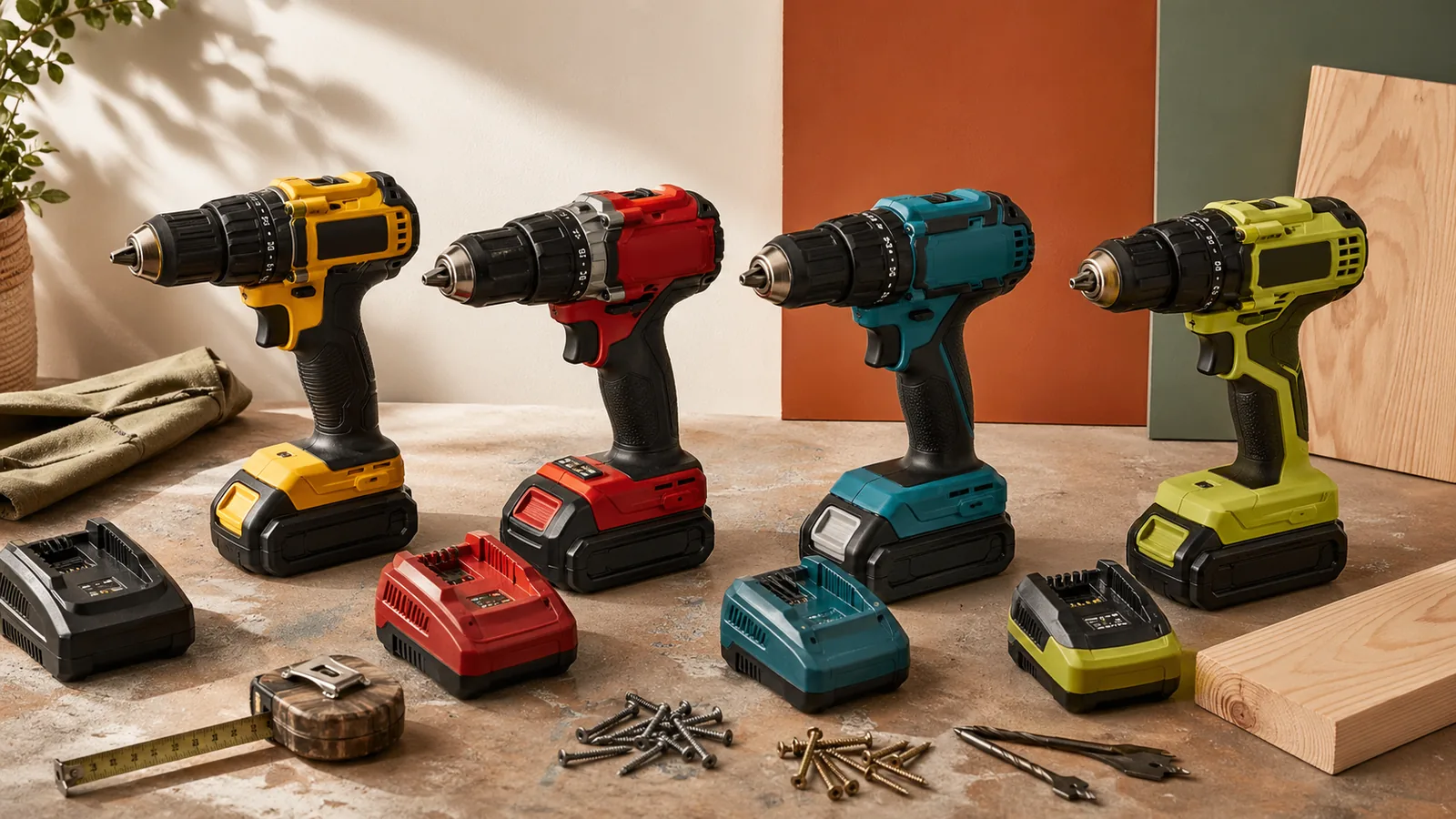
Choosing the right cordless drill in 2026 is really a decision about which battery ecosystem you want to live in for the next decade — not which drill has the highest torque number on the spec sheet. Consumer Reports, which has tested more than 50 cordless drills, frames it exactly this way: the battery platform you choose determines which future tools you can add without buying new batteries and chargers. Get that choice right and every subsequent tool purchase gets cheaper. Get it wrong and you either buy into a second ecosystem or sell tools at a loss.
Here's the short version before the details: Ryobi ONE+ 18V for budget-first buyers building a first toolkit, DeWalt 20V MAX for most homeowners who want broad retail availability and balanced value, Milwaukee M18 FUEL for serious DIYers who want the best-performing tools and plan to build a workshop, and Makita LXT 18V for anyone who prioritizes compact ergonomics and contractor-grade handling.
Best cordless drill for homeowners in 2026: quick pick by battery platform
Your first drill is your platform vote. The drill itself may cost $60–$200, but the batteries you buy with it will follow you through $1,000+ in future tool purchases.
QuickComparisonTable
| Platform | Best For | Ecosystem Size | Entry Strategy |
|---|---|---|---|
| DeWalt 20V MAX | Most homeowners, broad retail access | Large, multi-battery-type family | Kit for first buyers, bare tool after |
| Milwaukee M18 FUEL | Serious DIYers, workshop builders | Premium, deep lineup | Bare tool if already in M18 |
| Makita LXT 18V | Compact-feel preference, contractor handling | World's largest 18V lineup | Bare tool after first kit |
| Ryobi ONE+ 18V | First-time buyers, budget builds | 300+ products | Kit is the value entry point |
As Consumer Reports notes, modern cordless drills have become "lighter, more powerful, and more energy-efficient" thanks to lithium-ion batteries and brushless motors — which means even the budget platforms now deliver enough performance for typical home tasks. The meaningful difference between brands at this point is ecosystem breadth, retail availability, and long-term total cost of ownership.
Watch Out: Buying a bare tool ("tool only") saves roughly one-third compared to buying the kit version — but only if you already own that brand's batteries. If you're starting from zero, buy the kit.
DeWalt vs Milwaukee vs Makita vs Ryobi: which platform fits your first purchase
Each of these four brands runs a genuinely shared battery ecosystem — every drill, circular saw, impact driver, and outdoor tool in the same platform takes the same batteries. But they serve different buyers.
Brand-by-brand comparison matrix
| Brand | Torque (representative model) | Key Strength | Retailer Availability | Best Buyer Profile |
|---|---|---|---|---|
| DeWalt 20V MAX | 300 UWO (DCD771C2 compact kit) | Balance of value, availability, ecosystem depth | General U.S. retail distribution | Most homeowners, first serious tool buyer |
| Milwaukee M18 FUEL | 1,200 in-lbs (2803-20) | Highest performance, most compact in class | General U.S. retail distribution | Serious DIYers, future workshop builders |
| Makita LXT 18V | 970 in-lbs (XPH16Z hammer drill) | Ergonomics, contractor-grade feel, world's largest 18V lineup | General U.S. retail distribution | Compact-preference buyers, contractor-adjacent DIYers |
| Ryobi ONE+ 18V | 515 in-lbs (3/8" drill/driver kit) | Lowest entry cost, 300+ tool ecosystem, homeowner breadth | General U.S. retail distribution | First-time buyers, budget-first homeowners |
DeWalt 20V MAX is the safest all-around pick for a homeowner who doesn't yet know what tools come next. The 20V MAX platform covers cordless drills, circular saws, jigsaws, oscillating tools, impact drivers, leaf blowers, and more — all sharing batteries within the family, including Powerstack and standard 20V MAX packs. DeWalt also carries a 3-year limited warranty on most tools purchased after January 1, 2004, which is solid assurance for occasional home use.
Milwaukee M18 costs more upfront but delivers specs that most homeowners won't fully use — until they start doing serious cabinetry, deck framing, or automotive work. If that's where you're headed, starting in M18 now avoids a costly platform switch later.
Makita created the 18V lithium-ion cordless category in 2005 and describes its LXT lineup as the world's largest 18V cordless tool line-up — a meaningful claim for a buyer planning to build a complete shop over time. Makita's primary weakness for homeowners is slightly thinner retail availability; you'll find a strong selection through major U.S. retailers and tool specialty stores, but not always the deep end-cap presence that DeWalt and Ryobi command at big-box stores.
Ryobi ONE+ is Home Depot's house power tool brand in all but name — the store carries the deepest Ryobi selection of any retailer, often with bundle deals that make starting the platform genuinely affordable. The 300+ product ecosystem means one set of batteries can run your drill, circular saw, and shop light. For a homeowner who wants to own a complete set of tools without spending contractor money, Ryobi is the rational choice.
Pro Tip: If a family member or close neighbor already owns one of these platforms, strongly consider matching their brand — borrowed batteries are the best batteries.
Bare tool vs kit pricing: when saving about one-third is the smart move
Every major brand sells two versions of most drills: a kit (drill + one or two batteries + charger) and a bare tool (drill only, no batteries or charger included). The bare tool consistently runs about one-third less than the kit equivalent.
CostBreakdown logic (representative, not retailer-verified prices):
- Drill kit (drill + 2 batteries + charger): ~$100–$250 depending on brand and model tier
- Bare tool (drill only): typically ~$60–$170 for equivalent models
- Savings if you already own batteries: ~$40–$80 per tool added to your platform
DeWalt's ATOMIC™ multi-head drill/driver is sold tool-only with the note that "battery and charger sold separately." Milwaukee's M18 FUEL drill/driver (model 2803-20) likewise offers a tool-only SKU for platform owners. Makita's XFD03Z states "battery sold separately" on its product page.
The important constraint: bare-tool savings only exist if you're already in that platform. A bare Milwaukee drill without M18 batteries is an expensive paperweight until you spend $80–$150 on a battery and charger separately — at which point you've likely spent more than the kit would have cost.
Watch Out: Retailers sometimes list bare tools and kits side by side without making the distinction obvious. Always check whether batteries and a charger are included before adding to cart. The word "kit" in the product name is your signal they are; model numbers ending in "-B" or "-20" (Milwaukee convention) or "-B" (DeWalt bare-tool convention) usually signal tool-only.
The smart bare-tool strategy: buy your first drill as a kit to establish the platform. Every tool after that — impact driver, circular saw, reciprocating saw — buy as bare tool and pocket the savings.
Why battery platform lock-in matters more than raw torque
A 1,200 in-lb drill does not make holes that a 515 in-lb drill cannot. For drilling into wood studs, driving drywall screws, assembling furniture, or hanging a TV mount, most homeowners will never feel the torque difference. What you will feel is the cost of switching battery platforms after you've accumulated three tools.
Consumer Reports' testing explicitly frames the cordless drill decision as a platform choice: batteries can often be shared across tools from the same brand, but that same convenience ties you to one brand for future purchases. As Consumer Reports puts it, modern cordless drills are "lighter, more powerful, and more energy-efficient" because of lithium-ion batteries and brushless motors. That's not a complaint — it's the architecture of how cordless tools work — but it means your drill purchase is also a vote for your future circular saw, impact driver, and leaf blower.
EcosystemDecision — Read before you buy:
- If you already own tools in one brand's ecosystem: Stay there. Buying a bare tool in your existing platform costs significantly less and adds zero friction. Switching brands means buying new batteries and accepting that your current batteries are now single-tool assets.
- If this is your first tool: Choose the platform, not the drill. Pick the brand whose full tool lineup aligns with what you'll buy next — and whose batteries will still be stocked at your local hardware store five years from now.
- Resale value: DeWalt and Milwaukee batteries hold secondary-market value better than budget-tier platforms. If you ever sell tools, being in a premium platform protects resale. Ryobi tools resell easily due to volume, but at lower dollar amounts.
- Future-tool expansion: Ryobi ONE+ offers 300+ tools on one battery. Makita describes its 18V LXT as the world's largest 18V cordless tool line-up. DeWalt's 20V MAX family covers everything from compact drills to 60V FLEXVOLT tools with backward-compatible batteries. Milwaukee M18 runs the deepest professional lineup.
The practical implication: two homeowners can buy the same drill and have completely different five-year costs depending on which one locked into the right platform early.
How Consumer Reports and test-based rankings should shape your choice
Lab tests tell you which drill performs best under controlled conditions. They don't tell you which platform to bet your tool collection on — and for most homeowners, the platform bet matters more than a 10% torque advantage in a controlled drill press test.
Consumer Reports tested more than 50 cordless drills and emphasizes that lithium-ion batteries and brushless motors have made modern cordless drills lighter, more powerful, and more energy-efficient than the corded drills many homeowners grew up using. Their framework explicitly calls out battery sharing across same-brand tools as a key feature — and warns that it also creates brand lock-in.
Use CR rankings as a quality floor, not a final answer. If a model scores well in lab testing and it's on the platform you've already chosen, that's a confident buy. If a top-rated drill is on a different platform than your existing tools, the math of switching platforms usually doesn't pencil out unless you're starting completely fresh.
What matters most in a homeowner cordless drill: torque, weight, brushless motor, and compactness
SpecChecklist — what to look for (and what not to obsess over):
- Brushless motor: Buy one. A brushless motor runs more efficiently, generates less heat, and lasts longer than a brushed motor. Consumer Reports specifically links brushless motors to the improvement in modern drill performance. Milwaukee's M18 FUEL uses a POWERSTATE™ Brushless Motor; Makita's XPH16Z is brushless; DeWalt's ATOMIC line is brushless. Ryobi offers both — look for "brushless" in the model name for the same advantages at a lower price than the premium brands.
- Torque (in-lbs or UWO): More is not always better for home use. Milwaukee's M18 FUEL 2803-20 is rated at 1,200 in-lbs; Makita's XPH16Z at 970 in-lbs; the Ryobi ONE+ 3/8" drill/driver delivers 515 in-lbs. For driving screws into drywall or drilling through 2×4 lumber, the Ryobi's output is more than adequate. The Milwaukee's torque advantage shows up in demanding applications: lag bolts, thick hardwood, long stainless screws. Don't pay for torque you won't use.
- Weight and compactness: This is underrated. DeWalt describes the DCD771C2 compact kit as built to "Complete jobs in tight spots with the lightweight 20V MAX* Compact Drill/Driver." Milwaukee lists the M18 FUEL 2803-20 at 7.50 inches in length and markets it as the "Most Compact solution in class," noting it is "reducing fatigue when used for extended periods of time." For overhead drilling — installing ceiling fans, mounting shelving in a closet — a shorter, lighter drill is noticeably better.
- Clutch settings: More clutch settings give finer control over driving depth, which matters when you're driving cabinet screws or pocket screws and don't want to strip the head or punch through the surface. The exact number matters less than having enough fine control for the work you do.
- Chuck size: 1/2-inch chuck accepts larger drill bits and is worth prioritizing if you plan to do any structural work. The Ryobi 3/8-inch drill/driver is fine for general home tasks but won't accept larger spade bits or self-feed bits.
Pro Tip: For a drill-driver used primarily for hanging pictures, assembling flat-pack furniture, and basic home repairs, a compact 18V or 20V drill in the 3–4 lb range with a brushless motor and enough clutch control to avoid stripping screws covers 90% of home tasks without needing the premium tier's torque numbers.
Drill-driver vs hammer drill: when masonry capability is worth it
A drill-driver (also called a driver-drill) rotates the bit to drill or drive. A hammer drill does the same thing but adds a rapid forward-and-back percussion action — the hammering motion that breaks up masonry as the bit rotates. That percussion is what makes drilling into concrete, brick, cinder block, or tile actually feasible instead of brutally slow.
Use-case decision tree:
[Image: Decision flowchart — drill-driver vs hammer drill by material type]
Buy a standard drill-driver if you drill exclusively into: - Wood (studs, joists, dimensional lumber, plywood) - Drywall - Soft metals (aluminum, thin steel) - MDF or particleboard
Buy a hammer drill if you ever drill into: - Concrete (garage floors, basement walls, slabs) - Brick (exterior walls, chimneys) - Cinder block (foundation walls, basement construction) - Mortar joints - Ceramic or porcelain tile (with a masonry bit) - Stucco
Ryobi's 18V ONE+ 1/2" Hammer Drill is explicitly described as delivering "fast hammer drilling through concrete and masonry with up to 28,000 BPM." Makita's XPH16Z is a Hammer Driver-Drill combining up to 970 in-lbs of torque with hammer capability. Both DeWalt and Milwaukee sell separate hammer drill models within their respective platforms; the base M18 FUEL drill/driver (2803-20) is a drill-driver only and does not include hammer mode.
Watch Out: If you may ever drill masonry — even once — buy the hammer drill version now. Buying a drill-driver today and a hammer drill later means buying two tools when you could have bought one. The price difference between a drill-driver and a hammer drill in the same product family is usually modest. The hammer drill handles everything a drill-driver does plus concrete and brick. The drill-driver cannot do masonry.
The one honest exception: if you live in a house with wood-framed construction and zero concrete, stucco, or brick surfaces you'd ever need to drill into, a drill-driver is lighter, slightly simpler, and adequate. But most homeowners eventually want to mount something to a concrete basement wall or a brick exterior — and discovering you need a hammer drill at that moment is frustrating.
DeWalt cordless drills for homeowners: best for balanced value and broad availability
DeWalt 20V MAX is the platform most US homeowners encounter first, and that familiarity reflects genuine product strength rather than just marketing. DeWalt is stocked at major U.S. retailers and hardware stores, which means replacement batteries, new tools, and accessories are generally easy to source.
AffiliateProductCard:
- Model: DeWalt 20V MAX Compact Drill/Driver Kit (DCD771C2)
- Torque: Up to 300 UWO
- Best for: First kit purchase, tight-space work, general home tasks
- Platform: DeWalt 20V MAX (includes Powerstack and standard 20V MAX batteries)
- Warranty: 3-year limited on most tools purchased after January 1, 2004
- Bare-tool option: Yes — DeWalt ATOMIC™ multi-head drill/driver (DCD803B) available tool-only for existing platform owners
The DCD771C2 kit is DeWalt's entry point — lightweight, compact, and designed, as DeWalt puts it, to "Complete jobs in tight spots with the lightweight 20V MAX* Compact Drill/Driver." For most homeowners doing a mix of drilling, driving, and occasional more demanding tasks, the 20V MAX platform scales with you: the same batteries run the DCD771C2 compact drill and a full-sized circular saw or reciprocating saw when you're ready to add them. The platform's multi-battery-type structure — covering both standard 20V MAX and Powerstack batteries — gives you options as battery technology improves without forcing a full platform switch.
Milwaukee cordless drills for homeowners: best for premium performance and workshop growth
Milwaukee's M18 FUEL line is where homeowners who know they're headed toward a serious workshop should start. The price premium is real, but the performance difference shows up consistently in demanding applications — and the M18 ecosystem includes drill-drivers, rotary hammers, circular saws, jigsaws, routers, and high-output outdoor power equipment.
AffiliateProductCard:
- Model: Milwaukee M18 FUEL 1/2" Drill/Driver (2803-20)
- Torque: Up to 1,200 in-lbs
- Speed: Up to 2,000 RPM
- Length: 7.50 inches
- Motor: POWERSTATE™ Brushless
- Best for: Heavy DIY tasks, future workshop expansion, professional-grade ambition
- Platform: Milwaukee M18 (tool-only SKU available for platform owners)
- Bare-tool option: Yes — model 2803-20 is tool-only; batteries and charger purchased separately
Milwaukee describes the M18 FUEL drill/driver as the "Most Compact solution in class," and the combination of 1,200 in-lbs of torque in a 7.5-inch package is notable: you get maximum output without a tool that's awkward to use in tight spots or overhead. The POWERSTATE brushless motor contributes to both the power output and the extended runtime per charge.
Pro Tip: If you're already in Milwaukee M18, the tool-only (2803-20) is the smart buy — no reason to purchase batteries you already own. Use the savings toward your next M18 tool in whatever combo kit configuration makes sense for your next project.
The honest trade-off: Milwaukee's entry cost is higher, and you need to be honest with yourself about whether your home projects will actually use the extra performance. If your typical weekend involves hanging shelves and assembling patio furniture, the Milwaukee's torque advantage sits largely unused. But if you're planning deck builds, basement finishing, or major renovation work, the M18 platform is an investment that pays back.
Makita cordless drills for homeowners: best for compact feel and contractor-grade handling
Makita earns the ergonomics category honestly — its tools feel different in the hand, and that's not marketing. The grip geometry, balance point, and overall compactness of Makita's LXT line reflect decades of contractor feedback. If you've ever used a Makita and then picked up a competing drill, the difference is tangible.
AffiliateProductCard:
- Model: Makita 18V LXT Brushless 1/2" Hammer Driver-Drill (XPH16Z)
- Torque: 970 in-lbs max
- Type: Hammer driver-drill (masonry-capable)
- Best for: Buyers who want hammer drill capability plus compact handling
- Platform: Makita 18V LXT (batteries with Star symbol only)
- Bare-tool option: Yes — tool only; battery sold separately
- Also consider: Makita XFD03Z — compact brushless driver-drill for drill-driver-only use cases, described as "delivers high torque, power, performance and improved ergonomics in a compact size"; 3-year limited warranty
Makita's platform claim is substantive: the company says it created the 18V lithium-ion cordless tool category in 2005 and that its LXT lineup is now the world's largest 18V cordless tool line-up. For a homeowner planning to expand into a complete tool set, that ecosystem depth is a real asset.
One important note on battery compatibility: Makita 18V LXT tools, including the XFD03Z, are compatible only with Makita 18V Lithium-Ion batteries bearing a Star symbol. Not all Makita 18V batteries carry the Star designation — check your existing batteries before buying a bare tool. This specificity is more constraining than DeWalt's or Ryobi's more broadly compatible battery families, so verify compatibility carefully when expanding the platform.
For retail access, Makita is well-stocked through major U.S. retailers and tool specialty retailers, but its big-box presence is slightly narrower than DeWalt's. Tool specialty retailers often carry deeper Makita selections than general hardware stores.
Ryobi cordless drills for homeowners: best budget platform for first-time buyers
Ryobi ONE+ 18V is the right starting point for a homeowner who wants to build a complete tool collection without a contractor's budget. The ecosystem spans over 300 products — every tool works with any Ryobi 18V ONE+ battery — and the entry price for a kit is consistently lower than comparable kits from DeWalt, Milwaukee, or Makita.
AffiliateProductCard:
- Model: Ryobi 18V ONE+ 3/8" Drill/Driver Kit
- Torque: Up to 515 in-lbs
- Best for: First-time buyers, light-to-medium home tasks, budget platform build
- Platform: Ryobi ONE+ 18V (works with any Ryobi 18V ONE+ battery)
- Ecosystem: 300+ tools
- Also consider: Ryobi 18V ONE+ 1/2" Hammer Drill — up to 28,000 BPM for concrete and masonry, same battery platform
Expand your RYOBI 18V ONE+ System with the RYOBI 18V ONE+ 1/2" Hammer Drill is the kind of manufacturer language that explains why the platform works for homeowners: you can start with a drill and add a hammer drill, then keep building from there on the same battery base. The ONE+ platform's 300+ product count is the real story here, because it makes one battery family practical across a very large tool set. Running your entire yard and garage on one battery family is a meaningful household economy.
The honest trade-off: Ryobi brushed-motor models don't have the runtime or longevity of the premium brands' brushless offerings. When buying Ryobi, spend the extra to get the brushless version — the "PCL" or "PBLID" prefix on newer models typically signals brushless. The torque ceiling of 515 in-lbs is adequate for wood, drywall, and light metal but will feel underpowered on long lag bolts or dense hardwood. For most homeowner tasks, that's a non-issue.
Pro Tip: Ryobi is primarily stocked at Home Depot in the US — both in-store and online. Home Depot regularly bundles Ryobi tools into value combo kits, making the platform particularly efficient to build out through seasonal sales and tool events.
Which brand is best if you may buy saws, impact drivers, or outdoor tools later
Platform expansion is where the choice between these brands gets concrete. Here's how each ranks for a homeowner planning to add saws, impact drivers, or outdoor tools over time:
FutureToolExpansion comparison:
| Platform | Circular Saws | Impact Drivers | Outdoor Power | Resale Strength | Notes |
|---|---|---|---|---|---|
| DeWalt 20V MAX | Strong | Strong | Moderate | High | 20V / 60V FLEXVOLT dual-voltage bridges indoor and outdoor tools |
| Milwaukee M18 FUEL | Strongest | Strongest | Good | Highest | M18 covers routers, rotary hammers, and high-output outdoor equipment |
| Makita LXT 18V | Strong | Strong | Good | High | World's largest 18V lineup; Star-battery compatibility check required |
| Ryobi ONE+ 18V | Good | Good | Best value | Moderate | 300+ tools; best price-per-tool ratio for outdoor expansion |
Ryobi's 300+ product ecosystem is the widest in raw product count, and for outdoor tools specifically — where premium pricing is hardest to justify for a weekend homeowner — Ryobi's platform value is strongest.
Makita's LXT lineup is the deepest in contractor-grade tools and has the most established 18V ecosystem history, which matters for long-term parts and battery availability. DeWalt's 20V MAX platform bridges into 60V FLEXVOLT territory with backward-compatible batteries — meaning a FLEXVOLT battery runs in your 20V drill without an adapter, but also powers a full-size table saw. That's a legitimate future-workshop advantage.
Milwaukee's resale strength is the best in the category. M18 batteries, chargers, and tools hold value on the secondary market (Facebook Marketplace, Craigslist, eBay) better than any other platform in this comparison. If you ever move, upgrade, or sell tools, that matters.
Watch Out: Buying into a platform you can't easily source batteries for locally is a hidden long-term cost. Verify that your preferred brand has strong in-store presence at a nearby retailer — not just online availability — before committing to a platform you'll depend on for the next decade.
Where to buy cordless drills in the US right now
All four brands maintain active U.S. manufacturer product pages. Here is the simplest way to shop them: use the brand pages to verify current models, then compare kit versus bare-tool listings at the retailer you prefer before buying.
RetailAvailabilityNote:
- Manufacturer pages: DeWalt, Milwaukee, Makita, and Ryobi all maintain current U.S. product pages for the drills covered in this article.
- Shopping guidance: Check the retailer listing carefully for kit versus bare-tool packaging, battery inclusion, charger inclusion, and exact model number before checkout.
- Price comparison: Use current retailer listings to compare the same model across sellers; pricing changes frequently with sales and seasonal promotions.
- Availability check: If a specific model is out of stock at one retailer, compare other authorized sellers or wait for the next promotion rather than switching ecosystems on impulse.
Watch Out: When shopping online, always check whether the listing is a kit or a bare tool before purchasing. Bare tools and kits are often listed adjacently with similar thumbnail images. Confirm battery and charger inclusion in the product description — not just the listing title — before you add to cart.
No retailer-specific prices are quoted here because power tool pricing shifts frequently with sales, promotions, and seasonal events. Check current pricing at your preferred retailer directly; the bare-tool vs kit price split is the most important number to compare.
FAQ about cordless drills, battery platforms, and homeowner buying decisions
Can I use the same battery across different tools from the same brand?
Yes — that's the central feature of every major cordless platform covered here. Consumer Reports confirms that batteries can often be shared across tools from the same brand, and Ryobi makes it explicit: their tools "work with any Ryobi 18V ONE+ battery." DeWalt's 20V MAX batteries work across the 20V MAX tool family. Milwaukee M18 batteries run the entire M18 ecosystem.
The one exception to watch: Makita specifies that its 18V LXT tools require batteries bearing a Star symbol — not all Makita 18V batteries qualify. Check for that symbol on any Makita battery before assuming compatibility.
Should I buy a drill kit or a bare tool?
Buy the kit if this is your first drill or your first tool in that brand's platform — you need the batteries and charger regardless, and kits bundle them at a discount compared to buying separately. Buy the bare tool for every subsequent tool you add to your platform, and save roughly one-third versus buying another kit's worth of batteries and charger you already own.
The math is simple: if you already have two DeWalt 20V MAX batteries and a charger from your first kit, every new DeWalt tool you add as a bare tool costs significantly less than a kit version. That savings compounds across a full tool collection.
Do I need a hammer drill for home use?
You need a hammer drill if you ever plan to drill into concrete, brick, cinder block, mortar, or stucco. For wood, drywall, and metal only, a standard drill-driver handles everything. The practical advice: if your home has any masonry surfaces you might want to mount something to — a concrete basement wall, a brick exterior, a stucco facade — buy the hammer drill version of your chosen platform's drill now. Ryobi's hammer drill delivers up to 28,000 BPM for concrete and masonry; Makita's XPH16Z combines hammer capability with 970 in-lbs of torque. The price difference between a drill-driver and a hammer drill in the same family is modest; buying a second tool later when you discover you need hammer mode is not.
What does battery platform lock-in actually mean for me?
It means that whichever brand's batteries you buy today, you'll likely keep buying that brand's tools for years — because the batteries you already own are free assets that reduce the cost of every new tool in the same platform. Switching platforms later means either selling your existing batteries at a loss or maintaining two separate battery ecosystems. Consumer Reports specifically notes that while battery sharing across same-brand tools is a genuine advantage, it also ties you to that manufacturer for future purchases. Choose deliberately: if you plan to own 10 tools eventually, your first drill purchase is also choosing the brand for 9 of those tools.
Sources & References
- Consumer Reports — Best Cordless Drills — CR's testing of 50+ cordless drills; platform-decision framework and lithium-ion/brushless motor context
- DeWalt 20V MAX Compact Drill/Driver Kit (DCD771C2) — Product specs and description
- DeWalt ATOMIC Multi-Head Drill/Driver Tool Only (DCD803B) — Bare-tool listing and battery/charger sold separately disclosure
- DeWalt 20V MAX Cordless Platform — Platform ecosystem and battery compatibility documentation
- DeWalt Warranty Information — 3-year limited warranty terms
- Milwaukee M18 FUEL 1/2" Drill/Driver Tool Only (2803-20) — Specs: 1,200 in-lbs torque, 2,000 RPM, 7.50" length, POWERSTATE brushless motor
- Makita 18V LXT Brushless Hammer Driver-Drill (XPH16Z) — Specs: 970 in-lbs max torque, hammer drill capability
- Makita 18V LXT Compact Brushless Driver-Drill (XFD03Z) — Drill-driver specs, Star-battery compatibility requirement, 3-year warranty
- Makita 18V LXT Platform (XAD01) — World's largest 18V cordless tool line-up claim; 2005 category creation
- Ryobi 18V ONE+ 3/8" Drill/Driver Kit — Specs: 515 in-lbs torque, 300+ product ecosystem
- Ryobi 18V ONE+ 1/2" Hammer Drill — Specs: 28,000 BPM, concrete and masonry capability
- Ryobi ONE+ Battery Compatibility — Works with any Ryobi 18V ONE+ battery confirmation
Keywords: DeWalt 20V MAX, Milwaukee M18 FUEL, Makita LXT 18V, Ryobi ONE+ 18V, brushless motor, drill-driver, hammer drill, bare tool, battery platform lock-in, lithium-ion battery, Home Depot, Lowe's, Amazon, Acme Tools, Ohio Power Tool