Do cellular shades really save energy on hot windows and winter drafts?
Cellular shades do reduce heat gain and drafts in a measurable way — but the payoff is uneven depending on your window orientation, climate, how well the shade fits, and which cell configuration you choose. They are not a substitute for weatherstripping, insulation, or HVAC upgrades, but as energy-efficient window treatments go, they outperform almost everything else you can hang in a window frame.
At a Glance: Cellular shades work by trapping air inside hollow honeycomb cells. More cells, better fit, and correct window orientation all amplify the benefit. A poorly measured shade with air gaps at the edges performs closer to a basic blind than the premium product you paid for.
As Homewyse's 2026 cellular-shade cost guide puts it, cellular shades feature "fabric woven into hollow honeycomb shapes, or cells" and "because the cells hold air they are especially good insulators and can reduce energy costs better than most other types of blinds." That's a sourced claim — but notice the phrasing: can reduce costs, not will for every home. The source supports improved insulation performance; it does not guarantee a specific dollar savings figure across all climates, house sizes, or window counts.
What this article covers is the practical question underneath the energy story: which spec of cellular shade actually helps on a hot west-facing window, which one cuts a winter draft, and when the upgrade cost is too high to justify the gain.
How cellular shades insulate windows better than blinds or curtains
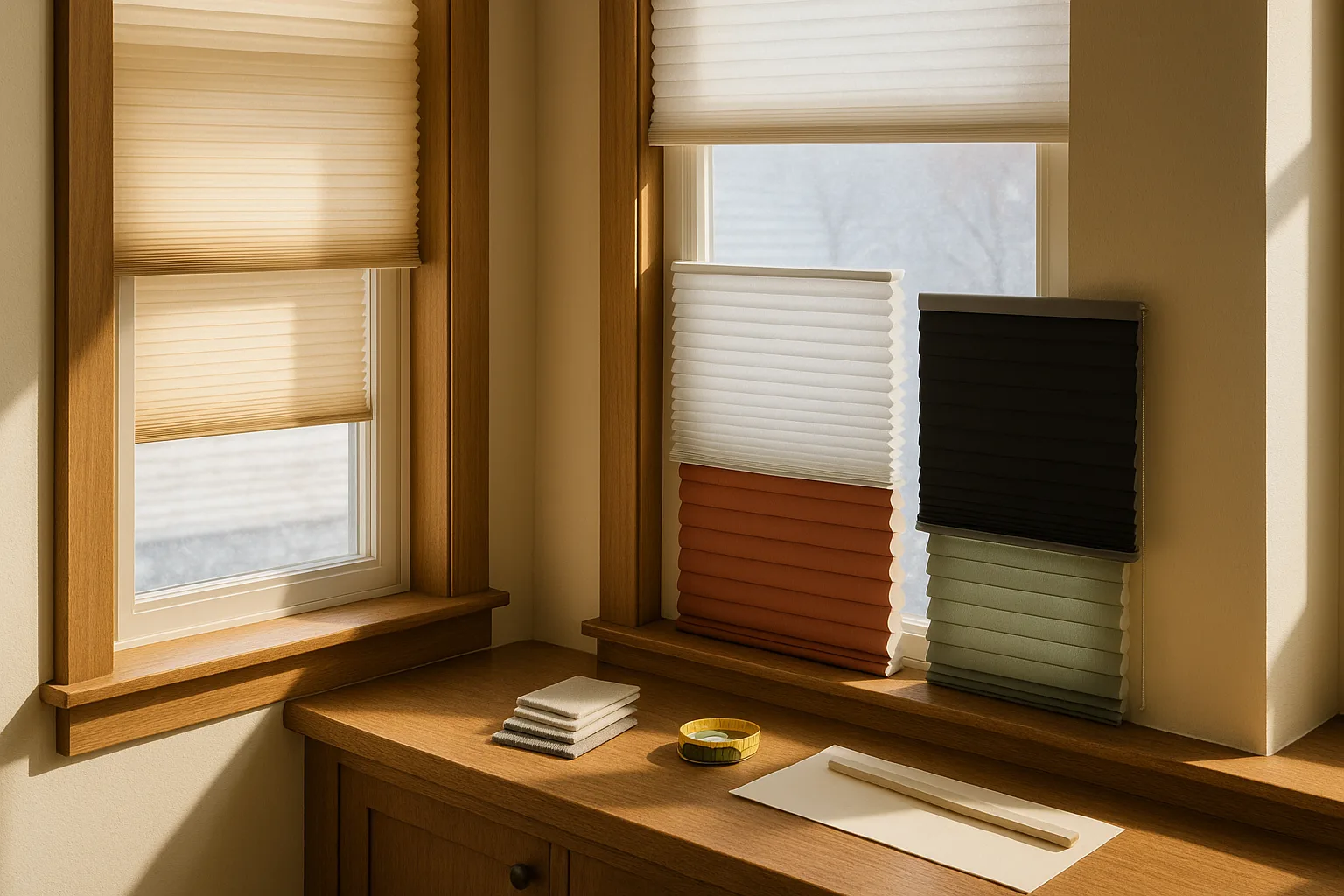
The mechanism is straightforward. A cellular shade, also called a honeycomb shade, is built from fabric folded and bonded into a row of enclosed tubes. When installed, those tubes run horizontally across the window, and each one traps a column of still air. Still air is a poor conductor of heat, which means it slows the transfer of warmth from your room to the cold glass in winter, and slows the transfer of solar heat from hot glass into your room in summer.
IKEA describes the principle well: "The honeycomb-like cells trap the air and transform it into an insulating barrier between the window and the room, creating a more stable and comfortable indoor climate." IKEA's own cellular blind category markets the product specifically on the insulation benefit — keeping rooms warmer in winter and cooler in summer.
The result is that window insulation products built on the cellular principle sit in a different category than decorative window treatments. They are doing a functional job that curtains (which drape away from the glass and allow convection loops behind them) and slatted blinds (which have open gaps between every slat) simply cannot match.
[Image: Cross-section diagram of a cellular shade showing honeycomb cells with trapped air pockets vs. open-slat aluminum blind — labeled arrows indicate heat transfer paths]
Why trapped air matters more than slat blinds
A standard aluminum or faux-wood slat blind creates shade but not insulation. Between every slat there are gaps, and air circulates freely through those gaps. Cold glass chills the air near the window surface; that denser cold air sinks, warm room air flows in to replace it, and you get a convection loop that pulls heat out of the room all night. The slats interrupt light, not airflow.
A cellular shade seals that gap with a fabric wall and fills the space behind it with enclosed air pockets. There is no open channel for convection to run. The result is a product that behaves more like a thin insulating panel than a light-control device. It won't approach the R-value of a wall — no window treatment will — but compared with every other type of blind or standard curtain, the enclosed-cell design is meaningfully better.
Pro Tip: Layering a cellular shade behind a curtain panel captures two air barriers and can noticeably improve performance on very cold nights — the curtain adds a second still-air zone between the shade and the room.
Where fit and install quality change the payoff
A cellular shade that doesn't fit well is just an expensive blind with air gaps on the sides. This is the most common reason homeowners don't feel the energy benefit they expected.
Levolor's installation instructions and Select Blinds' cellular shade install guide both treat inside-mount vs. outside-mount as a core setup decision, not a cosmetic preference. American Blinds is explicit: "Position and secure two brackets based on Inside or Outside mount location as shown below." Mount choice affects how much the shade covers the window opening, where light gaps appear, and how effectively it seals against drafts.
Watch Out: Even a small gap on each side of an inside-mount shade creates an air channel that partially defeats the honeycomb insulation. Measure twice, order once — and follow the manufacturer's width guidance so the shade doesn't bind in the frame.
Inside mounts look clean and are easier to fit, but they require a window frame with enough depth to recess the hardware. If your frame is shallow or out of square, an outside mount that overlaps the casing will close more of the gap and deliver better draft reduction. Check the manufacturer's minimum depth requirement for the specific shade you're ordering — it varies by brand and cell size.
Single-cell vs double-cell cellular shades: which is better for your room?
Single-cell and double-cell are the two most common configurations you'll encounter shopping for cellular shades. The difference is exactly what the names say: one row of honeycomb tubes versus two rows stacked together. More rows mean more trapped air, more insulation, a thicker shade body, and a higher price.
The Shade Store sells both configurations, with light-filtering cellular shades starting from $250, and describes them as providing "insulation while helping create comfortable temperatures." That starting price is for custom sizing; single-cell typically costs less than double-cell within the same product line.
| Feature | Single-Cell | Double-Cell |
|---|---|---|
| Insulation level | Good | Better |
| Shade bulk/thickness | Slimmer | Noticeably thicker |
| Price (custom) | Lower | Higher |
| Best for | Mild climates, living areas, budget refreshes | Cold/hot climates, bedrooms, west-facing windows |
The table above is a practical framework, not an absolute rule. A well-fitted single-cell shade in a temperate climate will outperform a poorly fitted double-cell shade anywhere.
When single-cell shades make the most sense
Single-cell shades are the right choice when your primary goal is to upgrade from slatted blinds or bare windows without a large budget commitment, and your climate isn't extreme. Blinds.com positions its cellular shades as "insulating and lightweight" — the lightweight part matters for large windows where a thicker shade would add unwanted bulk or require heavier hardware.
Good scenarios for single-cell:
- Moderate climates (U.S. climate zones 3–5, roughly the mid-Atlantic, Pacific Northwest, and parts of the South) where winter lows rarely drop below the mid-20s°F and summers stay below 95°F for most of the year
- South- or east-facing windows that get morning light but not sustained afternoon heat load
- Living rooms and dining rooms where you want insulation benefit but also lighter fabric and lower-profile hardware
- Budget-focused whole-house refreshes where covering 8–12 windows at once makes double-cell pricing impractical
- Rental upgrades where you want to keep costs reasonable and the shades may move with you
Blinds.com's cellular shade lineup covers this tier well, with customizable sizing and a large review base that helps you validate fit before ordering.
When double-cell shades earn their higher price
Double-cell shades make sense when the window is either a significant heat source or a significant heat sink — and you're willing to pay for meaningful improvement. The construction stacks two rows of honeycomb cells, which means two air barriers instead of one. As IKEA describes the mechanism, the cells "transform [trapped air] into an insulating barrier" — and two layers of that barrier do more work than one.
Use double-cell shades when:
- West-facing windows that take direct afternoon sun from about 2 pm onward — these are the hardest windows in most homes, and the extra insulation plus a blackout or room-darkening fabric combination cuts both radiant heat and glare
- Bedrooms in cold U.S. climates (zones 5–7, think the Upper Midwest, New England, mountain West) where you want to sleep without cold-glass chill near the bed
- Any window in a room where you notice a draft or cold pocket near the glass in winter — the deeper cell construction, especially with a snug outside mount, creates a more effective thermal buffer
- Rooms with older single-pane windows that can't be replaced yet — double-cell doesn't fix old glass, but it reduces the penalty
The Shade Store's double-cell options start above $250 custom; you'll also find competitive double-cell pricing at Blinds.com and Select Blinds for windows where custom sizing matters but premium boutique pricing doesn't.
Pro Tip: If you're on the fence between single and double cell, start with double on your two worst windows (usually west-facing bedroom and living room) and single everywhere else. You'll feel the difference without committing to a whole-house budget jump.
Best cellular shade specs for west-facing sun, winter drafts, bedrooms, and living rooms
The right cellular shade spec depends on what problem you're solving. West-facing heat and winter drafts require different priorities than bedroom darkness or a living room that needs diffused daylight. Here's how to match spec to scenario.
| Window/Room Scenario | Cell Count | Opacity | Mount Type | Priority |
|---|---|---|---|---|
| West-facing, afternoon sun | Double-cell | Blackout or room-darkening | Outside (if possible) | Heat + glare control |
| Drafty older window, cold climate | Double-cell | Any | Outside with overlap | Air seal + insulation |
| Bedroom, any climate | Single or double | Blackout | Inside or outside | Sleep quality + insulation |
| Living room, moderate climate | Single-cell | Light-filtering | Inside | Diffused light + insulation |
Hot west-facing windows and afternoon heat gain
West-facing windows are the hardest window problem in residential energy efficiency. They take direct sun from mid-afternoon through sunset — the hottest part of the day — and solar load through glass can raise a room's temperature noticeably within an hour of exposure. A cellular shade on a west window needs to address both the radiant heat coming through the glass and the radiant heat the shade itself absorbs.
For west-facing windows, choose:
- Double-cell construction for the extra insulating air layer between the hot shade face and the room air
- Blackout or room-darkening fabric, which blocks more solar radiation than light-filtering fabric — IKEA's HOPPVALS room-darkening cellular blind is a concrete example of this combination
- Outside mount if the frame allows, so the shade overlaps the casing and reduces edge gaps where heat can sneak around
A light-filtering single-cell shade on a west window will help, but it won't cut the afternoon heat load nearly as well. If glare is the dominant complaint more than raw heat, read the solar shades section below first — they may serve you better.
Watch Out: A dark-colored blackout shade on a west window absorbs more solar energy than a light-colored one. If the shade face gets hot to the touch, some of that heat re-radiates into the room. Light or medium gray/white room-darkening fabrics manage this better than dark charcoal or navy.
Winter drafts and older leaky windows
For drafty windows — especially older single-pane or builder-grade double-pane windows where the seal has degraded — cellular shades act as a secondary thermal barrier. They won't seal a window the way weatherstripping does at the sash, but they dramatically reduce the cold convection loop described earlier by trapping a warm air cushion against the glass.
Fit matters more here than anywhere else. An outside mount that extends beyond the window opening on all sides cuts off the edge air path that would otherwise leak around an inside mount. IKEA's HOPPVALS, for example, supports wall or ceiling mounting — a ceiling mount drops the shade past the top of the window trim, eliminating the gap at the head of the frame where cold air often infiltrates first.
For drafty windows, prioritize:
- Double-cell construction for maximum air-pocket depth
- Outside mount with enough overlap to cover the full frame perimeter
- Snug side fit — order width to overlap the casing, not just the glass
These window insulation products work as a supplement to proper weatherstripping, not a replacement. If your window rattles in wind or has visible daylight around the sash, fix that first. The shade handles the thermal performance; the weatherstripping handles the air seal.
Bedrooms versus living areas: blackout or light-filtering
Bedroom cellular shades have one job beyond insulation: block enough light for quality sleep. Blackout cellular shades use a fabric with a solid backing or liner that prevents light transmission. They're the right call for:
- Primary bedrooms facing east (sunrise wake-up is real) or west (afternoon naps, shift workers)
- Children's rooms and nurseries where earlier bedtimes mean daylight interference
- Any bedroom where streetlights, neighbors' lights, or security lights create nighttime light pollution
Light-filtering cellular shades transmit diffused daylight without harsh glare or direct view-through. They're the better fit for:
- Living rooms and family rooms where you want natural light and privacy without a dark cave effect
- Home offices where glare on screens is the problem but total darkness kills the room
- Dining rooms where daytime meals benefit from diffused natural light
Neither opacity choice changes the insulation mechanism — the honeycomb cells work the same way regardless of fabric opacity. Blackout fabric does add a slight barrier to radiant heat because the backing blocks more direct solar radiation, which gives blackout shades a modest edge on west-facing bedrooms specifically.
How cellular shades compare with solar shades and pleated shades
Homewyse's cellular-shade cost page explicitly groups solar shades and pleated shades in the same related-product family as cellular shades — they're the natural comparison set. Each solves a different version of the window-treatment problem.
| Treatment | Insulation | Glare/Heat Control | Privacy | Daylight | Best For |
|---|---|---|---|---|---|
| Cellular shades | Best | Good to excellent (blackout) | Good | Light-filtering or blocked | Drafts, cold climates, bedrooms |
| Solar shades | Minimal | Excellent | Partial (visible from outside at night) | Preserved, tinted | Bright rooms, view-keeping |
| Pleated shades | Modest | Moderate | Good | Light-filtering | Budget-friendly style upgrade |
Cellular shades are the clear winner for insulation. Solar shades win on view preservation and glare control. Pleated shades split the difference on price but give up meaningful insulation to do it.
When solar shades are the better buy
Solar shades are the right choice when you want to keep your view, cut UV exposure and screen glare, and manage heat gain — but insulation against cold drafts is not your main concern. A solar shade is made from an open-weave mesh that blocks a percentage of solar radiation while keeping the outside view partially intact. The weave has no enclosed air cells, so it doesn't create a thermal air barrier the way cellular construction does.
Choose solar shades when:
- You have a great view you don't want to lose (lake, garden, city skyline) and the window faces a direction that creates glare at certain times of day
- UV protection for furniture and flooring is the priority — solar shades are effective at blocking UV that fades fabric and wood
- Your climate is mild and you're not fighting drafts or extreme temperatures
- The room is used primarily in daylight hours and privacy at night is acceptable (most solar shades offer minimal privacy after dark when interior lights are on)
Solar shades are not the answer for drafty winter windows or for bedrooms. As energy-efficient window treatments go, they're a glare and UV management tool, not an insulation product.
When pleated shades are enough and when they are not
Pleated shades look similar to cellular shades — they're made from accordion-folded fabric — but the folds are single-layer with no enclosed air pocket. That's the critical difference. A pleated shade creates a thin fabric barrier between the glass and the room but doesn't trap air. It offers some insulation benefit over bare glass or open slats, but meaningfully less than even a single-cell cellular shade.
Pleated shades make sense when:
- Budget is the primary constraint and you're covering many windows at a basic level
- Aesthetics matter more than performance — pleated shades come in a wider range of fabrics, textures, and patterns than cellular options
- The window faces north or a shaded direction and thermal performance is less critical
Pleated shades are not enough when you're dealing with a drafty old window in a cold climate, a hot west-facing room, or any situation where you're counting on the window treatment to meaningfully cut heating or cooling load. In those scenarios, the lack of an enclosed air pocket means you're paying for style without the thermal payoff. Consider these window insulation products a decorative upgrade rather than an efficiency investment.
How much value do cellular shades add by climate, window type, and payback
This is the question the rest of the internet dances around. The honest answer: cellular shades add real, measurable insulation value, but the dollar savings depend on too many variables — your climate zone, how many windows you treat, what your current window treatments are (or aren't), your energy rates, and how well the shades fit — for anyone to hand you a single payback number.
What the source material supports is that cellular shades can reduce energy costs better than most other blind types. What it does not support is a universal claim like "save $X per window per year." Keep that distinction in mind when you evaluate any coverage you read that promises specific savings figures without citing the window specs and climate zone behind them.
A practical way to think about payback:
High-payback scenarios — the upgrade is worth it when: - You're in a heating-dominated U.S. climate zone (zones 5–7: Midwest, Northeast, Mountain West) and currently have no window treatments or single-pane glass - You have west- or south-facing windows that generate noticeable overheating in summer - You're replacing blinds in a room where you can feel cold air near the window on winter nights - You're doing a whole-house treatment and the per-window cost averages down with volume ordering
Lower-payback scenarios — reconsider the upgrade when: - You're in a mild U.S. climate zone (zones 2–3) with newer double- or triple-pane windows - The window faces north or is shaded by a porch, tree, or overhang most of the day - You're covering just one or two windows in an otherwise well-insulated room - Your energy bills are already low and the driver is more aesthetic than thermal
Cost Snapshot: Custom cellular shades start around $250 per window at premium retailers like The Shade Store. Mid-range Blinds.com custom options typically run less. Mass-market options from IKEA are aimed at standard-size windows and a lower entry price, with fit and configuration that work best when your opening is straightforward. The gap is wide; so is the quality and fit range.
What raises or lowers the total cost per window
Several factors drive cellular shade pricing within and across brand tiers:
- Custom sizing vs. stock sizing: Custom-cut shades fit better and cost more. Stock sizes (common at IKEA and big-box stores) are cheaper but may require an outside mount to cover gaps if they don't exactly match your opening
- Cell count: Double-cell shades cost more than single-cell within the same product line — the Shade Store's cellular catalog confirms both configurations are available with a price difference
- Blackout vs. light-filtering fabric: Blackout liners and backing add to the per-shade cost
- Motorization: Motorized lift systems add significantly to the price of any shade — budgets vary widely by brand and motor type
- Brand tier: The spread between a budget Blinds.com custom shade and a premium custom option is substantial and reflects fabric quality, hardware quality, and support
Custom Hunter Douglas versus IKEA, big-box, and online brands
Hunter Douglas is the most recognized premium cellular shade brand in the US market, sold primarily through authorized dealers. Expect prices well above $300 per window for custom sizes; the brand's Duette line is the benchmark for quality and has a wide range of opacities, cell sizes, and operating systems. You're paying for precise fabrication, superior hardware, and dealer installation support.
The Shade Store offers a premium custom experience from $250 up with an online-plus-showroom model and free swatches.
Blinds.com and Select Blinds serve the online custom middle market — real customization at prices significantly below Hunter Douglas, with large customer review bases to validate fit and quality before you commit.
IKEA's cellular blinds are the budget entry point: genuine honeycomb construction, standard sizes only, cordless operation, and a fit that works best for straightforward openings. For windows with unusual dimensions or where energy performance is the main goal, the custom options will serve you better.
Pro Tip: Order fabric swatches from any retailer before committing to a color. Cellular shade fabric looks different in person than on screen — opacity in particular is hard to judge from photos alone.
How to measure cellular shades so the energy benefits are not lost
Measurement is where most cellular shade installs go wrong. A shade that is even slightly off in width can lose draft-control value. A shade ordered for inside mount on a frame too shallow to accept the hardware will gap at the top and sides. Levolor provides separate installation instructions for custom cellular shades and stock cellular shades, and that distinction itself signals how much measurement and product selection interact.
American Blinds' installation guidance advises reviewing mounting types and basic window terminology before installation, and instructs you to "position and secure two brackets based on Inside or Outside mount location as shown below."
Measurement checklist before ordering:
- Decide inside mount vs. outside mount first — the decision drives how you measure width and height
- For inside mounts: Measure width at three points (top, middle, bottom of the opening) and use the narrowest measurement; follow the manufacturer's specified clearance for that product line
- For inside mounts: Measure height at three points (left, center, right) and use the longest
- Check frame depth: The shade's headrail and hardware must fit within the frame depth without hitting the sash — verify the minimum depth requirement for the exact model you're ordering
- For outside mounts: Follow the manufacturer’s install guide for the overlap and coverage dimensions that best block light gaps and side leaks; the exact add-on varies by product line
- Check for square: Measure both diagonals of the opening to assess squareness and choose outside mount when the frame is irregular or out of square
Watch Out: For wider windows, most manufacturers require additional support brackets to prevent the headrail from bowing. American Blinds' instructions specifically note that extra brackets may be required for wider shades so they don't interfere with operating mechanisms. Confirm bracket count at ordering, not after delivery.
Inside mount depth, recess clearance, and light gaps
Inside mount gives the cleanest finished look — the shade sits flush within the window frame, doesn't protrude into the room, and shows off the window trim. The tradeoff is that any gap between the shade's edge and the frame interior becomes a light gap and a draft path.
Cellular shade headrails are typically 1–2 inches deep. Your window frame needs to accommodate that depth plus the operating clearance. Check the specific minimum recess depth in the manufacturer's spec sheet for your chosen shade — it varies, and Levolor maintains separate spec documentation for stock versus custom lines.
Side light gaps on inside mounts are nearly unavoidable — manufacturers build in a small clearance so the shade operates without binding. For rooms where you want maximum light blockout (bedrooms especially), consider a room-darkening or blackout model that uses a channel system along the sides to close that gap, or plan to layer drapes over the shade to cover the edges.
When an outside mount is the smarter insulation choice
Outside mount wins when insulation performance matters more than aesthetics, when the frame is too shallow for inside hardware, or when the window opening is irregular or out of square. By overlapping the window casing, an outside-mount shade closes the air path around the entire perimeter of the window — the gap that inside mounts cannot fully eliminate.
IKEA's HOPPVALS cellular blind supports wall or ceiling mounting, which is essentially an outside mount that extends beyond the frame. A ceiling mount is especially useful on tall windows or problem windows where you want to cover the full surface and eliminate the top-of-frame gap where cold air tends to infiltrate first.
For older homes with plaster window surrounds, out-of-plumb frames, or windows where the original trim is too narrow for a proper inside fit, outside mount is not a compromise — it's the correct choice.
Cordless, smart, and child-safe cellular shade options to consider
Cordless cellular shades are now the standard recommendation for any room in a home, not just rooms with children. Beyond safety, cordless operation simplifies daily use, eliminates tangling, and removes the cord management problem that makes corded shades look messy over time.
The U.S. Consumer Product Safety Commission (CPSC) is unambiguous: "Cordless window coverings are the only option to eliminate the strangulation hazard." A voluntary safety standard for window coverings took effect December 15, 2018, and the CPSC has continued to push for cordless products across all rooms. Most major cellular shade manufacturers — Levolor, Blinds.com, The Shade Store — now offer cordless lift as a standard option.
Cordless shades for nurseries and family rooms
The CPSC advises buying and installing cordless window coverings "in all rooms where a child may be present." In practice, that means every room in most family homes — children don't stay in nurseries. Treat cordless as the baseline, not an upgrade.
For nurseries specifically, a blackout cordless cellular shade handles two jobs at once: blocks daylight for naps and overnight sleep, and eliminates cord hazard. IKEA's HOPPVALS room-darkening cellular blind notes that "the cord is hidden inside the blind, making it safer if you have children at home" — keep that distinction in mind, because a hidden cord is not the same thing as a true cordless lift.
Watch Out: "Cordless" means different things on different products. A shade where the cord is hidden inside the headrail mechanism is not the same as a truly cordless lift that uses spring tension or motorization. For the safest option in rooms with young children, verify that there is no accessible cord or looped pull anywhere on the product, including the lift cord, tilt mechanism, or continuous-loop cord.
For family rooms where the shade goes up and down frequently, look for cordless cellular shades with a reliable spring-tensioned lift system. Read reviews specifically for lift ease after extended use — spring tension can weaken on cheaper mechanisms over two to three years of daily operation.
Motorized shades and smart-home compatibility
Motorized cellular shades add a battery or hardwired motor to the headrail, letting you raise and lower the shade via remote, app, or voice command. The convenience is real — especially for large shades, hard-to-reach windows, or homes where you want scheduled shade operation tied to sunrise and sunset.
Motorization changes how the shade is operated; it does not change the honeycomb construction that provides the insulating benefit. If you are choosing between lift systems, prioritize fit and cell configuration first, then decide whether the convenience of automation is worth the added cost.
Most premium motorized cellular shades are compatible with common smart-home controls, but verify the current compatibility claims directly with the manufacturer before purchasing, as ecosystem support changes.
Pro Tip: For motorized shades on a smart-home schedule, the real energy benefit isn't in the motor — it's that you'll actually operate the shades at optimal times (closed during peak afternoon heat, open to capture winter sun) rather than leaving them in one position all day. Behavior change from automation is the energy benefit, not the motor itself.
FAQ about cellular shade energy savings
Do cellular shades really save energy?
Yes — with conditions. Cellular shades create an insulating air barrier at the window by trapping still air inside honeycomb cells, which slows heat transfer in both directions. As Homewyse documents, they "can reduce energy costs better than most other types of blinds." The source material supports improved insulation performance, but not a universal dollar-savings figure that applies to every home. The real savings depend on your climate, how many windows you treat, what you're replacing, and how well the shades fit. On a drafty single-pane window in Minnesota, the difference is noticeable. On a new triple-pane window in San Diego, the marginal gain is small.
Are double-cell shades worth it?
For west-facing windows, cold climates, and bedrooms, yes. Double-cell shades stack two rows of honeycomb cells to create a deeper insulating air barrier — The Shade Store offers both single- and double-cell configurations with double-cell positioned as the higher-insulation premium option. For living rooms in moderate climates or budget-constrained whole-house projects, single-cell delivers most of the benefit at a lower price. Start with double-cell on your two most problematic windows and see whether the performance difference justifies expanding to the rest of the house.
Which blinds are best for hot windows?
For hot west-facing windows, a double-cell blackout or room-darkening cellular shade is the strongest window-treatment option available. It combines the honeycomb insulating air barrier with a fabric that blocks more direct solar radiation than light-filtering alternatives. Pair it with an outside mount for best results. Solar shades are a reasonable alternative if preserving your view matters more than maximum insulation — they cut glare and UV effectively but don't insulate against heat or cold the way cellular shades do.
Do cellular shades help with winter drafts?
They reduce the impact of drafts significantly but don't seal a window. A well-fitted cellular shade — especially a double-cell outside-mount shade that overlaps the window casing — eliminates the cold convection loop that forms when room air contacts a cold glass surface, which is often the main reason you "feel" a draft near a window. IKEA's description of the cells creating "a more stable and comfortable indoor climate" captures the result accurately. For windows that actually leak air around the sash or frame, weatherstripping and caulk address the source; the cellular shade handles the thermal performance of the glass surface itself.
Sources & References
- Homewyse – Cost of Cellular Shades (2026) — Primary source for cellular shade insulation claims, cost positioning, and related product comparisons
- IKEA – HOPPVALS Room-Darkening Cellular Blind — Source for honeycomb insulation mechanism quote and product specs
- IKEA – Cellular/Pleated Blinds Category — Budget product tier reference and insulation marketing claims
- The Shade Store – Cellular Shades — Premium pricing reference; single-cell and double-cell configuration verification
- Blinds.com – Cellular Shades — Mid-market pricing and product tier reference
- Blinds.com – Cellular Shades Product Page — Custom cellular shade product detail
- Levolor – How to Install Cellular Shades — Custom cellular shade installation instructions
- Levolor – Stock Cellular Installation Instructions — Stock cellular shade installation reference
- American Blinds – How to Install Cellular Shades — Installation bracket and mount type guidance
- Select Blinds – Cellular Shades Installation Instructions (PDF) — Mount type installation reference
- CPSC – Go Cordless — Source for cordless safety standard and strangulation hazard quote
- CPSC – Updated Voluntary Window Covering Safety Standard (2019) — Safety standard effective date reference
- CPSC – Safest Window Coverings When Young Children Are Present (2022) — Cordless recommendation for all rooms with children
Keywords: single-cell cellular shades, double-cell cellular shades, honeycomb shades, top-down bottom-up shades, blackout cellular shades, light-filtering cellular shades, solar shades, pleated shades, R-value, west-facing windows, drafty windows, CPSC cordless window coverings, inside mount, outside mount